REVIEW 4 major objections 6 minor 57 references
Open Ising Model Perturbed by Classical Colored Noises
T0 review · 4 major / 6 minor · reviewed 2026-08-14 · deepseek-v4-flash
Pith's one-line read Noise color controls relaxation of an open Ising model: pink noise accelerates decay, blue noise slows it, and strong qubit coupling yields a metastable nonzero magnetization.
desk verdict Pink-noise comparison is built on a normalization that pushes the effective dissipation far outside the weak-coupling limit; the white-noise metastability result is the more solid part. read the letter →
The pith
A machine-rendered reading of the paper's core claim, the machinery that carries it, and where it could break.
The reading
What carries the argument
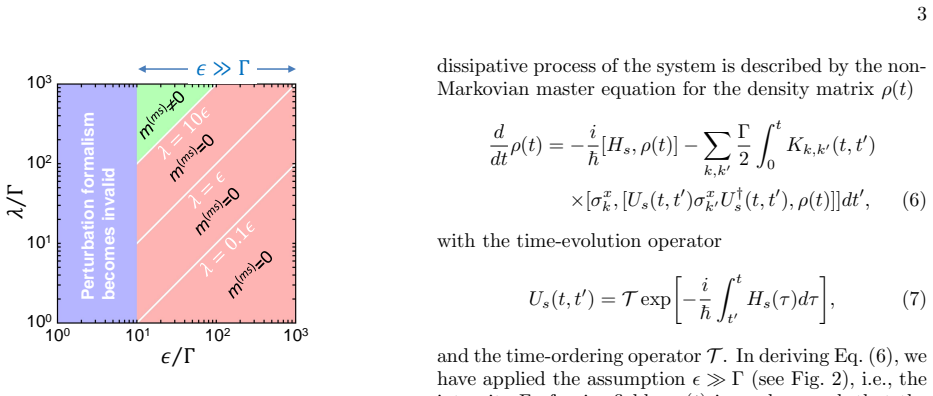
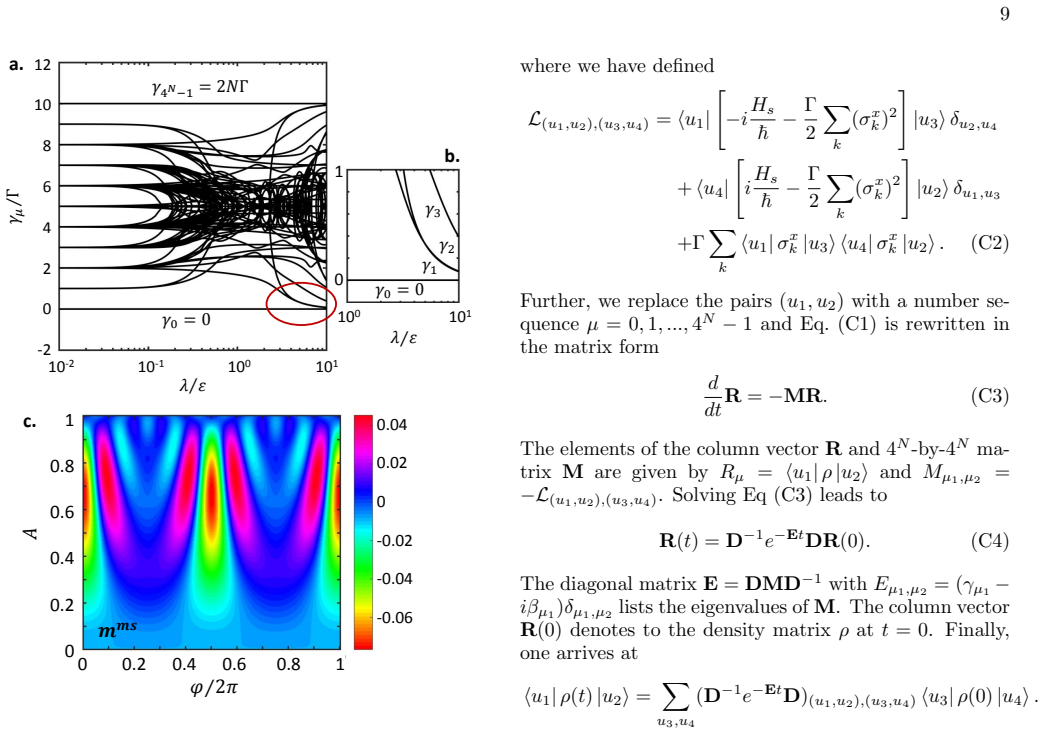
The central object is the non-Markovian master equation with a time-convolution integral over the noise correlation function $K_{k,k'}(t,t')$, in the local-in-time form derived from a perturbation formalism. The sign of the noise memory enters through the effective time-dependent decay rate $\tilde{\Gamma}_k(t)=\Gamma\int_0^t K_{k,k}(t,t')\,dt'$, which is larger than $\Gamma$ for pink noise and smaller for blue noise. Metastability is explained by diagonalizing the Markovian Liouvillian: in the strong-coupling regime, several relaxation modes have decay rates $\gamma_\mu$ close to $\gamma_0=0$, producing a long-lived transient plateau in the magnetization.
What would settle it
Measure the magnetization relaxation in a superconducting qubit array with gate voltage filtered to pink and blue noise and compare it with the white-noise case; alternatively, compute the spectral gap and metastable magnetization for N = 10, 12, 16 or via a mean-field treatment and check whether the plateau and the pink/blue relaxation ordering survive.
Extended reading notes
Core claim
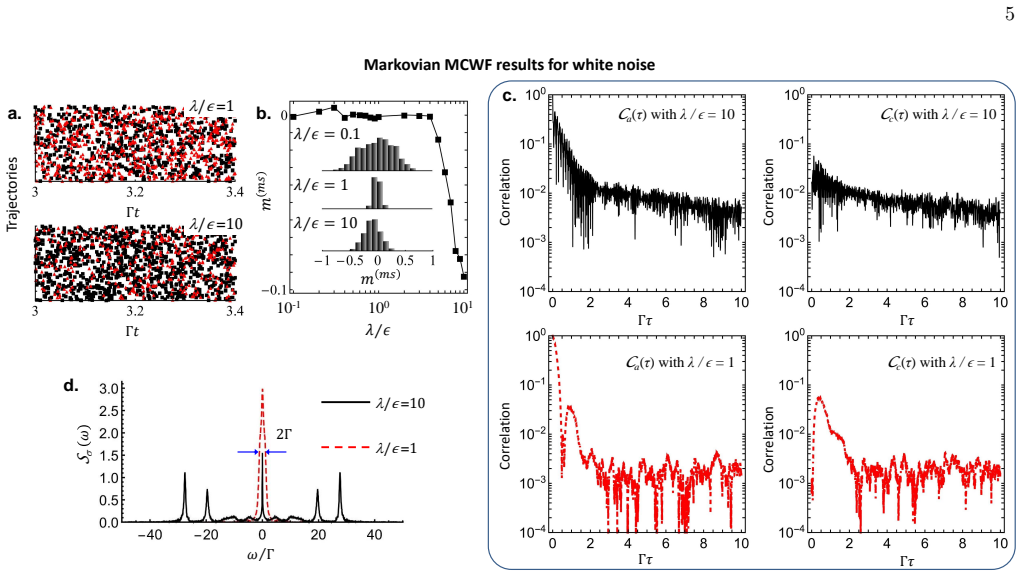
The dissipative dynamics of a fully connected quantum Ising model, simulated with superconducting charge qubits and perturbed by classical colored noise, depends on the sign of the noise memory. For pink noise, the effective decay rate is enhanced, so the system reaches its stationary state faster than with white noise; for blue noise, the decay rate is suppressed. In the strong inter-qubit coupling limit ($\lambda/\epsilon \gg 1$), the Markovian white-noise system exhibits metastability: the magnetization $m(t)$ settles to a nonzero metastable value $m_{\rm ms}\neq 0$ before decaying to the true stationary state $m_{\rm ss}=0$.
Load-bearing premise
The central results are computed for an eight-qubit system, and the paper assumes, without finite-size scaling, that these eight qubits capture the behavior of much larger qubit arrays.
Editorial extensions
If this is right
- In the strong-coupling regime ($\lambda/\epsilon \gg 1$), the magnetization first relaxes to a nonzero metastable value $m_{\rm ms}<0$ before decaying to the stationary state.
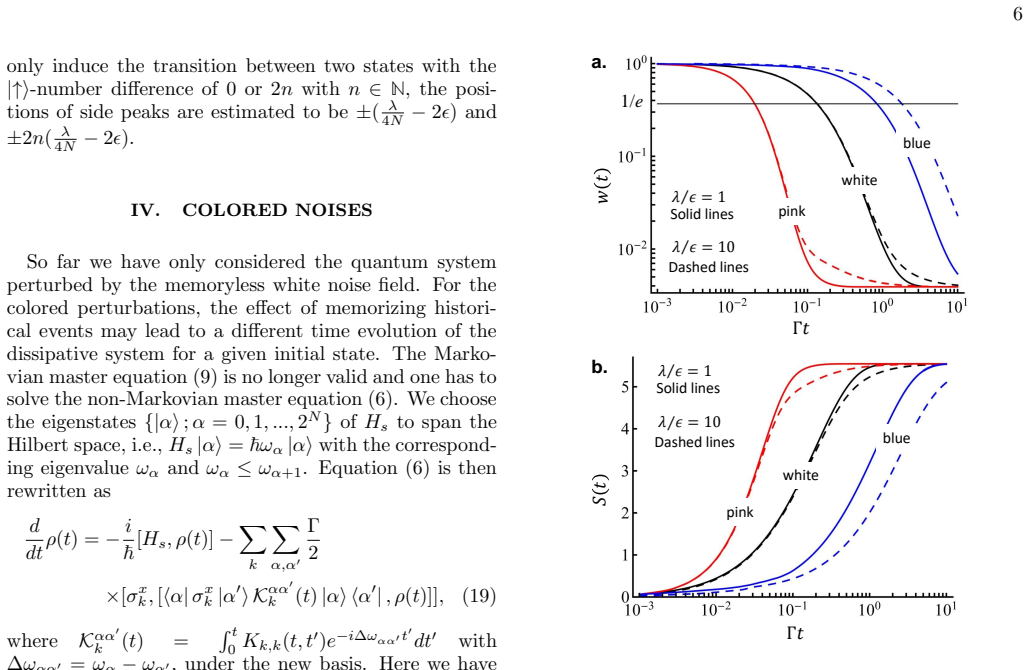
- Pink-colored noise accelerates relaxation toward the true stationary state relative to white noise, shortening both the metastable period and the ground-state lifetime.
- Blue-colored noise slows relaxation, so within the same observation window the system may not even reach its metastable plateau.
- The single-spin power spectrum shows a narrow central peak plus side peaks, with side-peak positions set by $\pm(\lambda/4N - 2\epsilon)$ and integer multiples.
- The acceleration or suppression of relaxation is governed by the sign of the noise correlation: positive memory enhances the effective decay rate, negative memory reduces it.
Reading between the lines
- The sign-of-memory rule suggests a predictable monotonic ordering for any $1/f^\alpha$ noise: as the spectral exponent $\alpha$ is swept from negative (blue-like) to positive (pink-like), relaxation should interpolate between the blue and pink extremes, which could be tested on the same circuit by changing the filter.
- If the metastable plateau survives finite-size scaling, the plateau value and lifetime as a function of $\lambda/\epsilon$ could serve as a sensitive probe of the environment's noise spectrum.
- Because the derivation assumes weak coupling ($\epsilon \gg \Gamma$), the claimed acceleration or slowing might change in the ultrastrong-coupling regime; extending the treatment beyond perturbation would test whether the memory-sign rule is universal.
- For the fully connected model, a mean-field or large-$N$ analysis could confirm whether the metastable gap structure seen at $N=8$ persists or is a finite-size artifact.
Signed reviews
Editorial analysis
A structured set of objections, weighed in public.
Referee Report
Summary. The manuscript studies an N-qubit fully connected Ising model realized in a superconducting charge-qubit circuit, with each qubit subject to classical white, pink, or blue noise. Starting from a circuit Hamiltonian derived in Appendix A, the authors use a time-convolutionless master equation from Ref. [14] to compute the relaxation of the magnetization m(t). For white noise they find a metastable plateau m_ms != 0 in the strong-interaction regime lambda/epsilon >> 1, supported by a Liouvillian spectral analysis in Appendix C. For colored noise, they report that pink noise accelerates relaxation relative to the white-noise Markovian limit, while blue noise slows it down, and they attribute this to positive versus negative memory in the noise correlation function. The paper also examines ground-state weight and von Neumann entropy for the three noise colors.
Significance. If the colored-noise results were robust, the paper would provide a useful, experimentally motivated step toward engineering the environment of superconducting many-body simulators. The manuscript has clear strengths: the circuit derivation in Appendix A is explicit, the white-noise metastability is diagnosed through the Liouvillian spectrum rather than asserted, and the numerical methods are standard and described sufficiently for reproduction. However, the central pink/blue comparison is not currently established: the pink-noise operating point lies outside the stated validity regime of the master equation, and the normalization convention used for the three spectra may predetermine the reported ordering of relaxation rates. The white-noise metastability result appears sound and could stand independently; the colored-noise claims need additional work, including a non-perturbative check or a properly controlled normalization.
major comments (4)
- [Section II and IV, Eq. (6) and Fig. 3] The pink-noise simulations violate the assumption epsilon >> Gamma used to derive Eq. (6). The paper sets epsilon/Gamma = 10 and 2f0/Gamma = 10^3, so the Nyquist frequency is pi f0 ≈ 1570 Gamma. Because all noise spectra are normalized to the same value at pi f0 and S_pink ∝ 1/f, the pink spectral density at a Bohr frequency Delta omega = 2 epsilon = 20 Gamma is S_pink ≈ (f0 / (Delta omega / 2 pi)) S_white ≈ (500 / 3.18) S_white ≈ 157 S_white. The dissipative rate entering Eq. (6) is therefore of order 100 Gamma for pink noise, an order of magnitude larger than epsilon = 10 Gamma. This is precisely the regime in which the paper states that Eq. (6) is no longer valid, because the noise term becomes comparable to Hs. The reported acceleration by pink noise may thus be an artifact of using a second-order time-convolutionless equation outside its radius of validity, while the blue case is suppressed by the same normalization. I ask for a non-perturbative check, e.g., exact averaging over trajectories of the stochastic Hamiltonian (2), or a reparameterization for which the effective dissipative rates are at most of order Gamma for all three colors.
- [Section III, after Eq. (14), and Appendix C] The representativeness of the N = 8 simulations is asserted, not demonstrated. The paper states that N = 8 is used 'to capture the general features of larger systems', but the Liouvillian spectral analysis in Fig. 6 is actually performed at N = 5 because of matrix-size limits, and no finite-size scaling or large-N argument is provided. For the all-to-all Hamiltonian (3), the spectrum and the Liouvillian gap structure change with N, so the metastable plateau and the relaxation rates extracted from N = 8 may not transfer to the large-scale processors mentioned in the abstract. Please add N-dependence scans (e.g., N = 4, 6, 8, 10) or a mean-field/large-N analysis to support the 'general features' claim.
- [Section IV, Eq. (19)] Equation (19) as written is not equivalent to Eq. (6). For Hs eigenstates, the relevant matrix element of U_s(t,t') sigma_x U_s^dagger(t,t') is <alpha|sigma_x|alpha'> exp[-i Delta omega_{alpha alpha'}(t-t')], so after the time integral the coefficient should contain exp[-i Delta omega_{alpha alpha'} t] times an integral over exp[+i Delta omega_{alpha alpha'} t'] K(t,t'), or an equivalent rotating-frame expression. The present definition K^{alpha alpha'}_k(t) = integral_0^t K(t,t') exp[-i Delta omega t'] dt' has the wrong phase and no compensating factor. Since the colored-noise results are obtained by directly integrating Eq. (19), the phase convention affects which frequency components of the noise are sampled. Please correct the equation and repeat the numerical calculation, or explicitly specify the rotating frame in which Eq. (19) is intended to hold.
- [Section IV, paragraph after Eq. (20)] The central interpretation of the colored-noise results does not isolate memory effects from the imposed spectral shape. The authors normalize all PSDs to the same value at pi f0 and then observe that for all f < f0 the pink PSD lies above and the blue PSD lies below the white value. With the stated slopes S ∝ f^-1 and S ∝ f, this ordering is fixed by construction, so the resulting hierarchy of relaxation rates is largely predetermined by the normalization. To make the claim that positive memory enhances and negative memory suppresses relaxation non-tautological, the authors should fix a common physical noise strength, for instance equal spectral density at the system's characteristic transition frequency or equal integrated variance over the relevant frequency band, and show that the asymmetry persists under that comparison.
minor comments (6)
- [Section III, Eq. (18)] The Fourier transform in Eq. (18) should be S_sigma(omega) = integral C_a(tau) exp(-i omega tau) d tau; as written it integrates over t while C_a is a function of tau.
- [Section IV, basis enumeration] The text says the eigenstates are labeled alpha = 0, 1, ..., 2N; since the Hilbert space of N qubits has dimension 2^N, this should read alpha = 0, 1, ..., 2^N - 1.
- [Section IV and Fig. 3 caption] The manuscript alternates between 'pink' and 'red' noise: the abstract and most of Section IV use 'pink', but the text before Eq. (8) and the Fig. 3 caption use 'red-colored'; please harmonize the terminology.
- [Introduction] There is a typo in the Introduction: 'have alreadly provided' should be 'have already provided'.
- [References] References [32] and [47] are the same Nakamura, Pashkin, and Tsai paper; one duplicate should be removed or cross-referenced.
- [Section IV, spectral support statement] The statement that all transition frequencies |Delta omega| are smaller than pi f0 'due to pi f0 > epsilon and lambda' is not correct as written, because the spectral width of Hs scales as O(N(epsilon + lambda)) for N qubits; the condition should be stated for the actual spectral support of the transitions coupled by sigma_x.
Circularity Check
No significant circularity: central claims are derived numerically from an externally cited master equation, not fitted or self-referential.
full rationale
The derivation chain is self-contained. The non-Markovian master equation (6) is adopted from the external perturbation formalism of Chenu et al. [14], not from the authors' own prior work, and Eqs. (19) and (20) are algebraic reductions of that master equation in the eigenbasis of Hs. The relaxation-rate comparison is not obtained by fitting: the parameters ϵ/Γ = 10, 2f0/Γ = 10^3, and λ/ϵ = 1 or 10 are fixed model specifications, and m(t) is obtained by direct numerical integration of Eq. (19). The pink/blue acceleration or slowdown follows explicitly from the sign of the correlation integral K_k(t) = ∫ K_{k,k}(t,t') dt' and the effective decay rate ΓK_k(t) in Eq. (20); the paper presents this as a derived consequence of the model, not as an independent empirical prediction, and it also gives the transparent PSD-based interpretation. The many self-citations (refs. 36-44) support peripheral tunability and qubit-coherence claims and are not load-bearing for the main result. The finite-size statement N = 8 and the possible weak-coupling validity concern for pink noise are correctness or robustness risks, not circularity. No circular step is therefore identified.
Assumptions & free parameters
free parameters (5)
- Noise-characteristic frequency ratio ϵ/Γ =
10
- Nyquist frequency ratio 2f0/Γ =
10^3
- Inter-qubit coupling λ/ϵ =
0.1, 1, 10 (swept)
- Number of qubits N =
8
- Colored-noise PSD normalization =
Equal at Nyquist frequency πf0
assumptions (4)
- domain assumption Second-order time-convolutionless perturbation formalism of Ref. [14] applies to classical colored Gaussian noise.
- domain assumption The noise fields on different qubits are independent, identical in color and amplitude, and classical Gaussian processes.
- domain assumption Two-state approximation for each Cooper-pair box and neglect of the qubit-local electromagnetic reservoir.
- ad hoc to paper N=8 results are representative of larger many-body systems.
Cite this review
Pith. "Pith review of Open Ising Model Perturbed by Classical Colored Noises." pith.science (2026). https://pith.science/paper/BFC7ORWV
@misc{pith2026190801494,
  author       = {Pith},
  title        = {Pith review of: Open Ising Model Perturbed by Classical Colored Noises},
  year         = {2026},
  howpublished = {\url{https://pith.science/paper/BFC7ORWV}},
  note         = {Machine review of arXiv:1908.01494}
}
read the original abstract
We investigate the non-Markovian dynamics of an open Ising model simulated by a superconducting circuit. The quantum many-body system is weakly coupled to a white, pink- or blue-colored environment. The relaxation of the system in the strong inter-qubit interaction regime shows a metastable behaviour. In comparison with the dissipative system in the Markovian limit, the negative memory of the blue-colored noise weakens the system's relaxation. However, for the pink-colored noise the relaxation rate of the system is enhanced due to the positive memory effect. The understanding of quantum many-body systems responding to different colored noise fields is necessary for designing the environment of superconducting qubits in a large scale quantum processor.
Figures


Figures from the paper (3 more)
Reference graph
Works this paper leans on
-
[14]
Chenu, M
A. Chenu, M. Beau, J. Cao, and A. del Campo, Phys. Rev. Lett. 118, 140403 (2017)
2017
-
[1]
I. M. Georgescu, S. Ashhab, and Franco Nori, Rev. Mod. Phys. 86, 153 (2014)
work page 2014
- [2]
-
[3]
Blatt and C
R. Blatt and C. F. Roos, Nat. Phys. 8, 277 (2012)
2012
- [4]
-
[5]
A. A. Houck, H. E. T¨ ureci, and J. Koch, Nat. Phys. 8, 292 (2012)
2012
- [6]
-
[7]
Verstraete, M
F. Verstraete, M. M. Wolf, and J. I. Cirac, Nat. Phys. 5, 633 (2009)
2009
Show all 57 references
-
[8]
T. E. Lee, H. H¨ affner, and M. C. Cross, Phys. Rev. Lett. 108, 023602 (2012)
2012
-
[9]
Pastawski, L
F. Pastawski, L. Clemente, and J. I. Cirac, Phys. Rev. A 83, 012304 (2011)
2011
-
[10]
J. Jing, X. Zhao, J. Q. You, W. T. Strunz, and T. Yu, Phys. Rev. A 88, 052122 (2013)
2013
-
[11]
V. R. Overbeck and H. Weimer, Phys. Rev. A 93, 012106 (2016)
2016
-
[12]
Sweke, M
R. Sweke, M. Sanz, I. Sinayskiy, F. Petruccione, and E. Solano, Phys. Rev. A 94, 022317 (2016)
2016
-
[13]
Mascarenhas and I
E. Mascarenhas and I. de Vega, Phys. Rev. A 96, 062117 (2017)
2017
-
[15]
Banchi, E
L. Banchi, E. Grant, A. Rocchetto, and S. Severini, New J. Phys. 20, 123030 (2018)
2018
-
[16]
Nakajima, Progr
S. Nakajima, Progr. Theor. Phys. 20, 948 (1958)
1958
-
[17]
Zwanzig, J
R. Zwanzig, J. Chem. Phys. 33, 1338 (1960)
1960
-
[18]
Shabani and D
A. Shabani and D. A. Lidar, Phys. Rev. A 71, 020101 (2005)
2005
-
[19]
Chaturvedi and F
S. Chaturvedi and F. Shibata, Z. Phys. B 35, 297 (1979)
1979
-
[20]
Shibata, Y
R. Shibata, Y. Takahashi and N. Hashitsume, J. Stat. Phys. 17, 171 (1977)
1977
-
[21]
Mazzola, E.-M
L. Mazzola, E.-M. Laine, H.-P. Breuer, S. Maniscalco, and J. Piilo, Phys. Rev. A 81, 062120 (2010)
2010
-
[22]
Piilo, S
J. Piilo, S. Maniscalco, K. H¨ ark¨ onen, and K.-A. Suomi- nen, Phys. Rev. Lett. 100, 180402 (2008)
2008
-
[23]
Ferraro, H.-P
E. Ferraro, H.-P. Breuer, A. Napoli, M. A. Jivulescu, and A. Messina, Phys. Rev. B 78, 064309 (2008)
2008
-
[24]
Piilo, K
J. Piilo, K. H¨ ark¨ onen, S. Maniscalco, and K.-A. Suomi- nen Phys. Rev. A 79, 062112 (2009)
2009
-
[25]
Rebentrosta, R
P. Rebentrosta, R. Chakraborty, and A. Aspuru-Guzik, J. Chem. Phys. 131, 184102 (2009)
2009
-
[26]
Ajoy and P
A. Ajoy and P. Cappellaro, Phys. Rev. Lett. 110, 220503 (2013)
2013
-
[27]
Hayes, S
D. Hayes, S. T. Flammia, and M. J. Biercuk, New J. Phys. 16, 083027 (2014)
2014
-
[28]
Di Candia, J
R. Di Candia, J. S. Pedernales, A. del Campo, E. Solano, and J. Casanova, Sci. Rep. 5, 9981 (2015)
2015
-
[29]
Diehl, A
S. Diehl, A. Micheli, A. Kantian, B. Kraus, H. P. Bchler, and P. Zoller, Nat. Phys. 4, 878 (2008)
2008
-
[30]
Lloyd and L
S. Lloyd and L. Viola, Phys. Rev. A 65, 010101 (2001)
2001
-
[31]
Boixo, S
S. Boixo, S. T. Albash, F. M. Spedalieri, N. Chancellor, D. A. Lidar, Nat. Commun. 4, 2067 (2013)
2013
-
[33]
Chiorescu, Y
I. Chiorescu, Y. Nakamura, C. J. P. M. Harmans, and J. E. Mooij, Science 299, 1869 (2003)
2003
-
[34]
J. Koch, T. M. Yu, J. Gambetta, A. A. Houck, D. I. Schuster, J. Majer, A. Blais, M. H. Devoret, S. M. Girvin, and R. J. Schoelkopf, Phys. Rev. A 76, 042319 (2007)
2007
-
[35]
Wendin, Rep
G. Wendin, Rep. Prog. Phys. 80, 106001 (2017)
2017
-
[36]
D. Yu, L. C. Kwek, and R. Dumke, J. Phys. Commun. 2, 095001 (2018)
2018
-
[37]
D. Yu, L. C. Kwek, L. Amico, and R. Dumke, Phys. Rev. A 98, 033833 (2018)
2018
-
[38]
D. Yu, M. M.Valado, C. Hufnagel, L. C. Kwek, L. Amico, and R. Dumke, Phys. Rev. A 93, 042329 (2016)
2016
-
[39]
D. Yu, A. Landra, M. M. Valado, C. Hufnagel, L. C. Kwek, L. Amico, and R. Dumke, Phys. Rev. A94, 062301 (2016)
2016
-
[40]
D. Yu, M. M. Valado, C. Hufnagel, L. C. Kwek, L. Amico, and R. Dumke, Sci. Rep. 6, 38356 (2016)
2016
-
[41]
D. Yu, L. C. Kwek, L. Amico, and R. Dumke, Phys. Rev. A 95, 053811 (2017)
2017
-
[42]
D. Yu, L. C. Kwek, L. Amico, and R. Dumke, Quantum Sci. Technol. 2, 035005 (2017)
2017
-
[43]
D. Yu, A. Landra, L. C. Kwek, L. Amico, and R. Dumke, New J. Phys. 20, 023031 (2018)
2018
-
[44]
Yu and R
D. Yu and R. Dumke, Phys. Rev. A 97, 053813 (2018)
2018
-
[45]
Yoshihara, T
F. Yoshihara, T. Fuse, S. Ashhab, K. Kakuyanagi, S. Saito, and K. Semba, Nat. Phys. 13, 44 (2017)
2017
-
[46]
Zhivomirov, Romanian Journal of Acoustics and Vi- bration 15, 14 (2018)
H. Zhivomirov, Romanian Journal of Acoustics and Vi- bration 15, 14 (2018)
2018
-
[47]
Nakamura, Yu
Y. Nakamura, Yu. A. Pashkin, and J. S. Tsai, Nature 398, 786 (1999)
1999
-
[48]
Sachdev, Quantum phase transitions (Cambridge Uni- versity Press, 1999)
S. Sachdev, Quantum phase transitions (Cambridge Uni- versity Press, 1999)
1999
-
[49]
M. H. Devoret and R. J. Schoelkopf, Science 339, 1169 (2013)
2013
-
[50]
Astafiev, Yu
O. Astafiev, Yu. A. Pashkin, Y. Nakamura, T. Ya- mamoto, and J. S. Tsai, Phys. Rev. Lett. 93, 267007 (2004)
2004
-
[51]
Mølmer, Y
K. Mølmer, Y. Castin, and J. Dalibard, J. Opt. Soc. Am. B 10, 524 (1993)
1993
-
[52]
Olmos, D
B. Olmos, D. Yu, Y. Singh, F. Schreck, K. Bongs, and I. Lesanovsky, Phys. Rev. Lett. 110, 143602 (2013)
2013
-
[53]
Foss-Feig, P
M. Foss-Feig, P. Niroula, J. T. Young, M. Hafezi, A. V. Gorshkov, R. M. Wilson, and M. F. Maghrebi, Phys. Rev. A 95, 043826 (2017)
2017
-
[54]
D. Yu, J. Mod. Opt. 63, 428 (2016)
2016
-
[55]
Macieszczak, M
K. Macieszczak, M. Gut ¸˘ a, I. Lesanovsky, and J. P. Gar- rahan, Phys. Rev. Lett. 116, 240404 (2016)
2016
-
[56]
B. R. Mollow, Power spectrum of light scattered by two- level systems, Phys. Rev. 188, 1969 (1969)
1969
-
[57]
Breuer, B
H.-P. Breuer, B. Kappler, and F. Petruccione, Phys. Rev. A 59, 1633 (1999)
1999
-
[58]
Gambetta and H
J. Gambetta and H. M. Wiseman, Phys. Rev. A 68, 062104 (2003)
2003
Reviewed August 14, 2026 · model on record in the stance chip above.
Discussion (0). Continue with ORCID to comment.