REVIEW 3 major objections 4 minor
Topological phase rectification via Aharonov-Bohm interference in a Majorana--quantum-dot interferometer
T0 review · 3 major / 4 minor · reviewed 2026-08-11 · deepseek-v4-flash
Pith's one-line read Magnetic flux at half-integer quanta converts a quantum-dot–Majorana interferometer into a strictly one-way supercurrent diode.
desk verdict The Z_TD diagnostic is not just unbenchmarked; the model's own gauge symmetry forces η_u to be Φ0-periodic, so A_{1/2}=0 and Z_TD≡0, and the same symmetry undermines the claimed unipolar supercurrent at half-integer flux. read the letter →
The pith
A machine-rendered reading of the paper's core claim, the machinery that carries it, and where it could break.
The reading
What carries the argument
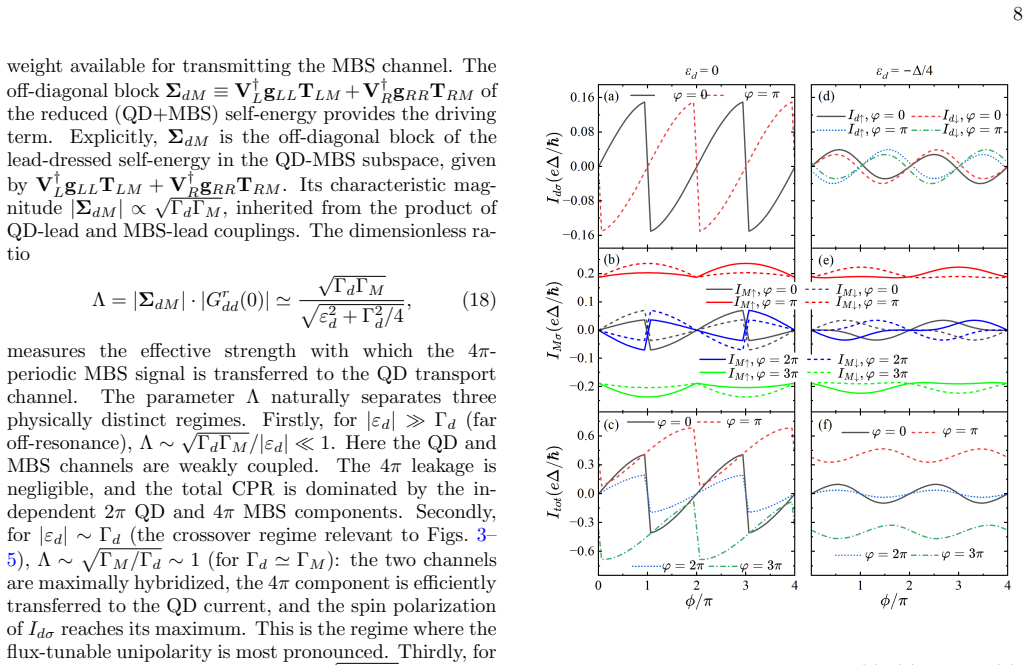
The load-bearing element is the off-diagonal block of the lead-dressed self-energy, $\Sigma_{dM}=V_L^\dagger g_{LL}T_{LM}+V_R^\dagger g_{RR}T_{RM}$, whose spin-dependent phase factors $e^{\pm i\varphi/2}$ set the relative phase between the quantum-dot and Majorana arms. The current is split into $I_{2\pi}$ plus $I_{4\pi}$, with $I_{4\pi}$ the single-electron Majorana component that changes sign under a $2\pi$ shift of the superconducting phase $\phi$; the persistent background $I_{\rm off}$ is the average of $I_{\rm tot}$ over one $2\pi$ period. The analytic current-carrying density of states for the Majorana arm, $j_{M\uparrow(\downarrow)}(\varepsilon)=\pm t_0^2(1-p)(|\Delta|/\varepsilon)\,\mathrm{Re}[e^{-i\varphi/2}\,\mathrm{Im}\sum_{i,j}G^r_{MM,ij}(\varepsilon)]$, fixes the $4\pi$ periodicity, the exact opposite signs of the spin channels, and the quenching of the Majorana current at full spin polarization $p=1$. A dimensionless leakage parameter $\Lambda\simeq\sqrt{\Gamma_d\Gamma_M}/\sqrt{\varepsilon_d^2+\Gamma_d^2/4}$ controls how much of the $4\pi$ signal transfers into the quantum-dot path, identifying intermediate dot detuning as the optimal regime for unipolarity.
What would settle it
Compute η_u(φ) for an Aharonov-Bohm interferometer whose two arms are both ordinary quantum dots, using the same φ/4 gauge convention as the paper; a nonzero A_{1/2} Fourier component (or a 2Φ0 flux period of η_u instead of Φ0) would falsify the claim that half-integer harmonics are a unique signature of the 4π-periodic Majorana channel.
Extended reading notes
Core claim
The central claim is that flux-controlled quantum interference between topologically distinct arms converts a bipolar current-phase relation into a unipolar one. With the Aharonov-Bohm phase distributed symmetrically as $e^{{±iφ/4}}$ among the four tunneling amplitudes, neither arm alone acquires flux dependence, but the cross-coupling self-energy carries phase $e^{{±iφ/2}}$ and breaks time-reversal symmetry for φ not a multiple of 2π. The total current decomposes as I_tot = I_{2π} + I_{4π}, where the Majorana single-electron component satisfies I_{4π}(ϕ+2π) = −I_{4π}(ϕ); its average over a 2π window is the persistent background I_off, which vanishes at integer flux and is maximal at half-integer flux. When |I_off| exceeds the oscillation amplitude I_amp, the CPR no longer crosses zero, and the paper's signed unipolarity factor η_u = I_off/(|I_off| + I_amp) exceeds 0.5 in magnitude, defining a strict one-way supercurrent with the reverse-bias current suppressed. The paper further claims that the Fourier spectrum of η_u(φ) contains half-integer harmonics k = 1/2, 3/2, ... that are inherently absent for any purely 2π-periodic trivial channel, so Z_TD = A_{1/2}/A_1 being nonzero identifies the 4π-periodic Majorana origin of the rectification.
Load-bearing premise
The load-bearing premise is that a purely trivial, 2π-periodic current-phase relation in an Aharonov-Bohm interferometer produces a flux period of Φ0 and strictly no half-integer Fourier harmonics of η_u(φ); if a trivial two-path system also produced such harmonics, the claimed Majorana specificity of Z_TD would collapse.
Editorial extensions
If this is right
- At flux phase $\varphi=(2n+1)\pi$, the total current-phase relation is strictly positive (or strictly negative at the next half-integer), so the reverse critical current is suppressed and the conventional diode efficiency saturates toward $\eta=1$.
- The polarity and magnitude of the rectification can be reversed continuously by sweeping the Aharonov-Bohm flux in situ, without reversing an external magnetic field or rewiring the device.
- The $4\pi$-periodic Majorana component leaks into the quantum-dot path most efficiently at intermediate dot detuning $|\varepsilon_d|\sim\Gamma_d$, so optimal unipolarity occurs away from resonance.
- Thermal smearing reduces the $2\pi$ oscillatory amplitude more than the continuum-sourced persistent background, so $|\eta_u|$ is mildly enhanced up to $k_B T\simeq 0.1\Delta$, and quasiparticle poisoning mainly affects coherent $4\pi$ ac signals rather than the dc unipolarity.
- A nonzero $Z_{\rm TD}$ is claimed to be a sufficient condition for the presence of the $4\pi$-periodic Majorana channel, while conventional Rashba, ferromagnet, and topological-insulator-surface superconducting diode platforms all give $Z_{\rm TD}=0$.
Reading between the lines
- A natural test the paper leaves implicit: simulate a fully trivial two-arm Aharonov-Bohm interferometer under the same $\varphi/4$ gauge to see whether half-integer Fourier harmonics of $\eta_u(\varphi)$ truly vanish; if they do not, $Z_{\rm TD}$ would not be Majorana-specific.
- The half-integer harmonic content of $\eta_u(\varphi)$ could be cross-checked against the asymmetric suppression of odd Shapiro steps in the same device, since both would trace back to the same $I_{4\pi}$ component.
- Because the paper attributes $I_{\rm off}$ to continuum states above the gap, one testable extension is that unipolarity should be insensitive to the detailed subgap Andreev spectrum and should only degrade when $k_BT$ approaches the superconducting gap $\Delta$.
- The claim that $Z_{\rm TD}$ tracks fermion parity suggests the same flux-resolved dc measurement could double as a parity readout if the sign of $A_{1/2}$ can be resolved, connecting the diode diagnostic to topological qubit measurements.
Editorial analysis
A structured set of objections, weighed in public.
Referee Report
Summary. The manuscript proposes a quantum-dot–Majorana Aharonov-Bohm interferometer as a superconducting rectifier. Using a nonequilibrium Green's function calculation, the authors argue that interference between a trivial 2π-periodic QD channel and a topological 4π-periodic Majorana channel produces, at non-integer flux, a persistent current background I_off that shifts the current-phase relation into a unipolar regime. They introduce a signed unipolarity factor η_u, relate it to the conventional diode efficiency, study robustness against parameters, temperature, and quasiparticle poisoning, and propose a topological diode figure of merit Z_TD defined as the ratio of half-integer to integer Fourier harmonics of η_u(φ). Appendix A gives an analytic derivation of the Majorana-channel current-carrying density of states.
Significance. If the central claims were correct, the paper would offer a new mechanism for unipolar supercurrents and a potentially useful diagnostic of Majorana-mediated transport. The NEGF calculation is a forward model with no data fitting, and Appendix A provides a transparent analytic derivation of the 4π periodicity, the spin cancellation, and the δ_M independence of the isolated Majorana-junction current. However, the proposed Z_TD diagnostic is internally inconsistent with the gauge symmetry of the model, and the claimed trivial-system benchmark is not actually computed. These issues affect the paper's main advertised contribution, so the manuscript in its present form is not publishable.
major comments (3)
- The topological diode figure of merit Z_TD is identically zero under the gauge symmetry of the model. The symmetric gauge phase assignment of Sec. II gives V_Ld∝e^{iφ/4}, V_Rd∝e^{-iφ/4}, t_L∝e^{-iφ/4}, t_R∝e^{iφ/4}. Rephasing the left lead by e^{iπ/4} and the right lead by e^{-iπ/4} maps H(φ+π,ϕ) exactly onto H(φ,ϕ−π), because the lead pairings acquire phases −π/2 and +π/2 while the tunneling amplitudes recover their φ values. Since the total supercurrent is 2π-periodic in ϕ, the set of current values over one ϕ period, and hence I_max, I_min, I_off, I_amp, and η_u, is invariant under φ→φ+π. Therefore η_u(φ) is π-periodic in φ. A π-periodic function expanded on [0,4π] has vanishing half-integer Fourier coefficients, so A_{1/2}=0 and Z_TD=0 identically. This contradicts Fig. 8, which reports Z_TD∼10^3. The contradiction is not resolved by the sign pattern stated in Sec. III.C (η_u>0.5 on (0,π), η_u<−0.5 on (π,2π)): that pattern is 2π-periodic in φ and therefore also has A_{1/2}=0. The only reading that would give a nonzero A_{1/2} is η_u(φ+2π)=−η_u(φ), which is neither the gauge-symmetric result nor the behavior described in Sec. III.C. The large A_{1/2} in Fig. 8 is an artifact of Fourier analysis over a 4π window without enforcing the correct periodicity. Because the abstract and Sec. III.E present Z_TD as a 'model-independent signature of the 4π-periodic Majorana channel,' this is a load-bearing error.
- The claim that half-integer Fourier harmonics of η_u(φ) are 'strictly absent in any trivial SDE system' is not supported by any calculation. A purely trivial two-path AB interferometer is never solved under the same symmetric gauge convention, and Fig. 4(a) shows the trivial QD channel to be 2π-periodic in both φ and ϕ. The asserted flux period Φ0 for a trivial 2π-periodic CPR is therefore not demonstrated. Since this asserted trivial-system property is part of the justification for Z_TD's Majorana specificity, it needs an explicit benchmark calculation; in the current manuscript it is an assumption presented as a result.
- The sign reversal of the unipolarity with flux stated in Sec. III.C is inconsistent with the gauge transformation described above. If η_u(φ+π)=η_u(φ), then the unipolar regime on (0,π) must repeat on (π,2π) rather than reverse sign. The numerical results in Fig. 5(a) need to be checked against this symmetry; either the implementation violates gauge invariance or the text misdescribes the plotted quantity. This is not a minor presentation issue because the sign-reversal pattern is used to justify the 2Φ0 period and the half-integer Fourier analysis.
minor comments (4)
- The text refers to 'Fig. effig4(a)' twice; the intended figure label should be corrected (likely Fig. 4(a) or Fig. 5(a)).
- The sentence 'The unipolarity factor η_u can be extracted directly from the measured I_c^+ and I_c^- via Eq. (16)' cites the wrong equation; the definition of η_u is Eq. (13).
- There is a duplicated incomplete sentence: 'The lesser Green’s function via the fluctuation-dissipation theorem, replacing the T=0 step function.' This sentence should be removed or completed.
- The Fourier expansion η_u(φ)=Σ_k A_k cos(kφ+δ_k) on [0,4π] is not fully specified: the normalization of A_k, the parity convention, and the treatment of the endpoint 4π should be stated explicitly.
Circularity Check
Central Z_TD diagnostic reduces by construction: the paper's own 2π-periodicity statement forces A_{1/2}=0, so the claimed topological Fourier signature is an artifact of the expansion window.
-
self definitional
[Section III.E, definition of Z_TD (Eq. 22) and Fig. 8]
"The quantity η_u(φ) oscillates with period 2π in φ=πΦ/Φ_0, corresponding to a flux period of 2Φ_0. ... Half-integer harmonics k=1/2,3/2,..., by contrast, change sign under a 2π shift, originate from the 4π-periodic MBS contribution to the CPR, and are strictly absent in any trivial SDE system."
The observable meant to certify the 4π MBS channel is defined as the half-integer Fourier coefficient that is said to originate from that same 4π channel. But the paper itself states that η_u(φ) has period 2π in φ; a 2π-periodic function expanded on [0,4π] has identically zero A_{1/2} by orthogonality. Moreover, the model's gauge symmetry (the φ/4 coupling phases of Section II) forces η_u(φ+π)=η_u(φ), so the function is actually π-periodic and even A_1 vanishes, making Z_TD=A_{1/2}/A_1 undefined (0/0) rather than the O(10^3) value in Fig. 8. The nonzero Z_TD is therefore not a derived prediction of the NEGF calculation; it is manufactured by Fourier-analyzing a shorter-period function on a 4π window and labeling the resulting half-integer harmonic as the Majorana channel.
full rationale
The core NEGF calculation is a self-contained forward model: no parameters are fitted to the claimed outputs, and the unipolar supercurrent, η_u, and its mapping to diode efficiency follow algebraically from the Hamiltonian (Eqs. 1-15) with all scales fixed. No load-bearing self-citation exists; Refs. [20,21] by overlapping authors are used only for comparison, and the gauge convention of Refs. [53-55] is explicitly shown to be a gauge choice with gauge-invariant observables. The serious problem is the central diagnostic Z_TD: the paper simultaneously asserts η_u has period 2π in φ and defines A_{1/2} as a half-integer Fourier component of η_u on [0,4π], which must vanish for a 2π-periodic function; the model's gauge symmetry actually forces η_u to be π-periodic in φ. The O(10^3) value in Fig. 8 is thus an artifact of the expansion window, not a derived signature, and the claim that nonzero Z_TD is a model-independent Majorana signature is unsupported. This affects the paper's central conceptual contribution, while the unipolar-rectification calculation itself remains independent and non-circular; accordingly the score reflects partial circularity of the figure of merit, not of the transport derivation.
Assumptions & free parameters
free parameters (5)
- Γ_M (MBS-lead coupling strength) =
0.05Δ to 0.5Δ (scanned)
- ε_d (quantum dot level) =
0 and -Δ/4 (scanned)
- p (MBS spin polarization factor) =
0 to 1 (scanned)
- δ_M (inter-MBS overlap) =
0 to Δ (scanned)
- φ_R (Rashba-induced phase) =
0 to 2π (scanned)
assumptions (5)
- domain assumption The topological nanowire is described by the minimal two-Majorana Hamiltonian of Eq. (4), valid for δ_M ≪ Δ_top.
- domain assumption Wide-band approximation: the normal density of states of the superconducting leads is energy-independent.
- standard math Equilibrium NEGF with the fluctuation-dissipation theorem G^< = -f(ε)(G^r - G^a) is applicable for the phase-biased junction.
- ad hoc to paper The symmetric gauge, assigning e^{±iφ/4} to the four tunneling amplitudes, yields gauge-invariant physical observables.
- ad hoc to paper Quasiparticle poisoning can be captured by a non-Hermitian broadening that reduces I_off by a factor (1+ℏ/τ_qp δ_M)^{-1}.
invented entities (2)
-
η_u (signed unipolarity factor)
independent evidence
-
Z_TD (topological diode figure of merit)
independent evidence
Cite this review
Pith. "Pith review of Topological phase rectification via Aharonov-Bohm interference in a Majorana--quantum-dot interferometer." pith.science (2026). https://pith.science/paper/BFWOYWUU
@misc{pith2026260809845,
  author       = {Pith},
  title        = {Pith review of: Topological phase rectification via Aharonov-Bohm interference in a Majorana--quantum-dot interferometer},
  year         = {2026},
  howpublished = {\url{https://pith.science/paper/BFWOYWUU}},
  note         = {Machine review of arXiv:2608.09845}
}
abstract
We propose and theoretically investigate a topological superconducting rectifier based on a quantum-dot--Majorana interferometer. The Aharonov-Bohm phase, controlled by a magnetic flux threading the interferometer loop, tunes the quantum interference between a trivial $2\pi$-periodic quantum-dot channel and a topological $4\pi$-periodic Majorana channel. At non-integer flux, this interference generates a persistent current background $I_{\rm off}$ that shifts the current-phase relation into a unipolar regime, in which the supercurrent flows strictly in one direction. We introduce a signed unipolarity factor $\eta_u$, with $|\eta_u|>0.5$ defining the unipolar regime, and establish its quantitative relationship to the conventional diode efficiency $\eta$. The unipolarity proves robust against variations of the quantum-dot level, spin polarization, and Majorana hybridization, is enhanced by stronger Majorana coupling and Rashba spin-orbit interaction, and persists at realistic temperatures and under quasiparticle poisoning. We further propose a topological diode figure of merit $\mathcal{Z}_{\rm TD}$, defined from the Fourier spectrum of $\eta_u$, whose nonzero value provides a model-independent signature of the $4\pi$-periodic Majorana channel and distinguishes topological from trivial rectification mechanisms. Our findings establish the quantum-dot--Majorana interferometer as a promising route toward high-performance topological superconducting diodes with clear experimental signatures accessible via standard dc transport measurements.
Figures


Figures from the paper (5 more)


Reviewed August 11, 2026 · model on record in the stance chip above.
Discussion (0). Continue with ORCID to comment.