REVIEW 4 major objections 5 minor 2 cited by
A Survey of Post-Quantum Cryptography Support in Cryptographic Libraries
T0 review · 4 major / 5 minor · reviewed 2026-08-05 · deepseek-v4-flash
Pith's one-line read As of early 2025, support for NIST post-quantum algorithms across nine major open-source crypto libraries is uneven: four are production-ready, others have none.
desk verdict A useful but already stale snapshot of PQC library support; fix the OpenSSL inconsistency and version the cutoff before relying on it. read the letter →
The pith
A machine-rendered reading of the paper's core claim, the machinery that carries it, and where it could break.
The reading
What carries the argument
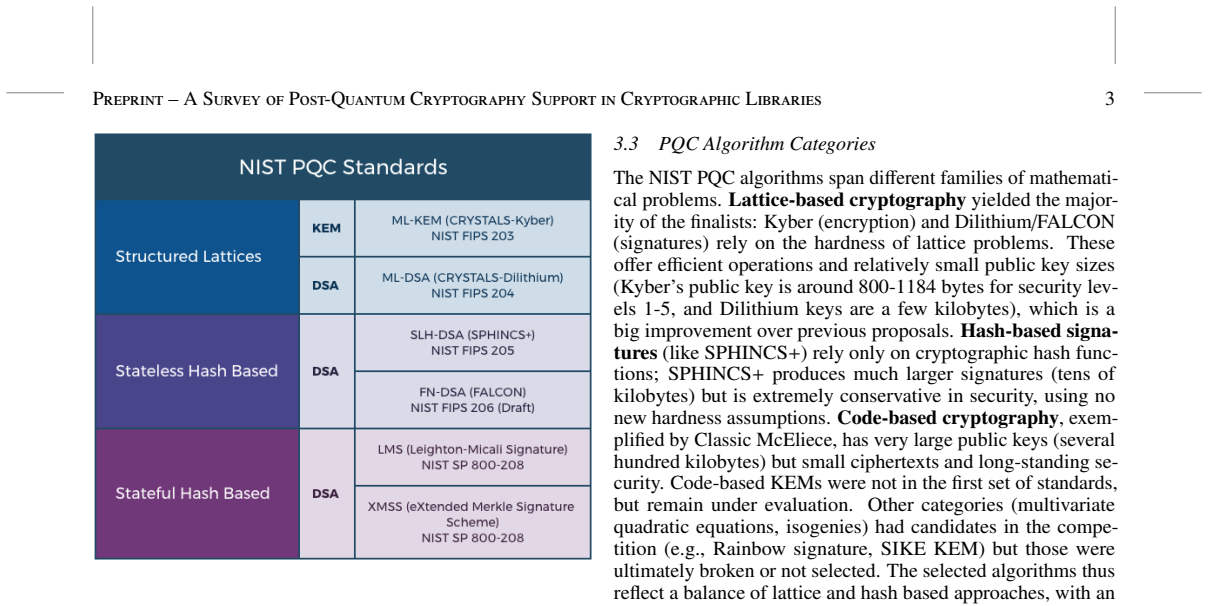
The survey's yardstick is the set of algorithms NIST selected for standardization in 2022: CRYSTALS-Kyber, now ML-KEM, for key establishment, and CRYSTALS-Dilithium (ML-DSA), FALCON, and SPHINCS+ (SLH-DSA) for signatures. Each library is checked against five criteria—whether it supports any of the finalists, since which version that support is stable or experimental, whether a roadmap exists, whether alternative PQC schemes (stateful LMS/XMSS, code-based schemes) are present, and whether support is in a production release or only a development branch. The argument is carried by the resulting readiness matrix, which compresses documentation, release notes, and vendor announcements for nine li
What would settle it
Inspect the source trees of the latest stable release of each of the nine libraries for implementations of ML-KEM, ML-DSA, FALCON, and SLH-DSA (search for the algorithm names or NIST identifiers). The survey predicts those implementations appear only in wolfSSL, Bouncy Castle, Botan, and BoringSSL, with LMS/XMSS additionally in wolfSSL and MbedTLS; finding such code in libsodium, Crypto++, LibreSSL, or mainline OpenSSL would refute the 'no support' verdicts, just as finding none in a library called production-ready would refute the ready verdicts.
Extended reading notes
Core claim
Readiness splits into three tiers. wolfSSL ships ML-KEM and ML-DSA in TLS plus LMS/XMSS and claims CNSA 2.0 compliance; Bouncy Castle implements all four NIST finalists and many alternates; Botan ships Kyber, Dilithium, SPHINCS+, and XMSS; BoringSSL took ML-KEM and ML-DSA to production through Chrome's hybrid X25519+Kyber exchange. At the other end, libsodium has no PQC despite community interest, Crypto++ and LibreSSL have neither support nor a stated roadmap, and MbedTLS offers only stateful LMS while planning ML-KEM first. OpenSSL sits in the middle: no mainline PQC at the early-2025 cutoff, but an announced roadmap, an external-provider option, and—per the paper's own footnote—a 3.5 rele
Load-bearing premise
The survey assumes its early-2025 snapshot is both current and complete — that no public announcement means no support and no roadmap — an assumption its own footnote undercuts: OpenSSL 3.5 shipped PQC in April 2025, months before the paper's September 2025 compilation date.
Editorial extensions
If this is right
- An organization that needs PQC today can already ship it in production with wolfSSL, Bouncy Castle, Botan, or BoringSSL, without waiting for the broader ecosystem.
- When OpenSSL 3.5 (recorded in the paper's footnote as released in April 2025) propagates, the most widely used TLS library will natively support the NIST algorithms, making Kyber key exchange and Dilithium signatures available to mainstream server deployments.
- MbedTLS's existing LMS support lets IoT firmware signing become quantum-resistant now, but embedded TLS handshakes remain classical until ML-KEM is added.
- Projects built on libsodium, Crypto++, or LibreSSL have no in-library PQC path at the snapshot date, forcing them to add a second library or delay their migration.
- The uneven landscape means the 2035 US government transition deadline will require targeted work on the lagging libraries, not just automatic adoption of standards.
Reading between the lines
- The paper's own footnote makes the snapshot's shelf life visible: OpenSSL 3.5 shipped PQC in April 2025, so by the September 2025 compilation date the 'transitional' tier is already smaller than the survey's conclusion states; re-running the survey now would likely move OpenSSL into the ready tier, leaving the same three laggards.
- The adoption pattern tracks library philosophy more than size: the ready libraries are the comprehensive APIs and the embedded-market specialist, while the laggards are the minimalists and the FIPS-leaning C++ library; whether a minimalist library can absorb complex lattice primitives without breaking its design is a question the paper leaves open.
- Because several verdicts rest on the absence of public announcements, a direct source-code audit of each library's current release—rather than its documentation—would convert those verdicts from inference to fact and is cheap enough to run as a follow-up check.
Editorial analysis
A structured set of objections, weighed in public.
Referee Report
Summary. The paper surveys nine widely used open-source cryptographic libraries (OpenSSL, wolfSSL, BoringSSL, LibreSSL, Bouncy Castle, libsodium, Crypto++, Botan, MbedTLS) for their support of the NIST post-quantum finalists (Kyber/ML-KEM, Dilithium/ML-DSA, FALCON, SPHINCS+) as of early 2025. It ranks libraries using GitHub forks/stars, evaluates each library against consistent criteria, presents a support matrix (Table 1), and discusses real-world use cases in government, web, enterprise, and IoT settings. The central claim, stated in Section 7, is that the nine libraries reveal a landscape of uneven progress, with some libraries already offering production PQC and others lagging. The paper also discusses implementation challenges, including performance, side-channel security, and crypto agility.
Significance. If made internally consistent and current, this survey would be a useful practical reference for practitioners planning PQC migration, since it consolidates primary sources from library release notes, maintainer statements, and the PKI Consortium's PQC matrix. Strengths include the systematic library selection, the explicit evaluation criteria in Section 4.2, the attention to production deployments such as Chrome/BoringSSL and wolfSSL, and the discussion of non-finalist schemes like LMS/XMSS. However, the current version contains load-bearing internal contradictions and relies on absence-of-evidence for several negative classifications, so the readiness matrix cannot yet be considered a reliable basis for the paper's conclusion.
major comments (4)
- [Table 1 vs. §5.1] There is a direct internal contradiction in the core readiness matrix. Table 1 gives OpenSSL a 'Yes' for 'Supports NIST PQC', but §5.1 states the status is 'in development, not yet in mainline', and the table row also lists a roadmap with no entry. The footnote to §5.1 (and the footnote in §7) says OpenSSL 3.5 launched in April 2025 with PQC. The paper must reconcile these: either the survey's snapshot is early 2025 and OpenSSL is correctly 'No' at that cutoff, or the survey is current to its September 2025 compilation and OpenSSL must be listed as supporting ML-KEM/ML-DSA in 3.5. As written, the paper's most important example is internally inconsistent.
- [§2/§7 and footnotes 1 and 2] The abstract and Section 2 state the analysis reflects the state 'as of early 2025', yet the manuscript is compiled in September 2025 and the footnotes acknowledge the April 2025 OpenSSL 3.5 release. This makes the reported snapshot already stale at the stated compilation date, and the conclusion in Section 7 repeats 'does not officially support PQC as of early 2025' while the footnote immediately after says OpenSSL 3.5 includes PQC. Please update all statuses to a single clearly stated cutoff date, or explicitly separate an 'early 2025 snapshot' from a 'current as of compilation' update. The current presentation will mislead readers about OpenSSL's present-day readiness.
- [§5.9 and §5.4] The negative classifications for LibreSSL and Crypto++ are inferred from the absence of evidence. Section 5.9 concludes 'none yet' for LibreSSL because release notes through 3.8/3.9 made no mention of PQC, and Section 5.4 infers Crypto++ has no official PQC support because it is absent from mainline. Silence in public sources is weak evidence for a negative claim about fast-moving open-source projects, as development branches and unannounced efforts may exist. The paper should either provide positive evidence (maintainer statements, issue-tracker responses, absence after explicit search) or phrase these entries as 'no public support found at cutoff' and temper the corresponding conclusions about lagging libraries.
- [Table 1, MbedTLS row] The table lists MbedTLS as 'Partial' for NIST PQC, but Section 5.3 explicitly says MbedTLS has none of the four NIST finalists (Kyber, Dilithium, FALCON, SPHINCS+). The 'Partial' appears to derive from LMS support, which is an alternate PQC signature scheme. This conflates two different criteria. Under the paper's stated criterion 1 ('Does the library support any of the NIST PQC finalist algorithms?'), MbedTLS should be 'No' for finalist support, with LMS noted separately. The same ambiguity affects the BoringSSL 'Partial' row and should be clarified by defining the table's status levels.
minor comments (5)
- [Table 1] The column 'PQC Forks Exist' is not defined in the text. It is not clear how it is determined (e.g., third-party forks like cryptopp-pqc, OQS provider branches) or why OpenSSL and MbedTLS have 'Yes' while Bouncy Castle and wolfSSL have 'No'. Add a legend or a definition.
- [§5.2] The statement that libsodium's latest release is in the '1.0.x series' is vague; give the specific version number and date, and check whether the ML-KEM roadmap statement from discussion #1275 has evolved by the paper's compilation date.
- [§5.7] The Botan section says FALCON was not yet supported at the time of the PQC matrix update, but this is cited to an external matrix rather than to current Botan release notes. Please verify against Botan 3.x release notes and state the verification date.
- [Figures] Figures 1, 2, and 3 are referenced in the text, but in the supplied manuscript no figure images appear, only captions. Verify that the final PDF includes the actual figures.
- [§4.1] The GitHub star/fork ranking method is described but the resulting ranks are not tabulated or justified. Since the survey claims to rank the nine libraries, a small table with star/fork counts and ranks would improve reproducibility.
Circularity Check
No significant circularity: the survey compiles external, independently verifiable library statuses and performs no derivation that reduces to its own inputs.
full rationale
This paper is a descriptive survey of post-quantum cryptography support in nine open-source libraries. Its central claim—'a landscape of uneven progress toward post-quantum cryptography support'—is supported by citations to external documentation, release notes, mailing-list posts, vendor announcements, and third-party matrices (e.g., the PKI Consortium PQC Capabilities Matrix). There is no fitted parameter, no derived equation, and no prediction that is equivalent by construction to an input. The authors do not introduce a model, uniqueness theorem, or ansatz that is then used to justify the same conclusion. Self-citation is not load-bearing: no reference is authored by the present authors, and the argument does not depend on any prior work by the same team. The paper's weakness is empirical rather than circular: it relies on an early-2025 snapshot and, in places, on absence-of-evidence inferences (e.g., LibreSSL 'none yet' because no announcement was found). The paper itself acknowledges that OpenSSL 3.5 shipped NIST PQC in April 2025 after the nominal cutoff, in footnotes to Sections 5.1 and 7. This makes the readiness landscape partially stale, but staleness and fragility of negative inference are correctness/timeliness concerns, not circularity. There is no derivation chain for a circularity analysis to attach to. Therefore the appropriate score is 0.
Assumptions & free parameters
assumptions (3)
- domain assumption The nine selected libraries are representative of widely used open-source cryptographic libraries
- domain assumption Public release notes, documentation, forum posts, and the PKI Consortium matrix accurately reflect actual library PQC support as of early 2025
- domain assumption NIST PQC finalists (ML-KEM, ML-DSA, FN-DSA, SLH-DSA) are the relevant algorithms to assess readiness
Cite this review
Pith. "Pith review of A Survey of Post-Quantum Cryptography Support in Cryptographic Libraries." pith.science (2026). https://pith.science/paper/BGC7MYMM
@misc{pith2026250816078,
  author       = {Pith},
  title        = {Pith review of: A Survey of Post-Quantum Cryptography Support in Cryptographic Libraries},
  year         = {2026},
  howpublished = {\url{https://pith.science/paper/BGC7MYMM}},
  note         = {Machine review of arXiv:2508.16078}
}
read the original abstract
The rapid advancement of quantum computing poses a significant threat to modern cryptographic systems, necessitating the transition to Post-Quantum Cryptography (PQC). This study evaluates the support for PQC algorithms within nine widely used open-source cryptographic libraries -- OpenSSL, wolfSSL, BoringSSL, LibreSSL, Bouncy Castle, libsodium, Crypto++, Botan, and MbedTLS -- focusing on their implementation of the NIST-selected PQC finalists: CRYSTALS-Kyber, CRYSTALS-Dilithium, FALCON, and SPHINCS+. Our analysis, based on the latest available documentation, release notes, and industry reports as of early 2025, reveals a varied state of readiness across these libraries. While some libraries have integrated PQC support or have clear implementation roadmaps, others lag behind, creating potential security risks as quantum threats become more imminent. We discuss key challenges, including performance trade-offs, implementation security, and adoption hurdles in real-world cryptographic applications. Our findings highlight the urgent need for continued research, standardization efforts, and coordinated adoption strategies to ensure a secure transition to the quantum-resistant cryptographic landscape.
Figures


Forward citations
Cited by 2 Pith papers
-
Mind the Gap: Policy vs Reality in Post-Quantum TLS Deployment
Across 684k consistently reachable domains, PQ-TLS adoption reached 49% by March 2026, almost entirely via X25519MLKEM768 and managed infrastructure, with no measurable latency increase.
-
Are Enterprises Ready for Quantum-Safe Cybersecurity?
A survey-based review concludes that enterprise readiness for quantum-safe cryptography is uneven and generally insufficient, with fewer than 5% having transition plans.
Reference graph
Works this paper leans on
-
[1]
P. W. Shor, “Polynomial-Time Algorithms for Prime Fac- torization and Discrete Logarithms on a Quantum Com- puter,” SIAM Journal on Computing , vol. 26, pp. 1484– 1509, Oct. 1997. 2In April 2025, OpenSSL o fficially launched version 3.5, which includes full incorporation of the NIST PQC standard algorithms
work page 1997
-
[2]
NIST’s pleasant post-quantum surprise
“NIST’s pleasant post-quantum surprise.” https://blog.cloudflare.com/nist-post-quantum-surprise/, July 2022
work page 2022
-
[3]
A fast quantum mechanical algorithm for database search,
L. K. Grover, “A fast quantum mechanical algorithm for database search,” Nov. 1996
work page 1996
-
[4]
Current State of Transport Layer Security (TLS) Post-Quantum Cryptography
R. Levine, “Current State of Transport Layer Security (TLS) Post-Quantum Cryptography.” https://securityboulevard.com/2024/05/current-state-of- transport-layer-security-tls-post-quantum-cryptography/, May 2024
work page 2024
-
[5]
Understanding Quantum Threats | How to Secure Data with PQC
“Understanding Quantum Threats | How to Secure Data with PQC.” https://www.appviewx.com/blogs/understanding- quantum-threats-and-how-to-secure-data-with-post- quantum-cryptography/, Mar. 2025
work page 2025
-
[6]
NIST Announces First Four Quantum-Resistant Cryptographic Algorithms
“NIST Announces First Four Quantum-Resistant Cryptographic Algorithms.” https: //www.nist.gov/news- events/news/2022/07/nist-announces-first-four-quantum- resistant-cryptographic-algorithms, July 2022
work page 2022
-
[7]
Comparison of cryptography libraries
“Comparison of cryptography libraries.” https://w.wiki/F6Xb, Mar. 2025
work page 2025
- [8]
Show all 61 references
-
[9]
wolfSSL – Embedded SSL /TLS Library
“wolfSSL – Embedded SSL /TLS Library.”
-
[10]
Boringssl - Git at Google
“Boringssl - Git at Google.” https://boringssl.googlesource.com/boringssl/
-
[11]
LibreSSL
“LibreSSL.” https: //www.libressl.org/
-
[12]
Bouncy Castle open-source cryptographic APIs
“Bouncy Castle open-source cryptographic APIs.” https://www.bouncycastle.org/
-
[13]
Introduction | libsodium
“Introduction | libsodium.” https://doc.libsodium.org, May 2024
2024
-
[14]
Weidai11 /cryptopp
weidai11, “Weidai11 /cryptopp.” https://github.com/weidai11/cryptopp, Mar. 2025
2025
-
[15]
Botan — Botan
“Botan — Botan.” https: //botan.randombit.net/
-
[16]
Mbed TLS
“Mbed TLS.” https: //tinyurl.com/mbedtls3
-
[17]
NIST announced the winners of the PQC competition - Xiphera
“NIST announced the winners of the PQC competition - Xiphera.” https://xiphera.com/nist-announced-the-winners- of-the-pqc-competition/, July 2022
2022
-
[18]
Recommendation for Stateful Hash-Based Signature Schemes,
D. Cooper, D. Apon, Q. Dang, M. Davidson, M. Dworkin, and C. Miller, “Recommendation for Stateful Hash-Based Signature Schemes,” Tech. Rep. NIST Special Publication (SP) 800-208, National Institute of Standards and Technol- ogy, Oct. 2020
2020
-
[19]
Post-Quantum Algorithms in OpenSSL
“Post-Quantum Algorithms in OpenSSL.” https://openssl- foundation.org/post/2024-09-17-post-quantum/, Sept. 2024
2024
-
[20]
NIST Releases First 3 Finalized Post-Quantum Encryption Standards
“NIST Releases First 3 Finalized Post-Quantum Encryption Standards.” https: //www.nist.gov/news- events/news/2024/08/nist-releases-first-3-finalized-post- quantum-encryption-standards, Aug. 2024
2024
-
[21]
Technology Security
“Technology Security.” https://www.quantum.gov/security/
-
[22]
“National Security Memorandum on Promoting United States Leadership in Quantum Computing While Mitigating Risks to Vulnerable Cryptographic Preprint – A Survey of Post-Quantum Cryptography Support in Cryptographic Libraries 12 Systems.” https://bidenwhitehouse.archives.gov/bri...
2022
-
[23]
M-23-02 MEMORANDUM FOR THE HEADS OF EXECUTIVE DEPARTMENTS AND AGENCIES
S. D. Young, “M-23-02 MEMORANDUM FOR THE HEADS OF EXECUTIVE DEPARTMENTS AND AGENCIES.” https: //www.whitehouse.gov/wp- content/uploads/2022/11/M-23-02-M-Memo-on- Migrating-to-Post-Quantum-Cryptography.pdf
2022
-
[24]
A Plain English Guide to Recent White House Guidance and Legislation on Post-Quantum Cryptography
aubergine-p, “A Plain English Guide to Recent White House Guidance and Legislation on Post-Quantum Cryptography.” https: //pqshield.com/guide-to-recent- white-house-guidance-post-quantum-cryptography/, Jan. 2023
2023
-
[25]
NSA Post-Quantum Cybersecurity Resources
“NSA Post-Quantum Cybersecurity Resources.” https://www.nsa.gov/Cybersecurity/Post-Quantum- Cybersecurity-Resources/
-
[26]
Post-Quantum Cryptography | Homeland Security
“Post-Quantum Cryptography | Homeland Security.” https://www.dhs.gov/quantum
-
[27]
Post-Quantum Cryptography Initiative | CISA
“Post-Quantum Cryptography Initiative | CISA.” https://www.cisa.gov/quantum
-
[28]
The performance of post-quantum TLS 1.3,
M. Sosnowski, F. Wiedner, E. Hauser, L. Steger, D. Schoinianakis, S. Gallenmüller, and G. Carle, “The performance of post-quantum TLS 1.3,” in Companion of the 19th International Conference on Emerging Network- ing Experiments and Technologies, CoNEXT 2023, (New York, NY , USA...
2023
-
[29]
A new path for Kyber on the web
“A new path for Kyber on the web.” https://security.googleblog.com/2024/09/a-new-path- for-kyber-on-web.html
2024
-
[30]
Quantum-Readiness: Migration to Post-Quantum Cryp- tography
“Quantum-Readiness: Migration to Post-Quantum Cryp- tography.” https://tinyurl.com/cisa-pdf, 2023
2023
-
[31]
PQC Capabilities Matrix (PQCCM)
“PQC Capabilities Matrix (PQCCM).” https://pkic.org/pqccm/
-
[32]
KyberSlash attacks put quantum encryption projects at risk
“KyberSlash attacks put quantum encryption projects at risk.” https://tinyurl.com/kb-slash
-
[33]
KyberSlash: Exploiting secret- dependent division timings in Kyber implementations,
D. J. Bernstein, K. Bhargavan, S. Bhasin, A. Chattopad- hyay, T. K. Chia, M. J. Kannwischer, F. Kiefer, T. B. Paiva, P. Ravi, and G. Tamvada, “KyberSlash: Exploiting secret- dependent division timings in Kyber implementations,” IACR Transactions on Cryptographic Hardware and E...
2025
-
[34]
OQS About our project
“OQS About our project.” https://openquantumsafe.org/about/
-
[35]
Cryptolib: Comparing and selecting cryptography libraries,
J. Wohlwender, R. Huesmann, A. Heinemann, and A. Wies- maier, “Cryptolib: Comparing and selecting cryptography libraries,” in Proceedings of the 2022 European Interdisci- plinary Cybersecurity Conference, Eicc ’22, (New York, NY , USA), pp. 6–11, Association for Computing Mach...
2022
-
[36]
The top programming languages
“The top programming languages.” https://octoverse.github.com/2022/top-programming- languages
2022
-
[37]
Post quantum cryptography · jedisct1/libsodium · Discussion #1275
“Post quantum cryptography · jedisct1/libsodium · Discussion #1275.” https://github.com/jedisct1/libsodium/discussions/1275
-
[38]
Mbedtls and PQC algorithms support - mbed-tls - lists.trustedfirmware.org
“Mbedtls and PQC algorithms support - mbed-tls - lists.trustedfirmware.org.” https://tinyurl.com/mbedtls1
-
[39]
Support for Quantum Safe Algorithms - mbed-tls - lists.trustedfirmware.org
“Support for Quantum Safe Algorithms - mbed-tls - lists.trustedfirmware.org.” https://tinyurl.com/mbedtls2
-
[40]
Juliushekkala /cryptopp-pqc
juliushekkala, “Juliushekkala /cryptopp-pqc.” https://github.com/juliushekkala/cryptopp-pqc, May 2023
2023
-
[41]
Implementing post-quantum cryptography for developers,
J. Hekkala, K. Halunen, and V . Vallivaara, “Implementing post-quantum cryptography for developers,” pp. 73–83, Jan. 2022
2022
-
[42]
Post-Quantum Algorithm Update in Bouncy Cas- tle
“Post-Quantum Algorithm Update in Bouncy Cas- tle.” https: //www.keyfactor.com/blog/post-quantum- algorithm-update-in-bouncy-castle/
-
[43]
Bouncy Castle Crypto Package - Release Notes
“Bouncy Castle Crypto Package - Release Notes.” https://downloads.bouncycastle.org/java/docs/bctls- jdk14-javadoc/releasenotes.html
-
[44]
wolfCrypt Post Quantum | Products – wolfSSL
“wolfCrypt Post Quantum | Products – wolfSSL.” https://www.wolfssl.com/products/wolfcrypt-post- quantum/
-
[45]
wolfSSL Unveils Post Quantum Cryptography and Security Solutions at Embedded World 2025 – wolfSSL
“wolfSSL Unveils Post Quantum Cryptography and Security Solutions at Embedded World 2025 – wolfSSL.” https://www.wolfssl.com/wolfssl-unveils-post-quantum- cryptography-and-security-solutions-at-embedded-world- 2025/, Mar. 2025
2025
-
[46]
Experimenting with Post-Quantum Cryptography - wolf- SSL Manual
“Experimenting with Post-Quantum Cryptography - wolf- SSL Manual.” https://tinyurl.com/wolf-ssl
-
[47]
Release Notes — Botan
“Release Notes — Botan.” https://botan.randombit.net/news.html
-
[48]
“CECPQ2.” https: //w.wiki/DVrn, Mar. 2025
2025
-
[49]
Cloudflare now uses post-quantum cryptography to talk to your origin server
“Cloudflare now uses post-quantum cryptography to talk to your origin server.” https: //blog.cloudflare.com/post- quantum-to-origins/, Sept. 2023
2023
-
[50]
A comprehensive survey on post-quantum TLS,
N. Alnahawi, J. Müller, J. Oupický, and A. Wiesmaier, “A comprehensive survey on post-quantum TLS,” IACR Communications in Cryptology, vol. 1, no. 2, 2024-07-08, 2024
2024
-
[51]
LibreSSL 3.8.4 and 3.9.1 released
“LibreSSL 3.8.4 and 3.9.1 released.” https://tinyurl.com/libre-3-8-3-9
-
[52]
Blog – wolfSSL
“Blog – wolfSSL.” https://www.wolfssl.com/blog/, Dec. 2024
2024
-
[53]
AWS post-quantum cryptography mi- gration plan | AWS Security Blog
“AWS post-quantum cryptography mi- gration plan | AWS Security Blog.” https://aws.amazon.com/blogs/security/aws-post- quantum-cryptography-migration-plan/, Dec. 2024
2024
-
[54]
Post-quantum readiness for TLS at Meta
“Post-quantum readiness for TLS at Meta.” https://engineering.fb.com/2024/05/22/security/post- quantum-readiness-tls-pqr-meta/, May 2024
2024
-
[55]
Microsoft’s quantum-resistant cryptogra- phy is here | Microsoft Community Hub
“Microsoft’s quantum-resistant cryptogra- phy is here | Microsoft Community Hub.” https://techcommunity.microsoft.com/blog/microsoft- security-blog/microsofts-quantum-resistant- cryptography-is-here/4238780. Preprint – A Survey of Post-Quantum Cryptography Support in Cryptogra...
-
[56]
Support for the O fficial Post-Quantum Stan- dards ML-KEM and ML-DSA – wolfSSL
“Support for the O fficial Post-Quantum Stan- dards ML-KEM and ML-DSA – wolfSSL.” https://www.wolfssl.com/support-for-the-official-post- quantum-standards-ml-kem-and-ml-dsa/, Oct. 2024
2024
-
[57]
Post-Quantum Cryptography for Internet of Things: A Survey on Perfor- mance and Optimization,
T. Liu, G. Ramachandran, and R. Jurdak, “Post-Quantum Cryptography for Internet of Things: A Survey on Perfor- mance and Optimization,” Jan. 2024
2024
-
[58]
Integration of PQC in TLS Protocol for IoT Devices
S. P. O ffice, “Integration of PQC in TLS Protocol for IoT Devices.” https://www.securitypattern.com/post/integration-of- pqc-in-tls-protocol-for-iot-devices, Jan. 2024
2024
-
[59]
Analysis of post-quantum cryptography for internet of things,
S. P C, K. Jain, and P. Krishnan, “Analysis of post-quantum cryptography for internet of things,” in 2022 6th Interna- tional Conference on Intelligent Computing and Control Systems (ICICCS), pp. 387–394, 2022
2022
-
[60]
BSI project: Development of a secure crypto library
“BSI project: Development of a secure crypto library.” https://tinyurl.com/bsiproject
-
[61]
Protecting Chrome Tra ffic with Hybrid Kyber KEM
“Protecting Chrome Tra ffic with Hybrid Kyber KEM.” https://blog.chromium.org/2023/08/protecting-chrome- traffic-with-hybrid.html
2023
Reviewed August 5, 2026 · model on record in the stance chip above.
Discussion (0). Continue with ORCID to comment.