Disentangling Spin Pumping and Two-Magnon Scattering Contributions to Gilbert Damping in YIG/V Bilayers
Pith reviewed 2026-06-29 05:52 UTC · model grok-4.3
The pith
Neglecting two-magnon scattering in YIG/V bilayers overestimates spin-pumping contributions and produces unphysically large spin-mixing conductance.
A machine-rendered reading of the paper's core claim, the machinery that carries it, and where it could break.
Core claim
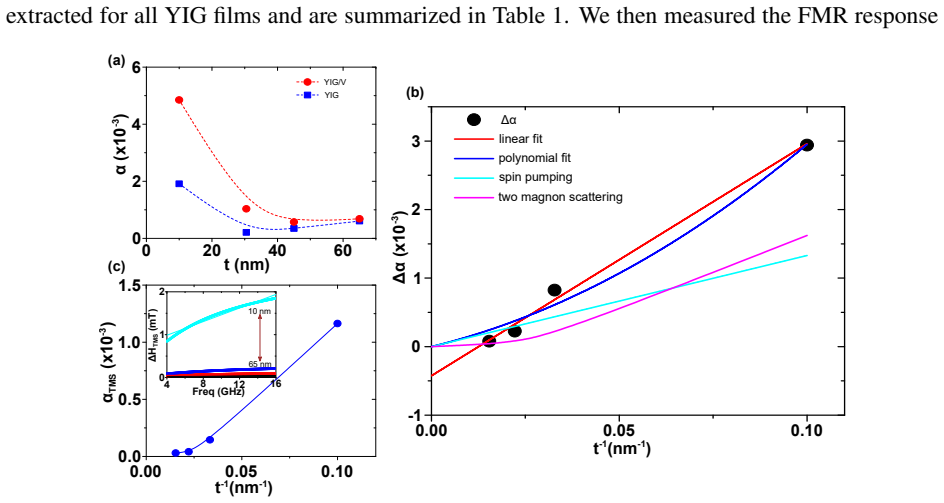
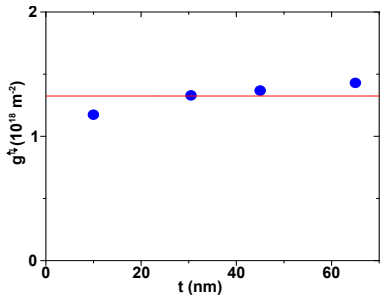
In YIG/V bilayers the apparent enhancement of Gilbert damping with decreasing YIG thickness arises mainly from two-magnon scattering rather than spin pumping. A thickness-dependent damping model that incorporates both contributions disentangles the relaxation channels and isolates an intrinsic spin-pumping term, producing a thickness-independent effective spin-mixing conductance of 1.33 × 10^18 m^{-2}.
What carries the argument
Thickness-dependent damping model that separates spin-pumping and two-magnon scattering contributions to Gilbert damping.
If this is right
- Neglecting two-magnon scattering produces spin-mixing conductance values that exceed physically plausible limits.
- The extracted effective spin-mixing conductance remains constant across YIG thicknesses once two-magnon scattering is removed.
- Extrinsic damping channels must be subtracted before interpreting inverse spin Hall effect data in FM/HM bilayers.
- The same separation procedure applies to other ferromagnetic/heavy-metal interfaces where thickness-dependent damping appears.
Where Pith is reading between the lines
- Similar overestimation of spin-mixing conductance is likely in other FM/NM systems when thickness series are analyzed without an explicit two-magnon term.
- Experiments that vary interface quality while holding thickness fixed could test whether two-magnon scattering strength tracks interface roughness.
- Extending the model to include temperature dependence would reveal whether the extracted conductance remains constant under thermal variation.
Load-bearing premise
The thickness-dependent damping model used to separate the two mechanisms is complete and contains no significant unaccounted relaxation channels in the nanometer regime.
What would settle it
A direct measurement of the inverse spin Hall voltage in the same YIG/V samples that yields a spin-mixing conductance consistent with 1.33 × 10^18 m^{-2} rather than the larger values obtained when two-magnon scattering is ignored.
Figures
read the original abstract
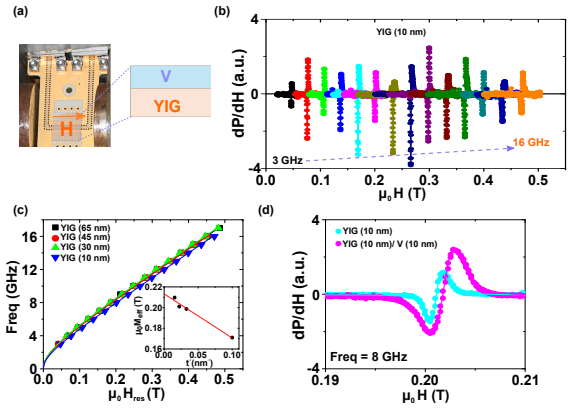
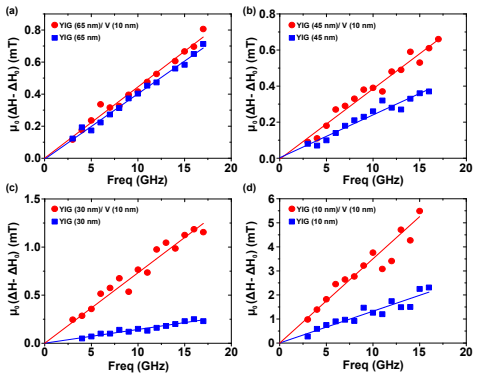
In this work, we investigate the magnetic damping and spin pumping response of YIG-based bilayers incorporating vanadium (V) as the normal metal layer via broadband ferromagnetic resonance (FMR) measurements as a function of YIG thickness. We show that the apparent enhancement of the Gilbert damping in YIG/V bilayers cannot be solely attributed to spin pumping. Instead, two-magnon scattering (TMS) plays a dominant role in governing the thickness dependence of the damping in the nanometer regime. By applying a thickness-dependent damping model that accounts for both spin pumping and two-magnon scattering contributions, we successfully disentangle the different relaxation contributions. Our analysis reveals that neglecting two-magnon scattering leads to an overestimation of the spin-pumping contribution and consequently to unphysically large values of the effective spin-mixing conductance. After isolating the intrinsic spin pumping contribution, we extract a thickness-independent effective spin-mixing conductance of $g^{\uparrow\downarrow}_{\mathrm{eff}} = 1.33 \times 10^{18}~\mathrm{m^{-2}}$. These findings provide a more accurate framework for quantifying spin transport parameters in FM/HM systems and emphasize the necessity of accounting for extrinsic damping mechanisms when interpreting spin pumping and inverse spin Hall effect experiments.
Editorial analysis
A structured set of objections, weighed in public.
Referee Report
Summary. The manuscript reports broadband FMR measurements of Gilbert damping versus YIG thickness in YIG/V bilayers. It claims that the observed thickness dependence cannot be explained by spin pumping alone and that two-magnon scattering (TMS) dominates in the nanometer regime. Application of a combined thickness-dependent model separates the ~1/t spin-pumping term from TMS, yielding a thickness-independent effective spin-mixing conductance g↑↓_eff = 1.33 × 10^18 m^{-2} and showing that omission of TMS produces unphysically large conductance values.
Significance. If the separation holds, the work supplies a practical correction procedure for extracting reliable spin-transport parameters from damping data in FM/NM bilayers and demonstrates the quantitative impact of neglecting TMS. The explicit test of the “TMS omitted” case and the resulting constant g_eff are useful strengths.
major comments (1)
- [Abstract and model-application section] Abstract and the section describing the model fit to the thickness series: the claim of successful disentanglement and extraction of a constant g_eff rests on the quality of the fit, yet no R² values, residual plots, error bars on the fitted parameters, data-exclusion criteria, or independent cross-check of the TMS term (e.g., via angular dependence or temperature) are supplied. These omissions are load-bearing for the central numerical result.
minor comments (2)
- [Introduction or Methods] Notation for the extracted conductance is introduced only in the abstract; a clear definition (including any assumptions about interface transparency or spin-memory loss) should appear in the main text before the numerical value is quoted.
- [Experimental section] The thickness range and number of samples used in the FMR series are not stated; this information is needed to judge the leverage of the 1/t term versus the TMS term.
Simulated Author's Rebuttal
We thank the referee for the constructive comment and for recognizing the potential utility of the disentanglement procedure. We address the single major comment below.
read point-by-point responses
-
Referee: [Abstract and model-application section] Abstract and the section describing the model fit to the thickness series: the claim of successful disentanglement and extraction of a constant g_eff rests on the quality of the fit, yet no R² values, residual plots, error bars on the fitted parameters, data-exclusion criteria, or independent cross-check of the TMS term (e.g., via angular dependence or temperature) are supplied. These omissions are load-bearing for the central numerical result.
Authors: We agree that quantitative indicators of fit quality are necessary to support the central claim. In the revised manuscript we will add the R² value of the combined TMS + spin-pumping fit, residual plots versus YIG thickness, and error bars (with 95 % confidence intervals) on all fitted parameters, including the reported g↑↓_eff. We will also state explicitly that every measured data point was retained and that no exclusion criteria were applied. Regarding independent cross-checks, the present dataset consists of broadband FMR measurements performed at room temperature and fixed in-plane field orientation; additional angular- or temperature-dependent measurements were not performed. The thickness-dependent model itself follows the established TMS formalism of Arias and Mills, and the internal consistency check (constant g_eff after TMS subtraction versus unphysically large values when TMS is omitted) is already shown in the manuscript. We therefore view the requested statistical diagnostics as sufficient to address the concern for a minor revision. revision: partial
Circularity Check
No significant circularity identified
full rationale
The paper applies a thickness-dependent damping model to broadband FMR data across YIG thicknesses, separates spin-pumping (~1/t) from TMS contributions, and extracts a constant g↑↓_eff by fitting. This is standard parameter extraction from measurements rather than any reduction by the paper's own equations to a self-defined quantity, a fitted input renamed as prediction, or a self-citation chain. No load-bearing uniqueness theorem, ansatz smuggling, or renaming of known results occurs. The extracted value is independent of prior fitted parameters within the work and remains falsifiable against external data.
Axiom & Free-Parameter Ledger
free parameters (1)
- effective spin-mixing conductance =
1.33 × 10^18 m^{-2}
axioms (1)
- domain assumption The thickness-dependent damping model correctly accounts for both spin pumping and two-magnon scattering without significant omissions.
Reference graph
Works this paper leans on
-
[1]
Dieny, I
B. Dieny, I. L. Prejbeanu, K. Garello, P. Gambardella, P. Freitas, R. Lehndorff, W. Raberg, U. Ebels, S. O. Demokritov, J. Åkerman, A. Deac, P. Pirro, C. Adelmann, A. Anane, A. V . Chumak, A. Hirohata, S. Mangin, S. O. Valenzuela, M. C. Onba¸ slı, M. d’Aquino, G. Prenat, G. Finocchio, L. Lopez-Diaz, R. Chantrell, O. Chubykalo-Fesenko, and P. Bortolotti, O...
2020
-
[2]
Tserkovnyak, A
Y . Tserkovnyak, A. Brataas, G. E. W. Bauer, and B. I. Halperin, Nonlocal magnetization dynamics in ferromagnetic heterostructures, Rev. Mod. Phys.77, 1375 (2005)
2005
-
[3]
Zhang, W
W. Zhang, W. Han, X. Jiang, S.-H. Yang, and S. S. P. Parkin, Role of transparency of platinum- ferromagnet interfaces in determining the intrinsic magnitude of the spin hall effect, Nat. Phys.11, 496 (2015)
2015
-
[4]
M. I. D’yakonov and V . I. Perel’, Possibility of orienting electron spins with current, J. Exp. Theor. Phys. Lett.13, 467 (1971)
1971
-
[5]
J. E. Hirsch, Spin hall effect, Phys. Rev. Lett.83, 1834 (1999)
1999
-
[6]
Liu, C.-F
L. Liu, C.-F. Pai, Y . Li, H. W. Tseng, D. C. Ralph, and R. A. Buhrman, Spin-torque switching with the giant spin hall effect of tantalum, Science336, 555 (2012)
2012
-
[7]
Hoffmann, Spin hall effects in metals, IEEE Transactions on Magnetics49, 5172 (2013)
A. Hoffmann, Spin hall effects in metals, IEEE Transactions on Magnetics49, 5172 (2013)
2013
-
[8]
Ranjbar, P
M. Ranjbar, P. Drrenfeld, M. Haidar, E. Iacocca, M. Balinskiy, T. Q. Le, M. Fazlali, A. Houshang, A. A. Awad, R. K. Dumas, and J. Åkerman, Cofeb-based spin hall nano-oscillators, IEEE Magnetics Letters5, 1 (2014)
2014
-
[9]
L. Chen, Y . Sun, S. Mankovsky, T. N. G. Meier, M. Kronseder, C. Sun, A. Orekhov, H. Ebert, D. Weiss, and C. H. Back, Signatures of magnetism control by flow of angular momentum, Nature633, 548 (2024)
2024
-
[10]
Haidar, Synchronization of propagating spin waves in spin hall oscillators: A micromagnetic study, Applied Physics Letters127, 082403 (2025)
M. Haidar, Synchronization of propagating spin waves in spin hall oscillators: A micromagnetic study, Applied Physics Letters127, 082403 (2025)
2025
-
[11]
K. Ando, S. Takahashi, K. Harii, K. Sasage, J. Ieda, S. Maekawa, and E. Saitoh, Electric manipulation of spin relaxation using the spin hall effect, Phys. Rev. Lett.101, 036601 (2008). 12
2008
-
[12]
O. d’Allivy Kelly, A. Anane, R. Bernard, J. Ben Youssef, C. Hahn, A. H. Molpeceres, C. Carrétéro, E. Jacquet, C. Deranlot, P. Bortolotti, R. Lebourgeois, J.-C. Mage, G. de Loubens, O. Klein, V . Cros, and A. Fert, Inverse spin hall effect in nanometer-thick yttrium iron garnet/pt system, Applied Physics Letters103, 082408 (2013), https://doi.org/10.1063/1.4819157
-
[13]
C. Hahn, G. de Loubens, O. Klein, M. Viret, V . V . Naletov, and J. Ben Youssef, Comparative measure- ments of inverse spin hall effects and magnetoresistance in yig/pt and yig/ta, Phys. Rev. B87, 174417 (2013)
2013
-
[14]
Balinsky, M
M. Balinsky, M. Ranjbar, M. Haidar, P. Dürrenfeld, R. K. Dumas, S. Khartsev, A. Slavin, and J. Åk- erman, Spin pumping and the inverse spin hall effect via magnetostatic surface spin wave modes in yig/pt bilayers, IEEE Mag. Lett.6, 3000604 (2015)
2015
-
[15]
Haidar, P
M. Haidar, P. Dürrenfeld, M. Ranjbar, M. Balinsky, M. Fazlali, M. Dvornik, R. K. Dumas, S. Khartsev, and J. Åkerman, Controlling gilbert damping in a yig film using nonlocal spin currents, Phys. Rev. B 94, 180409 (2016)
2016
-
[16]
T. Yoshino, K. Ando, K. Harii, H. Nakayama, Y . Kajiwara, and E. Saitoh, Universality of the spin pumping in metallic bilayer films, Applied Physics Letters98, 132503 (2011), https://pubs.aip.org/aip/apl/article-pdf/doi/10.1063/1.3571556/13972503/132503_1_online.pdf
work page doi:10.1063/1.3571556/13972503/132503_1_online.pdf 2011
-
[17]
Caminale, A
M. Caminale, A. Ghosh, S. Auffret, U. Ebels, K. Ollefs, F. Wilhelm, A. Rogalev, and W. E. Bailey, Spin pumping damping and magnetic proximity effect in Pd and Pt spin-sink layers, Phys. Rev. B94, 014414 (2016)
2016
-
[18]
Heinrich, C
B. Heinrich, C. Burrowes, E. Montoya, B. Kardasz, E. Girt, Y .-Y . Song, Y . Sun, and M. Wu, Spin pumping at the magnetic insulator (yig)/normal metal (au) interfaces, Phys. Rev. Lett.107, 066604 (2011)
2011
-
[19]
Haertinger, C
M. Haertinger, C. H. Back, J. Lotze, M. Weiler, S. Geprägs, H. Huebl, S. T. B. Goennenwein, and G. Woltersdorf, Spin pumping in yig/pt bilayers as a function of layer thickness, Phys. Rev. B92, 054437 (2015)
2015
-
[20]
M. Haidar, H. Mazraati, P. Dürrenfeld, H. Fulara, M. Ranjbar, and J. Åkerman, Compositional effect on auto-oscillation behavior of ni 100−xfex/pt spin hall nano-oscillators, Applied Physics Letters118, 012406 (2021), https://doi.org/10.1063/5.0035697
-
[21]
Mishra, P
A. Mishra, P. Das, R. Chhatoi, S. Dash, S. Sahoo, K. S. Rathore, P.-R. Cha, S.-C. Lee, S. Bhattacharjee, and S. Bedanta, Enhancement of spin hall angle by an order of magnitude via cu intercalation in mos2/co-fe-b heterostructures, Phys. Rev. Appl.24, 064032 (2025). 13
2025
-
[22]
Sahoo, S
A. Sahoo, S. Mahanta, and S. Bedanta, Significant influence of low soc materials on magnetization dynamics and spin-orbital to charge conversion, npj Spintronics3, 20 (2025)
2025
-
[23]
H. L. Wang, C. H. Du, Y . Pu, R. Adur, P. C. Hammel, and F. Y . Yang, Large spin pumping from epitaxial y3fe5o12 thin films to pt and w layers, Phys. Rev. B88, 100406 (2013)
2013
-
[24]
Yang and P
F. Yang and P. Chris Hammel, Fmr-driven spin pumping in y3fe5o12-based structures, Journal of Physics D: Applied Physics51, 253001 (2018)
2018
-
[25]
Harajli, S
Z. Harajli, S. Isber, and M. Haidar, Optimizing spin pumping in yttrium iron garnet/platinum bilayers under varying oxygen pressure, Journal of Magnetism and Magnetic Materials610, 172572 (2024)
2024
-
[26]
Mosendz, V
O. Mosendz, V . Vlaminck, J. E. Pearson, F. Y . Fradin, G. E. W. Bauer, S. D. Bader, and A. Hoffmann, Detection and quantification of inverse spin hall effect from spin pumping in permalloy/normal metal bilayers, Phys. Rev. B82, 214403 (2010)
2010
-
[27]
Weiler, M
M. Weiler, M. Althammer, M. Schreier, J. Lotze, M. Pernpeintner, S. Meyer, H. Huebl, R. Gross, A. Kamra, J. Xiao, Y .-T. Chen, H. Jiao, G. E. W. Bauer, and S. T. B. Goennenwein, Experimental test of the spin mixing interface conductivity concept, Phys. Rev. Lett.111, 176601 (2013)
2013
-
[28]
C.-F. Pai, Y . Ou, L. H. Vilela-Leão, D. C. Ralph, and R. A. Buhrman, Dependence of the efficiency of spin hall torque on the transparency of pt/ferromagnetic layer interfaces, Phys. Rev. B92, 064426 (2015)
2015
-
[29]
Carva and I
K. Carva and I. Turek, Spin-mixing conductances of thin magnetic films from first principles, Phys. Rev. B76, 104409 (2007)
2007
-
[30]
Dolui, U
K. Dolui, U. Bajpai, and B. K. Nikoli ´c, Effective spin-mixing conductance of topological- insulator/ferromagnet and heavy-metal/ferromagnet spin-orbit-coupled interfaces: A first-principles floquet-nonequilibrium green function approach, Phys. Rev. Mater.4, 121201(R) (2020)
2020
-
[31]
Y . Sun, Y .-Y . Song, H. Chang, M. Kabatek, M. Jantz, W. Schneider, M. Wu, H. Schultheiss, and A. Hoffmann, Growth and ferromagnetic resonance properties of nanometer-thick yttrium iron garnet films, Applied Physics Letters101, 152405 (2012), https://doi.org/10.1063/1.4759039
-
[32]
M. B. Jungfleisch, V . Lauer, R. Neb, A. V . Chumak, and B. Hillebrands, Improvement of the yt- trium iron garnet/platinum interface for spin pumping-based applications, Applied Physics Letters 103, 022411 (2013)
2013
-
[33]
Pogoryelov, M
Y . Pogoryelov, M. Pereiro, S. Jana, A. Kumar, S. Akansel, M. Ranjbar, D. Thonig, D. Primetzhofer, P. Svedlindh, J. Åkerman, O. Eriksson, O. Karis, and D. A. Arena, Nonreciprocal spin pumping damp- ing in asymmetric magnetic trilayers, Phys. Rev. B101, 054401 (2020). 14
2020
-
[34]
Zhang, G
Y . Zhang, G. Wu, Z. Ji, X. Chen, Q. Y . Jin, and Z. Zhang, Significant and nonmonotonic dynamic magnetic damping in asymmetric Co-Fe/Ru/Co-Fe trilayers, Phys. Rev. Appl.17, 034033 (2022)
2022
-
[35]
S.-H. Jang, G. Park, D. H. Yun, H. C. Koo, S.-K. Kim, and O. Lee, Exceptional field-like spin–orbit torques in pd/co heterostructures enabled by interfacial spin–orbit coupling, ACS Applied Electronic Materials7, 4501 (2025), https://doi.org/10.1021/acsaelm.5c00339
-
[36]
Bonda, L
A. Bonda, L. Uba, S. Uba, A. Wawro, Z. Kurant, and A. Maziewski, Enhanced spin pumping in asymmetric co/re/co trilayers with antiferromagnetic coupling and mixed magnetic anisotropy, Phys. Rev. B113, 184414 (2026)
2026
-
[37]
Rojas-Sánchez, N
J.-C. Rojas-Sánchez, N. Reyren, P. Laczkowski, W. Savero, J.-P. Attané, C. Deranlot, M. Jamet, J.-M. George, L. Vila, and H. Jaffrès, Spin pumping and inverse spin hall effect in platinum: The essential role of spin-memory loss at metallic interfaces, Phys. Rev. Lett.112, 106602 (2014)
2014
-
[38]
L. Zhu, D. C. Ralph, and R. A. Buhrman, Effective spin-mixing conductance of heavy-metal– ferromagnet interfaces, Phys. Rev. Lett.123, 057203 (2019)
2019
-
[39]
M. Haidar, M. Ranjbar, M. Balinsky, R. K. Dumas, S. Khartsev, and J. Åkerman, Thickness- and temperature-dependent magnetodynamic properties of yttrium iron garnet thin films, Journal of Ap- plied Physics117, 17D119 (2015), https://doi.org/10.1063/1.4914363
-
[40]
Haidar, B
M. Haidar, B. El-Khoury, and S. Isber, Broadband ferromagnetic resonance of ultrathin yttrium iron garnet films by pulsed laser deposition: Effects of deposition parameters, Journal of Magnetism and Magnetic Materials580, 170888 (2023)
2023
-
[41]
Demasius, T
K. Demasius, T. Phung, W. Zhang, B. P. Hughes, S. H. Yang, A. Kellock, A. Pushp, and S. S. P. Parkin, Enhanced spin–orbit torques by oxygen incorporation in tungsten films, natcom7, 10644 (2016)
2016
- [42]
-
[43]
H. L. Wang, C. H. Du, Y . Pu, R. Adur, P. C. Hammel, and F. Y . Yang, Scaling of spin hall angle in 3d, 4d, and 5d metals from y3fe5o12/metal spin pumping, Phys. Rev. Lett.112, 197201 (2014)
2014
-
[44]
Azevedo, A
A. Azevedo, A. B. Oliveira, F. M. de Aguiar, and S. M. Rezende, Extrinsic contributions to spin-wave damping and renormalization in thin ni50fe50 films, Phys. Rev. B62, 5331 (2000)
2000
-
[45]
Arias and D
R. Arias and D. L. Mills, Extrinsic contributions to the ferromagnetic resonance response of ultrathin films, Phys. Rev. B60, 7395 (1999)
1999
-
[46]
L. Zhu, D. C. Ralph, and R. A. Buhrman, Spin-orbit torques in heavy-metal–ferromagnet bilayers with varying strengths of interfacial spin-orbit coupling, Phys. Rev. Lett.122, 077201 (2019). 15
2019
-
[47]
D. H. Yun, K.-H. Han, Y .-J. Nah, Y . Kim, S.-H. Jang, M.-G. Kang, S.-H. Shin, B.-C. Min, H. C. Koo, B.-K. Ju, and O. Lee, Contributions of interfacial spin–orbit coupling to magnetic and spintronic properties in aupt/ferromagnet bilayers, Applied Physics Letters125, 072403 (2024)
2024
-
[48]
C. Du, H. Wang, P. C. Hammel, and F. Yang, Y3fe5o12 spin pumping for quantitative understanding of pure spin transport and spin hall effect in a broad range of materials (invited), Journal of Applied Physics117, 172603 (2015). 16
2015
discussion (0)
Sign in with ORCID, Apple, or X to comment. Anyone can read and Pith papers without signing in.