Optimal scenario design for climate emulation
Pith reviewed 2026-06-26 18:40 UTC · model grok-4.3
The pith
One optimized scenario produces more skillful climate emulators than six standard pathways.
A machine-rendered reading of the paper's core claim, the machinery that carries it, and where it could break.
Core claim
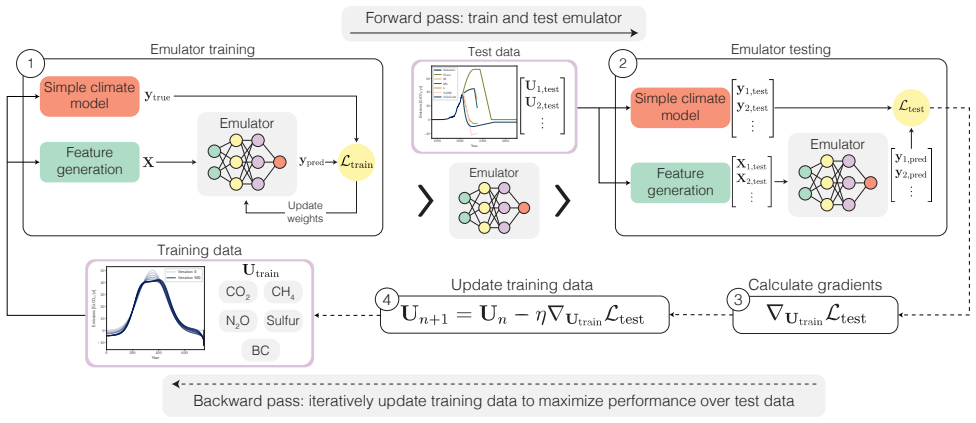
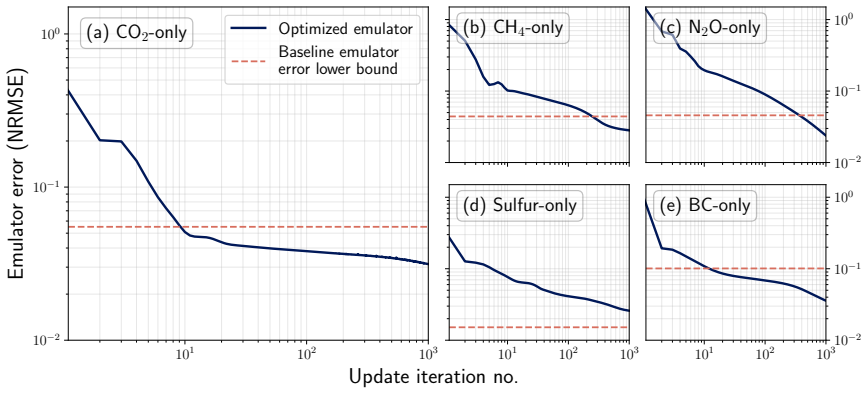
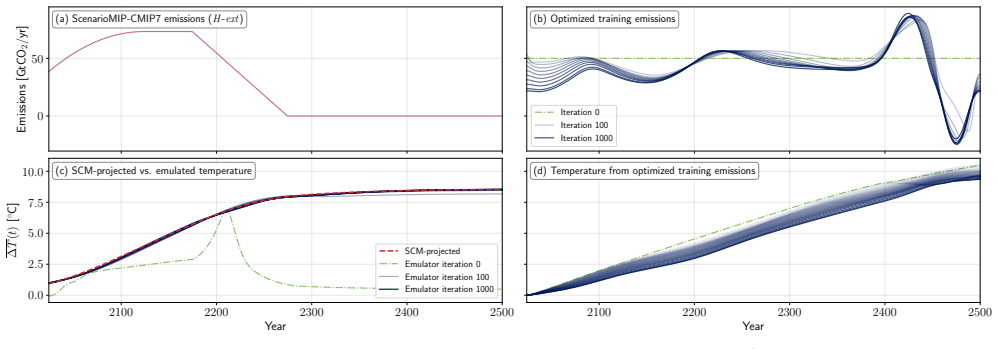
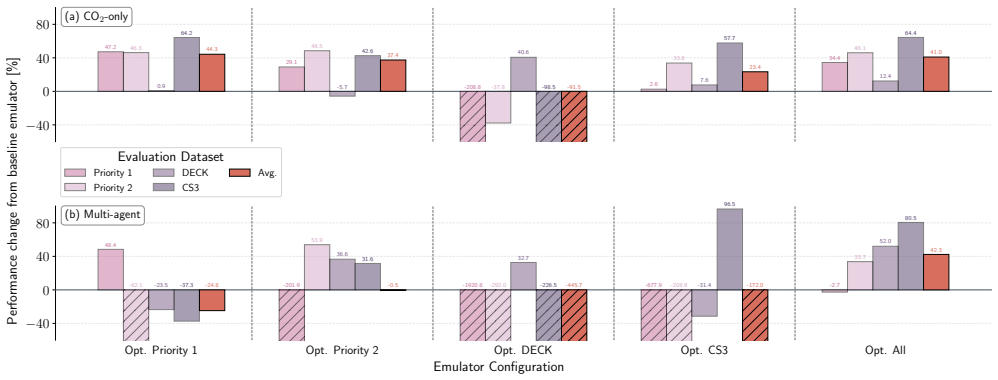
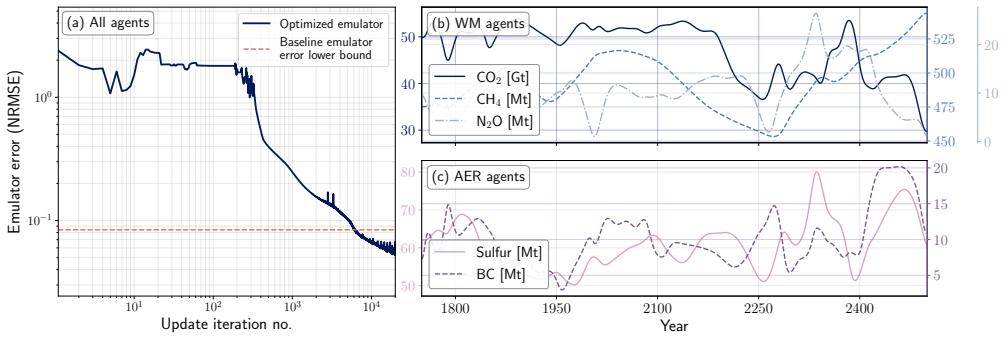
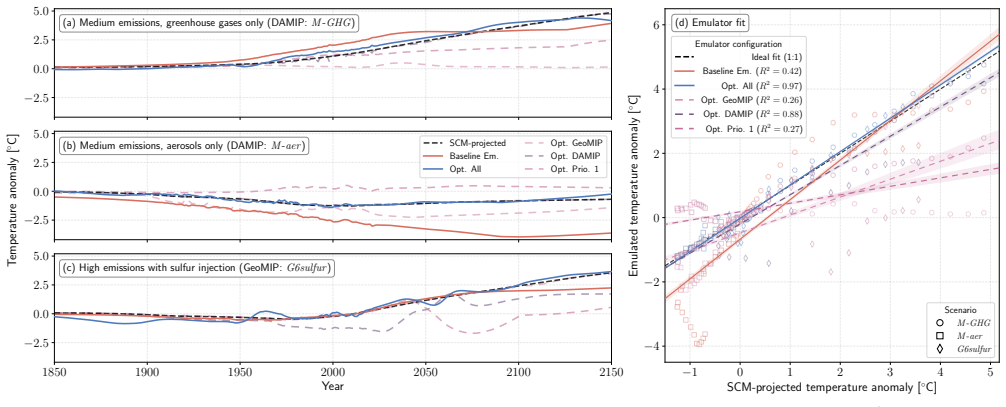
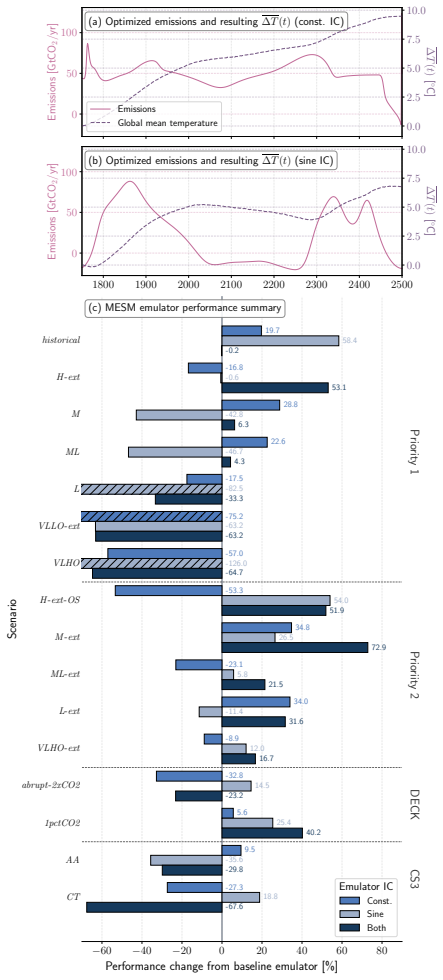
We introduce a method to create training datasets that produce emulators capable of generalizing to new, structurally different scenarios absent from the training data. We use a differentiable Simple Climate Model to calculate the sensitivity of emulator loss to perturbations in the training data, iteratively updating the training data to maximize emulator skill. For an SCM, training on one scenario optimized in this fashion outperforms an emulator trained on six standard ScenarioMIP pathways. We achieve this higher predictive skill despite training on a smaller dataset, finding that our emulator successfully isolates distinct physical behaviors of different climate forcing agents without si
What carries the argument
A differentiable Simple Climate Model used to compute gradients of emulator loss with respect to perturbations in the training scenarios, allowing iterative optimization of those scenarios.
If this is right
- Emulators trained on the optimized scenarios generalize to new pathways not seen in training.
- Distinct responses to different forcing agents can be isolated without dedicated single-forcing experiments.
- In settings where full model runs are expensive, a small number of rich scenarios provides greater marginal value than expanding the set of traditional pathways.
Where Pith is reading between the lines
- The same gradient-based design approach could be tested on other surrogate tasks where the structure of the input ensemble limits generalization.
- If the transfer from SCM to intermediate model holds further, scenario design for large ensembles might shift from adding more pathways to deliberately maximizing response diversity.
- The method implies that intercomparison projects could prioritize a minimal set of dynamically informative runs over exhaustive coverage of conventional narratives.
Load-bearing premise
Gradients and sensitivities derived from the simple differentiable SCM remain informative when the resulting optimized scenarios are used to train emulators driven by outputs from higher-complexity models.
What would settle it
Run the SCM-optimized scenarios and the standard ScenarioMIP scenarios through a full-complexity GCM, train separate emulators on each set, and compare their predictive skill on a set of structurally novel future pathways.
Figures
read the original abstract
As deep learning for physical systems continues to grow in popularity, efforts to improve generalizability have primarily focused on designing architectures that embed physical constraints. However, for machine-learning surrogate climate models (emulators), we show that the low structural diversity in existing scenarios commonly used to generate training data places a ceiling on predictive skill. Here, we examine whether training datasets themselves can be optimized to improve generalization. We introduce a method to create datasets that produce emulators capable of generalizing to new, structurally different scenarios absent from the training data. We use a differentiable Simple Climate Model (SCM) to calculate the sensitivity of emulator loss to perturbations in the training data, iteratively updating the training data to maximize emulator skill. For an SCM, training on one scenario optimized in this fashion outperforms an emulator trained on six standard ScenarioMIP pathways. We achieve this higher predictive skill despite training on a smaller dataset, finding that our emulator successfully isolates distinct physical behaviors of different climate forcing agents (e.g., greenhouse gases vs. aerosols) without single-forcing runs. We then demonstrate that scenarios optimized using an SCM, when used to drive an intermediate-complexity climate model, produce a training dataset that yields a more skillful emulator than training on ScenarioMIP outputs. Our results suggest that, in the compute-constrained environment of running full-scale climate models, generating a small number of dynamically rich scenarios provides greater marginal value for emulation and characterizing system responses than expanding the suite of traditional emissions pathways.
Editorial analysis
A structured set of objections, weighed in public.
Referee Report
Summary. The manuscript introduces a method to optimize training scenarios for climate emulators by using gradients from a differentiable simple climate model (SCM) to iteratively update forcing trajectories and maximize emulator skill on held-out scenarios. It claims that an emulator trained on a single such optimized scenario outperforms one trained on six standard ScenarioMIP pathways despite the smaller dataset size, that the resulting emulator isolates distinct behaviors of forcing agents (e.g., GHGs vs. aerosols) without single-forcing experiments, and that the same optimized scenarios, when used to drive an intermediate-complexity climate model, yield a more skillful emulator than ScenarioMIP outputs.
Significance. If the central claims hold after addressing the evidence gaps, the work would demonstrate that scenario design itself can be a high-leverage lever for emulator generalization in compute-constrained settings, potentially offering greater marginal value than simply expanding suites of traditional pathways. The use of a differentiable SCM to derive scenario sensitivities is a concrete technical strength that enables the optimization loop and supplies a reproducible pathway for generating dynamically rich training data.
major comments (2)
- [Abstract] Abstract and results on SCM emulator: the headline claim that training on one optimized scenario outperforms an emulator trained on six ScenarioMIP pathways is presented without error bars, exact definitions of the loss function used for optimization or evaluation, details on validation splits, or quantitative transfer metrics, leaving the magnitude and robustness of the reported skill gain only partially supported.
- [Transfer results] Transfer demonstration (results section on intermediate-complexity model): the claim that SCM-optimized scenarios produce a more skillful emulator when driving the intermediate model rests on a single model pair with no numerical quantification of SCM–model discrepancy, no ablation isolating the contribution of the optimization versus the choice of forcing agents, and no assessment of how large the mismatch must be before the gradient-derived scenarios lose their advantage.
minor comments (2)
- [Methods] Notation for the emulator loss and the sensitivity computation should be defined explicitly with equation numbers rather than described only in prose.
- [Figures] Figure captions for the forcing trajectories and emulator skill comparisons should include the exact number of ensemble members or runs used to generate each curve.
Simulated Author's Rebuttal
We thank the referee for their constructive and detailed comments. We address each major point below, indicating where revisions will strengthen the presentation of results and where certain aspects reflect the scope of the current study.
read point-by-point responses
-
Referee: [Abstract] Abstract and results on SCM emulator: the headline claim that training on one optimized scenario outperforms an emulator trained on six ScenarioMIP pathways is presented without error bars, exact definitions of the loss function used for optimization or evaluation, details on validation splits, or quantitative transfer metrics, leaving the magnitude and robustness of the reported skill gain only partially supported.
Authors: We agree that the abstract is concise and that the main claim would be better supported by additional quantitative details. The loss function (mean squared error on global-mean temperature and other diagnostics) and optimization procedure are defined in the Methods, and validation uses held-out ScenarioMIP pathways as described in Section 3.2. We will revise the manuscript to include error bars from multiple random seeds in the relevant figures, add explicit cross-references to the loss definition, and report quantitative skill metrics (e.g., RMSE reductions) both in the results text and, space permitting, in the abstract. revision: yes
-
Referee: [Transfer results] Transfer demonstration (results section on intermediate-complexity model): the claim that SCM-optimized scenarios produce a more skillful emulator when driving the intermediate model rests on a single model pair with no numerical quantification of SCM–model discrepancy, no ablation isolating the contribution of the optimization versus the choice of forcing agents, and no assessment of how large the mismatch must be before the gradient-derived scenarios lose their advantage.
Authors: The transfer experiment is presented as a proof-of-concept demonstration on one intermediate-complexity model. We will add numerical quantification of the emulator skill gain relative to ScenarioMIP training and a brief discussion of the observed SCM–model discrepancy. A full ablation isolating the optimization contribution from the choice of forcing agents would require additional model integrations beyond the current computational budget; we will therefore note this as a limitation and outline it as future work. We will also provide a qualitative assessment of mismatch sensitivity based on the single pair examined. revision: partial
Circularity Check
No circularity; optimization validated on held-out scenarios and independent model
full rationale
The derivation uses a differentiable SCM solely to optimize scenario inputs via gradients on emulator loss, then directly compares the resulting single-scenario emulator against emulators trained on six standard ScenarioMIP pathways (held-out test) and further demonstrates skill gains when the same optimized scenarios drive an independent intermediate-complexity climate model. This constitutes an external empirical benchmark rather than any reduction of the claimed result to its own fitted inputs or self-citations by construction. No self-definitional loops, fitted inputs renamed as predictions, or load-bearing self-citations appear in the derivation chain.
Axiom & Free-Parameter Ledger
Reference graph
Works this paper leans on
-
[1]
Paltsev, Sergey and Schlosser, C. Adam and Berthet, Etienne and Brandolini, Filippo and Chen, Henry and Chinta, Sandeep and Dutkiewicz, Stephanie and Gao, Xiang and Gurgel, Angelo and Yang, Kevin Lin and Morris, Jennifer and Selin, Noelle E. and Salunke, Popat and Scott, Jeffery and Sokolov, Andrei and White, Dominic and Womack, Christopher B. and Wong, A...
2025
-
[2]
Windisch, Michael Gregory and Quilcaille, Yann and Mathison, Camilla and Tebaldi, Claudia and Burke, Eleanor and Gohar, Laila and Smith, Chris and Schöngart, Sarah and Snyder, Abigail and Durga, Siddarth and Dorheim, Kalyn and Seneviratne, Sonia , month = may, year =. Advancing the. doi:10.5194/egusphere-2026-2253 , abstract =
-
[3]
and Schleussner, Carl-Friedrich and Seneviratne, Sonia , month = mar, year =
Schöngart, Sarah and Gudmunsson, Lukas and Womack, Christopher B. and Schleussner, Carl-Friedrich and Seneviratne, Sonia , month = mar, year =. A review of spatially explicit climate emulators for enhancing modelling agility , url =. doi:10.5194/egusphere-egu26-6394 , note =
-
[4]
Seneviratne, Sonia and Quilcaille, Yann and Windisch, Michael and Gudmundsson, Lukas and Biess, Bianca and Jaeger, Felix and Hauser, Matthias and Hirschi, Martin , month = mar, year =. Using regional. doi:10.5194/egusphere-egu24-18731 , note =
-
[5]
and Sandstad, Marit and Dewey, Maura and Steinert, Norman Julius and Fjeldså, Johannes L
Sanderson, Benjamin M. and Sandstad, Marit and Dewey, Maura and Steinert, Norman Julius and Fjeldså, Johannes L. , month = may, year =. doi:10.5194/egusphere-2026-2029 , abstract =
-
[6]
Liu, Laibao and Hauser, Mathias and Windisch, Michael and Seneviratne, Sonia I. , month = sep, year =. Hysteresis and reversibility of agroecological droughts in response to carbon dioxide removal , volume =. Nature Water , publisher =. doi:10.1038/s44221-025-00487-8 , abstract =
-
[7]
AIMIP Phase 1: systematic evaluations of AI weather and climate models
Henn, Brian and Bretherton, Christopher S. and Kodunov, Nikolay and Lessig, Christian and Molina, Maria J. and Arcomano, Troy and Watt-Meyer, Oliver and Couairon, Guillaume and Singh, Renu and Brunstein, Robert and Hasson, Yana and Jost, Antonia and Brenowitz, Noah and Manshausen, Peter and Cresswell-Clay, Nathaniel and Durran, Dale and Hall, Kyle Joseph ...
work page internal anchor Pith review Pith/arXiv arXiv doi:10.48550/arxiv.2605.06944
-
[8]
and Brovkin, Victor and Fisher, Rosie A
Sanderson, Benjamin M. and Brovkin, Victor and Fisher, Rosie A. and Hohn, David and Ilyina, Tatiana and Jones, Chris D. and Koenigk, Torben and Koven, Charles and Li, Hongmei and Lawrence, David M. and Lawrence, Peter and Liddicoat, Spencer and MacDougall, Andrew H. and Mengis, Nadine and Nicholls, Zebedee and O'Rourke, Eleanor and Romanou, Anastasia and ...
-
[9]
Limited reversal of regional climate signals in overshoot scenarios , volume =
Pfleiderer, Peter and Schleussner, Carl-Friedrich and Sillmann, Jana , month = jan, year =. Limited reversal of regional climate signals in overshoot scenarios , volume =. Environmental Research: Climate , publisher =. doi:10.1088/2752-5295/ad1c45 , abstract =
-
[10]
Towards accurate extreme event likelihoods from diffusion model climate emulators
Manshausen, Peter and Brenowitz, Noah and Berner, Julius and Kashinath, Karthik and Pritchard, Mike , year =. Towards accurate extreme event likelihoods from diffusion model climate emulators , copyright =. doi:10.48550/ARXIV.2605.03802 , abstract =
work page internal anchor Pith review Pith/arXiv arXiv doi:10.48550/arxiv.2605.03802
-
[11]
and Wang, Cindy and Roberts, Kelsey and Watanabe, Shingo and Reboita, Michelle S
Visioni, Daniele and Robock, Alan and Duffey, Alistair and Henry, Matthew and Hirasawa, Haruki and Lee, Walker R. and Wang, Cindy and Roberts, Kelsey and Watanabe, Shingo and Reboita, Michelle S. and Sugiyama, Masahiro and Kravitz, Ben and Haywood, Jim and Tilmes, Simone and Bonou, Frederic and Chen, Jack and Sukodolov, Timofei and Vattioni, Sandro and Jö...
-
[12]
Social Science Quarterly , author =
Science,. Social Science Quarterly , author =. 2016 , note =. doi:10.1111/ssqu.12317 , abstract =
-
[13]
Keys, Patrick W. and Barnes, Elizabeth A. and Diffenbaugh, Noah S. and Hurrell, James W. and Bell, Curtis M. , month = oct, year =. Potential for perceived failure of stratospheric aerosol injection deployment , volume =. Proceedings of the National Academy of Sciences , publisher =. doi:10.1073/pnas.2210036119 , abstract =
-
[14]
Environmental Research Letters , author =
Early onset of significant local warming in low latitude countries , volume =. Environmental Research Letters , author =. 2011 , pages =. doi:10.1088/1748-9326/6/3/034009 , abstract =
-
[15]
Delayed detection of climate mitigation benefits due to climate inertia and variability , volume =
Tebaldi, Claudia and Friedlingstein, Pierre , month = oct, year =. Delayed detection of climate mitigation benefits due to climate inertia and variability , volume =. Proceedings of the National Academy of Sciences , publisher =. doi:10.1073/pnas.1300005110 , abstract =
-
[16]
Fire,. AGU Advances , author =. 2025 , note =. doi:10.1029/2024AV001628 , abstract =
-
[17]
Zhuang, Yizhou and Fu, Rong and Santer, Benjamin D. and Dickinson, Robert E. and Hall, Alex , month = nov, year =. Quantifying contributions of natural variability and anthropogenic forcings on increased fire weather risk over the western. Proceedings of the National Academy of Sciences , publisher =. doi:10.1073/pnas.2111875118 , abstract =
-
[18]
Ecological Applications , author =
Climate and wildfire area burned in western. Ecological Applications , author =. 2009 , note =. doi:10.1890/07-1183.1 , abstract =
-
[19]
Clarke, Hamish and Nolan, Rachael H. and De Dios, Victor Resco and Bradstock, Ross and Griebel, Anne and Khanal, Shiva and Boer, Matthias M. , month = nov, year =. Forest fire threatens global carbon sinks and population centres under rising atmospheric water demand , volume =. Nature Communications , publisher =. doi:10.1038/s41467-022-34966-3 , abstract =
-
[20]
Abatzoglou, John T. and Williams, A. Park , month = oct, year =. Impact of anthropogenic climate change on wildfire across western. Proceedings of the National Academy of Sciences , publisher =. doi:10.1073/pnas.1607171113 , abstract =
-
[21]
Sedano, F. and Randerson, J. T. , month = jul, year =. Multi-scale influence of vapor pressure deficit on fire ignition and spread in boreal forest ecosystems , volume =. Biogeosciences , publisher =. doi:10.5194/bg-11-3739-2014 , abstract =
-
[22]
International Journal of Wildland Fire , author =
Correlations between components of the water balance and burned area reveal new insights for predicting forest fire area in the southwest. International Journal of Wildland Fire , author =. 2014 , pages =. doi:10.1071/WF14023 , abstract =
-
[23]
Global Change Biology , author =
Record-setting climate enabled the extraordinary 2020 fire season in the western. Global Change Biology , author =. 2021 , note =. doi:10.1111/gcb.15388 , language =
-
[24]
Spatial and temporal pattern of wildfires in
Li, Shu and Banerjee, Tirtha , month = apr, year =. Spatial and temporal pattern of wildfires in. Scientific Reports , publisher =. doi:10.1038/s41598-021-88131-9 , abstract =
-
[25]
Science of The Total Environment , author =
Climate change induced declines in fuel moisture may turn currently fire-free. Science of The Total Environment , author =. 2021 , keywords =. doi:10.1016/j.scitotenv.2021.149104 , abstract =
-
[26]
Agricultural and Forest Meteorology , author =
A semi-mechanistic model for predicting the moisture content of fine litter , volume =. Agricultural and Forest Meteorology , author =. 2015 , keywords =. doi:10.1016/j.agrformet.2015.01.002 , abstract =
-
[27]
Journal of Geophysical Research: Atmospheres , author =
The added value to global model projections of climate change by dynamical downscaling:. Journal of Geophysical Research: Atmospheres , author =. 2012 , note =. doi:10.1029/2012JD018091 , abstract =
-
[28]
An analysis of the disagreement about added value by regional climate models , volume =. Synthese , author =. 2021 , keywords =. doi:10.1007/s11229-020-02821-x , abstract =
-
[29]
A perfect model study on the reliability of the added small-scale information in regional climate change projections , volume =. Climate Dynamics , author =. 2023 , keywords =. doi:10.1007/s00382-022-06451-6 , abstract =
-
[30]
Stefanova, Lydia and Sura, Philip and Griffin, Melissa , month = feb, year =. Quantifying the. doi:10.1175/JCLI-D-12-00161.1 , abstract =
-
[31]
doi:10.22541/essoar.176314951.18114616/v1 , abstract =
Moses, William S and Cheng, Gong and Churavy, Valentin and Gelbrecht, Maximilian and Klöwer, Milan and Kump, Joseph and Morlighem, Mathieu and Williamson, Sarah and Apte, Dhruv and Berg, Paul and Giordano, Mosè and Hill, Chris and Loose, Nora and Montoison, Alexis and Narayanan, Sri Hari Krishna and Pal, Avik and Schanen, Michel and Silvestri, Simone and ...
-
[32]
Koopman invariant subspaces and finite linear representations of nonlinear dynamical systems for control , volume =. PLOS ONE , author =. 2016 , note =. doi:10.1371/journal.pone.0150171 , abstract =
-
[33]
Tellus A: Dynamic Meteorology and Oceanography , author =
Stochastic climate models,. Tellus A: Dynamic Meteorology and Oceanography , author =. 1977 , pages =. doi:10.3402/tellusa.v29i4.11362 , number =
-
[34]
Van Vuuren, Detlef P. and O'Neill, Brian C. and Tebaldi, Claudia and Sanderson, Benjamin M. and Chini, Louise P. and Friedlingstein, Pierre and Hasegawa, Tomoko and Riahi, Keywan and Govindasamy, Bala and Bauer, Nico and Eyring, Veronika and Fall, Cheikh M. N. and Frieler, Katja and Gidden, Matthew J. and Gohar, Laila K. and Högner, Annika and Jones, Andr...
-
[35]
Nature Climate Change , author =
Climate damage projections beyond annual temperature , volume =. Nature Climate Change , author =. 2024 , pages =. doi:10.1038/s41558-024-01990-8 , abstract =
-
[36]
Assessing. Climate. 2015 , pages =. doi:10.1017/CBO9781107415416.012 , abstract =
-
[37]
How well do integrated assessment models simulate climate change? , volume =. Climatic Change , author =. 2011 , keywords =. doi:10.1007/s10584-009-9764-2 , abstract =
-
[38]
and Rennels, Lisa and Newell, Richard G
Rennert, Kevin and Errickson, Frank and Prest, Brian C. and Rennels, Lisa and Newell, Richard G. and Pizer, William and Kingdon, Cora and Wingenroth, Jordan and Cooke, Roger and Parthum, Bryan and Smith, David and Cromar, Kevin and Diaz, Delavane and Moore, Frances C. and Müller, Ulrich K. and Plevin, Richard J. and Raftery, Adrian E. and Ševčíková, Hana ...
-
[39]
Gillingham, Kenneth and Nordhaus, William and Anthoff, David and Blanford, Geoffrey and Bosetti, Valentina and Christensen, Peter and McJeon, Haewon and Reilly, John , month = oct, year =. Modeling. Journal of the Association of Environmental and Resource Economists , publisher =. doi:10.1086/698910 , abstract =
-
[40]
An. Earth's Future , author =. 2026 , note =. doi:10.1029/2025EF007289 , abstract =
-
[41]
Global energy-assessing the future , publisher =
Edmonds, Jae and Reiley, JM , year =. Global energy-assessing the future , publisher =
-
[42]
Winner, Langdon , year =. Do. Daedalus , publisher =
-
[43]
Journal of Advances in Modeling Earth Systems , author =
Score-. Journal of Advances in Modeling Earth Systems , author =. 2026 , note =. doi:10.1029/2025MS005558 , abstract =
-
[44]
Geogdzhayev, Gosha and Souza, Andre N. and Flierl, Glenn R. and Ferrari, Raffaele , month = mar, year =. An. Earth System Dynamics , publisher =. doi:10.5194/esd-17-235-2026 , abstract =
-
[45]
Climate. Earth's Future , author =. 2026 , note =. doi:10.1029/2025EF007622 , abstract =
-
[46]
and Visioni, Daniele and Kravitz, Ben and Bednarz, Ewa M
Farley, Jared and MacMartin, Douglas G. and Visioni, Daniele and Kravitz, Ben and Bednarz, Ewa M. and Duffey, Alistair and Henry, Matthew and Akherati, Ali , month = mar, year =. A. Geoscientific Model Development , publisher =. doi:10.5194/gmd-19-1809-2026 , abstract =
-
[47]
The national fire-danger rating system, 1978 , volume =
Deeming, John E and Burgan, Robert E and Cohen, Jack D , year =. The national fire-danger rating system, 1978 , volume =
1978
-
[49]
Plant responses to rising vapor pressure deficit , volume =. New Phytologist , author =. 2020 , note =. doi:10.1111/nph.16485 , abstract =
-
[50]
Proceedings of the National Academy of Sciences of the United States of America , author =
Greatly enhanced risk to humans as a consequence of empirically determined lower moist heat stress tolerance , volume =. Proceedings of the National Academy of Sciences of the United States of America , author =. 2023 , pages =. doi:10.1073/pnas.2305427120 , abstract =
-
[51]
Sensitivity of regional climate to global temperature and forcing , volume =
Tebaldi, Claudia and O’Neill, Brian and Lamarque, Jean-François , month = jul, year =. Sensitivity of regional climate to global temperature and forcing , volume =. Environmental Research Letters , publisher =. doi:10.1088/1748-9326/10/7/074001 , abstract =
-
[52]
Davrinche, Cécile and Orsi, Anaïs and Amory, Charles and Kittel, Christoph and Agosta, Cécile , month = nov, year =. Future changes in. The Cryosphere , publisher =. doi:10.5194/tc-19-6023-2025 , abstract =
-
[53]
Paltsev, Sergey and Reilly, John M and Jacoby, Henry D and Eckaus, Richard S and McFarland, James R and Sarofim, Marcus C and Asadoorian, Malcolm O and Babiker, Mustafa HM , year =. The
-
[54]
IEEE Transactions on Signal Processing , author =
Direct frequency-domain deconvolution when the signals have no spectral inverse , volume =. IEEE Transactions on Signal Processing , author =. 1993 , keywords =. doi:10.1109/78.193238 , abstract =
-
[55]
IEEE Transactions on Acoustics, Speech, and Signal Processing , author =
Time domain deconvolution when the kernal has no spectral inverse , volume =. IEEE Transactions on Acoustics, Speech, and Signal Processing , author =. 1986 , keywords =. doi:10.1109/TASSP.1986.1164882 , abstract =
-
[56]
doi:10.22033/ESGF/CMIP6.6675 , urldate =
Wieners, Karl-Hermann and Giorgetta, Marco and Jungclaus, Johann and Reick, Christian and Esch, Monika and Bittner, Matthias and Legutke, Stephanie and Schupfner, Martin and Wachsmann, Fabian and Gayler, Veronika and Haak, Helmuth and de Vrese, Philipp and Raddatz, Thomas and Mauritsen, Thorsten and von Storch, Jin-Song and Behrens, Jörg and Brovkin, Vict...
-
[57]
doi:10.22033/ESGF/CMIP6.5711 , urldate =
Tatebe, Hiroaki and Watanabe, Masahiro , year =. doi:10.22033/ESGF/CMIP6.5711 , urldate =
-
[58]
Dix, Martin and Bi, Daohua and Dobrohotoff, Peter and Fiedler, Russell and Harman, Ian and Law, Rachel and Mackallah, Chloe and Marsland, Simon and O'Farrell, Siobhan and Rashid, Harun and Srbinovsky, Jhan and Sullivan, Arnold and Trenham, Claire and Vohralik, Peter and Watterson, Ian and Williams, Gareth and Woodhouse, Matthew and Bodman, Roger and Dias,...
-
[59]
and Bischoff, Tobias and Souza, Andre N
Giorgini, Ludovico T. and Bischoff, Tobias and Souza, Andre N. , month = sep, year =. Statistical. doi:10.48550/arXiv.2509.19660 , abstract =
-
[60]
Chaos, Solitons & Fractals , author =
A general framework for linking free and forced fluctuations via. Chaos, Solitons & Fractals , author =. 2026 , keywords =. doi:10.1016/j.chaos.2025.117540 , abstract =
-
[61]
and Silvestri, Simone , month = dec, year =
Souza, Andre N. and Silvestri, Simone , month = dec, year =. A. doi:10.48550/arXiv.2412.03734 , abstract =
-
[62]
Stochastic gradient boosting , volume =. Computational Statistics & Data Analysis , author =. 2002 , pages =. doi:10.1016/S0167-9473(01)00065-2 , abstract =
-
[63]
Environmental Science and Pollution Research , author =
Impact of climate change on biodiversity loss: global evidence , volume =. Environmental Science and Pollution Research , author =. 2022 , keywords =. doi:10.1007/s11356-021-15702-8 , abstract =
-
[64]
Infectious Diseases and Therapy , author =
Climate. Infectious Diseases and Therapy , author =. 2022 , keywords =. doi:10.1007/s40121-022-00647-3 , abstract =
-
[65]
Climate change and respiratory diseases , volume =
D’Amato, Gennaro and Cecchi, Lorenzo and D’Amato, Mariella and Annesi-Maesano, Isabella , month = may, year =. Climate change and respiratory diseases , volume =. European Respiratory Review , publisher =. doi:10.1183/09059180.00001714 , language =
-
[66]
The impact of climate change on migration: a synthesis of recent empirical insights , volume =. Climatic Change , author =. 2020 , pages =. doi:10.1007/s10584-019-02560-0 , abstract =
-
[67]
Refugee Survey Quarterly , author =
Migration and. Refugee Survey Quarterly , author =. 2011 , pages =. doi:10.1093/rsq/hdr006 , abstract =
-
[68]
Döll, P. and Jiménez-Cisneros, B. and Oki, T. and Arnell, N.W. and Benito, G. and Cogley, J.G. and Jiang, T. and Kundzewicz, Z.W. and Mwakalila, S. and Nishijima, A. , month = jan, year =. Integrating risks of climate change into water management , volume =. Hydrological Sciences Journal , publisher =. doi:10.1080/02626667.2014.967250 , abstract =
-
[69]
Theoretical and Applied Climatology , author =
Adapting agriculture to climate change: a review , volume =. Theoretical and Applied Climatology , author =. 2013 , keywords =. doi:10.1007/s00704-012-0780-1 , abstract =
-
[70]
Mark and Soussana, Jean-François and Tubiello, Francesco N
Howden, S. Mark and Soussana, Jean-François and Tubiello, Francesco N. and Chhetri, Netra and Dunlop, Michael and Meinke, Holger , month = dec, year =. Adapting agriculture to climate change , volume =. Proceedings of the National Academy of Sciences , publisher =. doi:10.1073/pnas.0701890104 , abstract =
-
[71]
Habitat International , author =
Climate change mitigation in the transport sector through urban planning:. Habitat International , author =. 2011 , keywords =. doi:10.1016/j.habitatint.2011.02.001 , abstract =
-
[72]
Jiang, Yunfang and Hou, Luyao and Shi, Tiemao and Gui, Qinchang , month = dec, year =. A. Sustainability , publisher =. doi:10.3390/su9122224 , abstract =
-
[73]
Perera, A. T. D. and Nik, Vahid M. and Chen, Deliang and Scartezzini, Jean-Louis and Hong, Tianzhen , month = feb, year =. Quantifying the impacts of climate change and extreme climate events on energy systems , volume =. Nature Energy , publisher =. doi:10.1038/s41560-020-0558-0 , abstract =
-
[74]
Smart grids:. Energy Policy , author =. 2011 , keywords =. doi:10.1016/j.enpol.2011.05.024 , abstract =
-
[75]
Economics & Philosophy , author =
What do climate change winners owe, and to whom? , volume =. Economics & Philosophy , author =. 2021 , keywords =. doi:10.1017/S0266267120000449 , abstract =
-
[76]
O'Brien, Karen L. and Leichenko, Robin M. , month = mar, year =. Winners and. Annals of the Association of American Geographers , publisher =. doi:10.1111/1467-8306.93107 , abstract =
-
[77]
Environmental and Resource Economics , author =
The. Environmental and Resource Economics , author =. 2019 , keywords =. doi:10.1007/s10640-017-0197-5 , abstract =
-
[78]
Mathison, Camilla and Burke, Eleanor and Hartley, Andrew J. and Kelley, Douglas I. and Burton, Chantelle and Robertson, Eddy and Gedney, Nicola and Williams, Karina and Wiltshire, Andy and Ellis, Richard J. and Sellar, Alistair A. and Jones, Chris D. , month = jul, year =. Description and evaluation of the. Geoscientific Model Development , publisher =. d...
-
[79]
and van den Hurk, Bart and AghaKouchak, Amir and Jézéquel, Aglaé and Mahecha, Miguel D
Zscheischler, Jakob and Martius, Olivia and Westra, Seth and Bevacqua, Emanuele and Raymond, Colin and Horton, Radley M. and van den Hurk, Bart and AghaKouchak, Amir and Jézéquel, Aglaé and Mahecha, Miguel D. and Maraun, Douglas and Ramos, Alexandre M. and Ridder, Nina N. and Thiery, Wim and Vignotto, Edoardo , month = jul, year =. A typology of compound ...
-
[80]
A. AGU Advances , author =. 2025 , note =. doi:10.1029/2025AV001706 , abstract =
-
[81]
Chapman, William E. and Schreck, John S. and Sha, Yingkai and Gagne, David John and Kimpara, Dhamma and Zanna, Laure and Mayer, Kirsten J. and Berner, Judith , month = apr, year =. doi:10.48550/arXiv.2504.06007 , abstract =
discussion (0)
Sign in with ORCID, Apple, or X to comment. Anyone can read and Pith papers without signing in.