REVIEW 2 major objections 5 minor 293 references
Most free-floating planets are ejected from their birth systems, not born alone, and three dynamical mechanisms likely dominate that ejection.
Reviewed by Pith at T0; open to challenge. T0 means a machine referee read the full paper against a public rubric. the ladder, T0–T4 →
T0 review · deepseek-v4-flash
2026-08-04 00:35 UTC pith:BGP3PPUG
load-bearing objection A useful, honest review whose synthesis table is more conditional than it looks; referee it, but don't let Table 1 carry the ranking. the 2 major comments →
The Dynamics of Planetary Ejection
The pith
A machine-rendered reading of the paper's core claim, the machinery that carries it, and where it could break.
Core claim
This review argues that where planets form, planets are ejected: dynamical instabilities are a normal stage of planetary system evolution, and the free-floating planet population is largely a collection of ejected former members of such systems. Four mechanisms are considered: close encounters between neighboring planets, instabilities in binary and multi-star systems, flybys by passing stars and substellar objects, and post-main-sequence stellar mass loss. The paper synthesizes evidence from the solar system's probable fifth giant planet and from the eccentric, tightly packed architectures of exoplanet systems, and it tabulates relative production rates. The headline conclusion is that plan
What carries the argument
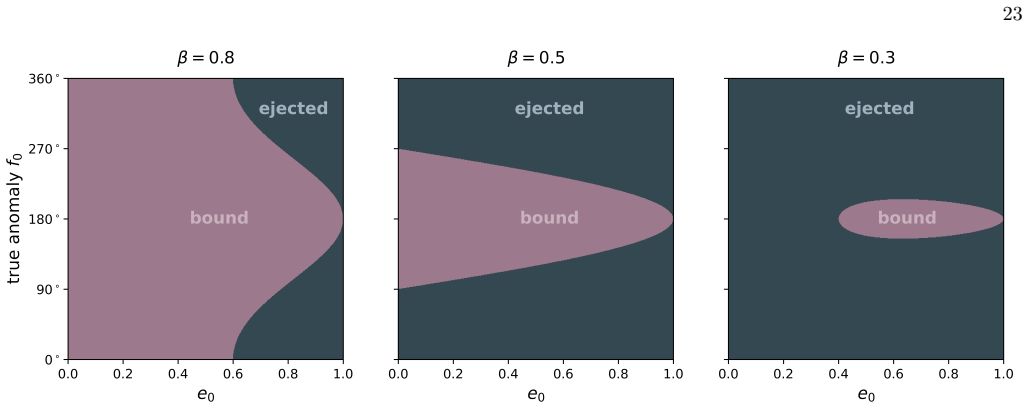
The organizing tools are a small set of dynamical quantities that separate ejection from other outcomes. The Safronov number, the ratio of a planet's escape velocity squared to the escape velocity from the host star at the planet's orbit, predicts whether close encounters tend to eject bodies or merge them; high-Safronov planets, especially wide-orbit Jovians, are the efficient ejectors. The angular momentum deficit measures how much non-circular, inclined orbital angular momentum a system carries, and systems above a critical value become unstable and scatter planets. For binary systems, empirical stability boundaries delimit the allowed circumstellar and circumbinary orbital radii. The mas
Load-bearing premise
The quantitative ranking of ejection mechanisms assumes planets actually form in the unstable orbital regions, such as circumbinary planets in binaries up to about 3 AU and circumstellar planets only in binaries wider than about 10 AU, and that planets extend out to about 30 AU; if formation is suppressed there, the claimed predominance changes.
What would settle it
Take a completeness-corrected microlensing sample of several hundred free-floating planets with measured parallaxes and hence velocities. If the excess-velocity distribution peaks well above about 6 km/s, or the mass function shows no turnover near 0.8 Earth masses, the claim that scattering and binary instabilities dominate would be falsified; a sample dominated by roughly 2-6 km/s objects with a bottom-heavy mass function would confirm it.
If this is right
- Most low-mass free-floating planets are former members of planetary systems, so their numbers imply that unstable orbital configurations are common outcomes of planet formation, not rare accidents.
- The mass function of ejected planets should be bottom-heavy: early instabilities preferentially eject the lowest-mass planets, while late secular instabilities preferentially remove the highest-mass planets from multi-giant systems.
- Measuring the velocity distribution of free-floating planets can identify the dominant ejection route, since scattering yields roughly 2-6 km/s excess velocities, circumbinary instabilities roughly 8-12 km/s, cluster encounters roughly 5-12 km/s, and supernova ejections roughly 18 km/s.
- Upcoming microlensing surveys, with hundreds of detections and parallax-based mass and velocity measurements, can test the predicted mass-function turnover near 0.8 Earth masses and distinguish truly unbound planets from wide-orbit bound planets.
- The solar system itself may carry the signature: a fifth giant planet ejected during instability, plus a population of ejected embryos, would fit the paper's claim that ejection is a normal stage of system evolution.
Where Pith is reading between the lines
- If ejection is as common as claimed, standard disk-mass estimates undercount the planet-forming mass budget, because many planets are removed wholesale; the mass needed to produce the free-floating census may require heavier early disks.
- The same dynamical logic extends to smaller bodies: with wide-orbit Neptune-mass planets common and efficient ejectors, interstellar objects should be dominated by icy bodies ejected from beyond the snow line, with velocity signatures mirroring the free-floating planet channels.
- A sharper test than average velocity is the joint mass-velocity distribution: scattering predicts a correlation between ejected planet mass and excess velocity that cluster and supernova channels do not, so a large microlensing sample could separate the components statistically.
- The assumption that planets form in unstable binary regions is directly checkable by imaging protoplanetary disks in binaries, measuring how often disks and planets appear at separations that would later trigger ejection.
Editorial analysis
A structured set of objections, weighed in public.
Referee Report
Summary. The manuscript is a comprehensive review of the dynamical mechanisms that can eject planets from their natal systems: planet-planet scattering, instabilities in binary/multi-star systems, stellar and planetary flybys (especially in clusters), and post-main-sequence stellar evolution. It presents the underlying theory (Safronov number, angular momentum deficit, stability criteria, mass-loss index), summarizes the empirical evidence for each channel, and concludes with a comparative Table 1 estimating the relative rates of free-floating planet (FFP) production. The central claim, stated in Sec. 7, is that planetary ejection is common and that planet-planet scattering, embedded cluster encounters, and binary instabilities are likely the predominant FFP production mechanisms, with post-main-sequence channels subdominant. The paper also discusses observational prospects (Roman, Earth 2.0) and the ambiguities in identifying true FFPs versus wide-orbit bound planets.
Significance. If the synthesis holds, the paper provides a valuable framework for interpreting existing and upcoming microlensing surveys and for guiding theoretical work on the initial conditions of planetary systems. Its strengths include the breadth of the literature synthesized, the clear exposition of the dynamical formalism (e.g., Eqs. 6-7, 10, 20-21, 31), updated demographic figures (Figs. 3-4), and an explicit, assumptions-stated Table 1 that can serve as a starting point for quantitative comparisons. The review also makes falsifiable predictions (e.g., FFP velocity distributions, mass-function features) that upcoming surveys can test. The main weakness is that the quantitative ranking in Table 1 rests on unvalidated assumptions about planet formation in dynamically unstable regions, which the manuscript itself acknowledges but still leverages in the headline conclusion.
major comments (2)
- [Table 1; Sec. 7] The headline claim that planet-planet scattering, embedded cluster encounters, and binary instabilities are 'likely predominant' (Sec. 7) is carried by Table 1, but the binary-instability rows are conditional upper bounds. As the manuscript states in Sec. 3.4, if planet formation is not ubiquitous in the unstable regions, 'the census... may be much lower,' and Sec. 6.1 notes that 'The true rate of initial planet formation in these unstable regions is not well-characterized.' The p-type and s-type rows (9% and 10% of stars, up to 100% ejection) assume planets form in binaries with separations up to 3 AU (p-type) or with ab ≥ 10 AU and ap/ab ≥ 0.1 (s-type). If formation in these zones is suppressed by disk truncation, photoevaporation, or dynamical stirring, both rows could fall far below the embedded-cluster or scattering rows, changing the ranking. As written, Sec. 7 overstates a conditi
- [Sec. 6.1] The derivation of the 9% and 10% values for binary-instability susceptibility depends on several unvalidated choices: adopting G. A. L. Coleman & W. DeRocco (2025) that p-type planets form around binaries with separations up to 3 AU; assuming s-type planets form only when ab ≳ 10 AU; taking ap,max = 30 AU; and extending the Offner et al. (2023) separation distributions to stellar mass ranges beyond direct constraints. These are reasonable for an order-of-magnitude estimate, but Table 1 reports ejection rates without propagated uncertainties or any sensitivity analysis. A factor-of-two change in any of these thresholds could alter the predominance ranking. I request either a sensitivity table or an explicit statement of how the relative rates depend on these assumptions, so the reader can judge the robustness of the central claim.
minor comments (5)
- [Table 1] Typo: 'T able 1' should be 'Table 1'.
- [Sec. 6.1] The sentence 'such that it is possible that all such systems eject one or more planetary companions' is ambiguous; it would be clearer to say that the upper bound corresponds to formation in all unstable systems, not that such a rate is established.
- [Sec. 2.4.3] Minor formatting: '30◦' should be written as '30°' or '30 degrees' with consistent spacing.
- [Sec. 3.4] Equation reference: 'C J >3.46' should be typeset as C_J > 3.46 with subscripts in math mode.
- [Sec. 5.7] Grammar: 'A. P. Stephan & K. G. Stassun (2026) finds' should be 'find' (the reference is plural).
Circularity Check
No significant circularity: the review's synthesis rests on independent simulation benchmarks and observational inputs, not on equations that reduce to their own assumptions.
full rationale
The paper is a review that synthesizes published dynamical simulations, analytic results, and observational surveys. The central claim that planetary ejection is common is independently grounded in the microlensing FFP mass function (Sumi et al. 2023) and in the extensive literature on scattering, binary instabilities, and cluster dynamics. The quantitative Table 1 is explicitly conditional: the text states, 'The true rate of initial planet formation in these unstable regions is not well-characterized, such that it is possible that all such systems eject one or more planetary companions,' and earlier it cautions that if planet formation is not ubiquitous in unstable regions, 'the census ... may be much lower.' No equation in the paper is defined in terms of a quantity it purports to predict. The only notable self-citations (e.g., Coleman & DeRocco 2025) are used as inputs or supporting simulation results, not as a substitute for derivation, and the same quantitative claims are also attributed to independent prior works. Therefore no circular step meets the standard of a specific reduction of a 'prediction' to an input by construction.
Axiom & Free-Parameter Ledger
free parameters (2)
- Binary separation thresholds for planet formation in unstable regions =
3 AU (p-type), 10 AU (s-type lower limit), 30 AU (max planet semi-major axis)
- Mass-radius scaling normalization =
not reported (scaled to match the exoplanet census in Figure 4)
axioms (4)
- ad hoc to paper Planets can form in the dynamically unstable regions assumed for each mechanism (e.g., p−type planets around binaries with ab ≤ 3 AU; s−type planets for ab ≳ 10 AU).
- domain assumption The FFP mass function of Sumi et al. (2023) is representative of the true population and the candidates are mostly unbound.
- domain assumption Binary companion fractions and separation distributions from Offner et al. (2023) and Raghavan et al. (2010) extend to the adopted mass ranges.
- standard math Standard Newtonian two-body and three-body dynamics.
read the original abstract
The ubiquity of free-floating planets inferred from microlensing and direct imaging surveys suggests that planetary ejection---a process in which planets initially born encircling a stellar host become gravitationally unbound---is common. Four overarching mechanisms have been proposed to induce planetary ejection: close approaches of neighboring planets, instabilities in binary or multi-star systems, stellar and planetary flybys, and post-main-sequence stellar evolution. Here we review the mechanisms underlying planetary ejection, as well as predictions derived from each. Current and upcoming microlensing surveys offer the potential to test existing models and distinguish between potential planetary ejection mechanisms, offering further insight into the demographic-level architectures of exoplanets across stellar environments.
Figures



Reference graph
Works this paper leans on
-
[1]
C., Hollenbach, D., Laughlin, G., & Gorti, U
Adams, F. C., Hollenbach, D., Laughlin, G., & Gorti, U. 2004, ApJ, 611, 360, doi: 10.1086/421989
doi:10.1086/421989 2004
-
[2]
Adams, F. C., & Laughlin, G. 2001, Icarus, 150, 151, doi: 10.1006/icar.2000.6567
arXiv 2001
-
[3]
Adams, F. C., & Laughlin, G. 2003, Icarus, 163, 290, doi: 10.1016/S0019-1035(03)00081-2
-
[4]
Adams, F. C., Proszkow, E. M., Fatuzzo, M., & Myers, P. C. 2006, ApJ, 641, 504, doi: 10.1086/500393
doi:10.1086/500393 2006
-
[5]
2019, arXiv e-prints, arXiv:1902.05569, doi: 10.48550/arXiv.1902.05569
Akeson, R., Armus, L., Bachelet, E., et al. 2019, arXiv e-prints, arXiv:1902.05569, doi: 10.48550/arXiv.1902.05569
-
[6]
Alvarado-Montes, J. A., Zuluaga, J. I., & Sucerquia, M. 2017, MNRAS, 471, 3019, doi: 10.1093/mnras/stx1745
-
[7]
2017, arXiv e-prints, arXiv:1702.00786, doi: 10.48550/arXiv.1702.00786
Amaro-Seoane, P., Audley, H., Babak, S., et al. 2017, arXiv e-prints, arXiv:1702.00786, doi: 10.48550/arXiv.1702.00786
-
[8]
M., Huang, J., P´ erez, L
Andrews, S. M., Huang, J., P´ erez, L. M., et al. 2018, ApJL, 869, L41
2018
-
[9]
Armitage, P. J. 2000, A&A, 362, 968, doi: 10.48550/arXiv.astro-ph/0007044
-
[10]
A., & Thorsett, S
Arzoumanian, Z., Joshi, K., Rasio, F. A., & Thorsett, S. E. 1996, in Astronomical Society of the Pacific Conference
1996
-
[11]
105, IAU Colloquium 160: Pulsars: Problems and Progress, ed
Series, Vol. 105, IAU Colloquium 160: Pulsars: Problems and Progress, ed. S. Johnston, M. A. Walker, & M. Bailes, 525–530, doi: 10.48550/arXiv.astro-ph/9605141 Astropy Collaboration, Robitaille, T. P., Tollerud, E. J., et al. 2013, A&A, 558, A33, doi: 10.1051/0004-6361/201322068 Astropy Collaboration, Price-Whelan, A. M., Lim, P. L., et al. 2022, ApJ, 935...
-
[12]
Bailer-Jones, C. A. L., Farnocchia, D., Meech, K. J., et al. 2018, AJ, 156, 205, doi: 10.3847/1538-3881/aae3eb
-
[13]
Bailer-Jones, C. A. L., Farnocchia, D., Ye, Q., Meech, K. J., & Micheli, M. 2020, A&A, 634, A14, doi: 10.1051/0004-6361/201937231
-
[14]
2019, AJ, 158, 94, doi: 10.3847/1538-3881/ab2d2a
Bailey, N., & Fabrycky, D. 2019, AJ, 158, 94, doi: 10.3847/1538-3881/ab2d2a
-
[15]
2014, ApJL, 780, L4, doi: 10.1088/2041-8205/780/1/L4
Bailey, V., Meshkat, T., Reiter, M., et al. 2014, ApJL, 780, L4, doi: 10.1088/2041-8205/780/1/L4
-
[16]
Barclay, T., Quintana, E. V., Raymond, S. N., & Penny, M. T. 2017, ApJ, 841, 86, doi: 10.3847/1538-4357/aa705b
-
[17]
2004, ApJ, 611, 494, doi: 10.1086/421321
Barnes, R., & Quinn, T. 2004, ApJ, 611, 494, doi: 10.1086/421321
doi:10.1086/421321 2004
-
[18]
Barnes, R., & Raymond, S. N. 2004, ApJ, 617, 569, doi: 10.1086/423419
doi:10.1086/423419 2004
-
[19]
2019, AJ, 158, 187, doi: 10.3847/1538-3881/ab4130
Baron, F., Lafreni` ere, D., Artigau,´E., et al. 2019, AJ, 158, 187, doi: 10.3847/1538-3881/ab4130
-
[20]
2021, MNRAS, 506, 6181, doi: 10.1093/mnras/stab1465
Urrutxua, H. 2021, MNRAS, 506, 6181, doi: 10.1093/mnras/stab1465
-
[21]
Batalha, N. M., Rowe, J. F., Bryson, S. T., et al. 2013, ApJS, 204, 24, doi: 10.1088/0067-0049/204/2/24
-
[22]
Batygin, K., & Brown, M. E. 2010, ApJ, 716, 1323, doi: 10.1088/0004-637X/716/2/1323
-
[23]
Batygin, K., Brown, M. E., & Betts, H. 2012, ApJL, 744, L3, doi: 10.1088/2041-8205/744/1/L3
-
[24]
1988a, Celestial Mechanics, 43, 47, doi: 10.1007/BF01234553 32
Benest, D. 1988a, Celestial Mechanics, 43, 47, doi: 10.1007/BF01234553 32
-
[25]
1993, Celestial Mechanics and Dynamical Astronomy, 56, 45, doi: 10.1007/BF00699718
Benest, D. 1993, Celestial Mechanics and Dynamical Astronomy, 56, 45, doi: 10.1007/BF00699718
-
[26]
Bhaskar, H. G., & Perets, H. B. 2025, The Astrophysical Journal, 991, 132, doi: 10.3847/1538-4357/adf4e2
-
[27]
Black, D. C. 1982, AJ, 87, 1333, doi: 10.1086/113220
doi:10.1086/113220 1982
-
[28]
Bohn, A. J., Kenworthy, M. A., Ginski, C., et al. 2020, ApJL, 898, L16, doi: 10.3847/2041-8213/aba27e
-
[29]
Bohn, A. J., Ginski, C., Kenworthy, M. A., et al. 2021, A&A, 648, A73, doi: 10.1051/0004-6361/202140508
-
[30]
Boley, A. C., Payne, M. J., & Ford, E. B. 2012, ApJ, 754, 57, doi: 10.1088/0004-637X/754/1/57
-
[31]
Boley, K. M., Christiansen, J. L., Zink, J., et al. 2024, AJ, 168, 128, doi: 10.3847/1538-3881/ad6570
-
[32]
T., Belyakov, M., Fremling, C., et al
Bolin, B. T., Belyakov, M., Fremling, C., et al. 2025, MNRAS, 542, L139, doi: 10.1093/mnrasl/slaf078
-
[33]
Bolmont, E., Galantay, E., Blanco-Cuaresma, S., Oza, A. V., & Mordasini, C. 2025, A&A, 704, A9, doi: 10.1051/0004-6361/202554625
-
[35]
Bonomo, A. S., H´ ebrard, G., Raymond, S. N., et al. 2017, A&A, 603, A43, doi: 10.1051/0004-6361/201730624
-
[36]
T., Sato, H., et al
Borisov, G., Durig, D. T., Sato, H., et al. 2019, Comet C/2019 Q4 (Borisov),, Central Bureau Electronic
2019
-
[37]
J., Koch, D., Basri, G., et al
Borucki, W. J., Koch, D., Basri, G., et al. 2010, Science, 327, 977
2010
-
[38]
Borucki, W. J., Koch, D. G., Basri, G., et al. 2011, ApJ, 736, 19, doi: 10.1088/0004-637X/736/1/19
-
[39]
2026, A&A, 708, A218, doi: 10.1051/0004-6361/202555031
Bouy, H., Duchˆ ene, G., Strampelli, G., et al. 2026, A&A, 708, A218, doi: 10.1051/0004-6361/202555031
-
[40]
Bowler, B. P. 2016, PASP, 128, 102001, doi: 10.1088/1538-3873/128/968/102001
-
[41]
Brasil, P. I. O., Roig, F., Nesvorn´ y, D., et al. 2016, Icarus, 266, 142, doi: 10.1016/j.icarus.2015.11.015
-
[42]
Brodie, J. P., & Strader, J. 2006, ARA&A, 44, 193, doi: 10.1146/annurev.astro.44.051905.092441
arXiv 2006
-
[43]
2025, The Open Journal of Astrophysics, 8, E161, doi: 10.33232/001c.146688
Brown, G., Malhotra, R., & Rein, H. 2025, The Open Journal of Astrophysics, 8, E161, doi: 10.33232/001c.146688
-
[44]
2022, MNRAS, 515, 5942, doi: 10.1093/mnras/stac1763
Brown, G., & Rein, H. 2022, MNRAS, 515, 5942, doi: 10.1093/mnras/stac1763
-
[45]
2014, A&A, 561, L9, doi: 10.1051/0004-6361/201322584
Brucalassi, A., Pasquini, L., Saglia, R., et al. 2014, A&A, 561, L9, doi: 10.1051/0004-6361/201322584
-
[46]
2018, A&A, 619, A91, doi: 10.1051/0004-6361/201833097
Busetti, F., Beust, H., & Harley, C. 2018, A&A, 619, A91, doi: 10.1051/0004-6361/201833097
-
[47]
Cai, M. X., Kouwenhoven, M. B. N., Portegies Zwart, S. F., & Spurzem, R. 2017, MNRAS, 470, 4337, doi: 10.1093/mnras/stx1464
-
[48]
X., Portegies Zwart, S., & van Elteren, A
Cai, M. X., Portegies Zwart, S., & van Elteren, A. 2018, MNRAS, 474, 5114, doi: 10.1093/mnras/stx3064 ´Calovi´ c, A., Nayakshin, S., Casewell, S., & Miret-Roig, N. 2026, MNRAS, 545, staf2097, doi: 10.1093/mnras/staf2097
-
[49]
Carrera, D., Raymond, S. N., & Davies, M. B. 2019, A&A, 629, L7, doi: 10.1051/0004-6361/201935744
-
[50]
Chambers, J. E. 2001, Icarus, 152, 205, doi: 10.1006/icar.2001.6639
arXiv 2001
-
[51]
Chambers, J. E., Wetherill, G. W., & Boss, A. P. 1996, Icarus, 119, 261, doi: 10.1006/icar.1996.0019
arXiv 1996
-
[52]
Chatterjee, S., Ford, E. B., Geller, A. M., & Rasio, F. A. 2012, MNRAS, 427, 1587, doi: 10.1111/j.1365-2966.2012.22057.x
arXiv 2012
-
[53]
B., Matsumura, S., & Rasio, F
Chatterjee, S., Ford, E. B., Matsumura, S., & Rasio, F. A. 2008, ApJ, 686, 580
2008
-
[54]
2017, ApJ, 834, 17, doi: 10.3847/1538-4357/834/1/17
Chen, J., & Kipping, D. 2017, ApJ, 834, 17, doi: 10.3847/1538-4357/834/1/17
-
[55]
2013, MNRAS, 431, 3444, doi: 10.1093/mnras/stt424
Chiang, E., & Laughlin, G. 2013, MNRAS, 431, 3444, doi: 10.1093/mnras/stt424
-
[56]
Chirikov, B. V. 1979, PhR, 52, 263, doi: 10.1016/0370-1573(79)90023-1
-
[57]
2026, arXiv e-prints, arXiv:2604.05035, doi: 10.48550/arXiv.2604.05035
Choksi, N., Lithwick, Y., Chiang, E., & Li, R. 2026, arXiv e-prints, arXiv:2604.05035, doi: 10.48550/arXiv.2604.05035
-
[58]
Christiansen, J. L., McElroy, D. L., Harbut, M., et al. 2025, PSJ, 6, 186, doi: 10.3847/PSJ/ade3c2
-
[59]
Clanton, C., & Gaudi, B. S. 2014, ApJ, 791, 90, doi: 10.1088/0004-637X/791/2/90
-
[60]
Clanton, C., & Gaudi, B. S. 2016, ApJ, 819, 125, doi: 10.3847/0004-637X/819/2/125
-
[61]
Clarke, C. J., & Pringle, J. E. 1993, MNRAS, 261, 190, doi: 10.1093/mnras/261.1.190
-
[62]
Clement, M. S., Deienno, R., Kaib, N. A., et al. 2021a, Icarus, 367, 114556, doi: 10.1016/j.icarus.2021.114556
arXiv 2021
-
[63]
Clement, M. S., Kaib, N. A., Raymond, S. N., & Walsh, K. J. 2018, Icarus, 311, 340, doi: 10.1016/j.icarus.2018.04.008
-
[64]
Clement, M. S., Raymond, S. N., Kaib, N. A., et al. 2021b, Icarus, 355, 114122, doi: 10.1016/j.icarus.2020.114122
arXiv 2020
-
[65]
2015, ApJ, 813, 8, doi: 10.1088/0004-637X/813/1/8
Cloutier, R., Tamayo, D., & Valencia, D. 2015, ApJ, 813, 8, doi: 10.1088/0004-637X/813/1/8
-
[66]
Coleman, G. A. L. 2024, Monthly Notices of the Royal Astronomical Society, 530, 630, doi: 10.1093/mnras/stae903 33
-
[67]
Coleman, G. A. L., & DeRocco, W. 2025, Monthly Notices of the Royal Astronomical Society, 537, 2303, doi: 10.1093/mnras/staf138
-
[68]
Correa-Otto, J. A., & Gil-Hutton, R. A. 2017, A&A, 608, A116, doi: 10.1051/0004-6361/201731229
-
[69]
Craig, J., & Krumholz, M. R. 2013, ApJ, 769, 150, doi: 10.1088/0004-637X/769/2/150
-
[70]
Cresswell, P., & Nelson, R. P. 2006, A&A, 450, 833, doi: 10.1051/0004-6361:20054551
-
[71]
Cuello, N., M´ enard, F., & Price, D. J. 2023, European Physical Journal Plus, 138, 11, doi: 10.1140/epjp/s13360-022-03602-w
-
[72]
2020, MNRAS, 491, 504, doi: 10.1093/mnras/stz2938 ´Cuk, M
Cuello, N., Louvet, F., Mentiplay, D., et al. 2020, MNRAS, 491, 504, doi: 10.1093/mnras/stz2938 ´Cuk, M. 2018, ApJ, 852, L15, doi: 10.3847/2041-8213/aaa3db
-
[73]
Cumming, A., Butler, R. P., Marcy, G. W., et al. 2008, PASP, 120, 531, doi: 10.1086/588487
doi:10.1086/588487 2008
-
[74]
Daffern-Powell, E. C., & Parker, R. J. 2022, MNRAS, 517, 2103, doi: 10.1093/mnras/stac2797
-
[75]
2024, AJ, 168, 239, doi: 10.3847/1538-3881/ad83a6
Dai, F., Goldberg, M., Batygin, K., et al. 2024, AJ, 168, 239, doi: 10.3847/1538-3881/ad83a6
-
[76]
David, E.-M., Quintana, E. V., Fatuzzo, M., & Adams, F. C. 2003, PASP, 115, 825, doi: 10.1086/376395
doi:10.1086/376395 2003
-
[77]
Davies, M. B., Adams, F. C., Armitage, P., et al. 2014, in Protostars and Planets VI, ed. H. Beuther, R. S. Klessen, C. P. Dullemond, & T. Henning, 787–808, doi: 10.2458/azu uapress 9780816531240-ch034
doi:10.2458/azu 2014
-
[79]
Debes, J. H., & Sigurdsson, S. 2002, The Astrophysical Journal, 572, 556, doi: 10.1086/340291
doi:10.1086/340291 2002
-
[80]
Debes, J. H., & Sigurdsson, S. 2007, ApJL, 668, L167, doi: 10.1086/523103
doi:10.1086/523103 2007
-
[81]
Deienno, R., Morbidelli, A., Gomes, R. S., & Nesvorn´ y, D. 2017, AJ, 153, 153, doi: 10.3847/1538-3881/aa5eaa
-
[82]
2014, AJ, 148, 25, doi: 10.1088/0004-6256/148/2/25
Deienno, R., Nesvorn´ y, D., Vokrouhlick´ y, D., & Yokoyama, T. 2014, AJ, 148, 25, doi: 10.1088/0004-6256/148/2/25
discussion (0)
Sign in with ORCID, Apple, or X to comment. Anyone can read and Pith papers without signing in.