REVIEW 1 major objections 6 minor 28 references
Stochastic background of gravitational waves from cosmic-rays
T0 review · 1 major / 6 minor · reviewed 2026-08-07 · deepseek-v4-flash
Pith's one-line read Cosmic rays spiraling in galactic magnetic fields produce a gravitational-wave background whose energy density peaks at a few millihertz, far too weak to detect but with a shape set by the cosmic-ray spectrum.
desk verdict A clean completeness calculation of a new SGWB source — tiny amplitude, plausible mHz peak — that should be refereed, with one requested spectrum-shape check. read the letter →
The pith
A machine-rendered reading of the paper's core claim, the machinery that carries it, and where it could break.
The reading
What carries the argument
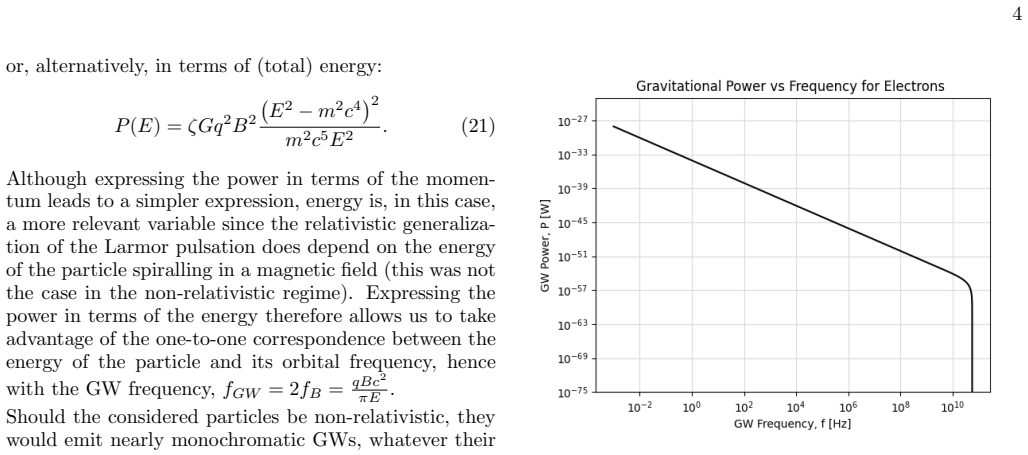
The key machinery is the phenomenological power formula P ≈ ζ G c $m^{2}$ $β^{6}$ $γ^{4}$ / $R^{2}$ with ζ ≈ 5, which matches both the non-relativistic result (scaling as $β^{6}$) and the ultra-relativistic result (scaling as $γ^{4}$), combined with the assumption that each particle radiates all its gravitational power at the single frequency f_GW = $qBc^{2}$/(πE), twice the orbital frequency. This frequency mapping, together with the measured interstellar cosmic-ray spectra (rewritten as functions of frequency), allows a direct convolution to produce the background Ω(f).
What would settle it
Recompute the background using the full gravitational synchrotron spectrum of Eq. (16) instead of the monochromatic approximation, and compare the resulting Ω(f) peak with the claimed 5 mHz for electrons and 2 mHz for protons; if the peak moves by more than a factor of a few, the central claim fails. A second falsifier would be a future detector with sensitivity around $10^{-47}$ J $m^{-2}$ in the mHz band, which could either find the predicted background or rule it out.
Extended reading notes
Core claim
The central claim is that the stochastic gravitational-wave background from Galactic cosmic rays has a computable, non-trivial spectral shape with a maximum around a few millihertz, about 5 mHz for electrons and 2 mHz for protons, arising from the convolution of the single-particle gravitational radiation power with the cosmic-ray number density per unit frequency. The amplitude is extremely small, with power flux in the range $10^{-47}$ J $m^{-2}$ for electrons and $10^{-50}$ J $m^{-2}$ for protons, so it is not a measurable signal; the interest lies in the fact that a well-established physical process produces a background with a distinctive peak in a band that future space-based interferometers will explore.
Load-bearing premise
The predicted peak frequency and shape of the background depend on the approximate formula for the radiated power that blends the slow and fast limits with a single coefficient, and on the simplification that each particle radiates all its gravitational power at exactly twice its orbital frequency.
Editorial extensions
If this is right
- The Galactic cosmic-ray background has a peak in the mHz range, overlapping the most sensitive band of LISA, but with an amplitude many orders of magnitude below the instrument's reach.
- The shape of Ω(f) is determined by the convolution of the cosmic-ray spectrum with the radiated power, so future precise cosmic-ray measurements could in principle be cross-checked against the predicted gravitational-wave spectrum.
- The extra-galactic component, though extremely small, acquires a redshift-smeared cutoff and is essentially isotropic; its shape near the cutoff differs from the Galactic one.
- For ultra-heavy charged particles with mass above about 6.8×10^-10 kg, gravitational synchrotron power would exceed electromagnetic synchrotron power at relativistic speeds.
- The strain amplitude of a single particle depends only on its speed, not on the magnetic field strength, a counterintuitive feature of the emission.
Reading between the lines
- The monochromatic approximation, which places all radiation at twice the orbital frequency, could be replaced by the full spectrum of Eq. (16); if the true spectrum is broad, the peak of Ω(f) might be slightly wider or shifted, so the exact peak frequency is tied to that approximation.
- The same formalism could be applied to other galaxies; if their cosmic-ray spectra and magnetic fields differ, the extra-galactic background might have a different effective peak, and the 'typical galaxy' assumption could be relaxed.
- The ratio of gravitational to electromagnetic power for a charged particle in a magnetic field could, in principle, be used to search for new ultra-heavy charged particles, since gravitational-wave emission would dominate for masses above roughly 10^-10 kg.
- Although undetectable today, this background is a guaranteed foreground for any future detector with sensitivity better than about 10^-47 J m^-2 in the mHz band; computing it removes a potential confusion source for such instruments.
Editorial analysis
A structured set of objections, weighed in public.
Referee Report
Summary. This manuscript investigates gravitational radiation emitted by cosmic-ray electrons and protons spiraling in a uniform magnetic field. It derives the non-relativistic and ultra-relativistic power formulas for a charged particle, proposes a phenomenological interpolation P ≈ ζ G c m² β⁶ γ⁴ / R² with ζ ≈ 5, replaces the gravitational-wave spectrum by a monochromatic line at f_GW = qBc²/(πE), and convolves the result with galactic and extra-galactic cosmic-ray spectra. The resulting stochastic background Ω(f) is found to peak at ≈5 mHz for electrons and ≈2 mHz for protons, within the LISA band but with amplitudes far below any foreseeable sensitivity. The paper also provides a pedagogical comparison with electromagnetic synchrotron radiation and emphasizes that the signal is a guaranteed but unobservable background.
Significance. If the monochromatic-spectrum approximation is valid, the paper identifies a new, physically guaranteed stochastic gravitational-wave background from known astrophysical populations, with a non-trivial spectral shape that happens to peak in the LISA band. The manuscript is honest about its limitations (constant B, uniform CR density, isotropic emission, alternative spectral views) and is clearly written. It provides explicit analytic formulas that can be checked and reused, and it correctly stresses that measurable predictions are not the only purpose of a calculation. The main claim, however, hinges on a delta-function replacement of the actual gravitational-wave spectrum (Eq. (16)), and the paper does not quantify the error introduced by that replacement; this should be addressed before the peak frequencies can be considered robust.
major comments (1)
- [Section III, Eqs. (16)-(22); Section VI, Eq. (28)] The peak frequency and shape of Ω(f), which are the paper's central claims, are obtained by assuming that all gravitational power of a particle of energy E is emitted at the single frequency f_GW = qBc²/(πE). The justification given is that the spectrum of Eq. (16) is "monotonically decreasing ... and thus dominated by the fundamental mode". This inference is not demonstrated quantitatively. For the electrons that dominate the peak (E ≈ 3.4 GeV, γ ≈ 6.7×10³), the characteristic frequency in Eq. (16) is ω_c = γ³ω_B ≈ 3×10¹¹ ω_B, so "dominated by the fundamental" must mean an enormous suppression of the high-frequency tail; a spectrum that is merely monotonically decreasing could still have most of its power at frequencies far above the fundamental. I ask the authors to quantify, using Eq. (16) or an equivalent published result, the fraction of the total power radiated within a logarithmic interval around the fundamental for the energies that determine the peak, and to state how f_peak and the shape of Ω(f) change when the exact spectral distribution is used instead of the delta-function approximation. The existence of an alternative viewpoint (Refs. [26,27]) makes this check essential. Without it, the headline "maximum around a few mHz" is not yet established.
minor comments (6)
- [Section II] The sentence "f_GW = 4πωB" is dimensionally inconsistent and contradicts the later definition f_GW = qBc²/(πE). Since ω_B is an angular frequency, the correct GW frequency is f_GW = ω_B/π (equivalently ω_GW = 2ω_B).
- [Section V, Eq. (27)] The Jacobian relation as written, d f = qBc²/(2π f²) dE, is not consistent with f_GW = qBc²/(πE); differentiating that mapping gives dE/df = qBc²/(π f²). The factor 2 and the direction of the relation should be corrected, and the text should clarify whether f in this equation denotes the GW frequency or the orbital frequency f_B = f_GW/2.
- [Section III, Eqs. (16)-(17)] Eq. (16) uses Φ₂(y) before it is defined in Eq. (17), and the brackets "3x−1/3" appear garbled. Please reorder the equations and typeset the Airy-function terms unambiguously.
- [Section VI, Eq. (28) and Eq. (29)] The paper should specify the value of R_max used for the galactic component, and it should state explicitly how the flux dP/dSdf of Eq. (28) is converted into the energy density ρ used in Eq. (29), including the appropriate geometric factor (e.g., 1/c versus 4π/c for an isotropic background).
- [Section V, Eqs. (25)-(26)] The proton parametrization is said to differ from that in Ref. [23], but no reference or derivation is given for the modified form; please provide one.
- [Throughout] There are several typographical errors, including "inflationnary" (Introduction), "synchroton" (Conclusion), and "AKNOWLEDGEMENTS" (Section IX).
Circularity Check
No significant circularity: the Ω(f) background is an independent convolution of empirical cosmic-ray spectra with a theoretically motivated single-particle gravitational-wave power.
full rationale
The derivation chain is self-contained: single-particle GW power in the NR and UR limits is taken from standard results (Eqs. (5) and (14)), interpolated by the phenomenological Eq. (19) with ζ≈5, and then convolved with interstellar cosmic-ray spectra (Eqs. (25) and (26)) via Eq. (28) to obtain the GW power flux and finally Ω(f) via Eq. (29). The only parameters that could look fitted are ζ in Eq. (19) and the monochromatic-emission assumption. ζ is a multiplicative constant calibrated to the two known limiting coefficients (32/5 and 39/8); it scales the overall amplitude but does not affect the location of the Ω(f) peak or its shape, which are the paper's headline claims. The monochromatic-emission ansatz is presented as an approximation based on the monotonically decreasing spectrum from external references [16–18], and the paper explicitly acknowledges in the conclusion that an alternative viewpoint exists in [26,27]. No load-bearing step reduces to the target result by construction, no fitted parameter is renamed as a prediction, and no load-bearing self-citation appears in the argument. The calculation is therefore not circular, though its physical accuracy depends on the validity of the single-frequency and interpolation approximations.
Assumptions & free parameters
free parameters (2)
- zeta (phenomenological interpolation coefficient) =
approximately 5
- Galactic magnetic field amplitude B_gal =
6 microG (6e-10 T)
assumptions (6)
- domain assumption The standard quadrupole formula remains valid for a charged particle in an external magnetic field even though the system is not isolated.
- domain assumption The ultra-relativistic gravitational synchrotron power and spectrum from Pustovoit-Gertsenshtein (Ref. [13]) and Chen (Ref. [16]) are correct.
- domain assumption All gravitational wave power is radiated at the single frequency f_GW = qBc^2/(pi E), because the synchrotron spectrum is monotonically decreasing and dominated by the fundamental mode.
- domain assumption The galactic magnetic field can be approximated as constant in amplitude (6 microG) with statistically isotropic emission.
- domain assumption The interstellar cosmic-ray fluxes are accurately described by Eqs. (25)-(26), based on GALPROP fits to VOYAGER/AMS/BESS/PAMELA data.
- domain assumption For the extra-galactic component, the Milky Way is a typical galaxy and the galaxy distribution is homogeneous on large scales.
Cite this review
Pith. "Pith review of Stochastic background of gravitational waves from cosmic-rays." pith.science (2026). https://pith.science/paper/BHGVJII5
@misc{pith2026250613237,
  author       = {Pith},
  title        = {Pith review of: Stochastic background of gravitational waves from cosmic-rays},
  year         = {2026},
  howpublished = {\url{https://pith.science/paper/BHGVJII5}},
  note         = {Machine review of arXiv:2506.13237}
}
read the original abstract
Cosmic-rays are charged particles moving in magnetic fields. They not only emit well-known synchrotron photons but also gravitational radiation. We clarify the characteristics of the gravitational wave signal in this specific situation and underline some unexpected features. A phenomenological approximation for the radiated power is given. We derive the shape and peaking frequency of the associated stochastic backgrounds of gravitational waves for both electrons and protons, either of galactic or extra-galactic origin.
Figures


Figures from the paper (3 more)


Reference graph
Works this paper leans on
- [13]
- [16]
-
[15]
to investigate the GW generation in storage rings of accelerators, where theγdependence is incorrect. When comparing different expressions one should be careful at identifying which quantities are fixed. In our case, the magnetic field is fixed and the radius of curvature obviously depends on the energy, or speed, of the con- sidered particle. The emitted...
-
[1]
On the analogies between gravitational and electromagnetic radiative energy
H. Gomes and C. Rovelli,On the analogies between grav- itational and electromagnetic radiative energy(2023), 2303.14064
work page Pith review arXiv 2023
- [2]
-
[3]
R. Abbott et al. (LIGO Scientific, Virgo), Phys. Rev. X 11, 021053 (2021), 2010.14527
arXiv 2021
-
[4]
R. Abbott et al. (LIGO Scientific, VIRGO, KAGRA), GWTC-3: Compact Binary Coalescences Observed by LIGO and Virgo During the Second Part of the Third Observing Run(2021), 2111.03606
arXiv 2021
- [5]
Show all 28 references
-
[6]
Badaracco (ET), Nuovo Cim
F. Badaracco (ET), Nuovo Cim. C47, 66 (2024)
2024
- [7]
-
[8]
Berlin, D
A. Berlin, D. Blas, R. Tito D’Agnolo, S. A. R. Ellis, R. Harnik, Y. Kahn, and J. Sch¨ utte-Engel, Phys. Rev. D 105, 116011 (2022), 2112.11465
2022 arXiv
-
[9]
Berlin, D
A. Berlin, D. Blas, R. Tito D’Agnolo, S. A. R. Ellis, R. Harnik, Y. Kahn, J. Sch¨ utte-Engel, and M. Wentzel, Phys. Rev. D108, 084058 (2023), 2303.01518
2023 arXiv
-
[10]
Vacalis, G
G. Vacalis, G. Marocco, J. Bamber, R. Bingham, and 9 G. Gregori, Class. Quant. Grav.40, 155006 (2023), 2301.08163
2023 arXiv
-
[11]
Maggiore,Gravitational Waves
M. Maggiore,Gravitational Waves. Vol. 1: Theory and Experiments(Oxford University Press, 2007), ISBN 978- 0-19-171766-6, 978-0-19-852074-0
2007
-
[12]
gravitational synchrotron radia- tion
– leads to the two polarisations 1: h+(t) = 4mR2ω2 B r G c4 1 + cos2(θ) 2 cos(2ωBt),(1) h×(t) = 4mR2ω2 B r G c4 cos(θ) sin(2ωBt),(2) whereθis the angle between the axis of orbit and an observer located at a distancerfrom the source, mis the mass of the particle, andRis the rad...
2025 arXiv
-
[14]
Blanchet, Comptes Rendus Physique20, 507 (2019), 1902.09801
L. Blanchet, Comptes Rendus Physique20, 507 (2019), 1902.09801
2019 arXiv
-
[17]
Diambrini Palazzi and D
G. Diambrini Palazzi and D. Fargion, Phys. Lett. B197, 302 (1987)
1987
- [18]
-
[19]
V. R. Khalilov, Y. M. Loskutov, A. A. Sokolov, and I. M. Ternov, Phys. Lett. A42, 43 (1972)
1972
-
[20]
A. N. Aliev, D. V. Galtsov, and A. A. Sokolov, Moscow Univ. Phys. Bull.35, 9 (1980)
1980
-
[21]
D. M. Chitre and R. H. Price, Phys. Rev. Lett.29, 185 (1972)
1972
-
[22]
R. A. Breuer, R. Ruffini, J. Tiomno, and C. V. Vishvesh- wara, Phys. Rev. D7, 1002 (1973), URLhttps://link. aps.org/doi/10.1103/PhysRevD.7.1002
1973 doi
-
[23]
I. M. Ternov, V. R. Khalilov, G. A. Chizhov, and I. I. Maglevannyi, Zh. Eksp. Teor. Fiz.68, 377 (1975)
1975
-
[24]
Ghelfi, F
A. Ghelfi, F. Barao, L. Derome, and D. Maurin, Astron. Astrophys.591, A94 (2016), [Erratum: As- tron.Astrophys. 605, C2 (2017)], 1511.08650
2016 arXiv
-
[25]
Bisschoff, M
D. Bisschoff, M. S. Potgieter, and O. P. M. Aslam, As- trophys. J.878, 59 (2019), 1902.10438
2019 arXiv
-
[26]
Beck, Scholarpedia2, 2411 (2007), revision #200663
R. Beck, Scholarpedia2, 2411 (2007), revision #200663
2007
- [27]
-
[29]
Sokolov, D
A. Sokolov, D. Galtsov, and V. Petukhov, Physics Letters A68, 1 (1978), ISSN 0375-9601, URL https://www.sciencedirect.com/science/article/ pii/0375960178907375
1978
Reviewed August 7, 2026 · model on record in the stance chip above.
Discussion (0). Sign in to comment.