Generalized deformation potential and machine-learning approaches for electron-phonon coupling and thermoelectric transport in semiconductors
Pith reviewed 2026-06-26 20:06 UTC · model grok-4.3
The pith
Two inexpensive methods using few first-principles matrix elements accurately compute thermoelectric transport in 2D MoS2.
A machine-rendered reading of the paper's core claim, the machinery that carries it, and where it could break.
Core claim
The generalized acoustic deformation potential model for arbitrary symmetries and the machine-learning interpolation of electron-phonon matrix elements, each derived from a small number of first-principles calculations, produce thermoelectric transport properties for two-dimensional MoS2 that agree closely with state-of-the-art first-principles computations and with experiments.
What carries the argument
Generalized acoustic deformation potential model and machine-learning interpolation of electron-phonon matrix elements from limited first-principles data.
If this is right
- Thermoelectric transport coefficients become accessible at substantially reduced computational cost for semiconductors.
- The deformation potential model supplies an explicit formulation valid for any crystal symmetry and band-extrema location.
- Machine-learning interpolation yields higher accuracy and simpler implementation than the model-based approach.
- Both methods reproduce experimental thermoelectric data for monolayer MoS2.
- The techniques apply directly to other two-dimensional materials where full calculations remain expensive.
Where Pith is reading between the lines
- The methods could accelerate high-throughput computational searches for new thermoelectric semiconductors.
- Machine-learning interpolation might extend to other carrier-scattering processes beyond electron-phonon coupling.
- Validation on bulk three-dimensional compounds would test whether the same limited-data strategy holds outside two-dimensional systems.
- Coupling these approaches with device-level simulations could lower the barrier to predicting performance in thermoelectric generators.
Load-bearing premise
Parameters fitted or interpolated from only about ten or one hundred first-principles matrix elements per band and mode can capture the full momentum dependence of electron-phonon coupling across the Brillouin zone.
What would settle it
A complete first-principles calculation of all electron-phonon matrix elements for a different semiconductor, followed by comparison showing that the modeled or interpolated transport coefficients deviate substantially from the full result.
Figures
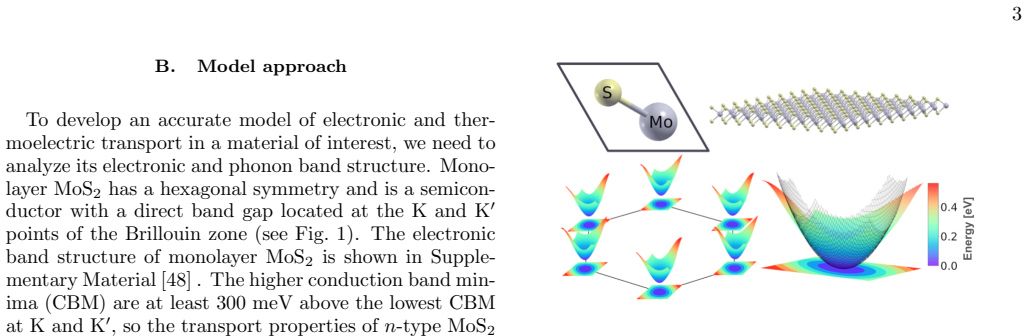
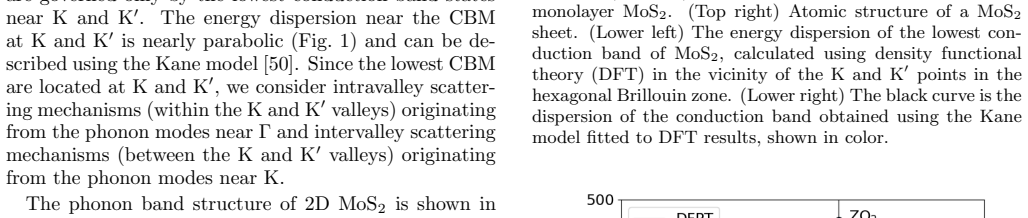
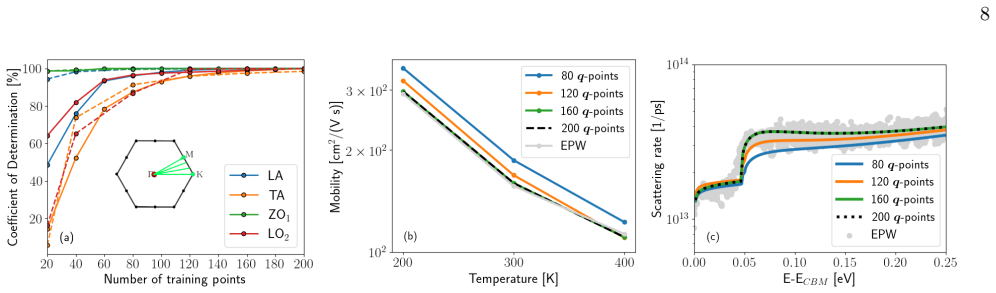
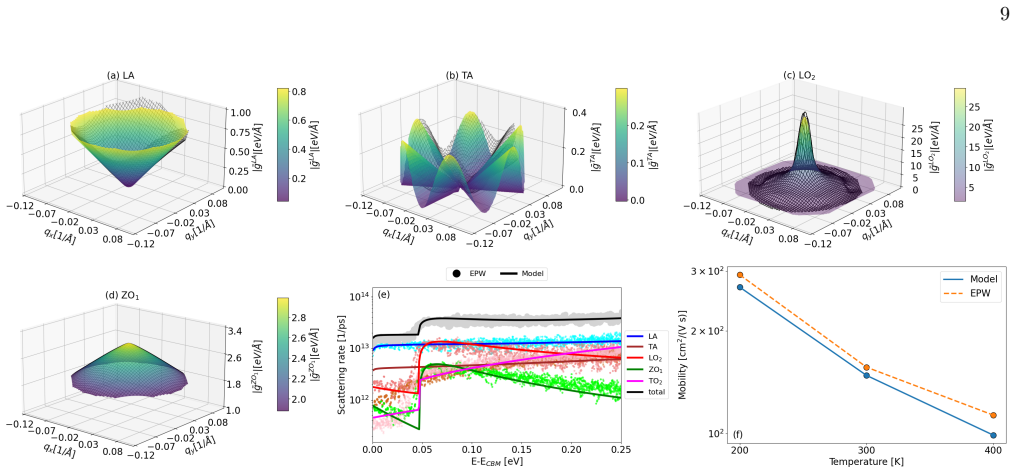
read the original abstract
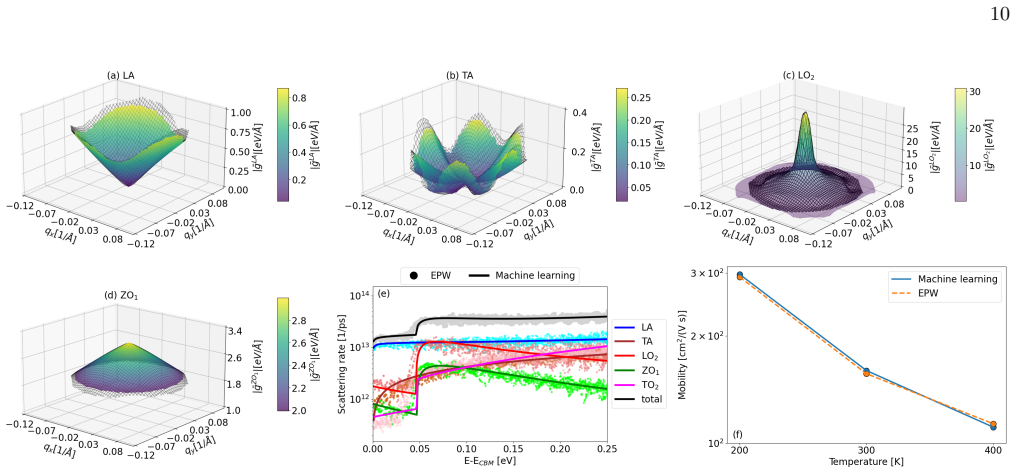
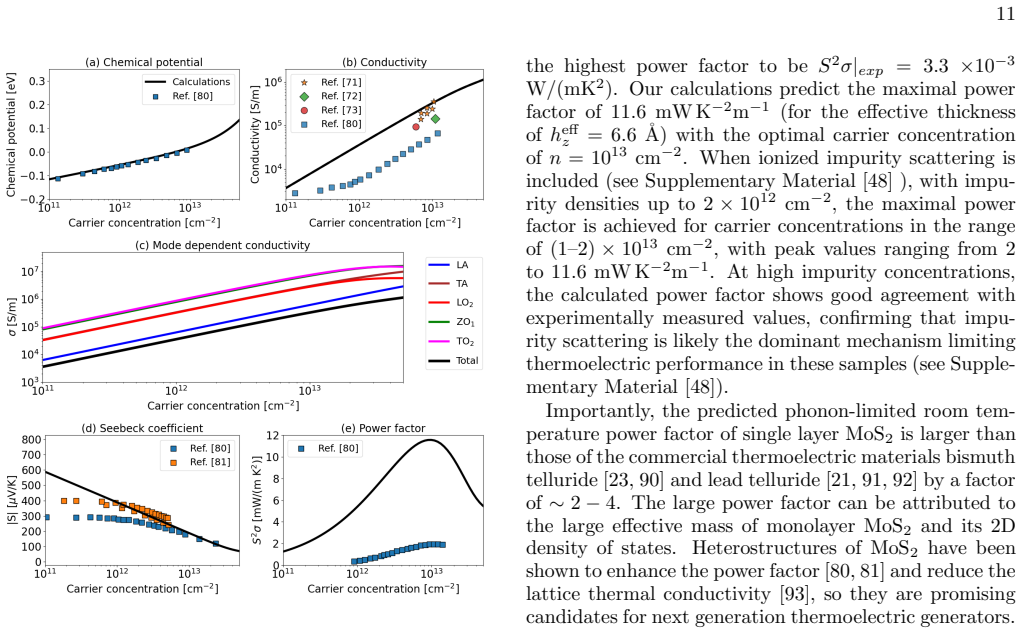
The ability to compute electron-phonon coupling from first principles, using density functional perturbation theory and interpolation techniques, has enabled predictive calculations of electronic transport coefficients in crystalline materials. However, these methods are still computationally expensive. Here we present two inexpensive methods to obtain thermoelectric transport properties of semiconductors using a small number of electron-phonon matrix elements calculated from first principles. The first method combines models for coupling of electrons with different phonon modes whose parameters are obtained from $\sim 10$ matrix elements per electronic band and phonon mode calculated from first principles. Within this method, we formulate the acoustic deformation potential model for arbitrary crystal symmetries and band extrema locations. The second method uses machine learning to interpolate $\sim 100$ electron-phonon matrix elements per electronic band and phonon mode on dense reciprocal space grids in the parts of the Brillouin zone relevant for transport. We apply both methods to two-dimensional MoS$_2$ and show very good agreement with the state-of-the-art method. The calculated thermoelectric properties also agree well with experiments. We find that the machine-learning method is more accurate and straightforward to implement compared to the model approach.
Editorial analysis
A structured set of objections, weighed in public.
Referee Report
Summary. The paper claims that two inexpensive methods—a generalized deformation potential model fitted to ~10 first-principles electron-phonon matrix elements per band/mode and a machine-learning interpolant using ~100 such elements—can compute thermoelectric transport properties in semiconductors. Applied to 2D MoS2, both methods are reported to produce results in very good agreement with full DFPT calculations and with experiment.
Significance. If the accuracy holds beyond the single material studied, the approaches would meaningfully reduce the cost of predictive electron-phonon transport calculations, enabling broader materials screening. The generalization of the acoustic deformation potential to arbitrary crystal symmetries and valley locations is a clear methodological contribution.
major comments (3)
- [Results for MoS2] Results section on MoS2: the claim of 'very good agreement' with the reference DFPT method is not supported by any quantitative error metrics (relative errors on mobility, Seebeck coefficient, or power factor), details on the size or composition of the validation set, or checks against post-hoc parameter choices. Without these, it is impossible to judge whether the integrated transport quantities are reliable.
- [Generalized deformation potential model] Generalized deformation potential model: the functional form plus the use of only ~10 matrix elements per band/mode implicitly assumes that |g(k,q)| is sufficiently smooth or low-rank to be constrained by such sparse sampling. In 2D MoS2 this is non-obvious because of possible non-analyticities at small q and intervalley processes; the manuscript should show direct comparison of model-predicted matrix elements at unsampled (k,q) points against full DFPT values.
- [Machine learning interpolation] Machine-learning interpolation: with only ~100 training points per band/mode, the method's ability to recover the full Brillouin-zone dependence needed for the transport integrals is not demonstrated by any convergence test with respect to the number of input elements or by error maps of the interpolated |g(k,q)|. Such a test is required to substantiate that the integrated scattering rates remain accurate.
minor comments (2)
- [Abstract] The abstract would be strengthened by stating the numerical level of agreement (e.g., 'within 10% of DFPT') rather than the qualitative phrase 'very good agreement'.
- [Methods] Notation for the electron-phonon matrix elements g_mn u(k,q) should be defined once at first use and used consistently thereafter.
Simulated Author's Rebuttal
We thank the referee for their careful reading and constructive comments on our manuscript. We address each major comment below and have revised the manuscript accordingly to provide the requested quantitative metrics, direct comparisons, and convergence tests.
read point-by-point responses
-
Referee: [Results for MoS2] Results section on MoS2: the claim of 'very good agreement' with the reference DFPT method is not supported by any quantitative error metrics (relative errors on mobility, Seebeck coefficient, or power factor), details on the size or composition of the validation set, or checks against post-hoc parameter choices. Without these, it is impossible to judge whether the integrated transport quantities are reliable.
Authors: We agree that quantitative error metrics and validation details are needed to support the claims of agreement. In the revised manuscript we have added a table in Section III reporting relative errors (mobility <4%, Seebeck coefficient <3%, power factor <5% versus full DFPT) together with the size and composition of the validation set (500 independent k-points drawn from the dense grid and excluded from any fitting). We also explicitly state that no post-hoc adjustments were performed after the initial parameter determination from the ~10 matrix elements. revision: yes
-
Referee: [Generalized deformation potential model] Generalized deformation potential model: the functional form plus the use of only ~10 matrix elements per band/mode implicitly assumes that |g(k,q)| is sufficiently smooth or low-rank to be constrained by such sparse sampling. In 2D MoS2 this is non-obvious because of possible non-analyticities at small q and intervalley processes; the manuscript should show direct comparison of model-predicted matrix elements at unsampled (k,q) points against full DFPT values.
Authors: We acknowledge that direct validation on unsampled points is required to justify the sparse-sampling assumption. The revised manuscript includes a new figure comparing the generalized deformation-potential predictions against DFPT matrix elements at 1000 randomly chosen (k,q) points withheld from the fitting set; the mean absolute deviation is reported and the figure explicitly addresses small-q non-analytic behavior through the long-wavelength formulation already present in the model. revision: yes
-
Referee: [Machine learning interpolation] Machine-learning interpolation: with only ~100 training points per band/mode, the method's ability to recover the full Brillouin-zone dependence needed for the transport integrals is not demonstrated by any convergence test with respect to the number of input elements or by error maps of the interpolated |g(k,q)|. Such a test is required to substantiate that the integrated scattering rates remain accurate.
Authors: We agree that convergence tests and error maps are necessary. The revised manuscript adds a convergence plot of the computed mobility and power factor versus training-set size (50–200 points) showing that results stabilize within 2% of the DFPT reference once ~100 points are reached. Error maps of the interpolated |g(k,q)| are now provided in the supplementary information, confirming that maximum interpolation errors remain below the threshold that would affect the integrated transport quantities. revision: yes
Circularity Check
No significant circularity; derivation uses independent DFPT inputs for approximation
full rationale
The paper computes a small number of first-principles DFPT electron-phonon matrix elements, fits parameters of a generalized deformation potential model (~10 per band/mode) and trains an ML interpolant (~100 per band/mode), then evaluates thermoelectric transport integrals with the resulting approximate |g(k,q)|. These transport coefficients are compared to full-DFPT benchmarks and experiment; the fitted quantities are not re-predicted as outputs, and no load-bearing step reduces by construction to the inputs or to self-citations. The approach is an explicit approximation whose validity is tested externally rather than enforced by definition.
Axiom & Free-Parameter Ledger
free parameters (1)
- model parameters for acoustic deformation potential
axioms (1)
- standard math Standard assumptions of density functional perturbation theory for electron-phonon matrix elements
Reference graph
Works this paper leans on
-
[1]
A second-rank symmetric tensor has a maxi- mum of six independent components
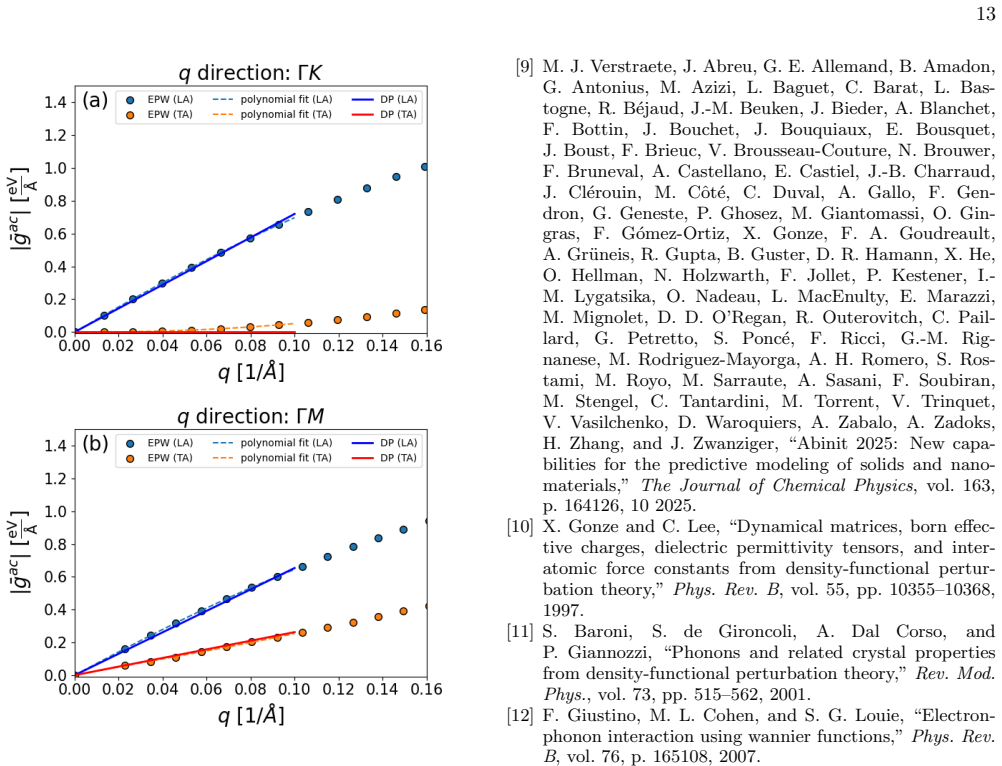
Intravalley acoustic scattering: Generalized deformation potential model The interaction between electrons and acoustic phonons in the long-wavelength limit is characterized by a slowly varying potential, which can be expressed as 4 [14, 24, 55] Hep = X αβ Ξαβϵαβ,(6) where Ξ is the deformation potential (DP) tensor,ϵis the strain tensor, andαandβare the C...
-
[2]
Scattering via phonons near the Brillouin zone edge typically has a weak wave vector dependence [14]
Intravalley non-polar optical phonon and intervalley scattering Intervalley scattering between the K and K ′ valleys occurs via phonons near the K point. Scattering via phonons near the Brillouin zone edge typically has a weak wave vector dependence [14]. The el-ph matrix element between the lowest conduction band states with wave vectorsk≈K andk ′ ≈K ′ c...
-
[3]
Intravalley homopolar optical phonon scattering It has been recently established that the el-ph ma- trix elements associated with the homopolar optical ZO 1 mode near Γ have a small long-range contribution [2, 56, 57] Therefore, these el-ph matrix elements exhibit stronger wave vector dependence compared to the zone- center non-polar optical TO2 mode. We ...
-
[4]
PolynomialFeatures
Intravalley polar optical phonon scattering In addition to the deformation potential in the long- wavelength limit, the atomic displacements correspond- ing to the LO 2 mode of MoS 2 create long-range interac- tions between electrons and LO2 modes. This long-range interaction can be described using the expression for the Fr¨ ohlich interaction in 2D cryst...
2020
-
[5]
Phonon-limited electronic transport through first prin- ciples,
R. Claes, S. Ponc´ e, G.-M. Rignanese, and G. Hautier, “Phonon-limited electronic transport through first prin- ciples,”Nature Reviews Physics, vol. 7, pp. 73–90, 2025
2025
-
[6]
Long-range electrostatic contribution to electron- phonon couplings and mobilities of two-dimensional and bulk materials,
S. Ponc´ e, M. Royo, M. Stengel, N. Marzari, and M. Gib- ertini, “Long-range electrostatic contribution to electron- phonon couplings and mobilities of two-dimensional and bulk materials,”Phys. Rev. B, vol. 107, p. 155424, 2023
2023
-
[7]
First-principles predictions of hall and drift mobilities in semiconductors,
S. Ponc´ e, F. Macheda, E. R. Margine, N. Marzari, N. Bonini, and F. Giustino, “First-principles predictions of hall and drift mobilities in semiconductors,”Phys. Rev. Res., vol. 3, p. 043022, 2021
2021
-
[8]
Electron-phonon interactions using the projector augmented-wave method and wannier functions,
M. Engel, M. Marsman, C. Franchini, and G. Kresse, “Electron-phonon interactions using the projector augmented-wave method and wannier functions,”Phys. Rev. B, vol. 101, p. 184302, 2020
2020
-
[9]
H. Lee, S. Ponc´ e, K. Bushick, S. Hajinazar, J. Lafuente- Bartolome, J. Leveillee, C. Lian, J.-M. Lihm, F. Macheda, H. Mori, H. Paudyal, W. H. Sio, S. Tiwari, M. Zacharias, X. Zhang, N. Bonini, E. Kioupakis, E. R. Margine, and F. Giustino, “Electron–phonon physics 13 FIG. 7. Scaled electron-phonon matrix elements due to acoustic modes between the electro...
2023
-
[10]
Perturbo: A software package for ab initio electron–phonon interactions, charge transport and ul- trafast dynamics,
J.-J. Zhou, J. Park, I.-T. Lu, I. Maliyov, X. Tong, and M. Bernardi, “Perturbo: A software package for ab initio electron–phonon interactions, charge transport and ul- trafast dynamics,”Computer Physics Communications, vol. 264, p. 107970, 2021
2021
-
[11]
Phoebe: a high-performance frame- work for solving phonon and electron boltzmann trans- port equations,
A. Cepellotti, J. Coulter, A. Johansson, N. S. Fedorova, and B. Kozinsky, “Phoebe: a high-performance frame- work for solving phonon and electron boltzmann trans- port equations,”Journal of Physics: Materials, vol. 5, no. 3, p. 035003, 2022
2022
-
[12]
Epiq: An open-source software for the calculation of electron-phonon interaction related properties,
G. Marini, G. Marchese, G. Profeta, J. Sjakste, F. Macheda, N. Vast, F. Mauri, and M. Calandra, “Epiq: An open-source software for the calculation of electron-phonon interaction related properties,”Com- puter Physics Communications, vol. 295, p. 108950, 2024
2024
-
[13]
Abinit 2025: New capa- bilities for the predictive modeling of solids and nano- materials,
M. J. Verstraete, J. Abreu, G. E. Allemand, B. Amadon, G. Antonius, M. Azizi, L. Baguet, C. Barat, L. Bas- togne, R. B´ ejaud, J.-M. Beuken, J. Bieder, A. Blanchet, F. Bottin, J. Bouchet, J. Bouquiaux, E. Bousquet, J. Boust, F. Brieuc, V. Brousseau-Couture, N. Brouwer, F. Bruneval, A. Castellano, E. Castiel, J.-B. Charraud, J. Cl´ erouin, M. Cˆ ot´ e, C. ...
2025
-
[14]
Dynamical matrices, born effec- tive charges, dielectric permittivity tensors, and inter- atomic force constants from density-functional pertur- bation theory,
X. Gonze and C. Lee, “Dynamical matrices, born effec- tive charges, dielectric permittivity tensors, and inter- atomic force constants from density-functional pertur- bation theory,”Phys. Rev. B, vol. 55, pp. 10355–10368, 1997
1997
-
[15]
Phonons and related crystal properties from density-functional perturbation theory,
S. Baroni, S. de Gironcoli, A. Dal Corso, and P. Giannozzi, “Phonons and related crystal properties from density-functional perturbation theory,”Rev. Mod. Phys., vol. 73, pp. 515–562, 2001
2001
-
[16]
Electron- phonon interaction using wannier functions,
F. Giustino, M. L. Cohen, and S. G. Louie, “Electron- phonon interaction using wannier functions,”Phys. Rev. B, vol. 76, p. 165108, 2007
2007
-
[17]
Phonon-limited electron mobility in si, gaas, and gap with exact treatment of dynamical quadrupoles,
G. Brunin, H. P. C. Miranda, M. Giantomassi, M. Royo, M. Stengel, M. J. Verstraete, X. Gonze, G.-M. Rignanese, and G. Hautier, “Phonon-limited electron mobility in si, gaas, and gap with exact treatment of dynamical quadrupoles,”Phys. Rev. B, vol. 102, p. 094308, 2020
2020
-
[18]
B. K. Ridley,Quantum Processes in Semiconductors, pp. 82 – 137. Oxford, UK: Oxford University Press, fourth ed., 1999
1999
-
[19]
First-principles cal- culation of carrier-phonon scattering inn-type si 1−xgex alloys,
F. Murphy-Armando and S. Fahy, “First-principles cal- culation of carrier-phonon scattering inn-type si 1−xgex alloys,”Phys. Rev. B, vol. 78, p. 035202, 2008
2008
-
[20]
Acoustic deformation potentials ofn-type pbte from first principles,
A. R. Murphy, F. Murphy-Armando, S. Fahy, and I. Savi´ c, “Acoustic deformation potentials ofn-type pbte from first principles,”Phys. Rev. B, vol. 98, p. 085201, 2018
2018
-
[21]
Dominant electron-phonon scattering mecha- nisms inn-type pbte from first principles,
J. Cao, J. D. Querales-Flores, A. R. Murphy, S. Fahy, and I. Savi´ c, “Dominant electron-phonon scattering mecha- nisms inn-type pbte from first principles,”Phys. Rev. B, vol. 98, p. 205202, 2018
2018
-
[22]
Electron-phonon scattering and thermoelectric transport inp-type pbte from first principles,
R. D’Souza, J. Cao, J. D. Querales-Flores, S. Fahy, and I. Savi´ c, “Electron-phonon scattering and thermoelectric transport inp-type pbte from first principles,”Phys. Rev. B, vol. 102, p. 115204, 2020
2020
-
[23]
Efficient calculation of carrier scattering rates from first princi- ples,
A. M. Ganose, J. Park, A. Faghaninia, R. Woods- Robinson, K. A. K. A. Persson, and A. Jain, “Efficient calculation of carrier scattering rates from first princi- ples,”Nature Communications, vol. 12, p. 2222, 2021
2021
-
[24]
Electra code: Full-band electronic transport properties of materials,
P. Graziosi, Z. Li, and N. Neophytou, “Electra code: Full-band electronic transport properties of materials,” Computer Physics Communications, vol. 287, p. 108670, 14 2023
2023
-
[25]
Low effective mass leading to high thermoelectric per- formance,
Y. Pei, A. D. LaLonde, H. Wang, and G. J. Snyder, “Low effective mass leading to high thermoelectric per- formance,”Energy Environ. Sci., vol. 5, pp. 7963–7969, 2012
2012
-
[26]
Weak electron–phonon coupling contributing to high thermoelectric performance in n-type pbse,
H. Wang, Y. Pei, A. D. LaLonde, and G. J. Snyder, “Weak electron–phonon coupling contributing to high thermoelectric performance in n-type pbse,”Proceedings of the National Academy of Sciences, vol. 109, no. 25, pp. 9705–9709, 2012
2012
-
[27]
The thermoelec- tric properties of bismuth telluride,
I. T. Witting, T. C. Chasapis, F. Ricci, M. Peters, N. A. Heinz, G. Hautier, and G. J. Snyder, “The thermoelec- tric properties of bismuth telluride,”Advanced Electronic Materials, vol. 5, no. 6, p. 1800904, 2019
2019
-
[28]
Transport and deformation- potential theory for many-valley semiconductors with anisotropic scattering,
C. Herring and E. Vogt, “Transport and deformation- potential theory for many-valley semiconductors with anisotropic scattering,”Phys. Rev., vol. 101, pp. 944– 961, 1956
1956
-
[29]
Band structure, de- formation potentials, and carrier mobility in strained si, ge, and sige alloys,
M. V. Fischetti and S. E. Laux, “Band structure, de- formation potentials, and carrier mobility in strained si, ge, and sige alloys,”Journal of Applied Physics, vol. 80, no. 4, pp. 2234–2252, 1996
1996
-
[30]
Ther- mally induced band gap increase and high thermoelectric figure of merit of n-type pbte,
J. Cao, J. Querales-Flores, S. Fahy, and I. Savi´ c, “Ther- mally induced band gap increase and high thermoelectric figure of merit of n-type pbte,”Materials Today Physics, vol. 12, p. 100172, 2020
2020
-
[31]
Temperature induced band convergence, inter- valley scattering, and thermoelectric transport in p-type pbte,
R. D’Souza, J. D. Querales-Flores, J. Cao, S. Fahy, and I. Savi´ c, “Temperature induced band convergence, inter- valley scattering, and thermoelectric transport in p-type pbte,”ACS Applied Energy Materials, vol. 5, pp. 7260– 7268, 2022
2022
-
[32]
Machine learning electron-phonon in- teractions in two-dimensional semiconducting materi- als: The case of zero-point renormalization,
A. Haldar, Q. Clark, M. Zacharias, F. Giustino, and S. Sharifzadeh, “Machine learning electron-phonon in- teractions in two-dimensional semiconducting materi- als: The case of zero-point renormalization,”Phys. Rev. Mater., vol. 8, p. L101001, 2024
2024
-
[33]
Active learning for accelerated design of layered materials,
L. B. Oftelie, P. Rajak, R. K. Kalia, A. Nakano, F. Sha, J. Sun, D. J. Singh, M. Aykol, P. Huck, K. Persson, and P. Vashishta, “Active learning for accelerated design of layered materials,”npj Computational Materials, vol. 4, p. 74, 2018
2018
-
[34]
Ma- chine learning approaches for thermoelectric materials research,
T. Wang, C. Zhang, H. Snoussi, and G. Zhang, “Ma- chine learning approaches for thermoelectric materials research,”Advanced Functional Materials, vol. 30, no. 5, p. 1906041, 2020
2020
-
[35]
A critical review of machine learn- ing techniques on thermoelectric materials,
X. Wang, Y. Sheng, J. Ning, J. Xi, L. Xi, D. Qiu, J. Yang, and X. Ke, “A critical review of machine learn- ing techniques on thermoelectric materials,”The Journal of Physical Chemistry Letters, vol. 14, pp. 1808–1822, 2023
2023
-
[36]
Leveraging language represen- tation for materials exploration and discovery,
J. Qu, Y. R. Xie, K. M. Ciesielski, C. E. Porter, E. S. Toberer, and E. Ertekin, “Leveraging language represen- tation for materials exploration and discovery,”npj Com- putational Materials, vol. 10, p. 58, 2024
2024
-
[37]
Machine learning based feature engineering for thermo- electric materials by design,
U. S. Vaitesswar, D. Bash, T. Huang, J. Recatala-Gomez, T. Deng, S.-W. Yang, X. Wang, and K. Hippalgaonkar, “Machine learning based feature engineering for thermo- electric materials by design,”Digital Discovery, vol. 3, pp. 210–220, 2024
2024
-
[38]
Thermoelectric material performance (zt) predictions with machine learning,
N. K. Barua, S. Lee, A. O. Oliynyk, and H. Kleinke, “Thermoelectric material performance (zt) predictions with machine learning,”ACS Applied Materials & In- terfaces, vol. 17, p. 1662–1673, 2025
2025
-
[39]
Machine learning modeling of superconducting critical tempera- ture,
V. Stanev, C. Oses, A. G. Kusne, E. Rodriguez, J. Paglione, S. Curtarolo, and I. Takeuchi, “Machine learning modeling of superconducting critical tempera- ture,”npj Computational Materials, vol. 4, p. 29, 2018
2018
-
[40]
Machine learning of superconducting critical temperature from eliashberg theory,
S. R. Xie, Y. Quan, A. C. Hire, B. Deng, J. M. DeStefano, I. Salinas, U. S. Shah, L. Fanfarillo, J. Lim, J. Kim, G. R. Stewart, P. J. Hamlin, J. J.and Hirschfeld, and R. G. Hennig, “Machine learning of superconducting critical temperature from eliashberg theory,”npj Computational Materials, vol. 8, p. 14, 2022
2022
-
[41]
Searching materials space for hy- dride superconductors at ambient pressure,
T. F. T. Cerqueira, Y.-W. Fang, I. Errea, A. Sanna, and M. A. L. Marques, “Searching materials space for hy- dride superconductors at ambient pressure,”Advanced Functional Materials, vol. 34, no. 40, p. 2404043, 2024
2024
-
[42]
Machine-learning accel- erated prediction of two-dimensional conventional super- conductors,
T. H. B. da Silva, T. Cavignac, T. F. T. Cerqueira, H.-C. Wang, and M. A. L. Marques, “Machine-learning accel- erated prediction of two-dimensional conventional super- conductors,”Materials Horizons, vol. 12, pp. 3408–3419, 2025
2025
-
[43]
Deep-learning density func- tional perturbation theory,
H. Li, Z. Tang, J. Fu, W.-H. Dong, N. Zou, X. Gong, W. Duan, and Y. Xu, “Deep-learning density func- tional perturbation theory,”Phys. Rev. Lett., vol. 132, p. 096401, Feb 2024
2024
-
[44]
Accelerating the calculation of electron–phonon coupling strength with machine learning,
Y. Zhong, S. Liu, B. Zhang, Z. Tao, Y. Sun, W. Chu, X.- G. Gong, J.-H. Yang, and H. Xiang, “Accelerating the calculation of electron–phonon coupling strength with machine learning,”Nature Computational Science, vol. 4, pp. 615–625, 2024
2024
-
[45]
Z. Wang, W. Duan, and Z. LinarXiv:2602.23084
-
[46]
Quantification of uncertainties in thermoelectric properties of materials from a first-principles prediction method: An approach based on gaussian process regres- sion,
D. Wee, J. Kim, S. Bang, G. Samsonidze, and B. Kozin- sky, “Quantification of uncertainties in thermoelectric properties of materials from a first-principles prediction method: An approach based on gaussian process regres- sion,”Phys. Rev. Mater., vol. 3, p. 033803, 2019
2019
-
[47]
Two-dimensional fr¨ ohlich interaction in transition-metal dichalcogenide monolayers: Theoretical modeling and first-principles calculations,
T. Sohier, M. Calandra, and F. Mauri, “Two-dimensional fr¨ ohlich interaction in transition-metal dichalcogenide monolayers: Theoretical modeling and first-principles calculations,”Phys. Rev. B, vol. 94, p. 085415, 2016
2016
-
[48]
Unified ab initio descrip- tion of fr¨ ohlich electron-phonon interactions in two- dimensional and three-dimensional materials,
W. H. Sio and F. Giustino, “Unified ab initio descrip- tion of fr¨ ohlich electron-phonon interactions in two- dimensional and three-dimensional materials,”Phys. Rev. B, vol. 105, p. 115414, 2022
2022
-
[49]
N. W. Ashcroft and N. D. Mermin,Solid State Physics, pp. 250–258. New York City, USA: Harcourt College Publishers, 1st ed., 1976
1976
-
[50]
Phonon-limited resistivity of graphene by first-principles calculations: Electron- phonon interactions, strain-induced gauge field, and boltzmann equation,
T. Sohier, M. Calandra, C.-H. Park, N. Bonini, N. Marzari, and F. Mauri, “Phonon-limited resistivity of graphene by first-principles calculations: Electron- phonon interactions, strain-induced gauge field, and boltzmann equation,”Phys. Rev. B, vol. 90, p. 125414, Sep 2014
2014
-
[51]
First-principles method for electron-phonon coupling and electron mobility: Applications to two-dimensional materials,
T. Gunst, T. Markussen, K. Stokbro, and M. Brandbyge, “First-principles method for electron-phonon coupling and electron mobility: Applications to two-dimensional materials,”Phys. Rev. B, vol. 93, p. 035414, Jan 2016
2016
-
[52]
The Supplemental Material also contains Ref
See Supplemental Material at [url] for more details about the calculated electronic band structure of MoS 2, the derivation of the deformation potentials for arbitrary crystal symmetries and band extrema locations, our cal- culations of the parameters for intravalley polar and non- polar and intervalley scattering, details of our ionized im- purity scatte...
-
[53]
Electronic prop- 15 erties of two-dimensional systems,
T. Ando, A. B. Fowler, and F. Stern, “Electronic prop- 15 erties of two-dimensional systems,”Reviews of Modern Physics, vol. 54, p. 437–672, Apr. 1982
1982
-
[54]
Band structure of indium antimonide,
E. O. Kane, “Band structure of indium antimonide,” Journal of Physics and Chemistry of Solids, vol. 1, no. 4, pp. 249–261, 1957
1957
-
[55]
M. S. Dresselhaus, G. Dresselhaus, and A. Jorio,Group Theory: Application to the Physics of Condensed Mat- ter, pp. 97, 246, 254–255. Berlin/Heidelberg, Germany: Springer-Verlag, 1st ed., 2008
2008
-
[56]
Lat- tice dynamics of hexagonal mos2 studied by neutron scat- tering,
N. Wakabayashi, H. G. Smith, and R. M. Nicklow, “Lat- tice dynamics of hexagonal mos2 studied by neutron scat- tering,”Phys. Rev. B, vol. 12, pp. 659–663, Jul 1975
1975
-
[57]
The experimental points correspond to bulk MoS 2, but only for the modes that are expected to appear in the monolayer
-
[58]
Acous- tic phonon limited mobility in two-dimensional semicon- ductors: Deformation potential and piezoelectric scatter- ing in monolayer mos 2 from first principles,
K. Kaasbjerg, K. S. Thygesen, and A.-P. Jauho, “Acous- tic phonon limited mobility in two-dimensional semicon- ductors: Deformation potential and piezoelectric scatter- ing in monolayer mos 2 from first principles,”Phys. Rev. B, vol. 87, p. 235312, 2013
2013
-
[59]
P. Y. Yu and M. Cardona,Fundamentals of Semicon- ductors: Physics and Materials Properties, pp. 120–121. Heidelberg, Germany: Springer, fourth ed., 2010
2010
-
[60]
Ab initio dipolar electron-phonon interactions in two-dimensional materials,
T. Deng, G. Wu, W. Shi, Z. M. Wong, J.-S. Wang, and S.- W. Yang, “Ab initio dipolar electron-phonon interactions in two-dimensional materials,”Phys. Rev. B, vol. 103, p. 075410, Feb 2021
2021
-
[61]
Accurate prediction of hall mobilities in two-dimensional materials through gauge-covariant quadrupolar contributions,
S. Ponc´ e, M. Royo, M. Gibertini, N. Marzari, and M. Stengel, “Accurate prediction of hall mobilities in two-dimensional materials through gauge-covariant quadrupolar contributions,”Phys. Rev. Lett., vol. 130, p. 166301, 2023
2023
-
[62]
Scikit-learn: Machine learning in Python,
F. Pedregosa, G. Varoquaux, A. Gramfort, V. Michel, B. Thirion, O. Grisel, M. Blondel, P. Prettenhofer, R. Weiss, V. Dubourg, J. Vanderplas, A. Passos, D. Cour- napeau, M. Brucher, M. Perrot, and E. Duchesnay, “Scikit-learn: Machine learning in Python,”Journal of Machine Learning Research, vol. 12, pp. 2825–2830, 2011
2011
-
[63]
Quantum espresso: a modular and open-source software project for quantum simulations of materials,
P. Giannozzi, S. Baroni, N. Bonini, M. Calandra, R. Car, C. Cavazzoni, D. Ceresoli, G. L. Chiarotti, M. Cococ- cioni, I. Dabo, A. Dal Corso, S. de Gironcoli, S. Fabris, G. Fratesi, R. Gebauer, U. Gerstmann, C. Gougoussis, A. Kokalj, M. Lazzeri, L. Martin-Samos, N. Marzari, F. Mauri, R. Mazzarello, S. Paolini, A. Pasquarello, L. Paulatto, C. Sbraccia, S. S...
2009
-
[64]
Ad- vanced capabilities for materials modelling with quantum espresso,
P. Giannozzi, O. Andreussi, T. Brumme, O. Bunau, M. Buongiorno Nardelli, M. Calandra, R. Car, C. Cavaz- zoni, D. Ceresoli, M. Cococcioni, N. Colonna, I. Carn- imeo, A. Dal Corso, S. de Gironcoli, P. Delugas, R. A. DiStasio, A. Ferretti, A. Floris, G. Fratesi, G. Fugallo, R. Gebauer, U. Gerstmann, F. Giustino, T. Gorni, J. Jia, M. Kawamura, H.-Y. Ko, A. Ko...
2017
-
[65]
Generalized gradient approximation made simple,
J. P. Perdew, K. Burke, and M. Ernzerhof, “Generalized gradient approximation made simple,”Phys. Rev. Lett., vol. 77, pp. 3865–3868, 1996
1996
-
[66]
Density func- tional perturbation theory for gated two-dimensional het- erostructures: Theoretical developments and application to flexural phonons in graphene,
T. Sohier, M. Calandra, and F. Mauri, “Density func- tional perturbation theory for gated two-dimensional het- erostructures: Theoretical developments and application to flexural phonons in graphene,”Phys. Rev. B, vol. 96, p. 075448, 2017
2017
-
[67]
Epw: Electron–phonon coupling, transport and superconduct- ing properties using maximally localized wannier func- tions,
S. Ponc´ e, E. Margine, C. Verdi, and F. Giustino, “Epw: Electron–phonon coupling, transport and superconduct- ing properties using maximally localized wannier func- tions,”Computer Physics Communications, vol. 209, pp. 116–133, 2016
2016
-
[68]
Metallicity of 2H- MoS2 induced by au hybridization,
B. T. Blue, G. G. Jernigan, D. Le, J. J. Fonseca, S. D. Lough, J. E. Thompson, D. D. Smalley, T. S. Rahman, J. T. Robinson, and M. Ishigami, “Metallicity of 2H- MoS2 induced by au hybridization,”2d Mater., vol. 7, p. 025021, Feb. 2020
2020
-
[69]
Atomically thin mos 2: A new direct-gap semiconduc- tor,
K. F. Mak, C. Lee, J. Hone, J. Shan, and T. F. Heinz, “Atomically thin mos 2: A new direct-gap semiconduc- tor,”Phys. Rev. Lett., vol. 105, p. 136805, 2010
2010
-
[70]
Mechanical and thermal properties of h-MX 2 (M=Cr, Mo, W; X=O, S, Se, Te) monolayers: A comparative study,
D. C ¸ akır, F. M. Peeters, and C. Sevik, “Mechanical and thermal properties of h-MX 2 (M=Cr, Mo, W; X=O, S, Se, Te) monolayers: A comparative study,”Applied Physics Letters, vol. 104, p. 203110, May 2014
2014
-
[71]
Phonon-limited mobility inn-type single-layer mos 2 from first principles,
K. Kaasbjerg, K. S. Thygesen, and K. W. Jacobsen, “Phonon-limited mobility inn-type single-layer mos 2 from first principles,”Phys. Rev. B, vol. 85, p. 115317, 2012
2012
-
[72]
Intrinsic transport properties of electrons and holes in monolayer transition-metal dichalcogenides,
Z. Jin, X. Li, J. T. Mullen, and K. W. Kim, “Intrinsic transport properties of electrons and holes in monolayer transition-metal dichalcogenides,”Phys. Rev. B, vol. 90, p. 045422, Jul 2014
2014
-
[73]
Kaasbjerg, K
K. Kaasbjerg, K. S. Thygesen, and K. W. JacobsenPhys. Rev. B, vol. 85, p. 115317, 2012
2012
-
[74]
Mobility engineering and a metal–insulator transition in monolayer mos2,
B. Radisavljevic and A. Kis, “Mobility engineering and a metal–insulator transition in monolayer mos2,”Nature Materials, vol. 12, pp. 815–820, 2013
2013
-
[75]
Realization of room-temperature phonon- limited carrier transport in monolayer mos2 by dielectric and carrier screening,
Z. Yu, Z.-Y. Ong, Y. Pan, Y. Cui, R. Xin, Y. Shi, B. Wang, Y. Wu, T. Chen, Y.-W. Zhang, G. Zhang, and X. Wang, “Realization of room-temperature phonon- limited carrier transport in monolayer mos2 by dielectric and carrier screening,”Advanced Materials, vol. 28, no. 3, pp. 547–552, 2016
2016
-
[76]
Multi-terminal transport measurements of mos2 using a van der waals heterostructure device platform,
X. Cui, G.-H. Lee, Y. D. Kim, G. Arefe, P. Y. Huang, C.- H. Lee, D. A. Chenet, X. Zhang, L. Wang, F. Ye, F. Piz- zocchero, B. S. Jessen, K. Watanabe, T. Taniguchi, D. A. Muller, T. Low, P. Kim, and J. Hone, “Multi-terminal transport measurements of mos2 using a van der waals heterostructure device platform,”Nature Nanotechnol- ogy, vol. 10, p. 534–540, Apr. 2015
2015
-
[77]
Toward barrier free contact to molybde- num disulfide using graphene electrodes,
Y. Liu, H. Wu, H.-C. Cheng, S. Yang, E. Zhu, Q. He, M. Ding, D. Li, J. Guo, N. O. Weiss, Y. Huang, and X. Duan, “Toward barrier free contact to molybde- num disulfide using graphene electrodes,”Nano Letters, vol. 15, p. 3030–3034, Apr. 2015
2015
-
[78]
Intrinsic electrical transport properties of monolayer silicene and mos2 from first principles,
X. Li, J. T. Mullen, Z. Jin, K. M. Borysenko, M. Buon- giorno Nardelli, and K. W. Kim, “Intrinsic electrical transport properties of monolayer silicene and mos2 from first principles,”Phys. Rev. B, vol. 87, p. 115418, 2013
2013
-
[79]
Electrical transport limited by electron-phonon coupling from boltzmann transport equation: An ab ini- tio study of si, al, and mos 2,
W. Li, “Electrical transport limited by electron-phonon coupling from boltzmann transport equation: An ab ini- tio study of si, al, and mos 2,”Phys. Rev. B, vol. 92, 16 p. 075405, 2015
2015
-
[80]
Mo- bility of two-dimensional materials from first principles in an accurate and automated framework,
T. Sohier, D. Campi, N. Marzari, and M. Gibertini, “Mo- bility of two-dimensional materials from first principles in an accurate and automated framework,”Phys. Rev. Mater., vol. 2, p. 114010, Nov 2018
2018
discussion (0)
Sign in with ORCID, Apple, or X to comment. Anyone can read and Pith papers without signing in.