Fermion mass relations in one-parameter modular models
Pith reviewed 2026-06-25 22:57 UTC · model grok-4.3
The pith
In the one-parameter modular limit, a shared modulus fixes exact high-scale mass relations between down quarks and charged leptons.
A machine-rendered reading of the paper's core claim, the machinery that carries it, and where it could break.
Core claim
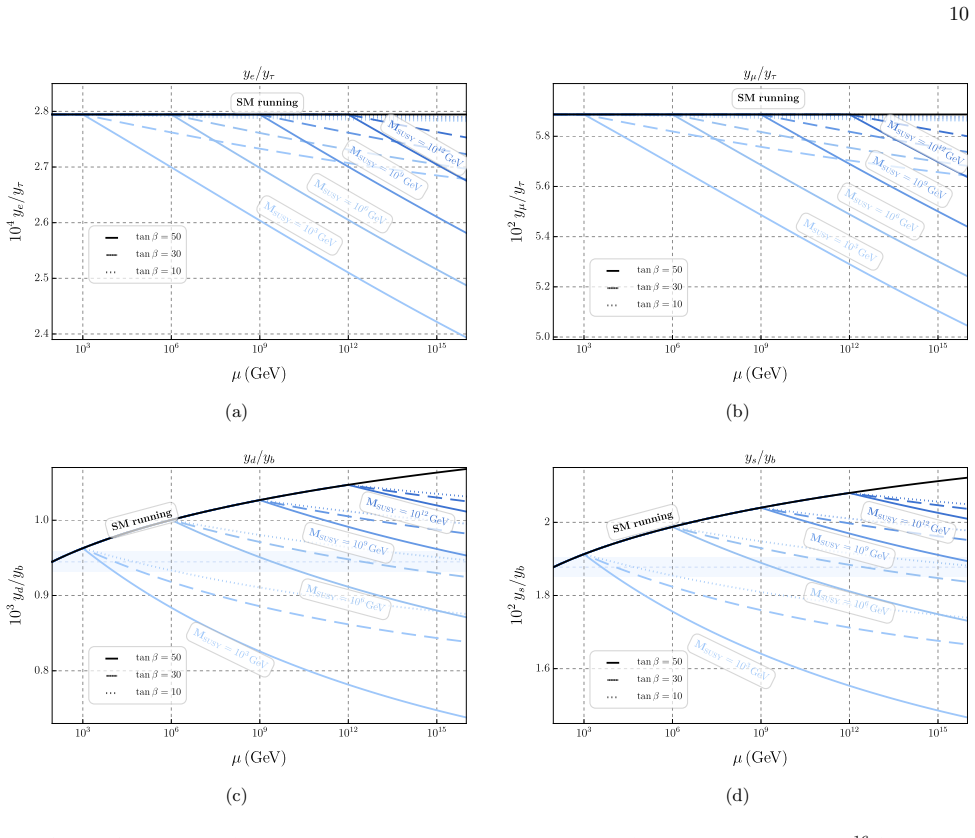
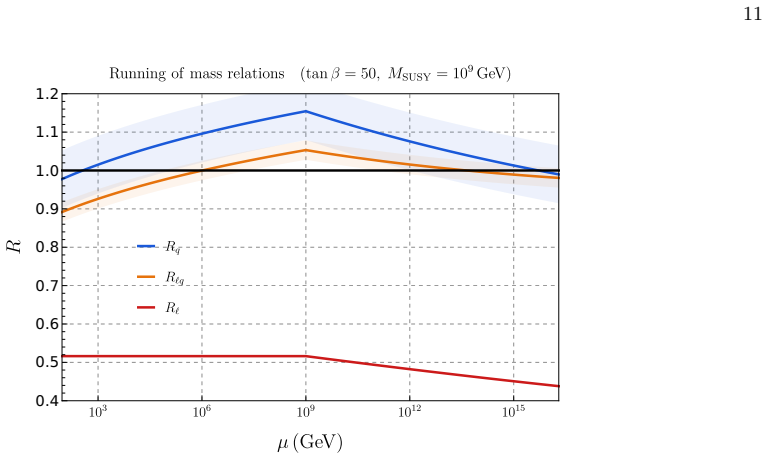
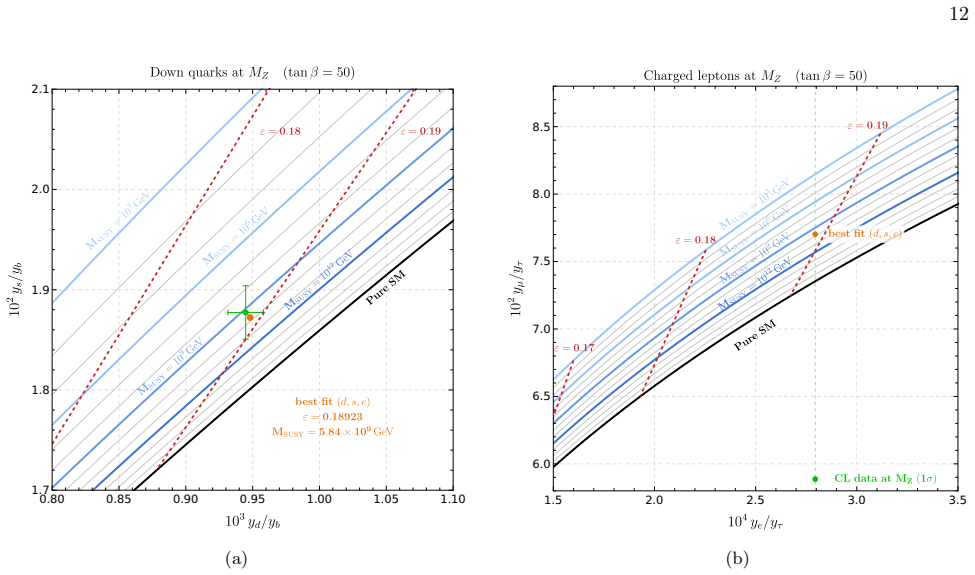
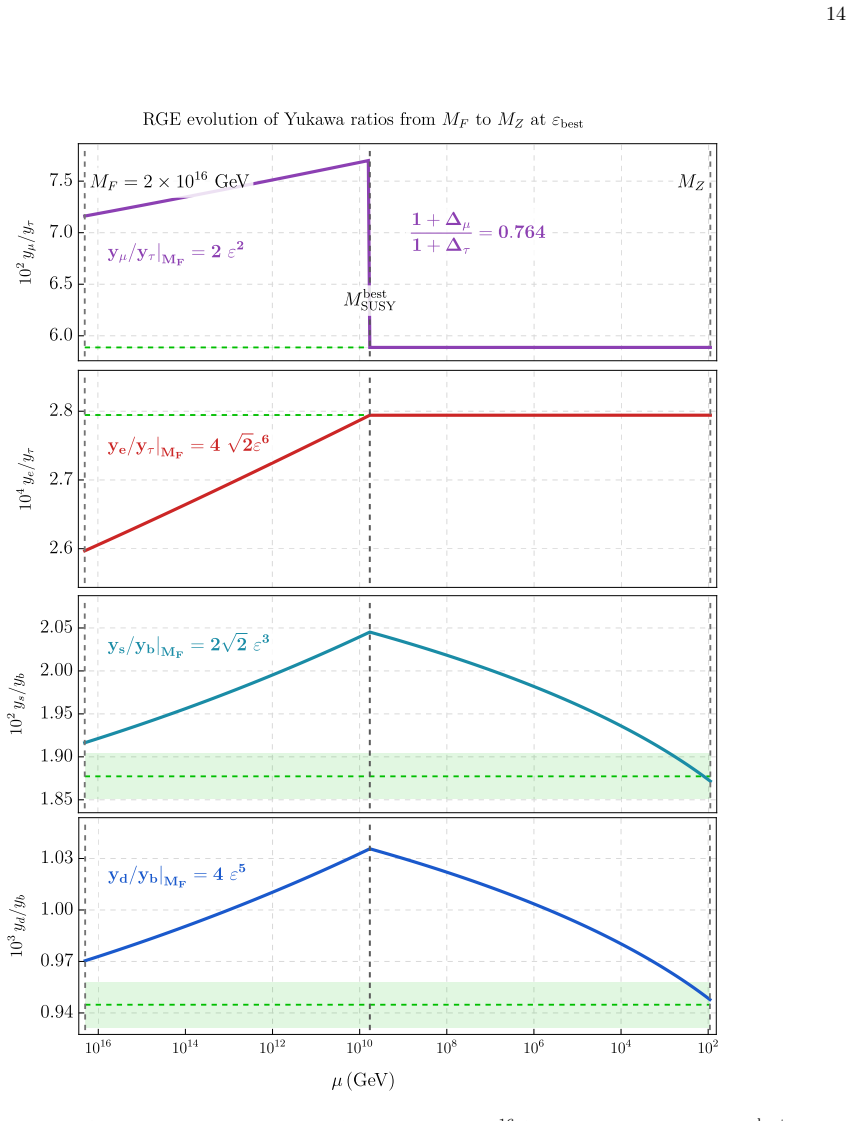
In the extreme OPM limit each charged-fermion mass matrix arises from exactly one modular invariant contraction. When the charged-lepton and down-quark sectors are controlled by the same modulus, the resulting mass matrices at the flavour scale satisfy the three exact relations m_s^5 = 2√2 m_d^3 m_b^2, m_μ^3 = √2 m_e m_τ^2 and m_s^2 m_τ = √2 m_e m_b^2. These relations remain consistent with low-energy data after renormalization-group running and selective supersymmetric threshold effects are taken into account.
What carries the argument
The one-parameter modular (OPM) limit, in which each charged-fermion mass matrix is fixed by a single modular invariant contraction of one complex modulus.
If this is right
- The three mass relations hold exactly at the flavour scale before any running occurs.
- Renormalization-group evolution from the flavour scale down to the electroweak scale must be included to compare predictions with data.
- Selective supersymmetric threshold corrections can adjust the running to restore compatibility with observed masses.
- The up-quark sector is not constrained by the same common modulus and may be treated separately.
Where Pith is reading between the lines
- The relations link quark and lepton masses without extra free parameters beyond the single modulus.
- Precision flavour measurements at future facilities could test whether the high-scale values satisfy the predicted ratios after accounting for running.
- Similar one-parameter structures might be applied to the neutrino sector to generate additional testable predictions.
Load-bearing premise
The model must realize the extreme limit in which every charged-fermion mass matrix is fixed by exactly one modular invariant contraction while keeping modular invariance across sectors.
What would settle it
A calculation that evolves the measured low-energy masses upward, including all relevant thresholds, and finds that the resulting high-scale values violate any of the three stated relations outside combined experimental and theoretical uncertainties.
Figures
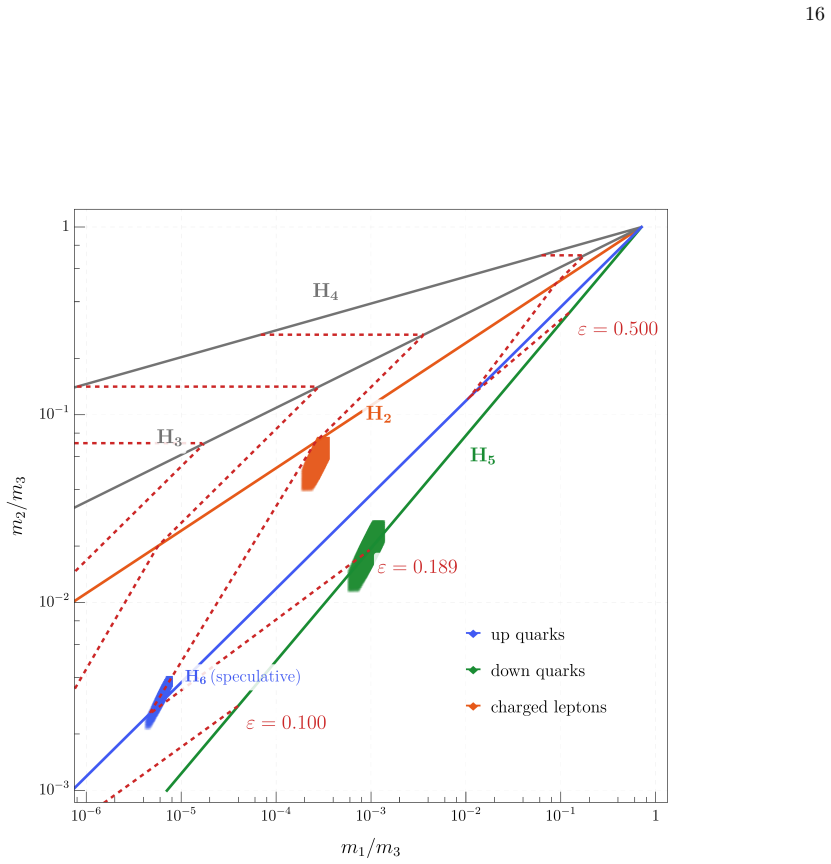
read the original abstract
Modular flavour symmetries provide a possible organizing principle for the Standard Model Yukawa sector, by replacing generic couplings with a potentially small number of modular forms controlled by a single complex modulus. We study the extreme limit of this idea: \acp{OPM}, in which each charged-fermion mass matrix is fixed by a single modular invariant contraction. We develop a systematic method to construct such models, showing that the \ac{OPM} requirement is already highly constraining at the level of possible fermion hierarchies. In a concrete realization, the charged-lepton and down-quark sectors are controlled by the common modulus, leading to exact mass relations at the flavour scale, \[ m_s^5 = 2\sqrt{2}\,m_d^3m_b^2, \qquad m_\mu^3 = \sqrt{2}\,m_e m_\tau^2, \qquad m_s^2m_\tau = \sqrt{2}\,m_e m_b^2. \] We show that, once renormalization-group evolution and selective supersymmetric threshold effects are included, these high-scale relations can be made compatible with low-energy charged-fermion data. Our results provide a working proof of principle for \acp{OPM} and point towards a possible route to the flavour puzzle through highly
Editorial analysis
A structured set of objections, weighed in public.
Referee Report
Summary. The manuscript develops a systematic approach to one-parameter modular (OPM) models in which each charged-fermion mass matrix arises from exactly one modular invariant contraction. In a concrete realization with a shared modulus for the down-quark and charged-lepton sectors, this yields exact high-scale mass relations m_s^5 = 2√2 m_d^3 m_b^2, m_μ^3 = √2 m_e m_τ^2 and m_s^2 m_τ = √2 m_e m_b^2. The authors show that renormalization-group evolution together with selective supersymmetric threshold corrections can bring these relations into agreement with low-energy data.
Significance. If the OPM construction is internally consistent, the work supplies a concrete proof-of-principle that modular symmetries can produce parameter-free fermion mass relations controlled by a single complex modulus. The explicit demonstration that the high-scale relations survive RG running and threshold effects adds phenomenological relevance. The systematic construction method itself is a useful contribution to the modular-flavour literature.
major comments (2)
- [concrete realization (section containing the explicit model)] The central claim that the quoted mass relations follow directly from the single-contraction OPM requirement rests on the viability of assigning modular weights such that each of the down-quark and lepton mass matrices is fixed by precisely one invariant while sharing the same modulus τ. The manuscript must supply the explicit weight assignments and verify that no additional contractions are permitted by modular invariance; without this verification the exact numerical coefficients (including the factor 2√2) cannot be confirmed to arise solely from the OPM condition.
- [concrete realization] The up-quark sector is not included in the quoted relations. If the model is intended to be complete, the same single-contraction constraint must be satisfied simultaneously for the up sector with the identical modulus; otherwise the claim that the framework is realized with a common τ for all charged fermions is incomplete.
minor comments (1)
- [RG evolution discussion] The abstract refers to 'selective supersymmetric threshold effects' without specifying which thresholds are retained or suppressed; a brief table or paragraph listing the retained thresholds would improve clarity.
Simulated Author's Rebuttal
We thank the referee for the positive assessment of our work's significance and for the constructive major comments. We address each point below, indicating the revisions that will be incorporated.
read point-by-point responses
-
Referee: [concrete realization (section containing the explicit model)] The central claim that the quoted mass relations follow directly from the single-contraction OPM requirement rests on the viability of assigning modular weights such that each of the down-quark and lepton mass matrices is fixed by precisely one invariant while sharing the same modulus τ. The manuscript must supply the explicit weight assignments and verify that no additional contractions are permitted by modular invariance; without this verification the exact numerical coefficients (including the factor 2√2) cannot be confirmed to arise solely from the OPM condition.
Authors: We agree that explicit verification is essential. The concrete realization section of the manuscript already specifies the modular weights that enforce single contractions, but we will expand this in the revision by adding a dedicated table listing all field weights together with a short proof that modular invariance forbids additional independent contractions for each matrix entry. This will directly confirm the numerical prefactors in the mass relations. revision: yes
-
Referee: [concrete realization] The up-quark sector is not included in the quoted relations. If the model is intended to be complete, the same single-contraction constraint must be satisfied simultaneously for the up sector with the identical modulus; otherwise the claim that the framework is realized with a common τ for all charged fermions is incomplete.
Authors: The manuscript explicitly limits the concrete realization to the down-quark and charged-lepton sectors sharing a common modulus, as stated in the abstract. No claim is made that the up-quark sector must employ the identical τ. The up sector can be realized separately within the OPM framework (possibly with its own modulus). We will insert a clarifying sentence in the revised text to restate the intended scope and note that a fully unified three-sector construction lies outside the present proof-of-principle study. revision: partial
Circularity Check
No circularity: mass relations derived from modular invariance and OPM construction
full rationale
The paper constructs OPM models where each charged-fermion mass matrix is fixed by a single modular invariant contraction. In the concrete realization with shared modulus for down-quarks and leptons, the quoted mass relations follow directly as algebraic consequences of that single-contraction requirement and modular invariance. These are presented as exact high-scale outputs of the model, not as fits to data. Compatibility with low-energy observables is checked via standard RG evolution and threshold corrections, which are external to the model. No self-citations, fitted inputs renamed as predictions, or self-definitional steps appear in the derivation chain. The central claim therefore remains independent of its inputs.
Axiom & Free-Parameter Ledger
free parameters (1)
- complex modulus tau
axioms (1)
- domain assumption Yukawa couplings are modular forms of definite weight under a modular group
Reference graph
Works this paper leans on
-
[1]
among the representationsr i under which the VVMFsY (k) ri transform, only one representation,r, can contract withψ c andψto produce a trivial (non-vanishing) singlet
-
[2]
there is only one modular form of weightkfurnishing the representationr; If either of these conditions is not met, more than one contraction will be present. For a model with three generations of massive fermions, all three generations must participate in the con- traction so that each generation acquires a mass. Together with the condition in item 1, thi...
-
[3]
G. Altarelli and F. Feruglio,Discrete Flavor Symmetries and Models of Neutrino Mixing,Rev. Mod. Phys.82 (2010) 2701 [1002.0211]
Pith/arXiv arXiv 2010
-
[4]
H. Ishimori, T. Kobayashi, H. Ohki, Y. Shimizu, H. Okada and M. Tanimoto,Non-Abelian Discrete Symmetries in Particle Physics,Prog. Theor. Phys. Suppl.183(2010) 1 [1003.3552]
Pith/arXiv arXiv 2010
-
[5]
S. F. King, A. Merle, S. Morisi, Y. Shimizu and M. Tanimoto,Neutrino Mass and Mixing: from Theory to Experiment,New J. Phys.16(2014) 045018 [1402.4271]
Pith/arXiv arXiv 2014
-
[6]
S. T. Petcov,Discrete Flavour Symmetries, Neutrino Mixing and Leptonic CP Violation,Eur. Phys. J. C78 (2018) 709 [1711.10806]
Pith/arXiv arXiv 2018
-
[7]
F. Feruglio and A. Romanino,Lepton flavor symmetries,Rev. Mod. Phys.93(2021) 015007 [1912.06028]
arXiv 2021
-
[8]
G.-J. Ding and J. W. F. Valle,The symmetry approach to quark and lepton masses and mixing,Phys. Rept.1109 (2025) 1 [2402.16963]
arXiv 2025
-
[9]
F. Feruglio,Are neutrino masses modular forms?, inFrom My Vast Repertoire...: Guido Altarelli’s Legacy (A. Levy, S. Forte and G. Ridolfi, eds.), pp. 227–266. World Scientific Publishing, 2019. [1706.08749]
Pith/arXiv arXiv 2019
-
[10]
T. Kobayashi and M. Tanimoto,Modular flavor symmetric models,Int. J. Mod. Phys. A39(2024) 2441012 [2307.03384]
arXiv 2024
-
[11]
G.-J. Ding and S. F. King,Neutrino mass and mixing with modular symmetry,Rept. Prog. Phys.87(2024) 084201 [2311.09282]
arXiv 2024
-
[12]
M.-C. Chen, S. Ramos-S´ anchez and M. Ratz,A note on the predictions of models with modular flavor symmetries, Phys. Lett. B801(2020) 135153 [1909.06910]. 23
arXiv 2020
-
[13]
M.-C. Chen, S. F. King, O. Medina and J. W. F. Valle,Quark-lepton mass relations from modular flavor symmetry,JHEP02(2024) 160 [2312.09255]
arXiv 2024
-
[14]
F. Feruglio, V. Gherardi, A. Romanino and A. Titov,Modular invariant dynamics and fermion mass hierarchies aroundτ=i,JHEP05(2021) 242 [2101.08718]
arXiv 2021
-
[15]
P. P. Novichkov, J. T. Penedo and S. T. Petcov,Fermion mass hierarchies, large lepton mixing and residual modular symmetries,JHEP04(2021) 206 [2102.07488]
arXiv 2021
-
[16]
M. Carducci, D. Meloni, M. Parriciatu and J. T. Penedo,Quark hierarchies and CP violation from the Siegel modular group,2604.21979
-
[17]
J. T. Penedo and S. T. Petcov,Finite modular symmetries and the strong CP problem,JHEP10(2024) 172 [2404.08032]
arXiv 2024
-
[18]
M.-C. Chen, X. Li, X.-G. Liu and M. Ratz,Modular flavor symmetries and fermion mass hierarchies,JHEP10 (2025) 033 [2506.23343]
arXiv 2025
-
[19]
Feruglio,Fermion masses, critical behavior and universality,JHEP03(2023) 236 [2302.11580]
F. Feruglio,Fermion masses, critical behavior and universality,JHEP03(2023) 236 [2302.11580]
arXiv 2023
-
[20]
X.-G. Liu and G.-J. Ding,Modular flavor symmetry and vector-valued modular forms,JHEP03(2022) 123 [2112.14761]
arXiv 2022
-
[21]
The GAP Group,GAP – Groups, Algorithms, and Programming, Version 4.10.2, 2019, https://www.gap-system.org
2019
-
[22]
R. de Adelhart Toorop, F. Feruglio and C. Hagedorn,Finite Modular Groups and Lepton Mixing,Nucl. Phys. B 858(2012) 437 [1112.1340]
Pith/arXiv arXiv 2012
-
[23]
J. C. Criado and F. Feruglio,Modular Invariance Faces Precision Neutrino Data,SciPost Phys.5(2018) 042 [1807.01125]
Pith/arXiv arXiv 2018
-
[24]
S. Antusch, J. Kersten, M. Lindner, M. Ratz and M. A. Schmidt,Running neutrino mass parameters in see-saw scenarios,JHEP03(2005) 024 [hep-ph/0501272]
Pith/arXiv arXiv 2005
-
[25]
S. Antusch and C. Sluka,Predicting the Sparticle Spectrum from GUTs via SUSY Threshold Corrections with SusyTC,JHEP07(2016) 108 [1512.06727]
Pith/arXiv arXiv 2016
-
[26]
S. Antusch, C. Hohl and V. Susiˇ c,Employing nucleon decay as a fingerprint of SUSY GUT models using SusyTCProton,JHEP06(2021) 022 [2011.15026]
arXiv 2021
-
[27]
S. Kikuchi, T. Kobayashi, K. Nasu, H. Otsuka, S. Takada and H. Uchida,Modular symmetry of soft supersymmetry breaking terms,PTEP2022(2022) 123B02 [2203.14667]
arXiv 2022
-
[28]
G.-J. Ding, X.-G. Liu and C.-Y. Yao,A minimal modular invariant neutrino model,JHEP01(2023) 125 [2211.04546]
arXiv 2023
-
[29]
S. Antusch and M. Spinrath,Quark and lepton masses at the GUT scale including SUSY threshold corrections, Phys. Rev. D78(2008) 075020 [0804.0717]. [28]Particle Data Groupcollaboration, S. Navas et al.,Review of particle physics,Phys. Rev. D110(2024) 030001
Pith/arXiv arXiv 2008
-
[30]
A. Baur, H. P. Nilles, S. Ramos-Sanchez, A. Trautner and P. K. S. Vaudrevange,The eclectic flavor symmetries of T2/ZK orbifolds,JHEP09(2024) 159 [2405.20378]
arXiv 2024
discussion (0)
Sign in with ORCID, Apple, or X to comment. Anyone can read and Pith papers without signing in.