REVIEW 4 major objections 4 minor 170 references
A layered architecture for log analysis in complex IT systems
T0 review · 4 major / 4 minor · reviewed 2026-08-15 · deepseek-v4-flash
Pith's one-line read A three-layer log analysis architecture claims anomaly detection F1 scores of 0.98-1.0 and root cause candidates in the top 10 for 90-98% of failures.
desk verdict A coherent thesis-style integration of the author's earlier log-analysis methods; the packaging is genuinely new, but the headline F1/RCA numbers rest on an unvalidated PU-learning premise and on an evaluation chapter I cannot actually check in the provided text. read the letter →
The pith
A machine-rendered reading of the paper's core claim, the machinery that carries it, and where it could break.
The reading
What carries the argument
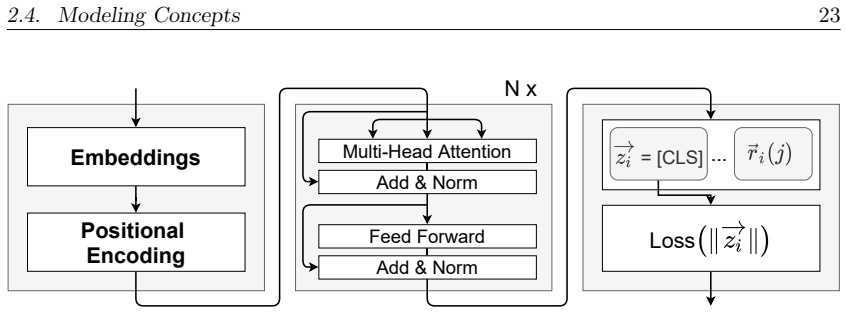
The load-bearing mechanism is PU learning over failure time windows, combined with a transformer encoder whose anomaly score is the vector norm of the $[CLS]$ token. Positive class $P$ contains all log lines outside the monitoring-derived failure windows; unknown class $U$ contains all lines inside them. The objective is $\frac{1}{m}\sum_i ((1-\tilde y_i)\|z_i\|^2 + \tilde y_i (|P|/(|P|+|U|))^2/\|z_i\|)$, so normal lines are pulled toward the origin and unknown lines are pushed away, with the push strength scaled by the ratio of class sizes. Iterative training smooths scores with $\tanh(\max(0,\|z_i\|-m))$ to turn them into pseudo-labels for the next model, and the inference stage builds a decision boundary by augmenting log lines and observing how scores shift. This same machinery is reused for labeling, for anomaly detection under all three training paradigms, and—after a clustering-based balancing step—for root cause ranking.
What would settle it
On one of the paper's public datasets (for example BGL), compare the labeling-layer F1 when the failure time windows are exactly the ones used in the evaluation versus windows shifted by a few seconds or widened by a factor of two. If the near-unity F1 scores degrade sharply under realistic monitoring jitter, the claim that the method needs only rough failure estimates is refuted.
Extended reading notes
Core claim
The thesis's core claim is that the entire log analysis workflow can be built on one repeated pattern: split the log lines by estimated failure time windows, treat everything outside the windows as the positive class $P$ (presumed normal) and everything inside as the unknown class $U$ (presumed anomalous but actually mixed), and train a transformer encoder to assign each line an anomaly score equal to the norm of its $[CLS]$ embedding. The loss pushes $P$ scores toward zero and pushes $U$ scores away from zero, with a class-ratio weight that keeps the model stable when the unknown class is large. An iterative loop converts the previous model's scores into smoothed pseudo-labels via $\tanh(\max(0,\|z_i\|-m))$ and retrains, which the paper argues removes the bias of the initial inaccurate window labels. The paper also derives a decision boundary from data augmentation rather than from labeled validation data, and reports F1 scores of 0.98-1.0 for unsupervised, weakly supervised, and supervised training on three public datasets plus industry data; for root cause analysis, it reports that 90-98% of root cause log lines appear in the top 10 ranked candidates after balancing the training data.
Load-bearing premise
The load-bearing premise is that the log lines outside the estimated failure time windows are all truly normal, so the positive class $P$ contains no hidden anomalies; if monitoring timestamps are imprecise or a failure leaks log lines outside the window, every layer inherits that error.
Editorial extensions
If this is right
- DevOps teams could obtain per-line anomaly labels automatically from monitoring timestamps, removing the manual labeling bottleneck.
- One anomaly detector would cover all three training regimes, so a team can start unsupervised and later add labels without replacing the model.
- Operators would receive a shortlist of at most 10 candidate lines for most failures, reducing manual log reading during incident response.
- The anomaly taxonomy would let teams inspect which anomaly types dominate their logs and choose detection methods accordingly.
- The autonomous labeling layer could bootstrap supervised training on systems that currently have no labels at all.
Reading between the lines
- If the reported scores depend strongly on the purity of the positive class, then the architecture's real-world ceiling is set by monitoring accuracy, not by the model; a quick test is to inject a small fraction of anomalies into $P$ and measure F1 decay.
- The same PU-plus-transformer recipe may transfer to other weakly labeled event sequences (traces, metrics, CI/CD logs), where failure windows are even noisier than in the datasets used here.
- The 'top 10 candidates' framing suggests root cause analysis is better posed as ranking than classification; the paper's balancing step implies that rare root cause lines, not common ones, are what limit recall.
- The architecture's modularity implies each layer can be used alone; the labeling layer, in particular, could serve as a data-cleaning step for any downstream log model, not just the one proposed.
Signed reviews
Editorial analysis
A structured set of objections, weighed in public.
Referee Report
Summary. The dissertation-style manuscript introduces a three-layer log-analysis architecture. Layer 1 (Log Investigation) contributes an autonomous labeling method based on PU learning with failure-time windows and an anomaly taxonomy dividing anomalies into template, attribute, and contextual types. Layer 2 (Anomaly Detection) contributes a transformer-encoder method that can be trained unsupervised, weakly supervised, or supervised, together with a decision-boundary procedure for inference. Layer 3 (Root Cause Analysis) aims to identify a small, ranked set of log lines describing the origin and propagation of a failure. The headline empirical claims are F1-scores of 0.98-1.0 for anomaly detection across all three training modes and 90-98% of root-cause log lines appearing within the top-10 candidates.
Significance. If the results hold, the architecture would be practically significant: it would allow per-line anomaly labeling without manual effort, a single detection method spanning multiple supervision regimes, and a ranked root-cause shortlist for DevOps teams. The manuscript's strengths include the explicit formalization of the PU-learning setup in Section 2.4.2, the detailed preprocessing pipeline in Section 6.3, the careful discussion of decision boundaries as a first-class inference problem, and the fact that the components build on six peer-reviewed publications. The significance is currently conditional, however: the provided arXiv text is truncated after Section 6.4.2, so the evaluation that supports the abstract's numbers is not available for review, and the central PU objective in Eq. (5.5) has a mathematical issue that needs attention.
major comments (4)
- [§2.4.2, §5.1.2, §7.2] The architecture's load-bearing premise is Assumption 1 in Section 2.4.2: the positive class P (log lines outside the failure-time windows) consists of true normal samples. This is stated as an assumption but never validated. If monitoring fault times are imprecise, or if failures emit log lines outside the chosen ±δ windows, then P is silently polluted with anomalies, and every downstream score, label, and RCA ranking inherits that bias. The claimed F1 0.98-1.0 and RCA recall@10 numbers are therefore conditional on an unvalidated property. Please provide a direct measurement of P purity (the fraction of ground-truth anomaly lines that fall into P) as a function of δ, and a sensitivity analysis of AD F1 and RCA recall@10 to δ on the public datasets with known ground truth; reporting F1 at different δ values (e.g., Table 8.7) does not by itself establish that P is anomaly-free.
- [§5.1.5, Eq. (5.5)] The unknown-class term in the objective function is b(zi) = q^2 / ||zi||, making the total loss in Eq. (5.5) monotonically decreasing as ||zi|| grows. The loss is therefore unbounded below: a model can reduce it without limit by inflating output norms, and no regularization, weight decay, or norm constraint is described. This makes the labeling method and the weakly supervised anomaly-detection variant ill-posed, because the anomaly score has no finite optimum. The objective should be replaced or supplemented with a bounded/margin-based formulation, and the boundedness of the resulting loss should be explicitly established.
- [§4.1.3, Definition 6] The formal definition of Root Cause Analysis uses Lroot = arg max over subsets S of Σ_{li∈S} Impact(li), but the function Impact(li) is never defined in Chapter 4 or in any of the available text. Since the RCA recall@10 claim is a headline result, the objective function must be specified precisely: what is Impact(li), how is it computed from the anomaly scores and service information, and how is the subset maximization carried out? Without these details the RCA method in Chapter 7 and the reported 90-98% recall@10 cannot be reproduced.
- [§8 (Evaluation)] The provided manuscript is truncated after Section 6.4.2, so Tables 8.6-8.11 and Figures 8.2-8.10, which are referenced as supporting the abstract's headline numbers, are not available for review. As submitted, the central empirical claims are unverifiable. A complete evaluation must include: dataset statistics, hyperparameter settings (δ, τ, S, R, α, a, b), baseline configurations, standard deviations across repeated runs, statistical significance tests, and a clear statement of which public splits are used. Without this material, the F1 range 0.98-1.0 and the RCA top-10 recall cannot be assessed.
minor comments (4)
- [§5.1.2] The sentence 'Whereas P contains presumably normal log lines, the label normal1 is assigned' contains a typo; it should read 'the label normal, i.e., 0, is assigned' to be consistent with the formal definition in Section 2.4.2.
- [§5.2.3, Eq. (5.7)] The set notation in Eq. (5.7) appears malformed: the closing bracket is ']' instead of '}', and the example c10 = {l8, l9, l11} refers to log lines whereas the formula defines contexts over template ids txj. Please align the notation.
- [§6.4.1, Definitions 7-11] The terms 'Positive Training Data' and 'Unknown Training Data' conflict with the earlier PU-learning notation, where P denotes the normal class and U denotes the failure-window class. In Definition 9, 'positive' means 'single-class' rather than 'anomalous', which is confusing; please rename or explicitly disambiguate.
- [§3.2.3] There is a duplicated word in the sentence introducing LogBD: 'Temporal Convolutional Networks Temporal Convolutional Networkss' should be 'Temporal Convolutional Networks'.
Circularity Check
No significant circularity: the central AD and labeling derivations are evaluated against independent ground truth, and the PU-window premise is an explicit assumption rather than a hidden reduction.
full rationale
The dissertation's core derivations are not circular by the paper's own equations. The log-labeling and anomaly-detection methods (Chapters 5 and 6) use PU learning with failure-time windows only to construct noisy training classes P and U; the reported F1 evaluations on public datasets are scored against independent ground-truth labels, and the weak-supervision objective (Eq. 5.5) learns from the noisy split rather than importing the target labels. The RCA definition (Definition 6) is formally underspecified because Impact(li) is not defined there, and the truncated evaluation prevents fully verifying whether the RCA ground truth is independent of the window-based U; however, no passage in the provided manuscript equates the RCA target to the PU training input by construction. The PU assumption that P contains only true normal samples is stated explicitly (Section 2.4.2) and is a testable premise; concerns about imprecise monitoring windows are correctness and robustness risks, not circularity. Self-citations to the author's prior peer-reviewed papers describe the same methods but are not used as the load-bearing justification for the central claims; external citations support the transformer and PU-learning foundations. Thus no specific reduction of a prediction to its own input is exhibited.
Assumptions & free parameters
free parameters (6)
- δ (failure time window half-width) =
δ = ±10000 ms featured; swept in Tables 8.6 and 8.7
- Labeling/decision threshold τ =
not specified numerically
- S (max tokens per log line) =
75th percentile guideline
- R (regex replacement rules) =
not fixed; per system
- α (augmentation token replacement count) =
not fixed; example α=2 in Figure 6.6
- a, b (context boundaries) =
example a=2, b=1
assumptions (6)
- domain assumption The approximated normal class P consists of true normal samples.
- domain assumption Real abnormal samples hidden in U have characteristics that differ from normal samples.
- domain assumption Failure times are roughly known from monitoring systems or similar sources.
- domain assumption Log anomalies of interest for AD are detectable from a single log line's content (point anomalies).
- domain assumption At least half of all log samples are normal.
- standard math Transformer encoder representation is adequate for log line classification (Vaswani et al. background), plus positional encoding details.
Cite this review
Pith. "Pith review of A layered architecture for log analysis in complex IT systems." pith.science (2026). https://pith.science/paper/BIZLEHHY
@misc{pith2026250908698,
  author       = {Pith},
  title        = {Pith review of: A layered architecture for log analysis in complex IT systems},
  year         = {2026},
  howpublished = {\url{https://pith.science/paper/BIZLEHHY}},
  note         = {Machine review of arXiv:2509.08698}
}
read the original abstract
In the evolving IT landscape, stability and reliability of systems are essential, yet their growing complexity challenges DevOps teams in implementation and maintenance. Log analysis, a core element of AIOps, provides critical insights into complex behaviors and failures. This dissertation introduces a three-layered architecture to support DevOps in failure resolution. The first layer, Log Investigation, performs autonomous log labeling and anomaly classification. We propose a method that labels log data without manual effort, enabling supervised training and precise evaluation of anomaly detection. Additionally, we define a taxonomy that groups anomalies into three categories, ensuring appropriate method selection. The second layer, Anomaly Detection, detects behaviors deviating from the norm. We propose a flexible Anomaly Detection method adaptable to unsupervised, weakly supervised, and supervised training. Evaluations on public and industry datasets show F1-scores between 0.98 and 1.0, ensuring reliable anomaly detection. The third layer, Root Cause Analysis, identifies minimal log sets describing failures, their origin, and event sequences. By balancing training data and identifying key services, our Root Cause Analysis method consistently detects 90-98% of root cause log lines within the top 10 candidates, providing actionable insights for mitigation. Our research addresses how log analysis methods can be designed and optimized to help DevOps resolve failures efficiently. By integrating these three layers, the architecture equips teams with robust methods to enhance IT system reliability.
Figures


Figures from the paper (51 more)



Reference graph
Works this paper leans on
-
[1]
Reliability engineering: Old problems and new challenges
Enrico Zio. “Reliability engineering: Old problems and new challenges”. In:Reli- ability engineering & system safety94.2 (2009), pp. 125–141
2009
-
[2]
Basicconcepts and taxonomy of dependable and secure computing
AlgirdasAvizienis,J-CLaprie,BrianRandell,andCarlLandwehr.“Basicconcepts and taxonomy of dependable and secure computing”. In:IEEE transactions on dependable and secure computing1.1 (2004), pp. 11–33
2004
-
[3]
Why do computers stop and what can be done about it?
Jim Gray. “Why do computers stop and what can be done about it?” In:Sympo- sium on reliability in distributed software and database systems. Los Angeles, CA, USA. 1986, pp. 3–12
1986
-
[4]
The internet of things: A survey
Luigi Atzori, Antonio Iera, and Giacomo Morabito. “The internet of things: A survey”. In:Computer networks 54.15 (2010), pp. 2787–2805
2010
-
[5]
Transforming business using digital innovations: The ap- plication of AI, blockchain, cloud and data analytics
Shahriar Akter, Katina Michael, Muhammad Rajib Uddin, Grace McCarthy, and Mahfuzur Rahman. “Transforming business using digital innovations: The ap- plication of AI, blockchain, cloud and data analytics”. In:Annals of Operations Research (2022), pp. 1–33
2022
-
[6]
BigDataAnalyticsin Healthcare: exploring the role of Machine Learning in Predicting patient outcomes and improving Healthcare Delivery
FedericoDelGiorgioSolfaandFernandoRogelioSimonato.“BigDataAnalyticsin Healthcare: exploring the role of Machine Learning in Predicting patient outcomes and improving Healthcare Delivery”. In:International Journal of Computations, Information and Manufacturing (IJCIM)3 (2023)
2023
-
[7]
Digital transformation and strategy in the banking sector: Evaluating the acceptance rate of e-services
Fotis Kitsios, Ioannis Giatsidis, and Maria Kamariotou. “Digital transformation and strategy in the banking sector: Evaluating the acceptance rate of e-services”. In: Journal of Open Innovation: Technology, Market, and Complexity7.3 (2021), p. 204
2021
-
[8]
The Impact of Social Media Use on Social Interaction in Contemporary Society
Hizbul Khootimah Azzaakiyyah. “The Impact of Social Media Use on Social Interaction in Contemporary Society”. In: Technology and Society Perspectives (TACIT) 1.1 (2023), pp. 1–9. 133 134 BIBLIOGRAPHY
2023
Show all 170 references
-
[9]
Cloud computing: state-of-the-art and research challenges
Qi Zhang, Lu Cheng, and Raouf Boutaba. “Cloud computing: state-of-the-art and research challenges”. In:Journal of internet services and applications1 (2010), pp. 7–18
2010
-
[10]
Analyzing the use of concept maps in computer science: A systematic mapping study
Vinicius dos Santos, Erica F de Souza, Katia R Felizardo, and Nandamudi L Vi- jaykumar. “Analyzing the use of concept maps in computer science: A systematic mapping study”. In:Informatics in Education16.2 (2017), pp. 257–288
2017
-
[11]
Rapid business and IT change: drivers for strategic information systems planning?
Henry E Newkirk, Albert L Lederer, and Alice M Johnson. “Rapid business and IT change: drivers for strategic information systems planning?” In:European Journal of Information Systems17 (2008), pp. 198–218
2008
-
[12]
Debugging reinvented: asking and answering why and why not questions about program behavior
Amy J Ko and Brad A Myers. “Debugging reinvented: asking and answering why and why not questions about program behavior”. In:Proceedings of the 30th in- ternational conference on Software engineering. 2008, pp. 301–310
2008
-
[13]
Assessing de- pendability with software fault injection: A survey
Roberto Natella, Domenico Cotroneo, and Henrique S Madeira. “Assessing de- pendability with software fault injection: A survey”. In:ACM Computing Surveys (CSUR) 48.3 (2016), pp. 1–55
2016
-
[14]
The organization of complex systems
Herbert A Simon and Herbert A Simon. “The organization of complex systems”. In:Models of discovery: And other topics in the methods of science(1977),pp.245– 261
1977
-
[15]
DevOps capabilities, practices, and challenges: Insights from a case study
Mali Senapathi, Jim Buchan, and Hady Osman. “DevOps capabilities, practices, and challenges: Insights from a case study”. In:Proceedings of the 22nd Interna- tional Conference on Evaluation and Assessment in Software Engineering 2018. 2018, pp. 57–67
2018
-
[16]
Addison-Wesley Professional, 2015
Len Bass, Ingo Weber, and Liming Zhu.DevOps: A software architect’s perspec- tive. Addison-Wesley Professional, 2015
2015
-
[17]
Evolving from tra- ditional systems to AIOps: design, implementation and measurements
Shijun Shen, Jiuling Zhang, Daochao Huang, and Jun Xiao. “Evolving from tra- ditional systems to AIOps: design, implementation and measurements”. In:2020 IEEE International Conference on Advances in Electrical Engineering and Com- puter Applications (AEECA). IEEE. 2020, pp. 276–280
2020
-
[18]
Logmine: Fast pattern recognition for log analytics
Hossein Hamooni, Biplob Debnath, Jianwu Xu, Hui Zhang, Guofei Jiang, and Ab- dullah Mueen. “Logmine: Fast pattern recognition for log analytics”. In:ACM In- ternational on Conference on Information and Knowledge Management (CIKM). 2016
2016
-
[19]
Aiops: real-world challenges and research innovations
Yingnong Dang, Qingwei Lin, and Peng Huang. “Aiops: real-world challenges and research innovations”. In:2019 IEEE/ACM 41st International Conference on Software Engineering: Companion Proceedings (ICSE-Companion). IEEE. 2019, pp. 4–5. BIBLIOGRAPHY 135
2019
-
[20]
Artificialintelligence for it operations (aiops) workshop white paper
JasminBogatinovski,SashoNedelkoski,AlexanderAcker,FlorianSchmidt,Thors- tenWittkopp,SoerenBecker,JorgeCardoso,andOdejKao.“Artificialintelligence for it operations (aiops) workshop white paper”. In:arXiv preprint arXiv:2101.- 06054 (2021)
2021
-
[21]
A systematic mapping study in AIOps
Paolo Notaro, Jorge Cardoso, and Michael Gerndt. “A systematic mapping study in AIOps”. In:International Conference on Service-Oriented Computing. Springer. 2020, pp. 110–123
2020
-
[22]
Towards aiops in edge computing environments
Soeren Becker, Florian Schmidt, Anton Gulenko, Alexander Acker, and Odej Kao. “Towards aiops in edge computing environments”. In:2020 IEEE International Conference on Big Data (Big Data). IEEE. 2020, pp. 3470–3475
2020
-
[23]
A survey on log research of aiops: Methods and trends
Jiang Zhaoxue, Li Tong, Zhang Zhenguo, Ge Jingguo, You Junling, and Li Liangx- iong. “A survey on log research of aiops: Methods and trends”. In:Mobile Networks and Applications26.6 (2021), pp. 2353–2364
2021
-
[24]
A system architecture for real-time anomaly detection in large-scale nfv systems
Anton Gulenko, Marcel Wallschläger, Florian Schmidt, Odej Kao, and Feng Liu. “A system architecture for real-time anomaly detection in large-scale nfv systems”. In: Procedia Computer Science94 (2016), pp. 491–496
2016
-
[25]
Operational-log analysis for big data systems: Challenges and solutions
Andriy Miranskyy, Abdelwahab Hamou-Lhadj, Enzo Cialini, and Alf Larsson. “Operational-log analysis for big data systems: Challenges and solutions”. In: IEEE Software33.2 (2016), pp. 52–59
2016
-
[26]
Advances and challenges in log analysis
Adam J. Oliner, Archana Ganapathi, and Wei Xu. “Advances and challenges in log analysis”. In:Commun. ACM 55.2 (2012), pp. 55–61
2012
-
[27]
Beehive: Large-scale log analysis for detecting suspicious activity in enterprise networks
Ting-Fang Yen, Alina Oprea, Kaan Onarlioglu, Todd Leetham, William Robert- son, Ari Juels, and Engin Kirda. “Beehive: Large-scale log analysis for detecting suspicious activity in enterprise networks”. In:Proceedings of the 29th annual com- puter security applications conferen...
2013
-
[28]
Detecting Large-Scale System Problems by Mining Console Logs
Wei Xu, Ling Huang, Armando Fox, David A. Patterson, and Michael I. Jordan. “Detecting Large-Scale System Problems by Mining Console Logs”. In:Proceedings of the 27th International Conference on Machine Learning (ICML-10), June 21- 24, 2010, Haifa, Israel. Omnipress, 2010, pp. 37–46
2010
-
[29]
Mining temporal invariants from partially ordered logs
Ivan Beschastnikh, Yuriy Brun, Michael D Ernst, Arvind Krishnamurthy, and Thomas E Anderson. “Mining temporal invariants from partially ordered logs”. In: Managing Large-scale Systems via the Analysis of System Logs and the Application of Machine Learning Techniques. 2011, pp. 1–10
2011
-
[30]
Mining program workflow from inter- leaved logs
J-GLQF Shengqi and YANG Jiang LI. “Mining program workflow from inter- leaved logs”. In:Proceedings of the 16th ACM SIGKDD international conference on Knowledge discovery and data mining (KDD’10). 2010. 136 BIBLIOGRAPHY
2010
-
[31]
Efficient fault detection and diagnosis in complex software systems with informa- tion-theoreticmonitoring
Miao Jiang, Mohammad A Munawar, Thomas Reidemeister, and Paul AS Ward. “Efficient fault detection and diagnosis in complex software systems with informa- tion-theoreticmonitoring”.In: IEEE Transactions on Dependable and Secure Com- puting 8.4 (2011), pp. 510–522
2011
-
[32]
Execution anomaly detection in distributed systems through unstructured log analysis
Qiang Fu, Jian-Guang Lou, Yi Wang, and Jiang Li. “Execution anomaly detection in distributed systems through unstructured log analysis”. In:2009 ninth IEEE international conference on data mining. IEEE. 2009, pp. 149–158
2009
-
[33]
Kafka: A distributed messaging sys- tem for log processing
Jay Kreps, Neha Narkhede, Jun Rao, et al. “Kafka: A distributed messaging sys- tem for log processing”. In: Proceedings of the NetDB. Vol. 11. 2011. Athens, Greece. 2011, pp. 1–7
2011
-
[34]
LogBERT: Log Anomaly Detection via BERT
Haixuan Guo, Shuhan Yuan, and Xintao Wu. “LogBERT: Log Anomaly Detection via BERT”. In:International Joint Conference on Neural Networks, IJCNN 2021, Shenzhen, China, July 18-22, 2021. IEEE, 2021, pp. 1–8
2021
-
[35]
Deeplog: Anomaly de- tection and diagnosis from system logs through deep learning
Min Du, Feifei Li, Guineng Zheng, and Vivek Srikumar. “Deeplog: Anomaly de- tection and diagnosis from system logs through deep learning”. In:Proceedings of the 2017 ACM SIGSAC Conference on Computer and Communications Security. 2017, pp. 1285–1298
2017
-
[36]
Self-supervised log parsing
Sasho Nedelkoski, Jasmin Bogatinovski, Alexander Acker, Jorge Cardoso, and Odej Kao. “Self-supervised log parsing”. In: Machine Learning and Knowledge Discovery in Databases: Applied Data Science Track: European Conference, ECML PKDD 2020, Ghent, Belgium, September 14–18, 2020...
2020
-
[37]
Log filtering and interpretation for root cause analysis
Hamzeh Zawawy, Kostas Kontogiannis, and John Mylopoulos. “Log filtering and interpretation for root cause analysis”. In:IEEE International Conference on Soft- ware Maintenance (ICSM). 2010
2010
-
[38]
LogLAB: Attention-Based Labeling of Log Data Anomalies via Weak Supervi- sion
Thorsten Wittkopp, Philipp Wiesner, Dominik Scheinert, and Alexander Acker. “LogLAB: Attention-Based Labeling of Log Data Anomalies via Weak Supervi- sion”. In: Service-Oriented Computing - 19th International Conference, ICSOC 2021, Virtual Event, November 22-25, 2021, Proceed...
2021
-
[39]
Landscape of Automated Log Anal- ysis: A Systematic Literature Review and Mapping Study
Łukasz Korzeniowski and Krzysztof Goczyła. “Landscape of Automated Log Anal- ysis: A Systematic Literature Review and Mapping Study”. In: IEEE Access (2022)
2022
-
[40]
Log-based abnormal task detection and root cause analysis for spark
Siyang Lu, BingBing Rao, Xiang Wei, Byungchul Tak, Long Wang, and Liqiang Wang. “Log-based abnormal task detection and root cause analysis for spark”. In: IEEE International Conference on Web Services (ICWS). 2017. BIBLIOGRAPHY 137
2017
-
[41]
A2Log: Attentive Augmented Log Anomaly Detection
Thorsten Wittkopp, Alexander Acker, Sasho Nedelkoski, Jasmin Bogatinovski, Dominik Scheinert, Wu Fan, and Odej Kao. “A2Log: Attentive Augmented Log Anomaly Detection”. In: 55th Hawaii International Conference on System Sci- ences, HICSS 2022, Virtual Event / Maui, Hawaii, USA,...
2022
-
[42]
PULL: Reactive Log Anomaly Detection Based On Iterative PU Learning
Thorsten Wittkopp, Dominik Scheinert, Philipp Wiesner, Alexander Acker, and Odej Kao. “PULL: Reactive Log Anomaly Detection Based On Iterative PU Learning”. In:56th Hawaii International Conference on System Sciences, HICSS 2023, Maui, Hawaii, USA, January 3-6, 2023. ScholarSpa...
2023
-
[43]
SwissLog: Robust and Unified Deep Learning Based Log Anomaly Detection for Diverse Faults
Xiaoyun Li, Pengfei Chen, Linxiao Jing, Zilong He, and Guangba Yu. “SwissLog: Robust and Unified Deep Learning Based Log Anomaly Detection for Diverse Faults”. In:31st IEEE International Symposium on Software Reliability Engineer- ing, ISSRE 2020, Coimbra, Portugal, October 12...
2020
-
[44]
LogAnomaly: Un- supervised Detection of Sequential and Quantitative Anomalies in Unstructured Logs
Weibin Meng, Ying Liu, Yichen Zhu, Shenglin Zhang, Dan Pei, Yuqing Liu, Yihao Chen, Ruizhi Zhang, Shimin Tao, Pei Sun, and Rong Zhou. “LogAnomaly: Un- supervised Detection of Sequential and Quantitative Anomalies in Unstructured Logs”. In: Proceedings of the Twenty-Eighth Inte...
2019
-
[45]
LogRule: Ef- ficient Structured Log Mining for Root Cause Analysis
Paolo Notaro, Soroush Haeri, Jorge Cardoso, and Michael Gerndt. “LogRule: Ef- ficient Structured Log Mining for Root Cause Analysis”. In:IEEE Transactions on Network and Service Management(2023)
2023
-
[46]
LADRA: Log-based abnormal task detection and root-cause analysis in big data processing with Spark
Siyang Lu, Xiang Wei, Bingbing Rao, Byungchul Tak, Long Wang, and Liqiang Wang. “LADRA: Log-based abnormal task detection and root-cause analysis in big data processing with Spark”. In: Future Generation Computer Systems 95 (2019)
2019
-
[47]
Log- master: Mining event correlations in logs of large-scale cluster systems
Xiaoyu Fu, Rui Ren, Jianfeng Zhan, Wei Zhou, Zhen Jia, and Gang Lu. “Log- master: Mining event correlations in logs of large-scale cluster systems”. In:2012 IEEE 31st Symposium on Reliable Distributed Systems. IEEE. 2012, pp. 71–80
2012
-
[48]
Log-based predictive maintenance
Ruben Sipos, Dmitriy Fradkin, Fabian Moerchen, and Zhuang Wang. “Log-based predictive maintenance”. In:Proceedings of the 20th ACM SIGKDD international conference on knowledge discovery and data mining. 2014, pp. 1867–1876
2014
-
[49]
Experience Report: System Log Analysis for Anomaly Detection
Shilin He, Jieming Zhu, Pinjia He, and Michael R. Lyu. “Experience Report: System Log Analysis for Anomaly Detection”. In:27th IEEE International Sym- posium on Software Reliability Engineering, ISSRE 2016, Ottawa, ON, Canada, October 23-27, 2016. IEEE Computer Society, 2016, ...
2016
-
[50]
How to im- prove cloud services availability? Investigating the impact of power and it subsys- tems failures
Daniel Rosendo, Guto Leoni, Demis Gomes, André Moreira, Glauco Gonçalves, Patricia Endo, Judith Kelner, Djamel Sadok, and Mozhgan Mahloo. “How to im- prove cloud services availability? Investigating the impact of power and it subsys- tems failures”. In:Hawaii International Con...
2018
-
[51]
A survey of aiops methods for failure management
Paolo Notaro, Jorge Cardoso, and Michael Gerndt. “A survey of aiops methods for failure management”. In:ACM Transactions on Intelligent Systems and Tech- nology (TIST)12.6 (2021), pp. 1–45
2021
-
[52]
AI-Governance and Levels of Automation for AIOps-supported System Administration
Anton Gulenko, Alexander Acker, Odej Kao, and Feng Liu. “AI-Governance and Levels of Automation for AIOps-supported System Administration”. In: IEEE International Conference on Computer Communications and Networks (ICCCN). 2020
2020
-
[53]
AIOps-Artificial Intelligence for IT Operations: Todays Challenges of new Technologies and new Methodologies in IT Operations
Martin Andenmatten. “AIOps-Artificial Intelligence for IT Operations: Todays Challenges of new Technologies and new Methodologies in IT Operations”. In: HMD Praxis der Wirtschaftsinformatik56 (2019), pp. 332–344
2019
-
[54]
On the future of cloud engineering
David Bermbach, Abhishek Chandra, Chandra Krintz, Aniruddha Gokhale, Alek- sanderSlominski,LauritzThamsen,EvertonCavalcante,TianGuo,IvonaBrandic, and Rich Wolski. “On the future of cloud engineering”. In:2021 IEEE Interna- tional conference on cloud engineering (IC2E). IEEE. 2...
2021
-
[55]
Distributed systems observability: a guide to building robust sys- tems
Cindy Sridharan. Distributed systems observability: a guide to building robust sys- tems. O’Reilly Media, 2018
2018
-
[56]
A Generic Review on Anomaly Detection
Nishu Bansal and Swimpy Pahuja. “A Generic Review on Anomaly Detection”. In:Proceedings of 3rd International Conference on Machine Learning, Advances in Computing, Renewable Energy and Communication. Singapore: Springer Nature Singapore, 2022, pp. 495–506
2022
-
[57]
A review of ma- chine learning and deep learning techniques for anomaly detection in IoT data
Redhwan Al-amri, Raja Kumar Murugesan, Mustafa Man, Alaa Fareed Abdula- teef, Mohammed A Al-Sharafi, and Ammar Ahmed Alkahtani. “A review of ma- chine learning and deep learning techniques for anomaly detection in IoT data”. In: Applied Sciences11.12 (2021), p. 5320
2021
-
[58]
Aiops:Amul- tivocal literature review
LaxmiRijal,RicardoColomo-Palacios,andMarySánchez-Gordón.“Aiops:Amul- tivocal literature review”. In:Artificial Intelligence for Cloud and Edge Computing (2022), pp. 31–50
2022
-
[59]
Optimal IT service availability: Shorter outages, or fewer?
Ulrik Franke. “Optimal IT service availability: Shorter outages, or fewer?” In: IEEE Transactions on Network and Service Management9.1 (2011), pp. 22–33. BIBLIOGRAPHY 139
2011
-
[60]
A joint study of the challenges, opportunities, and roadmap of mlops and aiops: A systematic survey
Josu Diaz-De-Arcaya, Ana I Torre-Bastida, Gorka Zárate, Raúl Miñón, and Aitor Almeida. “A joint study of the challenges, opportunities, and roadmap of mlops and aiops: A systematic survey”. In:ACM Computing Surveys56.4 (2023), pp. 1– 30
2023
-
[61]
Microrca: Root cause local- ization of performance issues in microservices
Li Wu, Johan Tordsson, Erik Elmroth, and Odej Kao. “Microrca: Root cause local- ization of performance issues in microservices”. In:NOMS 2020-2020 IEEE/IFIP Network Operations and Management Symposium. IEEE. 2020, pp. 1–9
2020
-
[62]
CloudRCA: A root cause analysis framework for cloud computing platforms
Yingying Zhang, Zhengxiong Guan, Huajie Qian, Leili Xu, Hengbo Liu, Qingsong Wen, Liang Sun, Junwei Jiang, Lunting Fan, and Min Ke. “CloudRCA: A root cause analysis framework for cloud computing platforms”. In:Proceedings of the 30th ACM International Conference on Information...
2021
-
[63]
Real-time root cause analysis for complex technical systems
Jan Eric Larsson and Joseph DeBor. “Real-time root cause analysis for complex technical systems”. In: 2007 IEEE 8th Human Factors and Power Plants and HPRCT 13th Annual Meeting. IEEE. 2007, pp. 156–163
2007
-
[64]
Qulog: Data-driven approach for log instruction quality assessment
Jasmin Bogatinovski, Sasho Nedelkoski, Alexander Acker, Jorge Cardoso, and Odej Kao. “Qulog: Data-driven approach for log instruction quality assessment”. In: Proceedings of the 30th IEEE/ACM International Conference on Program Comprehension. 2022, pp. 275–286
2022
-
[65]
Drain: An online log parsing approach with fixed depth tree
Pinjia He, Jieming Zhu, Zibin Zheng, and Michael R Lyu. “Drain: An online log parsing approach with fixed depth tree”. In:IEEE International Conference on Web Services (ICWS). 2017
2017
-
[66]
A tax- onomy of anomalies in log data
Thorsten Wittkopp, Philipp Wiesner, Dominik Scheinert, and Odej Kao. “A tax- onomy of anomalies in log data”. In:International Conference on Service-Oriented Computing. Springer. 2021, pp. 153–164
2021
-
[67]
Bert: Pre- training of deep bidirectional transformers for language understanding
Jacob Devlin, Ming-Wei Chang, Kenton Lee, and Kristina Toutanova. “Bert: Pre- training of deep bidirectional transformers for language understanding”. In:arXiv preprint arXiv:1810.04805 (2018)
2018 arXiv
-
[68]
Fast, consistent tokenization of natural language text
Lincoln A. Mullen, Kenneth Benoit, Os Keyes, Dmitry Selivanov, and Jeffrey Arnold. “Fast, consistent tokenization of natural language text”. In:Journal of Open Source Software3.23 (2018), p. 655
2018
-
[69]
Natural lan- guage processing: state of the art, current trends and challenges
Diksha Khurana, Aditya Koli, Kiran Khatter, and Sukhdev Singh. “Natural lan- guage processing: state of the art, current trends and challenges”. In:Multim. Tools Appl.82.3 (2023), pp. 3713–3744. 140 BIBLIOGRAPHY
2023
-
[70]
Tools and benchmarks for automated log parsing
Jieming Zhu, Shilin He, Jinyang Liu, Pinjia He, Qi Xie, Zibin Zheng, and Michael R. Lyu. “Tools and benchmarks for automated log parsing”. In:Proceedings of the 41st International Conference on Software Engineering: Software Engineering in Practice, ICSE (SEIP) 2019, Montreal,...
2019
-
[71]
A survey on automated log analysis for reliability engineering
Shilin He, Pinjia He, Zhuangbin Chen, Tianyi Yang, Yuxin Su, and Michael R Lyu. “A survey on automated log analysis for reliability engineering”. In:ACM computing surveys (CSUR)54.6 (2021), pp. 1–37
2021
-
[72]
Unsupervised learning based on artificial neural network: A review
Happiness Ugochi Dike, Yimin Zhou, Kranthi Kumar Deveerasetty, and Qingtian Wu. “Unsupervised learning based on artificial neural network: A review”. In:2018 IEEE International Conference on Cyborg and Bionic Systems (CBS).IEEE.2018, pp. 322–327
2018
-
[73]
Unsupervised K-means clustering algo- rithm
Kristina P Sinaga and Miin-Shen Yang. “Unsupervised K-means clustering algo- rithm”. In:IEEE access8 (2020), pp. 80716–80727
2020
-
[74]
Principal Component Analysis.SpringerSeriesinStatistics.Springer,
IanT.Jolliffe. Principal Component Analysis.SpringerSeriesinStatistics.Springer,
-
[75]
An analysis of the t-sne al- gorithm for data visualization
Sanjeev Arora, Wei Hu, and Pravesh K Kothari. “An analysis of the t-sne al- gorithm for data visualization”. In:Conference on learning theory. PMLR. 2018, pp. 1455–1462
2018
-
[76]
Neural Unsupervised Domain Adaptation in NLP - A Survey
Alan Ramponi and Barbara Plank. “Neural Unsupervised Domain Adaptation in NLP - A Survey”. In:arXiv preprint arXiv:2006.00632(2020)
2020 arXiv
-
[77]
Small data challenges in big data era: A survey of recent progress on unsupervised and semi-supervised methods
Guo-Jun Qi and Jiebo Luo. “Small data challenges in big data era: A survey of recent progress on unsupervised and semi-supervised methods”. In:IEEE Trans- actions on Pattern Analysis and Machine Intelligence(2020)
2020
-
[78]
How to cope with change?- preserving validity of predictive services over time
Lucas Baier, Niklas Kühl, and Gerhard Satzger. “How to cope with change?- preserving validity of predictive services over time”. In:Proceedings of the 52nd Hawaii International Conference on System Sciences. 2019
2019
-
[79]
A brief introduction to weakly supervised learning
Zhi-Hua Zhou. “A brief introduction to weakly supervised learning”. In:National science review5.1 (2018)
2018
-
[80]
Learning from positive and unlabeled data: A survey
Jessa Bekker and Jesse Davis. “Learning from positive and unlabeled data: A survey”. In:Machine Learning109.4 (2020)
2020
-
[81]
Introduction to Semi-Supervised Learn- ing
Xiaojin Zhu and Andrew B. Goldberg. “Introduction to Semi-Supervised Learn- ing”. In: Synthesis Lectures on Artificial Intelligence and Machine Learning (2009)
2009
-
[82]
Multiple instance learning: A survey of problem characteristics and appli- cations
Marc-André Carbonneau, Veronika Cheplygina, Eric Granger, and Ghyslain Gag- non. “Multiple instance learning: A survey of problem characteristics and appli- cations”. In:Pattern Recognition77 (2018), pp. 329–353. BIBLIOGRAPHY 141
2018
-
[83]
Partially supervised classifi- cation of text documents
Bing Liu, Wee Sun Lee, Philip S Yu, and Xiaoli Li. “Partially supervised classifi- cation of text documents”. In:ICML. Sydney, NSW. 2002
2002
-
[84]
Decentralized Federated Learning Pre- serves Model and Data Privacy
Thorsten Wittkopp and Alexander Acker. “Decentralized Federated Learning Pre- serves Model and Data Privacy”. In:Service-Oriented Computing - ICSOC 2020 Workshops - AIOps, CFTIC, STRAPS, AI-PA, AI-IOTS, and Satellite Events, Dubai, United Arab Emirates, December 14-17, 2020, P...
2020
-
[85]
Time series data augmentation for deep learning: A survey
Qingsong Wen, Liang Sun, Fan Yang, Xiaomin Song, Jingkun Gao, Xue Wang, and Huan Xu. “Time series data augmentation for deep learning: A survey”. In: arXiv preprint arXiv:2002.12478(2020)
2020 arXiv
-
[86]
Robust log-based anomaly detection on unstable log data
Xu Zhang, Yong Xu, Qingwei Lin, Bo Qiao, Hongyu Zhang, Yingnong Dang, Chunyu Xie, Xinsheng Yang, Qian Cheng, Ze Li, et al. “Robust log-based anomaly detection on unstable log data”. In:ESEC/FSE. 2019
2019
-
[87]
Self-supervised learning: Generative or contrastive
Xiao Liu, Fanjin Zhang, Zhenyu Hou, Li Mian, Zhaoyu Wang, Jing Zhang, and Jie Tang. “Self-supervised learning: Generative or contrastive”. In:IEEE transactions on knowledge and data engineering35.1 (2021), pp. 857–876
2021
-
[88]
Not all unlabeled data are equal: Learning to weight data in semi-supervised learning
Zhongzheng Ren, Raymond Yeh, and Alexander Schwing. “Not all unlabeled data are equal: Learning to weight data in semi-supervised learning”. In:Advances in Neural Information Processing Systems33 (2020), pp. 21786–21797
2020
-
[89]
MIT press, 2018
Mehryar Mohri, Afshin Rostamizadeh, and Ameet Talwalkar.Foundations of ma- chine learning. MIT press, 2018
2018
-
[90]
Christopher M Bishop and Nasser M Nasrabadi.Pattern recognition and machine learning. Vol. 4. 4. Springer, 2006
2006
-
[91]
The elements of statistical learning: data mining, inference, and prediction
Trevor Hastie, Robert Tibshirani, Jerome H Friedman, and Jerome H Friedman. The elements of statistical learning: data mining, inference, and prediction. Vol. 2. Springer, 2009
2009
-
[92]
Recurrent neu- ral network attention mechanisms for interpretable system log anomaly detection
Andy Brown, Aaron Tuor, Brian Hutchinson, and Nicole Nichols. “Recurrent neu- ral network attention mechanisms for interpretable system log anomaly detection”. In: Proceedings of the first workshop on machine learning for computing systems. 2018, pp. 1–8
2018
-
[93]
Deep learning for anomaly detec- tion: A survey
Raghavendra Chalapathy and Sanjay Chawla. “Deep learning for anomaly detec- tion: A survey”. In:arXiv preprint arXiv:1901.03407(2019)
2019 arXiv
-
[94]
BERT: Pre-training of Deep Bidirectional Transformers for Language Understanding
Jacob Devlin, Ming-Wei Chang, Kenton Lee, and Kristina Toutanova. “BERT: Pre-training of Deep Bidirectional Transformers for Language Understanding”. In: NAACL-HLT. Association for Computational Linguistics, 2019. 142 BIBLIOGRAPHY
2019
-
[95]
Attention is All you Need
Ashish Vaswani, Noam Shazeer, Niki Parmar, Jakob Uszkoreit, Llion Jones, Aidan N. Gomez, Lukasz Kaiser, and Illia Polosukhin. “Attention is All you Need”. In: NeurIPS. 2017
2017
-
[96]
Convolutional Sequence to Sequence Learning
JonasGehring,MichaelAuli,DavidGrangier,DenisYarats,andYannN.Dauphin. “Convolutional Sequence to Sequence Learning”. In:ICML. PMLR, 2017
2017
-
[97]
ImageNet Classification with Deep Convolutional Neural Networks
Alex Krizhevsky, Ilya Sutskever, and Geoffrey E. Hinton. “ImageNet Classification with Deep Convolutional Neural Networks”. In: (2012), pp. 1106–1114
2012
-
[98]
Revisiting Unreasonable Effectiveness of Data in Deep Learning Era
Chen Sun, Abhinav Shrivastava, Saurabh Singh, and Abhinav Gupta. “Revisiting Unreasonable Effectiveness of Data in Deep Learning Era”. In:IEEE International Conference on Computer Vision, ICCV 2017, Venice, Italy, October 22-29, 2017. IEEE Computer Society, 2017, pp. 843–852
2017
-
[99]
Time Series Data Augmentation for Deep Learning: A Survey
Qingsong Wen, Liang Sun, Fan Yang, Xiaomin Song, Jingkun Gao, Xue Wang, and Huan Xu. “Time Series Data Augmentation for Deep Learning: A Survey”. In: IJCAI. ijcai.org, 2021
2021
-
[100]
Snorkel: rapid training data creation with weak supervision
Alexander Ratner, Stephen H. Bach, Henry R. Ehrenberg, Jason A. Fries, Sen Wu, and Christopher Ré. “Snorkel: rapid training data creation with weak supervision”. In: VLDB J.29.2-3 (2020), pp. 709–730
2020
-
[101]
Learning classifiers from only positive and unla- beled data
Charles Elkan and Keith Noto. “Learning classifiers from only positive and unla- beled data”. In:Proceedings of the 14th ACM SIGKDD International Conference on Knowledge Discovery and Data Mining, Las Vegas, Nevada, USA, August 24- 27, 2008. ACM, 2008, pp. 213–220
2008
-
[102]
Building text classifiers using positive and unlabeled examples
Bing Liu, Yang Dai, Xiaoli Li, Wee Sun Lee, and Philip S Yu. “Building text classifiers using positive and unlabeled examples”. In:ICDM. IEEE. 2003
2003
-
[103]
Anomaly detection: A survey
Varun Chandola, Arindam Banerjee, and Vipin Kumar. “Anomaly detection: A survey”. In:ACM computing surveys (CSUR)41.3 (2009)
2009
-
[104]
A Classification Framework for Anomaly Detection
Ingo Steinwart, Don Hush, and Clint Scovel. “A Classification Framework for Anomaly Detection.” In:Journal of Machine Learning Research6.2 (2005)
2005
-
[105]
A tax- onomy and platform for anomaly detection
Gheorghe Sebestyen, Anca Hangan, Zoltan Czako, and Gyorgy Kovacs. “A tax- onomy and platform for anomaly detection”. In:AQTR. IEEE. 2018
2018
-
[106]
A review on outlier/anomalydetectionintimeseriesdata
Ane Blazquez-Garcia, Angel Conde, Usue Mori, and Jose A Lozano. “A review on outlier/anomalydetectionintimeseriesdata”.In: arXiv preprint arXiv:2002.04236 (2020)
2020 arXiv
-
[107]
Structured Com- parative Analysis of Systems Logs to Diagnose Performance Problems
Karthik Nagaraj, Charles Edwin Killian, and Jennifer Neville. “Structured Com- parative Analysis of Systems Logs to Diagnose Performance Problems”. In:NSDI. USENIX Association, 2012. BIBLIOGRAPHY 143
2012
-
[108]
Deep learning–based text classification: a comprehen- sive review
Shervin Minaee, Nal Kalchbrenner, Erik Cambria, Narjes Nikzad, Meysam Chen- aghlu, and Jianfeng Gao. “Deep learning–based text classification: a comprehen- sive review”. In:ACM computing surveys (CSUR)54.3 (2021), pp. 1–40
2021
-
[109]
Text classification algorithms: A survey
Kamran Kowsari, Kiana Jafari Meimandi, Mojtaba Heidarysafa, Sanjana Mendu, Laura Barnes, and Donald Brown. “Text classification algorithms: A survey”. In: Information 10.4 (2019)
2019
-
[110]
Induction of decision trees
J. Ross Quinlan. “Induction of decision trees”. In:Machine learning1.1 (1986)
1986
-
[111]
A survey of decision tree classifier methodology
S Rasoul Safavian and David Landgrebe. “A survey of decision tree classifier methodology”.In: IEEE transactions on systems, man, and cybernetics21.3(1991)
1991
-
[112]
Failure Diagnosis Using Decision Trees
Mike Y. Chen, Alice X. Zheng, Jim Lloyd, Michael I. Jordan, and Eric A. Brewer. “Failure Diagnosis Using Decision Trees”. In:1st International Conference on Au- tonomic Computing (ICAC 2004), 17-19 May 2004, New York, NY, USA. IEEE Computer Society, 2004, pp. 36–43
2004
-
[113]
Random decision forests
Tin Kam Ho. “Random decision forests”. In: Third International Conference on Document Analysis and Recognition, ICDAR 1995, August 14 - 15, 1995, Mon- treal, Canada. Volume I. IEEE Computer Society, 1995, pp. 278–282
1995
-
[114]
David W Hosmer Jr, Stanley Lemeshow, and Rodney X Sturdivant.Applied lo- gistic regression. Vol. 398. John Wiley & Sons, 2013
2013
-
[115]
A comparative study of the Binary Logistic Regression (BLR) and Artificial Neural Network (ANN) mod- els for GIS-based spatial predicting landslides at a regional scale
J Dou, H Yamagishi, Z Zhu, AP Yunus, and CW Chen. “A comparative study of the Binary Logistic Regression (BLR) and Artificial Neural Network (ANN) mod- els for GIS-based spatial predicting landslides at a regional scale”. In:Landslide Dynamics: ISDR-ICL Landslide Interactive T...
2018
-
[116]
Large-Scale Bayesian LogisticRegressionforTextCategorization
Alexander Genkin, David D. Lewis, and David Madigan. “Large-Scale Bayesian LogisticRegressionforTextCategorization”.In: Technometrics49.3(2007),pp.291– 304
2007
-
[117]
Support vector machines
Marti A. Hearst, Susan T Dumais, Edgar Osuna, John Platt, and Bernhard Scholkopf. “Support vector machines”. In:IEEE Intelligent Systems and their ap- plications 13.4 (1998), pp. 18–28
1998
-
[118]
One-class SVMs for document classifica- tion
Larry M Manevitz and Malik Yousef. “One-class SVMs for document classifica- tion”. In:Journal of machine Learning research2.Dec (2001)
2001
-
[119]
BoosTexter: A boosting-based system for text categorization
Robert E Schapire and Yoram Singer. “BoosTexter: A boosting-based system for text categorization”. In:Machine learning39.2 (2000)
2000
-
[120]
Large scale multi-label text classification of a hierarchical dataset using Rocchio algorithm
BJ Sowmya, KG Srinivasa, et al. “Large scale multi-label text classification of a hierarchical dataset using Rocchio algorithm”. In:CSITSS. IEEE. 2016. 144 BIBLIOGRAPHY
2016
-
[121]
Text categorization using Rocchio algorithm and random forest algo- rithm
S Thamarai Selvi, P Karthikeyan, A Vincent, V Abinaya, G Neeraja, and R Deepika. “Text categorization using Rocchio algorithm and random forest algo- rithm”. In:ICoAC. IEEE. 2017
2017
-
[122]
Failure pre- diction in ibm bluegene/l event logs
Yinglung Liang, Yanyong Zhang, Hui Xiong, and Ramendra Sahoo. “Failure pre- diction in ibm bluegene/l event logs”. In:ICDM. IEEE. 2007
2007
-
[123]
Anomaly detection from log files using data mining techniques
Jakub Breier and Jana Branišová. “Anomaly detection from log files using data mining techniques”. In: Information Science and Applications. Springer, 2015, pp. 449–457
2015
-
[124]
MiningInvariants from Console Logs for System Problem Detection
Jian-GuangLou,QiangFu,ShengqiYang,YeXu,andJiangLi.“MiningInvariants from Console Logs for System Problem Detection”. In: 2010 USENIX Annual Technical Conference, Boston, MA, USA, June 23-25, 2010.USENIXAssociation, 2010, pp. 1–14
2010
-
[125]
Event Logs for the Analysis of Software Failures: A Rule-Based Approach
Marcello Cinque, Domenico Cotroneo, and Antonio Pecchia. “Event Logs for the Analysis of Software Failures: A Rule-Based Approach”. In:IEEE Transactions on Software Engineering39.6 (2013), pp. 806–821
2013
-
[126]
Relational Syn- thesis of Text and Numeric Data for Anomaly Detection on Computing System Logs
Elisabeth Baseman, Sean Blanchard, Zongze Li, and Song Fu. “Relational Syn- thesis of Text and Numeric Data for Anomaly Detection on Computing System Logs”. In:15th IEEE International Conference on Machine Learning and Applica- tions, ICMLA 2016, Anaheim, CA, USA, December 18-...
2016
-
[127]
Dynamic log file analysis: An unsupervised cluster evolution approach for anomaly detection
Max Landauer, Markus Wurzenberger, Florian Skopik, Giuseppe Settanni, and Peter Filzmoser. “Dynamic log file analysis: An unsupervised cluster evolution approach for anomaly detection”. In:Computers & Security 79 (2018), pp. 94– 116
2018
-
[128]
Improving Log-Based Anomaly Detection with Component-Aware Analysis
Kun Yin, Meng Yan, Ling Xu, Zhou Xu, Zhao Li, Dan Yang, and Xiaohong Zhang. “Improving Log-Based Anomaly Detection with Component-Aware Analysis”. In: IEEE International Conference on Software Maintenance and Evolution, ICSME 2020, Adelaide, Australia, September 28 - October 2...
2020
-
[129]
Enhanced network anomaly detection based on deep neural networks
Sheraz Naseer, Yasir Saleem, Shehzad Khalid, Muhammad Khawar Bashir, Jihun Han, Muhammad Munwar Iqbal, and Kijun Han. “Enhanced network anomaly detection based on deep neural networks”. In:IEEE access6 (2018), pp. 48231– 48246
2018
-
[130]
A Hybrid Autoencoder and Density Estimation Model for Anomaly Detection
Van Loi Cao, Miguel Nicolau, and James McDermott. “A Hybrid Autoencoder and Density Estimation Model for Anomaly Detection”. In:Parallel Problem Solv- ing from Nature - PPSN XIV - 14th International Conference, Edinburgh, UK, BIBLIOGRAPHY 145 September 17-21, 2016, Proceedings...
2016
-
[131]
AnomalyDetectionUsingAutoencoderswith Nonlinear Dimensionality Reduction
MayuSakuradaandTakehisaYairi.“AnomalyDetectionUsingAutoencoderswith Nonlinear Dimensionality Reduction”. In:Proceedings of the MLSDA 2014 2nd Workshop on Machine Learning for Sensory Data Analysis, Gold Coast, Australia, QLD, Australia, December 2, 2014. ACM, 2014, p. 4
2014
-
[132]
nLSALog: An Anomaly Detection Framework for Log Sequence in Security Management
Ruipeng Yang, Dan Qu, Ying Gao, Yekui Qian, and Yongwang Tang. “nLSALog: An Anomaly Detection Framework for Log Sequence in Security Management”. In: IEEE Access7 (2019), pp. 181152–181164
2019
-
[133]
Detecting anomaly in big data system logs using convolutional neural network
Siyang Lu, Xiang Wei, Yandong Li, and Liqiang Wang. “Detecting anomaly in big data system logs using convolutional neural network”. In:2018 IEEE 16th Intl Conf on Dependable, Autonomic and Secure Computing, 16th Intl Conf on Pervasive Intelligence and Computing, 4th Intl Conf ...
2018
-
[134]
Self-Attentive Classification-Based Anomaly Detection in Unstructured Logs
S. Nedelkoski, J. Bogatinovski, A. Acker, J. Cardoso, and O. Kao. “Self-Attentive Classification-Based Anomaly Detection in Unstructured Logs”. In:2020 IEEE International Conference on Data Mining (ICDM). 2020, pp. 1196–1201
2020
-
[135]
Unsupervised log message anomaly detec- tion
Amir Farzad and T. Aaron Gulliver. “Unsupervised log message anomaly detec- tion”. In:ICT Express(2020)
2020
-
[136]
ADA: Adaptive Deep Log Anomaly Detector
Yali Yuan, Sripriya Srikant Adhatarao, Mingkai Lin, Yachao Yuan, Zheli Liu, and Xiaoming Fu. “ADA: Adaptive Deep Log Anomaly Detector”. In:IEEE Interna- tional Conference on Computer Communications (INFOCOM). 2020
2020
-
[137]
Log clustering based problem identification for online service systems
Qingwei Lin, Hongyu Zhang, Jian-Guang Lou, Yu Zhang, and Xuewei Chen. “Log clustering based problem identification for online service systems”. In:Interna- tional Conference on Software Engineering (ICSE). ACM, 2016
2016
-
[138]
Semi-supervisedlearn- ing
OlivierChapelle,BernhardScholkopf,andAlexanderZien.“Semi-supervisedlearn- ing”. In:IEEE Transactions on Neural Networks20.3 (2009), pp. 542–542
2009
-
[139]
Discriminative unsupervised feature learning with exemplar convolutional neural networks
Dosovitskiy Alexey, Philipp Fischer, Jost Tobias, Martin Riedmiller Springenberg, and Thomas Brox. “Discriminative unsupervised feature learning with exemplar convolutional neural networks”. In:IEEE TPAMI 38.9 (2016), pp. 1734–1747
2016
-
[140]
Semi-supervised log-based anomaly detection via probabilis- tic label estimation
Lin Yang, Junjie Chen, Zan Wang, Weijing Wang, Jiajun Jiang, Xuyuan Dong, and Wenbin Zhang. “Semi-supervised log-based anomaly detection via probabilis- tic label estimation”. In:2021 IEEE/ACM 43rd International Conference on Soft- ware Engineering (ICSE). IEEE. 2021, pp. 1448...
2021
-
[141]
Device-agnostic log anomaly classification with partial labels
Weibin Meng, Ying Liu, Shenglin Zhang, Dan Pei, Hui Dong, Lei Song, and Xu- long Luo. “Device-agnostic log anomaly classification with partial labels”. In:2018 IEEE/ACM 26th International Symposium on Quality of Service (IWQoS). IEEE. 2018
2018
-
[142]
Loglg: Weakly supervised log anomaly detection via log-event graph construction
Hongcheng Guo, Yuhui Guo, Jian Yang, Jiaheng Liu, Zhoujun Li, Tieqiao Zheng, Liangfan Zheng, Weichao Hou, and Bo Zhang. “Loglg: Weakly supervised log anomaly detection via log-event graph construction”. In:International Conference on Database Systems for Advanced Applications....
2023
-
[143]
A weakly supervised anomaly detection method based on deep anomaly scoring network
Xin Xie, Zixi Li, Yuhui Huang, and Dengquan Wu. “A weakly supervised anomaly detection method based on deep anomaly scoring network”. In:Signal, Image and Video Processing17.8 (2023), pp. 3903–3911
2023
-
[144]
Weakly Supervised Anomaly Detection via Knowledge-Data Alignment
Haihong Zhao, Chenyi Zi, Yang Liu, Chen Zhang, Yan Zhou, and Jia Li. “Weakly Supervised Anomaly Detection via Knowledge-Data Alignment”. In:Proceedings of the ACM on Web Conference 2024. 2024, pp. 4083–4094
2024
-
[145]
Deep weakly-supervised anomaly detection
Guansong Pang, Chunhua Shen, Huidong Jin, and Anton van den Hengel. “Deep weakly-supervised anomaly detection”. In:Proceedings of the 29th ACM SIGKDD Conference on Knowledge Discovery and Data Mining. 2023, pp. 1795–1807
2023
-
[146]
Data programming: Creating large training sets, quickly
Alexander J Ratner, Christopher M De Sa, Sen Wu, Daniel Selsam, and Christo- pher Re. “Data programming: Creating large training sets, quickly”. In:Advances in neural information processing systems29 (2016)
2016
-
[147]
Isolation forest
Fei Tony Liu, Kai Ming Ting, and Zhi-Hua Zhou. “Isolation forest”. In:2008 eighth ieee international conference on data mining. IEEE. 2008
2008
-
[148]
Iso- lation forest based anomaly detection: A systematic literature review
Wahid Salman Al Farizi, Indriana Hidayah, and Muhammad Nur Rizal. “Iso- lation forest based anomaly detection: A systematic literature review”. In:2021 8th International Conference on Information Technology, Computer and Electrical Engineering (ICITACEE). IEEE. 2021, pp. 118–122
2021
-
[149]
LogBD: A Log Anomaly Detec- tion Method Based on Pretrained Models and Domain Adaptation
Shuxian Liu, Le Deng, Huan Xu, and Wei Wang. “LogBD: A Log Anomaly Detec- tion Method Based on Pretrained Models and Domain Adaptation”. In:Applied Sciences 13.13 (2023), p. 7739
2023
-
[150]
Learning from positive and unlabeled examples
Fabien Letouzey, François Denis, and Rémi Gilleron. “Learning from positive and unlabeled examples”. In:International Conference on Algorithmic Learning The- ory. Springer. 2000, pp. 71–85
2000
-
[151]
Detecting positive and negative deceptive opinions using PU- learning
Donato Hernández Fusilier, Manuel Montes-y-Gómez, Paolo Rosso, and Rafael Guzmán-Cabrera. “Detecting positive and negative deceptive opinions using PU- learning”. In:Information Process Management51.4 (2015), pp. 433–443
2015
-
[152]
A bagging SVM to learn from positive and unlabeled examples
Fantine Mordelet and Jean-Philippe Vert. “A bagging SVM to learn from positive and unlabeled examples”. In:Pattern Recognition Letters37 (2014), pp. 201–209. BIBLIOGRAPHY 147
2014
-
[153]
hPSD: A Hybrid PU-Learning-Based Spammer Detection Model for Product Reviews
Zhiang Wu, Jie Cao, Yaqiong Wang, Youquan Wang, Lu Zhang, and Junjie Wu. “hPSD: A Hybrid PU-Learning-Based Spammer Detection Model for Product Reviews”. In:IEEE Trans. Cybern.50.4 (2020), pp. 1595–1606
2020
-
[154]
PULearninginPayload- based Web Anomaly Detection
YuxuanLuo,ShaoyinCheng,ChongLiu,andFanJiang.“PULearninginPayload- based Web Anomaly Detection”. In:Third International Conference on Security of Smart Cities, Industrial Control System and Communications, SSIC 2018, Shang- hai, China, October 18-19, 2018. IEEE, 2018, pp. 1–5
2018
-
[155]
What Supercomputers Say: A Study of Five System Logs
Adam Oliner and Jon Stearley. “What Supercomputers Say: A Study of Five System Logs”. In:DSN. 2007
2007
-
[156]
Automated log audits for privacy compliance validation: a literature survey
Jenni Reuben, Leonardo A Martucci, and Simone Fischer-Hübner. “Automated log audits for privacy compliance validation: a literature survey”. In:Privacy and Identity Management. Time for a Revolution? 10th IFIP WG 9.2, 9.5, 9.6/11.7, 11.4, 11.6/SIG 9.2. 2 International Summer S...
2016
-
[157]
Hands-onAIOps
NavinSabharwalandGBhardwaj.“Hands-onAIOps”.In: Apress eBooks, Springer (2022)
2022
-
[158]
Monitor- ing and mitigating software aging on IBM cloud controller system
Harish Sukhwani, Rivalino Matias, Kishor S Trivedi, and Andy Rindos. “Monitor- ing and mitigating software aging on IBM cloud controller system”. In:ISSREW. IEEE. 2017
2017
-
[159]
Condi- tional Anomaly Detection
Xiuyao Song, Mingxi Wu, Christopher M. Jermaine, and Sanjay Ranka. “Condi- tional Anomaly Detection”. In:IEEE Trans. Knowl. Data Eng.19.5 (2007)
2007
-
[160]
Pretrained transformers for text ranking: BERT and beyond
Andrew Yates, Rodrigo Nogueira, and Jimmy Lin. “Pretrained transformers for text ranking: BERT and beyond”. In:Proceedings of the 14th ACM International Conference on web search and data mining. 2021, pp. 1154–1156
2021
-
[161]
LogRCA: Log-based Root Cause Analysis for Distributed Services
Thorsten Wittkopp, Philipp Wiesner, and Odej Kao. “LogRCA: Log-based Root Cause Analysis for Distributed Services”. In: European Conference on Parallel Processing. Springer. 2024
2024
-
[162]
Semi-Autonomous Labeling of Unstructured Maintenance Log Data for Diagnostic Root Cause Anal- ysis
MichaelESharp,ThurstonBSexton,andMichaelPBrundage.“Semi-Autonomous Labeling of Unstructured Maintenance Log Data for Diagnostic Root Cause Anal- ysis”. In:International Conference Advances in Production Management Systems (APMS). 2016
2016
-
[163]
A Quantitative Causal Analysis for Network Log Data
Richard Jarry, Satoru Kobayashi, and Kensuke Fukuda. “A Quantitative Causal Analysis for Network Log Data”. In: IEEE 45th Annual Computers, Software, and Applications Conference, COMPSAC 2021, Madrid, Spain, July 12-16, 2021. IEEE, 2021, pp. 1437–1442. 148 BIBLIOGRAPHY
2021
-
[164]
Progressing from Anomaly Detection to Automated Log Labeling and Pioneering Root Cause Analysis
Thorsten Wittkopp, Alexander Acker, and Odej Kao. “Progressing from Anomaly Detection to Automated Log Labeling and Pioneering Root Cause Analysis”. In: IEEE International Conference on Data Mining, ICDM 2023 - Workshops, Shang- hai, China, December 4, 2023. IEEE, 2023, pp. 1231–1239
2023
-
[165]
Survey on deep learning with class imbalance
Justin Johnson and Taghi Khoshgoftaar. “Survey on deep learning with class imbalance”. In:Journal of Big Data6 (Mar. 2019)
2019
-
[166]
Automaticclusteringusingnature- inspired metaheuristics: A survey
AdanJose-GarciaandWilfridoGomez-Flores.“Automaticclusteringusingnature- inspired metaheuristics: A survey”. In:Applied Soft Computing41 (2016), pp. 192– 213
2016
-
[167]
Probabilistic Outputs for Support Vector Machines and Comparisons to Regularized Likelihood Methods
John Platt. “Probabilistic Outputs for Support Vector Machines and Comparisons to Regularized Likelihood Methods”. In:Advances in Large-Margin Classifiers10 (1999)
1999
-
[168]
On Calibration of Modern Neural Networks
Chuan Guo, Geoff Pleiss, Yu Sun, and Kilian Q. Weinberger. “On Calibration of Modern Neural Networks”. In:International Conference on Machine Learning (ICML). 2017
2017
-
[169]
BIRCH: an efficient data clustering method for very large databases
Tian Zhang, Raghu Ramakrishnan, and Miron Livny. “BIRCH: an efficient data clustering method for very large databases”. In:ACM sigmod record25.2 (1996), pp. 103–114
1996
-
[1986]
isbn: 978-1-4757-1906-2
1906
Reviewed August 15, 2026 · model on record in the stance chip above.
Discussion (0). Continue with ORCID to comment.