Shape evolution of krypton isotopes calculated with axially deformed relativistic Hartree-Bogoliubov approach
Pith reviewed 2026-06-28 16:27 UTC · model grok-4.3
The pith
Axially deformed relativistic Hartree-Bogoliubov calculations identify shape coexistence in 74,75Kr and 90-92Kr along with functional-dependent oblate-to-prolate transitions.
A machine-rendered reading of the paper's core claim, the machinery that carries it, and where it could break.
Core claim
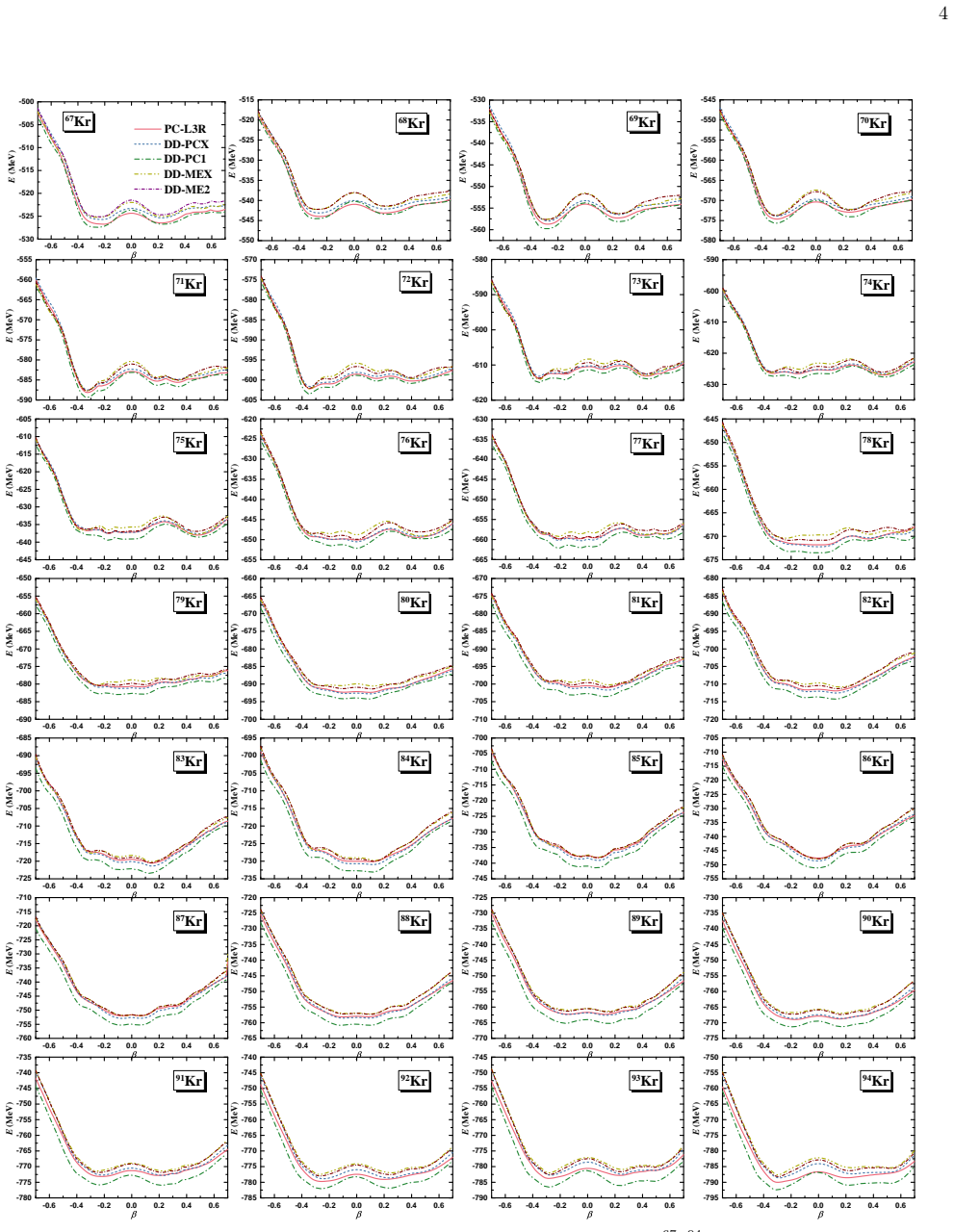
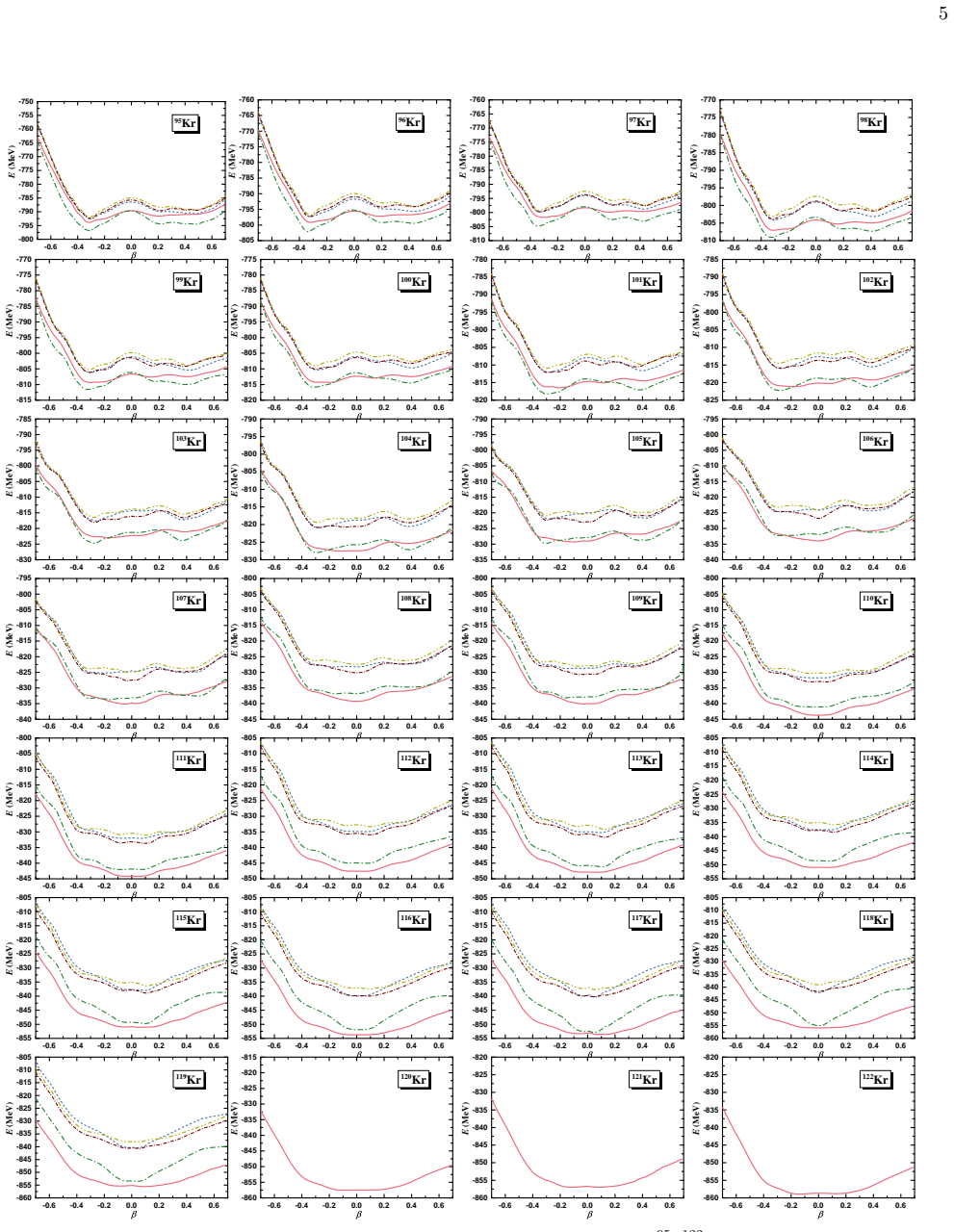
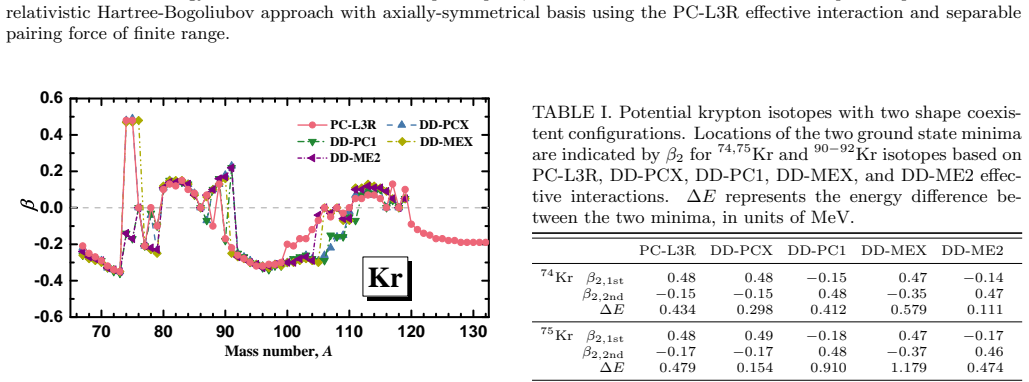
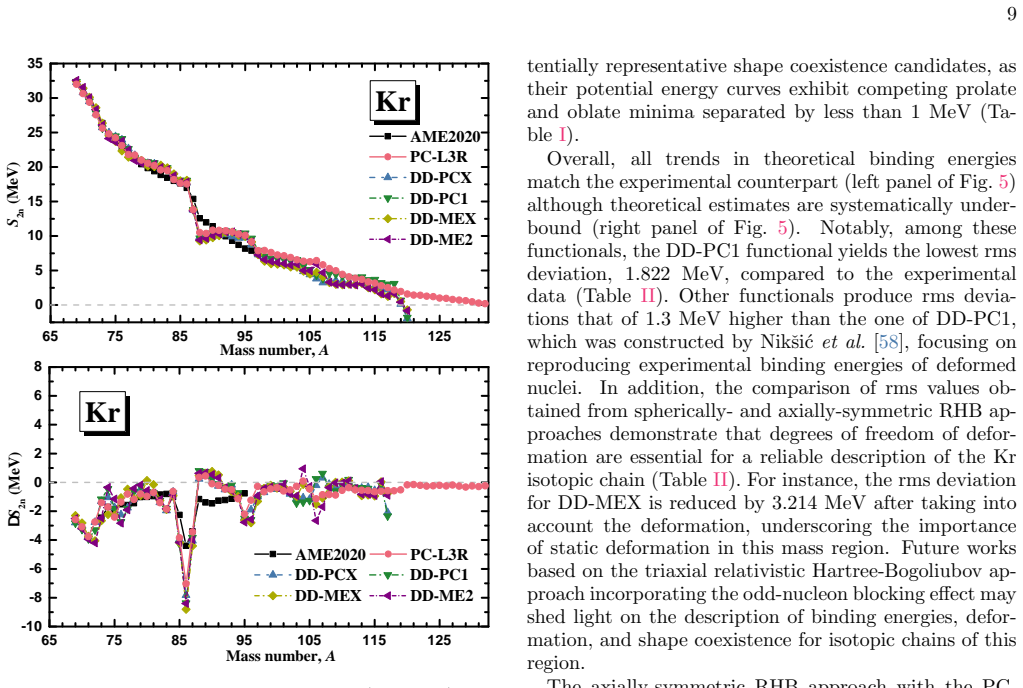
Using five covariant density functionals within the axially deformed relativistic Hartree-Bogoliubov framework, the potential energy surfaces of krypton isotopes reveal that 74,75Kr and 90,91,92Kr are typical shape-coexistence candidates. Three functionals display an abrupt oblate-to-prolate shape transition at 73-74Kr while the other two preserve oblate ground states; the differences trace to single-particle occupations near the Fermi surface. Deformation is shown to be essential for reproducing two-neutron separation energies that mark the N=50 and N=82 closures, and one functional extends the two-neutron drip line to 132Kr, suggesting a softening of the N=82 shell closure.
What carries the argument
The axially deformed relativistic Hartree-Bogoliubov approach applied to potential energy surfaces of krypton isotopes with five covariant density functionals.
If this is right
- Consideration of deformation improves the description of two-neutron separation energies and makes the N=50 and N=82 shell closures visible.
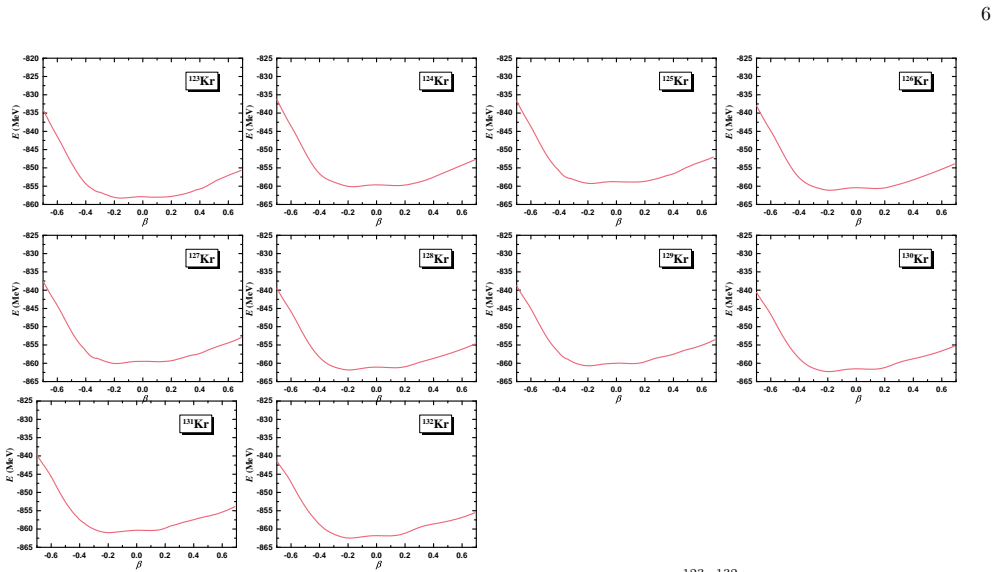
- PC-L3R interaction extends the two-neutron drip line to 132Kr unlike the others that stop at 119Kr.
- Discrepancies among functionals are due to different occupations of single-particle levels near the Fermi surface.
- Future studies should include triaxial deformation and beyond-mean-field correlations to resolve the observed differences.
Where Pith is reading between the lines
- Confirmation of the predicted shapes in 74Kr would constrain which density functionals are reliable near the N=50 region.
- The extended drip line in one model suggests that traditional magic numbers may weaken in very neutron-rich nuclei.
- Similar calculations on neighboring isotopic chains could test whether the functional dependence is specific to krypton or more general.
Load-bearing premise
The five chosen covariant density functionals correctly capture the single-particle level occupations near the Fermi surface for krypton nuclei.
What would settle it
Precise experimental measurement of the ground-state quadrupole moment or shape signature in 74Kr or 73Kr that shows no oblate-prolate transition or the opposite transition from the one predicted by the functionals.
Figures
read the original abstract
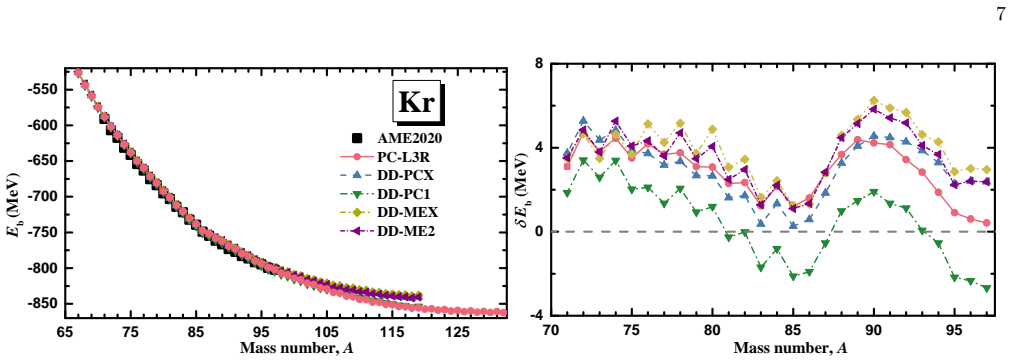
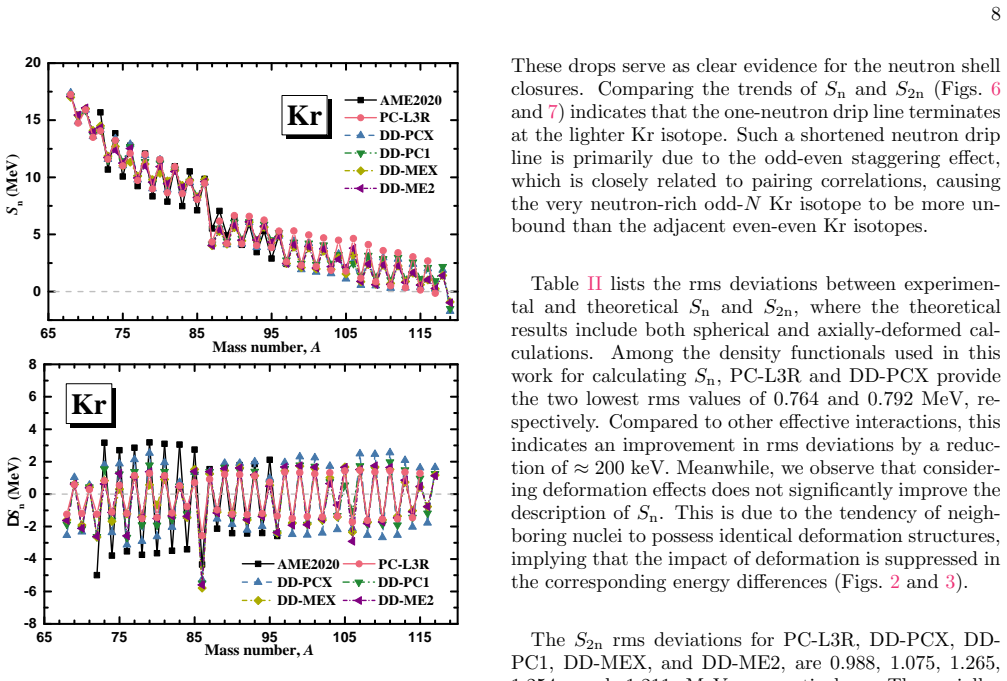
We perform a systematic study of the structure and properties of the krypton isotopic chain including both even-even and odd-$A$ nuclei based on the axially deformed relativistic Hartree-Bogoliubov approach. Five effective interactions of three families of covariant density functionals, i.e., PC-L3R, DD-PCX, DD-PC1, DD-MEX, and DD-ME2, are employed to calculate potential energy surfaces of krypton isotopes. $^{74,75}$Kr and $^{90,91,92}$Kr are determined as typical candidates of shape coexistence. The potential surfaces originating from the PC-L3R, DD-PCX, and DD-MEX interactions exhibit an abrupt shape transition from oblate to prolate for $^{73\text{-}74}$Kr, whereas DD-PC1 and DD-ME2 preserve an oblate ground-state shape. Such discrepancies are attributed to the occupations of single-particle levels at the vicinity of the Fermi surface described by these functionals. Moreover, the comparison between spherical and deformed calculations verifies the indispensability of deformation degrees of freedom in this region. The consideration of deformation effects improves the description of two-neutron separation energies, of which its evolution clearly demonstrates the $N=50$ and $82$ shell closures. Interestingly, PC-L3R predicts a more extended two-neutron drip line up to $^{132}$Kr, in agreement with the NL3* and PC-PK1 nonlinear effective interactions, whereas other functionals estimate a rather short isotopic chain up to $^{119}$Kr. This anomalous extension implies a significant softening or even collapse of the traditional $N=82$ shell closure near the neutron-rich drip line, highlighting the need for future studies based on triaxial deformation and beyond-mean-field correlations in this nuclear region.
Editorial analysis
A structured set of objections, weighed in public.
Referee Report
Summary. The manuscript performs a systematic axially deformed relativistic Hartree-Bogoliubov study of even-even and odd-A krypton isotopes using five covariant density functionals (PC-L3R, DD-PCX, DD-PC1, DD-MEX, DD-ME2). It computes potential energy surfaces, identifies 74,75Kr and 90-92Kr as shape-coexistence candidates, reports an abrupt oblate-to-prolate transition for 73-74Kr in three functionals but not the other two, attributes the functional dependence to single-particle occupations near the Fermi surface, shows that deformation improves two-neutron separation energies and highlights N=50,82 closures, and finds that PC-L3R extends the two-neutron drip line to 132Kr while the others terminate near 119Kr, suggesting possible N=82 softening.
Significance. The multi-functional comparison usefully exposes model dependence in predicted shapes and drip-line location for the Kr chain. The explicit spherical-versus-deformed comparison credibly demonstrates the necessity of deformation for separation energies. If the attribution of discrepancies to single-particle occupations were substantiated, the work would strengthen understanding of how functional choice affects coexistence and shell evolution near N=50 and N=82; without that link the model-dependent claims remain less secure.
major comments (1)
- [Results/Discussion] Results section (discussion of functional discrepancies): the claim that differences in shape evolution (abrupt transition in PC-L3R/DD-PCX/DD-MEX versus preserved oblate ground states in DD-PC1/DD-ME2) arise from single-particle level occupations near the Fermi surface is not supported by any presented data. No tabulated occupations, single-particle level diagrams, or quantitative occupation comparisons across the five functionals appear in the manuscript. This attribution is load-bearing for the identification of shape-coexistence candidates and the drip-line extension, yet remains unsubstantiated.
minor comments (2)
- [Abstract] Abstract: quantitative measures of shape coexistence (e.g., energy differences between minima or barrier heights) and explicit experimental comparisons are absent, weakening the claim that 74,75Kr and 90-92Kr are 'typical candidates'.
- [Results] The manuscript would benefit from a table or figure panel displaying the single-particle spectra or occupations for at least the key nuclei (74Kr, 90Kr) across all five functionals to allow direct verification of the stated cause of discrepancies.
Simulated Author's Rebuttal
We thank the referee for the careful reading of our manuscript and the constructive comments. We address the single major comment below and will revise the manuscript to strengthen the presentation.
read point-by-point responses
-
Referee: [Results/Discussion] Results section (discussion of functional discrepancies): the claim that differences in shape evolution (abrupt transition in PC-L3R/DD-PCX/DD-MEX versus preserved oblate ground states in DD-PC1/DD-ME2) arise from single-particle level occupations near the Fermi surface is not supported by any presented data. No tabulated occupations, single-particle level diagrams, or quantitative occupation comparisons across the five functionals appear in the manuscript. This attribution is load-bearing for the identification of shape-coexistence candidates and the drip-line extension, yet remains unsubstantiated.
Authors: We agree that the manuscript currently states the attribution to single-particle occupations near the Fermi surface without providing supporting data such as level diagrams or occupation numbers. This leaves the claim unsubstantiated. In the revised manuscript we will add single-particle spectra and quantitative occupation comparisons for the five functionals around the relevant Fermi surfaces (particularly for the 73-74Kr and 90-92Kr regions) to directly demonstrate how the level occupations differ and drive the observed shape-evolution discrepancies. revision: yes
Circularity Check
No significant circularity: shapes and drip lines are direct outputs of pre-existing functionals
full rationale
The paper applies five established covariant density functionals (PC-L3R, DD-PCX, DD-PC1, DD-MEX, DD-ME2) to compute potential energy surfaces for the Kr isotopic chain. Reported shape coexistence in 74,75Kr and 90-92Kr, oblate-to-prolate transitions, and drip-line extensions are numerical results from these pre-existing interactions applied to new nuclei. Attribution of discrepancies to single-particle occupations near the Fermi surface is an interpretive statement, not a fitted or self-defined quantity. No load-bearing self-citations, ansatze smuggled via prior work, or reductions of predictions to quantities fitted inside this manuscript. The derivation chain remains independent of the target results.
Axiom & Free-Parameter Ledger
free parameters (1)
- parameters of PC-L3R, DD-PCX, DD-PC1, DD-MEX, DD-ME2
axioms (2)
- domain assumption Axial symmetry suffices to capture the relevant shapes
- domain assumption Relativistic Hartree-Bogoliubov mean-field approximation is adequate
Reference graph
Works this paper leans on
-
[1]
The form factorP(r) is of Gaussian shape P(r) = 1 (4πa2)3/2 e−r2/4a2 .(6) According to Tianet al
=−Gδ(R−R ′)P(r)P(r ′)1 2(1−P σ), (5) with the center of mass,R= (r 1+r2)/2, and the relative coordinates,r=r 1 −r 2. The form factorP(r) is of Gaussian shape P(r) = 1 (4πa2)3/2 e−r2/4a2 .(6) According to Tianet al. [64], theGstrength in Eq. (5) and theaparameter in Eq. (6) are defined as 728 MeV fm 3 and 0.644 fm, respectively. It is worth noting that thi...
2094
-
[2]
Yamaguchi, H
T. Yamaguchi, H. Koura, Y. Litvinov, and M. Wang, Prog. Part. Nucl. Phys.120, 103882 (2021)
2021
-
[3]
W. Nan, B. Guo, J. Chen, B. Cui, W. Fu, X. Jia, C. Kan, J. Li, Y. Li, C. Lin, Y. Liu, N. Ma, Z. Peng, Y. Shen, G. Song, J. Su, B. Tang, H. Wang, Y. Wang, L. Yang, X. Yang, Z. Yin, Y. Zheng, T. Zhang, and W. Liu, Prog. Part. Nucl. Phys.145, 104188 (2025)
2025
-
[4]
Gales, Nucl
S. Gales, Nucl. Phys.A 834, 717 (2010)
2010
-
[5]
Thoennessen, Nucl
M. Thoennessen, Nucl. Phys.A 834, 688 (2010)
2010
-
[6]
Motobayashi, Nucl
T. Motobayashi, Nucl. Phys.A 834, 707 (2010)
2010
-
[7]
Sturm, B
C. Sturm, B. Sharkov, and H. St¨ ocker, Nucl. Phys.A 834, 682 (2010)
2010
-
[8]
Tshoo, Y
K. Tshoo, Y. K. Kim, Y. K. Kwon, H. J. Woo, G. D. Kim, Y. J. Kim, B. H. Kang, S. J. Park, Y.-H. Park, J. W. Yoon, and et al., Nucl. Instr. Meth.B 317, 242 (2013)
2013
-
[9]
X. H. Zhou, J. C. Yang, and the HIAF project team, AAPPS Bull.32, 35 (2022)
2022
-
[10]
Leoni, B
S. Leoni, B. Fornal, A. Bracco, Y. Tsunoda, and T. Ot- suka, Prog. Part. Nucl. Phys.139, 104119 (2024)
2024
-
[11]
P. Guo, X. Cao, K. Chen, Z. Chen, M.-K. Cheoun, Y.- B. Choi, P. C. Lam, W. Deng, J. Dong, P. Du, X. Du, K. Duan, X. Fan, W. Gao, L. Geng, E. Ha, X.-T. He, J. Hu, J. Huang, K. Huang, Y. Huang, Z. Huang, K. D. Hyung, H. Y. Chan, X. Jiang, S. Kim, Y. Kim, C.-H. Lee, J. Lee, J. Li, M. Li, Z. Li, Z. Li, Z. Lian, H. Liang, L. Liu, X. Lu, Z.-R. Liu, J. Meng, Z. ...
2024
-
[12]
Sarazin, H
F. Sarazin, H. Savajols, W. Mittig, F. Nowacki, N. A. Orr, Z. Ren, P. Roussel-Chomaz, G. Auger, D. Bai- borodin, A. V. Belozyorov, C. Borcea, E. Caurier, Z. Dlouh´ y, A. Gillibert, A. S. Lalleman, M. Lewitowicz, S. M. Lukyanov, F. de Oliveira, Y. E. Penionzhkevich, D. Ridikas, H. Sakura¨ ı, O. Tarasov, and A. de Vismes, Phys. Rev. Lett.84, 5062 (2000)
2000
-
[13]
Hady´ nska-Kl¸ ek, P
K. Hady´ nska-Kl¸ ek, P. J. Napiorkowski, M. Zieli´ nska, J. Srebrny, A. Maj, F. Azaiez, J. J. Valiente Dob´ on, M. Kici ´ nska Habior, F. Nowacki, H. Na¨ ıdja, B. Boun- thong, T. R. Rodr´ ıguez, G. de Angelis, T. Abraham, G. Anil Kumar, D. Bazzacco, M. Bellato, D. Borto- lato, P. Bednarczyk, G. Benzoni, L. Berti, B. Birkenbach, B. Bruyneel, S. Brambilla,...
2018
-
[14]
Petrovici, K
A. Petrovici, K. Schmid, A. Faessler, J. Hamilton, and A. Ramayya, Prog. Part. Nucl. Phys.43, 485 (1999)
1999
-
[15]
T. R. Rodr´ ıguez and J. L. Egido, Phys. Lett.B 705, 255 (2011)
2011
-
[16]
Togashi, Y
T. Togashi, Y. Tsunoda, T. Otsuka, N. Shimizu, and M. Honma, Phys. Rev. Lett.121, 062501 (2018)
2018
-
[17]
Maya-Barbecho and J
E. Maya-Barbecho and J. E. Garc´ ıa-Ramos, Phys. Rev. C 105, 034341 (2022)
2022
-
[18]
D. L. Hendrie, Phys. Rev. Lett.31, 478 (1973)
1973
-
[19]
Nikˇ si´ c, D
T. Nikˇ si´ c, D. Vretenar, P. Ring, and G. A. Lalazissis, Phys. Rev.C 65, 054320 (2002)
2002
-
[20]
Heyde and J
K. Heyde and J. L. Wood, Rev. Mod. Phys.83, 1467 (2011)
2011
-
[21]
P. E. Garrett, M. Zieli´ nska, and E. Cl´ ement, Prog. Part. Nucl. Phys.124, 103931 (2022)
2022
-
[22]
Chandler, P
C. Chandler, P. H. Regan, C. J. Pearson, B. Blank, A. M. Bruce, W. N. Catford, N. Curtis, S. Czajkowski, W. Gel- letly, R. Grzywacz, Z. Janas, M. Lewitowicz, C. Marc- hand, N. A. Orr, R. D. Page, A. Petrovici, A. T. Reed, M. G. Saint-Laurent, S. M. Vincent, R. Wadsworth, D. D. Warner, and J. S. Winfield, Phys. Rev.C 56, R2924 (1997)
1997
-
[23]
Bouchez, I
E. Bouchez, I. Matea, W. Korten, F. Becker, B. Blank, C. Borcea, A. Buta, A. Emsallem, G. de France, J. Gen- evey, F. Hannachi, K. Hauschild, A. H¨ urstel, Y. Le Coz, M. Lewitowicz, R. Lucas, F. Negoita, F. d. O. San- tos, D. Pantelica, J. Pinston, P. Rahkila, M. Rejmund, M. Stanoiu, and C. Theisen, Phys. Rev. Lett.90, 082502 (2003)
2003
-
[24]
Almehed and N
D. Almehed and N. R. Walet, Phys. Lett.B 604, 163 (2004)
2004
-
[25]
J. Park, A. B. Garnsworthy, R. Kr¨ ucken, C. Andreoiu, G. C. Ball, P. C. Bender, A. Chester, A. Close, P. Finlay, P. E. Garrett, J. Glister, G. Hackman, B. Hadinia, K. G. Leach, E. T. Rand, S. Sjue, K. Starosta, C. E. Svensson, and E. Tardiff, Phys. Rev.C 93, 014315 (2016)
2016
-
[26]
Singh, W
P. Singh, W. Korten, T. W. Hagen, A. G¨ orgen, L. Grente, M.-D. Salsac, F. Farget, E. Cl´ ement, G. de France, T. Braunroth, B. Bruyneel, I. Celikovic, O. Delaune, 11 A. Dewald, A. Dijon, J.-P. Delaroche, M. Girod, M. Hackstein, B. Jacquot, J. Libert, J. Litzinger, J. Ljungvall, C. Louchart, A. Gottardo, C. Michelagnoli, C. M¨ uller-Gatermann, D. R. Napol...
2018
-
[27]
Randrup, P
J. Randrup, P. M¨ oller, and A. J. Sierk, Phys. Rev.C 84, 034613 (2011)
2011
-
[28]
D. E. Ward, B. G. Carlsson, T. Døssing, P. M¨ oller, J. Randrup, and S. ˚Aberg, Phys. Rev.C 95, 024618 (2017)
2017
-
[29]
Aggarwal, P
M. Aggarwal, P. Parab, A. Jain, and G. Saxena, Nucl. Phys.A 1067, 123321 (2026)
2026
-
[30]
Bender, P.-H
M. Bender, P.-H. Heenen, and P.-G. Reinhard, Rev. Mod. Phys.75, 121 (2003)
2003
-
[31]
Abusara and S
H. Abusara and S. Ahmad, Phys. Rev.C 96, 064303 (2017)
2017
-
[32]
Duguet, M
T. Duguet, M. Bender, P. Bonche, and P.-H. Heenen, Phys. Lett.B 559, 201 (2003)
2003
-
[33]
R. R. Rodr´ ıguez-Guzm´ an, J. L. Egido, and L. M. Rob- ledo, Phys. Rev.C 69, 054319 (2004)
2004
-
[34]
Bhuyan, B
M. Bhuyan, B. V. Carlson, S. K. Patra, and S.-G. Zhou, Phys. Rev.C 97, 024322 (2018)
2018
-
[35]
X. Y. Zhang, Z. M. Niu, W. Sun, and X. W. Xia, Phys. Rev.C 108, 024310 (2023)
2023
-
[36]
Kucharek and P
H. Kucharek and P. Ring, Z. Phys. A339, 23 (1991)
1991
-
[37]
Ring, Prog
P. Ring, Prog. Part. Nucl. Phys.37, 193 (1996)
1996
-
[38]
Meng and P
J. Meng and P. Ring, Phys. Rev. Lett.77, 3963 (1996)
1996
-
[39]
P¨ oschl, D
W. P¨ oschl, D. Vretenar, G. A. Lalazissis, and P. Ring, Phys. Rev. Lett.79, 3841 (1997)
1997
-
[40]
Lu, Z.-X
W.-L. Lu, Z.-X. Liu, S.-H. Ren, W. Zhang, and T.-T. Sun, J. Phys. G: Nucl. Part. Phys.44, 125104 (2017)
2017
-
[41]
Liu, C.-J
Z.-X. Liu, C.-J. Xia, W.-L. Lu, Y.-X. Li, J. N. Hu, and T.-T. Sun, Phys. Rev.C 98, 024316 (2018)
2018
-
[42]
X. W. Xia, Y. Lim, P. W. Zhao, H. Z. Liang, X. Y. Qu, Y. Chen, H. Liu, L. F. Zhang, S. Q. Zhang, Y. Kim, and J. Meng, At. Data Nucl. Data Tables121, 1 (2018)
2018
-
[43]
A. V. Afanasjev, S. E. Agbemava, and A. Gyawali, Phys. Lett.B 782, 533 (2018)
2018
-
[44]
F. Ji, J. N. Hu, and H. Shen, Phys. Rev.C 103, 055802 (2021)
2021
-
[45]
D. Vale, Y. F. Niu, and N. Paar, Phys. Rev.C 103, 064307 (2021)
2021
-
[46]
U. C. Perera, A. V. Afanasjev, and P. Ring, Phys. Rev. C 104, 064313 (2021)
2021
-
[47]
K. Y. Zhang, M.-K. Cheoun, Y.-B. Choi, P. S. Chong, J. M. Dong, Z. H. Dong, X. K. Du, L. S. Geng, E. J. Ha, X.-T. He, C. Heo, M. C. Ho, E. J. In, S. Kim, Y. Kim, C.-H. Lee, J. Lee, H. X. Li, Z. P. Li, T. P. Luo, J. Meng, M.-H. Mun, Z. M. Niu, C. Pan, P. Papakonstantinou, X. L. Shang, C. W. Shen, G. F. Shen, W. Sun, X.-X. Sun, C. K. Tam, Thaivayongnou, C. ...
2022
-
[48]
Z. X. Liu, Y. H. Lam, N. Lu, and P. Ring, Phys. Lett.B 842, 137946 (2023)
2023
-
[49]
Z. X. Liu, Y. H. Lam, N. Lu, and P. Ring, At. Data Nucl. Data Tables156, 101635 (2024)
2024
-
[50]
B. Osei, A. V. Afanasjev, and A. Dalbah, Phys. Rev.C 112, 054321 (2025)
2025
-
[51]
Vretenar, A
D. Vretenar, A. V. Afanasjev, G. A. Lalazissis, and P. Ring, Phys. Rep.409, 101 (2005)
2005
-
[52]
J. Meng, H. Toki, S.-G. Zhou, S. Q. Zhang, W. H. Long, and L. S. Geng, Prog. Part. Nucl. Phys.57, 470 (2006)
2006
-
[53]
Sugahara and H
Y. Sugahara and H. Toki, Nucl. Phys. A579, 557 (1994)
1994
-
[54]
G. A. Lalazissis, J. K¨ onig, and P. Ring, Phys. Rev.C 55, 540 (1997)
1997
-
[55]
W. H. Long, J. Meng, N. V. Giai, and S. G. Zhou, Phys. Rev.C 69, 034319 (2004)
2004
-
[56]
G. A. Lalazissis, T. Nikˇ si´ c, D. Vretenar, and P. Ring, Phys. Rev.C 71, 024312 (2005)
2005
-
[57]
A. V. Afanasjev, S. E. Agbemava, D. Ray, and P. Ring, Phys. Lett.B 726, 680 (2013)
2013
-
[58]
B. A. Nikolaus, T. Hoch, and D. G. Madland, Phys. Rev. C 46, 1757 (1992)
1992
-
[59]
Nikˇ si´ c, D
T. Nikˇ si´ c, D. Vretenar, and P. Ring, Phys. Rev.C 78, 034318 (2008)
2008
-
[60]
P. W. Zhao, Z. P. Li, J. M. Yao, and J. Meng, Phys. Rev. C 82, 054319 (2010)
2010
-
[61]
Y¨ uksel, T
E. Y¨ uksel, T. Marketin, and N. Paar, Phys. Rev.C 99, 034318 (2019)
2019
-
[62]
Taninah, S
A. Taninah, S. E. Agbemava, A. V. Afanasjev, and P. Ring, Phys. Lett.B 800, 135065 (2020)
2020
-
[63]
Y. H. Lam, Z. X. Liu, A. Heger, N. Lu, A. M. Jacobs, and Z. Johnston, Astrophys. J.929, 72 (2022)
2022
-
[64]
G. A. Lalazissis, D. Vretenar, and P. Ring, Phys. Rev.C 57, 2294 (1998)
1998
-
[65]
Y. Tian, Z. Y. Ma, and P. Ring, Phys. Lett.B 676, 44 (2009)
2009
-
[66]
Chappert, M
F. Chappert, M. Girod, and S. Hilaire, Phys. Lett.B 668, 420 (2008)
2008
-
[67]
S. E. Agbemava, A. V. Afanasjev, D. Ray, and P. Ring, Phys. Rev.C 89, 054320 (2014)
2014
-
[68]
J. L. Mora˜ na and X. Vi˜ nas, Phys. Rev.C 108, 014605 (2023)
2023
-
[69]
Zietek, N
G. Zietek, N. Pillet, M. Anguiano, P. Carpentier, N. Dubray, R. Bernard, G. Blanchon, and D. Regnier, Phys. Lett.B 872, 140072 (2026)
2026
-
[70]
Nikˇ si´ c, N
T. Nikˇ si´ c, N. Paar, D. Vretenar, and P. Ring, Comput. Phys. Commun.185, 1808 (2014)
2014
-
[71]
Ring and P
P. Ring and P. Schuck,The Nuclear Many-body Problem (Springer-Verlag, 1980)
1980
-
[72]
Choi, C.-H
Y.-B. Choi, C.-H. Lee, M.-H. Mun, and Y. Kim, Phys. Rev.C 105, 024306 (2022)
2022
-
[73]
F. G. Kondev, M. Wang, W. J. Huang, S. Naimi, and G. Audi, Chin. Phys.C 45, 030001 (2021)
2021
discussion (0)
Sign in with ORCID, Apple, or X to comment. Anyone can read and Pith papers without signing in.