REVIEW 3 major objections 6 minor 33 references
A charge-only maximum-likelihood method using calibration-derived nPE maps reconstructs both radius and visible energy of positron events in a ton-scale spherical liquid-scintillator detector, achieving in Monte Carlo a vertex bias below 2
Reviewed by Pith at T0; open to challenge. T0 means a machine referee read the full paper against a public rubric. the ladder, T0–T4 →
T0 review · deepseek-v4-flash
2026-08-01 14:15 UTC pith:BJMI56RA
load-bearing objection Honest but overstated application of a known likelihood template method to a small LS detector; the missing energy-resolution number and radius-dependent vertex claim need fixing before the headline results can be trusted. the 3 major comments →
A method for energy and radius reconstruction with simulated charge information in a ton-scale liquid scintillator detector like Taishan Antineutrino Observatory
The pith
A machine-rendered reading of the paper's core claim, the machinery that carries it, and where it could break.
Core claim
On its own terms, the paper claims that the expected light pattern on the SiPM array, expressed as an nPE map per unit visible energy and parameterized only by event radius and SiPM polar angle, is a sufficient statistic for simultaneous radius and energy reconstruction. Because the detector is spherical, maps measured along one axis describe all directions, and maps at five calibration radii can be linearly interpolated. The maximum-likelihood fit over radius and energy, with angles fixed by a center-of-charge seed, yields sub-4-cm radius resolution and sub-2-cm bias for positrons in simulation, and an energy resolution whose dominant term is photoelectron statistics, with quenching the lar
What carries the argument
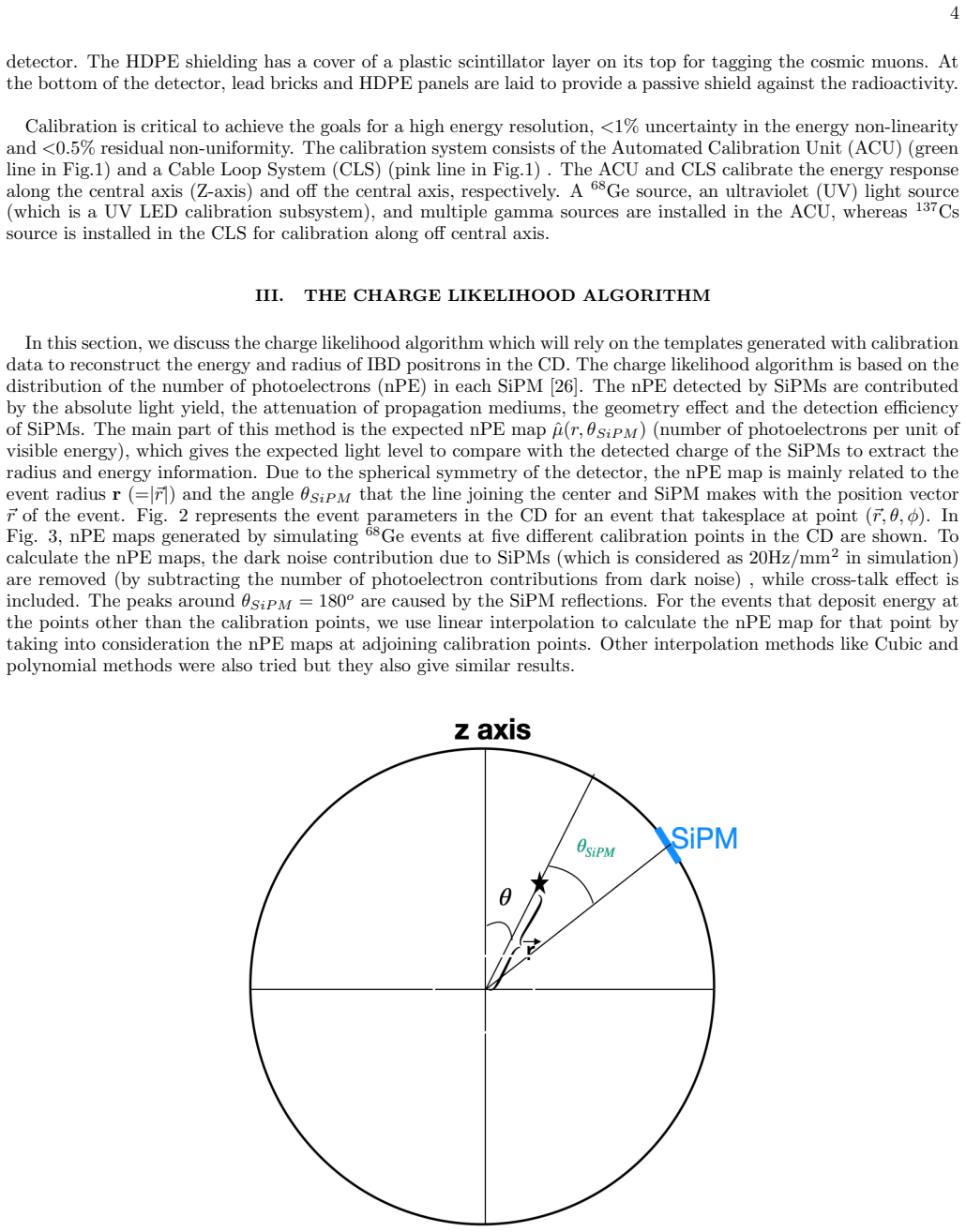
The central object is the nPE map, mu_hat(r, theta_SiPM): the expected number of photoelectrons per MeV of visible energy seen by each SiPM as a function of the event radius r and the angle between the event position and the SiPM direction. It feeds a likelihood that combines a Poisson distribution for the number of photoelectrons on each channel with a Gaussian single-photoelectron charge response; maximizing the negative log-likelihood over r and E gives the reconstructed values. The map's separability into radius and angle plus linear interpolation between calibration points is what carries the argument.
Load-bearing premise
The method assumes that nPE maps measured at five calibration radii can be linearly interpolated to any radius, and that maps measured along one axis describe all directions because the detector is perfectly spherically symmetric.
What would settle it
Take a real calibration source at a radius not in the template grid, say 500 mm, and reconstruct it using templates built from the other radii; if the reconstructed radius bias or resolution exceeds the quoted few-centimeter values, the linear-interpolation or spherical-symmetry assumption breaks. Separately, compare real 137Cs/68Ge calibration maps with simulated maps: a mismatch in the reflection peak or angular shape would directly invalidate the MC-based performance numbers.
If this is right
- Charge-only information is sufficient for radial and visible-energy reconstruction in compact spherical liquid-scintillator detectors, so timing readout is not needed for these quantities.
- Calibration with gamma sources at a few positions (e.g., 137Cs and 68Ge) can generate templates that work across event energies; the energy-dependent reflection region changes the overall resolution by less than 1%.
- The same template method transfers to other detectors of similar size and spherical geometry, provided their SiPM response can be calibrated.
- The main limit to energy resolution is photoelectron statistics; crosstalk, dark noise, and reflections each contribute roughly half a percent or less, while scintillator quenching is the largest non-statistical effect.
Where Pith is reading between the lines
- A natural test beyond the paper is to build nPE maps from real calibration data at the five radii and reconstruct events from an independent source position; success would confirm that linear interpolation and one-axis maps hold in the physical detector.
- Because the quoted performance comes from the same simulated detector used to produce the templates, a mismatch between simulation and the real optical response (e.g., unmodeled reflections or SiPM non-uniformity) would change the numbers; the method's robustness to such mismatch is not yet demonstrated.
- The radial resolution for positrons is worse than for electrons because annihilation gammas smear the light profile; combining charge-only reconstruction with timing information could push vertex resolution below the quoted 4 cm.
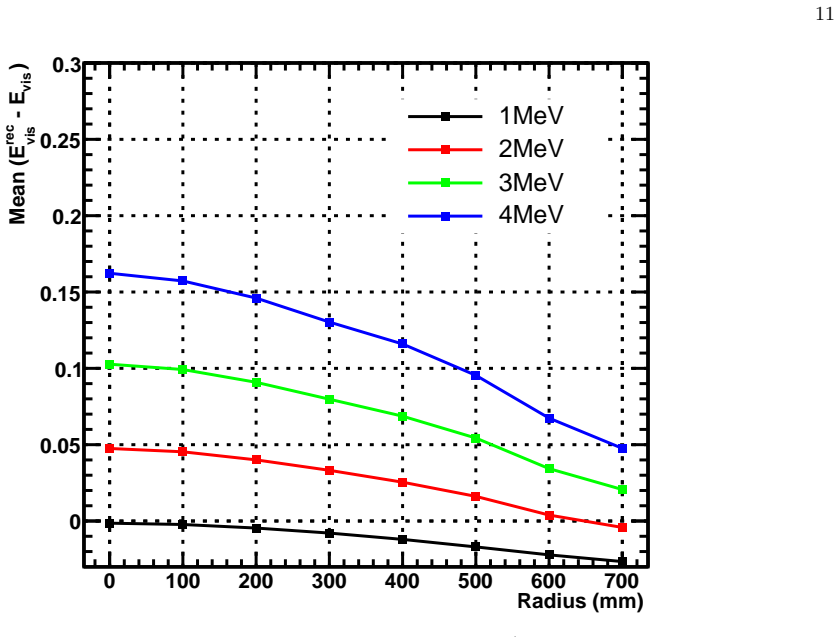
- The energy bias rising with energy near the boundary points to energy leakage; an energy-dependent template interpolation or an explicit leakage correction could extend the method's useful fiducial volume.
Editorial analysis
A structured set of objections, weighed in public.
Referee Report
Summary. The paper proposes a charge-only maximum-likelihood reconstruction method (QMLE) for simultaneous reconstruction of the radius and visible energy of IBD positrons in a ton-scale liquid scintillator detector of the JUNO-TAO type. The method builds templates of the expected number of photoelectrons per MeV as a function of event radius and SiPM angle, using simulated calibration sources (68Ge, 137Cs), interpolates these nPE maps between calibration radii and along axes, and then minimizes a Poisson-Gaussian charge likelihood over r and E, with θ and φ fixed from the CCA algorithm. The authors report Monte Carlo results for reconstructed radial bias and resolution for e+ and e− samples and study the effect of reflections, cross-talk, dark noise, and quenching on energy resolution. The conclusion states that vertex bias below 2 cm and vertex resolution below 4 cm can be achieved for positrons, and that the method is applicable to similar spherical neutrino detectors.
Significance. If the claimed performance were fully substantiated, the method would be a useful contribution to reconstruction in compact liquid scintillator detectors: it uses only charge information, exploits spherical symmetry, and is intended to be calibrated from radioactive source data rather than from an analytical optical model. The template-based charge likelihood is a reasonable and transparent statistical framework, and the paper includes MC samples covering multiple energies and radii, and some robustness checks on cross-talk, dark noise, and reflections. However, the paper as presented does not support its headline claims: no energy resolution number is reported despite the abstract promising 'unprecedented energy resolution', and the vertex performance is qualified only in a small central region, not over the fiducial volume as the conclusion implies. These issues are central and require additional analysis or a substantial reframing of the claims.
major comments (3)
- [Sec. V, Sec. IV A, Fig. 6, Table II] The conclusion states 'vertex bias less than 2 cm and vertex resolution less than 4 cm can be achieved for the positrons' without radial qualification. Fig. 6(b) shows this holds only for small radii; for radii ≳500 mm the radial resolution is above 40 mm at all kinetic energies, and the bias grows to ~30–40 mm near the 650 mm fiducial boundary. Table II gives center values of 15–16 mm bias and 38–38.5 mm resolution for e+, so even at the center the resolution is only 2 mm below the claimed 4 cm. Because IBD vertices are roughly uniformly distributed in the LS volume, the volume-averaged resolution will be substantially worse than 4 cm. The paper should report the claimed performance as a function of radius and specify the fiducial radius over which the 'less than 4 cm' statement is valid.
- [Abstract, Sec. IV B, Figs. 9–10] The abstract's central promise is 'unprecedented energy resolution', but the paper never quotes an energy resolution value. Sec. IV B reports only relative changes ('less than 1%', 'around 0.5%', 'around 0.16%') and energy bias in Figs. 9 and 10; there is no σ(E_rec)/E or equivalent resolution metric anywhere. Without this number, the energy-reconstruction claim is unsupported. The authors should add energy resolution as a function of radius and energy for both nPE map types, and if the energy resolution is not competitive with existing methods, the abstract should be revised accordingly.
- [Sec. III, Figs. 3–4, Sec. IV] The performance numbers are obtained in a fully self-consistent MC setup: both the nPE-map templates and the reconstructed event samples are generated with the same Geant4 simulation and the same optical model. This is a closure test, not a validation against real calibration data. The paper emphasizes that templates will be built from calibration sources, but it does not test sensitivity to template mismatch—e.g., interpolation errors between the five calibration radii, imperfect source-position knowledge, or differences between simulated and actual reflection/absorption. A concrete test would be to perturb the optical parameters or source positions when building templates and then reconstruct the nominal samples, showing that the quoted biases and resolutions are stable at the claimed level.
minor comments (6)
- [Throughout] The manuscript contains many typos and grammatical errors, e.g., 'scintilling', 'the the', 'achi-eved', 'reletive', 'infromation', 'reconstrucede +', 'met-hod', and 'eutrinos'. A thorough language edit is needed.
- [Figs. 9–10] The y-axis label in Figs. 9 and 10 reads 'Mean(E_vis − E_rec_vis)' but the panel title says 'QMLE Vertex Bias'. This is misleading; it should be labeled 'energy bias'.
- [Sec. IV B] The relative changes 'less than 1%', 'around 0.5%', and 'around 0.16%' are quoted without statistical uncertainties or the baseline resolution values to which they refer. Please provide the absolute resolutions and errors for these comparisons.
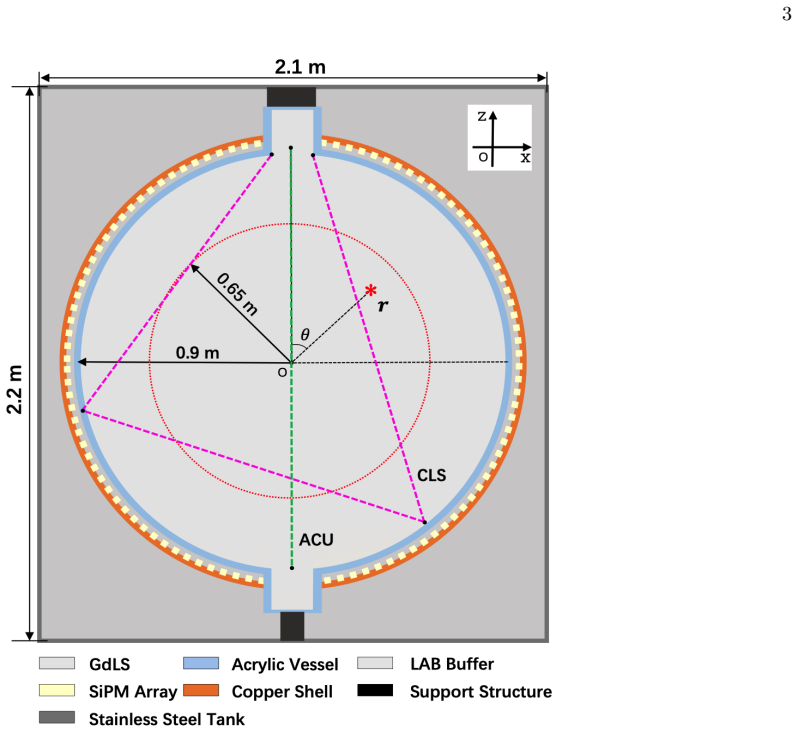
- [Sec. II / Fig. 1] The calibration system description would benefit from a clear statement of the radius coverage of the ACU and CLS calibration points, and how the five radii in Fig. 3 (0, 200, 375, 650, 850 mm) correspond to the actual calibration path.
- [Eq. (4)] The notation 'unhit' and 'hit' is not formally defined; please state that unhit channels are those with zero recorded photoelectrons. Also, the Gaussian charge response in Eq. (2) uses the same S_i for all k; its validity for small k should be commented on.
- [Sec. III] The interpolation from five calibration radii to arbitrary radii is stated to work 'similar' for cubic and polynomial methods, but no quantitative comparison is shown. It would help to report the interpolation residuals or to state that the results are insensitive to the interpolation order.
Circularity Check
No circularity: the template likelihood is self-contained; MC-only evaluation limits generality but does not make the derivation circular.
full rationale
The claimed derivation is not circular. The nPE templates (Sec. III, Fig. 3) are generated by simulating 68Ge/137Cs sources at fixed calibration positions; Eq. (3) then writes mu_i(r,E)=E·mu_hat_i(r,theta_SiPM), and Eq. (5) minimizes the likelihood over free parameters r and E. The target radius and energy are not used to build the templates, and the test samples (Table I: e+ at 0-70 cm with 0-4 MeV) are independent of the calibration points. Thus Eq. (5) does not reduce by construction to its inputs; there is no fitted parameter renamed as a prediction. The radial degradation visible in Fig. 6 is a performance caveat, not circularity: the quoted '<2 cm bias, <4 cm resolution' holds only near the center, and the MC-only evaluation means the numbers measure self-consistency with the optical model rather than robustness to a mismatched real detector. No load-bearing self-citation appears: Ref. [19] includes an author but is an unrelated E nu ES physics citation; the template/likelihood machinery cites external prior work ([26]) and uses standard Geant4 simulation. Therefore no circular step is identified.
Axiom & Free-Parameter Ledger
free parameters (4)
- nPE map interpolation order =
linear
- theta_cut for reflection region =
160 deg
- Single photoelectron spectrum Qi, Si =
not stated
- Dark noise rate =
20 Hz/mm^2
axioms (4)
- domain assumption The number of photoelectrons k on each SiPM follows a Poisson distribution with mean mu_i(r,E).
- domain assumption The single-photoelectron charge response for k photoelectrons is Gaussian with mean k*Qi and variance k*Si^2.
- domain assumption The expected nPE map mu_hat(r, theta_SiPM) is independent of the event direction and azimuthal angle.
- domain assumption The energy dependence of the nPE map is negligible over the fit range.
read the original abstract
Small neutrino detectors are a ton level detectors which can be placed very close to the core of Nuclear Power Plant. In some detectors liquid scintilling (LS) material is used as the detecting material. The antineutrinos from the reactor core fall on the liquid scintillator of the detector where they deposit energy via Inverse Beta Decay process (IBD). The energy absorbed by liquid scintillator is re-emitted in the form of scintillation. These photons then travel through the scintillating material and hit the Silicon Photo Multipliers (SiPMs) which are installed on the inner surface of detector's spherical copper shell. These SiPMs absorb the photons to give a charge output signal. The energy and radius reconstruction is done using the information of charge collected by the SiPMs. Due to factors like large photo-coverage with large photon detection efficiency, small spherical detector size and low temperature operation, small size LS detectors can achieve an unprecedented energy resolution. In this paper, we have used a template-dependent method exploiting simulated data to reconstruct the event radius and energy. This method uses response functions generated using radioactive source calibration data and the charge information to reconstruct the energy and the radius of the event by constructing maximizing a likelihood function. This methodology is applicable to all similar size spherical neutrino detector experiments.
Figures



Reference graph
Works this paper leans on
-
[1]
First results from KamLAND: Evidence for reactor anti-neutrino disappearance,
K. Eguchiet al.[KamLAND], “First results from KamLAND: Evidence for reactor anti-neutrino disappearance,” Phys. Rev. Lett.90, 021802 (2003) doi:10.1103/PhysRevLett.90.021802 [arXiv:hep-ex/0212021 [hep-ex]]
Pith/arXiv arXiv 2003
-
[2]
M. Redchuk, “Looking inside the Sun with the Borexino experiment: detection of solar eutrinos from the proton-proton chain and the CNO cycle,” doi:10.18154/R WTH-2020-12244
work page doi:10.18154/r 2020
-
[3]
Indication of Reactor ¯ν e Disappearance in the Double Chooz xperiment,
Y. Abeet al.[Double Chooz], “Indication of Reactor ¯ν e Disappearance in the Double Chooz xperiment,” Phys. Rev. Lett. 108, 131801 (2012) doi:10.1103/PhysRevLett.108.131801 [arXiv:1112.6353 [hep-ex]]
Pith/arXiv arXiv 2012
-
[4]
Observation of electron-antineutrino disappearance at Daya Bay,
F. P. Anet al.[Daya Bay], “Observation of electron-antineutrino disappearance at Daya Bay,” Phys. Rev. Lett.108, 171803 (2012) doi:10.1103/PhysRevLett.108.171803 [arXiv:1203.1669 [hep-ex]]
Pith/arXiv arXiv 2012
-
[5]
Observation of Reactor Electron Antineutrino Disappearance in the RENO Experiment,
J. K. Ahnet al.[RENO], “Observation of Reactor Electron Antineutrino Disappearance in the RENO Experiment,” Phys. Rev. Lett.108, 191802 (2012) doi:10.1103/PhysRevLett.108.191802 [arXiv:1204.0626 [hep-ex]]
Pith/arXiv arXiv 2012
-
[6]
A. Abuslemeet al.[JUNO], “JUNO physics and detector,” Prog. Part. Nucl. Phys.123, 103927 (2022) doi:10.1016/j.ppnp.2021.103927 [arXiv:2104.02565 [hep-ex]]
arXiv 2022
-
[7]
First measurement of reactor neutrino oscillations at JUNO,
A. Abuslemeet al.[JUNO], “First measurement of reactor neutrino oscillations at JUNO,” [arXiv:2511.14593 [hep-ex]]
-
[8]
G. h. Huang, W. Jiang, L. j. Wen, Y. f. Wang and W. M. Luo, Nucl. Sci. Tech.34(2023) no.6, 83 doi:10.1007/s41365- 023-01240-0 [arXiv:2211.16768 [physics.ins-det]]
Pith/arXiv arXiv 2023
-
[9]
Prediction of Energy Resolution in the JUNO Experiment,
A. Abuslemeet al.[JUNO], “Prediction of Energy Resolution in the JUNO Experiment,” Chin. Phys. C49(2025) no.1, 013003 doi:10.1088/1674-1137/ad83aa [arXiv:2405.17860 [hep-ex]]
arXiv 2025
-
[10]
Constraints on non-standard neutrino interactions from Borexino extended data-set,
V. Antonelliet al.[BOREXINO], “Constraints on non-standard neutrino interactions from Borexino extended data-set,” [arXiv:2602.08685 [hep-ex]]
-
[11]
Determination of the Neutrino Mass Hierarchy at an Intermediate Baseline,
L. Zhan, Y. Wang, J. Cao and L. Wen, “Determination of the Neutrino Mass Hierarchy at an Intermediate Baseline,” Phys. Rev. D78, 111103 (2008) doi:10.1103/PhysRevD.78.111103 [arXiv:0807.3203 [hep-ex]]
Pith/arXiv arXiv 2008
-
[12]
Neutrinoless Double-Beta Decay: Status and Prospects,
M. J. Dolinski, A. W. P. Poon and W. Rodejohann, “Neutrinoless Double-Beta Decay: Status and Prospects,” Ann. Rev. Nucl. Part. Sci.69, 219-251 (2019) doi:10.1146/annurev-nucl-101918-023407 [arXiv:1902.04097 [nucl-ex]]
Pith/arXiv arXiv 2019
-
[13]
S. Gariazzo, C. Giunti, M. Laveder, Y. F. Li and E. M. Zavanin, “Light sterile neutrinos,” J. Phys. G43, 033001 (2016) doi:10.1088/0954-3899/43/3/033001 [arXiv:1507.08204 [hep-ph]]
Pith/arXiv arXiv 2016
-
[14]
Future searches for light sterile neutrinos at nuclear reactors,
J. M. Berryman, L. A. Delgadillo and P. Huber, “Future searches for light sterile neutrinos at nuclear reactors,” Phys. Rev. D105, no.3, 035002 (2022) doi:10.1103/PhysRevD.105.035002 [arXiv:2104.00005 [hep-ph]]
Pith/arXiv arXiv 2022
-
[15]
JUNO sensitivity to the annihilation of MeV dark matter in the galactic halo,
A. Abuslemeet al.[JUNO], “JUNO sensitivity to the annihilation of MeV dark matter in the galactic halo,” JCAP09 (2023), 001 doi:10.1088/1475-7516/2023/09/001 [arXiv:2306.09567 [hep-ex]]
arXiv 2023
-
[16]
q i”generated by thei th SiPM after being hit by “k
and also has some potential through elastic neutrino-electron scattering (EνES) [19]. The reconstruction of the individual events is one of the most important task in order to obtain neutrino information such as their energies. In general, the event reconstruction should provide us the information about the energy, vertex and the interaction time (relativ...
-
[17]
A. Abuslemeet al.[JUNO], “TAO Conceptual Design Report: A Precision Measurement of the Reactor Antineutrino Spectrum with Sub-percent Energy Resolution,” [arXiv:2005.08745 ]
arXiv 2005
-
[18]
On the determination of anti-neutrino spectra from nuclear reactors,
P. Huber, “On the determination of anti-neutrino spectra from nuclear reactors,” Phys. Rev. C84, 024617 (2011) [erratum: Phys. Rev. C85, 029901 (2012)] doi:10.1103/PhysRevC.85.029901 [arXiv:1106.0687 [hep-ph]]
Pith/arXiv arXiv 2011
-
[19]
Improved Predictions of Reactor Antineutrino Spectra,
T. A. Mueller,et al.“Improved Predictions of Reactor Antineutrino Spectra,” Phys. Rev. C83, 054615 (2011) doi:10.1103/PhysRevC.83.054615 [arXiv:1101.2663 [hep-ex]]
Pith/arXiv arXiv 2011
-
[20]
Elastic neutrino-electron scattering perspectives at nuclear reactors,
L. A. Delgadillo, Q. Liu and R. Singh, “Elastic neutrino-electron scattering perspectives at nuclear reactors,” Phys. Rev. D113, no.11, 113007 (2026) doi:10.1103/m6yl-nzd9 [arXiv:2602.21523 [hep-ph]]
Pith/arXiv arXiv 2026
-
[21]
Maximum likelihood reconstruction of a detector with reflective panels,
L. J. Wen, J. Cao, Y. Wang, Z. Wang and C. Yang, “Maximum likelihood reconstruction of a detector with reflective panels,” Nucl. Instrum. Meth. A629, 296-302 (2011) doi:10.1016/j.nima.2010.11.030
-
[22]
Vertex and energy reconstruction in JUNO with machine learning methods,
Z. Qian, V. Belavin, V. Bokov, R. Brugnera, A. Compagnucci, A. Gavrikov, A. Garfagnini, M. Gonchar, L. Khatbullina and Z. Li,et al.“Vertex and energy reconstruction in JUNO with machine learning methods,” Nucl. Instrum. Meth. A 1010(2021), 165527 doi:10.1016/j.nima.2021.165527 [arXiv:2101.04839 [physics.ins-det]]
arXiv 2021
-
[23]
Vertex reconstruction in the TAO experiment,
H. Shi, J. Wang, G. Cao, W. Wang and Y. Wei, “Vertex reconstruction in the TAO experiment,” [arXiv:2508.06293 [physics.ins-det]]
-
[24]
First-principle event reconstruction by time-charge readouts for TAO,
X. Liu, W. Dou, B. Xu, H. Wang and G. Cao, “First-principle event reconstruction by time-charge readouts for TAO,” Eur. Phys. J. C85(2025) no.4, 438 [erratum: Eur. Phys. J. C85(2025) no.6, 653] doi:10.1140/epjc/s10052-025-14161-6 [arXiv:2403.01239 [hep-ex]]
Pith/arXiv arXiv 2025
-
[25]
F. P. Anet al.[Daya Bay], “Measurement of electron antineutrino oscillation based on 1230 days of operation of the Daya Bay experiment,” Phys. Rev. D95, no.7, 072006 (2017) doi:10.1103/PhysRevD.95.072006 [arXiv:1610.04802 [hep-ex]]
Pith/arXiv arXiv 2017
-
[26]
Calibration strategy of the JUNO-TAO experiment,
H. Xu,et al.“Calibration strategy of the JUNO-TAO experiment,” Eur. Phys. J. C82, no.12, 1112 (2022) doi:10.1140/epjc/s10052-022-11069-3 [arXiv:2204.03256 ]
arXiv 2022
-
[27]
A new method of energy reconstruction for large spherical liquid scintillator detectors,
W. Wu, M. He, X. Zhou and H. Qiao, “A new method of energy reconstruction for large spherical liquid scintillator detectors,” JINST14, no.03, P03009 (2019) doi:10.1088/1748-0221/14/03/P03009 [arXiv:1812.01799 ]. 13
Pith/arXiv arXiv 2019
-
[28]
A side-by-side comparison of Daya Bay antineutrino detectors,
F. P. Anet al.[Daya Bay], “A side-by-side comparison of Daya Bay antineutrino detectors,” Nucl. Instrum. Meth. A685, 78-97 (2012) doi:10.1016/j.nima.2012.05.030 [arXiv:1202.6181 ]
Pith/arXiv arXiv 2012
-
[29]
GEANT4 - A Simulation Toolkit,
S. Agostinelliet al.[GEANT4], “GEANT4 - A Simulation Toolkit,” Nucl. Instrum. Meth. A506, 250-303 (2003) doi:10.1016/S0168-9002(03)01368-8
-
[30]
Optimization of the JUNO liquid scintillator composition using a Daya Bay antineutrino detector,
A. Abuslemeet al.[JUNO and Daya Bay], “Optimization of the JUNO liquid scintillator composition using a Daya Bay antineutrino detector,” Nucl. Instrum. Meth. A988, 164823 (2021) doi:10.1016/j.nima.2020.164823 [arXiv:2007.00314 ]
arXiv 2021
-
[31]
A complete optical model for liquid-scintillator detectors,
Y. Zhang, Z. Y. Yu, X. Y. Li, Z. Y. Deng and L. J. Wen, “A complete optical model for liquid-scintillator detectors,” Nucl. Instrum. Meth. A967, 163860 (2020) doi:10.1016/j.nima.2020.163860 [arXiv:2003.12212 ]
arXiv 2020
-
[32]
J. B. Birks, “Scintillations from Organic Crystals: Specific Fluorescence and Relative Response to Different Radiations,” Proc. Phys. Soc. A64, 874-877 (1951) doi:10.1088/0370-1298/64/10/303
-
[33]
The Nature of the Saturation Effect of Fluorescent Scintillators,
C. N. Chou, “The Nature of the Saturation Effect of Fluorescent Scintillators,” Phys. Rev.87, no.5, 904-905 (1952) doi:10.1103/PhysRev.87.904
discussion (0)
Sign in with ORCID, Apple, or X to comment. Anyone can read and Pith papers without signing in.