REVIEW 2 major objections 2 minor 19 references
S-GAI: Spectral Geometry-Aware Initialization for Sigmoidal MLPs -- From Dataset Geometry to Network Weights
T0 review · 2 major / 2 minor · reviewed 2026-06-30 · grok-4.3
Pith's one-line read S-GAI initializes sigmoidal MLPs by embedding class-wise spectral geometry from SVD into sigmoid gates.
desk verdict S-GAI turns class-wise SVD into paired sigmoid gates for shallow MLPs, but the abstract leaves the exact mapping and the numbers unclear. read the letter →
The pith
A machine-rendered reading of the paper's core claim, the machinery that carries it, and where it could break.
The reading
What carries the argument
Class-specific pairs of sigmoid gates derived from SVD principal directions and spectral scales to form the hidden layer from dataset geometry.
What would settle it
Observing that the SVD-based subspace classifier achieves low accuracy on held-out data, or that the frozen S-GAI hidden layer performs similarly to or worse than random initialization in output-layer training.
Extended reading notes
Core claim
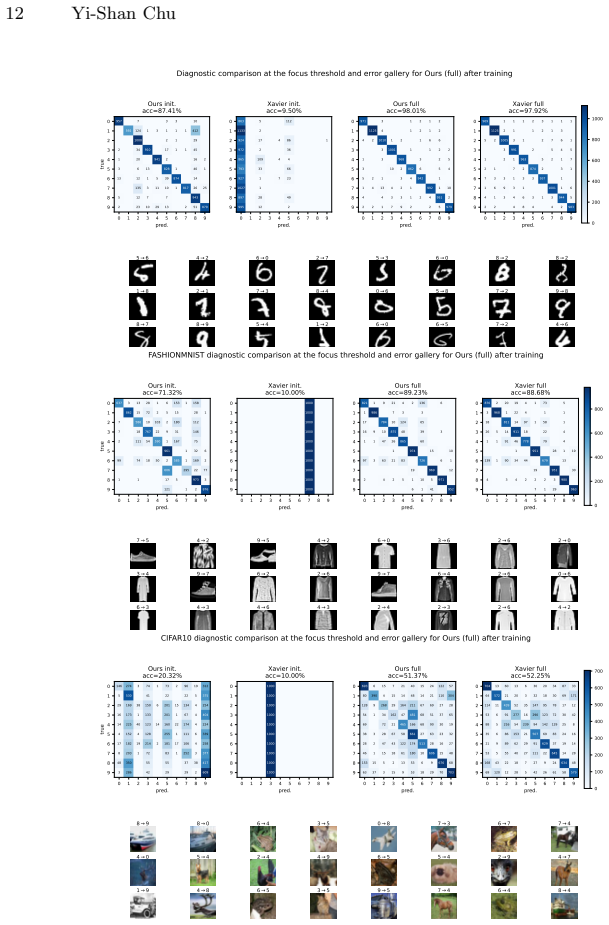
S-GAI constructs the hidden layer of a one-hidden-layer sigmoidal MLP by estimating class-wise spectral geometry via SVD on training images, selecting principal directions above an energy threshold, and representing each direction with a pair of sigmoid gates. This initialization is tested against a non-neural SVD-based subspace classifier to confirm the geometry is discriminative, and experiments show the resulting MLP achieves stronger performance than Xavier initialization when the hidden layer is frozen and comparable accuracy after full training on MNIST, Fashion-MNIST, and CIFAR-10.
Load-bearing premise
Class-wise spectral geometry obtained via SVD on the training images is already sufficiently discriminative and can be faithfully represented by pairs of sigmoid gates.
Editorial extensions
If this is right
- The S-GAI-initialized MLP starts from a substantially more informative hidden state than Xavier initialization.
- When the hidden layer is frozen, training only the output layer gives stronger performance than with frozen random gates.
- The method reaches comparable final accuracy under full training on the tested image datasets.
- The SVD-based subspace classifier confirms that the estimated spectral class geometry is already discriminative before embedding.
Reading between the lines
- This initialization strategy could be adapted for multi-layer networks by applying spectral decomposition sequentially.
- Direct embedding of geometry might allow for reduced training epochs or smaller datasets in some cases.
- The approach highlights a path from data analysis to network parameters without iterative optimization for the initial state.
Editorial analysis
A structured set of objections, weighed in public.
Referee Report
Summary. The manuscript proposes S-GAI, a spectral geometry-aware initialization for one-hidden-layer sigmoidal MLPs. Class-wise SVD on training images yields means, principal directions, and spectral scales; an energy threshold selects retained directions, each encoded by two sigmoid gates that are aggregated into a shared hidden layer. A SVD-based subspace classifier serves as a non-neural reference to test discriminativeness of the estimated geometry prior to embedding. Experiments on MNIST, Fashion-MNIST, and CIFAR-10 claim that S-GAI yields a more informative initial hidden state than Xavier initialization, reaches comparable final accuracy under full training, and outperforms frozen random gates when only the output layer is trained.
Significance. If the mapping from SVD quantities to gate parameters can be made explicit and the empirical claims supported by quantitative results, the work would supply a concrete, data-dependent alternative to random initialization that directly incorporates class-wise spectral structure. The SVD-based subspace classifier is a useful geometric baseline that strengthens interpretability. The approach is internally consistent once the embedding step is formalized, though it lies outside standard random-initialization practice.
major comments (2)
- [method section] Initialization procedure (method section): no explicit equations are given that map the class-wise SVD mean, principal directions, and spectral scales to the weight vectors, biases, and any scaling of the two sigmoid gates per retained direction. This mapping is load-bearing for the central claim that class-wise spectral geometry is faithfully embedded rather than approximated by generic supervised initialization.
- [experiments section] Experimental results: the manuscript reports only qualitative improvements in initial and frozen-layer performance without quantitative tables, error bars, exact hyperparameter values (including the energy threshold), or statistical tests. This prevents assessment of whether the observed lift is attributable to the claimed geometry embedding.
minor comments (2)
- Clarify the precise definition of the energy threshold and how it interacts with the number of retained directions across datasets.
- The subspace classifier description would benefit from an explicit statement of its decision rule and accuracy computation to allow direct comparison with the MLP.
Simulated Author's Rebuttal
We thank the referee for the constructive feedback. We address the two major comments point by point below.
read point-by-point responses
-
Referee: [method section] Initialization procedure (method section): no explicit equations are given that map the class-wise SVD mean, principal directions, and spectral scales to the weight vectors, biases, and any scaling of the two sigmoid gates per retained direction. This mapping is load-bearing for the central claim that class-wise spectral geometry is faithfully embedded rather than approximated by generic supervised initialization.
Authors: We agree that the mapping from SVD quantities to gate parameters must be stated explicitly. The revised manuscript will add a dedicated subsection with the precise equations relating the class-wise mean vector, retained principal directions, and spectral scales to the corresponding weight vectors, biases, and scaling coefficients of each pair of sigmoid gates. revision: yes
-
Referee: [experiments section] Experimental results: the manuscript reports only qualitative improvements in initial and frozen-layer performance without quantitative tables, error bars, exact hyperparameter values (including the energy threshold), or statistical tests. This prevents assessment of whether the observed lift is attributable to the claimed geometry embedding.
Authors: The current version indeed presents results primarily through qualitative statements. In revision we will supply quantitative tables that report mean test accuracies together with standard deviations across repeated runs, list the exact energy-threshold value employed for each dataset, and include the requested hyperparameter details. revision: yes
Circularity Check
No significant circularity; initialization is a direct data-driven construction with separate empirical validation.
full rationale
The paper defines S-GAI as an explicit procedure that computes per-class SVD (mean, directions, scales) on training images, applies an energy threshold, and maps each retained direction to two sigmoid gates whose parameters are set directly from those SVD quantities to initialize the hidden layer. This construction is presented as the method itself rather than a derived prediction. The SVD-based subspace classifier is introduced as an independent non-neural reference to check discriminativeness before embedding. All performance claims (better initial state than Xavier, stronger frozen-hidden performance than random gates) are supported by direct experiments on MNIST, Fashion-MNIST, and CIFAR-10 rather than by any reduction of the result back to the input SVD quantities by construction. No self-citations, uniqueness theorems, or ansatzes are invoked as load-bearing steps. The derivation chain is therefore self-contained and non-circular.
Assumptions & free parameters
free parameters (1)
- energy threshold
assumptions (1)
- domain assumption Sigmoid units can act as smooth half-space gates
Cite this review
Pith. "Pith review of S-GAI: Spectral Geometry-Aware Initialization for Sigmoidal MLPs -- From Dataset Geometry to Network Weights." pith.science (2026). https://pith.science/paper/BJUM7CIO
@misc{pith2026260628444,
  author       = {Pith},
  title        = {Pith review of: S-GAI: Spectral Geometry-Aware Initialization for Sigmoidal MLPs -- From Dataset Geometry to Network Weights},
  year         = {2026},
  howpublished = {\url{https://pith.science/paper/BJUM7CIO}},
  note         = {Machine review of arXiv:2606.28444}
}
read the original abstract
Classical universal approximation theorems establish the expressive power of sigmoidal multilayer perceptrons, but they do not prescribe how initial weights should encode the geometry of a data distribution. We propose S-GAI, a spectral geometry-aware initialization framework for one-hidden-layer sigmoidal MLPs. Starting from the constructive idea that sigmoid units can act as smooth half-space gates, we move from hand-specified planar geometry to class-wise spectral geometry estimated from image data. For each class, SVD provides a mean, principal directions, and spectral scales. An energy threshold selects the retained directions, and each retained direction is represented by two sigmoid gates. These class-specific gates form a shared hidden layer initialized directly from the training set. We also formulate a SVD-based subspace classifier as a non-neural geometric reference, which tests whether the estimated spectral class geometry is already discriminative before being embedded into the MLP. Experiments on MNIST, Fashion-MNIST, and a more challenging CIFAR-10 test show that the S-GAI-initialized MLP starts from a substantially more informative hidden state than Xavier initialization and reaches comparable final accuracy under full training. When the hidden layer is frozen, training only the output layer still gives stronger performance than frozen random gates, providing evidence that S-GAI effectively embeds class-wise spectral geometry into the MLP.
Figures


Figures from the paper (3 more)


Reference graph
Works this paper leans on
-
[1]
IEEE Transactions on Information Theory39(3), 930–945 (1993).https: //doi.org/10.1109/18.2565003
Barron, A.R.: Universal approximation bounds for superpositions of a sigmoidal function. IEEE Transactions on Information Theory39(3), 930–945 (1993).https: //doi.org/10.1109/18.2565003
-
[2]
Newton, Chris Oehmen, Stefan M
Chu, Y.S., Kuo, Y.C.: From universal approximation theorem to tropical geom- etry of multi-layer perceptrons (2025).https://doi.org/10.48550/arXiv.2510. 15012,https://arxiv.org/abs/2510.150122, 3, 4, 9
-
[3]
Cybenko, G.: Approximation by superpositions of a sigmoidal function. Mathe- matics of Control, Signals and Systems2(4), 303–314 (1989).https://doi.org/ 10.1007/BF025512741, 3
-
[4]
In: International Conference on Learning Representations (2021) 11
Dosovitskiy, A., Beyer, L., Kolesnikov, A., Weissenborn, D., Zhai, X., Unterthiner, T., Dehghani, M., Minderer, M., Heigold, G., Gelly, S., Uszkoreit, J., Houlsby, N.: An image is worth 16x16 words: Transformers for image recognition at scale. In: International Conference on Learning Representations (2021) 11
2021
-
[5]
Neural Networks2(3), 183–192 (1989).https://doi.org/10.1016/ 0893-6080(89)90003-83
Funahashi, K.I.: On the approximate realization of continuous mappings by neu- ral networks. Neural Networks2(3), 183–192 (1989).https://doi.org/10.1016/ 0893-6080(89)90003-83
1989
-
[6]
In: Proceedings of the Thirteenth International Conference on Artificial Intelligence and Statistics
Glorot, X., Bengio, Y.: Understanding the difficulty of training deep feedforward neural networks. In: Proceedings of the Thirteenth International Conference on Artificial Intelligence and Statistics. JMLR Workshop and Conference Proceedings, vol. 9, pp. 249–256 (2010),https://proceedings.mlr.press/v9/glorot10a.html 2
2010
-
[7]
In: Proceedings of the IEEE Conference on Computer Vision and Pattern Recognition
He, K., Zhang, X., Ren, S., Sun, J.: Deep residual learning for image recognition. In: Proceedings of the IEEE Conference on Computer Vision and Pattern Recognition. pp. 770–778 (2016) 11
2016
-
[8]
Neu- ral Networks4(2), 251–257 (1991).https://doi.org/10.1016/0893-6080(91) 90009-T3
Hornik, K.: Approximation capabilities of multilayer feedforward networks. Neu- ral Networks4(2), 251–257 (1991).https://doi.org/10.1016/0893-6080(91) 90009-T3
Show all 19 references
-
[9]
Neural Networks2(5), 359–366 (1989).https://doi.org/ 10.1016/0893-6080(89)90020-83
Hornik, K., Stinchcombe, M., White, H.: Multilayer feedforward networks are uni- versal approximators. Neural Networks2(5), 359–366 (1989).https://doi.org/ 10.1016/0893-6080(89)90020-83
1989 doi
-
[10]
Springer, 2 edn
Jolliffe, I.T.: Principal Component Analysis. Springer, 2 edn. (2002).https://doi. org/10.1007/b988352 14 Yi-Shan Chu
2002 doi
-
[11]
In: Interna- tional Conference on Learning Representations (2015),https://arxiv.org/abs/ 1412.69807
Kingma, D.P., Ba, J.: Adam: A method for stochastic optimization. In: Interna- tional Conference on Learning Representations (2015),https://arxiv.org/abs/ 1412.69807
2015
-
[12]
Krizhevsky, A.: Learning multiple layers of features from tiny images. Tech. rep., University of Toronto (2009),https://www.cs.toronto.edu/ ~kriz/ learning-features-2009-TR.pdf7
2009
-
[13]
Proceedings of the IEEE86(11), 2278–2324 (1998).https: //doi.org/10.1109/5.7267917, 11
LeCun, Y., Bottou, L., Bengio, Y., Haffner, P.: Gradient-based learning applied to document recognition. Proceedings of the IEEE86(11), 2278–2324 (1998).https: //doi.org/10.1109/5.7267917, 11
1998 doi
-
[14]
LeCun, Y., Cortes, C., Burges, C.J.C.: MNIST handwritten digit database.http: //yann.lecun.com/exdb/mnist/(2010) 7
2010
-
[15]
Neu- ral Networks6(6), 861–867 (1993).https://doi.org/10.1016/S0893-6080(05) 80131-53
Leshno, M., Lin, V.Y., Pinkus, A., Schocken, S.: Multilayer feedforward networks with a nonpolynomial activation function can approximate any function. Neu- ral Networks6(6), 861–867 (1993).https://doi.org/10.1016/S0893-6080(05) 80131-53
1993 doi
-
[16]
Maclagan, D., Sturmfels, B.: Introduction to Tropical Geometry, Graduate Studies in Mathematics, vol. 161. American Mathematical Society (2015) 4
2015
-
[17]
Acta Numerica8, 143–195 (1999).https://doi.org/10.1017/S09624929000029193
Pinkus, A.: Approximation theory of the MLP model in neural networks. Acta Numerica8, 143–195 (1999).https://doi.org/10.1017/S09624929000029193
1999 doi
-
[18]
arXiv preprint arXiv:1708.07747 (2017) 7
Xiao, H., Rasul, K., Vollgraf, R.: Fashion-mnist: a novel image dataset for bench- marking machine learning algorithms. arXiv preprint arXiv:1708.07747 (2017) 7
2017 arXiv
-
[19]
In: Proceedings of the 35th International Conference on Machine Learning
Zhang, L., Naitzat, G., Lim, L.H.: Tropical geometry of deep neural networks. In: Proceedings of the 35th International Conference on Machine Learning. Pro- ceedings of Machine Learning Research, vol. 80, pp. 5824–5832 (2018),https: //proceedings.mlr.press/v80/zhang18i.html4
2018
Reviewed June 30, 2026 · model on record in the stance chip above.
Discussion (0). Continue with ORCID to comment.