REVIEW 3 major objections 5 minor 35 references
The paper constructs a large class of six-dimensional gauged-supergravity domain walls that, after type IIA uplift, describe D4-branes wrapped on constant-curvature four-manifolds and serve as holographic duals of supersymmetric quantum mec
Reviewed by Pith at T0; open to challenge. T0 means a machine referee read the full paper against a public rubric. the ladder, T0–T4 →
T0 review · deepseek-v4-flash
2026-08-02 22:20 UTC pith:BK5JM5WT
load-bearing objection A solid catalogue extension of wrapped-D4 domain walls with two analytic solutions, but the D4/SQM interpretation rests on a partial IIA uplift the authors admit is incomplete. the 3 major comments →
Supersymmetric quantum mechanics from wrapped D4-branes
The pith
A machine-rendered reading of the paper's core claim, the machinery that carries it, and where it could break.
Core claim
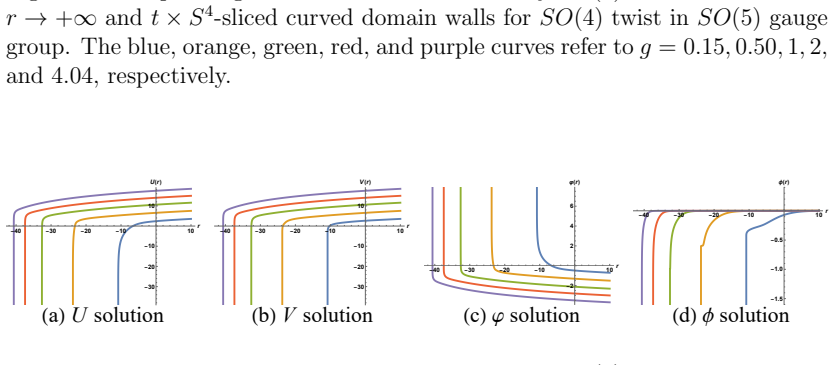
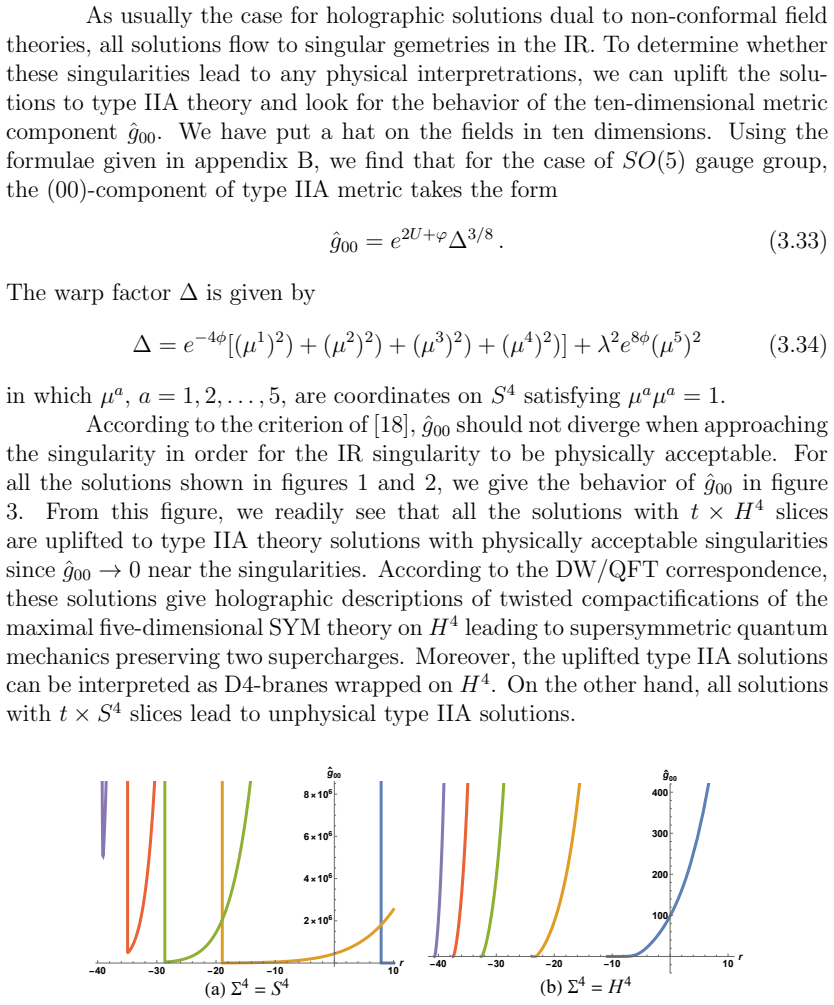
On the paper's own terms, the discovery is that twisted compactifications of D4-branes on four-manifolds of constant curvature have explicit supergravity descriptions. The solutions are t×M4-sliced domain walls that interpolate between asymptotically locally flat domain walls—the gravity duals of five-dimensional maximal SYM—and singular infrared geometries which, after uplift, are interpreted as D4-brane configurations wrapping M4. The construction uses topological twists to cancel the spin connection of M4, reducing the supersymmetry conditions to first-order flow equations for the warp factors and scalar fields. Each infrared singularity is then classified by the behavior of the type-IIA
What carries the argument
The engine is the topological twist combined with the BPS flow equations. For each four-manifold M4, gauge fields are turned on so that their field strengths cancel the spin connection of M4, allowing radial Killing spinors and preserving between one and eight supercharges depending on the twist; the supersymmetry variations then reduce to first-order ordinary differential equations for the warp factors, the dilaton, and the remaining scalars. The second load-bearing piece is the uplift test: using partial consistent-truncation data, the authors compute the (00)-component of the ten-dimensional type-IIA metric, ĝ00, and classify an infrared singularity as physical exactly when this component
Load-bearing premise
The load-bearing premise is that the partial truncation data used to lift the six-dimensional solutions to ten dimensions come from genuinely consistent truncations; if the full ansätze contain additional fields, the computed ĝ00—and with it the physical/unphysical classification—could change.
What would settle it
Pick one solution with a claimed physical infrared singularity, such as the t×H4 flow with SO(4) twist in the SO(5) gauge group, and construct or obtain the complete consistent truncation ansatz from type IIA theory; if the exact ten-dimensional metric has ĝ00 diverging at the infrared endpoint where the partial formula does not, the central claim fails. A weaker but still decisive test is to verify that the truncated BPS equations imply all second-order field equations of the full six-dimensional theory, including those that were imposed rather than derived.
If this is right
- If the central claim is right, five-dimensional maximal SYM on the D4 world-volume, when twisted and compactified on H4, H2×H2, H2×R2, or CH2, flows to one-dimensional supersymmetric quantum mechanics with two preserved supercharges, and the paper supplies explicit gravity duals for those flows.
- The ĝ00 criterion gives a practical way to separate trustworthy wrapped-brane holographic duals from suspect ones: negative-curvature slicings generically pass, positive-curvature slicings generically fail.
- The analytic solutions in the CSO(3,0,2), CSO(3,0,1)⋉R4, and CSO(2,0,2)⋉R4 gauge groups provide closed-form examples whose infrared singularities are either cleanly physical or cleanly unphysical, making them convenient starting points for further computation.
- These constructions add a new class of gravity duals of supersymmetric quantum mechanics that do not come from D0-branes, broadening the domain-wall/QFT correspondence to (0+1)-dimensional field theories.
- For each family considered, the paper records for which gauge groups, twist types, and parameter values the infrared singularity passes the criterion, giving a systematic catalogue of candidate quantum-mechanics duals from wrapped D4-branes.
Where Pith is reading between the lines
- The authors leave open the full ten-dimensional uplift; if the missing consistent-truncation ansätze are constructed, the complete metric could shift the physical/unphysical split, so the tables are best read as provisional until that check exists.
- The recurring pattern that negatively curved slicings pass while positively curved ones fail hints that curvature sign, not just topology, drives the infrared physics; testing intermediate cases such as lens spaces or mixed products would isolate that variable.
- A sharper check of the physicality criterion would be a boundary observable—say the spectrum of the preserved supercharges or a holographic entanglement entropy in the proposed quantum mechanics—which the paper does not compute and which could decide whether 'physical singularity' corresponds to finite low-energy physics.
- Because the same six-dimensional gauged supergravity also encodes D4-branes wrapped on two- and three-manifolds, this construction plausibly joins those families into a unified set of wrapped-D4 quantum-mechanics duals across dimensions; that unification is implicit but not stated in the paper.
Editorial analysis
A structured set of objections, weighed in public.
Referee Report
Summary. The paper studies supersymmetric t×M4-sliced domain walls in six-dimensional maximal gauged supergravity with CSO(p,q,5−p−q) and CSO(p,q,4−p−q)⋉R4 gauge groups. It constructs topological twists for four-manifolds M4 that are either space forms, products of two Riemann surfaces, or Kähler four-cycles, derives first-order BPS equations from the fermionic supersymmetry variations, and presents numerical and a few analytic interpolating solutions between locally flat domain walls and singular IR geometries. The paper then uses the g00 criterion of [18] to label IR singularities as physical or unphysical after a partial type IIA uplift, and interprets the physical cases as holographic duals of supersymmetric quantum mechanics from twisted compactifications of D4-branes. The six-dimensional construction is standard and documented in detail; the central unresolved point is that the type IIA/D4-brane interpretation relies on incomplete truncation ansätze, as the authors themselves state in the Introduction.
Significance. If the higher-dimensional embedding is made fully consistent, this would be a substantial catalogue of holographic RG-flow candidates from 5D SYM to 1D SQM, including analytic branches (CSO(3,0,2) and CSO(2,0,2)⋉R4) and parameter regions for physical singularities. The systematic treatment of Bianchi identities, for instance around Eqs. (3.23)–(3.26), is careful and is a genuine strength. However, because only the (00)-component of the ten-dimensional metric is computed, the D4-brane interpretation is conditional. As it stands, the paper is best evaluated as a 6D supergravity classification; the advertised D4-brane/SQM interpretation is a plausible but not yet established corollary.
major comments (3)
- [Introduction, p.4; App. B] The D4-brane/SQM interpretation is the headline claim, but it rests on incomplete higher-dimensional truncations. The paper states that complete type IIA/11D truncation ansätze on H^{p,q}×R^{4−p−q} and H^{p,q}×R^{5−p−q} have not been worked out, and only g00 is obtained from partial results in [33,34]. Tables 1–11 base all physical/unphysical verdicts on this single component. If the actual consistent truncation contains additional fields, or if the partial ansatz does not extend to a full embedding, g00 can be corrected and the classification can change. This is not a demonstrated error, but it is load-bearing. Please either provide the complete truncation, prove that the singlet sector used here is a consistent truncation, or explicitly state that the D4-brane interpretation is conjectural and not established by the present equations. The abstract should match that caveat.
- [§3.1, Eqs. (3.27)–(3.30); cf. §3.2, §3.3, §4] The first-order BPS systems are introduced with 'we find', and the claim that they satisfy all bosonic field equations is asserted with phrases such as 'It can be verified that these equations satisfy all bosonic field equations'. Since every numerical solution in the paper is a solution of these first-order equations rather than of the second-order field equations, this verification is not a formality: it is what makes the flows actual supergravity solutions. Please include an explicit check for at least one representative case in each family, and indicate whether the remaining cases follow by identical algebra. Without this, the reader cannot distinguish an actual solution from a solution to a truncated but inconsistent set.
- [§4, Eqs. (4.11)–(4.12)] For the CSO(p,q,4−p−q)⋉R4 gaugings, all tensor fields are set to zero and the Bianchi identity is satisfied by requiring the term proportional to H∧H to vanish. This is a structural restriction, and it is not shown that the resulting subspace is a consistent truncation of the full six-dimensional theory. The text says 'we are not able to find a consistent set of BPS equations with non-vanishing two-form fields'; this is an explicit open consistency question. Please provide an independent consistency argument for the scalar/vector sector used in §4, or discuss whether the omitted tensor fields could become nonzero once the BPS equations are embedded in the full theory.
minor comments (5)
- [Throughout] There are many typos and grammatical errors, e.g., 'gemetries', 'interpretrations', 'Upon uplifted', 'topological twits'. A careful proofread is needed.
- [Table 11 caption] The caption says 'obtained from SO(3) twist', but Section 4.2.2 is about an SO(2) twist. Please correct.
- [Figures 1–65] No numerical integration details are given: no method, tolerances, boundary conditions, or error estimates. Given the extensive parameter-space claims, adding reproducibility information or code would materially strengthen confidence in the numerical classification.
- [§3.3.1 and §4.2.1] The analytic solutions include integration constants C0 and C1. A short statement of which constants are physical moduli and which can be absorbed by coordinate rescalings would help.
- [References] Some arXiv identifiers are incomplete or malformed, e.g., ref [2] 'hep-th/9802.109' and ref [15] '250315954'. Please standardize.
Circularity Check
No circularity: the BPS equations are derived from the 6D SUSY variations with explicit twist projectors, and the acknowledged incomplete uplift is a support gap, not a circular step.
full rationale
The derivation chain is not circular. The first-order equations (e.g. (3.27)-(3.30)) are obtained by imposing δψ=0 and δχ=0 in the known fermionic supersymmetry variations (2.28)-(2.31) together with explicit twist/projector conditions (3.18)-(3.21), and are then integrated numerically; no parameter is fitted to a target physicality verdict. The [18] criterion is applied after constructing the solutions to classify singularities, not used to define the ansatz. The paper itself states the main limitation: "complete truncation ansatze for both type IIA theory on H^{p,q}×R^{4-p-q} or eleven-dimensional supergravity on H^{p,q}×R^{5-p-q} have not been worked to date" and that only ĝ00 can be computed from partial results [33,34]. This is an acknowledged support gap: if the full truncation is inconsistent or corrects ĝ00, the D4-brane/SQM interpretation could fail, but this is not equivalent-by-construction to the inputs. Reliance on the authors' prior papers [28-31] for notation, flat-domain-wall asymptotics, and analogous wrapped-brane solutions is ordinary extension of prior work, not a self-citation chain that forces the conclusion. The claim that BPS equations imply all field equations is asserted rather than shown, but that is an unverified check, not circular reasoning.
Axiom & Free-Parameter Ledger
free parameters (4)
- gauge coupling g =
scanned values 0.1–4.04, signs chosen per gauge group
- twist charges z1, z2 and magnetic charges p, p_ij, p1, p2 =
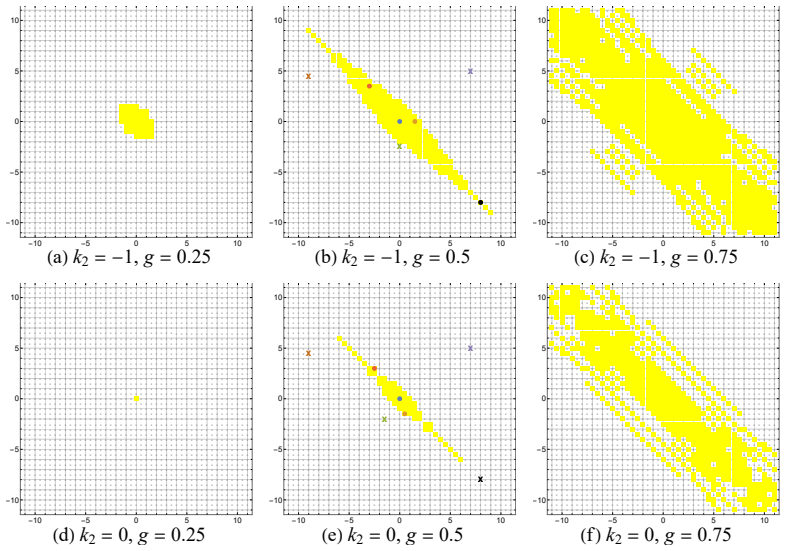
scanned over e.g. (z1,z2)∈[-10,10], p1∈[-4,4]
- integration constants C0, C1 in analytic branches =
C1 = 0 vs C1 ≠ 0
- embedding-tensor signs p, q, κ, λ =
κ, λ ∈ {0,±1}; p+q+r = 5 (or 4)
axioms (6)
- standard math Maximal 6D N=(2,2) supergravity with embedding-tensor formalism (from [27]) as the starting action
- standard math The gaugings CSO(p,q,5-p-q) and CSO(p,q,4-p-q)⋉R4 embed in SO(5,5) as specified by Ymn and U^{np,m}
- domain assumption Consistent truncations of type IIA/11D on H^{p,q}×R^{...} exist and the partial results of [33,34] determine type-IIA g00
- domain assumption Maldacena-Nuñez criterion [18]: non-divergence of g00 near the IR singularity suffices to call the singularity physical
- domain assumption DW/QFT correspondence maps these singular domain-wall flows to RG flows ending in supersymmetric quantum mechanics
- domain assumption The BPS equations imply the full set of bosonic field equations
read the original abstract
We find a large class of holographic solutions describing D4-branes wrapped on 4-manifolds $\mathcal{M}_4$ with constant curvature leading to gravity duals of supersymmetric quantum mechanics in the IR via twisted compactifications. The manifolds $\mathcal{M}_4$ considered here are four-dimensional spheres and hyperbolic spaces, products of two Riemann surfaces, and Kahler four-cycles. The solutions are obtained from the maximal gauged supergravity in six dimensions with $CSO(p,q,5-p-q)$ and $CSO(p,q,4-p-q)\ltimes \mathbb{R}^4$ gauge groups. These gauged supergravities can be embedded in type IIA theory via consistent truncations on $H^{p,q}\times \mathbb{R}^{5-p-q}$ and $H^{p,q}\times\mathbb{R}^{4-p-q}\times S^1$, respectively. The solutions take the form of $t\times \mathcal{M}_4$-sliced domain walls interpolating between locally flat domain walls and singular geometries in the IR. Upon uplifted to type IIA theory, many solutions admit physical IR singularities and could holographically describe supersymmetric quantum mechanics arising from twisted compactifications of D4-branes on $\mathcal{M}_4$.
Figures





Reference graph
Works this paper leans on
-
[1]
The largeNlimit of superconformal field theories and supergravity
J. M. Maldacena, “The largeNlimit of superconformal field theories and supergravity”, Adv. Theor. Math. Phys.2(1998) 231-252, arXiv: hep- th/9711200
arXiv 1998
-
[2]
Gauge theory correlators from noncritical string theory
S. S. Gubser, I. R. Klebanov and A. M. Polyakov, “Gauge theory correlators from noncritical string theory”, Phys. Lett.B428(1998) 105-114, arXiv: hep-th/9802.109
1998
-
[3]
Anti De Sitter Space and holography
E. Witten, “Anti De Sitter Space and holography”, Adv. Theor. Math. Phys. 2(1998) 253-291, arXiv: 9802150
1998
-
[4]
The domain-wall/QFT correspondence
H.J. Boonstra, K. Skenderis and P.K. Townsend, “The domain-wall/QFT correspondence”, JHEP 01 (1999)003, arXiv: hep-th/9807137
Pith/arXiv arXiv 1999
-
[5]
Supergravity, Non-Conformal Field Theories and Brane-Worlds
T. Gherghetta and Y. Oz, “Supergravity, Non-Conformal Field Theories and Brane-Worlds”, Phys. Rev.D65(2002) 046001, arXiv: hep-th/0106255
Pith/arXiv arXiv 2002
-
[6]
Precision holography for non-conformal branes
Ingmar Kanitscheider, Kostas Skenderis and Marika Taylor, “Precision holography for non-conformal branes”, JHEP 09 (2008)094, arXiv: 0807.3324
Pith/arXiv arXiv 2008
-
[7]
M-theory as a matrix model: A conjecture
T. Bank, W. Fischler, S. H. Shenker and L. Susskind, “M-theory as a matrix model: A conjecture”, Phys. Rew.D55(1997) 5112, arXiv: hep-th/9610043
Pith/arXiv arXiv 1997
-
[8]
Strings in flat space and pp waves fromN= 4 super Yang Mills
D. Berenstein, J. M. Maldacena and H. Nastase, “Strings in flat space and pp waves fromN= 4 super Yang Mills”, JHEP 04 (2002)013, arXiv: hep- th/0202021
arXiv 2002
-
[9]
Matrix Quantum Mechanics and Entanglement Entropy: A Review
J. R. Fliss and A. Frenkel, “Matrix Quantum Mechanics and Entanglement Entropy: A Review”, arXiv: 2512.03163
-
[10]
TASI lectures on Matrix Theory from a modern viewpoint
H. W. Lin, “TASI lectures on Matrix Theory from a modern viewpoint”, arXiv: 2508.20970
-
[11]
SO(9) supergravity in two dimensions
T. Ortiz and H. Samtleben, “SO(9) supergravity in two dimensions”, JHEP 01 (2013)183, arXiv: 1210.4266
Pith/arXiv arXiv 2013
-
[12]
Gauging hidden symmetries in two dimen- sions
H. Samtleben and M. Weidner, “Gauging hidden symmetries in two dimen- sions”, JHEP 08 (2007)076, arXiv: 0705.2606
Pith/arXiv arXiv 2007
-
[13]
Rotating D0-branes and consis- tent truncations of supergravity
A. Anabalon, T. Ortiz and H. Samtleben, “Rotating D0-branes and consis- tent truncations of supergravity”, Phys. Lett.B727(2013) 516-523, arXiv: 1310.1321
Pith/arXiv arXiv 2013
-
[14]
T. Ortiz, H. Samtleben and D. Tsimpis, “Matrix model holography”, JHEP 12 (2014)096, arXiv: 1410.0487. 90
Pith/arXiv arXiv 2014
-
[15]
Holographic deformations of ma- trix models
A. Bovon, H. Samtleben and D. Tsimpis, “Holographic deformations of ma- trix models”, JHEP 07 (2025)051, arXiv: 250315954
2025
-
[16]
Spherical branes and the BMN matrix quantum mechanics
N. Bobev, P. Bomans and F. F. Gautason, “Spherical branes and the BMN matrix quantum mechanics”, JHEP 01 (2025)170, arXiv: 2410.21376
Pith/arXiv arXiv 2025
-
[17]
Topological Quantum Field Theory
E. Witten, “Topological Quantum Field Theory”, Commun. Math. Phys. 117 (1988)353
1988
-
[18]
Supergravity description of field theories on curved manifolds and a no go theorem
J. Maldacena and C. Nunez, “Supergravity description of field theories on curved manifolds and a no go theorem”, Int. J. Mod. Phys.A16(2001) 822, arXiv: hep-th/0007018
Pith/arXiv arXiv 2001
-
[19]
M five-branes Wrapped on Super- symmetric Cycles
J. P. Gauntlett, N. Kim, and D. Waldram, “M five-branes Wrapped on Super- symmetric Cycles”, Phys. Rev.D63(2001) 126001, arXiv: hep-th/0012195
Pith/arXiv arXiv 2001
-
[20]
M five-branes wrapped on supersymmetric cycles 2
J. P. Gauntlett and N. Kim, “M five-branes wrapped on supersymmetric cycles 2”, Phys. Rev.D65(2002) 086003, arXiv: hep-th/0109039
Pith/arXiv arXiv 2002
-
[21]
Branes wrapped on coassociative cycles
R. Hernandez, “Branes wrapped on coassociative cycles”, Phys. Lett.B521 (2001) 371-375, arXiv: hep-th/0106055
Pith/arXiv arXiv 2001
-
[22]
RG flows from Spin(7), CY 4-fold and HK manifolds to AdS, Penrose limits and pp waves
U. Gursoy, C. Nunez and M. Schvellinger, “RG flows from Spin(7), CY 4-fold and HK manifolds to AdS, Penrose limits and pp waves”, JHEP 04 (2001) 025, JHEP 06 (2002)015, arXiv: hep-th/0203124
Pith/arXiv arXiv 2001
-
[23]
Two-dimensional SCFTs from wrapped branes and c-extremization
F. Benini and N. Bobev, “Two-dimensional SCFTs from wrapped branes and c-extremization”, JHEP 1306 (2013)005, arXiv: 1302.4451
Pith/arXiv arXiv 2013
-
[24]
3D Supergravity from wrapped M5- branes
P. Karndumri and E. O Colgain, “3D Supergravity from wrapped M5- branes”, JHEP 03 (2016)188, arXiv: 1508.00963
Pith/arXiv arXiv 2016
-
[25]
D4-branes wrapped on supersymmetric four-cycles
M. Suh, “D4-branes wrapped on supersymmetric four-cycles”, JHEP 1901 (2019)035, arXiv: 1809.03517
Pith/arXiv arXiv 1901
-
[26]
D4-branes wrapped on supersymmetric four-cycles from mat- ter coupled F(4) gauged supergravity
M. Suh, “D4-branes wrapped on supersymmetric four-cycles from mat- ter coupled F(4) gauged supergravity”, JHEP 1902 (2019)108, arXiv: 1810.00675
Pith/arXiv arXiv 1902
-
[27]
The Gauging of Maximal D=6 Supergravity
E. Bergshoeff, H. Samtleben, and E. Sezgin, “The Gauging of Maximal D=6 Supergravity”, JHEP05(2020) 015, arXiv:0712.4277
Pith/arXiv arXiv 2020
-
[28]
Supersymmetric domain walls in maximal 6D gauged supergravity I
P. Karndumri and P. Nuchino,“Supersymmetric domain walls in maximal 6D gauged supergravity I”, Eur. Phys. J. C81(2021): 764, arXiv: 2102.11185
Pith/arXiv arXiv 2021
-
[29]
Supersymmetric domain walls in max- imal 6D gauged supergravity II
P. Karndumri and P. Nuchino,“Supersymmetric domain walls in max- imal 6D gauged supergravity II”, Phys. Rev. D104(2021): 106008, arXiv:2108.08260. 91
Pith/arXiv arXiv 2021
-
[30]
Supersymmetric domain walls in maximal 6D gauged supergravity III
P. Karndumri and P. Nuchino,“Supersymmetric domain walls in maximal 6D gauged supergravity III”, Eur. Phys. J. C84(2024): 333, arXiv:2312.15777
Pith/arXiv arXiv 2024
-
[31]
Wrapped D4-branes from maximal 6D gauged supergravity
P. Karndumri and P. Nuchino,“Wrapped D4-branes from maximal 6D gauged supergravity”, Phys. Rev.D112(2025) 126026, arXiv: 2509.11216
arXiv 2025
-
[32]
The maximal D=7 supergravities
H. Samtleben and M. Weidner, “The maximal D=7 supergravities”, Nucl. Phys.725(2005) 383-419, arXiv: hep-th/0506237
Pith/arXiv arXiv 2005
-
[33]
Dualising consistent IIA /IIB truncations
E. Malek and H. Samtleben, “Dualising consistent IIA /IIB truncations”, JHEP 12 (2015)029, arXiv: 1510.03433
Pith/arXiv arXiv 2015
-
[34]
Consistent Kaluza-Klein Truncations via Ex- ceptional Field Theory
O. Hohm and H. Samtleben, “Consistent Kaluza-Klein Truncations via Ex- ceptional Field Theory”, JHEP 01 (2015)131, arXiv: 1410.8145
Pith/arXiv arXiv 2015
-
[35]
S 3 andS 4 Reductions of Type IIA Supergravity
M. Cvetic, H. Lu, C. N. Pope, A. Sadrzadeh, and T. A. Tran, “S 3 andS 4 Reductions of Type IIA Supergravity”, Nucl. Phys.B590(2000) 233-251, arXiv: hep-th/0005137. 92
Pith/arXiv arXiv 2000
discussion (0)
Sign in with ORCID, Apple, or X to comment. Anyone can read and Pith papers without signing in.