REVIEW 4 major objections 5 minor 1 cited by
M$^3$-VOS: Multi-Phase, Multi-Transition, and Multi-Scenery Video Object Segmentation
T0 review · 4 major / 5 minor · reviewed 2026-08-11 · deepseek-v4-flash
Pith's one-line read The paper introduces a phase taxonomy and a 479-video benchmark for objects undergoing phase transitions, and a reverse-refinement module that raises segmentation accuracy on it.
desk verdict M3-VOS is a genuinely useful benchmark, but the ReVOS gains are not interpretable until the training data for the fusion module is disclosed. read the letter →
The pith
A machine-rendered reading of the paper's core claim, the machinery that carries it, and where it could break.
The reading
What carries the argument
The central mechanism is bidirectional mask propagation built on a frozen Cutie-style matching backbone. In the forward pass, the model keeps a sliding window of length T of image and memory readout features; after predicting the final frame, ReVOS re-introduces the boosted final mask as the starting point and propagates it backward through the same window, using a separate reverse memory that is cleared at the start of each backward run. The booster applies $M = \sigma(\alpha X_{\mathrm{decode}})$ to the decoded logits, and the readout fusion module combines the forward readout $X_F$ and backward readout $X_B$ (via convolution, pooling, concatenation, and dot product) to decode the final mask. The motivating measurement is the Local Binary Pattern entropy $h_{\mathrm{LBP}}$ of the object mask, which the paper reports increases from 4.28 to 4.37 (first to latter half) on M3-VOS, supporting the claim that the backward pass is entropy-reducing.
What would settle it
Take a video in which a scattered pile of fragments is assembled into a single block, so the mask's $h_{\mathrm{LBP}}$ visibly decreases over time; if ReVOS still shows the same J gain as on ordinary phase-transition videos, the entropy-reduction explanation is not what drives the improvement, and the reverse pass must be helping for a different reason (such as temporal averaging or additional refinement steps).
Extended reading notes
Core claim
The core claim is that the forward process of mask propagation is entropy-increasing: as objects undergo phase transitions, their binary masks become more disordered, which is measured by the Local Binary Pattern entropy $h_{\mathrm{LBP}}$ of the mask. Consequently, a reverse pass that begins from the well-annotated final mask and propagates backward traverses a gradually simplifying sequence, and fusing that reverse readout with the forward readout yields better segmentation. ReVOS realizes this with three additions on top of a frozen propagation backbone: a reverse memory that stores high-resolution features for the backward sliding window, a booster that inflates the forward mask so small object parts are not lost, and a readout fusion module that combines forward and backward features before decoding. The paper reports that this raises J on M3-VOS full from 74.6 (Cutie) to 75.6, with gains across all four phase-transition categories and the largest gain on cross-phase transitions, while remaining comparable on DAVIS'17 and YouTubeVOS.
Load-bearing premise
The load-bearing premise is that an object's mask becomes progressively more disordered over the video, so every backward pass runs from a low-entropy final frame into a simpler sequence; the paper's own table shows that this trend reverses on DAVIS'17 ($h_{\mathrm{LBP}}$ falls from 4.72 to 4.68), so the entropy story does not explain the improvement on every video.
Editorial extensions
If this is right
- ReVOS improves J on M3-VOS full from 74.6 to 75.6 and on M3-VOS core from 64.6 to 66.3, using the frozen Cutie backbone, so reverse refinement is a post-hoc plug-in rather than a retrained model.
- The gain appears across all four phase-transition groups (intra-solid, intra-liquid, intra-gas, cross-phase), with the largest margins on cross-phase transitions, so the method specifically addresses the benchmark's hardest cases.
- On standard benchmarks, ReVOS stays comparable to Cutie: DAVIS'17 val J 86.0 vs 85.6 and YouTubeVOS overall G 86.8 vs 86.8, so the plug-in does not sacrifice established VOS performance.
- A larger reverse interval L (up to 60) improves both performance and FPS, while a longer sliding window T trades FPS for accuracy, giving users a practical speed-quality knob.
Reading between the lines
- The entropy measure is computed on the binary mask, not the video pixels; one could test whether ReVOS's gain disappears on artificially constructed videos with decreasing mask entropy, which would separate the entropy mechanism from generic temporal smoothing.
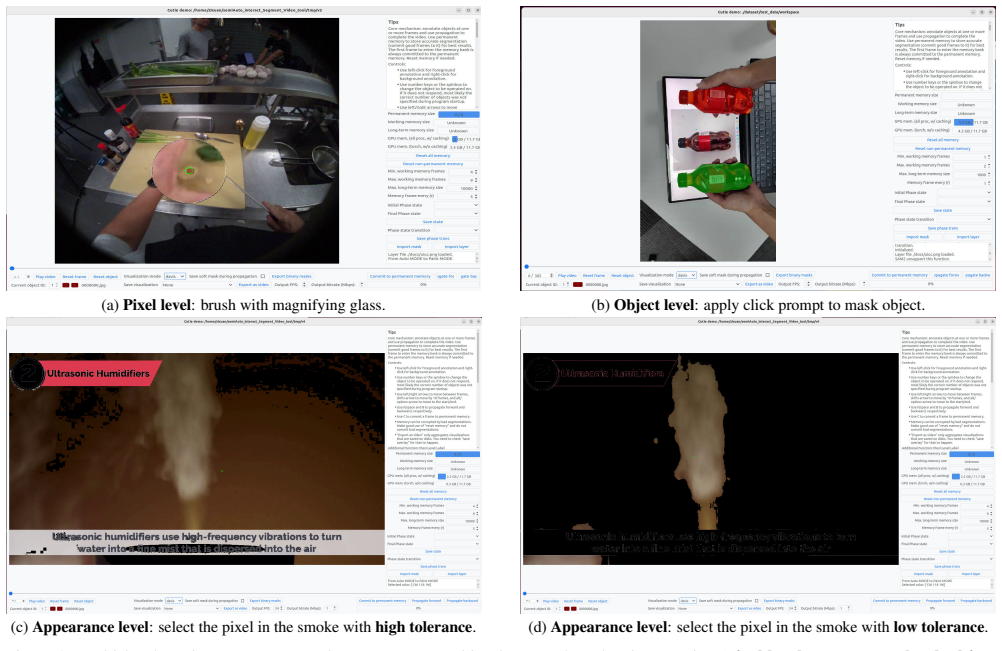
- The annotation pipeline's color-difference masking, designed for transparent smoke and splashes, could be reused to label amorphous objects in existing segmentation datasets, effectively extending benchmarks without new capture.
- If reverse propagation helps whenever the target's disorder grows, the same readout-fusion idea may transfer to other forward-in-time prediction problems, such as optical flow or video prediction, where a backward pass from a known final state could refine estimates.
- Since only the readout fusion module is trained while the backbone stays frozen, a natural extension is joint training of the backbone with both passes; the paper reports only frozen-backbone results, so the headroom of a fully tuned bidirectional model remains untested.
Signed reviews
Editorial analysis
A structured set of objections, weighed in public.
Referee Report
Summary. The paper introduces M3-VOS, a new benchmark of 479 high-resolution videos for video object segmentation of objects undergoing intra-phase and cross-phase transitions, with dense instance masks at 30 fps, bilingual text descriptions, and a taxonomy of phases and transitions. The authors evaluate several state-of-the-art VOS methods on this benchmark and find that appearance-based propagation models degrade on phase-transition videos. They propose ReVOS, a plug-and-play reverse-propagation module that runs a backward pass over a sliding window, boosts the final mask, and fuses forward and backward readout features, using a frozen Cutie backbone and a trained Readout Fusion Module. Their main empirical claim is that ReVOS improves Cutie on M3-VOS full (+1.0 J) and M3-VOS core (+1.7 J) while remaining comparable on DAVIS and YouTubeVOS, and that this improvement is explained by an entropy-increasing forward process and an entropy-reducing reverse process.
Significance. If the benchmark and the ReVOS method hold up, this is a useful contribution: the dataset targets an underexplored axis of object change (phase transitions), with a relatively large number of videos, dense annotation, multiple scenarios, and explicit quality-control procedures including dual-model cross-validation. The ReVOS framework is attractive as a post-hoc refinement that does not require retraining the backbone, and the paper includes both a motivation from disorder analysis and ablations of its components. However, the empirical evidence is currently not conclusive because the training data for the fusion module is undisclosed, the entropy hypothesis is contradicted by one of the four datasets in Table 3, and the reported gains are small and reported without error bars. The dataset and code are promised but not yet available, which limits verification of the annotation-quality claims.
major comments (4)
- [5.1] Section 5.1 states that 'we froze all the parameters of Cutie and only trained the Readout Fusion Module' but never specifies which videos or annotations were used for that training. If any M3-VOS videos appear in the training set, then the reported gains on M3-VOS full and core would reflect test-set leakage, not a general post-hoc improvement. Because the only substantial gains are on M3-VOS, the exact training split is load-bearing; please disclose it completely, or re-run the evaluation on a split that is provably disjoint from the finetuning data.
- [Table 3 and Section 5] The entropy hypothesis is contradicted by the DAVIS'17 row in Table 3: the average LBP entropy h_LBP decreases from 4.72 (first half) to 4.68 (second half). The paper states that 'in most datasets' the latter half has higher h_LBP, which is true, but the method is claimed to work on DAVIS and YouTubeVOS as well. As written, the motivating narrative does not explain why reverse propagation should help on a dataset where disorder decreases. Please either report the per-video or per-dataset breakdown with a statistical test, or reformulate the hypothesis to cover cases where the monotonicity does not hold.
- [6.1] The evaluation of DeAOT excludes 'a few long video cases' due to insufficient memory. Since excluding videos selectively changes the composition of the test set, the comparison in Table 4 is not uniform across methods. Please report the number of excluded videos, the criterion for exclusion, and provide an additional comparison where all methods are run on the same subset, or use a memory-bounded DeAOT configuration that can process all videos.
- [Table 4] The central empirical claim is based on differences of 1.0 and 1.7 J points on M3-VOS, while DAVIS and YouTubeVOS differences are within 0.4 points and inconsistent across metrics. The paper does not report standard deviations or multiple runs. Please provide error bars, multiple seeds, or a significance test, especially because the advantage on the benchmark used for the headline claim may not be statistically distinguishable from noise.
minor comments (5)
- [Eq. (2)] Equation (2) does not define the normalization of H(i); if H is a histogram of frequencies, it should be normalized to sum to 1, and N should be specified (e.g., number of LBP bins).
- [6.4] The ablation study uses 'M3-VOS mid set,' which is not defined anywhere in the main text or the supplementary material; please define this evaluation subset or rename it to match existing subsets.
- [Table 4 footnotes] The footnotes under Table 4 contain unclear and partially garbled text ('the grep region contains 469 objects', 'Video clip of Other Objects is too long'), and the asterisk/dagger markers for DeAOT are used inconsistently. These need to be rewritten for clarity.
- [5.1] The sentence 'The model is trained on 4 A100 GPUs for 10 hours' is fine, but the description of the training data (e.g., whether it includes M3-VOS or only pretraining datasets) should be moved to a dataset-table format for precision.
- [Section 7] Some typos remain, e.g., 'V olunteers' in Section 4.3.2 and 'inter-phase' when the paper elsewhere uses 'cross-phase'; please proofread.
Circularity Check
No derivation-level circularity: ReVOS is tested against external benchmarks with a frozen backbone; the main gap is an undisclosed training set, which is a verification issue rather than a demonstrated circular step.
full rationale
The claimed derivation chain is not circular. The entropy hypothesis (Eq. 2 and Table 3) is used only as motivation for reverse propagation; h_LBP is not used as a training objective, a loss term, or an inference input, so the method's reported gains are not equivalent to its entropy input by construction. The central empirical claim is supported by comparing ReVOS to a frozen Cutie backbone on external benchmarks (DAVIS'17, YouTubeVOS, VOST) and on the new M3-VOS benchmark, and Section 5.1 states that 'we froze all the parameters of Cutie and only trained the Readout Fusion Module', so any gain over Cutie is attributable to the added module rather than a refit of the existing backbone. The paper's self-citations (OCL, Instaboost, SRDA) are background or implementation references and do not carry the load-bearing argument; there is no imported uniqueness theorem or ansatz that forces the reverse-refinement choice. The strongest concern is not circularity but an omitted disclosure: Section 5.1 does not identify the data used to train the Readout Fusion Module, and Section 6.4 reports ablations on an undefined 'M3-VOS mid set', while M3-VOS full and core are described as evaluation subsets. This leaves open the possibility of test-set leakage, but the paper contains no quoted statement that the fusion module was trained on M3-VOS evaluation videos, so per the hard rules this is a reproducibility/verification gap rather than a demonstrated circular step. Accordingly, no circularity step is scored.
Assumptions & free parameters
free parameters (4)
- Boosting factor alpha =
not specified
- Sliding window length T =
30
- Reverse interval L =
30
- Color difference threshold delta =
user-adjustable
assumptions (6)
- ad hoc to paper LBP entropy of an object mask is a valid proxy for visual disorder.
- ad hoc to paper Videos in VOS naturally proceed from low disorder to high disorder.
- domain assumption The macroscopic phase taxonomy (solid, liquid, aerosol/gas with subcategories) is a useful frame for segmentation.
- ad hoc to paper Reverse propagation encounters a simpler (low-disorder) sequence and therefore improves accuracy.
- domain assumption The dual-model cross-validation demonstrates that annotation bias is negligible.
- domain assumption One checkpoint per method, selected by best DAVIS'17 validation performance, transfers fairly to all other benchmarks.
Cite this review
Pith. "Pith review of M$^3$-VOS: Multi-Phase, Multi-Transition, and Multi-Scenery Video Object Segmentation." pith.science (2026). https://pith.science/paper/BKBYPE2B
@misc{pith2026241213803,
  author       = {Pith},
  title        = {Pith review of: M$^3$-VOS: Multi-Phase, Multi-Transition, and Multi-Scenery Video Object Segmentation},
  year         = {2026},
  howpublished = {\url{https://pith.science/paper/BKBYPE2B}},
  note         = {Machine review of arXiv:2412.13803}
}
abstract
Intelligent robots need to interact with diverse objects across various environments. The appearance and state of objects frequently undergo complex transformations depending on the object properties, e.g., phase transitions. However, in the vision community, segmenting dynamic objects with phase transitions is overlooked. In light of this, we introduce the concept of phase in segmentation, which categorizes real-world objects based on their visual characteristics and potential morphological and appearance changes. Then, we present a new benchmark, Multi-Phase, Multi-Transition, and Multi-Scenery Video Object Segmentation (M$^3$-VOS), to verify the ability of models to understand object phases, which consists of 479 high-resolution videos spanning over 10 distinct everyday scenarios. It provides dense instance mask annotations that capture both object phases and their transitions. We evaluate state-of-the-art methods on M$^3$-VOS, yielding several key insights. Notably, current appearance-based approaches show significant room for improvement when handling objects with phase transitions. The inherent changes in disorder suggest that the predictive performance of the forward entropy-increasing process can be improved through a reverse entropy-reducing process. These findings lead us to propose ReVOS, a new plug-andplay model that improves its performance by reversal refinement. Our data and code will be publicly available at https://zixuan-chen.github.io/M-cube-VOS.github.io/.
Figures


Figures from the paper (8 more)




Forward citations
Cited by 1 Pith paper
-
Efficient Tracking and Understanding Object Transformations
FluxGraph detects object transformations reactively via SAM2's multi-mask disagreement, cutting TubeletGraph's inference cost by 3.3–10.7x with comparable tracking and state-graph quality.
Reference graph
Works this paper leans on
-
[1]
Burst: A benchmark for unifying object recognition, segmentation and tracking in video
Ali Athar, Jonathon Luiten, Paul V oigtlaender, Tarasha Khu- rana, Achal Dave, Bastian Leibe, and Deva Ramanan. Burst: A benchmark for unifying object recognition, segmentation and tracking in video. InProceedings of the IEEE/CVF winter conference on applications of computer vision, pages 1674–1683, 2023. 7
work page 2023
-
[2]
Xmem: Long- term video object segmentation with an atkinson-shiffrin memory model
Ho Kei Cheng and Alexander G Schwing. Xmem: Long- term video object segmentation with an atkinson-shiffrin memory model. InEuropean Conference on Computer Vi- sion, pages 640–658. Springer, 2022. 2, 3, 7, 8
work page 2022
-
[3]
Ho Kei Cheng, Yu-Wing Tai, and Chi-Keung Tang. Rethink- ing space-time networks with improved memory coverage for efficient video object segmentation.Advances in Neural Information Processing Systems, 34:11781–11794, 2021. 3
work page 2021
-
[4]
Putting the object back into video object segmentation
Ho Kei Cheng, Seoung Wug Oh, Brian Price, Joon-Young Lee, and Alexander Schwing. Putting the object back into video object segmentation. InProceedings of the IEEE/CVF Conference on Computer Vision and Pattern Recognition, pages 3151–3161, 2024. 2, 3, 5, 7, 8
work page 2024
-
[5]
Scaling egocentric vision: The epic-kitchens dataset
Dima Damen, Hazel Doughty, Giovanni Maria Farinella, Sanja Fidler, Antonino Furnari, Evangelos Kazakos, Davide Moltisanti, Jonathan Munro, Toby Perrett, Will Price, et al. Scaling egocentric vision: The epic-kitchens dataset. In Proceedings of the European conference on computer vision (ECCV), pages 720–736, 2018. 7
work page 2018
-
[6]
Imagenet: A large-scale hierarchical image database
Jia Deng, Wei Dong, Richard Socher, Li-Jia Li, Kai Li, and Li Fei-Fei. Imagenet: A large-scale hierarchical image database. In2009 IEEE conference on computer vision and pattern recognition, pages 248–255. Ieee, 2009. 1
2009
-
[7]
Mevis: A large-scale benchmark for video segmentation with motion expressions
Henghui Ding, Chang Liu, Shuting He, Xudong Jiang, and Chen Change Loy. Mevis: A large-scale benchmark for video segmentation with motion expressions. InProceedings of the IEEE/CVF International Conference on Computer Vi- sion, pages 2694–2703, 2023. 3
work page 2023
-
[8]
Mose: A new dataset for video object segmentation in complex scenes
Henghui Ding, Chang Liu, Shuting He, Xudong Jiang, Philip HS Torr, and Song Bai. Mose: A new dataset for video object segmentation in complex scenes. InProceedings of the IEEE/CVF International Conference on Computer Vi- sion, pages 20224–20234, 2023. 7
work page 2023
Show all 43 references
-
[9]
Instaboost: Boosting instance segmentation via probability map guided copy- pasting
Hao-Shu Fang, Jianhua Sun, Runzhong Wang, Minghao Gou, Yong-Lu Li, and Cewu Lu. Instaboost: Boosting instance segmentation via probability map guided copy- pasting. InICCV, 2019. 2
2019
-
[10]
The ecological approach to the visual per- ception of pictures.Leonardo, 11(3):227–235, 1978
James J Gibson. The ecological approach to the visual per- ception of pictures.Leonardo, 11(3):227–235, 1978. 1, 3
1978
-
[11]
Dis- covering states and transformations in image collections
Phillip Isola, Joseph J Lim, and Edward H Adelson. Dis- covering states and transformations in image collections. In Proceedings of the IEEE conference on computer vision and pattern recognition, pages 1383–1391, 2015. 1, 3
2015
-
[12]
Video object segmentation with language referring expressions
Anna Khoreva, Anna Rohrbach, and Bernt Schiele. Video object segmentation with language referring expressions. In Computer Vision–ACCV 2018: 14th Asian Conference on Computer Vision, Perth, Australia, December 2–6, 2018, Re- vised Selected Papers, Part IV 14, pages 123–141. Springer,
2018
-
[13]
Imagenet classification with deep convolutional neural net- works.Advances in neural information processing systems, 25, 2012
Alex Krizhevsky, Ilya Sutskever, and Geoffrey E Hinton. Imagenet classification with deep convolutional neural net- works.Advances in neural information processing systems, 25, 2012. 1, 2, 3
2012
-
[14]
Video object segmen- tation with joint re-identification and attention-aware mask propagation
Xiaoxiao Li and Chen Change Loy. Video object segmen- tation with joint re-identification and attention-aware mask propagation. InProceedings of the European conference on computer vision (ECCV), pages 90–105, 2018. 3
2018
-
[15]
Beyond object recognition: A new benchmark towards object concept learning
Yong-Lu Li, Yue Xu, Xinyu Xu, Xiaohan Mao, Yuan Yao, Siqi Liu, and Cewu Lu. Beyond object recognition: A new benchmark towards object concept learning. InProceedings of the IEEE/CVF International Conference on Computer Vi- sion, pages 20029–20040, 2023. 2
2023
-
[16]
Microsoft coco: Common objects in context
Tsung-Yi Lin, Michael Maire, Serge Belongie, James Hays, Pietro Perona, Deva Ramanan, Piotr Doll´ar, and C Lawrence Zitnick. Microsoft coco: Common objects in context. In Computer Vision–ECCV 2014: 13th European Conference, Zurich, Switzerland, September 6-12, 2014, Proceeding...
2014
-
[17]
Improved baselines with visual instruction tuning, 2024
Haotian Liu, Chunyuan Li, Yuheng Li, and Yong Jae Lee. Improved baselines with visual instruction tuning, 2024. 3
2024
-
[18]
Decoupled weight decay regularization.arXiv preprint arXiv:1711.05101, 2017
I Loshchilov. Decoupled weight decay regularization.arXiv preprint arXiv:1711.05101, 2017. 7
2017 arXiv
-
[19]
Generation and comprehension of unambiguous object descriptions, 2016
Junhua Mao, Jonathan Huang, Alexander Toshev, Oana Camburu, Alan Yuille, and Kevin Murphy. Generation and comprehension of unambiguous object descriptions, 2016. 3
2016
-
[20]
Timo Ojala, Matti Pietik ¨ainen, and Topi M¨aenp¨a¨a. Multires- olution gray-scale and rotation invariant texture classification with local binary patterns.IEEE Transactions on Pattern Analysis and Machine Intelligence, 24(7):971–987, 2002. 6
2002
-
[21]
A benchmark dataset and evaluation methodology for video object segmentation
Federico Perazzi, Jordi Pont-Tuset, Brian McWilliams, Luc Van Gool, Markus Gross, and Alexander Sorkine-Hornung. A benchmark dataset and evaluation methodology for video object segmentation. InProceedings of the IEEE conference on computer vision and pattern recognition, pages...
-
[22]
Plummer, Liwei Wang, Chris M
Bryan A. Plummer, Liwei Wang, Chris M. Cervantes, Juan C. Caicedo, Julia Hockenmaier, and Svetlana Lazeb- nik. Flickr30k entities: Collecting region-to-phrase corre- spondences for richer image-to-sentence models, 2016. 3
2016
-
[23]
The 2017 davis challenge on video object segmentation
Jordi Pont-Tuset, Federico Perazzi, Sergi Caelles, Pablo Ar- bel´aez, Alexander Sorkine-Hornung, and Luc Van Gool. The 2017 davis challenge on video object segmentation. arXiv:1704.00675, 2017. 3, 7
2017 arXiv
-
[24]
Occluded video instance segmentation: A bench- mark.International Journal of Computer Vision, 130(8): 2022–2039, 2022
Jiyang Qi, Yan Gao, Yao Hu, Xinggang Wang, Xiaoyu Liu, Xiang Bai, Serge Belongie, Alan Yuille, Philip HS Torr, and Song Bai. Occluded video instance segmentation: A bench- mark.International Journal of Computer Vision, 130(8): 2022–2039, 2022. 7
2022
-
[25]
Sam 2: Segment anything in images and videos.arXiv preprint arXiv:2408.00714, 2024
Nikhila Ravi, Valentin Gabeur, Yuan-Ting Hu, Ronghang Hu, Chaitanya Ryali, Tengyu Ma, Haitham Khedr, Roman R¨adle, Chloe Rolland, Laura Gustafson, et al. Sam 2: Segment anything in images and videos.arXiv preprint arXiv:2408.00714, 2024. 2, 3, 8
2024 arXiv
-
[26]
Urvos: Unified referring video object segmentation network with a large-scale benchmark
Seonguk Seo, Joon-Young Lee, and Bohyung Han. Urvos: Unified referring video object segmentation network with a large-scale benchmark. InComputer Vision–ECCV 2020: 16th European Conference, Glasgow, UK, August 23–28, 2020, Proceedings, Part XV 16, pages 208–223. Springer,
2020
-
[27]
Petrov, and Anton Konushin
Konstantin Sofiiuk, Ilia A. Petrov, and Anton Konushin. Re- viving iterative training with mask guidance for interactive segmentation, 2021. 5
2021
-
[28]
Pyramid dilated deeper convlstm for video salient object detection
Hongmei Song, Wenguan Wang, Sanyuan Zhao, Jianbing Shen, and Kin-Man Lam. Pyramid dilated deeper convlstm for video salient object detection. InProceedings of the Eu- ropean conference on computer vision (ECCV), pages 715– 731, 2018. 3
2018
-
[29]
Breaking the” object” in video object segmentation
Pavel Tokmakov, Jie Li, and Adrien Gaidon. Breaking the” object” in video object segmentation. InProceedings of the IEEE/CVF Conference on Computer Vision and Pattern Recognition, pages 22836–22845, 2023. 2, 3, 5, 7
2023
-
[30]
Youtube-vos: Sequence-to-sequence video object segmentation, 2018
Ning Xu, Linjie Yang, Yuchen Fan, Jianchao Yang, Dingcheng Yue, Yuchen Liang, Brian Price, Scott Cohen, and Thomas Huang. Youtube-vos: Sequence-to-sequence video object segmentation, 2018. 3, 7
2018
-
[31]
Youtube-vos: A large-scale video object segmentation benchmark.arXiv preprint arXiv:1809.03327, 2018
Ning Xu, Linjie Yang, Yuchen Fan, Dingcheng Yue, Yuchen Liang, Jianchao Yang, and Thomas Huang. Youtube-vos: A large-scale video object segmentation benchmark.arXiv preprint arXiv:1809.03327, 2018. 7
2018 arXiv
-
[32]
Srda: Generat- ing instance segmentation annotation via scanning, reason- ing and domain adaptation
Wenqiang Xu, Yonglu Li, and Cewu Lu. Srda: Generat- ing instance segmentation annotation via scanning, reason- ing and domain adaptation. InECCV, 2018. 2
2018
-
[33]
Decoupling features in hierar- chical propagation for video object segmentation.Advances in Neural Information Processing Systems, 35:36324–36336,
Zongxin Yang and Yi Yang. Decoupling features in hierar- chical propagation for video object segmentation.Advances in Neural Information Processing Systems, 35:36324–36336,
-
[34]
Video state-changing object segmentation
Jiangwei Yu, Xiang Li, Xinran Zhao, Hongming Zhang, and Yu-Xiong Wang. Video state-changing object segmentation. InProceedings of the IEEE/CVF International Conference on Computer Vision, pages 20439–20448, 2023. 2, 3, 7, 1
2023
-
[35]
Rmem: Re- stricted memory banks improve video object segmentation
Junbao Zhou, Ziqi Pang, and Yu-Xiong Wang. Rmem: Re- stricted memory banks improve video object segmentation. InProceedings of the IEEE/CVF Conference on Computer Vision and Pattern Recognition, pages 18602–18611, 2024. 2, 8 10 M3-VOS: Multi-Phase, Multi-Transition, and Multi-...
2024
-
[36]
Phase Definition We list the specific definitions of phase below: •Solid: V olume is relatively fixed, has distinct boundaries, and shapes independent of the container
Details of Annotations 9.1. Phase Definition We list the specific definitions of phase below: •Solid: V olume is relatively fixed, has distinct boundaries, and shapes independent of the container. – Particulate:Composed of several fragmented parts. – Non-particulate:Composed o...
-
[37]
Connected Component Jaccard Index To avoid ignorance of the small part during evaluation, we introduce the connect component Jaccard IndexJ cc. The definition ofJ cc is the average Jaccard Index of the max- imum bipartite matching corresponding to all connected mask components...
-
[38]
Three Criteria in Masks SQA We design three criteria to evaluate the annotation in M 3- VOS, including: •Tracking Accuracy –0: Target is lost or tracked incorrectly for a long time
Details of Masks SQA 11.1. Three Criteria in Masks SQA We design three criteria to evaluate the annotation in M 3- VOS, including: •Tracking Accuracy –0: Target is lost or tracked incorrectly for a long time. –1: Target is lost or tracked incorrectly for a short con- tinuous p...
-
[39]
In this process, we validate that 1 Table 8
Details of Avoidance of Model Bias In this part, we introduce the details of the dual-model cross-validation method. In this process, we validate that 1 Table 8. The different phase transitions and the unique initial state and final state. We give some examples to highlight th...
-
[40]
9, we show our details of the interactive UI of the multi-level semi-auto annotate tool
Multi-Level Semi-Auto Annotation Tool In Fig. 9, we show our details of the interactive UI of the multi-level semi-auto annotate tool. We implement this tool based on the interactive demo from Cutie [4], including pixel level, appearance level, and object level. In particu- la...
-
[41]
For each specific sce- nario, we extracted a subset of cases
Details of Core Subset We extract a subset of cases that better represent the full dataset and refer to it as a core subset. For each specific sce- nario, we extracted a subset of cases. During the selection of the core subset in each scenario, we consider a series of factors:...
-
[42]
Challenge Analysis In this part, we explore how the size of the object and the velocity of the target object influence the performance of Cutie-ReVOS. 15.1. Definition of Object Size In our experiment, given a target objectoin the imageI, its size is measured by the ratio betw...
-
[43]
11 and 12
More Failure Cases In this part, we show more failure cases of the current mod- els in Figs. 11 and 12. In case 1 (fry dough) of Fig. 11, the boiling oil makes it difficult to separate the boundaries of the dough sticks accurately. Even for some models, the boiling oil causes ...
Reviewed August 11, 2026 · model on record in the stance chip above.
Discussion (0). Continue with ORCID to comment.