Agentic Discovery of Non-Canonical Antimicrobial Peptides with AMPGAN v3
Pith reviewed 2026-06-27 02:32 UTC · model grok-4.3
The pith
AMPGAN v3 uses two separate discriminators to generate non-canonical antimicrobial peptides that include D-amino acids and show activity in lab tests.
A machine-rendered reading of the paper's core claim, the machinery that carries it, and where it could break.
Core claim
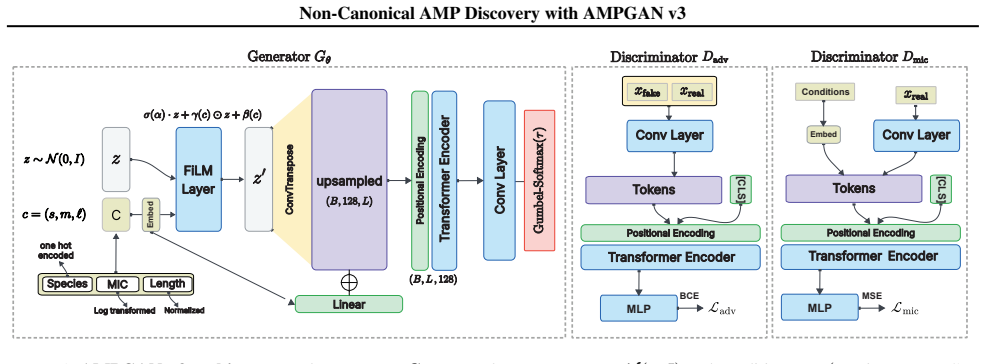
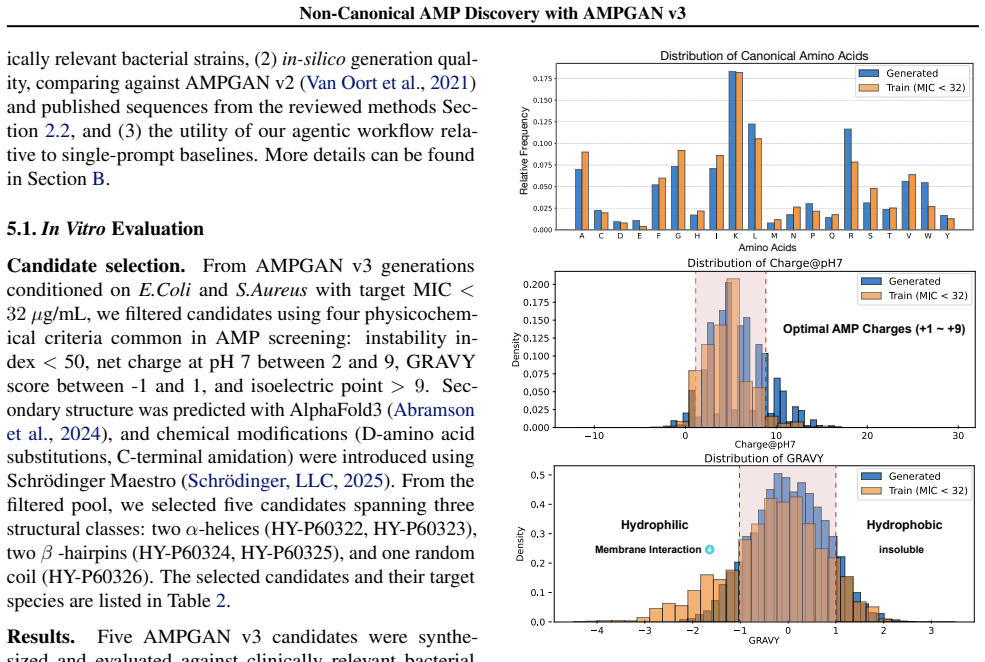
AMPGAN v3 is a multi-objective conditional GAN whose vocabulary includes D-amino acids and N/C-terminus modifications such as amidation. By assigning adversarial supervision to one discriminator and activity-aware supervision to a second, the model achieves greater training stability and higher scores on external activity classifiers than prior generative AMP models. Five candidates spanning three structural classes were advanced to in vitro testing; two proved active against Gram-positive strains, with the best candidate recording an MIC of 8 μg/mL against B. subtilis. PepCraft, a multi-agent orchestration framework, produces prioritization decisions that align with these experimental outco
What carries the argument
The dual-discriminator architecture of AMPGAN v3 that isolates adversarial sequence realism from activity-aware guidance.
If this is right
- The model can now propose peptides that contain non-natural amino acids and terminal modifications, moving generative design closer to molecules that can be developed as drugs.
- Training remains stable even when the output space includes chemical modifications, removing a previous barrier for conditional GANs in peptide design.
- A subset of generated sequences shows measurable activity in vitro, providing direct evidence that the dual-discriminator approach can produce functional molecules.
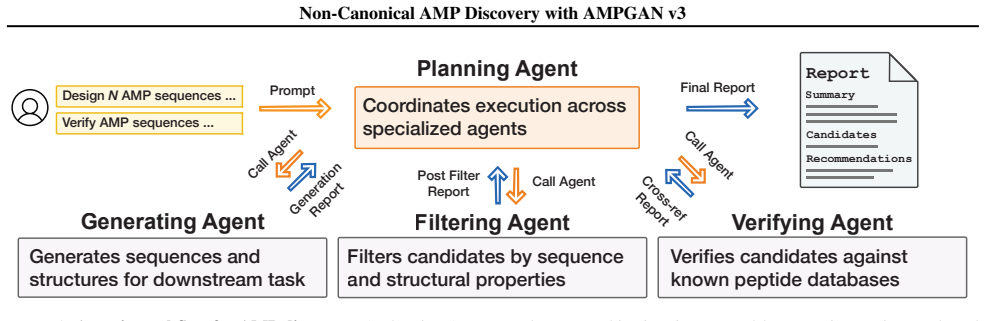
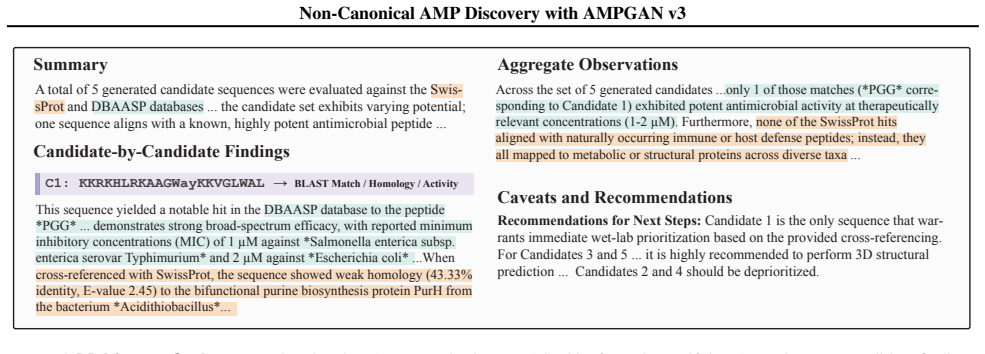
- PepCraft demonstrates that an agentic layer can coordinate generation, filtering, and experimental prioritization in a single workflow whose outputs match laboratory results.
- The combined generative-plus-agentic pipeline supplies an end-to-end example of AI-assisted therapeutic peptide discovery on a modest but real scale.
Where Pith is reading between the lines
- The same separation of realism and activity signals could be applied to generative models for other peptide or protein properties beyond antimicrobial activity.
- If the external classifiers continue to correlate with lab results at larger scale, the method could accelerate screening of chemical space that is otherwise expensive to explore experimentally.
- Extending PepCraft-style orchestration to additional specialized agents might further reduce the manual steps required between in silico generation and in vitro confirmation.
- Success with Gram-positive activity suggests the framework could be retrained or conditioned on different bacterial targets or resistance profiles to address additional clinical needs.
Load-bearing premise
External activity classifiers reliably identify which generated sequences will exhibit real antimicrobial activity when synthesized and tested in the laboratory.
What would settle it
Synthesizing and testing a larger panel of AMPGAN v3 outputs in standardized MIC assays and finding that few or none inhibit the target Gram-positive strains at the concentrations predicted by the classifiers.
Figures
read the original abstract
Antimicrobial resistance causes to over a million deaths annually. Antimicrobial peptides (AMPs) are a promising solution, but generative AMP models are not yet ready to design peptides with non-natural amino acids and/or chemical modifications, which are essential for real-world peptide drugs. We present AMPGAN v3, a multi-objective conditional GAN that expands the generative vocabulary to D-amino acids and N/C-terminus modifications such as amidation. By separating adversarial and activity-aware supervision across two specialized discriminators, AMPGAN v3 substantially improves training stability and outperforms prior generative AMP models on external classifiers. We validated five candidates spanning three structural classes in vitro; two showed activity against Gram-positive strains, with the best candidate reaching MIC 8 {\mu}g/mL against B. subtilis. To support downstream curation, we further present PepCraft, a multi-agent framework for end-to-end AMP discovery in which a Planning Agent orchestrates specialized executors for generation, filtering, and verification. Its prioritization recommendations align with our in vitro outcomes. Together, these contributions let us examine, on a small but real scale, how generative and agentic AI compose in therapeutic peptide discovery. Code: https://github.com/marszzibros/AMPGANv3
Editorial analysis
A structured set of objections, weighed in public.
Referee Report
Summary. The manuscript introduces AMPGAN v3, a multi-objective conditional GAN that generates antimicrobial peptides incorporating D-amino acids and N/C-terminal modifications. It claims that separating adversarial and activity-aware supervision into two specialized discriminators improves training stability and yields better performance than prior generative AMP models when evaluated on external classifiers. Five generated candidates across three structural classes were tested in vitro, with two showing activity against Gram-positive bacteria (best MIC of 8 μg/mL vs. B. subtilis). The work also presents PepCraft, a multi-agent framework for end-to-end AMP discovery whose prioritization aligns with the in vitro results, and releases code at the provided GitHub link.
Significance. If the performance and validation claims hold after detailed reporting, the work would contribute to extending generative peptide design beyond canonical amino acids, which is relevant for therapeutic development, and would illustrate a concrete composition of generative and agentic methods. The open release of code is a clear strength supporting reproducibility.
major comments (3)
- [Abstract] Abstract: the claim that separating supervision across two discriminators 'substantially improves training stability and outperforms prior generative AMP models on external classifiers' is presented without any quantitative metrics, ablation results, dataset sizes, or statistical comparisons, which is load-bearing for the central methodological contribution.
- [Abstract] Abstract: the in vitro validation reports activity for only two of five candidates but provides no information on experimental controls, replicates, error bars, statistical tests, or head-to-head comparison against peptides generated by prior models, limiting support for the claim that the generative approach produces functional non-canonical AMPs.
- [Abstract] Abstract: outperformance and candidate selection both rely on external classifiers as proxies for antimicrobial activity, yet no correlation data, ablation on classifier choice, or independent validation of those classifiers against the described lab setting is supplied.
minor comments (1)
- [Abstract] Abstract: 'causes to over a million deaths annually' contains a grammatical error and should read 'causes over a million deaths annually'.
Simulated Author's Rebuttal
We thank the referee for the constructive feedback. We address each major comment below and will revise the abstract to better support the claims with quantitative details and experimental context where possible.
read point-by-point responses
-
Referee: [Abstract] Abstract: the claim that separating supervision across two discriminators 'substantially improves training stability and outperforms prior generative AMP models on external classifiers' is presented without any quantitative metrics, ablation results, dataset sizes, or statistical comparisons, which is load-bearing for the central methodological contribution.
Authors: The quantitative metrics supporting improved training stability (e.g., loss variance reductions), performance gains on external classifiers, ablation results, dataset sizes, and statistical comparisons are reported in the main text (Results and Methods sections). To make the abstract self-contained, we will revise it to incorporate key quantitative values and references to these analyses. revision: yes
-
Referee: [Abstract] Abstract: the in vitro validation reports activity for only two of five candidates but provides no information on experimental controls, replicates, error bars, statistical tests, or head-to-head comparison against peptides generated by prior models, limiting support for the claim that the generative approach produces functional non-canonical AMPs.
Authors: The full manuscript describes the in vitro methods, including positive/negative controls, triplicate replicates with error bars, and statistical tests applied to MIC values. We will update the abstract to summarize these elements. Head-to-head comparisons against peptides from prior models were not performed, as the study prioritized validation of non-canonical candidates; this remains a limitation. revision: partial
-
Referee: [Abstract] Abstract: outperformance and candidate selection both rely on external classifiers as proxies for antimicrobial activity, yet no correlation data, ablation on classifier choice, or independent validation of those classifiers against the described lab setting is supplied.
Authors: The manuscript reports validation of the external classifiers on independent benchmark sets and notes alignment between classifier scores and the in vitro outcomes for PepCraft prioritization. We will revise the abstract to reference this correlation and validation. Limited ablation across classifier variants is discussed in the evaluation but can be highlighted more explicitly. revision: yes
Circularity Check
No circularity; claims rest on model architecture and external validation without self-referential reductions.
full rationale
The paper presents AMPGAN v3 as a conditional GAN using two specialized discriminators for adversarial and activity-aware supervision, with claims of improved stability and outperformance on external classifiers, followed by in vitro validation of five synthesized candidates (two active). No equations, derivations, fitted parameters renamed as predictions, or self-citation load-bearing steps appear in the abstract or described content. The in vitro MIC results and PepCraft framework provide independent external grounding rather than reducing to model inputs by construction. The derivation chain is self-contained.
Axiom & Free-Parameter Ledger
axioms (1)
- domain assumption Separating adversarial and activity-aware supervision across two discriminators improves training stability
Reference graph
Works this paper leans on
-
[1]
Nucleic Acids Research , author=
DBAASP v3: database of antimicrobial/cytotoxic activity and structure of peptides as a resource for development of new therapeutics , volume=. Nucleic Acids Research , author=. 2020 , month=. doi:https://doi.org/10.1093/nar/gkaa991 , number=
-
[2]
Journal of Chemical Information and Modeling , author=
AMPGAN v2: Machine Learning-Guided Design of Antimicrobial Peptides , volume=. Journal of Chemical Information and Modeling , author=. 2021 , month=. doi:https://doi.org/10.1021/acs.jcim.0c01441 , number=
-
[3]
A Generative Approach toward Precision Antimicrobial Peptide Design , DOI=
Ferrell, Jonathon B and Remington, Jacob M and Van, Colin M and Sharafi, Mona and Reem Aboushousha and Janssen-Heininger, Yvonne and Schneebeli, Severin T and Wargo, Matthew J and Safwan Wshah and Li, Jianing , year=. A Generative Approach toward Precision Antimicrobial Peptide Design , DOI=. bioRxiv (Cold Spring Harbor Laboratory) , publisher=
-
[4]
Gargate, Nupur and Laws, Mark and Rahman, Khondaker Miraz , year=. Current economic and regulatory challenges in developing antibiotics for Gram-negative bacteria , volume=. npj Antimicrobials and Resistance , publisher=. doi:https://doi.org/10.1038/s44259-025-00123-1 , number=
-
[5]
Challenges of antibacterial discovery , volume=
Silver, Lynn L , year=. Challenges of antibacterial discovery , volume=. Clinical microbiology reviews , publisher=. doi:https://doi.org/10.1128/CMR.00030-10 , number=
-
[6]
Antimicrobial resistance , url=
WHO , year=. Antimicrobial resistance , url=
-
[7]
Global Burden of Bacterial Antimicrobial Resistance in 2019: a Systematic Analysis , volume=. The Lancet , author =. 2022 , month=. doi:https://doi.org/10.1016/S0140-6736(21)02724-0 , number=
-
[8]
Antimicrobial Peptides: Opportunities and Challenges in Overcoming Resistance , volume=
Bucataru, Cezara and Ciobanasu, Corina , year=. Antimicrobial Peptides: Opportunities and Challenges in Overcoming Resistance , volume=. doi:https://doi.org/10.1016/j.micres.2024.127822 , journal=
-
[9]
Nature Biomedical Engineering , author=
Deep-learning-enabled antibiotic discovery through molecular de-extinction , DOI=. Nature Biomedical Engineering , author=. 2024 , month=
2024
-
[10]
Nature Communications , author=
Discovering highly potent antimicrobial peptides with deep generative model HydrAMP , volume=. Nature Communications , author=. 2023 , month=. doi:https://doi.org/10.1038/s41467-023-36994-z , number=
-
[11]
Evolutionary-scale prediction of atomic-level protein structure with a language model , volume=. Science , author=. 2023 , month=. doi:https://doi.org/10.1126/science.ade2574 , number=
-
[12]
Discovery of antimicrobial peptides with notable antibacterial potency by an LLM-based foundation model , volume=. Science Advances , author=. 2025 , month=. doi:https://doi.org/10.1126/sciadv.ads8932 , number=
-
[13]
Briefings in Bioinformatics , author=
MOFormer: navigating the antimicrobial peptide design space with Pareto-based multi-objective transformer , volume=. Briefings in Bioinformatics , author=. 2025 , month=. doi:https://doi.org/10.1093/bib/bbaf376 , number=
-
[14]
AutoLabs: Cognitive Multi-Agent Systems with Self-Correction for Autonomous Chemical Experimentation , author=. 2025 , eprint=. doi:https://doi.org/10.48550/arXiv.2509.25651 , journal=
-
[15]
2026 , doi =
Xu, Mingyang and Yan, Jiaxian and Feng, Runchuan and Cai, Qingran and Zhang, Peng and Zhao, Chuang and He, Cao and Wei, Zongting and Li, Jianping and Lin, Shiyi and Dong, Hongyu and Jin, Ruofan and Hou, Tingjun and Liu, Qi and Zhang, Zaixi , title =. 2026 , doi =. https://www.biorxiv.org/content/early/2026/04/14/2026.04.11.716807.full.pdf , journal =
2026
-
[16]
Mode Collapse in Generative Adversarial Networks: An Overview , year=
Kossale, Youssef and Airaj, Mohammed and Darouichi, Aziz , booktitle=. Mode Collapse in Generative Adversarial Networks: An Overview , year=
-
[17]
Verkuil, Robert and Kabeli, Ori and Du, Yilun and Wicky, Basile I. M. and Milles, Lukas F. and Dauparas, Justas and Baker, David and Ovchinnikov, Sergey and Sercu, Tom and Rives, Alexander , title =. 2022 , doi =. https://www.biorxiv.org/content/early/2022/12/22/2022.12.21.521521.full.pdf , journal =
2022
-
[18]
2026 , doi =
Fallahpour, Adibvafa and Seyed-Ahmadi, Arman and Idehpour, Parsa and Ibrahim, Omar and Gupta and others , title =. 2026 , doi =. https://www.biorxiv.org/content/early/2026/03/20/2026.03.19.712954.full.pdf , journal =
2026
-
[19]
Nucleic Acids Research , volume =
Wang, Guangshun and Schmidt, Cindy and Li, Xia and Wang, Zhe , title =. Nucleic Acids Research , volume =. 2026 , month =. doi:10.1093/nar/gkaf860 , url =
-
[20]
Ma, Xu and Wang, Qiang and Ren, Kexin and Xu, Tongtong and Zhang, Zigang and Xu, Meijuan and Rao, Zhiming and Zhang, Xian , year=. A Review of Antimicrobial Peptides: Structure, Mechanism of Action, and Molecular Optimization Strategies , volume=. Fermentation , publisher=. doi:https://doi.org/10.3390/fermentation10110540 , number=
-
[21]
Antimicrobial peptides: from discovery to developmental applications , volume=
Zhang, Qi , editor=. Antimicrobial peptides: from discovery to developmental applications , volume=. Applied and Environmental Microbiology , publisher=. 2025 , month=. doi:https://doi.org/10.1128/aem.02115-24 , number=
-
[22]
Fantner, Georg E and Barbero, Roberto J and Gray, David S and Belcher, Angela M , year=. Kinetics of antimicrobial peptide activity measured on individual bacterial cells using high-speed atomic force microscopy , volume=. Nature nanotechnology , publisher=. doi:https://doi.org/10.1038/nnano.2010.29 , number=
-
[23]
ACS Omega , volume =
Tucs, Andrejs and Tran, Duy Phuoc and Yumoto, Akiko and Ito, Yoshihiro and Uzawa, Takanori and Tsuda, Koji , title =. ACS Omega , volume =. 2020 , doi =
2020
-
[24]
and Zou, Quan and Zeng, Xiangxiang and Cao, Dongsheng , title =
Wang, Li and Liu, Yiping and Fu, Xiangzheng and Ye, Xiucai and Shi, Junfeng and Yen, Gary G. and Zou, Quan and Zeng, Xiangxiang and Cao, Dongsheng , title =. Journal of Medicinal Chemistry , volume =. 2025 , doi =
2025
-
[25]
2018 , isbn =
Guo, Jiaxian and Lu, Sidi and Cai, Han and Zhang, Weinan and Yu, Yong and Wang, Jun , title =. 2018 , isbn =
2018
-
[26]
AAAI , year=
FiLM: Visual Reasoning with a General Conditioning Layer , author=. AAAI , year=
-
[27]
ICML 2025 Generative AI and Biology (GenBio) Workshop , year=
ProteinCrow: A Language Model Agent That Can Design Proteins , author=. ICML 2025 Generative AI and Biology (GenBio) Workshop , year=
2025
-
[28]
2022 , month =
Chase, Harrison , title =. 2022 , month =
2022
-
[29]
Deep learning improves antimicrobial peptide recognition , volume=. Bioinformatics , author=. 2018 , month=. doi:https://doi.org/10.1093/bioinformatics/bty179 , number=
-
[30]
AmPEP: Sequence-based prediction of antimicrobial peptides using distribution patterns of amino acid properties and random forest , volume=. Scientific Reports , author=. 2018 , month=. doi:https://doi.org/10.1038/s41598-018-19752-w , number=
-
[31]
Ballard, Joshua Bambrick, et al
Accurate structure prediction of biomolecular interactions with AlphaFold 3 , volume=. Nature , author=. 2024 , month=. doi:https://doi.org/10.1038/s41586-024-07487-w , number=
-
[32]
Role of arginine and lysine in the antimicrobial mechanism of histone-derived antimicrobial peptides , volume=. FEBS Letters , author=. 2015 , month=. doi:https://doi.org/10.1016/j.febslet.2015.11.002 , number=
-
[33]
SimpleFold: Folding Proteins is Simpler than You Think , booktitle =
Yuyang Wang and Jiarui Lu and Navdeep Jaitly and Josh Susskind and Miguel Angel Bautista , year =. SimpleFold: Folding Proteins is Simpler than You Think , booktitle =
-
[34]
arXiv preprint arXiv:2403.05530 , year=
Gemini 1.5: Unlocking multimodal understanding across millions of tokens of context , author=. arXiv preprint arXiv:2403.05530 , year=
-
[35]
arXiv preprint arXiv:2312.11805 , year=
Gemini: a family of highly capable multimodal models , author=. arXiv preprint arXiv:2312.11805 , year=
-
[36]
arXiv preprint arXiv:2403.08295 , year=
Gemma: Open models based on gemini research and technology , author=. arXiv preprint arXiv:2403.08295 , year=
-
[37]
and Arruga, Yolanda and Petrachi, Emilia and Roig, Albert and Lucchi, Roberta and Oller-Salvia, Benjamí , TITLE =
Lucana, Maria C. and Arruga, Yolanda and Petrachi, Emilia and Roig, Albert and Lucchi, Roberta and Oller-Salvia, Benjamí , TITLE =. Pharmaceutics , VOLUME =. 2021 , NUMBER =
2021
-
[38]
Design of Stable -Helical Peptides and Thermostable Proteins in Biotechnology and Biomedicine , volume=. Acta Naturae , author=. 2016 , month=. doi:https://doi.org/10.32607/20758251-2016-8-4-70-81 , number=
-
[39]
UniProtKB/Swiss-Prot , volume=
Boutet, Emmanuel and Lieberherr, Damien and Tognolli, Michael and Schneider, Michel and Bairoch, Amos , year=. UniProtKB/Swiss-Prot , volume=. doi:https://doi.org/10.1007/978-1-59745-535-0_4 , journal=
-
[40]
BMC Bioinformatics , author=
BLAST+: architecture and applications , volume=. BMC Bioinformatics , author=. 2009 , pages=
2009
-
[41]
Annals of Translational Medicine , author=
Introduction to Machine learning: k-nearest Neighbors , volume=. Annals of Translational Medicine , author=. 2016 , month=. doi:https://doi.org/10.21037/atm.2016.03.37 , number=
-
[42]
2026 , note =
Gemini 3.1 Pro , howpublished =. 2026 , note =
2026
-
[43]
2026 , note =
Gemini 3.1 Flash , howpublished =. 2026 , note =
2026
-
[44]
Highly Accurate Protein Structure Prediction with Alphafold , volume=. Nature , author=. 2021 , month=. doi:https://doi.org/10.1038/s41586-021-03819-2 , number=
-
[45]
2025 , note =
Maestro,. 2025 , note =
2025
discussion (0)
Sign in with ORCID, Apple, or X to comment. Anyone can read and Pith papers without signing in.