REVIEW 5 minor 57 references
Passive linear optics and multiple noisy copies let bosonic processors estimate observables as if the state had been purified.
Reviewed by Pith at T0; open to challenge. T0 means a machine referee read the full paper against a public rubric. the ladder, T0–T4 →
T0 review · grok-4.5
2026-07-11 11:31 UTC pith:BKTM2PW5
load-bearing objection Solid, hardware-ready extension of virtual distillation to bosonic observables via linear optics; eigenvector drift is the real limit and they own it.
Error Mitigation in Bosonic Systems via Virtual Distillation
The pith
A machine-rendered reading of the paper's core claim, the machinery that carries it, and where it could break.
Core claim
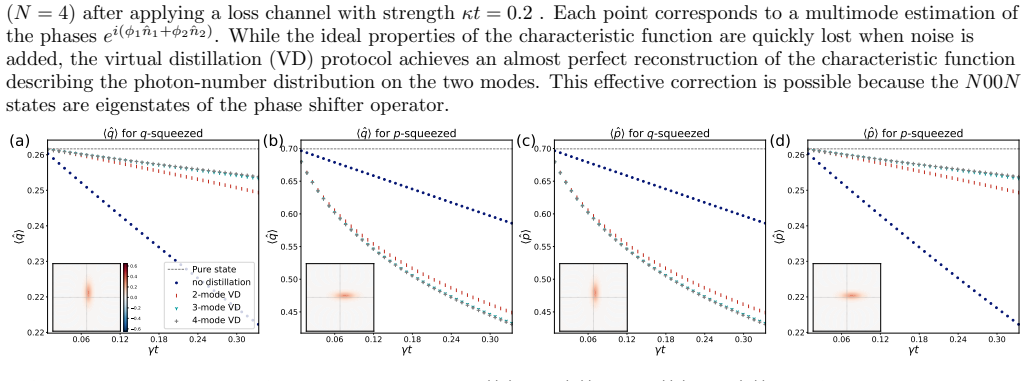
The paper shows that diagonalizing the cyclic-shift operator with a Fourier interferometer (and, when needed, a second passive unitary) converts multi-copy measurements into noise-mitigated expectation values of the number operator, any phase-shift operator e^{i ϕ n̂}, and arbitrary quadratures; the same data also yield the characteristic function of the photon-number distribution and therefore all number correlators. The protocols work for photon loss and dephasing and require only linear-optical resources already available in bosonic platforms.
What carries the argument
The spectral decomposition of the cyclic-shift operator S^(M) = F† D_S F, realized by a passive Fourier interferometer followed by photon-number (or homodyne) detection; when the target observable is not diagonal after this transform, a second passive unitary diagonalizes the product of the observable with S^(M).
Load-bearing premise
The ideal pure target must stay the unique largest eigenvector of the noisy state; if loss or dephasing moves that eigenvector, the protocol purifies the wrong state and gives no improvement.
What would settle it
Prepare a Fock or even-cat state, apply a controlled loss channel whose Kraus operators leave the target as the dominant eigenvector, run the multi-copy Fourier protocol, and check whether the recovered number or parity expectation value converges exponentially to the ideal pure-state value as the number of copies increases.
If this is right
- Bosonic processors can extract higher-fidelity Wigner functions and stellar-rank witnesses by virtual distillation of displaced parity measurements.
- Logical Pauli-Z readout of cat qubits improves without extra physical redundancy, aiding variational algorithms.
- Arbitrary photon-number correlators become accessible for near-term many-body simulations of long-range order and phase transitions.
- The same linear-optics circuits remain effective under modest additional coherent and incoherent noise inside the distillation interferometers themselves.
Where Pith is reading between the lines
- Extending the same diagonalization to higher moments of quadratures would give a direct error-mitigated probe of non-Gaussianity and non-classicality.
- When eigenvector drift is inevitable, hybrid schemes that first apply a cheap symmetry expansion or post-selection step before virtual distillation may restore the dominant-eigenvector condition.
- The characteristic-function route to correlators could be ported to atomic boson-sampling platforms to mitigate partial distinguishability without changing the lattice Hamiltonian.
Editorial analysis
A structured set of objections, weighed in public.
Referee Report
Summary. The manuscript develops a practical framework for virtual distillation (VD) in bosonic and continuous-variable systems. Starting from the standard multi-copy identities Tr[O ho^M] = Tr[O^(M) S^(M) ho^oxtimes M] and Tr[O ho^M] = Tr[O_k S^(M) ho^oxtimes M], the authors diagonalize the cyclic-shift operator S^(M) with a passive Fourier interferometer (Eqs. 15–17) and obtain two experimentally accessible protocols. Method 1 recovers noise-mitigated expectation values of the number operator and of arbitrary quadratures from a single Fourier interferometer plus local number/homodyne measurements (Eqs. 19, 21). Method 2 diagonalizes the composite operator e^{i heta n̂_1} S^(M) and thereby estimates phase-shift operators (including parity) and the full photon-number characteristic function, from which arbitrary-order number correlators follow (Eqs. 24–29, 34). Multimode extensions are given. Numerical simulations under photon loss and dephasing (Figs. 2–6) demonstrate exponential error suppression when the target pure state remains the dominant eigenvector of the noisy state and is an eigenstate of the measured observable; the same figures quantify the failure mode (eigenvector drift) when that spectral condition is violated. Appendices supply sample-complexity bounds, an explicit three-mode example, analytic forms of the diagonalizing unitaries, finite-difference error analysis for correlators, and a robustness check against coherent and incoherent circuit noise.
Significance. The work reclaims the original bosonic “virtual cooling” idea for modern continuous-variable quantum information processing and supplies concrete linear-optical circuits that use only passive interferometers already available in photonic and microwave platforms. The ability to extract purified number correlators and Wigner functions via the characteristic function is a genuine extension beyond the qubit literature and beyond the restricted observables of the 2019 virtual-cooling paper. The numerical evidence is carefully conditioned on the spectral assumption that the authors themselves state, and the appendices contain reproducible analytic and sampling analyses. If the protocols can be realized with a few copies on existing multi-mode platforms, they offer a near-term route to error-mitigated measurements of photon-number statistics and parity without full error correction.
minor comments (5)
- In Sec. II A the phrase “1/2 || ho - |ψ_{0} angle⟨ψ_{0}||_{1} = O(ϵ)” is used without an explicit definition of the O-notation for the trace distance; a one-line clarification would help readers who skip the later bound (Eq. 20).
- Fig. 1 caption mentions that a Fourier interferometer can be realized with O(M ln M) elements under arbitrary connectivity, citing Ref. [33]; a brief remark on whether current integrated-photonics platforms support that connectivity would strengthen the experimental claim.
- Appendix A, Eq. (A14): the optimal α is given, but the resulting n_tot is left in a somewhat cumbersome form; a short asymptotic statement “n_tot ∼ (1-ϵ)^{-2M}” would make the exponential cost immediately visible.
- In the multimode characteristic-function discussion (Sec. III C and Appendix E) the truncation N for the discrete Fourier inversion is left implicit; a pointer to the exponential-error bounds of Refs. [35,36] already cited elsewhere would be useful.
- Typographical: “VIR TUAL DISTILLA TION” appears with spaces in the section heading of Sec. III; likewise “SIMULA TIONS” and “APPLICA TIONS” in Sec. IV.
Circularity Check
No significant circularity; protocols follow by direct application of standard virtual-distillation identities and known Fourier diagonalization of cyclic shifts, with no fitted parameters or load-bearing self-citation loops.
full rationale
The derivation chain begins from the textbook virtual-distillation identities Tr[O ρ^M] = Tr[O^(M) S^(M) ρ^⊗M] and Tr[O ρ^M] = Tr[O_k S^(M) ρ^⊗M] (Eqs. 5–6), which are taken from the external literature [17,18] and are not redefined here. The cyclic-shift operator is diagonalized by the known M-mode Fourier interferometer (Eqs. 15–17, citing [21]), again an external construction. Method 1 then follows immediately by conjugating the symmetrized quadrature or number operator through that Fourier transform (Eq. 21); Method 2 follows by the elementary spectral decomposition of any passive linear unitary (Eq. 12) applied to e^{iϕ n̂_1} S^(M) (Eq. 24 and Appendix D). Multimode correlators are recovered from the characteristic function by the ordinary Fourier inversion or finite-difference formulae (Appendix E). All numerical examples are forward simulations of known loss/dephasing channels; no parameters are fitted to data and then re-presented as predictions. Self-citations (e.g., [41] for the multimode Fourier layer) supply only technical background and do not close any logical loop that forces the central claims. The sole acknowledged limitation—eigenvector drift when the target is not an eigenstate of the measured observable—is stated explicitly by the authors themselves and is not hidden by circular reasoning. Hence the paper is self-contained against external benchmarks and exhibits at most a negligible self-citation that is not load-bearing.
Axiom & Free-Parameter Ledger
axioms (3)
- domain assumption The noisy state admits the spectral form ρ = (1-ε)|ψ₀⟩⟨ψ₀| + Σ ε_i |ψ_i⟩⟨ψ_i| with 1-ε > ε_i (Eq. 1).
- standard math Cyclic-shift operators on M bosonic modes are unitarily diagonalized by the discrete Fourier interferometer (Eqs. 15–17).
- domain assumption Photon loss and pure dephasing are accurately described by the given Kraus operators with rates κ, γ.
read the original abstract
Virtual distillation is a promising error-mitigation technique that exploits multiple copies of a noisy quantum state to estimate observables as if measured on a purified state. Although originally introduced in the context of bosonic many-body systems under the name of virtual cooling, its development and applications have largely focused on qubit-based quantum computation. Here, we establish a framework for virtual distillation in bosonic quantum information processing and continuous-variable quantum computing. Building on a diagonalization of cyclic shift operators implemented with passive linear-optical interferometers, we derive experimentally accessible protocols for estimating virtually distilled expectation values of observables relevant to bosonic architectures. In particular, we show how to recover noise-mitigated expectation values of number operators, phase-shift operators, and arbitrary quadratures from multi-copy measurements. For number operators, we further demonstrate the estimation of virtually distilled correlators of arbitrary order through the characteristic function of the photon-number distribution. We apply the framework to states affected by photon loss and dephasing, two of the dominant noise mechanisms in bosonic quantum computation, and quantify the resulting suppression of noise contributions. Our results extend virtual distillation beyond its original setting and provide a practical route toward error-mitigated measurements in bosonic quantum processors using experimentally available linear-optical resources.
Figures




Reference graph
Works this paper leans on
-
[1]
Preskill, Quantum2, 79 (2018)
J. Preskill, Quantum2, 79 (2018)
2018
-
[2]
Katabarwa, K
A. Katabarwa, K. Gratsea, A. Caesura, and P. D. John- son, PRX Quantum5, 020101 (2024)
2024
-
[3]
Z. Cai, R. Babbush, S. C. Benjamin, S. Endo, W. J. Huggins, Y. Li, J. R. McClean, and T. E. O’Brien, Rev. Mod. Phys.95, 045005 (2023)
2023
-
[4]
Z. Zimbor´ as, B. Koczor, Z. Holmes, E.-M. Borrelli, A. Gily´ en, H.-Y. Huang, Z. Cai, A. Ac´ ın, L. Aolita, L. Banchi, F. G. S. L. Brand˜ ao, D. Cavalcanti, T. Cubitt, S. N. Filippov, G. Garc´ ıa-P´ erez, J. Goold, O. K´ alm´ an, E. Kyoseva, M. A. C. Rossi, B. Sokolov, I. Tavernelli, and S. Maniscalco, Myths around quantum computation be- fore full fault...
Pith/arXiv arXiv 2025
-
[5]
Barenco, A
A. Barenco, A. Berthiaume, D. Deutsch, A. Ekert, R. Jozsa, and C. Macchiavello, SIAM Journal on Com- puting26, 1541 (1997)
1997
-
[6]
J. I. Cirac, A. Ekert, and C. Macchiavello, Physical re- view letters82, 4344 (1999)
1999
-
[7]
A. M. Childs, H. Fu, D. Leung, Z. Li, M. Ozols, and V. Vyas, Quantum9, 1603 (2025)
2025
-
[8]
B. Yang, E. Kashefi, D. Leichtle, and H. Ollivier, arXiv preprint arXiv:2404.09973 (2024)
Pith/arXiv arXiv 2024
-
[9]
Keyl and R
M. Keyl and R. F. Werner, inAnnales Henri Poincare, Vol. 2 (Springer, 2001) pp. 1–26
2001
-
[10]
K. Zhang, H. Li, J. Jing, N. Treps, and M. Walschaers, Purification of gaussian states by photon subtraction 12 (2024), arXiv:2409.03473 [quant-ph]
Pith/arXiv arXiv 2024
-
[11]
Niset, J
J. Niset, J. Fiur´ aˇ sek, and N. J. Cerf, Physical review letters102, 120501 (2009)
2009
-
[12]
Giedke and J
G. Giedke and J. I. Cirac, Physical Review A66, 032316 (2002)
2002
-
[13]
C. F. D. Faurby, L. Carosini, H. Cao, P. I. Sund, L. M. Hansen, F. Giorgino, A. B. Villadsen, S. N. van den Hoven, P. Lodahl, S. Paesani, J. C. Loredo, and P. Walther, Purifying photon indistinguishability through quantum interference (2024), arXiv:2403.12866 [quant-ph]
Pith/arXiv arXiv 2024
-
[14]
F. Hoch, A. Camillini, G. Rodari, E. Caruccio, G. Carva- cho, T. Giordani, R. Albiero, N. D. Giano, G. Corrielli, F. Ceccarelli, R. Osellame, M. Robbio, L. Novo, N. Spag- nolo, E. F. Galv˜ ao, and F. Sciarrino, Optimal distillation of photonic indistinguishability (2025), arXiv:2509.02296 [quant-ph]
Pith/arXiv arXiv 2025
-
[15]
Marshall, Physical Review Letters129, 213601 (2022), arXiv:2203.15197 [quant-ph]
J. Marshall, Physical Review Letters129, 213601 (2022), arXiv:2203.15197 [quant-ph]
Pith/arXiv arXiv 2022
-
[16]
S. Endo, Y. Suzuki, K. Tsubouchi, R. Asaoka, K. Ya- mamoto, Y. Matsuzaki, and Y. Tokunaga, Phys. Rev. A 111, 062402 (2025)
2025
-
[17]
J. Cotler, S. Choi, A. Lukin, H. Gharibyan, T. Grover, M. E. Tai, M. Rispoli, R. Schittko, P. M. Preiss, A. M. Kaufman, M. Greiner, H. Pichler, and P. Hayden, Phys- ical Review X9, 10.1103/physrevx.9.031013 (2019)
-
[18]
W. J. Huggins, S. McArdle, T. E. O’Brien, J. Lee, N. C. Rubin, S. Boixo, K. B. Whaley, R. Babbush, and J. R. McClean, Physical Review X11, 10.1103/phys- revx.11.041036 (2021)
doi:10.1103/phys- 2021
-
[19]
Koczor, Physical Review X11, 031057 (2021)
B. Koczor, Physical Review X11, 031057 (2021)
2021
-
[20]
O’Brien, G
T. O’Brien, G. Anselmetti, Gkritsis, F. V. E. Elfving, S. Polla, W. J. Huggins, O. Oumarou, K. Kechedzhi, D. Abanin, R. Acharya, and N. C. Rubin, Nat. Phys. 19, 1782 (2023)
2023
-
[21]
A. J. Daley, H. Pichler, J. Schachenmayer, and P. Zoller, Phys. Rev. Lett.109, 020505 (2012)
2012
-
[22]
Hertz, O
A. Hertz, O. Oreshkov, and N. J. Cerf, Phys. Rev. A100, 052112 (2019)
2019
-
[23]
Arnhem, C
M. Arnhem, C. Griffet, and N. J. Cerf, Phys. Rev. A106, 043705 (2022)
2022
-
[24]
Griffet, M
C. Griffet, M. Arnhem, S. De Bi` evre, and N. J. Cerf, Phys. Rev. A108, 023730 (2023)
2023
-
[25]
Griffet, T
C. Griffet, T. Haas, and N. J. Cerf, Phys. Rev. A108, 022421 (2023)
2023
-
[26]
˙Zukowski, A
M. ˙Zukowski, A. Zeilinger, and M. A. Horne, Phys. Rev. A55, 2564 (1997)
1997
-
[27]
I. Jex, S. Stenholm, and A. Zeilinger, Optics Communi- cations117, 95 (1995)
1995
-
[28]
Joshi, K
A. Joshi, K. Noh, and Y. Y. Gao, Quantum Science and Technology6, 033001 (2021)
2021
-
[29]
Rudin,Real and Complex Analysis, 3rd ed., McGraw- Hill International Editions Mathematics Series (McGraw- Hill, New York, NY, 2013)
W. Rudin,Real and Complex Analysis, 3rd ed., McGraw- Hill International Editions Mathematics Series (McGraw- Hill, New York, NY, 2013)
2013
-
[30]
Koczor, New Journal of Physics23, 123047 (2021)
B. Koczor, New Journal of Physics23, 123047 (2021)
2021
-
[31]
M. Reck, A. Zeilinger, H. J. Bernstein, and P. Bertani, Physical Review Letters73, 58 (1994)
1994
-
[32]
W. R. Clements, P. C. Humphreys, B. J. Metcalf, W. S. Kolthammer, and I. A. Walmsley, An Optimal Design for Universal Multiport Interferometers (2017), arXiv:1603.08788 [physics]
Pith/arXiv arXiv 2017
-
[33]
Marcandelli, S
P. Marcandelli, S. Mariani, M. Siena, and S. Markidis, Algorithms19, 370 (2026)
2026
-
[34]
(17), we see that the operator ˆD ˆS(M) only involves theM−1 first modes, since the last one is associated with the observablee 2iπ M MˆnM = 1ˆnM which does not affect the result
By Eq. (17), we see that the operator ˆD ˆS(M) only involves theM−1 first modes, since the last one is associated with the observablee 2iπ M MˆnM = 1ˆnM which does not affect the result
-
[35]
V. Upreti, N. Quesada, and U. Chabaud, Exponentially- improved effective descriptions of physical bosonic sys- tems (2026), arXiv:2604.18720 [quant-ph]
Pith/arXiv arXiv 2026
-
[36]
G. Bressanini, B. Seron, L. Novo, N. J. Cerf, and M. S. Kim, Gaussian boson sampling validation via detector binning (2024), arXiv:2310.18113 [quant-ph]
Pith/arXiv arXiv 2024
-
[37]
M. Robbio, M. G. Jabbour, and N. J. Cerf, Complemen- tarity between bosonic and fermionic many-body inter- ferences with partially distinguishable particles (2026), arXiv:2604.23316 [quant-ph]
Pith/arXiv arXiv 2026
-
[38]
Van Herstraeten, M
Z. Van Herstraeten, M. G. Jabbour, and N. J. Cerf, AVS Quantum Science5(2023)
2023
-
[39]
M. C. Anguita, A. Camillini, S. Marzban, M. Robbio, B. Seron, L. Novo, and J. J. Renema, Experimental vali- dation of boson sampling using detector binning (2025), arXiv:2502.05093 [quant-ph]
Pith/arXiv arXiv 2025
-
[40]
M. E. O. Bezerra and V. Shchesnovich, arXiv preprint arXiv:2602.00071 (2026)
arXiv 2026
-
[41]
L. Novo, M. Robbio, E. F. Galv˜ ao, and N. J. Cerf, Na- tive linear-optical protocol for efficient multivariate trace estimation (2026), arXiv:2601.14204 [quant-ph]
arXiv 2026
-
[42]
Seron, L
B. Seron, L. Novo, A. Arkhipov, and N. J. Cerf, Quantum 8, 1479 (2024)
2024
-
[43]
A. W. Young, S. Geller, W. J. Eckner, N. Schine, S. Glancy, E. Knill, and A. M. Kaufman, Nature629, 311–316 (2024)
2024
-
[44]
Vikst˚ al, G
P. Vikst˚ al, G. Ferrini, and S. Puri, Quantum8, 1441 (2024)
2024
-
[45]
Becker, N
S. Becker, N. Datta, L. Lami, and C. Rouz´ e, Communi- cations in Mathematical Physics383, 223 (2021)
2021
-
[46]
O. Hahn, V. Preti, A. Maltesson, M. Ellerbroek, S.-R. Keshari, G. Ferrini, A. Ferraro, and U. Chabaud, Wit- nessing and quantifying stellar rank with the wigner func- tion (2026), in preparation
2026
-
[47]
A. L. Grimsmo, J. Combes, and B. Q. Baragiola, Phys. Rev. X10, 011058 (2020)
2020
-
[48]
S. Puri, S. Boutin, and A. Blais, npj Quantum Informa- tion3, 18 (2017)
2017
-
[49]
P. Vikst˚ al, L. Garc´ ıa-´Alvarez, S. Puri, and G. Ferrini, Quantum approximate optimization algorithm with cat qubits (2024), arXiv:2305.05556 [quant-ph]
Pith/arXiv arXiv 2024
-
[50]
Barbieri, PRX Quantum3, 010202 (2022)
M. Barbieri, PRX Quantum3, 010202 (2022)
2022
-
[51]
V. Kala, C. A. Breum, M. V. Larsen, U. L. Andersen, J. S. Neergaard-Nielsen, R. Filip, and P. Marek, Nul- lifiers of non-gaussian cluster states through homodyne measurement (2025), arXiv:2505.21066 [quant-ph]
arXiv 2025
-
[52]
A. I. Lvovsky and J. H. Shapiro, Phys. Rev. A65, 033830 (2002)
2002
-
[53]
V. S. Alfaro, arXiv preprint arXiv:2606.15464 (2026)
Pith/arXiv arXiv 2026
-
[54]
M. C. Tichy, Journal of Physics B: Atomic, Molecular and Optical Physics47, 103001 (2014)
2014
-
[55]
S. Aaronson and A. Arkhipov, The computational com- plexity of linear optics (2010), arXiv:1011.3245 [quant- ph]
Pith/arXiv arXiv 2010
-
[56]
S. Geller and E. Knill, Measuring multiparticle indis- tinguishability with the generalized bunching probability (2025), arXiv:2509.04550 [quant-ph]. 13 Appendix A: Sample complexity In the above discussion, we did not consider the sam- ple complexity of estimating Tr h ˆO˜ρ i , which of course will depend on the number of copies involved. Let us separate...
arXiv 2025
-
[57]
1 0 .(D1) First we compute the characteristic polynomial, which reduces to p(λ) =λ M −e iϕ =⇒λ k =e i (2πk+ϕ) M (D2) meaningD ϕ = diag(λ 1, . . . , λM). The corresponding eigenvector ofλ k can be found in the form vk = 1√ M 1 λ−1 k λ−2 k ... λ−M k (D3) and as a consequence the matrixV ϕ can be written as (Vϕ)jk = 1√ M e− i(j−1) M (2...
discussion (0)
Sign in with ORCID, Apple, or X to comment. Anyone can read and Pith papers without signing in.