REVIEW 2 major objections 1 minor 19 references
Reviewed by Pith at T0; open to challenge.
T0 means a machine referee read the full paper against a public rubric. The mark states how deep the mechanical check went, never who wrote it. the ladder, T0–T4 →
T0 review · grok-4.3
Audio diffusion models concentrate control over instruments, vocals and genres in a small shared set of attention layers.
2026-05-21 13:36 UTC pith:BLJGFJXH
load-bearing objection Audio diffusion models have a semantic bottleneck in a few attention layers that localized activation steering exploits for better concept control than prompt or weight baselines, per their user study. the 2 major comments →
TADA! Tuning Audio Diffusion Models through Activation Steering
The pith
A machine-rendered reading of the paper's core claim, the machinery that carries it, and where it could break.
Core claim
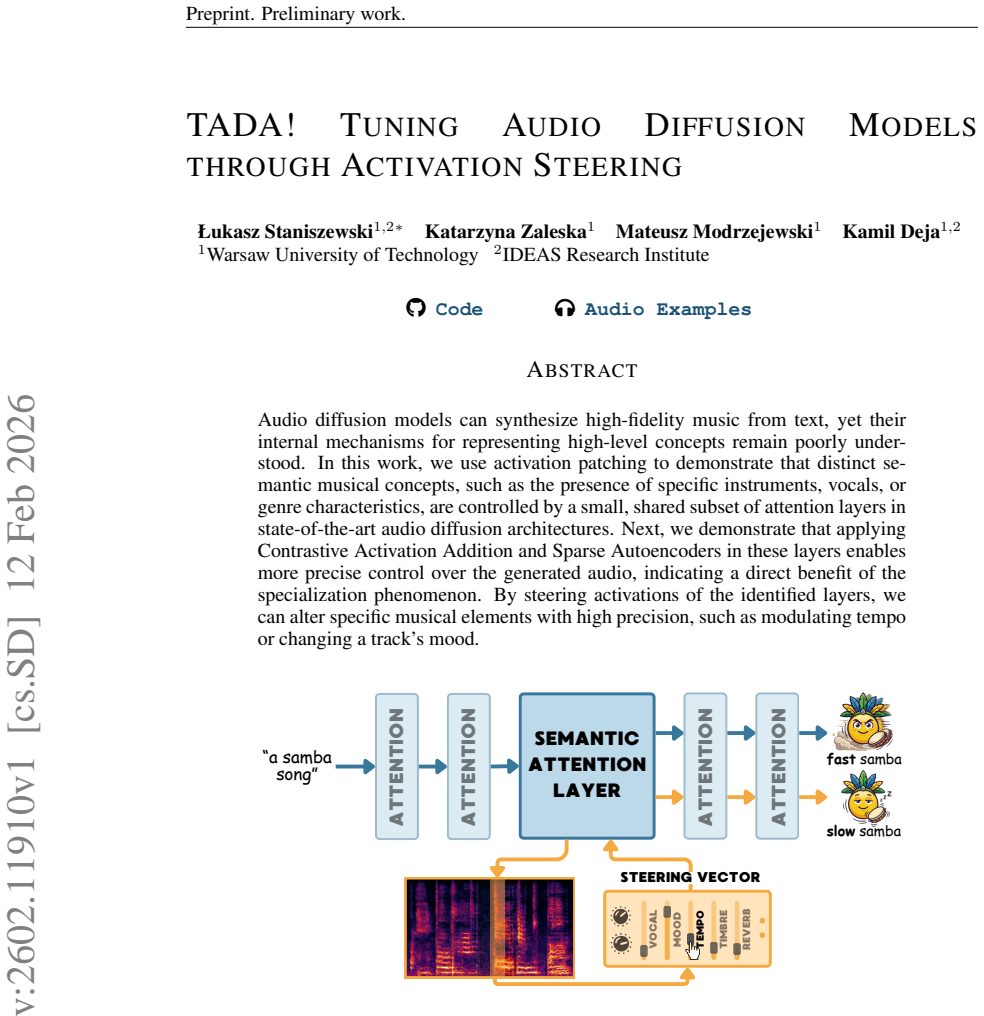
Recent audio diffusion architectures exhibit a semantic bottleneck, where a small, shared subset of consecutive attention layers controls distinct musical concepts, such as the presence of specific instruments, vocals, or genres. Building on activation patching, localized activation steering at these layers outperforms prompt-level, score-space, and weight-space interventions and sets a new state-of-the-art in audio concept modulation according to an extensive user study.
What carries the argument
Semantic bottleneck identified by activation patching in consecutive attention layers, which serves as the intervention site for activation steering to modulate musical concepts.
Load-bearing premise
The semantic bottleneck identified via activation patching is stable across different models, prompts, and musical concepts, and the user study reliably measures perceptual quality without bias from the steering method itself.
What would settle it
If steering activations outside the identified layers produces equal or better concept modulation in user studies, or if the same layers fail to control concepts on a new model or prompt set, the advantage of localized activation steering would not hold.
If this is right
- Steering at the bottleneck layers modulates presence of instruments, vocals or genres more effectively than other intervention types.
- The same small set of layers works for multiple distinct musical concepts rather than requiring separate sites for each.
- A new benchmark with user ratings shows localized activation steering reaches higher perceptual quality than prompt, score or weight interventions.
- The method requires no model retraining and works by editing internal activations during generation.
Where Pith is reading between the lines
- If the bottleneck proves consistent, the same patching technique could map concept control sites in video or 3D diffusion models.
- Steering could be combined with existing prompt engineering to allow both coarse and fine control in one generation pass.
- Developers might embed the identified layers as editable controls in music-generation interfaces for non-technical users.
Editorial analysis
A structured set of objections, weighed in public.
Referee Report
Summary. The manuscript uses activation patching to identify a semantic bottleneck in consecutive attention layers of audio diffusion models that selectively controls musical concepts such as instruments, vocals, and genres. It then evaluates localized activation steering at these sites against prompt-level, score-space, and weight-space baselines, claiming superior performance on a new user-study benchmark that establishes a new state-of-the-art in audio concept modulation.
Significance. If the bottleneck localization and user-study results hold, the work provides both mechanistic insight into concept representation in audio diffusion architectures and a practical, training-free method for fine-grained control. The systematic comparison of intervention sites and mechanisms is a constructive contribution to controllability research in generative audio models.
major comments (2)
- [§4.1] §4.1 Activation Patching: The identification of a 'small, shared subset of consecutive attention layers' as a stable semantic bottleneck is presented for the primary model and prompt set, but no cross-model or cross-concept ablation is reported to test whether the layer indices shift. This directly affects the claimed advantage of localized steering over other sites.
- [§5.3] §5.3 User Study: The new benchmark claims SOTA performance via perceptual ratings, yet the text provides no participant count, exclusion criteria, inter-rater reliability statistics, or controls for steering-induced artifacts that could be misattributed to the target concept. Without these, the superiority over baselines cannot be verified.
minor comments (1)
- [Figure 2] Figure 2: The activation patching heatmaps lack axis labels indicating layer indices and concept types, making it difficult to map the reported bottleneck location to the steering experiments.
Simulated Author's Rebuttal
We thank the referee for the constructive feedback on our manuscript. We address each major comment below and will revise the paper to strengthen the presentation of our results.
read point-by-point responses
-
Referee: [§4.1] §4.1 Activation Patching: The identification of a 'small, shared subset of consecutive attention layers' as a stable semantic bottleneck is presented for the primary model and prompt set, but no cross-model or cross-concept ablation is reported to test whether the layer indices shift. This directly affects the claimed advantage of localized steering over other sites.
Authors: We appreciate this observation. Our experiments identified the bottleneck layers consistently across the tested musical concepts (instruments, vocals, and genres) for the primary model. We did not include cross-model ablations in the original submission owing to the substantial computational resources required to repeat activation patching across additional large-scale audio diffusion models. We agree that demonstrating stability of the layer indices across models would further support the generality of localized steering. In the revised manuscript we will add a limited cross-model ablation on a secondary architecture to verify whether the identified consecutive attention layers remain stable. revision: yes
-
Referee: [§5.3] §5.3 User Study: The new benchmark claims SOTA performance via perceptual ratings, yet the text provides no participant count, exclusion criteria, inter-rater reliability statistics, or controls for steering-induced artifacts that could be misattributed to the target concept. Without these, the superiority over baselines cannot be verified.
Authors: We agree that these methodological details are necessary for readers to evaluate the user-study results. The details were omitted from the submitted text for space reasons, but the study was performed with standard practices including participant screening, attention checks, reliability metrics, and artifact controls. We will expand §5.3 with a complete description of the study protocol, including the number of participants, exclusion criteria, inter-rater reliability statistics, and the specific controls used to distinguish steering effects from potential artifacts. revision: yes
Circularity Check
No significant circularity; claims rest on empirical experiments and external benchmarks
full rationale
The paper describes an empirical investigation that applies activation patching to locate semantic bottlenecks in audio diffusion models, then compares activation steering against prompt-level, score-space, and weight-space baselines on a newly introduced benchmark validated by user study. No equations, derivations, or parameter-fitting steps are presented that reduce by construction to the paper's own inputs or prior self-citations. The state-of-the-art claim is grounded in comparative performance measurements rather than self-definitional or fitted-input predictions. The work is therefore self-contained against external benchmarks and does not exhibit any of the enumerated circularity patterns.
Axiom & Free-Parameter Ledger
read the original abstract
Audio diffusion models can synthesize high-fidelity music from text, yet achieving fine-grained control over specific musical attributes remains challenging, as their internal mechanisms for representing high-level concepts are poorly understood. In this work, we use activation patching to demonstrate that recent audio diffusion architectures exhibit a semantic bottleneck, where a small, shared subset of consecutive attention layers controls distinct musical concepts, such as the presence of specific instruments, vocals, or genres. Building on this, we systematically evaluate a broad spectrum of steering paradigms, comparing activation steering against prompt-level, score-space, and weight-space interventions, analyzing the interaction between the steering mechanism and the intervention site. Our new benchmark, supported by an extensive user study, demonstrates that localized activation steering establishes a new state-of-the-art in audio concept modulation.
Figures


Reference graph
Works this paper leans on
-
[1]
Josh Achiam, Steven Adler, Sandhini Agarwal, Lama Ahmad, Ilge Akkaya, Florencia Leoni Ale- man, Diogo Almeida, Janko Altenschmidt, Sam Altman, Shyamal Anadkat, et al. Gpt-4 technical report.arXiv preprint arXiv:2303.08774,
work page internal anchor Pith review Pith/arXiv arXiv
-
[2]
MusicLM: Generating Music From Text
Andrea Agostinelli, Timo I. Denk, Zal ´an Borsos, Jesse Engel, Mauro Verzetti, Antoine Caillon, Qingqing Huang, Aren Jansen, Adam Roberts, Marco Tagliasacchi, Matt Sharifi, Neil Zeghidour, and Christian Frank. Musiclm: Generating music from text.arXiv preprint arXiv: 2301.11325,
work page internal anchor Pith review Pith/arXiv arXiv
-
[3]
On mechanistic knowledge localization in text-to- image generative models
Samyadeep Basu, Keivan Rezaei, Priyatham Kattakinda, Vlad I Morariu, Nanxuan Zhao, Ryan A Rossi, Varun Manjunatha, and Soheil Feizi. On mechanistic knowledge localization in text-to- image generative models. InForty-first International Conference on Machine Learning, 2024a. Samyadeep Basu, Nanxuan Zhao, Vlad I. Morariu, Soheil Feizi, and Varun Manjunatha....
work page 2024
-
[4]
Bart Bussmann, Patrick Leask, and Neel Nanda
https://transformer- circuits.pub/2023/monosemantic-features/index.html. Bart Bussmann, Patrick Leask, and Neel Nanda. Batchtopk sparse autoencoders,
work page 2023
-
[5]
URL https://arxiv.org/abs/2412.06410. Runjin Chen, Andy Arditi, Henry Sleight, Owain Evans, and Jack Lindsey. Persona vectors: Mon- itoring and controlling character traits in language models.arXiv preprint arXiv:2507.21509,
-
[6]
URLhttps: //openreview.net/forum?id=YicbFdNTTy. 8 Preprint. Preliminary work. Zach Evans, Julian D. Parker, CJ Carr, Zack Zukowski, Josiah Taylor, and Jordi Pons. Stable audio open. InICASSP 2025 - 2025 IEEE International Conference on Acoustics, Speech and Signal Processing (ICASSP), pp. 1–5,
work page 2025
-
[7]
Lstm-qgan: Scalable nisq generative adversarial network,
doi: 10.1109/ICASSP49660.2025.10888461. Simone Facchiano, Giorgio Strano, Donato Crisostomi, Irene Tallini, Tommaso Mencattini, Fabio Galasso, and Emanuele Rodol `a. Activation patching for interpretable steering in music genera- tion.arXiv preprint arXiv:2504.04479,
-
[8]
CASteer: Cross-Attention Steering for Controllable Concept Erasure
Tatiana Gaintseva, Andreea-Maria Oncescu, Chengcheng Ma, Ziquan Liu, Martin Benning, Gregory Slabaugh, Jiankang Deng, and Ismail Elezi. Casteer: Steering diffusion models for controllable generation.arXiv preprint arXiv:2503.09630,
work page internal anchor Pith review arXiv
-
[9]
ACE-Step: A step towards music generation foundation model,
URLhttps://openreview.net/ forum?id=tcsZt9ZNKD. Junmin Gong, Sean Zhao, Sen Wang, Shengyuan Xu, and Joe Guo. Ace-step: A step towards music generation foundation model.arXiv preprint arXiv: 2506.00045,
-
[10]
Subhash Kantamneni, Joshua Engels, Senthooran Rajamanoharan, Max Tegmark, and Neel Nanda
doi: 10.5244/c.35.336. Subhash Kantamneni, Joshua Engels, Senthooran Rajamanoharan, Max Tegmark, and Neel Nanda. Are sparse autoencoders useful? a case study in sparse probing.arXiv preprint arXiv:2502.16681,
-
[11]
Fr ´echet audio distance: A reference-free metric for evaluating music enhancement algorithms
Kevin Kilgour, Mauricio Zuluaga, Dominik Roblek, and Matthew Sharifi. Fr ´echet audio distance: A reference-free metric for evaluating music enhancement algorithms. InProc. Interspeech 2019, pp. 2350–2354,
work page 2019
-
[12]
H., Nistal, J., Lattner, S., Pasini, M., and Fazekas, G
Ching Ho Lee, Javier Nistal, Stefan Lattner, Marco Pasini, and George Fazekas. Diffusion timbre transfer via mutual information guided inpainting.arXiv preprint arXiv:2601.01294,
-
[13]
Bruno A Olshausen and David J Field
URL https://proceedings.neurips.cc/paper_files/paper/2022/file/ 6f1d43d5a82a37e89b0665b33bf3a182-Paper-Conference.pdf. Bruno A Olshausen and David J Field. Sparse coding with an overcomplete basis set: A strategy employed by v1?Vision research, 37(23):3311–3325,
work page 2022
-
[14]
Nathan Paek, Yongyi Zang, Qihui Yang, and Randal Leistikow. Learning interpretable features in audio latent spaces via sparse autoencoders.arXiv preprint arXiv:2510.23802,
-
[15]
Nikhil Singh, Manuel Cherep, and Pattie Maes
URLhttps: //builders.mozilla.org/insider-whisper/. Nikhil Singh, Manuel Cherep, and Pattie Maes. Discovering interpretable concepts in large genera- tive music models.arXiv preprint arXiv:2505.18186,
-
[16]
Meta Audiobox Aesthetics: Unified Automatic Quality Assessment for Speech, Music, and Sound
URLhttps://arxiv.org/abs/2502.05139. Marcel A V´elez V´asquez, Charlotte Pouw, John Ashley Burgoyne, and Willem Zuidema. Exploring the inner mechanisms of large generative music models. ISMIR,
work page internal anchor Pith review Pith/arXiv arXiv
-
[17]
doi: 10.48550/arXiv.2410.00872. Yusong Wu, K. Chen, Tianyu Zhang, Yuchen Hui, Taylor Berg-Kirkpatrick, and S. Dubnov. Large- scale contrastive language-audio pretraining with feature fusion and keyword-to-caption augmen- tation.IEEE International Conference on Acoustics, Speech, and Signal Processing,
-
[18]
On the importance of different cough phases for covid-19 detection,
doi: 10.1109/ICASSP49357.2023.10095969. Yi Yang, Haowen Li, Tianxiang Li, Boyu Cao, Xiaohan Zhang, Liqun Chen, and Qi Liu. Melo- dia: Training-free music editing guided by attention probing in diffusion models.arXiv preprint arXiv:2511.08252,
-
[19]
MuQ: Self-Supervised Music Representation Learning with Mel Residual Vector Quantization
URLhttps://openreview.net/forum?id= SiBVbL7rsX. Haina Zhu, Yizhi Zhou, Hangting Chen, Jianwei Yu, Ziyang Ma, Rongzhi Gu, Yi Luo, Wei Tan, and Xie Chen. Muq: Self-supervised music representation learning with mel residual vector quantization.arXiv preprint arXiv:2501.01108,
discussion (0)
Sign in with ORCID, Apple, or X to comment. Anyone can read and Pith papers without signing in.