REVIEW 2 major objections 4 minor 2 cited by
Optimizers Qualitatively Alter Solutions And We Should Leverage This
T0 review · 2 major / 4 minor · reviewed 2026-08-06 · deepseek-v4-flash
Pith's one-line read The choice of optimizer in deep learning determines qualitative properties of the learned solution—sparsity, representation structure, and resistance to forgetting—not just convergence speed.
desk verdict A well-framed position paper whose most concrete proposal—the preconditioner equivalence—is asserted rather than proven or tested. read the letter →
The pith
A machine-rendered reading of the paper's core claim, the machinery that carries it, and where it could break.
The reading
What carries the argument
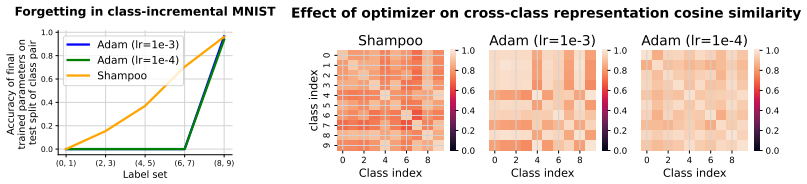
The load-bearing object is the preconditioner $P$ in the update rule, a matrix that rescales and rotates the gradient before it is applied. The paper's argument is that this matrix is not merely an acceleration device: by changing which directions are favoured at each step, it changes the basin of attraction the training process enters and therefore the qualitative character of the solution. Two specific mechanisms carry the examples. A non-diagonal preconditioner contains off-diagonal entries that encode how moving one weight affects the gradient of another, which the paper argues removes wasteful over-shooting and keeps learned representations in a lower-dimensional subspace. For sparsity, the mechanism is a saddle at zero: the reparameterization $\theta = \phi|\phi|^{\alpha-1}$ multiplies gradients by $|\phi|^{\alpha-1}$, making small parameters expensive to move, and the paper claims the same step-by-step dynamics are produced by the preconditioner $P = \operatorname{diag}(|\theta|^\beta)$ on the original parameters, with $\alpha$ folded into the learning rate.
What would settle it
Run a matched head-to-head: from the same initialization, train the same architecture on the same data with (a) the Power-propagation reparameterization and (b) plain SGD with preconditioner $P = \operatorname{diag}(|\theta|^\beta)$, with the learning-rate scaling specified in the paper. Record per-step parameter updates and the final weight-sparsity distribution; if the trajectories or the sparsity of the solutions differ materially, the claimed equivalence that underpins the sparsity example is false. For the continual-learning claim, a falsifying observation would be a non-diagonal preconditioner that consistently increases, rather than decreases, cross-task interference in a benchmark where Shampoo's lower-forgetting effect is currently the evidence.
Extended reading notes
Core claim
The paper's central claim is that the learning algorithm, and specifically its preconditioner, is a genuine source of inductive bias: it determines not only how fast a model converges but what kind of solution it converges to, and hence the effective expressivity of the model class. In the non-convex loss landscapes of deep networks, different optimizers follow different paths from the same initialization and can land in minima with different qualitative properties. The paper advances this thesis through two concrete illustrations. First, a non-diagonal preconditioner such as Shampoo is argued to produce more localized, lower-rank representations and less interference across sequentially learned tasks than diagonal methods like Adam, with supporting experiments on permuted and class-incremental MNIST. Second, the Power-propagation reparameterization for sparsity is recast as an equivalent preconditioner $P = \operatorname{diag}(|\theta|^\beta)$, showing that a solution property like sparsity can be engineered directly through optimizer choice, even at the cost of convergence speed.
Load-bearing premise
The concrete sparsity proposal depends on the claim that a change to the optimizer's step sizes can exactly reproduce the learning dynamics of a particular change to how the network's parameters enter the computation, and this exact equivalence is asserted without a proof or a direct experiment.
Editorial extensions
If this is right
- Expressivity analyses that consider only architecture and data are incomplete; the learning algorithm determines which functions are reachable from initialization, and this should be part of model-selection reasoning.
- Non-diagonal second-order preconditioners become a candidate tool for continual learning, since they are argued to reduce interference and forgetting while also compressing the effective dimensionality of representations.
- Optimizers can be deliberately built to sacrifice convergence speed in exchange for solution properties such as sparsity, exactly as a preconditioner can bias learning toward sparse solutions.
- For large pretrained models whose architecture is fixed, fine-tuning with a carefully chosen optimizer offers a practical route to injecting an inductive bias that architecture changes cannot provide.
- Comparing two optimizers solely by final accuracy is misleading: they may achieve similar error while producing solutions with different sparsity, representation rank, and robustness to task interference.
Reading between the lines
- A direct test of the paper's central equivalence is to train identical models with Power-propagation reparameterization and with preconditioned SGD using $P = \operatorname{diag}(|\theta|^\beta)$, tracking both the parameter trajectories and the sparsity of the final weights; if the dynamics diverge, the concrete sparsity proposal needs a weaker justification.
- If optimizer choice changes effective expressivity, negative results about what a model class can learn—such as debates over whether recurrent networks are Turing complete under gradient training—should be re-examined through the lens of reachability rather than pure representability.
- The paper's position implies that benchmark comparisons of optimizers should report solution-level diagnostics (effective rank, sparsity, cross-task interference) alongside accuracy and wall-clock time, because optimizers that tie on accuracy can still differ on these properties.
- A stronger but untested extension of the argument is that optimizer-induced biases and architectural inductive biases are partially interchangeable, so architecture search and optimizer search could be traded against each other in the design of a learning system.
Editorial analysis
A structured set of objections, weighed in public.
Referee Report
Summary. This position paper argues that under non-convex objectives the optimization algorithm is not merely a speed-of-convergence device: it selects among minima with qualitatively different properties, acting as an inductive bias and shaping the effective expressivity of the model class. The authors support this with existing literature (flat minima, implicit regularization, rich/lazy regimes) and with two examples. The first (Section 3.1) compares Shampoo and Adam/AdamW on permuted and class-incremental MNIST with small MLPs, reporting less catastrophic forgetting and lower effective rank for Shampoo. The second (Section 3.2) reframes Power-propagation as a sparsity-inducing preconditioner P=diag(|θ|^β), claiming identical learning dynamics to training the reparameterized model φ^α. Section 4 discusses limitations and counterarguments (reparameterization duality, hand-engineering of biases). The paper's recommendation is to design optimizers with explicit solution properties in mind rather than optimizing convergence speed only.
Significance. If the thesis holds, it elevates optimizer design to the same status as architecture selection and gives a concrete mechanism for inducing sparsity, low-rank representations, or low forgetting without changing architecture. The paper is a useful and honest synthesis: it cites a broad literature, openly labels the reparameterization–optimizer relationship as informal, and frames the examples as thought experiments rather than methodological contributions. Its main present weakness is that the load-bearing sparsity proposal rests on an unproved equivalence and an untested preconditioner; as written, the only concrete evidence for that mechanism comes from prior work on Power-propagation. The forgetting experiments are small-scale and lack uncertainty information. Nevertheless, the central conceptual claim is well-supported by prior literature and by the authors' experiments in a directional way, and the paper's call to study optimizer-induced biases is timely.
major comments (2)
- [Section 3.2, paragraph after the gradient equation] The assertion that optimizing θ=φ^α with Power-propagation gives 'identical learning dynamics' to preconditioned SGD with P=diag(|θ|^β) is not derived and is only true in an infinitesimal-step sense. For the reparameterized model, a finite step in φ yields θ_{t+1}=(φ_t−η φ_t^{α−1}g_θ)^α, while the preconditioned update on θ is θ_t−η|θ_t|^βg_θ; these agree only to first order in η (and only if β=2(α−1)/α, a relation the paper never states). The difference is O(η²) and is non-negligible near the very zero saddles that are supposed to drive sparsity. In addition, the proposed preconditioner is never implemented or tested. This is load-bearing because Section 3.2 is the paper's only concrete proposal for a new sparsity-inducing optimizer. Please either provide a rigorous derivation (including the β–α relation and a statement of the discrete regime in which the equivalence holds) or add a direct empirical comparison of P=diag(|θ|^β) against Power-propagation.
- [Section 3.1, Figures 3 and 4] The empirical support for the claim that non-diagonal preconditioners reduce forgetting and yield lower-rank representations is currently too thin to carry the example. The experiments use one architecture family (small MLPs) and one dataset family (MNIST variants); Figure 3 (right) shows a single covariance spectrum with no error bars, and Figure 4 does not report the number of seeds or variance. The Adam-vs-Shampoo comparison also changes the preconditioning scheme and the adaptive step-size dynamics simultaneously, so the observed difference in forgetting could in principle be due to different effective learning-rate schedules rather than to the non-diagonal structure of the preconditioner. Please add seed counts and error bars, and ideally a diagonal-preconditioner control matched in convergence speed, before presenting this as an illustration of the thesis.
minor comments (4)
- [Section 3.2] The notation switches between the simplified φ^α and the actual absolute-value reparameterization θ=φ|φ|^{α−1}; please state explicitly that the 'identical dynamics' claim is made for the simplified form and discuss whether the same calculation carries over for the absolute-value version.
- [Figure 3] The right panel lacks axis labels and a legend, and 'effective rank' is mentioned in the text but never defined; please define the quantity and show the truncation threshold used.
- [Abstract and Introduction] The paper would benefit from a short list of solution properties it considers 'qualitative' (e.g., sparsity, effective rank, forgetting, flatness), since the current examples imply but do not delimit the set.
- [Throughout] There are minor copyediting issues: 'Politechnique Montreal' should be 'Polytechnique Montréal', 'V elickovic' in the author list has a stray space, the denominator in the Section 3.2 gradient expression should be ∂(φ^α) rather than ∂ϕ^α, and the double 'the' in Section 4 should be corrected.
Circularity Check
No significant circularity: the central position is supported by independent literature and new experiments, and the Power-propagation recasting is transparently a reformulation rather than a self-derived prediction.
full rationale
The paper is a position/opinion piece. Its central thesis, that optimizers encode inductive biases and affect the qualitative properties of solutions, is supported by a broad literature review (flat minima, implicit regularization, SAM, NTK/rich regimes) and by new experiments in this paper: the Shampoo-vs-Adam comparisons on permuted and class-incremental MNIST are performed here and show differences in representation rank and forgetting. These experiments are not derived from the thesis, so the main claim is not circular. The sparsity example in Section 3.2 explicitly recasts Power-propagation, a published method with overlapping authorship, as a preconditioner. This is a self-citation, but the cited work contains its own published experiments (weight-magnitude distributions and sparsification benchmarks) that are externally checkable and not fitted to the present paper's conclusions. The paper also transparently labels the example as a 'thought experiment' and footnotes that the reparameterization/optimizer 'duality' is informal and requires considerably more work, so the asserted equivalence is not hidden. The key gap is that the claimed equivalence between Power-propagation and preconditioned SGD with P=diag(|θ|^β) is stated without a full derivation and the proposed preconditioner is never tested; folding 'α' into the learning rate is at best a first-order approximation. That is an unverified correctness/empirical gap, not a circular reduction: the preconditioner is not fitted to data, no equation is defined in terms of the target conclusion, and no fitted parameter is renamed as a prediction. No uniqueness theorem is imported from the authors' prior work, and no ansatz is smuggled in via citation. The paper's own limitations section acknowledges the main counterarguments, further weakening any appearance of a closed self-supporting loop.
Assumptions & free parameters
free parameters (1)
- beta =
None specified (beta > 0)
assumptions (4)
- domain assumption Non-convex loss landscapes contain multiple minima with qualitatively different properties, and the optimizer's trajectory selects among them.
- domain assumption Wasteful over-shooting movement in parameter space perturbs representations in a way that expands their dimensionality, and lower-dimensional representations reduce interference and forgetting.
- ad hoc to paper Step-wise equivalence between the phi^alpha reparameterization and preconditioner P = diag(|theta|^beta), with alpha folded into the learning rate.
- domain assumption The optimizer limits the set of reachable functions and therefore defines the effective expressivity of a model class.
Cite this review
Pith. "Pith review of Optimizers Qualitatively Alter Solutions And We Should Leverage This." pith.science (2026). https://pith.science/paper/BLQBDXAF
@misc{pith2026250712224,
  author       = {Pith},
  title        = {Pith review of: Optimizers Qualitatively Alter Solutions And We Should Leverage This},
  year         = {2026},
  howpublished = {\url{https://pith.science/paper/BLQBDXAF}},
  note         = {Machine review of arXiv:2507.12224}
}
read the original abstract
Due to the nonlinear nature of Deep Neural Networks (DNNs), one can not guarantee convergence to a unique global minimum of the loss when using optimizers relying only on local information, such as SGD. Indeed, this was a primary source of skepticism regarding the feasibility of DNNs in the early days of the field. The past decades of progress in deep learning have revealed this skepticism to be misplaced, and a large body of empirical evidence shows that sufficiently large DNNs following standard training protocols exhibit well-behaved optimization dynamics that converge to performant solutions. This success has biased the community to use convex optimization as a mental model for learning, leading to a focus on training efficiency, either in terms of required iteration, FLOPs or wall-clock time, when improving optimizers. We argue that, while this perspective has proven extremely fruitful, another perspective specific to DNNs has received considerably less attention: the optimizer not only influences the rate of convergence, but also the qualitative properties of the learned solutions. Restated, the optimizer can and will encode inductive biases and change the effective expressivity of a given class of models. Furthermore, we believe the optimizer can be an effective way of encoding desiderata in the learning process. We contend that the community should aim at understanding the biases of already existing methods, as well as aim to build new optimizers with the explicit intent of inducing certain properties of the solution, rather than solely judging them based on their convergence rates. We hope our arguments will inspire research to improve our understanding of how the learning process can impact the type of solution we converge to, and lead to a greater recognition of optimizers design as a critical lever that complements the roles of architecture and data in shaping model outcomes.
Figures


Figures from the paper (3 more)


Forward citations
Cited by 2 Pith papers
-
Can Transformers Really Do It All? On the Compatibility of Inductive Biases Across Tasks
Learned replacement non-linearities show transformers are rarely optimal for algorithmic tasks, with benefits that are task-specific, while language/code gains are smaller and more transferable.
-
Cross-Model Semantics in Representation Learning
The paper restates existing alignment metrics and claims, with no numerical evidence, that structured architectures show more stable cross-model representation geometry.
Reference graph
Works this paper leans on
-
[1]
Madhu S. Advani and Andrew M. Saxe. High-dimensional dynamics of generalization error in neural networks, 2017. URL https://arxiv.org/abs/1710.03667
arXiv 2017
-
[2]
Rahaf Aljundi, Marcus Rohrbach, and Tinne Tuytelaars. Selfless sequential learning, 2019. URL https://arxiv.org/abs/1806.05421
work page Pith review arXiv 2019
-
[3]
Learning and generalization in overparame- terized neural networks, going beyond two layers
Zeyuan Allen-Zhu, Yuanzhi Li, and Yingyu Liang. Learning and generalization in overparame- terized neural networks, going beyond two layers. In H. Wallach, H. Larochelle, A. Beygelzimer, F. d'Alché-Buc, E. Fox, and R. Garnett, editors, Advances in Neural Information Processing Sys- tems, volume 32. Curran Associates, Inc., 2019. URL https://proceedings.ne...
2019
-
[4]
Natural gradient works efficiently in learning
Shun-Ichi Amari. Natural gradient works efficiently in learning. Neural Comput., 10(2): 251–276, February 1998. ISSN 0899-7667. doi: 10.1162/089976698300017746. URL https://doi.org/10.1162/089976698300017746
-
[5]
When does preconditioning help or hurt generalization? 2020
Shun-ichi Amari, Jimmy Ba, Roger Grosse, Xuechen Li, Atsushi Nitanda, Taiji Suzuki, Denny Wu, and Ji Xu. When does preconditioning help or hurt generalization? 2020
work page 2020
-
[6]
Implicit regularization in deep matrix factorization, 2019
Sanjeev Arora, Nadav Cohen, Wei Hu, and Yuping Luo. Implicit regularization in deep matrix factorization, 2019. URL https://arxiv.org/abs/1905.13655
arXiv 2019
-
[7]
David G. T. Barrett and Benoit Dherin. Implicit gradient regularization, 2022. URL https: //arxiv.org/abs/2009.11162
arXiv 2022
-
[8]
Mikhail Belkin, Daniel Hsu, Siyuan Ma, and Soumik Mandal. Reconciling modern machine- learning practice and the classical bias–variance trade-off.Proceedings of the National Academy of Sciences, 116(32):15849–15854, July 2019. ISSN 1091-6490. doi: 10.1073/pnas.1903070116. URL http://dx.doi.org/10.1073/pnas.1903070116. 10
Show all 81 references
-
[9]
Learning deep architectures for ai
Yoshua Bengio. Learning deep architectures for ai. Foundations and Trends in Machine Learn- ing, 2(1):1–127, 2009. URL http://dblp.uni-trier.de/db/journals/ftml/ftml2. html#Bengio09
2009
-
[10]
Scaling Learning Algorithms towards AI
Yoshua Bengio and Yann Lecun. Scaling Learning Algorithms towards AI. MIT Press, 2007
2007
-
[11]
Greedy layer-wise training of deep networks
Yoshua Bengio, Pascal Lamblin, Dan Popovici, and Hugo Larochelle. Greedy layer-wise training of deep networks. In Proceedings of the 20th International Conference on Neural Information Processing Systems, NIPS’06, page 153–160, Cambridge, MA, USA, 2006. MIT Press
2006
-
[12]
Old optimizer, new norm: An anthology, 2024
Jeremy Bernstein and Laker Newhouse. Old optimizer, new norm: An anthology, 2024. URL https://arxiv.org/abs/2409.20325
2024 arXiv
-
[13]
The tradeoffs of large scale learning
Léon Bottou and Olivier Bousquet. The tradeoffs of large scale learning. In J. Platt, D. Koller, Y . Singer, and S. Roweis, editors,Advances in Neural Information Processing Systems, vol- ume 20. Curran Associates, Inc., 2007. URL https://proceedings.neurips.cc/paper_ files/pa...
2007
-
[14]
Large scale online learning
Léon Bottou and Yann Cun. Large scale online learning. In S. Thrun, L. Saul, and B. Schölkopf, editors, Advances in Neural Information Processing Systems , volume 16. MIT Press, 2003. URL https://proceedings.neurips.cc/paper_files/paper/2003/ file/9fb7b048c96d44a0337f049e0a61f...
2003
-
[15]
Chayes, Levent Sagun, and Riccardo Zecchina
Pratik Chaudhari, Anna Choromanska, Stefano Soatto, Yann LeCun, Carlo Baldassi, Christian Borgs, Jennifer T. Chayes, Levent Sagun, and Riccardo Zecchina. Entropy-sgd: Biasing gradient descent into wide valleys. CoRR, abs/1611.01838, 2016. URL http://arxiv.org/abs/ 1611.01838
2016 arXiv
-
[16]
On lazy training in differentiable program- ming
Lenaic Chizat, Edouard Oyallon, and Francis Bach. On lazy training in differentiable program- ming. In Advances in Neural Information Processing Systems, volume 32, pages 2937–2947, 2019
2019
-
[17]
Open problem: The landscape of the loss surfaces of multilayer networks
Anna Choromanska, Yann LeCun, and Gérard Ben Arous. Open problem: The landscape of the loss surfaces of multilayer networks. In Peter Grünwald, Elad Hazan, and Satyen Kale, editors, Proceedings of The 28th Conference on Learning Theory, volume 40 of Proceedings of Machine Lear...
2015
-
[18]
Turing completeness of bounded-precision recurrent neural networks
Stephen Chung and Hava Siegelmann. Turing completeness of bounded-precision recurrent neural networks. In M. Ranzato, A. Beygelzimer, Y . Dauphin, P.S. Liang, and J. Wortman Vaughan, editors, Advances in Neural Information Processing Systems , volume 34, pages 28431–28441. Cur...
2021
-
[19]
Dauphin, Razvan Pascanu, Caglar Gulcehre, Kyunghyun Cho, Surya Ganguli, and Yoshua Bengio
Yann N. Dauphin, Razvan Pascanu, Caglar Gulcehre, Kyunghyun Cho, Surya Ganguli, and Yoshua Bengio. Identifying and attacking the saddle point problem in high-dimensional non- convex optimization. InProceedings of the 28th International Conference on Neural Information Processi...
2014
-
[20]
A continual learning survey: Defying forgetting in classification tasks
Matthias De Lange, Rahaf Aljundi, Marc Masana, Sarah Parisot, Xu Jia, Aleš Leonardis, Gregory Slabaugh, and Tinne Tuytelaars. A continual learning survey: Defying forgetting in classification tasks. IEEE Transactions on Pattern Analysis and Machine Intelligence, 44(7): 3366–33...
2022
-
[21]
Sharp minima can generalize for deep nets, 2017
Laurent Dinh, Razvan Pascanu, Samy Bengio, and Yoshua Bengio. Sharp minima can generalize for deep nets, 2017. URL https://arxiv.org/abs/1703.04933
2017 arXiv
-
[22]
A theoretical analysis of catastrophic forgetting through the ntk overlap matrix
Thang Doan, Mehdi Bennani, Bogdan Mazoure, Guillaume Rabusseau, and Pierre Alquier. A theoretical analysis of catastrophic forgetting through the ntk overlap matrix. In Proceedings of the 24th International Conference on Artificial Intelligence and Statistics (AISTATS), volume
-
[23]
Continual backprop: Stochastic gradient descent with persistent randomness
Shibhansh Dohare, A Rupam Mahmood, and Richard S Sutton. Continual backprop: Stochastic gradient descent with persistent randomness. arXiv preprint arXiv:2108.06325, 2021
2021 arXiv
-
[24]
Asynchronous algorithmic alignment with cocycles, 2024
Andrew Dudzik, Tamara von Glehn, Razvan Pascanu, and Petar Veliˇckovi´c. Asynchronous algorithmic alignment with cocycles, 2024. URL https://arxiv.org/abs/2306.15632
2024 arXiv
-
[25]
Dumitru Erhan, Aaron Courville, Yoshua Bengio, and Pascal Vincent. Why does unsupervised pre-training help deep learning? In Yee Whye Teh and Mike Titterington, editors, Proceedings of the Thirteenth International Conference on Artificial Intelligence and Statistics, volume 9 ...
2010
-
[26]
Model-agnostic meta-learning for fast adap- tation of deep networks
Chelsea Finn, Pieter Abbeel, and Sergey Levine. Model-agnostic meta-learning for fast adap- tation of deep networks. In International conference on machine learning, pages 1126–1135. PMLR, 2017
2017
-
[27]
Sharpness-aware min- imization for efficiently improving generalization
Pierre Foret, Ariel Kleiner, Hossein Mobahi, and Behnam Neyshabur. Sharpness-aware min- imization for efficiently improving generalization. In International Conference on Learning Representations, 2021. URL https://openreview.net/forum?id=6Tm1mposlrM
2021
-
[28]
Stanislav Fort, Andrew Brock, Razvan Pascanu, Soham De, and Samuel L. Smith. Drawing multiple augmentation samples per image during training efficiently decreases test error, 2022. URL https://arxiv.org/abs/2105.13343
2022 arXiv
-
[29]
qualitatively characterizing neural network optimization prob- lems
Jonathan Frankle. Revisiting "qualitatively characterizing neural network optimization prob- lems", 2020. URL https://arxiv.org/abs/2012.06898
2020 arXiv
-
[30]
Catastrophic forgetting in connectionist networks
Robert M French. Catastrophic forgetting in connectionist networks. Trends in cognitive sciences, 3(4):128–135, 1999
1999
-
[31]
Understanding the difficulty of training deep feedforward neural networks
Xavier Glorot and Yoshua Bengio. Understanding the difficulty of training deep feedforward neural networks. In Yee Whye Teh and Mike Titterington, editors,Proceedings of the Thirteenth International Conference on Artificial Intelligence and Statistics, volume 9 of Proceedings ...
-
[32]
Goodfellow, Oriol Vinyals, and Andrew Saxe
Ian J. Goodfellow, Oriol Vinyals, and Andrew Saxe. Qualitatively characterizing neural network optimization problems. In Yoshua Bengio and Yann LeCun, editors, 3rd International Conference on Learning Representations, ICLR 2015, San Diego, CA, USA, May 7-9, 2015, Conference Tr...
2015 arXiv
-
[33]
Griffiths
Thomas L. Griffiths. Understanding human intelligence through human limitations, 2020. URL https://arxiv.org/abs/2009.14050
2020 arXiv
-
[34]
Shampoo: Preconditioned stochastic tensor optimization, 2018
Vineet Gupta, Tomer Koren, and Yoram Singer. Shampoo: Preconditioned stochastic tensor optimization, 2018. URL https://arxiv.org/abs/1802.09568
2018 arXiv
-
[35]
Embracing change: Con- tinual learning in deep neural networks
Raia Hadsell, Dushyant Rao, Andrei A Rusu, and Razvan Pascanu. Embracing change: Con- tinual learning in deep neural networks. Trends in Cognitive Sciences , 24(12):1028–1040, 2020
2020
-
[36]
Hinton, Simon Osindero, and Yee-Whye Teh
Geoffrey E. Hinton, Simon Osindero, and Yee-Whye Teh. A fast learning algorithm for deep belief nets. Neural Comput., 18(7):1527–1554, July 2006. ISSN 0899-7667. doi: 10.1162/neco.2006.18.7.1527. URL https://doi.org/10.1162/neco.2006.18.7.1527
2006 doi
-
[37]
Flat minima
Sepp Hochreiter and Jürgen Schmidhuber. Flat minima. Neural Comput., 9(1):1–42, January
-
[38]
Neural tangent kernel: Convergence and generalization in neural networks
Arthur Jacot, Franck Gabriel, and Clément Hongler. Neural tangent kernel: Convergence and generalization in neural networks. In Advances in Neural Information Processing Systems , volume 31, pages 8571–8580, 2018. 12
2018
-
[39]
On large-batch training for deep learning: Generalization gap and sharp minima
Nitish Shirish Keskar, Dheevatsa Mudigere, Jorge Nocedal, Mikhail Smelyanskiy, and Ping Tak Peter Tang. On large-batch training for deep learning: Generalization gap and sharp minima. In International Conference on Learning Representations, 2017. URL https://openreview. net/fo...
2017
-
[40]
Overcoming catastrophic forgetting in neural networks
James Kirkpatrick, Razvan Pascanu, Neil Rabinowitz, Joel Veness, Guillaume Desjardins, Andrei A Rusu, Kieran Milan, John Quan, Tiago Ramalho, Agnieszka Grabska-Barwinska, et al. Overcoming catastrophic forgetting in neural networks. Proceedings of the National Academy of Scien...
2017
-
[41]
Alex Krizhevsky, Ilya Sutskever, and Geoffrey E. Hinton. Imagenet classification with deep convolutional neural networks. In F. Pereira, C. J. C. Burges, L. Bottou, and K. Q. Weinberger, editors, Advances in Neural Information Processing Systems 25 , pages 1097–1105. Curran As...
2012
-
[42]
Continual learning as computationally constrained reinforcement learning,
Saurabh Kumar, Henrik Marklund, Ashish Rao, Yifan Zhu, Hong Jun Jeon, Yueyang Liu, and Benjamin Van Roy. Continual learning as computationally constrained reinforcement learning,
-
[43]
Maintaining plasticity in continual learning via regenerative regularization
Saurabh Kumar, Henrik Marklund, and Benjamin Van Roy. Maintaining plasticity in continual learning via regenerative regularization. 2024
2024
-
[44]
Asam: Adaptive sharpness- aware minimization for scale-invariant learning of deep neural networks
Jungmin Kwon, Jeongseop Kim, Hyunseo Park, and In Kwon Choi. Asam: Adaptive sharpness- aware minimization for scale-invariant learning of deep neural networks. In Marina Meila and Tong Zhang, editors, Proceedings of the 38th International Conference on Machine Learning, volume...
2021
-
[45]
Directions of curvature as an explanation for loss of plasticity
Alex Lewandowski, Haruto Tanaka, Dale Schuurmans, and Marlos C Machado. Directions of curvature as an explanation for loss of plasticity. arXiv preprint arXiv:2312.00246, 2023
2023 arXiv
-
[46]
Visualizing the loss landscape of neural nets
Hao Li, Zheng Xu, Gavin Taylor, Christoph Studer, and Tom Goldstein. Visualizing the loss landscape of neural nets. Advances in neural information processing systems, 31, 2018
2018
-
[47]
Lifelong machine learning: a paradigm for continuous learning
Bing Liu. Lifelong machine learning: a paradigm for continuous learning. Front. Comput. Sci., 11(3):359–361, June 2017. ISSN 2095-2228. doi: 10.1007/s11704-016-6903-6. URL https://doi.org/10.1007/s11704-016-6903-6
2017 doi
-
[48]
Decoupled weight decay regularization
Ilya Loshchilov and Frank Hutter. Decoupled weight decay regularization. In 7th International Conference on Learning Representations, ICLR 2019, New Orleans, LA, USA, May 6-9, 2019. OpenReview.net, 2019. URL https://openreview.net/forum?id=Bkg6RiCqY7
2019
-
[49]
Understanding and preventing capacity loss in reinforcement learning
Clare Lyle, Mark Rowland, and Will Dabney. Understanding and preventing capacity loss in reinforcement learning. In International Conference on Learning Representations, 2021
2021
-
[50]
Normalization and effective learning rates in reinforcement learning, 2024
Clare Lyle, Zeyu Zheng, Khimya Khetarpal, James Martens, Hado van Hasselt, Razvan Pascanu, and Will Dabney. Normalization and effective learning rates in reinforcement learning, 2024. URL https://arxiv.org/abs/2407.01800
2024 arXiv
-
[51]
Deep learning via hessian-free optimization
James Martens. Deep learning via hessian-free optimization. In Proceedings of the 27th International Conference on International Conference on Machine Learning, ICML’10, page 735–742, Madison, WI, USA, 2010. Omnipress. ISBN 9781605589077
2010
-
[52]
Optimizing neural networks with kronecker-factored approximate curvature
James Martens and Roger Grosse. Optimizing neural networks with kronecker-factored approximate curvature. In Francis Bach and David Blei, editors, Proceedings of the 32nd International Conference on Machine Learning , volume 37 of Proceedings of Ma- chine Learning Research, pa...
2015
-
[53]
A logical calculus of ideas immanent in nervous activity
Warren McCulloch and Walter Pitts. A logical calculus of ideas immanent in nervous activity. Bulletin of Mathematical Biophysics, 5:127–147, 1943. 13
1943
-
[54]
Minsky and S
M. Minsky and S. Papert. Perceptrons. MIT Press, Cambridge, MA, 1969
1969
-
[55]
Deep double descent: Where bigger models and more data hurt
Preetum Nakkiran, Gal Kaplun, Yamini Bansal, Tristan Yang, Boaz Barak, and Ilya Sutskever. Deep double descent: Where bigger models and more data hurt. CoRR, abs/1912.02292, 2019. URL http://arxiv.org/abs/1912.02292
1912 arXiv
-
[56]
Le, Ilya Sutskever, Lukasz Kaiser, Karol Kurach, and James Martens
Arvind Neelakantan, Luke Vilnis, Quoc V . Le, Ilya Sutskever, Lukasz Kaiser, Karol Kurach, and James Martens. Adding gradient noise improves learning for very deep networks. ArXiv, abs/1511.06807, 2015. URL https://api.semanticscholar.org/CorpusID:826188
2015 arXiv
-
[57]
Nerem, Samantha Chen, Sanjoy Dasgupta, and Yusu Wang
Robert R. Nerem, Samantha Chen, Sanjoy Dasgupta, and Yusu Wang. Graph neural networks extrapolate out-of-distribution for shortest paths, 2025. URLhttps://arxiv.org/abs/2503. 19173
2025
-
[58]
The role of over-parametrization in generalization of neural networks
Behnam Neyshabur, Zhiyuan Li, Srinadh Bhojanapalli, Yann LeCun, and Nathan Srebro. The role of over-parametrization in generalization of neural networks. InInternational Conference on Learning Representations, 2019. URL https://openreview.net/forum?id=BygfghAcYX
2019
-
[59]
The primacy bias in deep reinforcement learning
Evgenii Nikishin, Max Schwarzer, Pierluca D’Oro, Pierre-Luc Bacon, and Aaron Courville. The primacy bias in deep reinforcement learning. In International Conference on Machine Learning, pages 16828–16847. PMLR, 2022
2022
-
[60]
Jorge Nocedal and Stephen J. Wright. Numerical optimization. Springer Series in Operations Research and Financial Engineering, pages 1–664, 2006. ISSN 1431-8598
2006
-
[61]
Parisi, Ronald Kemker, Jose L
German I. Parisi, Ronald Kemker, Jose L. Part, Christopher Kanan, and Stefan Wermter. Continual lifelong learning with neural networks: A review. Neural Networks, 113:54 – 71, 2019. ISSN 0893-6080. doi: https://doi.org/10.1016/j.neunet.2019.01.012. URL http: //www.sciencedirec...
2019 doi
-
[62]
On the difficulty of training recurrent neural networks
Razvan Pascanu, Tomas Mikolov, and Yoshua Bengio. On the difficulty of training recurrent neural networks. In Proceedings of the 30th International Conference on International Con- ference on Machine Learning - Volume 28 , ICML’13, page III–1310–III–1318. JMLR.org, 2013
2013
-
[63]
Attention is turing-complete
Jorge Perez, Pablo Barcelo, and Javier Marinkovic. Attention is turing-complete. Journal of Machine Learning Research, 22(75):1–35, 2021. URL http://jmlr.org/papers/v22/ 20-302.html
2021
-
[64]
Rewarded soups: towards pareto-optimal alignment by interpolating weights fine-tuned on diverse rewards.Advances in Neural Information Processing Systems, 36:71095–71134, 2023
Alexandre Rame, Guillaume Couairon, Corentin Dancette, Jean-Baptiste Gaya, Mustafa Shukor, Laure Soulier, and Matthieu Cord. Rewarded soups: towards pareto-optimal alignment by interpolating weights fine-tuned on diverse rewards.Advances in Neural Information Processing System...
2023
-
[65]
Sparse feature learning for deep belief networks
Marc’ Aurelio Ranzato, Y-Lan Boureau, and Yann LeCun. Sparse feature learning for deep belief networks. In Proceedings of the 21st International Conference on Neural Information Processing Systems, NIPS’07, page 1185–1192, Red Hook, NY , USA, 2007. Curran Associates Inc. ISBN ...
2007
-
[66]
Catastrophic forgetting, rehearsal and pseudorehearsal
Anthony Robins. Catastrophic forgetting, rehearsal and pseudorehearsal. Connection Science, 7 (2):123–146, 1995
1995
-
[67]
Learning representations by back-propagating errors
David E Rumelhart, Geoffrey E Hinton, and Ronald J Williams. Learning representations by back-propagating errors. nature, 323(6088):533–536, 1986
1986
-
[68]
Jayakumar, Razvan Pascanu, Peter E
Jonathan Schwarz, Siddhant M. Jayakumar, Razvan Pascanu, Peter E. Latham, and Yee Whye Teh. Powerpropagation: A sparsity inducing weight reparameterisation, 2021. URL https: //arxiv.org/abs/2110.00296
2021 arXiv
-
[69]
Siegelmann and Eduardo D
Hava T. Siegelmann and Eduardo D. Sontag. On the computational power of neural nets. In Proceedings of the Fifth Annual Workshop on Computational Learning Theory , COLT ’92, page 440–449, New York, NY , USA, 1992. Association for Computing Machinery. ISBN 089791497X. doi: 10.1...
1992
-
[70]
Mas- tering the game of go with deep neural networks and tree search
David Silver, Aja Huang, Chris J Maddison, Arthur Guez, Laurent Sifre, George Van Den Driess- che, Julian Schrittwieser, Ioannis Antonoglou, Veda Panneershelvam, Marc Lanctot, et al. Mas- tering the game of go with deep neural networks and tree search. Nature, 529(7587):484–489, 2016
2016
-
[71]
Woodfisher: Efficient second-order approximation for neural network compression, 2020
Sidak Pal Singh and Dan Alistarh. Woodfisher: Efficient second-order approximation for neural network compression, 2020. URL https://arxiv.org/abs/2004.14340
2020 arXiv
-
[72]
Smith, Benoit Dherin, David G
Samuel L. Smith, Benoit Dherin, David G. T. Barrett, and Soham De. On the origin of implicit regularization in stochastic gradient descent, 2021. URL https://arxiv.org/abs/2101. 12176
2021
-
[73]
The dormant neuron phenomenon in deep reinforcement learning
Ghada Sokar, Rishabh Agarwal, Pablo Samuel Castro, and Utku Evci. The dormant neuron phenomenon in deep reinforcement learning. In International Conference on Machine Learning, pages 32145–32168. PMLR, 2023
2023
-
[74]
Mahdi Soltanolkotabi, Adel Javanmard, and Jason D. Lee. Theoretical insights into the opti- mization landscape of over-parameterized shallow neural networks. IEEE Trans. Inf. Theor., 65(2):742–769, February 2019. ISSN 0018-9448. doi: 10.1109/TIT.2018.2854560. URL https://doi.o...
2019
-
[75]
Practical issues in temporal difference learning
Gerald Tesauro. Practical issues in temporal difference learning. Mach. Learn., 8(3–4):257–277, May 1992. ISSN 0885-6125. doi: 10.1007/BF00992697. URL https://doi.org/10.1007/ BF00992697
1992 doi
-
[76]
softmax is not enough (for sharp out-of-distribution), 2024
Petar Veliˇckovi´c, Christos Perivolaropoulos, Federico Barbero, and Razvan Pascanu. softmax is not enough (for sharp out-of-distribution), 2024. URL https://arxiv.org/abs/2410. 01104
2024
-
[77]
Tiffany J Vlaar and Jonathan Frankle. What can linear interpolation of neural network loss landscapes tell us? In Kamalika Chaudhuri, Stefanie Jegelka, Le Song, Csaba Szepesvari, Gang Niu, and Sivan Sabato, editors, Proceedings of the 39th International Conference on Machine L...
2022
-
[78]
Lee, Edward Moroshko, Pedro Savarese, Itay Golan, Daniel Soudry, and Nathan Srebro
Blake Woodworth, Suriya Gunasekar, Jason D. Lee, Edward Moroshko, Pedro Savarese, Itay Golan, Daniel Soudry, and Nathan Srebro. Kernel and rich regimes in overparametrized models. In Jacob Abernethy and Shivani Agarwal, editors, Proceedings of Thirty Third Conference on Learni...
2020
-
[79]
Understanding deep learning requires rethinking generalization
Chiyuan Zhang, Samy Bengio, Moritz Hardt, Benjamin Recht, and Oriol Vinyals. Understanding deep learning requires rethinking generalization. In International Conference on Learning Representations, 2017. URL https://openreview.net/forum?id=Sy8gdB9xx. 15
2017
-
[1997]
doi: 10.1162/neco.1997.9.1.1
ISSN 0899-7667. doi: 10.1162/neco.1997.9.1.1. URL https://doi.org/10.1162/ neco.1997.9.1.1
1997 doi
-
[2023]
URL https://arxiv.org/abs/2307.04345
Reviewed August 6, 2026 · model on record in the stance chip above.
Discussion (0). Sign in to comment.