REVIEW 3 major objections 5 minor 2 cited by
A Mathematical Framework for AI-Human Integration in Work
T0 review · 3 major / 5 minor · reviewed 2026-08-07 · deepseek-v4-flash
Pith's one-line read This paper shows that job success probability can flip from near zero to near one when decision ability crosses a critical threshold, and that merging a strong planner with a strong executor can outperform either worker alone.
desk verdict Clean formal model with a missing steepness hypothesis and overstated empirical claims; worth refereeing with major revision. read the letter →
The pith
A machine-rendered reading of the paper's core claim, the machinery that carries it, and where it could break.
The reading
What carries the argument
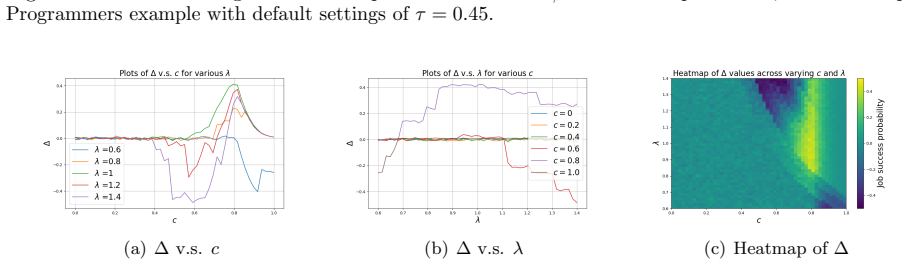
The engine is the pair of ability profiles $(\alpha_1, \alpha_2)$ mapping subskill difficulty to a distribution of performance, with decision-level and action-level subskills aggregated through monotone skill, task, and job error functions. The threshold behavior is driven by comparing the expected job error $Err_{avg}$ to the success threshold; a concentration bound converts closeness of $Err_{avg}$ to threshold into a bound on the success probability. The transition width is $\gamma_1 = L \sqrt{MaxDisp \ln(1/\theta)} / MinDer$, where $MinDer$ is the infimum over decision ability of the absolute derivative of $Err_{avg}$ with respect to that ability, and $MaxDisp$ aggregates the subgaussian dispersion of the noise. The merging result works by placing one worker's success probability below $\theta$ and the merged worker's above $1-\theta$ through the same concentration argument.
What would settle it
A reader could compute the expected job error for a specific job and ability profile, identify the critical ability $\mu_c$, then measure the success probability at $\mu_c$ plus and minus the predicted $\gamma_1$; if the success probability remains intermediate at both points rather than dropping below $\theta$ or rising above $1-\theta$, the threshold claim is contradicted.
Extended reading notes
Core claim
On the paper's own terms, the core claim is Theorem 3.2: there is a critical decision ability $\mu_c$ determined by where the expected job error equals the success threshold, and a derived transition width $\gamma_1$, such that the job success probability is at most $\theta$ below $\mu_c - \gamma_1$ and at least $1-\theta$ above $\mu_c + \gamma_1$. This makes job success look like a phase transition rather than a smooth ramp. The related Theorem 3.3 shows that if one worker's decision ability is sufficiently above another's while the second worker's action ability is sufficiently above the first's, then using the first worker's decision profile with the second worker's action profile gives a success probability at least $1-2\theta$ higher than relying on the second worker alone. The paper also derives productivity compression as a corollary: an AI assistant with strong action-level subskills narrows the gap between lower- and higher-skilled workers, matching field observations.
Load-bearing premise
The theorems require the expected job error to change steeply enough with decision ability, meaning its derivative must stay bounded away from zero across the relevant range; if the error curve is locally flat, the transition window can widen without bound and the sharp flip can disappear.
Editorial extensions
If this is right
- Near the critical decision ability, a small gain in ability or a small reduction in noise can raise success probability from below $\theta$ to above $1-\theta$, so targeted upskilling has a cliff-like payoff.
- Pairing a strong decision-maker with a strong executor can yield a success probability at least $1-2\theta$ higher than the better individual worker, formalizing superadditive human-AI collaboration.
- If two workers share the same decision ability but differ in action ability, adding a strong-action AI assistant narrows their success-probability gap, reproducing the productivity compression observed in field studies.
- A slight underestimation of decision ability can classify as failures workers whose true success probability is near 1, so evaluation bias can invert hiring decisions even when the bias is small.
- Strong dependencies between subskill noise widen the transition, meaning that reducing skill interdependencies makes ability improvements more effective.
Reading between the lines
- Editorial inference: the threshold mechanism is generic to any monotone aggregate of many noisy subskill errors, so similar cliffs could appear in team performance, software quality, or any KPI composed of many components; the paper only demonstrates it for jobs.
- Editorial inference: if the model is right, the distribution of success outcomes should be bimodal near the critical ability level, with most workers either clearly succeeding or clearly failing rather than clustering around the threshold.
- Editorial inference: the derivative analysis suggests that noise-reduction interventions such as standardized workflows can substitute for ability training, an implication the paper only touches on in its intervention plots.
- Editorial inference: the trust-parameter simulation implies that overestimating an AI's action ability can turn a merging gain into a loss, so accurate ability estimation is a practical precondition for realizing the superadditive benefit.
Editorial analysis
A structured set of objections, weighed in public.
Referee Report
Summary. The paper introduces a formal model in which each job skill is decomposed into a decision-level and an action-level subskill, and workers are represented by stochastic ability profiles over subskill difficulty. Error aggregation across subskills, skills, tasks, and jobs yields a job success probability P. The main theoretical results are (i) Theorem 3.2, a phase-transition bound asserting that P is below theta below a critical decision ability and above 1-theta above it, with a transition width gamma_1; (ii) Theorem 3.3, sufficient conditions for a merged worker with complementary decision/action abilities to outperform the best single worker by at least 1-2theta; and (iii) Corollary 3.4, a productivity-compression lower bound. The paper then calibrates the model to O*NET and BIG-bench Lite data and presents simulations for job-worker fit, merging, and robustness to alternative modeling choices.
Significance. The concentration-based proof of Theorem 3.2 is a genuine contribution: it connects Lipschitzness, noise independence, and subgaussian dispersion to a quantitative threshold, and the scaling gamma_1 ~ sigma sqrt(ln(1/theta)/n) for linear profiles is a falsifiable prediction. The merging theorem gives a formal sense in which complementary profiles can be superadditive, which is directly relevant to human-AI collaboration. The empirical calibration is useful as an illustration of how the framework can be instantiated, but it is not an independent validation because the same model outputs are used to fit key parameters. The stated generality of the main theorem is not supported as written: the transition width requires a strictly positive derivative lower bound, and the paper's own polynomial-profile analysis shows that this assumption can fail.
major comments (3)
- [Theorem 3.2 and Appendix B.2] The statement of Theorem 3.2 defines gamma_1 by dividing by MinDer_mu1 but never states MinDer_mu1 > 0 as a hypothesis. This is not a technicality: Lemma B.3 converts the vertical gap t into a horizontal window of width t/MinDer by integrating the derivative lower bound over [mu1, mu_c1]; if the infimum of |partial Erravg / partial mu1| over mu1 >= 0 is zero, no finite gamma_1 is obtained. For the polynomial profiles analyzed in B.2, partial Erravg / partial beta1 = (beta1 / 2n) sum_j s_{j1}^{beta1-1}, which equals 0 at beta1 = 0, so MinDer = 0 and gamma_1 = infinity. The proposed local repair, restricting to [beta_c1 - gamma_1, beta_c1 + gamma_1] and assuming a derivative bound there, is circular because the interval is defined through the very gamma_1 being bounded. Add an explicit global or local steepness hypothesis to Theorem 3.2 (and to Theorem 3.3, Corollary 3.4, and Theorem B.7, which inherit gamma_1), and either prove existence of a local interval satisfying the bound or state the polynomial-profile result as conditional. The same hypothesis is also needed to justify the asserted uniqueness of mu_c1.
- [Section 3.2, 'Generalization'] The main text claims that the analysis extends to constant and polynomial profiles, but for polynomial profiles the only derivation is the conditional one in Appendix B.2. The bound gamma_1 <= sigma sqrt(2n ln(1/theta) / sum_j s_{j1}) is derived under the assumption [beta_c1 - gamma_1, beta_c1 + gamma_1] subset [0.5, 2] and a resulting derivative lower bound of (1/4n) sum_j s_{j1}; no argument shows that the fixed point gamma_1 satisfying this containment exists. As written, the 'Generalization' paragraph overclaims the scope of Theorem 3.2.
- [Section 3.1 and Lemma B.3] The proof of Lemma B.3 invokes Proposition A.1 to couple the subskill draws under two ability parameters and conclude monotonicity of Erravg. Proposition A.1 is proved only for constant, linear, and polynomial families with uniform noise, while Theorem 3.2 is stated for general ability profiles parameterized by mu1. If the theorem is intended for arbitrary profiles, the stochastic-dominance condition should appear as an explicit assumption; otherwise the proof covers only the restricted families. This is separate from the MinDer issue but equally needed for the theorem statement to match its proof.
minor comments (5)
- [Abstract and throughout] The benchmark name is written both as 'Big-bench Lite' and 'BIG-bench Lite'; please use a single consistent spelling. There are also minor typographical issues such as missing spaces in 'productivity compression' in the abstract.
- [Section 3.2, Theorem 3.2] The definition of gamma_1 in Theorem 3.2 uses n(sigma_1^2 + sigma_2^2), whereas the generalized Theorem B.1 uses MaxDisp. For uniform noise, the bound on MaxDisp is n(sigma_1^2 + sigma_2^2)/4, so the two statements are not obviously consistent. Please clarify which noise model the main theorem targets or replace n(sigma_1^2 + sigma_2^2) by an explicit MaxDisp expression.
- [Section 4.1] The decision-level degree vector lambda and the task-skill dependencies T_i are generated by GPT-4o; the paper should state explicitly that these are model-generated estimates rather than ground truth, and ideally report sensitivity to the prompt or an inter-rater agreement measure.
- [Section 4.3] The text refers to 'Figure 4.2' when plotting Pmerge and Delta; this should be 'Figure 4' or a specific panel label. Also, the notation Pmerge is used in captions before being defined in the text.
- [Section 5] The limitations paragraph lists data and cost considerations but does not mention the mathematical restriction imposed by MinDer > 0 or the stochastic-dominance requirement. Adding these would give readers an accurate picture of the theorem's scope.
Circularity Check
Main theorems are self-contained, but the polynomial-profile generalization in Appendix B.2 bounds γ1 using an interval defined by γ1 itself, and Theorem 3.2 omits the MinDer>0 hypothesis its own polynomial example violates.
-
self definitional
[Appendix B.2, 'Analysis for polynomial profiles'; referenced by Section 3.2 'Generalization']
"Note that this partial derivative is 0 when β1 = 0, which results in MinDerβ1(σ, β2, σ) = 0 and γ1 =∞. However, by the proof of Theorem B.1, it suffices to bound the partial derivative for β1 ∈ [βc1−γ1, βc1+γ1] instead of the entire domain R≥0. Suppose we know that [βc1−γ1, βc1+γ1] ⊆ [0.5, 2]; this implies that ... Thus, we have the following bound for γ1: γ1 = L sqrt(0.5nσ2 ln(1/θ)) / (1/(4n) Σ sj1) ≤σ·sqrt(2n·ln(1/θ)/Σ sj1)."
The claimed polynomial-profile bound for γ1 is derived on the interval [βc1−γ1, βc1+γ1], whose endpoints are functions of γ1 itself. The paper first observes that the global MinDerβ1 is 0 for polynomial profiles, making the theorem's γ1 infinite. The repair then restricts attention to an interval whose location depends on the unknown γ1 and assumes the interval lies inside [0.5,2] without a fixed-point or existence proof. In effect, the argument assumes the smallness of γ1 that it claims to derive, so the extension of Theorem 3.2 to polynomial profiles is supported only by a self-referential construction rather than by an independent bound.
full rationale
The central theorems (Theorem 3.2, Theorem 3.3, Corollary 3.4) are derived from the stated Lipschitz, monotonicity, noise-independence, and stochastic-dominance assumptions via McDiarmid's inequality and elementary calculus; no fitted parameter enters the proofs, so the main derivation is self-contained. The one genuine circular step is in Appendix B.2, where the polynomial-profile transition width γ1 is bounded using an interval [βc1−γ1, βc1+γ1] whose definition involves γ1 itself. Since the paper's own computation gives MinDerβ1 = 0 for polynomial profiles, the theorem's global γ1 is initially infinite, and the repair simply assumes the smallness to be proved. This makes the Section 3.2 'Generalization' claim for polynomial profiles unsupported. Separately, Theorem 3.2 states γ1 with MinDer in the denominator without requiring MinDer > 0 as a hypothesis; for the paper's polynomial family MinDer = 0, so the theorem as stated is vacuous there. That is a correctness gap rather than a circularity. The empirical section instantiates the same model with Big-Bench/O*NET parameters and then illustrates the theorems by simulation; this is not an external validation and is mildly self-referential, but it is not a circular derivation. No load-bearing self-citation or imported uniqueness theorem was found.
Assumptions & free parameters
free parameters (9)
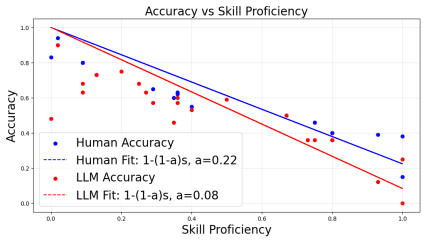
- human ability parameter a (slope 1-a = 0.78) =
a = 0.22
- GenAI ability parameter a (slope 1-a = 0.92) =
a = 0.08
- human skill-noise variance =
0.013 (skill level), 0.0065 per subskill
- GenAI skill-noise variance =
0.029 (skill level), 0.0145 per subskill
- decision-level degree vector lambda =
18 values listed in Eq. (10)
- task-skill dependency sets T_i =
17 tasks mapped to subsets of [18], listed in Appendix D.3
- success threshold tau =
0.45
- noise level sigma in Section 4 simulations =
0.08
- dependency parameter p in Section 4.2 =
swept in [0,1]
assumptions (5)
- domain assumption Noise independence (Assumption 3.1)
- domain assumption Monotone error aggregation and L-Lipschitz Err
- ad hoc to paper Global steepness MinDer > 0
- ad hoc to paper Subskill complementarity and extreme-point allocation (Assumptions D.1-D.3)
- domain assumption P proportional to RPH
invented entities (1)
-
decision-level and action-level subskills
Cite this review
Pith. "Pith review of A Mathematical Framework for AI-Human Integration in Work." pith.science (2026). https://pith.science/paper/BM6U3UAB
@misc{pith2026250523432,
  author       = {Pith},
  title        = {Pith review of: A Mathematical Framework for AI-Human Integration in Work},
  year         = {2026},
  howpublished = {\url{https://pith.science/paper/BM6U3UAB}},
  note         = {Machine review of arXiv:2505.23432}
}
read the original abstract
The rapid rise of Generative AI (GenAI) tools has sparked debate over their role in complementing or replacing human workers across job contexts. We present a mathematical framework that models jobs, workers, and worker-job fit, introducing a novel decomposition of skills into decision-level and action-level subskills to reflect the complementary strengths of humans and GenAI. We analyze how changes in subskill abilities affect job success, identifying conditions for sharp transitions in success probability. We also establish sufficient conditions under which combining workers with complementary subskills significantly outperforms relying on a single worker. This explains phenomena such as productivity compression, where GenAI assistance yields larger gains for lower-skilled workers. We demonstrate the framework' s practicality using data from O*NET and Big-Bench Lite, aligning real-world data with our model via subskill-division methods. Our results highlight when and how GenAI complements human skills, rather than replacing them.
Figures


Figures from the paper (20 more)






Forward citations
Cited by 2 Pith papers
-
Delegation and Verification Under AI
A rational-choice model shows that AI assistance can abruptly shift workers between manual work, verified delegation, and pure delegation, and can degrade institutional worker quality for those with weak verification ...
-
Hope, Signals, and Silicon: A Game-Theoretic Model of the Pre-Doctoral Academic Labor Market in the Age of AI
A three-stage game model predicts generative AI segments pre-doctoral labs into automation- and augmentation-driven types, dilutes PhD admission signals, and drives recommendation weight toward non-automatable creative work.
Reference graph
Works this paper leans on
-
[1]
Workforce optimization.https://en.wikipedia.org/wiki/Workforce_optimization
-
[2]
Phi-4 technical report.arXiv preprint arXiv:2412.08905, 2024
Marah Abdin, Jyoti Aneja, Harkirat Behl, S´ ebastien Bubeck, Ronen Eldan, Suriya Gunasekar, Michael Harrison, Russell J Hewett, Mojan Javaheripi, Piero Kauffmann, et al. Phi-4 technical report.arXiv preprint arXiv:2412.08905, 2024
arXiv 2024
-
[3]
The simple macroeconomics of ai.Economic Policy, 40(121):13–58, 2025
Daron Acemoglu. The simple macroeconomics of ai.Economic Policy, 40(121):13–58, 2025
work page 2025
-
[4]
Skills, tasks and technologies: Implications for employment and earnings
Daron Acemoglu and David Autor. Skills, tasks and technologies: Implications for employment and earnings. InHandbook of labor economics, volume 4, pages 1043–1171. Elsevier, 2011
work page 2011
-
[5]
https://www.imf.org/en/Publications/fandd/ issues/2023/12/Rebalancing-AI-Acemoglu-Johnson, Dec 2023
Daron Acemoglu and Simon Johnson. https://www.imf.org/en/Publications/fandd/ issues/2023/12/Rebalancing-AI-Acemoglu-Johnson, Dec 2023
work page 2023
-
[6]
Nikhil Agarwal, Alex Moehring, Pranav Rajpurkar, and Tobias Salz. Combining human expertise with artificial intelligence: Experimental evidence from radiology.SSRN Electronic Journal, 2023
work page 2023
-
[7]
Algorithmic recommendations and human discretion.SSRN Electronic Journal, 2023
Victoria Angelova, Will Dobbie, and Crystal Yang. Algorithmic recommendations and human discretion.SSRN Electronic Journal, 2023
work page 2023
-
[8]
AI to hit 40% of jobs and worsen inequality, IMF says
Annabelle Liang. AI to hit 40% of jobs and worsen inequality, IMF says. BBC, January 2024
work page 2024
Show all 74 references
-
[9]
Claude: An AI assistant by Anthropic
Anthropic. Claude: An AI assistant by Anthropic. https://www.anthropic.com, 2023. Available at:https://www.anthropic.com
2023
-
[10]
A theory for emergence of complex skills in language models
Sanjeev Arora and Anirudh Goyal. A theory for emergence of complex skills in language models. CoRR, abs/2307.15936, 2023
2023 arXiv
-
[11]
Applying AI to Rebuild Middle Class Jobs
David Autor. Applying AI to Rebuild Middle Class Jobs. NBER Working Papers 32140, National Bureau of Economic Research, Inc, February 2024
2024
-
[12]
Beyond the imitation game: Quantifying and extrapolating the capabilities of language models.Transactions on Machine Learning Research, 2023
BIG bench authors. Beyond the imitation game: Quantifying and extrapolating the capabilities of language models.Transactions on Machine Learning Research, 2023
2023
-
[13]
On the dangers of stochastic parrots: Can language models be too big? InProceedings of the 2021 ACM Conference on Fairness, Accountability, and Transparency, pages 610–623
Emily M Bender, Timnit Gebru, Angelina McMillan-Major, and Shmargaret Shmitchell. On the dangers of stochastic parrots: Can language models be too big? InProceedings of the 2021 ACM Conference on Fairness, Accountability, and Transparency, pages 610–623. ACM, 2021
2021
-
[14]
Limitations of AI in understanding human emotions.Cognitive Computation, 14(2):235–245, 2022
Ali Borji. Limitations of AI in understanding human emotions.Cognitive Computation, 14(2):235–245, 2022
2022
-
[15]
The hidden costs of AI: How generative models are reshaping corporate budgets, 2024
Sascha Brodsky. The hidden costs of AI: How generative models are reshaping corporate budgets, 2024
2024
-
[16]
Generative AI at work.SSRN Electronic Journal, 2023
Erik Brynjolfsson, Danielle Li, and Lindsey Raymond. Generative AI at work.SSRN Electronic Journal, 2023. 17
2023
-
[17]
Gehrke, Eric Horvitz, Ece Kamar, Peter Lee, Yin Tat Lee, Yuan-Fang Li, Scott M
S´ ebastien Bubeck, Varun Chandrasekaran, Ronen Eldan, John A. Gehrke, Eric Horvitz, Ece Kamar, Peter Lee, Yin Tat Lee, Yuan-Fang Li, Scott M. Lundberg, Harsha Nori, Hamid Palangi, Marco Tulio Ribeiro, and Yi Zhang. Sparks of artificial general intelligence: Early experiments ...
2023 arXiv
-
[18]
Improving human-ai collaboration with descriptions of AI behavior.Proceedings of the ACM on Human-Computer Interaction, 7(CSCW1):1–21, 2023
´Angel Alexander Cabrera, Adam Perer, and Jason I Hong. Improving human-ai collaboration with descriptions of AI behavior.Proceedings of the ACM on Human-Computer Interaction, 7(CSCW1):1–21, 2023
2023
-
[19]
Panton, Carlo Pizzinelli, Emma Rockall, and Marina M
Mauro Cazzaniga, Florence Jaumotte, Longji Li, Giovanni Melina, Augustus J. Panton, Carlo Pizzinelli, Emma Rockall, and Marina M. Tavares. Gen-AI: Artificial intelligence and the future of work
-
[20]
Elisa Celis, Anay Mehrotra, and Nisheeth K
L. Elisa Celis, Anay Mehrotra, and Nisheeth K. Vishnoi. Interventions for ranking in the presence of implicit bias. InF AT*, pages 369–380. ACM, 2020
2020
-
[21]
Aakanksha Chowdhery, Sharan Narang, Jacob Devlin, Maarten Bosma, Gaurav Mishra, Adam Roberts, Paul Barham, Hyung Won Chung, Charles Sutton, Sebastian Gehrmann, Parker Schuh, Kensen Shi, Sasha Tsvyashchenko, Joshua Maynez, Abhishek Rao, Parker Barnes, Yi Tay, Noam Shazeer, Vino...
2023
-
[22]
AI could replace equivalent of 300 million jobs - report
Chris Vallance. AI could replace equivalent of 300 million jobs - report. BBC, March 2023
2023
-
[23]
Gemini: A family of multimodal models, 2023
DeepMind. Gemini: A family of multimodal models, 2023
2023
-
[24]
Can AI language models replace human participants?Trends in Cognitive Sciences, 2023
Danica Dillion, Niket Tandon, Yuling Gu, and Kurt Gray. Can AI language models replace human participants?Trends in Cognitive Sciences, 2023
2023
-
[25]
GPTs are GPTs: An early look at the labor market impact potential of large language models.arXiv preprint arXiv:2303.10130, 2023
Tyna Eloundou, Sam Manning, Pamela Mishkin, and Daniel Rock. GPTs are GPTs: An early look at the labor market impact potential of large language models.arXiv preprint arXiv:2303.10130, 2023
2023 arXiv
-
[26]
Felten, Manav Raj, and Robert C
Edward W. Felten, Manav Raj, and Robert C. Seamans. How will language modelers like ChatGPT affect occupations and industries?SSRN Electronic Journal, 2023
2023
-
[27]
Samuel Fosso Wamba, Cameron Guthrie, Maciel M Queiroz, and Stefan Minner. ChatGPT and generative artificial intelligence: an exploratory study of key benefits and challenges in operations and supply chain management.International Journal of Production Research, pages 1–21, 2023. 18
2023
-
[28]
DeepSeek-R1: Incentivizing reasoning capability in LLMs via reinforcement learning.arXiv preprint arXiv:2501.12948, 2025
Daya Guo, Dejian Yang, Haowei Zhang, Junxiao Song, Ruoyu Zhang, Runxin Xu, Qihao Zhu, Shirong Ma, Peiyi Wang, Xiao Bi, et al. DeepSeek-R1: Incentivizing reasoning capability in LLMs via reinforcement learning.arXiv preprint arXiv:2501.12948, 2025
2025 arXiv
-
[29]
AI language models cannot replace human research participants.Ai & Society, pages 1–3, 2023
Jacqueline Harding, William D’Alessandro, NG Laskowski, and Robert Long. AI language models cannot replace human research participants.Ai & Society, pages 1–3, 2023
2023
-
[30]
FlagEvalMM: A flexible framework for comprehensive multimodal model evaluation, 2024
Zheqi He, Yesheng Liu, Jingshu Zheng, Bowen Qin, Jinge Yao, Richen Xuan, and Xi Yang. FlagEvalMM: A flexible framework for comprehensive multimodal model evaluation, 2024
2024
-
[31]
Measuring massive multitask language understanding
Dan Hendrycks, Collin Burns, Steven Basart, Andy Zou, Mantas Mazeika, Dawn Song, and Jacob Steinhardt. Measuring massive multitask language understanding. InInternational Conference on Learning Representations, 2021
2021
-
[32]
Human-machine symbiosis: A multivariate perspective for physically coupled human-machine systems.International Journal of Human- Computer Studies, 170:102926, 2023
Jairo Inga, Miriam Ruess, Jan Heinrich Robens, Thomas Nelius, Simon Rothfuß, Sean Kille, Philipp Dahlinger, Andreas Lindenmann, Roland Thomaschke, Gerhard Neumann, Sven Matthiesen, S¨ oren Hohmann, and Andrea Kiesel. Human-machine symbiosis: A multivariate perspective for phys...
2023
-
[33]
Motivation through the design of work: Test of a theory.Organiza- tional Behavior and Human Performance, 16:250–279, 1976
J., Richard, and Hackman. Motivation through the design of work: Test of a theory.Organiza- tional Behavior and Human Performance, 16:250–279, 1976
1976
-
[34]
Sonia Jaffe, Neha Parikh, Jenna L. Butler, Alex Farach, Alexia Cambon, Brent Hecht, Michael Schwarz, Jaime Teevan, Reid Andersen, Margarita Bermejo-Cano, James Bono, Georg Buscher, Chacha Chen, Steven Clarke, Scott Counts, Eleanor Dillon, Benjamin G. Edelman, Ulrike Gruber-Gre...
2024
-
[35]
Farrar, Straus and Giroux, New York, 2011
Daniel Kahneman.Thinking, Fast and Slow. Farrar, Straus and Giroux, New York, 2011
2011
-
[36]
Kleinberg and Manish Raghavan
Jon M. Kleinberg and Manish Raghavan. Selection problems in the presence of implicit bias. InITCS, volume 94 ofLIPIcs, pages 33:1–33:17. Schloss Dagstuhl - Leibniz-Zentrum f¨ ur Informatik, 2018
2018
-
[37]
Evaluating the cost of generative AI for effective implementation in your organization, 2024
Andrei Klubnikin, Innovation Analyst, Vitali Likhadzed, ITRex CEO, Kirill Stashevsky, and ITRex CTO. Evaluating the cost of generative AI for effective implementation in your organization, 2024
2024
-
[38]
Which U.S
Rakesh Kochhar. Which U.S. workers are more exposed to AI on their jobs?, Jul 2023
2023
-
[39]
Concentration in unbounded metric spaces and algorithmic stability
Aryeh Kontorovich. Concentration in unbounded metric spaces and algorithmic stability. In International conference on machine learning, pages 28–36. PMLR, 2014. 19
2014
-
[40]
What is a key performance indicator (KPI)? https://www.kpi.org/kpi-basics/, 2024
KPI.org. What is a key performance indicator (KPI)? https://www.kpi.org/kpi-basics/, 2024
2024
-
[41]
Licklider.Man-Computer Symbiosis, volume HFE-1
J.C.R. Licklider.Man-Computer Symbiosis, volume HFE-1. IRE Transactions on Human Factors in Electronics, 1960
1960
-
[42]
Increased productivity and reduced waste with robotic process automation and generative AI-powered ioe services.Journal of Web Engineering, 23(1):53–87, 2024
Wei Lo, Chun-Ming Yang, Qiansha Zhang, and Mingyuan Li. Increased productivity and reduced waste with robotic process automation and generative AI-powered ioe services.Journal of Web Engineering, 23(1):53–87, 2024
2024
-
[43]
Ivanova, Idan Asher Blank, Nancy Kanwisher, Joshua B
Kyle Mahowald, Anna A. Ivanova, Idan Asher Blank, Nancy Kanwisher, Joshua B. Tenenbaum, and Evelina Fedorenko. Dissociating language and thought in large language models.Trends in Cognitive Sciences, 28:517–540, 2024
2024
-
[44]
AI at work: Here now comes the hard part, 2023
Microsoft. AI at work: Here now comes the hard part, 2023
2023
-
[45]
Adding error bars to evals: A statistical approach to language model evaluations
Evan Miller. Adding error bars to evals: A statistical approach to language model evaluations. 2024
2024
-
[46]
Naveh, Y
Y. Naveh, Y. Richter, Y. Altshuler, D. L. Gresh, and D. P. Connors. Workforce optimization: Identification and assignment of professional workers using constraint programming.IBM Journal of Research and Development, 51(3.4):263–279, 2007
2007
-
[47]
Experimental evidence on the productivity effects of generative artificial intelligence.Science, 381:187 – 192, 2023
Shakked Noy and Whitney Zhang. Experimental evidence on the productivity effects of generative artificial intelligence.Science, 381:187 – 192, 2023
2023
-
[48]
Dick, and Hidenori Tanaka
Maya Okawa, Ekdeep Singh Lubana, Robert P. Dick, and Hidenori Tanaka. Compositional abilities emerge multiplicatively: Exploring diffusion models on a synthetic task.CoRR, abs/2310.09336, 2023
2023 arXiv
-
[49]
GPT-4 technical report
OpenAI. GPT-4 technical report. 2023
2023
-
[50]
Learning to reason with LLMs
OpenAI. Learning to reason with LLMs. https://openai.com/index/ learning-to-reason-with-llms/, 2024
2024
-
[51]
Clarke, Sol` ene Delecourt, David Holtz, and Rembrand Koning
Nicholas Otis, Rowan P. Clarke, Sol` ene Delecourt, David Holtz, and Rembrand Koning. The uneven impact of generative AI on entrepreneurial performance.SSRN Electronic Journal, 2024
2024
-
[52]
AI will reshape the global labor force
Tim Paradis. AI will reshape the global labor force. Employers will need to help their workers keep up. Business Insider, August 2024
2024
-
[53]
Mirabel Reid and Santosh S. Vempala. Does gpt really get it? a hierarchical scale to quantify human vs AI’s understanding of algorithms.ArXiv, abs/2406.14722, 2024
2024 arXiv
-
[54]
Noise: A flaw in human judgment.Vikalpa, 48:163 – 165, 2023
Umar Sadeeq. Noise: A flaw in human judgment.Vikalpa, 48:163 – 165, 2023
2023
-
[55]
AI for business study: The combined power of AI and generative AI.https://www.tcs.com/insights/blogs/ai-business-study, 2024
Tata Consultancy Services. AI for business study: The combined power of AI and generative AI.https://www.tcs.com/insights/blogs/ai-business-study, 2024
2024
-
[56]
Benefits or concerns of AI: A multistakeholder responsibility.Futures, page 103328, 2024
Somesh Sharma. Benefits or concerns of AI: A multistakeholder responsibility.Futures, page 103328, 2024. 20
2024
-
[57]
These are the jobs most likely to be lost – and created – because of AI
Ian Shine and Kate Whiting. These are the jobs most likely to be lost – and created – because of AI. World Economic Forum, May 2023
2023
-
[58]
Sinclair and Institute for Employment Studies.Workforce Planning: A Literature Review
A. Sinclair and Institute for Employment Studies.Workforce Planning: A Literature Review. Institute for Employment Studies, 2004
2004
-
[59]
How generative AI can boost highly skilled workers’ productivity, 2023
Meredith Somers. How generative AI can boost highly skilled workers’ productivity, 2023. Accessed: 2025-01-28
2023
-
[60]
Large language models could change the future of behavioral healthcare: a proposal for responsible development and evaluation.npj Mental Health Research, 3(1):12, 2024
Elizabeth C Stade, Shannon Wiltsey Stirman, Lyle H Ungar, Cody L Boland, H Andrew Schwartz, David B Yaden, Jo˜ ao Sedoc, Robert J DeRubeis, Robb Willer, and Johannes C Eichstaedt. Large language models could change the future of behavioral healthcare: a proposal for responsibl...
2024
-
[61]
Department of Labor, Employment and Training Administration.O*NET Online
U.S. Department of Labor, Employment and Training Administration.O*NET Online. National Center for O*NET Development, 2023.https://www.onetonline.org/
2023
-
[62]
Michelle Vaccaro, Abdullah Almaatouq, and Thomas W. Malone. When combinations of humans and AI are useful: A systematic review and meta-analysis.Nature human behaviour, 2024
2024
-
[63]
Ramon van Handel.Probability in High Dimension. 2014. Lecture notes, available at https: //web.math.princeton.edu/~rvan/Lectures14.pdf
2014
-
[64]
Cambridge Series in Statistical and Probabilistic Mathematics
Roman Vershynin.High-Dimensional Probability: An Introduction with Applications in Data Science. Cambridge Series in Statistical and Probabilistic Mathematics. Cambridge University Press, 2018
2018
-
[65]
Everything wrong with DORA metrics
James Walker. Everything wrong with DORA metrics. Aviator Blog, January 2023
2023
-
[66]
MMLU-Pro: A more robust and challenging multi-task language understanding benchmark
Yubo Wang, Xueguang Ma, Ge Zhang, Yuansheng Ni, Abhranil Chandra, Shiguang Guo, Weiming Ren, Aaran Arulraj, Xuan He, Ziyan Jiang, Tianle Li, Max Ku, Kai Wang, Alex Zhuang, Rongqi Fan, Xiang Yue, and Wenhu Chen. MMLU-Pro: A more robust and challenging multi-task language unders...
2024
-
[67]
Livebench: A challenging, contamination- free LLM benchmark
Colin White, Samuel Dooley, Manley Roberts, Arka Pal, Ben Feuer, Siddhartha Jain, Ravid Shwartz-Ziv, Neel Jain, Khalid Saifullah, Siddartha Naidu, Chinmay Hegde, Yann LeCun, Tom Goldstein, Willie Neiswanger, and Micah Goldblum. Livebench: A challenging, contamination- free LLM...
2024
-
[68]
Openai upgrades its smartest AI model with improved reasoning skills
Will Knight. Openai upgrades its smartest AI model with improved reasoning skills. WIRED, December 2024
2024
-
[69]
SKILL-MIX: a flexible and expandable family of evaluations for AI models
Dingli Yu, Simran Kaur, Arushi Gupta, Jonah Brown-Cohen, Anirudh Goyal, and Sanjeev Arora. SKILL-MIX: a flexible and expandable family of evaluations for AI models. InICLR. OpenReview.net, 2024. 21 A Properties of ability profiles This section discusses the properties of sever...
2024
-
[70]
Theorem B.1(Extension of Theorem 3.2 to general noise models).Fix the job instance, action-level ability µ2, and noise levels σ1, σ2
in γ1 (designed for both uniform and truncated normal noises) is replaced by the more general quantity MaxDispµ1(σ1, µ2, σ2). Theorem B.1(Extension of Theorem 3.2 to general noise models).Fix the job instance, action-level ability µ2, and noise levels σ1, σ2. Let µc 1 be the u...
-
[71]
B.4 Proof of Corollary 3.4 and extension to distinct ability profiles Similar to Section B.1, we extend Theorem 3.3 to handle a general noise model ε(s)
by merging a low-skilled human worker with action-level ability parameter a1 and a high-skilled human worker with action-level ability parameter a2 with a GenAI tool for different ranges of ( a1, a2) for the Computer Programmers example with default settings ofτ= 0.45. B.4 Pro...
-
[72]
If the merging ofW 2 andW AI utilizesW 2’s action-level abilities, we haveP 2 =P ′ 2 and hence, PC =P 2 −P 1 +P ′ 1 −P ′ 2 =P ′ 1 −P 1 ≥1−2θ
Hence, PC =|P 2 −P 1| − |P′ 2 −P ′ 1|=P 2 −P 1 +P ′ 1 −P ′ 2. If the merging ofW 2 andW AI utilizesW 2’s action-level abilities, we haveP 2 =P ′ 2 and hence, PC =P 2 −P 1 +P ′ 1 −P ′ 2 =P ′ 1 −P 1 ≥1−2θ. Otherwise, if the merging of W2 and WAI utilizes WAI’s action-level abili...
-
[73]
Computer Programmers
as the ability parameters a1 and a2 vary. We observe that PC increases with the ability gap a2 −a 1, indicating that the benefit of merging is more pronounced for lower-skilled workers. For instance, when a1 = 0.1 and a2 = 0.8, the productivity compression reaches PC = 0 .8. T...
-
[74]
Computer Programmers
= τ . Let θ∈ (0, 0.5). Let γ1 := L· q MaxDispµ1 (σ1,µ2,σ2)·ln 1 θ MinDerµ1 (σ1,µ2,σ2) . According to Theorem 3.2, if µ1 ≥µ ⋆ 1 + γ1, the job success probability P (α1, α2, h, g, f, τ) ≥ 1 −θ , indicating that the worker fits the job. However, the evaluated success probability ...
Reviewed August 7, 2026 · model on record in the stance chip above.
Discussion (0). Sign in to comment.