Phonon Interactions in Metal Halide Perovskites elucidated by Raman Scattering
Pith reviewed 2026-05-21 03:10 UTC · model grok-4.3
The pith
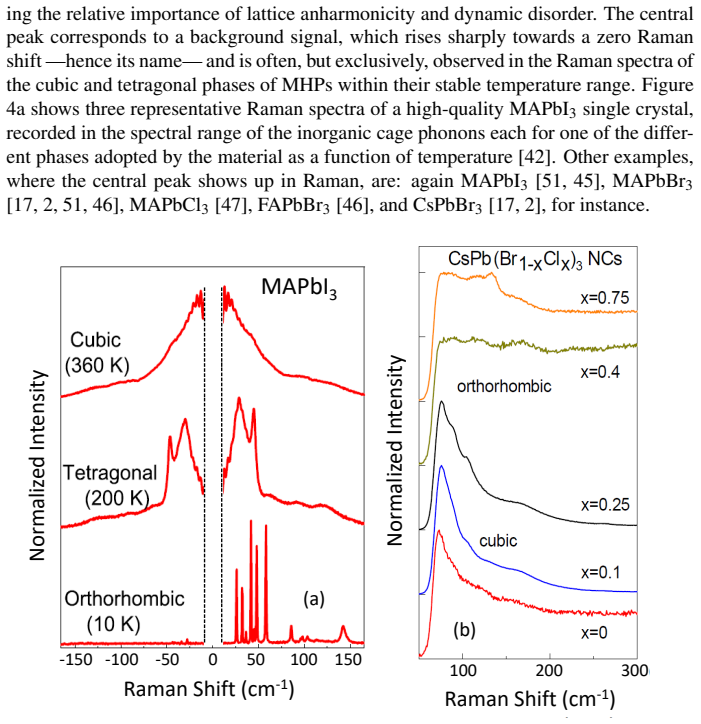
The central peak rising toward zero shift in Raman spectra of metal halide perovskites originates mainly from disorder-induced second-order acoustic-phonon scattering triggered by A-site cation dynamics.
A machine-rendered reading of the paper's core claim, the machinery that carries it, and where it could break.
Core claim
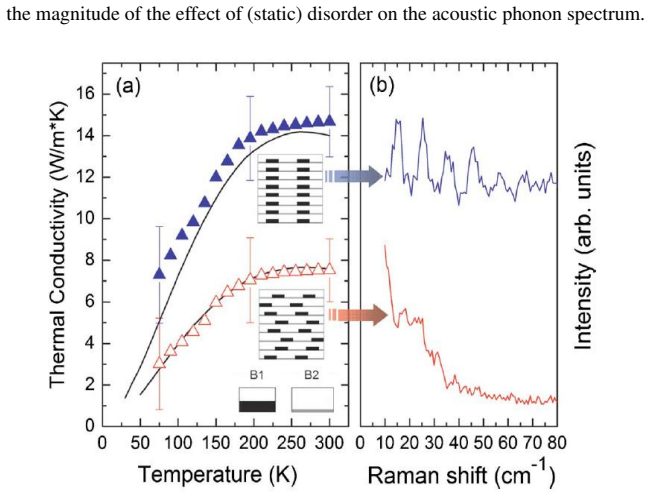
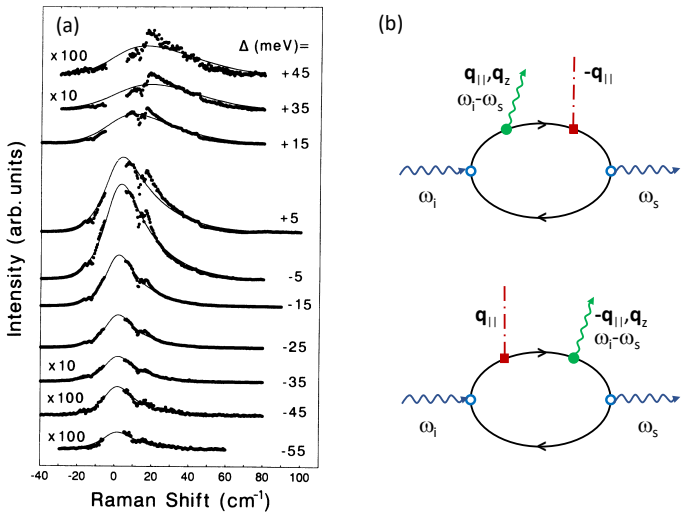
In metal halide perovskites the strong Raman background signal that rises steeply toward zero frequency shift, observed specifically in the temperature range where cubic and tetragonal phases are stable and A-site cation dynamics are active, arises predominantly from disorder-induced second-order acoustic-phonon Raman scattering. This assignment is supported by comparison with the central peaks measured in other semiconductors that exhibit nanoscale structural disorder, including vertically misaligned Ge quantum dots in multi-stack heterostructures and interface roughness in short-period GaAs/AlAs superlattices, and is distinguished from competing explanations based on lattice anharmonicity.
What carries the argument
Disorder-induced second-order acoustic-phonon Raman scattering, which generates the central peak when A-site cation motion introduces dynamic nanoscale disorder into the lattice.
If this is right
- Raman spectra of metal halide perovskites in their high-temperature phases can be analyzed without assigning the dominant central background to strong anharmonic phonon decay.
- The distinction between hydrogen-bond-mediated and sterically hindered coupling provides separate signatures in the temperature evolution of phonon linewidths and frequencies.
- Similar central-peak behavior is expected in any perovskite or related material whenever A-site dynamics create local lattice disorder on the scale of a few nanometers.
- In-situ Raman monitoring becomes a reliable probe of the onset of A-site cation motion and its effect on carrier-phonon scattering rates.
Where Pith is reading between the lines
- If the mechanism holds, controlled introduction of specific nanoscale disorder in perovskites could be used to tune acoustic-phonon lifetimes and thereby influence thermal conductivity or hot-carrier relaxation without altering the average crystal symmetry.
- The same second-order scattering channel may appear in other hybrid organic-inorganic lattices whenever rotational or translational freedom of molecular ions produces transient local strain fields.
- Quantitative modeling of the central-peak intensity versus temperature could yield an independent estimate of the correlation length of the dynamic disorder, complementary to diffraction or neutron-scattering data.
Load-bearing premise
The central peak shares the identical microscopic origin in disorder-induced second-order acoustic-phonon scattering that is seen in other nanoscale-disordered semiconductors such as misaligned Ge quantum dots.
What would settle it
Raman spectra recorded on metal halide perovskite samples engineered to suppress A-site cation dynamics while retaining the cubic structure show the central peak intensity remaining high rather than vanishing.
Figures
read the original abstract
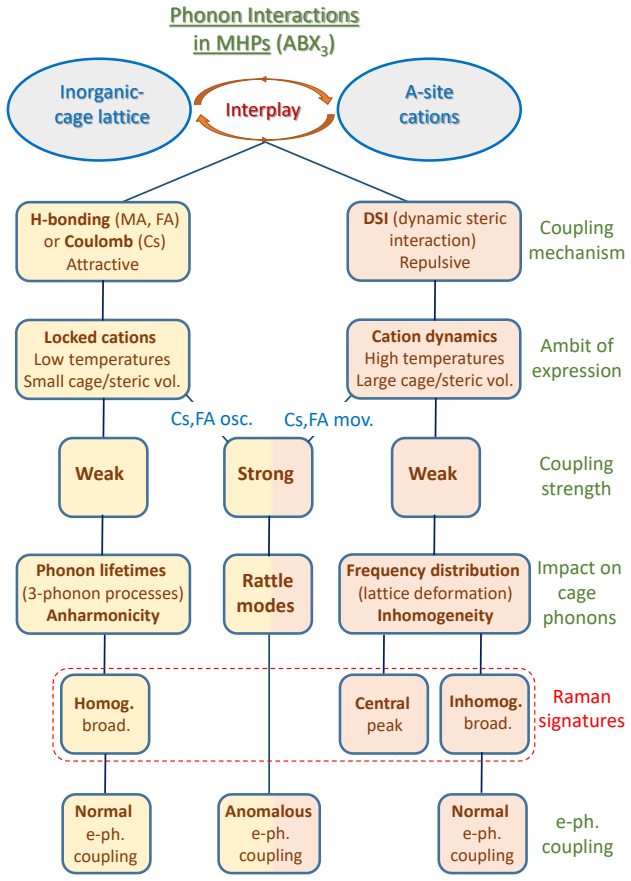
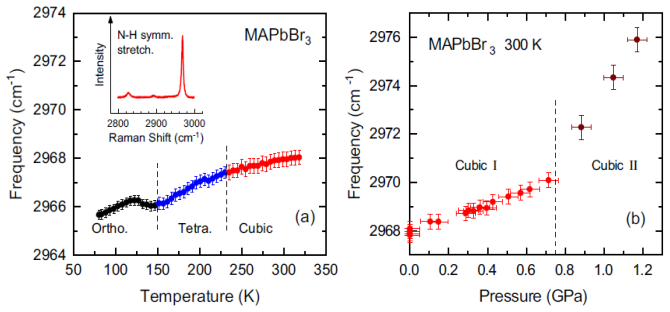
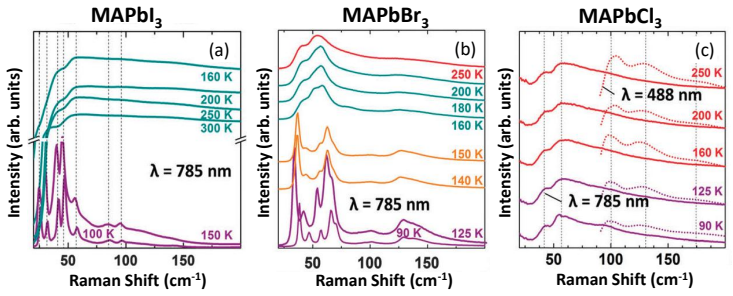
There is a growing consensus that the exceptional optoelectronic properties of metal halide perovskites (MHPs) are largely due to the peculiar interplay between the inorganic cage lattice, composed of a labile network of corner-sharing metal halide octahedra, and the A-site cationic sublattice. This interaction significantly affects the vibrational spectrum of MHPs (phonon frequencies, linewidths, and lifetimes), resulting from the effects of lattice potential anharmonicity and/or static/dynamic disorder. Raman scattering is a suitable technique to probe phonon interactions in solids, allowing for the in-situ characterization of chemical environments, revealing the nature of lattice vibrations. In this perspective, the available experimental evidence of the aforementioned interplay will be reviewed with special emphasis on understanding Raman signatures depending on whether the coupling is principally mediated by hydrogen bonding or steric hindrance. The controversy about the origin of a strong Raman background, steeply rising towards zero Raman shift and called central peak, will be specifically addressed. This background signal, which is typically observed in the temperature range of stability of cubic and tetragonal phases when the A-site cation dynamics unfold, will be shown to be mostly due to disorder-induced second-order acoustic-phonon Raman scattering. This interpretation receives support from other semiconductor systems with nanoscale structural disorder, where the central Raman peak arises either from the vertical misalignment of Ge quantum dots in multi-stack heterostructures or from the interface roughness exhibited by short-period GaAs/AlAs superlattices. In this way, a unifying picture of phonon interactions in MHPs and how they impact different Raman processes is provided, which is key to interpreting their Raman spectra.
Editorial analysis
A structured set of objections, weighed in public.
Referee Report
Summary. The manuscript is a perspective reviewing Raman scattering studies of metal halide perovskites (MHPs), focusing on the interplay between the inorganic cage and A-site cation dynamics. It argues that the strong central peak (background rising toward zero Raman shift) observed in the cubic and tetragonal phases arises primarily from disorder-induced second-order acoustic-phonon scattering, drawing support from analogous behavior in nanoscale-disordered systems such as vertically misaligned Ge quantum-dot stacks and rough GaAs/AlAs superlattices. The review contrasts hydrogen-bonding versus steric-hindrance mediated couplings and aims to provide a unifying interpretation of phonon interactions affecting Raman processes.
Significance. If the central-peak attribution holds, the work offers a coherent framework for interpreting low-frequency Raman backgrounds in MHPs as signatures of dynamic disorder rather than purely anharmonic or static effects, which could improve the extraction of phonon lifetimes and coupling strengths relevant to optoelectronic performance. The synthesis of cross-system analogies is a strength, but the absence of new MHP-specific quantitative modeling or statistical spectral fits limits the immediate predictive power.
major comments (1)
- [Abstract / central-peak section] Abstract and central-peak discussion: the claim that the central peak 'will be shown to be mostly due to disorder-induced second-order acoustic-phonon Raman scattering' rests on literature analogies to Ge quantum dots and GaAs/AlAs superlattices without presenting MHP-specific quantitative validation (e.g., explicit second-order scattering intensity calculations or temperature-dependent line-shape fits that isolate the acoustic-phonon contribution from anharmonic broadening). This leaves the distinction from competing anharmonicity explanations suggestive rather than definitive.
minor comments (1)
- [Abstract] The abstract mentions 'parameter-free' or direct comparisons but does not define quantitative metrics (e.g., integrated intensity ratios or linewidth scaling) used to rank mechanisms; adding such metrics in the main text would strengthen readability.
Simulated Author's Rebuttal
We thank the referee for their constructive and insightful review of our perspective manuscript. We appreciate the acknowledgment of the potential value in providing a unifying framework for low-frequency Raman features in metal halide perovskites and the cross-system analogies. We address the major comment below regarding the central-peak attribution.
read point-by-point responses
-
Referee: [Abstract / central-peak section] Abstract and central-peak discussion: the claim that the central peak 'will be shown to be mostly due to disorder-induced second-order acoustic-phonon Raman scattering' rests on literature analogies to Ge quantum dots and GaAs/AlAs superlattices without presenting MHP-specific quantitative validation (e.g., explicit second-order scattering intensity calculations or temperature-dependent line-shape fits that isolate the acoustic-phonon contribution from anharmonic broadening). This leaves the distinction from competing anharmonicity explanations suggestive rather than definitive.
Authors: We agree that the manuscript, as a perspective, does not present new MHP-specific quantitative calculations, intensity modeling, or dedicated line-shape fits to isolate the acoustic-phonon contribution. The interpretation is synthesized from the temperature-dependent behavior reported across multiple experimental studies on MHPs and is supported by established analogies to nanoscale disorder in other semiconductors. We will revise the abstract and central-peak discussion to use more measured language, replacing 'will be shown to be mostly due to' with 'is interpreted as arising primarily from' based on the reviewed evidence and cross-system comparisons. We will also add an explicit statement noting the suggestive character of the distinction from purely anharmonic mechanisms and highlighting the desirability of future first-principles calculations for quantitative validation. These textual clarifications will be incorporated in the revised manuscript. revision: partial
Circularity Check
No circularity: central-peak attribution rests on external literature synthesis and analogy, not internal reduction.
full rationale
The paper is a perspective that reviews temperature-dependent Raman data in MHPs and attributes the central peak to disorder-induced second-order acoustic-phonon scattering by drawing parallels to published spectra from Ge quantum-dot stacks and GaAs/AlAs superlattices. No equations, fitted parameters, or self-citations are presented as the load-bearing justification; the claim is framed as an interpretive synthesis of independent experimental evidence rather than a derivation that collapses to the paper's own inputs by construction. This satisfies the default expectation of a non-circular review article.
Axiom & Free-Parameter Ledger
axioms (2)
- domain assumption The exceptional optoelectronic properties of metal halide perovskites arise largely from the interplay between the inorganic cage lattice and the A-site cationic sublattice.
- standard math Raman scattering can probe phonon interactions, frequencies, linewidths, and lifetimes in solids and reveal the nature of lattice vibrations.
Lean theorems connected to this paper
-
IndisputableMonolith/Cost/FunctionalEquation.leanwashburn_uniqueness_aczel unclear?
unclearRelation between the paper passage and the cited Recognition theorem.
This background signal... will be shown to be mostly due to disorder-induced second-order acoustic-phonon Raman scattering.
-
IndisputableMonolith/Foundation/AlexanderDuality.leanalexander_duality_circle_linking unclear?
unclearRelation between the paper passage and the cited Recognition theorem.
central peak... arises either from the vertical misalignment of Ge quantum dots... or from the interface roughness exhibited by short-period GaAs/AlAs superlattices
What do these tags mean?
- matches
- The paper's claim is directly supported by a theorem in the formal canon.
- supports
- The theorem supports part of the paper's argument, but the paper may add assumptions or extra steps.
- extends
- The paper goes beyond the formal theorem; the theorem is a base layer rather than the whole result.
- uses
- The paper appears to rely on the theorem as machinery.
- contradicts
- The paper's claim conflicts with a theorem or certificate in the canon.
- unclear
- Pith found a possible connection, but the passage is too broad, indirect, or ambiguous to say the theorem truly supports the claim.
Reference graph
Works this paper leans on
-
[1]
T. Ivanovska, C. Quarti, G. Grancini, A. Petrozza, F. De Angelis, A. Milani, and G. Ruani, "Vibrational response of methylammonium lead iodide: From cation dynamics to phonon–phonon interactions", ChemSusChem9, 2994-3004 (2016)
work page 2016
-
[2]
Y . Guo, O. Yaffe, D. W. Paley, A. N. Beecher, T. D. Hull, G. Szpak, J. S. Owen, L. E. Brus, and M. A. Pimenta, "Interplay between organic cations and inorganic framework and incommensurability in hybrid lead-halide perovskite CH3NH3PbBr3", Phys. Rev. Mater.1, 042401R/1-6 (2017)
work page 2017
-
[3]
What is moving in hybride halide perovskite solar cells?
J. M. Frost and A. Walsh, "What is moving in hybride halide perovskite solar cells?", Acc. Chem. Res.49, 528-535 (2016)
work page 2016
-
[4]
Real- time observation of organic cation reorientation in methylammonium lead iodide perovskites
A. A. Bakulin, O. Selig, H. J. Bakker, Y . L. Rezus, C. Müller, T. Glaser, R. Lovrincic, Z. Sun, Z. Chen, A. Walsh, J. M. Frost, and T. L. C. Jansen, "Real- time observation of organic cation reorientation in methylammonium lead iodide perovskites", J. Phys. Chem. Lett.6, 3663-3669 (2015)
work page 2015
-
[5]
Organic cation rotation and immobilization in pure and mixed methylammonium lead-halide perovskites
O. Selig, A. Sadhanala, C. Müller, R. Lovrincic, Z. Chen, Y . L. Rezus, J. M. Frost, T. L. C. Jansen, and A. A. Bakulin, "Organic cation rotation and immobilization in pure and mixed methylammonium lead-halide perovskites", J. Am. Chem. Soc. 139, 4068-4074 (2017)
work page 2017
-
[6]
M. T. Weller, O. J. Weber, P. F. Henry, A. M. Di Pumpo, and T. C. Hansen, "Com- plete structure and cation orientation in the perovskite photovoltaic methylam- monium lead iodide between 100 and 352 K", Chem. Commun.51, 4180-4183 (2015)
work page 2015
-
[7]
Phase behavior and polymorphism of formamidinium lead iodide
O. J. Weber, D. Ghosh, S. Gaines, P. F. Henry, A. B. Walker, M. S. Islam, and M. T. Weller, "Phase behavior and polymorphism of formamidinium lead iodide", Chem. Mater.30, 3768-3778 (2018)
work page 2018
-
[8]
M. Szafra ´nski and A. Katrusiak, "Mechanism of pressure-induced phase transi- tions, amorphization, and absorption-edge shift in photovoltaic methylammonium lead iodide", J. Phys. Chem. Lett.7, 3458-3466 (2016). 18
work page 2016
-
[9]
Good vibra- tions: Locking of octahedral tilting in mixed-cation iodide perovskites for solar cells
D. Ghosh, P. W. Atkins, M. S. Islam, A. B. Walker, and C. Eames, "Good vibra- tions: Locking of octahedral tilting in mixed-cation iodide perovskites for solar cells", ACS Energy Lett.2, 2424-2429 (2017)
work page 2017
-
[10]
D. Ghosh, A. Aziz, J. A. Dawson, A. B. Walker, and M. S. Islam, "Putting the squeeze on lead iodide perovskites: Pressure-induced effects to tune their struc- tural and optoelectronic behavior", Chem. Mater.31, 4063-4071 (2019)
work page 2019
-
[11]
Deciphering the nature of temperature-induced phases of MAPbBr 3 by ab initio molecular dynamics
S. Maity, S. Verma, L. M. Ramaniah, and V . Srinivasan, "Deciphering the nature of temperature-induced phases of MAPbBr 3 by ab initio molecular dynamics", Chem. Mater.34, 10459-10469 (2022)
work page 2022
-
[12]
Rotational cation dynamics in metal halide perovskites: Effect on phonons and material properties
N. P. Gallop, O. Selig, G. Giubertoni, H. J. Bakker, Y . L. Rezus, J. M. Frost, T. L. C. Jansen, R. Lovrincic, and A. A. Bakulin, "Rotational cation dynamics in metal halide perovskites: Effect on phonons and material properties", J. Phys. Chem. Lett.9, 5987-5997 (2018)
work page 2018
-
[13]
P. Y . Yu and M. Cardona,Fundamentals of semiconductors(Springer, Berlin, 1995)
work page 1995
-
[14]
Raman spectroscopy in layered hybrid organic-inorganic metal halide perovskites
D. Spirito, Y . Asensio, L. E. Hueso, and B. Martín-García, "Raman spectroscopy in layered hybrid organic-inorganic metal halide perovskites", J. Phys. Mater. 5, 034004/1-25 (2022)
work page 2022
-
[15]
A. R. Goñi, "Raman linewidths as a probe of lattice anharmonicity and dynamic disorder in metal halide perovskites", Asin J. Phys.33, 29-38 (2024)
work page 2024
-
[16]
A. Francisco-López, B. L. Charles, O. J. Weber, M. I. Alonso, M. Garriga, M. Campoy-Quiles, M. T. Weller, and A. R. Goñi, "Pressure-induced locking of methylammonium cations versus amorphization in hybrid lead iodide per- ovskites", J. Phys. Chem. C122, 22073-22082 (2018)
work page 2018
-
[17]
Local polar fluctuations in lead halide perovskite crystals
O. Yaffe, Y . Guo, L. Z. Tan, D. A. Egger, T. Hull, C. C. Stoumpos, F. Zheng, T. F. Heinz, L. Kronik, M. G. Kanatzidis, J. S. Owen, A. M. Rappe, M. A. Pimenta, and L. E. Brus, "Local polar fluctuations in lead halide perovskite crystals", Phys. Rev. Lett.118, 136001/1-5 (2017)
work page 2017
-
[18]
P. D. Lacharmoise, A. Bernardi, A. R. Goñi, M. I. Alonso, M. Garriga, N. D. Lanzillotti-Kimura, and A. Fainstein, "Raman scattering interferences as a probe of vertical coherence in multilayers of carbon-induced Ge quantum dots", Phys. Rev. B76, 155311/1-6 (2007)
work page 2007
-
[19]
J. Alvarez-Quintana, X. Alvarez, J. Rodriguez-Viejo, D. Jou, P. D. Lacharmoise, A. Bernardi, A. R. Goñi, and M. I. Alonso, "Cross-plane thermal conductivity reduction of vertically uncorrelated Ge/Si quantum dot superlattices", Appl. Phys. Lett.93, 013112/1-3 (2008)
work page 2008
-
[20]
T. Ruf, J. Spitzer, V . F. Sapega, V . I. Belitsky, M. Cardona, and K. Ploog, "Inter- face roughness and homogeneous linewidths in quantum wells and superlattices studied by resonant acoustic-phonon Raman scattering", Phys. Rev. B50, 1792- 1806 (1994). 19
work page 1994
-
[21]
Theory of disorder-induced acoustic-phonon Raman scattering in quantum wells and superlattices
V . I. Belitsky, T. Ruf, J. Spitzer, and M. Cardona, "Theory of disorder-induced acoustic-phonon Raman scattering in quantum wells and superlattices", Phys. Rev. B49, 8263-8272 (1994)
work page 1994
-
[22]
T. Yin, Y . Fang, X. Fan, B. Zhang, J.-L. Kuo, T. J. White, G. M. Chow, J. Yan, and Z. X. Shen, "Hydrogen-bonding evolution during the polymorphic transfor- mations in CH3NH3PbBr3: Experiment and theory", Chem. Mater.29, 5974-5981 (2017)
work page 2017
-
[23]
Locking of methylammonium by pressure-enhanced H-bonding in (CH3NH3)PbBr3 hybrid perovskite
F. Capitani, C. Marini, S. Caramazza, P. Dore, A. Pisanu, L. Malavasi, L. Nataf, F. Baudelet, J.-B. Brubach, P. Roy, and P. Postorino, "Locking of methylammonium by pressure-enhanced H-bonding in (CH3NH3)PbBr3 hybrid perovskite", J. Phys. Chem. C121, 28125-28131 (2017)
work page 2017
-
[24]
S. Yesudhas, R. Burns, B. Lavina, S. N. Tkachev, J. Sun, C. A. Ullrich, and S. Guha, "Coupling of organic cation and inorganic lattice in methylammonium lead halide perovskites: Insights into a pressure-induced isostructural phase tran- sition", Phys. Rev. Mater.4, 105403/1-12 (2020)
work page 2020
-
[25]
A. G. Kontos, G. K. Manolis, A. Kaltzoglou, D. Palles, E. I. Kamitsos, M. G. Kanatzidis, and P. Falaras, "Halogen-NH + 2 interaction, temperature-induced phase transition, and ordering in (NH 2CHNH2)PbX3 (X = Cl, Br, I) hybrid per- ovskites", J. Phys. Chem. C124, 8479-8487 (2020)
work page 2020
-
[26]
Resolving the physical origin of octahedral tilting in halide perovskites
J.-H. Lee, N. C. Bristowe, J. H. Lee, S.-H. Lee, P. D. Bristowe, A. K. Cheetham, and H. M. Jang, "Resolving the physical origin of octahedral tilting in halide perovskites", Chem. Mater.28, 4259-4266 (2016)
work page 2016
-
[27]
J. H. Lee, J.-H. Lee, E.-H. Kong, and H. M. Jang, "The nature of hydrogen- bonding interaction in the prototypic hybrid halide perovskite, tetragonal CH3NH3PbI3", Sci. Rep.6, 21687/1-12 (2016)
work page 2016
-
[28]
Using pressure to unravel the structure-dynamic-disorder relationship in metal halide perovskites
K. Xu, L. Pérez-Fidalgo, B. L. Charles, M. T. Weller, M. I. Alonso, and A. R. Goñi, "Using pressure to unravel the structure-dynamic-disorder relationship in metal halide perovskites", Sci. Rep.13, 9300/1-12 (2023)
work page 2023
-
[29]
H. Wolff, U. Schmidt, and E. Wolff, "NH 2 stretching vibration absorption and association mechanism of methylamine inn-hexane and carbon tetrachloride", Spectrochimica Acta46A, 85-89 (1990)
work page 1990
-
[30]
S. Yi J.-H. and Lee, "Degenerate lattice-instability-driven amorphization under compression in metal halide perovskite CsPbI 3", J. Phys. Che. Lett.13, 9449- 9455 (2022)
work page 2022
-
[31]
A. M. A. Leguy, A. R. Goñi, J. M. Frost, J. Skelton, F. Brivio, X. Rodríguez- Martínez, O. J. Weber, A. Pallipurath, M. I. Alonso, M. Campoy-Quiles, M. T. Weller, J. Nelson, A. Walsh, and P. R. F. Barnes, "Dynamic disorder, phonon lifetimes, and the assignment of modes to the vibrational spectra of methylam- monium lead halide perovskites", Phys. Chem. Ch...
work page 2016
-
[32]
Do lead halide hybrid perovskites have hydrogen bonds?
J. Ibaceta-Jaña, M. Chugh, A. S. Novikov, H. Mirhosseini, T. D. Kühne, B. Szyszka, M. R. Wagner, and R. Muydinov, "Do lead halide hybrid perovskites have hydrogen bonds?", J. Phys. Chem. C126, 16215-16226 (2022)
work page 2022
-
[33]
J. Lahnsteiner, M. Rang, and M. Bokdam, "Tuning Einstein oscillator frequencies of cation rattlers: A molecular dynamics study of the lattice thermal conductivity of CsPbBr3", J. Phys. Chem. C128, 1341-1349 (2024)
work page 2024
-
[34]
Anomalous electron-phonon coupling in cesium-substituted methylammonium lead iodide perovskites
L. Pérez-Fidalgo, K. Xu, B. L. Charles, P. F. Henry, M. T. Weller, M. I. Alonso, and A. R. Goñi, "Anomalous electron-phonon coupling in cesium-substituted methylammonium lead iodide perovskites", J. Phys. Chem. C127, 22817-22826 (2023)
work page 2023
-
[35]
S. Fasahat, N. Fiuza-Maneiro, B. Schäfer, K. Xu, S. Gómez-Graña, M. I. Alonso, L. Polavarapu, and A. R. Goñi, "Sign of the gap temperature dependence in CsPb(Br,Cl)3 nanocrystals determined by Cs-rattler-mediated electron-phonon coupling", J. Phys. Chem. Lett.16, 1134-1141 (2025)
work page 2025
-
[36]
A. Francisco López, B. L. Charles, O. J. Weber, M. I. Alonso, M. Garriga, M. Campoy-Quiles, M. T. Weller, and A. R. Goñi, "Equal footing of thermal ex- pansion and electron-phonon interaction in the temperature dependence of lead halide perovskite band gaps", J. Phys. Chem. Lett.10, 2971-2977 (2019)
work page 2019
-
[37]
S. Fasahat, B. Schäfer, K. Xu, N. Fiuza-Maneiro, S. Gómez-Graña, M. I. Alonso, L. Polavarapu, and A. R. Goñi, "Absence of anomalous electron-phonon coupling in the temperature renormalization of the gap of CsPbBr3 nanocrystals", J. Phys. Chem. C129, 453-463 (2025)
work page 2025
-
[38]
A. Francisco-López, B. L. Charles, M. I. Alonso, M. Garriga, M. Campoy- Quiles, M. T. Weller, and A. R. Goñi, "Phase diagram of methylammo- nium/formamidinium lead iodide perovskite solid solutions from temperature- dependent photoluminescence and Raman spectroscopies". J. Phys. Chem. C124, 3448-3458 (2020)
work page 2020
-
[39]
K. Xu, A. Francisco-López, B. L. Charles, M. I. Alonso, M. Garriga, M. T. Weller, and A. R. Goñi, "Cationic Rattlers at the Origin of the Temperature-Induced Gap Bowing of Mixed Formamidinium-Methylammonium Lead Iodide Perovskites". to be submitted to J. Phys. Chem. Lett. (2026)
work page 2026
-
[40]
F. Brivio, J. M. Frost, J. M. Skelton, A. J. Jackson, O. J. Weber, M. T. Weller, A. R. Goñi, A. M. A. Leguy, P. R. F. Barnes, and A. Walsh, "Lattice dynam- ics and vibrational spectra of the orthorhombic, tetragonal, and cubic phases of methylammonium lead iodide", Phys. Rev. B92, 144308/1-8 (2015)
work page 2015
-
[41]
M. A. Pérez-Osorio, Q. Lin, R. T. Phillips, R. L. Milot, L. M. Herz, M. B. John- ston, and F. Giustino, "Raman spectrum of the organic-inorganic halide perovskite CH3NH3PbI3 from first principles and high-resolution low-temperature Raman measurements", J. Phys. Chem. C122, 21703-21717 (2018). 21
work page 2018
-
[42]
R. Sharma, M. Menahem, Z. Dai, L. Gao, T. M. Brenner, L. Yadgarov, J. Zhang, Y . Rakita, R. Korobko, I. Pinkas, A. M. Rappe, and O. Yaffe, "Lattice mode symmetry analysis of the orthorhombic phase of methylammonium lead iodide using polarized Raman", Phys. Rev. Mater.4, 051601R/1-6 (2020)
work page 2020
-
[43]
The ferroelectric-ferroelastic debate about metal halide perovskites
F. Ambrosio, F. De Angelis, and A. R. Goñi, "The ferroelectric-ferroelastic debate about metal halide perovskites", J. Phys. Chem. Lett.13, 7731-7740 (2022)
work page 2022
-
[44]
Y . Kim, S. Bae, J. Park, T. T. T. Nguyen, H. R. Jung, W. Jo, Y .-H. Kim, H. Raebiger, and S. Yoon, "Parallel alignment of methylammonium cations in an orthorhombic CH3NH3PbCl3 single crystal observed by polarized micro-Raman scattering spectroscopy", Chem. Mater.34, 2972-2980 (2022)
work page 2022
-
[45]
Elucidating the atomistic origin of anharmonicity in tetragonal CH 3NH3PbI3 with Raman scattering
R. Sharma, Z. Dai, L. Gao, T. M. Brenner, L. Yadgarov, J. Zhang, Y . Rakita, R. Korobko, A. M. Rappe, and O. Yaffe, "Elucidating the atomistic origin of anharmonicity in tetragonal CH 3NH3PbI3 with Raman scattering", Phys. Rev. Mater.4, 092401R/1-6 (2020)
work page 2020
-
[46]
M. Maczka and M. Ptak, "Temperature-dependent Raman studies of FAPbBr 3 and MAPbBr 3 perovskites: Effect of phase transitions on molecular dynamics and lattice distortion", Solids3, 111-121 (2022)
work page 2022
-
[47]
F. H. Naqvi and J.-H. Ko, "Structural phase transitions and thermal degradation process of MAPbCl3 single crystals studied by Raman and Brillouin scattering", Mater.15, 8151/1-20 (2022)
work page 2022
-
[48]
F. H. Naqvi and J.-H. Ko, "Lattice dynamics and phase transitions in FAPbBr 3 single crystals: Temperature- and pressure-dependent Raman spectroscopy", J. Raman Spectrosc.2023, 1-12 (2023)
work page 2023
-
[49]
A. E. J. Hoffman, R. A. Saha, S. Borgmans, P. Puech, T. Braeckevelt, M. B. J. Roeffaers, J. A. Steele, J. Hofkens, and V . Van Speybroeck, "Understanding the phase transition mechanism in the lead halide perovskite CsPbBr3 via theoretical and experimental GIW AXS and Raman spectroscopy", APL Mater.11, 041124/1- 12 (2023)
work page 2023
-
[50]
M. Maczka, J. A. Zienkiewicz, and M. Ptak, "Comparative studies of phonon properties of three-dimensional hybrid organic-inorganic perovskites comprising methylhydrazinium, methylammonium, and formamidinium cations", J. Phys. Chem. C126, 4048-4056 (2022)
work page 2022
-
[51]
K. Nakada, Y . Matsumoto, Y . Shimoi, K. Yamada, and Y . Furukawa, "Temperature-dependent evolution of Raman spectra of methylammonium lead halide perovskites, CH3NH3PbX3 (X = I, Br)", Molecules24, 626/1-10 (2019)
work page 2019
-
[52]
The structure of liquid water. A low frequency (10-400 cm −1) Raman study
O. F. Nielsen, "The structure of liquid water. A low frequency (10-400 cm −1) Raman study", Chem. Phys. Lett.60, 515-517 (1979). 22
work page 1979
-
[53]
Raman light scattering studies of the depolarized Rayleigh wing of liquids and solutions
M. Perrot, M. H. Brooker, and J. Lascombe, "Raman light scattering studies of the depolarized Rayleigh wing of liquids and solutions", J. Chem. Phys.74, 2787- 2794 (1981)
work page 1981
-
[54]
Density con- trol on self-assembling of Ge islands using carbon-alloyed strained SiGe layers
A. Bernardi, M. I. Alonso, A. R. Goñi, J. O. Ossó, and M. Garriga, "Density con- trol on self-assembling of Ge islands using carbon-alloyed strained SiGe layers", Appl. Phys. Lett.89, 101921/1-4 (2006)
work page 2006
-
[55]
Spa- tial correlations and Raman scattering interferences in self-assembled quantum dot multilayers
M. Cazayous, J. Groenen, J. R. Huntzinger, A. Mlayah, and O. G. Schmidt, "Spa- tial correlations and Raman scattering interferences in self-assembled quantum dot multilayers", Phys. Rev. B64, 033306/1-4 (2001). 23
work page 2001
discussion (0)
Sign in with ORCID, Apple, or X to comment. Anyone can read and Pith papers without signing in.