Nautilus Space Observatory: The Evolution of Planets and their Atmospheres
Pith reviewed 2026-06-26 01:37 UTC · model grok-4.3
The pith
A proposed constellation of large space telescopes called Nautilus would enable statistical tracking of how planetary atmospheres change from young disks to mature systems over billions of years.
A machine-rendered reading of the paper's core claim, the machinery that carries it, and where it could break.
Core claim
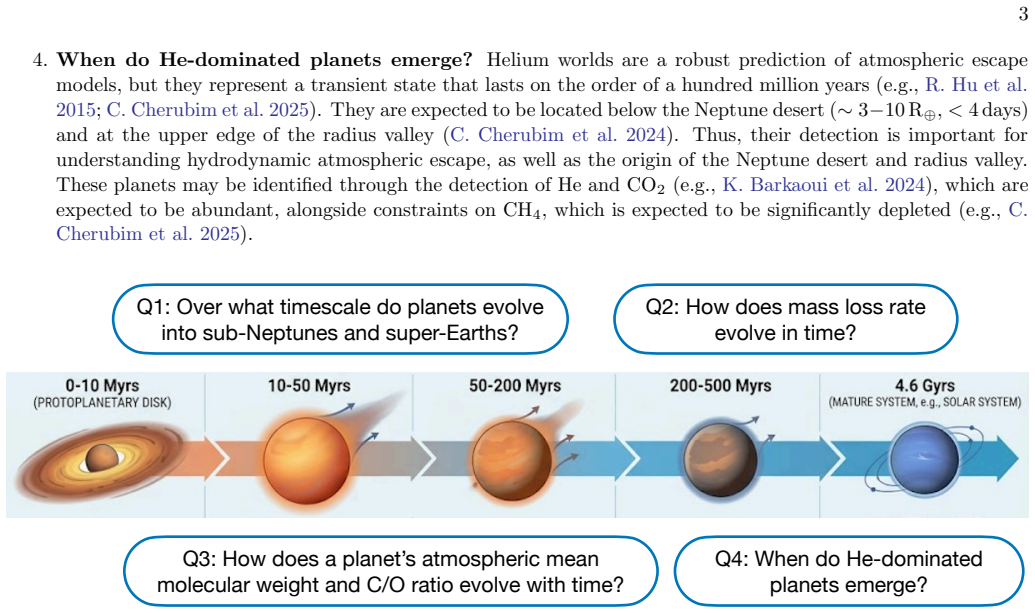
Nautilus provides the high spatial resolution, broad-wavelength coverage, large effective area, and parallelized multiple units required to determine the timescales over which planets evolve into sub-Neptunes and super-Earths, to track the temporal evolution of atmospheric mass-loss rates, to characterize the evolution of atmospheric mean molecular weight and C/O ratio, and to identify the emergence of Helium-dominated worlds.
What carries the argument
The Nautilus Space Observatory, a proposed constellation of large-diameter space telescopes whose multiple units operate in parallel to deliver the resolution, wavelength range, and collecting power needed for population-level atmospheric studies across planet ages.
If this is right
- The time required for young planets to lose envelope mass and settle into sub-Neptune or super-Earth sizes becomes measurable from direct observations.
- Atmospheric escape rates can be compared across orbital periods and system ages to reveal how mass loss changes with time.
- Trends in atmospheric mean molecular weight and carbon-to-oxygen ratio can be mapped as planets age, showing when and how compositions stabilize.
- The first helium-dominated atmospheres can be identified in older systems, marking a distinct late stage of evolution.
Where Pith is reading between the lines
- Such data would let observers test whether the same physical processes explain both the sizes of young planets seen in disks and the sizes of older field planets.
- Results could prioritize targets for detailed follow-up with other instruments by identifying which evolutionary stages still need closer study.
- The approach could be extended to compare atmospheric evolution in different stellar environments once enough systems are observed.
Load-bearing premise
Existing telescopes cannot gather enough simultaneous, high-quality data on atmospheres of many planets spanning young to old ages to perform the needed statistical studies.
What would settle it
A published survey using current or approved telescopes that measures atmospheric mass-loss rates, mean molecular weight, or C/O ratios across a statistically meaningful sample of planets at different ages would show the studies are already feasible without Nautilus.
Figures
read the original abstract
We are just beginning to explore the billion-year evolution from nascent planets in disks to mature planetary systems. Recent discoveries hint at demographic and atmospheric differences between young planets and their Gyr-old counterparts, but current facilities are limited - particularly in their ability to conduct statistical atmospheric studies over a broad period range. This white paper outlines compelling science achievable with the Nautilus Space Observatory, a proposed constellation of large-diameter space telescopes. We identify four primary scientific objectives: (1) determining the timescales over which planets evolve into sub-Neptunes and super-Earths; (2) tracking the temporal evolution of atmospheric mass-loss rates; (3) characterizing the evolution of the atmospheric mean molecular weight and C/O ratio; and (4) identifying the emergence of Helium-dominated worlds. Answering these questions requires the high spatial resolution, broad-wavelength coverage, large effective area, and parallelized multiple units that Nautilus provides. By isolating the physical processes that govern the evolution of planets and their atmospheres, these science objectives directly support NASA's Cosmic Origins and Exoplanet Exploration Programs.
Editorial analysis
A structured set of objections, weighed in public.
Referee Report
Summary. This white paper proposes the Nautilus Space Observatory, a constellation of large-diameter space telescopes, to address four science objectives on the billion-year evolution of planets and atmospheres: (1) timescales for evolution into sub-Neptunes and super-Earths; (2) temporal evolution of atmospheric mass-loss rates; (3) evolution of atmospheric mean molecular weight and C/O ratio; and (4) emergence of Helium-dominated worlds. It asserts that current facilities cannot perform the required statistical atmospheric studies over a broad period range and that Nautilus's high spatial resolution, broad-wavelength coverage, large effective area, and parallelized units are necessary to isolate the governing physical processes, supporting NASA's Cosmic Origins and Exoplanet Exploration Programs.
Significance. If the observational requirements case holds, the proposal would outline a coherent set of objectives for advancing demographic and atmospheric studies of young versus mature exoplanets, providing a forward-looking justification for new space-based capabilities that could enable statistical samples not currently feasible.
major comments (2)
- [Abstract] Abstract: the central premise that 'current facilities are limited - particularly in their ability to conduct statistical atmospheric studies over a broad period range' is stated without any quantitative comparison of existing or planned telescope capabilities, sensitivity limits, or example studies that fail, which is load-bearing for the justification that Nautilus is required.
- [Abstract] Abstract: the four objectives are presented as requiring Nautilus's specific capabilities, but no mapping is given from each objective to the minimum required resolution, wavelength range, collecting area, or number of parallel units, leaving the 'requires' claim unsupported by any requirements analysis or simulation.
minor comments (1)
- [Abstract] Abstract: references to 'recent discoveries' that 'hint at demographic and atmospheric differences' are not accompanied by citations, reducing traceability of the motivating premise.
Simulated Author's Rebuttal
We thank the referee for their careful reading and constructive comments on the Nautilus white paper. We address each major comment below and agree that targeted revisions to the abstract and supporting sections will strengthen the manuscript.
read point-by-point responses
-
Referee: [Abstract] Abstract: the central premise that 'current facilities are limited - particularly in their ability to conduct statistical atmospheric studies over a broad period range' is stated without any quantitative comparison of existing or planned telescope capabilities, sensitivity limits, or example studies that fail, which is load-bearing for the justification that Nautilus is required.
Authors: We agree that the abstract would benefit from quantitative support for this premise. In the revised manuscript we will expand the abstract and add a short capabilities-comparison paragraph (or table) that cites published sensitivity limits and sample sizes from JWST, HST, and ground-based facilities for young (<100 Myr) planets, showing the current shortfall in achieving statistical atmospheric characterization across a wide age baseline. revision: yes
-
Referee: [Abstract] Abstract: the four objectives are presented as requiring Nautilus's specific capabilities, but no mapping is given from each objective to the minimum required resolution, wavelength range, collecting area, or number of parallel units, leaving the 'requires' claim unsupported by any requirements analysis or simulation.
Authors: We acknowledge the value of an explicit requirements trace. The revised version will include a concise traceability table (or bullet list) that maps each of the four science objectives to the minimum needed spectral resolution, wavelength coverage, effective area, and number of parallel apertures, drawing on the exposure-time estimates already present in the full white-paper text. revision: yes
Circularity Check
No significant circularity
full rationale
This is a mission white paper outlining science objectives and required telescope capabilities. It contains no equations, derivations, parameter fits, or load-bearing self-citations. The central claim is an assertion of observational requirements for listed goals, not a result derived from inputs that loop back by construction. No steps match any enumerated circularity pattern.
Axiom & Free-Parameter Ledger
Reference graph
Works this paper leans on
-
[1]
and Huang, Jane and Pérez, Laura M
Andrews, S. M., Huang, J., P´ erez, L. M., et al. 2018, ApJL, 869, L41, doi: 10.3847/2041-8213/aaf741
work page internal anchor Pith review doi:10.3847/2041-8213/aaf741 2018
-
[2]
Apai, D., Milster, T. D., Kim, D. W., et al. 2019, AJ, 158, 83, doi: 10.3847/1538-3881/ab2631
-
[3]
2025, AJ, 170, 165, doi: 10.3847/1538-3881/adec89
Barat, S., D´ esert, J.-M., Mukherjee, S., et al. 2025, AJ, 170, 165, doi: 10.3847/1538-3881/adec89
-
[4]
Barber, M. G., Mann, A. W., Vanderburg, A., Boyle, A. W., & Lopez Murillo, A. I. 2025, AJ, 170, 32, doi: 10.3847/1538-3881/add7db
-
[5]
Barkaoui, K., Pozuelos, F. J., Hellier, C., et al. 2024, Nature Astronomy, 8, 909, doi: 10.1038/s41550-024-02259-y
-
[6]
Batalha, N. E., & Line, M. R. 2017, AJ, 153, 151, doi: 10.3847/1538-3881/aa5faa
-
[7]
2013, ApJ, 778, 153, doi: 10.1088/0004-637X/778/2/153
Benneke, B., & Seager, S. 2013, ApJ, 778, 153, doi: 10.1088/0004-637X/778/2/153
-
[8]
Bergsten, G. J., Pascucci, I., Mulders, G. D., Fernandes, R. B., & Koskinen, T. T. 2022, AJ, 164, 190, doi: 10.3847/1538-3881/ac8fea
-
[9]
2024, Nature Astronomy, 8, 463, doi: 10.1038/s41550-023-02183-7
Burn, R., Mordasini, C., Mishra, L., et al. 2024, Nature Astronomy, 8, 463, doi: 10.1038/s41550-023-02183-7
-
[10]
Cherubim, C., Wordsworth, R., Bower, D. J., et al. 2025, ApJ, 983, 97, doi: 10.3847/1538-4357/adbca9
-
[11]
2024, ApJ, 967, 139, doi: 10.3847/1538-4357/ad3e77
Cherubim, C., Wordsworth, R., Hu, R., & Shkolnik, E. 2024, ApJ, 967, 139, doi: 10.3847/1538-4357/ad3e77
-
[12]
Christiansen, J. L., Zink, J. K., Hardegree-Ullman, K. K., et al. 2023, AJ, 166, 248, doi: 10.3847/1538-3881/acf9f9
-
[13]
2024, AJ, 168, 239, doi: 10.3847/1538-3881/ad83a6
Dai, F., Goldberg, M., Batygin, K., et al. 2024, AJ, 168, 239, doi: 10.3847/1538-3881/ad83a6
-
[14]
Fernandes, R. B., Mulders, G. D., Pascucci, I., et al. 2022, AJ, 164, 78, doi: 10.3847/1538-3881/ac7b29
-
[15]
Fernandes, R. B., Bergsten, G. J., Mulders, G. D., et al. 2025, AJ, 169, 208, doi: 10.3847/1538-3881/adb97e
-
[16]
Fulton, B. J., Petigura, E. A., Howard, A. W., et al. 2017, AJ, 154, 109, doi: 10.3847/1538-3881/aa80eb
-
[17]
Ginzburg, S., Schlichting, H. E., & Sari, R. 2018, MNRAS, 476, 759, doi: 10.1093/mnras/sty290
-
[18]
Gully-Santiago, M., Morley, C. V., Luna, J., et al. 2024, AJ, 167, 142, doi: 10.3847/1538-3881/ad1ee8
-
[19]
Hu, R., Seager, S., & Yung, Y. L. 2015, ApJ, 807, 8, doi: 10.1088/0004-637X/807/1/8
-
[20]
Kite, E. S., & Barnett, M. N. 2020, Proceedings of the National Academy of Science, 117, 18264, doi: 10.1073/pnas.2006177117
-
[21]
Kunimoto, M., Daylan, T., Guerrero, N., et al. 2022, ApJS, 259, 33, doi: 10.3847/1538-4365/ac5688 Lamp´ on, M., L´ opez-Puertas, M., Sanz-Forcada, J., et al. 2021, A&A, 647, A129, doi: 10.1051/0004-6361/202039417
-
[22]
C., Oklopˇ ci´ c, A., & MacLeod, M
Linssen, D. C., Oklopˇ ci´ c, A., & MacLeod, M. 2022, A&A, 667, A54, doi: 10.1051/0004-6361/202243830
-
[23]
Lissauer, J. J., Batalha, N. M., & Borucki, W. J. 2023, in Astronomical Society of the Pacific Conference Series, Vol. 534, Protostars and Planets VII, ed. S. Inutsuka, Y. Aikawa, T. Muto, K. Tomida, & M. Tamura, 839, doi: 10.48550/arXiv.2311.04981
-
[24]
Lissauer, J. J., Rowe, J. F., Jontof-Hutter, D., et al. 2024, PSJ, 5, 152, doi: 10.3847/PSJ/ad0e6e
-
[25]
Long, F., Pinilla, P., Herczeg, G. J., et al. 2018, ApJ, 869, 17, doi: 10.3847/1538-4357/aae8e1
-
[26]
Madhusudhan, N., Ag´ undez, M., Moses, J. I., & Hu, Y. 2016, SSRv, 205, 285, doi: 10.1007/s11214-016-0254-3
-
[27]
W., Vanderburg, A., Rizzuto, A
Mann, A. W., Vanderburg, A., Rizzuto, A. C., et al. 2018, AJ, 155, 4, doi: 10.3847/1538-3881/aa9791 National Academies of Sciences, & Medicine, E. 2021, Pathways to Discovery in Astronomy and Astrophysics for the 2020s, doi: 10.17226/26141
-
[28]
2024, Journal of Geophysical Research (Planets), 129, 2024JE008576, doi: 10.1029/2024JE008576
Pierrehumbert, R. 2024, Journal of Geophysical Research (Planets), 129, 2024JE008576, doi: 10.1029/2024JE008576
-
[29]
Owen, J. E., & Wu, Y. 2017, ApJ, 847, 29, doi: 10.3847/1538-4357/aa890a
-
[30]
Pascucci, I., Testi, L., Herczeg, G. J., et al. 2016, ApJ, 831, 125, doi: 10.3847/0004-637X/831/2/125
-
[31]
Rogers, J. G. 2025, MNRAS, 539, 2230, doi: 10.1093/mnras/staf628
-
[32]
Rosenthal, L. J., Fulton, B. J., Hirsch, L. A., et al. 2021, ApJS, 255, 8, doi: 10.3847/1538-4365/abe23c
-
[33]
Thao, P. C., Mann, A. W., Feinstein, A. D., et al. 2024, AJ, 168, 297, doi: 10.3847/1538-3881/ad81d7
-
[34]
Vach, S., Zhou, G., Huang, C. X., et al. 2024, AJ, 167, 210, doi: 10.3847/1538-3881/ad3108
-
[35]
2019, AJ, 157, 206, doi: 10.3847/1538-3881/ab14de
Welbanks, L., & Madhusudhan, N. 2019, AJ, 157, 206, doi: 10.3847/1538-3881/ab14de
-
[36]
Zhang, K., P´ erez, L. M., Pascucci, I., et al. 2025, ApJ, 989, 1, doi: 10.3847/1538-4357/addebe
discussion (0)
Sign in with ORCID, Apple, or X to comment. Anyone can read and Pith papers without signing in.