REVIEW 3 major objections 5 minor 41 references
SPECTRA beats 14 of 18 probabilistic energy forecast benchmarks by modeling the forecast center and uncertainty spread through separate pathways.
Reviewed by Pith at T0; open to challenge. T0 means a machine referee read the full paper against a public rubric. the ladder, T0–T4 →
T0 review · deepseek-v4-flash
2026-08-01 10:35 UTC pith:BNFVAP43
load-bearing objection SPECTRA's architecture is genuinely novel, but the headline CRPS wins rely on three-seed point estimates with no error bars — the central empirical claim isn't yet supported as printed. the 3 major comments →
SPECTRA: State-Space Exogenous Context and Temporal-Frequency Resolution Architecture for Probabilistic Energy Forecasting
The pith
A machine-rendered reading of the paper's core claim, the machinery that carries it, and where it could break.
Core claim
SPECTRA proposes that the forecast distribution can be factorized by source: the median trajectory is carried by a low-frequency trend-periodic component, and the quantile spread is carried by a high-frequency residual component that retains the information lost in that split. The model realizes this factorization via MTPD, which builds an input-adaptive mask over the Fourier spectrum by combining a smooth low-frequency prior with a sigmoid-masked log-amplitude energy, then inverse-transforms to get the deterministic part and subtracts to get the residual part. Exogenous context is aligned separately to both streams by the Exogenous Context Synergizer; the deterministic stream is refined by
What carries the argument
The load-bearing mechanism is the MTPD adaptive spectral mask: a learned combination of a smooth low-frequency prior and a convolutional mask over log-amplitude Fourier energies that decides, per input instance, which frequencies belong to the deterministic stream and which to the residual stream. The rest of the architecture—cross-attention exogenous alignment, wavelet-plus-state-space refinement of the deterministic stream, and direction-aware quantile offsets from the residual stream—is designed to keep those two streams from re-entangling before quantile estimation.
Load-bearing premise
The whole approach depends on the MTPD spectral mask making a stable, meaningful split between predictable structure and uncertainty-bearing residual; the paper does not state whether the cutoff frequency and transition sharpness of the low-frequency prior are learned or fixed, and if predictable high-frequency content lands in the residual stream the uncertainty intervals inherit that error.
What would settle it
Inspect the residual stream on held-out test windows: if the residual stream still contains strong periodic autocorrelation at a known operating frequency (e.g., a 24-hour cycle), or if the 80% prediction intervals are systematically too narrow on ramp days and too wide on calm days, then the deterministic-stochastic split is not isolating uncertainty. A second check is to fix the low-frequency prior's cutoff and transition at several values and measure CRPS sensitivity; large swings would show the split is not adaptive in the way claimed.
If this is right
- If the principle holds, grid operators can use the residual stream directly as a signal for ramp and spike uncertainty, since the model has already separated what is predictable from what is not.
- Upper-tail quantile risk (ρ90) improves more than median error (ρ50), suggesting the two-stream design specifically helps the extreme events that matter for reserve scheduling and price-spike anticipation.
- The linear-time state-space backbone means the probabilistic gains do not come with quadratic attention cost, so long look-back windows remain computationally feasible.
- The same decomposition-first design could be applied to other time series with strong periodicity plus volatile residuals, not just energy.
- Because quantile offsets are constructed to lie on the correct side of the median, the model is structurally protected against quantile crossings between symmetric levels.
- The spectral amplitude regularizer adds frequency-domain consistency to quantile calibration, which may reduce distortion of periodic patterns in the forecast horizon.
Where Pith is reading between the lines
- One could test whether the spectral split, rather than the specific neural components, is responsible for the gains by freezing the MTPD mask and retraining the rest, or by replacing MTPD with a simple seasonal-trend decomposition.
- The direction-aware offset construction (absolute value with sign by quantile level) is a strong inductive bias; a fair reader would want to know how much of the CRPS gain comes from that constraint versus from the residual features themselves.
- The paper leaves robust forecasting under imperfect or missing exogenous information as future work; a useful stress test is to withhold weather covariates at test time and measure how much of the CRPS advantage disappears.
- The unspecified cutoff frequency and transition sharpness of the low-frequency prior are candidate hyperparameters whose sensitivity could be examined on a single dataset.
Editorial analysis
A structured set of objections, weighed in public.
Referee Report
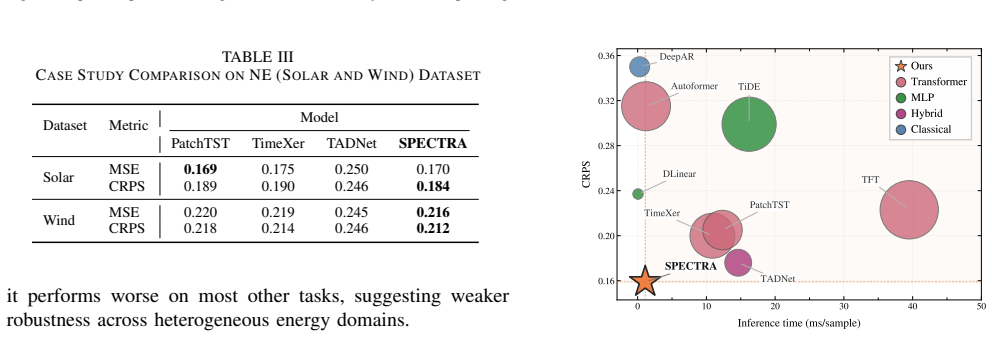
Summary. The paper proposes SPECTRA, a four-module deep architecture for probabilistic energy forecasting. The core design principle is deterministic-stochastic decoupling: a Macro-Trend & Periodic Decoupling (MTPD) module splits the normalized series into a trend-periodic backbone and a high-frequency residual; an Exogenous Context Synergizer (ECS) aligns exogenous variables separately with both streams; a Spectral-Temporal State-Space Engine (STSSE) refines the deterministic backbone with wavelet multi-resolution filtering and selective state-space layers; and a Stochastic Boundary Estimator (SBE) produces ordered quantiles from fused deterministic and residual features. The model is trained with quantile regression plus a frequency-domain regularizer. Experiments on ECL, OPS, GEFCom2014, and a NewEnergy2025 case study report CRPS, ρ50, and ρ90, claiming the best CRPS in 14 of 18 settings, top-two in 17, an average CRPS reduction of 5.74%, and a 7.27% reduction in ρ90 over the strongest baseline. The paper interprets these results as evidence for deterministic-stochastic separation as an effective design principle.
Significance. If the empirical claims held with adequate statistical support, the paper would make a meaningful contribution: the architecture is well-motivated, modular, and evaluated across diverse energy forecasting tasks; the ablations isolate the contributions of each component; code is made available; and the state-space backbone offers a plausible efficiency advantage over attention-based models. The cross-domain validation and explicit separation of deterministic and stochastic streams are ideas likely to interest the power-systems forecasting community. However, the central claim is an empirical superiority claim, and the current evidence is weakened by the absence of uncertainty quantification on the reported metrics, by the omission of several key hyperparameters, and by the small margins in some headline comparisons. These gaps must be addressed before the design-principle conclusion can be considered established.
major comments (3)
- [§IV-A.4, Table I] The main claim that SPECTRA 'achieves the best CRPS in 14 of 18 settings and reduces average CRPS by 5.74%' is not supported with any measure of uncertainty. Results are averaged over three seeds, but no standard deviations, confidence intervals, or paired significance tests are reported. Several decisive margins are tiny: GEF Wind S is a tie with TFT at 0.462; OPS Price L is 0.423 vs PatchTST 0.419; OPS Wind S is 0.406 vs PatchTST 0.404; OPS Wind L is 0.552 vs TADNet 0.540. With only three seeds, these orderings could easily flip. The paper should report per-seed or per-sample variability, and ideally a paired test or confidence interval, for the CRPS and ρ90 comparisons in Table I and the ablations in Table II.
- [§III-A, Eqs. (21)-(28); §III-C; §III-E] Reproducibility and the stability of the MTPD split are compromised by omitted hyperparameters. Eq. (25) defines the low-frequency prior with cutoff fc and transition sharpness τ, but the paper never states whether these are learned or fixed, nor gives their values. Similarly, the spectral regularizer weight η in Eq. (47), the top-K frequency set ΩK, and the wavelet family used in STSSE (Eqs. (34)-(35)) are unspecified. Since the MTPD split is the foundation of the deterministic-stochastic decoupling, and the residual stream is claimed to represent forecast uncertainty, the paper should state these settings and show sensitivity to them. Without this, a reader cannot reproduce the results or assess whether the split is stable across samples.
- [§III-D, Eq. (44)] The direction-aware offset construction restricts lower and upper quantiles to opposite sides of the median, but it does not guarantee monotonicity among quantiles on the same side. For example, two upper quantiles could in principle cross each other, which would produce an invalid predictive CDF. The paper says this construction 'reduces cross-side quantile violations' but supplies no diagnostic for monotonicity or quantile crossings, and no theoretical argument that crossings are controlled. Given that SBE's output is the probabilistic forecast, the paper should either prove monotonicity or report the frequency of quantile crossings in the experiments.
minor comments (5)
- [Author affiliations] Minor grammar issues: 'Yuedong Shi are with' and 'Tian Zheng are with' should be 'is with'.
- [§III-D, Eq. (44)] λ is described as 'learnable or trainable'; please clarify which one is used and report its initial value or whether it is a fixed constant.
- [Table I caption] The note 'For Wind and Solar, L uses only the 72-step horizon' is ambiguous. Please state explicitly that long horizon is H=72 only for those cases, and why H=120/168 are excluded.
- [§IV-B, Fig. 3] The y-axis labels 'MSE 10 50 90' are cryptic; clarify that these denote MSE at median and pinball losses at quantiles 0.1, 0.5, 0.9, or add a legend.
- [§IV-D.1, NewEnergy2025] The description says the dataset 'can be accessed in the code repository,' but no documentation of its construction or license is provided. For a case-study dataset, more detail or a public link would aid reproducibility.
Circularity Check
No circular derivation: SPECTRA's claims are empirical benchmark results; only minor non-load-bearing self-citation to authors' KARMA work.
full rationale
SPECTRA's central claim is an empirical comparison: on held-out splits of ECL/OPS/GEF (and the NE case study), the proposed architecture obtains lower CRPS/rho90 than external baselines. The derivation chain is architectural, not a formal proof from assumptions to results. MTPD's decomposition X_res = X_norm - X_det and SBE's use of H_res to form quantile offsets mean that, by construction, the residual stream contributes to uncertainty; however, the paper does not claim to derive this contribution as a prediction. The empirical CRPS improvement over baselines is not logically forced by Eq. (28) or Eqs. (43)-(45); it is established by held-out evaluation and ablation. The only self-citation is [16] (authors' prior KARMA), used in the introduction to support the general promise of Mamba alongside external citations [15],[32]; it is not load-bearing for any quantitative result. The omitted specification of MTPD cutoff f_c and transition sharpness tau (Eq. 25) and the lack of seed-level error bars are correctness/robustness limitations, not circular reasoning. No uniqueness theorem, imported ansatz, or redefined known result is used to force the conclusions. Score reflects one minor non-load-bearing self-citation; otherwise no significant circularity.
Axiom & Free-Parameter Ledger
free parameters (3)
- Spectral prior cutoff fc and transition sharpness τ =
unspecified
- Spectral regularizer weight η and top-K frequency set =
unspecified
- Direction-aware offset scale λ =
learnable, initialization unspecified
axioms (5)
- domain assumption Fourier and wavelet decomposition of a finite look-back window yields a stable trend-periodic/residual split that transfers to future uncertainty.
- domain assumption Exogenous context is available over both the historical window and the entire forecast horizon.
- standard math Quantile pinball loss and the quantile approximation of CRPS are valid training and evaluation objectives.
- standard math Selective state-space layers with Zero-Order Hold discretization are numerically stable and appropriate for these energy series.
- ad hoc to paper The sign-constrained quantile offsets in Eq. (44) sufficiently control quantile crossings.
read the original abstract
Modern power systems increasingly require probabilistic forecasts amid interacting uncertainties from renewable intermittency, flexible demand, market volatility, and weather-dependent generation. However, existing methods often treat multi-scale decomposition, exogenous-variable alignment, and probabilistic output as separate steps, obscuring how predictable structures and uncertainty-bearing fluctuations jointly shape the forecast distribution. This paper proposes a state-space exogenous-context and temporal-frequency resolution architecture for general probabilistic energy forecasting. Its central premise is that trend-periodic components primarily determine the baseline trajectory, whereas high-frequency residuals and external perturbations govern the spread and asymmetry of forecast uncertainty. Accordingly, the architecture adaptively separates deterministic and residual streams, aligns exogenous context with both, refines the deterministic backbone through multi-resolution spectral-temporal state-space modeling, and estimates ordered quantile boundaries from their complementary representations. Experiments on load, price, solar, and wind forecasting achieve the best continuous ranked probability score in 14 of 18 settings, reducing average CRPS by 5.74\% and upper-tail quantile risk by 7.27\% over the strongest baselines. These results support deterministic-stochastic separation as an effective design principle for general probabilistic energy forecasting.
Figures


Reference graph
Works this paper leans on
-
[1]
Energy forecasting: A review and outlook,
T. Hong, P. Pinson, Y . Wang, R. Weron, D. Yang, and H. Zareipour, “Energy forecasting: A review and outlook,”IEEE Open Access J. Power Energy, vol. 7, pp. 376–388, 2020
2020
-
[2]
DiffLoad: Uncertainty quantification in electrical load forecasting with the diffusion model,
Z. Wang, Q. Wen, C. Zhang, L. Sun, and Y . Wang, “DiffLoad: Uncertainty quantification in electrical load forecasting with the diffusion model,” IEEE Trans. Power Syst., vol. 40, no. 2, pp. 1777–1789, 2025
2025
-
[3]
Electricity demand and grid impacts of AI data centers: Challenges and prospects,
X. Chen, X. Wang, A. Colacelli, M. Lee, and L. Xie, “Electricity demand and grid impacts of AI data centers: Challenges and prospects,”arXiv preprint arXiv:2509.07218, 2025, accessed: Jul. 12, 2026
Pith/arXiv arXiv 2025
-
[4]
Probabilistic electric load forecasting: A tutorial review,
T. Hong and S. Fan, “Probabilistic electric load forecasting: A tutorial review,”Int. J. Forecast., vol. 32, no. 3, pp. 914–938, 2016
2016
-
[5]
Day-ahead electricity price forecasting using the wavelet transform and ARIMA models,
A. J. Conejo, M. A. Plazas, R. Esp ´ınola, and A. B. Molina, “Day-ahead electricity price forecasting using the wavelet transform and ARIMA models,”IEEE Trans. Power Syst., vol. 20, no. 2, pp. 1035–1042, 2005
2005
-
[6]
Short-term load forecasting based on a semi-parametric additive model,
S. Fan and R. J. Hyndman, “Short-term load forecasting based on a semi-parametric additive model,”IEEE Trans. Power Syst., vol. 27, no. 1, pp. 134–141, 2012
2012
-
[7]
Assessment of forecasting techniques for solar power production with no exogenous inputs,
H. T. C. Pedro and C. F. M. Coimbra, “Assessment of forecasting techniques for solar power production with no exogenous inputs,”Sol. Energy, vol. 86, no. 7, pp. 2017–2028, 2012
2017
-
[8]
Current methods and advances in forecasting of wind power generation,
A. M. Foley, P. G. Leahy, A. Marvuglia, and E. J. McKeogh, “Current methods and advances in forecasting of wind power generation,”Renew. Energy, vol. 37, no. 1, pp. 1–8, 2012
2012
-
[9]
Short-term residential load forecasting based on LSTM recurrent neural network,
W. Kong, Z. Y . Dong, Y . Jia, D. J. Hill, Y . Xu, and Y . Zhang, “Short-term residential load forecasting based on LSTM recurrent neural network,” IEEE Trans. Smart Grid, vol. 10, no. 1, pp. 841–851, 2019
2019
-
[10]
Attention-based neural load forecasting: A dynamic feature selection approach,
J. Xiong, P. Zhou, A. Chen, and Y . Zhang, “Attention-based neural load forecasting: A dynamic feature selection approach,” inProc. IEEE Power & Energy Soc. Gen. Meeting (PESGM), 2021, pp. 1–5
2021
-
[11]
DeepAR: Probabilistic forecasting with autoregressive recurrent networks,
D. Salinas, V . Flunkert, J. Gasthaus, and T. Januschowski, “DeepAR: Probabilistic forecasting with autoregressive recurrent networks,”Int. J. Forecast., vol. 36, no. 3, pp. 1181–1191, 2020
2020
-
[12]
Hybrid method for short-term photovoltaic power forecasting based on deep convolutional neural network,
H. Zang, L. Cheng, T. Ding, K. W. Cheung, Z. Liang, Z. Wei, and G. Sun, “Hybrid method for short-term photovoltaic power forecasting based on deep convolutional neural network,”IET Gener., Transmiss. Distrib., vol. 12, no. 20, pp. 4557–4567, 2018
2018
-
[13]
Autoformer: Decomposition transformers with Auto-Correlation for long-term series forecasting,
H. Wu, J. Xu, J. Wang, and M. Long, “Autoformer: Decomposition transformers with Auto-Correlation for long-term series forecasting,” in Proc. Adv. Neural Inf. Process. Syst., vol. 34, 2021, pp. 22 419–22 430
2021
-
[14]
A time series is worth 64 words: Long-term forecasting with transformers,
Y . Nie, N. H. Nguyen, P. Sinthong, and J. Kalagnanam, “A time series is worth 64 words: Long-term forecasting with transformers,” inProc. Int. Conf. Learn. Represent. (ICLR), 2023, accessed: Jul. 12, 2026
2023
-
[15]
Mamba: Linear-time sequence modeling with selective state spaces,
A. Gu and T. Dao, “Mamba: Linear-time sequence modeling with selective state spaces,” inProc. 1st Conf. Lang. Model. (COLM), 2024, accessed: Jul. 12, 2026
2024
-
[16]
KARMA: A multilevel decomposition hybrid Mamba framework for multivariate long-term time series forecasting,
H. Ye, G. Duan, H. Zeng, Y . Zhu, L. Meng, X. Zheng, and Y . Zhu, “KARMA: A multilevel decomposition hybrid Mamba framework for multivariate long-term time series forecasting,” inProc. Int. Conf. Wireless Artif. Intell. Comput. Syst. Appl., 2025, pp. 266–276
2025
-
[17]
F. He, J. Zhou, Z.-k. Feng, G. Liu, and Y . Yang, “A hybrid short-term load forecasting model based on variational mode decomposition and long short-term memory networks considering relevant factors with Bayesian optimization algorithm,”Appl. Energy, vol. 237, pp. 103–116, 2019
2019
-
[18]
An adaptive hybrid model for short term electricity price forecasting,
J. Zhang, Z. Tan, and Y . Wei, “An adaptive hybrid model for short term electricity price forecasting,”Appl. Energy, vol. 258, p. 114087, 2020
2020
-
[19]
Deep neural network for forecasting of photovoltaic power based on wavelet packet decomposition with similar day analysis,
X. Liu, Y . Liu, X. Kong, L. Ma, A. H. Besheer, and K. Y . Lee, “Deep neural network for forecasting of photovoltaic power based on wavelet packet decomposition with similar day analysis,”Energy, vol. 271, p. 126963, 2023
2023
-
[20]
Are transformers effective for time series forecasting?
A. Zeng, M. Chen, L. Zhang, and Q. Xu, “Are transformers effective for time series forecasting?” inProc. AAAI Conf. Artif. Intell., vol. 37, no. 9, 2023, pp. 11 121–11 128
2023
-
[21]
TADNet: Temporal attention decomposition networks for probabilistic energy forecasting,
J. Ye, B. Zhao, D. Liu, Q. Wei, and Y . Wang, “TADNet: Temporal attention decomposition networks for probabilistic energy forecasting,” IEEE Trans. Power Syst., vol. 39, no. 6, pp. 7190–7202, 2024
2024
-
[22]
A semi-empirical approach using gradient boost- ing and k-nearest neighbors regression for GEFCom2014 probabilistic solar power forecasting,
J. Huang and M. Perry, “A semi-empirical approach using gradient boost- ing and k-nearest neighbors regression for GEFCom2014 probabilistic solar power forecasting,”Int. J. Forecast., vol. 32, no. 3, pp. 1081–1086, 2016
2016
-
[23]
Probabilistic solar power forecasting based on weather scenario generation,
M. Sun, C. Feng, and J. Zhang, “Probabilistic solar power forecasting based on weather scenario generation,”Appl. Energy, vol. 266, p. 114823, 2020
2020
-
[24]
Weather-informed probabilistic forecasting and scenario generation in power systems,
H. Zhang, R. Zandehshahvar, M. Tanneau, and P. Van Hentenryck, “Weather-informed probabilistic forecasting and scenario generation in power systems,”Appl. Energy, vol. 384, p. 125369, 2025
2025
-
[25]
Multi-source and temporal attention network for probabilistic wind power prediction,
H. Zhang, J. Yan, Y . Liu, Y . Gao, S. Han, and L. Li, “Multi-source and temporal attention network for probabilistic wind power prediction,” IEEE Trans. Sustain. Energy, vol. 12, no. 4, pp. 2205–2218, 2021
2021
-
[26]
Temporal fusion transformers for interpretable multi-horizon time series forecasting,
B. Lim, S. ¨O. Arık, N. Loeff, and T. Pfister, “Temporal fusion transformers for interpretable multi-horizon time series forecasting,”Int. J. Forecast., vol. 37, no. 4, pp. 1748–1764, 2021
2021
-
[27]
Adaptive probabilistic forecasting of electricity (net-) load,
J. de Vilmarest, J. Browell, M. Fasiolo, Y . Goude, and O. Wintenberger, “Adaptive probabilistic forecasting of electricity (net-) load,”IEEE Trans. Power Syst., vol. 39, no. 2, pp. 4154–4163, 2024
2024
-
[28]
TimeXer: Empowering transformers for time series forecasting with exogenous variables,
Y . Wang, H. Wu, J. Dong, G. Qin, H. Zhang, Y . Liu, Y . Qiu, J. Wang, and M. Long, “TimeXer: Empowering transformers for time series forecasting with exogenous variables,” inProc. Adv. Neural Inf. Process. Syst., vol. 37, 2024
2024
-
[29]
Quantile regression based probabilistic forecasting of renewable energy generation and building electrical load: A state of the art review,
C. Xu, Y . Sun, A. Du, and D.-c. Gao, “Quantile regression based probabilistic forecasting of renewable energy generation and building electrical load: A state of the art review,”J. Build. Eng., vol. 79, p. 107772, 2023
2023
-
[30]
CRPS learning,
J. Berrisch and F. Ziel, “CRPS learning,”J. Econometrics, vol. 237, no. 2, p. 105221, 2023
2023
-
[31]
A new approach to linear filtering and prediction problems,
R. E. Kalman, “A new approach to linear filtering and prediction problems,”J. Basic Eng., vol. 82, no. 1, pp. 35–45, 1960
1960
-
[32]
Efficiently modeling long sequences with structured state spaces,
A. Gu, K. Goel, and C. R ´e, “Efficiently modeling long sequences with structured state spaces,”arXiv preprint arXiv:2111.00396, 2021, accessed: Jul. 12, 2026
Pith/arXiv arXiv 2021
-
[33]
Reversible instance normalization for accurate time-series forecasting against distribution shift,
T. Kim, J. Kim, Y . Tae, C. Park, J.-H. Choi, and J. Choo, “Reversible instance normalization for accurate time-series forecasting against distribution shift,” inProc. Int. Conf. Learn. Represent. (ICLR), 2021, accessed: Jul. 12, 2026
2021
-
[34]
Attention is all you need,
A. Vaswani, N. Shazeer, N. Parmar, J. Uszkoreit, L. Jones, A. N. Gomez, Ł. Kaiser, and I. Polosukhin, “Attention is all you need,” inProc. Adv. Neural Inf. Process. Syst., vol. 30, 2017, pp. 5998–6008
2017
-
[35]
A theory for multiresolution signal decomposition: the wavelet representation,
S. G. Mallat, “A theory for multiresolution signal decomposition: the wavelet representation,”IEEE Trans. Pattern Anal. Mach. Intell., vol. 11, no. 7, pp. 674–693, 1989
1989
-
[36]
Root mean square layer normalization,
B. Zhang and R. Sennrich, “Root mean square layer normalization,” in Proc. Adv. Neural Inf. Process. Syst., vol. 32, 2019, pp. 12 360–12 371
2019
-
[37]
FreDF: Learning to forecast in the frequency domain,
H. Wang, L. Pan, Y . Shen, Z. Chen, D. Yang, Y . Yang, S. Zhang, X. Liu, H. Li, and D. Tao, “FreDF: Learning to forecast in the frequency domain,” inProc. Int. Conf. Learn. Represent. (ICLR), 2025, accessed: Jul. 12, 2026
2025
-
[38]
ElectricityLoadDiagrams20112014,
A. Trindade, “ElectricityLoadDiagrams20112014,” UCI Machine Learning Repository, 2015, accessed: Jul. 12, 2026. [Online]. Available: https://archive.ics.uci.edu/dataset/321/electricityloaddiagrams20112014
2015
-
[39]
Open power system data–frictionless data for electricity system modelling,
F. Wiese, I. Schlecht, W.-D. Bunke, C. Gerbaulet, L. Hirth, M. Jahn, F. Kunz, C. Lorenz, J. M ¨uhlenpfordt, J. Reimannet al., “Open power system data–frictionless data for electricity system modelling,”Appl. Energy, vol. 236, pp. 401–409, 2019
2019
-
[40]
Probabilistic energy forecasting: Global energy forecasting competition 2014 and beyond,
T. Hong, P. Pinson, S. Fan, H. Zareipour, A. Troccoli, and R. J. Hyndman, “Probabilistic energy forecasting: Global energy forecasting competition 2014 and beyond,”Int. J. Forecast., vol. 32, no. 3, pp. 896–913, 2016
2014
-
[41]
Long-term forecasting with TiDE: Time-series dense encoder,
A. Das, W. Kong, A. Leach, S. K. Mathur, R. Sen, and R. Yu, “Long-term forecasting with TiDE: Time-series dense encoder,”Trans. Mach. Learn. Res., 2023
2023
discussion (0)
Sign in with ORCID, Apple, or X to comment. Anyone can read and Pith papers without signing in.