REVIEW 3 major objections 5 minor 119 references
A Next-Generation Exoplanet Atmospheric Retrieval Framework for Transmission Spectroscopy (NEXOTRANS): Comparative Characterization for WASP-39 b Using JWST NIRISS, NIRSpec PRISM, and MIRI Observations
T0 review · 3 major / 5 minor · reviewed 2026-08-16 · deepseek-v4-flash
Pith's one-line read A hybrid Bayesian-plus-machine-learning retrieval framework reads three JWST instruments at once and finds that WASP-39 b's atmosphere is super-solar in carbon, oxygen, and sulfur.
desk verdict A credible retrieval-framework benchmark undercut by a model-selection choice that contradicts the paper's own Bayesian evidence; the WASP-39 b abundance headline should not be taken at face value. read the letter →
The pith
A machine-rendered reading of the paper's core claim, the machinery that carries it, and where it could break.
The reading
What carries the argument
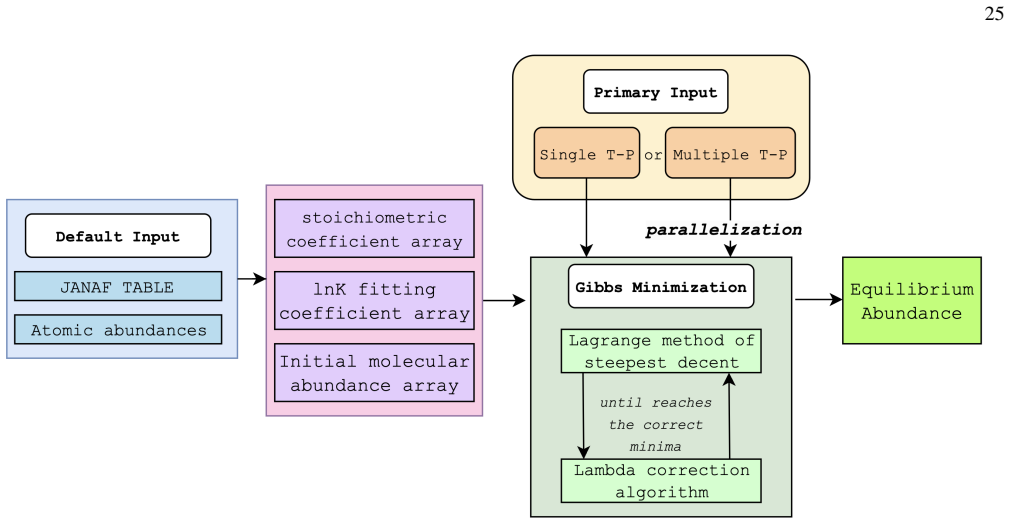
The load-bearing machinery is the NEXOTRANS pipeline itself. Its forward model converts layer-by-layer opacities into a transmission spectrum using the 1-D path distribution method of Robinson (2017), with absorption cross-sections from the POSEIDON opacity database and opacity contributions from Rayleigh scattering, collision-induced absorption, patchy grey clouds with hazes, and Mie-scattering aerosols (ZnS and MgSiO$_3$). Chemistry is handled by four prescriptions—free chemistry, NEXOCHEM equilibrium (a Gibbs free-energy minimizer benchmarked against FastChem), modified hybrid equilibrium, and modified equilibrium-offset—and the retrieval layer combines nested sampling (PyMultiNest/UltraNest) with a stacking regressor (Random Forest, Gradient Boosting, and k-Nearest Neighbor feeding a Ridge meta-model) trained on 60,000 generated spectra after wavelength-based feature reduction. The paper's central identity is the corrected combined 0.6–12 µm spectrum, which under the hybrid equilibrium model returns the reported super-solar elemental ratios.
What would settle it
Re-run the hybrid equilibrium retrieval on the same combined dataset with the offsets left free or modelled as wavelength-dependent, and check whether the recovered $\mathrm{O/H}$, $\mathrm{C/H}$, $\mathrm{S/H}$, and $\mathrm{C/O}$ move outside the quoted 1$\sigma$ intervals; if they do, the super-solar abundances are artifacts of the fixed-offset correction.
Extended reading notes
Core claim
The central discovery is that a hybrid retrieval framework—Bayesian inference run alongside a stacking-regressor machine-learning surrogate—recovers a consistent chemical picture of WASP-39 b from three JWST instruments, and that the statistically preferred modified hybrid equilibrium model yields a super-solar and carbon-enhanced composition. For the best-fit model the paper reports volume mixing ratios for H$_2$O, CO$_2$, CO, H$_2$S, and SO$_2$, with SO$_2$ log VMR between $-6.25$ and $-5.73$ across all non-equilibrium models, and elemental ratios $\mathrm{O/H} = 14.12^{+2.86}_{-1.82}\times$ solar, $\mathrm{C/H} = 21.37^{+4.93}_{-3.18}\times$ solar, $\mathrm{S/H} = 5.37^{+0.79}_{-0.65}\times$ solar, and $\mathrm{C/O} = 1.35^{+0.05}_{-0.02}\times$ solar. The equilibrium-only model fails by underpredicting SO$_2$, which the authors interpret as evidence of photochemical disequilibrium. Benchmarked against eight other retrieval codes on MIRI data (Powell et al. 2024), NEXOTRANS returns consistent water and SO$_2$ abundances, and the ML predictions agree with the Bayesian posteriors, so the framework is put forward as a validated tool for JWST-era comparative exoplanetology.
Load-bearing premise
The load-bearing premise is that the NIRISS and MIRI spectra can be aligned to NIRSpec PRISM by two constant multiplicative offsets (57 ppm and 311.13 ppm) derived from an initial free-chemistry retrieval, and that all later retrievals on the corrected data are unaffected by any error in those offsets.
Editorial extensions
If this is right
- If the hybrid equilibrium result holds, WASP-39 b's bulk elemental enrichment (O/H roughly 14 times solar, C/H roughly 21 times solar) is higher than earlier HST-era estimates, implying a more metal-rich formation environment for hot Saturns.
- The failure of equilibrium chemistry to produce the observed SO$_2$ feature strengthens the case that photochemical and other disequilibrium processes are essential ingredients in JWST retrievals of hot giant atmospheres.
- The consistency between the stacking-regressor ML retrievals and the Bayesian posteriors suggests that ML surrogates can replace or accelerate nested sampling for large JWST samples, provided their smaller error bars are interpreted carefully.
- The per-instrument reduced chi-square values (2.67, 3.19, and 2.14 for NIRISS, PRISM, and MIRI) indicate that a single global model does not fit all three instruments equally well, so joint-instrument retrievals need per-instrument noise or model flexibility.
- The constraints on ZnS and MgSiO$_3$ aerosols with modal sizes and terminator coverage fractions provide a path toward linking condensate chemistry to atmospheric dynamics in transmission spectra.
Reading between the lines
- If the constant-offset alignment is a fair approximation, the same hybrid Bayesian-plus-ML pipeline could be applied to other JWST targets with multi-instrument data, but the per-instrument chi-square disparity warns that cross-instrument systematics may dominate the error budget in such combined retrievals.
- The paper's reported C/O ratio (0.80 absolute, 1.35 times solar) is consistent with a carbon-enriched but not carbon-dominated atmosphere; a direct testable extension would be to search for C$_2$H$_2$ or HCN features shortward of 5 µm, where the model predicts enhanced carbon chemistry at super-solar C/O.
- Because the ML posterior is built from ±10% perturbations around the observed transit depths, the ML error bars likely underestimate true parameter uncertainty; a comparison with the Bayesian widths provides a cheap way to calibrate ML confidence intervals for future use.
- The offset values (57 ppm for NIRISS, 311.13 ppm for MIRI) differ by an order of magnitude; if MIRI's offset were partly astrophysical (e.g., a different terminator or wavelength-dependent spot contamination), the retrieved S/H and SO$_2$ abundances from MIRI absorption features could be biased, a hypothesis testable by fitting the MIRI data alone with and without the offset.
Signed reviews
Editorial analysis
A structured set of objections, weighed in public.
Referee Report
Summary. The manuscript presents NEXOTRANS, a new atmospheric retrieval framework that combines Bayesian nested sampling (PyMultiNest and UltraNest) with four machine-learning regressors, and applies it to JWST transmission spectroscopy of WASP-39 b using NIRISS (0.6-2.8 micron), NIRSpec PRISM (2.0-5.3 micron), and MIRI (5-12 micron). Four chemistry treatments are explored: free, equilibrium, modified hybrid equilibrium, and modified equilibrium-offset chemistry. The paper's central claims are that NEXOTRANS is validated as a hybrid Bayesian plus ML framework, that WASP-39 b's atmosphere is super-solar in O, C, and S, and that the best-fit model is the modified hybrid equilibrium chemistry, yielding O/H = 14.12 (+2.86/-1.82) x solar, C/H = 21.37 (+4.93/-3.18) x solar, S/H = 5.37 (+0.79/-0.65) x solar, and C/O = 1.35 (+0.05/-0.02) x solar. The authors also report constraints on SO2, Na, K, aerosols (ZnS, MgSiO3), and terminator cloud properties.
Significance. If the framework and the WASP-39 b results hold, NEXOTRANS would be a useful community tool: the MIRI benchmark in Table 5, comparing against eight independent retrieval codes across three pipeline reductions, provides strong external evidence that the forward model and sampler are sound, and the NEXOCHEM comparison against FastChem in Appendix 6.1 is a concrete, reproducible validation. The ML-Bayesian consistency checks are also a useful contribution. However, the headline elemental abundances are not reliable as presented because the model-selection step contradicts the paper's own Bayesian evidence, and because the instrument offsets used to align the datasets are derived from the same data and their uncertainties are not propagated. The scientific conclusions therefore require substantial reworking before the paper can be accepted.
major comments (3)
- [Section 4.1.1] The model-selection step is internally inconsistent with the paper's Bayesian framework. The text reports ln(Z) = 3148.86 for hybrid equilibrium and ln(Z) = 3163.09 for equilibrium offset under the same data and priors, a Bayes factor of roughly e^14 strongly favoring the equilibrium-offset model. The paper nevertheless selects hybrid equilibrium as the best statistical fit because its reduced chi-squared (2.97) is marginally lower than 2.98. These two reduced chi-squared values are statistically indistinguishable, and when Bayesian evidence has been computed, it is not justified to overturn the evidence ranking with an essentially flat chi-squared comparison. This choice directly affects the abstract's headline abundances, which are quoted for the hybrid model; the evidence-favored equilibrium-offset model gives different values, including log O/H of -1.72 versus -2.16 and C/O of 0.89 versus 0.80 (both still super-solar O/C/H/S, but shifted). The authors should either present the equilibrium-offset model as the primary result or provide a statistically justified argument, based on the computed evidences, for preferring the hybrid model.
- [Section 3, offset correction paragraph] The alignment of the three instruments rests on constant multiplicative offsets (57 ppm for NIRISS and 311.13 ppm for MIRI, relative to NIRSpec PRISM) that were themselves retrieved from an initial free-chemistry retrieval on the same combined dataset; all subsequent retrievals are then run on the corrected data. This is circular in an important sense: the offsets absorb any absolute-scale or wavelength-independent systematics, but their uncertainties are not carried into the final posterior distributions, and any wavelength-dependent residual between instruments would be misattributed to chemistry. The authors should fit the relative offsets as nuisance parameters simultaneously in all models, or demonstrate explicitly that the retrieved mixing ratios, C/O, and elemental abundances are insensitive to the offset values and their uncertainties. As written, the quoted error bars on the headline abundances omit this systematic term.
- [Section 4.2] The goodness-of-fit criterion itself is weakened by the fact that all combined-dataset reduced chi-squared values are near 3 (2.97-3.35), with per-instrument values of 2.67 (NIRISS), 3.19 (PRISM), and 2.14 (MIRI). These values indicate that the models underfit the data, yet the paper does not quote chi-squared probabilities, model the noise covariance, or rescale the error bars. Under these conditions, the small difference between reduced chi-squared values used for model ranking (2.97 versus 2.98) is not statistically meaningful. This reinforces Major Comment 1 and needs to be addressed by a proper noise model or by an explicit discussion of the underfitting and its consequences for parameter uncertainties.
minor comments (5)
- [Section 6.2.4 and Table 4] The text states that the Stacking Regressor achieves the highest R^2 score of 0.855, but Table 4 reports R^2 = 0.76 for the Stacking Regressor; this numerical inconsistency should be corrected.
- [Section 3.1.3] The ZnS modal particle radius is printed as 'log(rc/um) = 1.29' with a positive sign, whereas all comparable values elsewhere in the paper are negative (e.g., -1.29 in the free-chemistry retrieval); this is likely a sign error and should be corrected.
- [Throughout] The planet name is written inconsistently as both 'WASP-39 b' and 'WASP-39b'; the manuscript should adopt one convention.
- [Table 5 caption] The table header 'Redchi2' should be written as 'reduced chi-squared', and the caption should clarify which results correspond to NEXOTRANS's three cloud parametrizations for each reduction.
- [Section 4.2 and Appendix 6.4] The text says the per-dataset reduced chi-squared values were obtained by performing retrievals with the global best-fit hybrid equilibrium model; it should be stated explicitly whether these values come from fixed global best-fit parameters re-evaluated on each dataset or from re-fits to each individual dataset, since the interpretation differs.
Circularity Check
No significant circularity: external benchmarks ground the forward model, and the flagged issues are statistical or consistency concerns rather than derivation-by-construction.
full rationale
The paper's load-bearing derivation is the NEXOTRANS forward model, not a self-referential prediction. Section 2.4 benchmarks NEXOTRANS on JWST MIRI data against eight independent retrieval codes from Powell et al. (2024), including POSEIDON, with consistent 1-sigma posteriors, and Appendix 6.1 benchmarks NEXOCHEM against FastChem over a large grid with stated T-P-C/O-metallicity ranges. These are external, parameter-free checks, so the framework claim does not reduce to its own inputs. The ML-versus-Bayesian agreement in Section 3.1 is an internal consistency check, because both use the same forward model, but it is not load-bearing: the framework's validation rests on the external MIRI benchmark. The instrument-offset correction in Section 3 (57 ppm NIRISS, 311.13 ppm MIRI) is a data-preprocessing step that may double-use the data and could bias model comparison, but the headline abundances are not equal by construction to those offsets, so this is a statistical and correctness concern rather than circularity. Similarly, choosing hybrid equilibrium as the 'best fit' by reduced chi-squared (2.97 vs 2.98) while reporting Bayesian evidence that favors equilibrium offset (ln Z = 3163.09 vs 3148.86) is an internal model-selection inconsistency and should be evaluated as a correctness risk, not as a circular reduction. The elemental abundance claims are retrieved parameters from a clearly specified forward model, not first-principles predictions, so there is no self-definitional step.
Assumptions & free parameters
free parameters (16)
- C/O ratio (hybrid equilibrium) =
0.80 (+0.03/-0.01)
- Metallicity log[M/H] (hybrid) =
1.19 (+0.05/-0.04)
- log VMR SO2 (free in hybrid) =
-5.80 (+0.11/-0.13)
- log VMR Na (free in hybrid) =
-7.97 (+0.44/-0.50)
- log VMR K (free in hybrid) =
-8.74 (+0.15/-0.16)
- log VMR ZnS aerosol =
-2.54 (+0.74/-0.85)
- log VMR MgSiO3 aerosol =
-9.42 (+3.71/-4.87)
- ZnS modal particle radius log(rc/um) =
1.29 (+0.005/-0.005)
- MgSiO3 modal particle radius log(rc/um) =
-1.74 (+0.40/-0.51)
- hc (aerosol scale-height factor) =
0.78 (+0.01/-0.01)
- fc (terminator cloud fraction) =
0.59 (+0.01/-0.01)
- Madhusudhan P-T parameters (T0, alpha1, alpha2, log P1, log P2, log P3, log P_ref) =
not tabulated; see corner plots (Figures 16-17)
- NIRISS relative offset =
57 ppm
- MIRI relative offset =
311.13 ppm
- Equilibrium offset factors (H2O, CO, CO2, H2S, CH4) =
1.38, 0.94, 0.33, 1.23, 1.73
- C/O and log[M/H] (equilibrium-offset model) =
0.89 (+0.01/-0.02) and 1.66 (+0.09/-0.10)
assumptions (8)
- domain assumption H2/He dominated atmosphere with He/H2 = 0.17
- domain assumption Plane-parallel geometry, geometric limit, no refraction or scattering in radiative transfer
- domain assumption 100-layer log-uniform pressure grid from 1e-7 to 100 bar
- domain assumption Madhusudhan & Seager (2009) P-T parameterization is adequate
- ad hoc to paper Equilibrium chemistry grid from NEXOCHEM covers T=300-4000 K, P=1e-7-1e2 bar, C/O=0.2-2, [Fe/H]=0.1-1000 solar
- domain assumption Opacity line lists from the POSEIDON database are accurate
- standard math Likelihood uses independent Gaussian errors and ignores covariance between wavelength bins
- ad hoc to paper ML training spectra at R=158, generated by the same forward model, are sufficient training data
Cite this review
Pith. "Pith review of A Next-Generation Exoplanet Atmospheric Retrieval Framework for Transmission Spectroscopy (NEXOTRANS): Comparative Characterization for WASP-39 b Using JWST NIRISS, NIRSpec PRISM, and MIRI Observations." pith.science (2026). https://pith.science/paper/BNFZPSN3
@misc{pith2026250418815,
  author       = {Pith},
  title        = {Pith review of: A Next-Generation Exoplanet Atmospheric Retrieval Framework for Transmission Spectroscopy (NEXOTRANS): Comparative Characterization for WASP-39 b Using JWST NIRISS, NIRSpec PRISM, and MIRI Observations},
  year         = {2026},
  howpublished = {\url{https://pith.science/paper/BNFZPSN3}},
  note         = {Machine review of arXiv:2504.18815}
}
read the original abstract
The advent of JWST has marked a new era in exoplanetary atmospheric studies, offering higher-resolution data and greater precision across a broader spectral range than previous space-based telescopes. Accurate analysis of these datasets requires advanced retrieval frameworks capable of navigating complex parameter spaces. We present NEXOTRANS, an atmospheric retrieval framework that integrates Bayesian inference using UltraNest/PyMultiNest with four machine learning algorithms: Random Forest, Gradient Boosting, K-Nearest Neighbor, and Stacking Regressor. This hybrid approach enables a comparison between traditional Bayesian methods and computationally efficient machine learning techniques. Additionally, NEXOTRANS incorporates NEXOCHEM, a module for solving equilibrium chemistry. We applied NEXOTRANS to JWST observations of the Saturn-mass exoplanet WASP-39 b, spanning wavelengths from 0.6 microns to 12.0 microns using NIRISS, NIRSpec PRISM, and MIRI. Four chemistry models - free, equilibrium, modified hybrid equilibrium, and modified equilibrium-offset chemistry - were explored to retrieve precise Volume Mixing Ratios (VMRs) for H2O, CO2, CO, H2S, and SO2. Absorption features in both NIRSpec PRISM and MIRI data constrained SO2 log VMRs to values between -6.25 and -5.73 for all models except equilibrium chemistry. High-altitude aerosols, including ZnS and MgSiO3, were inferred, with constraints on their VMRs, particle sizes, and terminator coverage fractions, providing insights into cloud composition. For the best-fit modified hybrid equilibrium model, we derived super-solar elemental abundances of O/H = 14.12 (+2.86/-1.82) x solar, C/H = 21.37 (+4.93/-3.18) x solar, and S/H = 5.37 (+0.79/-0.65) x solar, along with a C/O ratio of 1.35 (+0.05/-0.02) x solar, demonstrating NEXOTRANS's potential for atmospheric characterization in the JWST era and beyond.
Figures


Figures from the paper (14 more)




Reference graph
Works this paper leans on
-
[1]
S., & Marley, M
Ackerman, A. S., & Marley, M. S. 2001, The Astrophysical Journal, 556, 872
2001
-
[2]
2023, Nature, 614, 649
Ahrer, E.-M. 2023, Nature, 614, 649
2023
-
[3]
B., Mansfield, M., et al
Ahrer, E.-M., Stevenson, K. B., Mansfield, M., et al. 2023, Nature, 614, 653
2023
-
[4]
R., Alam, M
Alderson, L., Wakeford, H. R., Alam, M. K., et al. 2023, Nature, 614, 664
2023
-
[5]
Altman, N. S. 1992, The American Statistician, 46, 175
1992
-
[6]
2021, A141
Asplund, M., Amarsi, A., & Grevesse, N. 2021, A141
2021
-
[7]
Asplund, M., Grevesse, N., Sauval, A. J., & Scott, P. 2009, Annual Review of Astronomy and Astrophysics, 47, 481, doi: 10.1146/annurev.astro.46.060407.145222
arXiv 2009
-
[8]
2016, Mon
Azzam, A., Yurchenko, S., Tennyson, J., & Naumenko, O. 2016, Mon. Not. R. Astron. Soc, 460, 4063
2016
Show all 119 references
-
[9]
2014, Monthly Notices of the Royal Astronomical Society, 437, 1828
Barber, R., Strange, J., Hill, C., et al. 2014, Monthly Notices of the Royal Astronomical Society, 437, 1828
2014
-
[10]
2007, The Astrophysical Journal, 661, L191
Barman, T. 2007, The Astrophysical Journal, 661, L191
2007
-
[11]
K., & Heng, K
Barstow, J. K., & Heng, K. 2020, Space science reviews, 216, 82
2020
-
[12]
2014, Publications of the Astronomical Society of the Pacific, 126, 1134
Beichman, C., Benneke, B., Knutson, H., et al. 2014, Publications of the Astronomical Society of the Pacific, 126, 1134
2014
-
[13]
J., Welbanks, L., Schlawin, E., et al
Bell, T. J., Welbanks, L., Schlawin, E., et al. 2023, Nature, 623, 709
2023
-
[14]
A., Lothringer, J., et al
Benneke, B., Knutson, H. A., Lothringer, J., et al. 2019, Nature Astronomy, 3, 813, doi: 10.1038/s41550-019-0800-5
2019 doi
-
[15]
Blecic, J., Harrington, J., & Bowman, M. O. 2016, The Astrophysical Journal Supplement Series, 225, 4, doi: 10.3847/0067-0049/225/1/4
2016 doi
-
[16]
1996, Machine learning, 24, 123 —
Breiman, L. 1996, Machine learning, 24, 123 —. 2001, Machine learning, 45, 5
1996
-
[17]
2021, arXiv preprint arXiv:2101.09604 —
Buchner, J. 2021, arXiv preprint arXiv:2101.09604 —. 2023, Statistic Surveys, 17, 169
2021 arXiv
-
[18]
2014, Astronomy & Astrophysics, 564, A125 B¨uhlmann, P., & Hothorn, T
Buchner, J., Georgakakis, A., Nandra, K., et al. 2014, Astronomy & Astrophysics, 564, A125 B¨uhlmann, P., & Hothorn, T. 2007, JSTOR
2014
-
[19]
2024, Nature Astronomy, 8, 1008
Carter, A., May, E., Espinoza, N., et al. 2024, Nature Astronomy, 8, 1008
2024
-
[20]
W., J., Curnutt, J
Chase, M. W., J., Curnutt, J. L., Downey, J. R., J., et al. 1982, Journal of Physical and Chemical Reference Data, 11, 695, doi: 10.1063/1.555666
1982 doi
-
[21]
Chase, M. W. 1986, JANAF thermochemical tables, 3rd edn. (Washington, D.C: American Chemical Society)
1986
-
[22]
D., Himes, M
Cobb, A. D., Himes, M. D., Soboczenski, F., et al. 2019, The astronomical journal, 158, 33
2019
-
[23]
2024, MNRAS, 530, 3252–3277
Constantinou, S., & Madhusudhan, N. 2024, MNRAS, 530, 3252–3277
2024
-
[24]
2023, The Astrophysical Journal Letters, 943, L10, doi: 10.3847/2041-8213/acaead
Constantinou, S., Madhusudhan, N., & Gandhi, S. 2023, The Astrophysical Journal Letters, 943, L10, doi: 10.3847/2041-8213/acaead
2023 doi
-
[25]
1967, IEEE transactions on information theory, 13, 21
Cover, T., & Hart, P. 1967, IEEE transactions on information theory, 13, 21
1967
-
[26]
Crossfield, I. J. 2023, Nature
2023
-
[27]
E., & Blecic, J
Cubillos, P. E., & Blecic, J. 2021, Monthly Notices of the Royal Astronomical Society, 505, 2675
2021
-
[28]
2019, MPI for Python, Feb
Dalcin, L. 2019, MPI for Python, Feb
2019
-
[29]
Dalcin, L., & Fang, Y .-L. L. 2021, Computing in Science & Engineering, 23, 47 Dalc´ın, L., Paz, R., & Storti, M. 2005, Journal of Parallel and Distributed Computing, 65, 1108
2021
-
[30]
2005, Journal of Parallel and Distributed Computing, doi: 10.1016/j.jpdc.2005.03.010 Dalc´ın, L., Paz, R., Storti, M., & D’El´ıa, J
Dalcin, L., Paz, R., & Storti, M. 2005, Journal of Parallel and Distributed Computing, doi: 10.1016/j.jpdc.2005.03.010 Dalc´ın, L., Paz, R., Storti, M., & D’El´ıa, J. 2008, Journal of Parallel and Distributed Computing, 68, 655
2005 doi
-
[31]
2013, The Astrophysical Journal, 774, 95, doi: 10.1088/0004-637X/774/2/95
Deming, D., Wilkins, A., McCullough, P., et al. 2013, The Astrophysical Journal, 774, 95, doi: 10.1088/0004-637X/774/2/95
2013 doi
-
[32]
Dittmann, A. J. 2024, arXiv preprint arXiv:2404.16928
2024 arXiv
-
[33]
Dudani, S. A. 1976, IEEE Transactions on Systems, Man, and Cybernetics, 325
1976
-
[34]
L., Welch, B
Eriksson, G., Holm, J. L., Welch, B. J., et al. 1971, Acta Chemica Scandinavica, 25, 2651–2658, doi: 10.3891/acta.chem.scand.25-2651
1971 doi
-
[35]
D., Radica, M., Welbanks, L., et al
Feinstein, A. D., Radica, M., Welbanks, L., et al. 2023, Nature, 614, 670
2023
-
[36]
Feroz, F., & Hobson, M. P. 2008, Monthly Notices of the Royal Astronomical Society, 384, 449, doi: 10.1111/j.1365-2966.2007.12353.x
2008
-
[37]
P., & Bridges, M
Feroz, F., Hobson, M. P., & Bridges, M. 2009, Monthly Notices of the Royal Astronomical Society, 398, 1601, doi: 10.1111/j.1365-2966.2009.14548.x
2009
-
[38]
P., Cameron, E., & Pettitt, A
Feroz, F., Hobson, M. P., Cameron, E., & Pettitt, A. N. 2013, arXiv preprint arXiv:1306.2144
2013 arXiv
-
[39]
J., Kitzmann, D., et al
Fisher, C., Hoeijmakers, H. J., Kitzmann, D., et al. 2020, The astronomical journal, 159, 192
2020
-
[40]
2009, Icarus, 199, 351
Fletcher, L., Orton, G., Teanby, N., Irwin, P., & Bjoraker, G. 2009, Icarus, 199, 351
2009
-
[41]
Fortney, J. J. 2024, arXiv preprint arXiv:2405.04587
2024 arXiv
-
[42]
Friedman, J. H. 2001, Annals of statistics, 1189
2001
-
[43]
2018, Monthly Notices of the Royal Astronomical Society, 474, 271
Gandhi, S., & Madhusudhan, N. 2018, Monthly Notices of the Royal Astronomical Society, 474, 271
2018
-
[44]
Gardner, J. P. 2005, Proceedings of the International Astronomical Union, 1, 87
2005
-
[45]
2021, Nature, 592, 205, doi: 10.1038/s41586-021-03381-x
Giacobbe, P., Brogi, M., Gandhi, S., et al. 2021, Nature, 592, 205, doi: 10.1038/s41586-021-03381-x
2021 doi
-
[46]
2010, Astronomy & Astrophysics, 520, A27
Guillot, T. 2010, Astronomy & Astrophysics, 520, A27
2010
-
[47]
2019, Astronomy & Astrophysics, 625, A107
Guilluy, G., Sozzetti, A., Brogi, M., et al. 2019, Astronomy & Astrophysics, 625, A107
2019
-
[48]
2022, Astronomy & Astrophysics, 665, A104 36
Guilluy, G., Giacobbe, P., Carleo, I., et al. 2022, Astronomy & Astrophysics, 665, A104 36
2022
-
[49]
2009, The elements of statistical learning: data mining, inference, and prediction, Springer
Hastie, T. 2009, The elements of statistical learning: data mining, inference, and prediction, Springer
2009
-
[50]
E., & Kennard, R
Hoerl, A. E., & Kennard, R. W. 1970, Technometrics, 12, 55
1970
-
[51]
2024, Nature, 1
Hu, R., Bello-Arufe, A., Zhang, M., et al. 2024, Nature, 1
2024
-
[52]
Hunter, J. D. 2007, Computing in Science & Engineering, 9, 90, doi: 10.1109/MCSE.2007.55 Joachim W. Stock, Daniel Kitzmann, A. B. C. P., & Sedlmayr, E. 2018, MNRAS 479, 865–874 (2018)
2018 doi
-
[53]
2022, Astrophysics Source Code Library, ascl
Kawahara, H., Kawashima, Y ., Masuda, K., et al. 2022, Astrophysics Source Code Library, ascl
2022
-
[54]
2020, The Astrophysical Journal, 890, 174
Kitzmann, D., Heng, K., Oreshenko, M., et al. 2020, The Astrophysical Journal, 890, 174
2020
-
[55]
L., D´esert, J.-M., et al
Kreidberg, L., Bean, J. L., D´esert, J.-M., et al. 2014, Nature, 505, 69
2014
-
[56]
L., & Peytremann, E
Kurucz, R. L., & Peytremann, E. 1975, SAO Special Report# 362, part 1., 362
1975
-
[57]
I., & Burrows, A
Lacy, B. I., & Burrows, A. 2020, The Astrophysical Journal, 904, 25
2020
-
[58]
K., Pitrou, A., & Seibert, S
Lam, S. K., Pitrou, A., & Seibert, S. 2015, in Proceedings of the Second Workshop on the LLVM Compiler Infrastructure in HPC, 1–6
2015
-
[59]
M., Mordasini, C., et al
Lavie, B., Mendonc ¸a, J. M., Mordasini, C., et al. 2017, The Astronomical Journal, 154, 91
2017
-
[60]
N., & Irwin, P
Lee, J.-M., Fletcher, L. N., & Irwin, P. G. 2012, Monthly Notices of the Royal Astronomical Society, 420, 170
2012
-
[61]
E., Rothman, L
Li, G., Gordon, I. E., Rothman, L. S., et al. 2015, The Astrophysical Journal Supplement Series, 216, 15
2015
-
[62]
2002, R news Lindg˚ard, A., & Nielsen, S
Liaw, A. 2002, R news Lindg˚ard, A., & Nielsen, S. E. 1977, Atomic data and nuclear data tables, 19, 533
2002
-
[63]
R., & Parmentier, V
Line, M. R., & Parmentier, V . 2016, The Astrophysical Journal, 820, 78
2016
-
[64]
R., Wolf, A
Line, M. R., Wolf, A. S., Zhang, X., et al. 2013, The Astrophysical Journal, 775, 137
2013
-
[65]
MacDonald, R. J. 2019, Apollo - University of Cambridge Repository, doi: 10.17863/CAM.44898
2019 doi
-
[66]
J., & Batalha, N
MacDonald, R. J., & Batalha, N. E. 2023a, Research Notes of the AAS, 7, 54 —. 2023b, Research Notes of the AAS, 7, 54, doi: 10.3847/2515-5172/acc46a
-
[67]
J., & Lewis, N
MacDonald, R. J., & Lewis, N. K. 2022, ApJ, 929:20 (32pp), 2022 April 10
2022
-
[68]
2019, Annual Review of Astronomy and Astrophysics, 57, 617, doi: https://doi.org/10.1146/annurev-astro-081817-051846
Madhusudhan, N. 2019, Annual Review of Astronomy and Astrophysics, 57, 617, doi: https://doi.org/10.1146/annurev-astro-081817-051846
2019 doi
-
[69]
2023, The Astrophysical Journal Letters, 956, L13
Madhusudhan, N., Sarkar, S., Constantinou, S., et al. 2023, The Astrophysical Journal Letters, 956, L13
2023
-
[70]
2009, The Astrophysical Journal, 707, 24
Madhusudhan, N., & Seager, S. 2009, The Astrophysical Journal, 707, 24
2009
-
[71]
Mai, C., & Line, M. R. 2019, The Astrophysical Journal, 883, 144 M´arquez-Neila, P., Fisher, C., Sznitman, R., & Heng, K. 2018, Nature Astronomy, 2, 719, doi: 10.1038/s41550-018-0504-2
2019 doi
-
[72]
A., Min, M., Kamp, I., & Palmer, P
Martinez, F. A., Min, M., Kamp, I., & Palmer, P. I. 2022, arXiv preprint arXiv:2203.01236
2022 arXiv
-
[73]
K., Barstow, J
Mikal-Evans, T., Sing, D. K., Barstow, J. K., et al. 2022, Nature Astronomy, 6, 471
2022
-
[74]
K., Dong, J., et al
Mikal-Evans, T., Sing, D. K., Dong, J., et al. 2023, The Astrophysical Journal Letters, 943, L17
2023
-
[75]
W., Chubb, K., Helling, C., & Kawashima, Y
Min, M., Ormel, C. W., Chubb, K., Helling, C., & Kawashima, Y . 2020, Astronomy & Astrophysics, 642, A28
2020
-
[76]
2019, Astronomy & Astrophysics, 627, A67
Molli`ere, P., Wardenier, J., Van Boekel, R., et al. 2019, Astronomy & Astrophysics, 627, A67
2019
-
[77]
2013, Frontiers in neurorobotics, 7, 21
Natekin, A., & Knoll, A. 2013, Frontiers in neurorobotics, 7, 21
2013
-
[78]
E., et al
Niraula, P., de Wit, J., Gordon, I. E., et al. 2022, Nature Astronomy, 6, 1287
2022
-
[79]
C., & Madhusudhan, N
Nixon, M. C., & Madhusudhan, N. 2020, Monthly Notices of the Royal Astronomical Society, 496, 269, doi: 10.1093/mnras/staa1150
2020 doi
-
[80]
W., & Min, M
Ormel, C. W., & Min, M. 2019, Astronomy & Astrophysics, 622, A121
2019
-
[81]
2024, Astronomy & Astrophysics, 690, A159
Patel, J., Brandeker, A., Kitzmann, D., et al. 2024, Astronomy & Astrophysics, 690, A159
2024
-
[82]
2011, Journal of Machine Learning Research, 12, 2825
Pedregosa, F., Varoquaux, G., Gramfort, A., et al. 2011, Journal of Machine Learning Research, 12, 2825
2011
-
[83]
Peterson, L. E. 2009, Scholarpedia, 4, 1883
2009
-
[84]
2017, Monthly Notices of the Royal Astronomical Society, 471, 4355
Pinhas, A., & Madhusudhan, N. 2017, Monthly Notices of the Royal Astronomical Society, 471, 4355
2017
-
[85]
V ., Madhusudhan, N., & Apai, D
Pinhas, A., Rackham, B. V ., Madhusudhan, N., & Apai, D. 2018, Monthly Notices of the Royal Astronomical Society, 480, 5314
2018
-
[86]
L., Kyuberis, A
Polyansky, O. L., Kyuberis, A. A., Zobov, N. F., et al. 2018, Monthly Notices of the Royal Astronomical Society, 480, 2597
2018
-
[87]
D., Lee, E
Powell, D., Feinstein, A. D., Lee, E. K., et al. 2024, Nature, 626, 979
2024
-
[88]
2011, http://physics
Ralchenko, Y . 2011, http://physics. nist. gov/asd
2011
-
[89]
E., Rothman, L
Richard, C., Gordon, I. E., Rothman, L. S., et al. 2012, Journal of Quantitative Spectroscopy and Radiative Transfer, 113, 1276
2012
-
[90]
Robinson, T. D. 2017, ApJ, 836:236 (18pp), 2017 February 20
2017
-
[91]
D., & Salvador, A
Robinson, T. D., & Salvador, A. 2023, The Planetary Science Journal, 4, 10
2023
-
[92]
2022, IEEE Transactions on Parallel and Distributed Systems, 34, 611
Rogowski, M., Aseeri, S., Keyes, D., & Dalcin, L. 2022, IEEE Transactions on Parallel and Distributed Systems, 34, 611
2022
-
[93]
2023, Nature, 614, 659
Rustamkulov, Z., Sing, D., Mukherjee, S., et al. 2023, Nature, 614, 659
2023
-
[94]
2010, Annual Review of Astronomy and Astrophysics, 48, 631
Seager, S., & Deming, D. 2010, Annual Review of Astronomy and Astrophysics, 48, 631
2010
-
[95]
K., Pont, F., Aigrain, S., et al
Sing, D. K., Pont, F., Aigrain, S., et al. 2011, Monthly Notices of the Royal Astronomical Society, 416, 1443
2011
-
[96]
K., Lecavelier des Etangs, A., Fortney, J
Sing, D. K., Lecavelier des Etangs, A., Fortney, J. J., et al. 2013, Monthly Notices of the Royal Astronomical Society, 436, 2956
2013
-
[97]
K., Fortney, J
Sing, D. K., Fortney, J. J., Nikolov, N., et al. 2016, Nature, 529, 59 37
2016
-
[98]
2006, Bayesian Analysis, 1, 833 , doi: 10.1214/06-BA127
Skilling, J. 2006, Bayesian Analysis, 1, 833 , doi: 10.1214/06-BA127
2006 doi
-
[99]
2005, JQSRT, 92, 293
Sneep, M., & Ubachs, W. 2005, JQSRT, 92, 293
2005
-
[100]
B., Bean, J
Stevenson, K. B., Bean, J. L., Madhusudhan, N., & Harrington, J. 2014, The Astrophysical Journal, 791, 36
2014
-
[101]
B., Harrington, J., Nymeyer, S., et al
Stevenson, K. B., Harrington, J., Nymeyer, S., et al. 2010, Nature, 464, 1161, doi: 10.1038/nature09013
2010 doi
-
[102]
2011, Journal of Quantitative Spectroscopy and Radiative Transfer, 112, 1403
Tashkun, S., & Perevalov, V . 2011, Journal of Quantitative Spectroscopy and Radiative Transfer, 112, 1403
2011
-
[103]
1996, Journal of the Royal Statistical Society Series B: Statistical Methodology, 58, 267
Tibshirani, R. 1996, Journal of the Royal Statistical Society Series B: Statistical Methodology, 58, 267
1996
-
[104]
2018, Experimental Astronomy, 46, 135, doi: 10.1007/s10686-018-9598-x
Tinetti, G., Drossart, P., Eccleston, P., et al. 2018, Experimental Astronomy, 46, 135, doi: 10.1007/s10686-018-9598-x
2018 doi
-
[105]
Tsai, S.-M., Lee, E. K. H., Powell, D., et al. 2023, Nature, 617, 483, doi: 10.1038/s41586-023-05902-2
2023 doi
-
[106]
2018, The Astronomical Journal, 155, 156
Tsiaras, A., Waldmann, I., Zingales, T., et al. 2018, The Astronomical Journal, 155, 156
2018
-
[107]
2016, Mon
Fateev, A. 2016, Mon. Not. R. Astron. Soc, 462, 4300 Van Rossum, G., & Drake, F. L. 2009, Python 3 Reference Manual (Scotts Valley, CA: CreateSpace)
2016
-
[108]
R., & Sing, D
Wakeford, H. R., & Sing, D. K. 2015, Astronomy & Astrophysics, 573, A122
2015
-
[109]
R., Sing, D
Wakeford, H. R., Sing, D. K., Deming, D., et al. 2017, The Astronomical Journal, 155, 29
2017
-
[110]
P., Tinetti, G., Rocchetto, M., et al
Waldmann, I. P., Tinetti, G., Rocchetto, M., et al. 2015, The Astrophysical Journal, 802, 107
2015
-
[111]
2021, The Astrophysical Journal, 913, 114
Welbanks, L., & Madhusudhan, N. 2021, The Astrophysical Journal, 913, 114
2021
-
[112]
B., Johnson, S
White, W. B., Johnson, S. M., & Dantzig, G. B. 1958, The Journal of Chemical Physics, 28, 751
1958
-
[113]
Wiese, W. L. 1966, Natl. Bur. Stand. Ref. Data Ser., Natl. Bur. Stand.(US) Circ., 4
1966
-
[114]
2018, Astronomy & Astrophysics, 614, A1
Woitke, P., Helling, C., Hunter, G., et al. 2018, Astronomy & Astrophysics, 614, A1
2018
-
[115]
Wolpert, D. H. 1992, Neural networks, 5, 241
1992
-
[116]
Owen, T. C. 2004, Icarus, 171, 153
2004
-
[117]
H., Changeat, Q., Al-Refaie, A., & Waldmann, I
Yip, K. H., Changeat, Q., Al-Refaie, A., & Waldmann, I. P. 2024, The Astrophysical Journal, 961, 30
2024
-
[118]
N., Amundsen, D
Yurchenko, S. N., Amundsen, D. S., Tennyson, J., & Waldmann, I. P. 2017, Astronomy & Astrophysics, 605, A95
2017
-
[119]
Zingales, T., & Waldmann, I. P. 2018, The Astronomical Journal, 156, 268
2018
Reviewed August 16, 2026 · model on record in the stance chip above.
Discussion (0). Continue with ORCID to comment.