REVIEW 4 major objections 5 minor 1 cited by
Massless scalar waves scattered by Frolov black holes are claimed to be governed by the unstable photon orbit, with the regular de Sitter-like core affecting absorption and scattering only through subleading corrections.
Reviewed by Pith at T0; open to challenge. T0 means a machine referee read the full paper against a public rubric. the ladder, T0–T4 →
Frolov black hole scalar absorption and scattering are photon-sphere-dominated: rescaling with photon-sphere frequency and geometric cross section collapses the high-frequency spectra, and impact-parameter-matched Frolov, Reissner-Nordström, and Hayward black holes look nearly identical.
T0 review reviewed 2026-08-03 challenge →
load-bearing objection Competent first computation of scalar absorption/scattering for Frolov black holes, but the photon-sphere-control claim is asserted on visual comparisons and needs quantitative residuals and convergence tests. the 4 major comments →
Absorption and scattering of massless scalar waves by Frolov black holes
The pith
A machine-rendered reading of the paper's core claim, the machinery that carries it, and where it could break.
The reading
Core claim
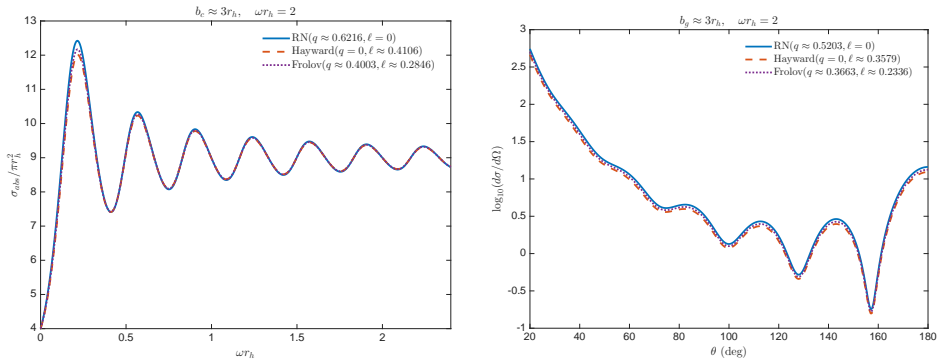
The central claims are two. First, for the Frolov spacetime the geometric-optics absorption and its oscillatory fine structure are controlled by photon-sphere data: σ_geo = π b_c², Ω_c = 1/b_c, and the Lyapunov exponent Λ_c enter a sinc-type formula whose rescaled form σ_abs/σ_geo versus ω/Ω_c collapses the high-frequency oscillations across the Frolov parameter space. Second, along iso-impact-parameter lines in the horizon-admitting (ℓ², q²) plane, Reissner–Nordström, Hayward, and intermediate Frolov configurations with matched b_c (for absorption) or b_g (for glory scattering) yield cross sections that nearly coincide, including in the intermediate frequency/angle regime where overlap is n
What carries the argument
The unstable photon orbit of the Frolov spacetime and its derived quantities—the critical radius r_c, the critical impact parameter b_c = r_c/√f(r_c), the photon-sphere angular frequency Ω_c = 1/b_c, and the Lyapunov exponent Λ_c (the damping rate of the orbit)—form the machinery. These enter the geometric capture cross section σ_geo = π b_c² and the high-frequency absorption formula σ_hf ≈ σ_geo[1 − (8πΛ_c/Ω_c) e^{−πΛ_c/Ω_c} sinc(2π b_c ω)], which supplies the benchmark curve for interpreting the numerics. The paper also uses iso-impact-parameter comparisons in the (ℓ², q²) parameter space, where fixing r_h = 1 makes the dimensionless mass m(q,ℓ) vary, to test whether wave observables track
Load-bearing premise
The conclusions rest on treating the standard high-frequency sinc formula, built from photon-sphere data, as a valid benchmark for the Frolov geometry at all displayed frequencies; the paper does not re-derive this approximation for the Frolov radial equation, so a core-induced reflection not captured by the formula would weaken the claim.
What would settle it
Compute the absorption cross section for a near-extremal Frolov configuration where the core curvature scale is comparable to the photon-sphere radius, at frequencies around the effective-potential barrier peak, with partial waves pushed to numerical convergence; if σ_abs/σ_geo plotted against ωb_c does not fall onto the same sinc envelope as Reissner–Nordström and Hayward black holes with matched b_c, the photon-sphere-control claim is refuted. A direct detection of reflected waves from the regular core in the time-domain wave scattering would also break the one-way eikonal picture.
If this is right
- If the photon-sphere control claim is right, massless-scalar absorption and scattering are weak probes of the regular core; distinguishing Frolov from Reissner–Nordström or Hayward geometries with these observables would require precision beyond the dominant oscillation pattern.
- Any regular black hole with the same photon-sphere parameters would be expected to produce the same high-frequency absorption fine structure, making the rescaled spectrum a model-independent benchmark.
- The r_h = 1 normalization means apparent trends of cross sections with charge and Hubble-length parameters partly reflect the variation of the normalized mass, so cross-normalization comparisons (r_h = 1 vs M = 1) must account for this to avoid misreading core effects.
- The matched-impact-parameter degeneracy extends from absorption to glory scattering, so both observables are governed by the same null-orbit data in the intermediate-to-high frequency regime.
Where Pith is reading between the lines
- The residual differences between the rescaled curves at intermediate frequencies, though subleading, may still encode the core length scale α; a systematic fit of σ_abs − σ_hf in ω could expose the de Sitter core's signature even when the dominant pattern does not.
- If the same reasoning carries to higher-spin fields, their spin-curvature coupling near the photon sphere is likely to break the impact-parameter degeneracy, making spin a sharper probe of the regular interior than the scalar field.
- The data collapse suggests a testable prediction for rotating regular black holes: the same photon-orbit rescaling applied separately to prograde and retrograde photon orbits should reproduce the collapse, with the core length scale entering only as subleading corrections.
- Because no convergence test is shown for the l-truncations used (l=10 for absorption, l=50 for scattering), verifying that the reported collapse survives higher truncation at intermediate frequencies would strengthen the empirical case for photon-sphere control.
Editorial analysis
A structured set of objections, weighed in public.
Referee Report
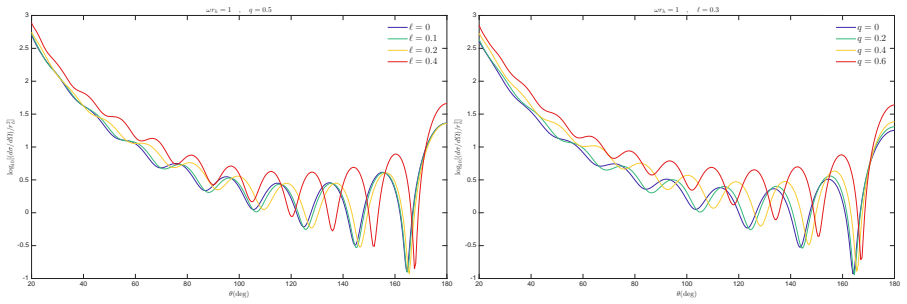
Summary. The paper studies massless scalar absorption and scattering by static, spherically symmetric Frolov black holes. It derives null-geodesic photon-sphere data (critical impact parameter, orbital frequency, Lyapunov exponent), weak-deflection and glory approximations, the partial-wave radial equation and effective potential, and the standard low- and high-frequency limits. Numerical integration of the radial equation yields total and partial absorption cross sections and differential scattering cross sections over a broad frequency range for representative parameter pairs (q,l) in the rh=1 normalization. The paper's central claims are: (i) after rescaling by the geometric capture cross section and the photon-sphere angular frequency, the high-frequency absorption oscillations collapse across parameter space (Fig. 7); and (ii) Reissner-Nordström, Hayward, and Frolov black holes with matched critical or glory impact parameters produce nearly identical absorption and scattering spectra (Fig. 11), so that photon-sphere data control the dominant signatures while core effects are subleading.
Significance. If substantiated quantitatively, the paper would provide a useful demonstration of universality in wave scattering by regular black holes. The analysis is parameter-free in the sense that no amplitudes are fitted: photon-sphere data are derived from the metric, and the numerical spectra are compared with independent analytic limits (low-frequency area law, high-frequency sinc formula, glory approximation). The careful discussion of the rh=1 versus M=1 normalizations and the resulting reinterpretation of parameter trends is a genuine strength. However, the central claims currently rest on visual comparisons of rescaled and matched curves; the manuscript does not report convergence tests, error estimates, or quantitative residuals. The paper also does not provide code or data. These gaps are fixable and do not undermine the evident competence of the analytic and numerical work.
major comments (4)
- [§IV.B, Fig. 7; §V] The 'data collapse' is only assessed visually. The variables σ_abs/σ_geo and x=ω/Ω_c are precisely the variables in which the imported sinc formula, Eq. (22), predicts a parameter-independent oscillation up to the slowly varying prefactor 8πΛ_c/Ω_c exp(-πΛ_c/Ω_c). Thus the collapse is, to a large extent, a restatement of Eq. (22) rather than an independent test of photon-sphere control. Please quantify: (i) the maximum/mean relative deviation among the rescaled curves over the displayed x range; (ii) the variation of the Eq. (22) prefactor across the parameter sets; (iii) the size of the residual relative to the numerical truncation error. Without such residuals, the claim that the high-frequency fine structure is 'largely governed by the unstable photon orbit' is not established at the quantitative level claimed.
- [§IV.A and §IV.D] The truncations l=10 for absorption and l=50 for scattering are asserted without convergence tests. This is load-bearing for Fig. 11: if the partial-wave sums are not fully converged at the displayed frequencies, the apparent overlap of matched spectra in the intermediate regime could be partly a truncation artifact. Please provide, for representative frequencies (e.g. ωrh=2, 4, 6), a convergence study in l_max for σ_abs and dσ/dΩ, including the YRW resummation at small angles, and state the estimated truncation error. This should be compared with the size of the claimed collapse residuals and matched-spectra differences.
- [§IV.D, Fig. 11] Matching b_c fixes σ_geo and the oscillation period, while matching b_g fixes the glory fringe spacing; hence the high-frequency agreement between the three geometries is substantially built into the matching procedure. The statement that the overlap in the intermediate regime is 'nontrivial' needs a quantitative definition. Please compute, for example, the L2 or maximum relative difference between the matched curves over ωrh∈[0,2] and over the displayed angular range, and compare these differences with those for unmatched parameter pairs (e.g. the curves in Figs. 6 and 10). Also show at least one additional matched pair at a different b_c or b_g value to demonstrate that the observed similarity is not a single tuned case.
- [Eqs. (22) and (39)] The high-frequency sinc formula is imported from Refs. [16,17] without derivation or a statement of the exact conditions under which it applies to the Frolov geometry, which has a de Sitter-like regular core. Since this formula is used as the benchmark for interpreting the numerical spectra and for motivating the collapse variables, the paper should either derive it in the Frolov setting via the complex-angular-momentum method, or explicitly cite the universality theorem and verify numerically that it reproduces the Frolov oscillations within residuals much smaller than the claimed subleading core effects. This is especially relevant at intermediate frequencies, where reflection from the regular core is not excluded a priori.
minor comments (5)
- [Fig. 10] The text and figure caption state ωrh=3, but the plot labels in the displayed figure appear to read 'ωrh = 1'. Please correct the inconsistency.
- [Fig. 4] The color-bar labels in the parameter-space plot are garbled (they appear as '5−1 0 1 62' etc.). The axis and color-bar labels should be cleaned up.
- [Eq. (44) and Fig. 5] The dependence of the dimensionless mass m(q,l) is central to the normalization discussion; a sentence explicitly stating that Fig. 5 uses Eq. (44) with the allowed domain from Eq. (43) would improve readability.
- [References] Ref. [44] is cited as an arXiv preprint; if the journal version has appeared, it should be updated. Also, some self-citations to very recent arXiv preprints (e.g. Refs. [49], [53]) may not yet be necessary for the core argument.
- [General notation] The notation x=ω/Ω_c is introduced in Fig. 7 and later used in the conclusion; please define it explicitly in the main text before first use, since the symbol x is otherwise used for the inverse-radius variable u=1/r in Sec. II.
Circularity Check
No significant circularity: the derivation is self-contained, with photon-sphere data computed from the metric and the high-frequency benchmark imported from independent literature.
full rationale
The paper's central chain—null geodesics determine bc, bg, σgeo, Ωc, Λc; partial-wave numerics produce σabs and dσ/dΩ; rescaling by photon-sphere scales is then compared with the external sinc/glory benchmarks—does not reduce to its inputs by construction. No parameter is fitted to the cross sections; the photon-sphere quantities are derived from the Frolov metric, and Eq. (22) is taken from the independent Regge-pole literature (Ref. [16]) rather than from the authors' own prior work. The data-collapse in Fig. 7 is a visualization in variables whose leading eikonal dependence is indeed removed, but that is a test of whether the remaining oscillation period and amplitude match the universal formula, not a definitional identity. Similarly, the matched-bc/bg comparisons in Fig. 11 fix the leading geometric scale and glory fringe spacing by construction, and the paper itself acknowledges that asymptotic agreement is expected; the residual overlap in the intermediate regime is an empirical finding, not a circular derivation. The absence of quantitative residuals and convergence tests is an evidentiary limitation, not a circularity. Self-citations appear only as contextual references and are not load-bearing for the main conclusions.
Axiom & Free-Parameter Ledger
axioms (5)
- domain assumption Frolov metric (Eq. 2) is a valid static, spherically symmetric regular black hole with an event horizon; the parameter constraint Eq. (43) delimits horizon-bearing configurations.
- standard math A minimally coupled massless scalar field obeys the Klein-Gordon equation, and its partial-wave decomposition with purely ingoing boundary conditions at the horizon yields the absorption and scattering cross sections.
- domain assumption The high-frequency absorption cross section is given by the sinc/Regge-pole formula Eq. (22)/(39) with photon-sphere frequency Ωc and Lyapunov exponent Λc, taken from Ref. [16] and assumed applicable to Frolov.
- standard math The classical cross sections σgeo=πbc², the weak-deflection expansion Eq. (25)/(28), and the glory approximation Eq. (29) apply to Frolov BHs.
- domain assumption The YRW resummation and l-cutoffs (l=10, 50) produce converged partial-wave series over the displayed frequency/angle ranges.
Cite this review
Pith. "Pith review of Absorption and scattering of massless scalar waves by Frolov black holes." pith.science (2026). https://pith.science/paper/BNLKRYDK
@misc{pith2026260119364,
  author       = {Pith},
  title        = {Pith review of: Absorption and scattering of massless scalar waves by Frolov black holes},
  year         = {2026},
  howpublished = {\url{https://pith.science/paper/BNLKRYDK}},
  note         = {Machine review of arXiv:2601.19364}
}
abstract
We study the absorption and scattering of massless scalar waves by Frolov black holes, a regular deformation of the Reissner--Nordstr\"om geometry. A null-geodesic analysis provides the photon-sphere radius and the critical impact parameters governing capture and glory scattering. Using a partial-wave approach, we compute total/partial absorption cross sections and differential scattering cross sections over a broad frequency range. When the absorption spectrum is rescaled by photon-sphere scales, the high-frequency oscillations exhibit a pronounced data collapse in the variables $\hat{\sigma}=\sigma_{\rm abs}/\sigma_{\rm geo}$ and $x=\omega/\Omega_c$, highlighting photon-sphere control of the absorption fine structure. We clarify the parameter dependence under the horizon-radius normalization and relate the apparent trends to the variation of the dimensionless mass across parameter space. Finally, comparing Frolov, Reissner--Nordstr\"om, and Hayward black holes with matched critical or glory impact parameters, we find that their absorption and scattering patterns can become remarkably close, indicating that in the intermediate-to-high frequency regime the dominant signatures are largely governed by the unstable photon orbit, while core effects enter as subleading corrections.
Figures


Forward citations
Cited by 1 Pith paper
-
Massive scalar field perturbations in noncommutative-geometry-inspired Schwarzschild black hole
Noncommutative parameter θ and scalar mass μ exert opposing influences on quasinormal modes and greybody factors in this modified black hole, with stability confirmed and extreme cases approaching classical Schwarzsch...
Reference graph
Works this paper leans on
-
[1]
Gravitational waves: Volume 1: Theory and experiments , volume 1
Michele Maggiore. Gravitational waves: Volume 1: Theory and experiments , volume 1. Oxford univer- sity press, 2008
2008
-
[2]
Gravitational Waves: Astrophysics and Cosmology , volume 2
Michele Maggiore. Gravitational Waves: Astrophysics and Cosmology , volume 2. Oxford University Press, 2008
2008
-
[3]
Gravitational-wave physics and astronomy: An intro- duction to theory, experiment and data analysis
Jolien DE Creighton and Warren G Anderson. Gravitational-wave physics and astronomy: An intro- duction to theory, experiment and data analysis . John Wiley & Sons, 2012
2012
-
[4]
Physics, astrophysics and cosmology with gravitational waves
Bangalore Suryanarayana Sathyaprakash and Bernard F Schutz. Physics, astrophysics and cosmology with gravitational waves. Living reviews in relativity , 12(1):2, 2009
2009
-
[5]
Listening to the universe with gravitational-wave astronomy
Scott A Hughes. Listening to the universe with gravitational-wave astronomy. Annals of Physics , 303(1):142–178, 2003. 22
2003
-
[6]
Observation of gravitational waves from a binary black hole merger
Benjamin P Abbott, Richard Abbott, Thomas D Abbott, Matthew R Abernathy, Fausto Acernese, Kendall Ackley, Carl Adams, Thomas Adams, Paolo Addesso, Rana X Adhikari, et al. Observation of gravitational waves from a binary black hole merger. Physical review letters , 116(6):061102, 2016
2016
-
[7]
Scattering by black holes
Nils Anderson and Bruce Jensen. Scattering by black holes. In Scattering, pages 1607–1626. Elsevier, 2002
2002
-
[8]
Scattering theory of waves and particles
Roger G Newton. Scattering theory of waves and particles . Springer Science & Business Media, 2013
2013
-
[9]
Spherical gravitational waves and quasi-spherical waves scattered from black string in massive gravity
Hongsheng Zhang and Yang Huang. Spherical gravitational waves and quasi-spherical waves scattered from black string in massive gravity. Journal of High Energy Physics , 2021(12):1–11, 2021
2021
-
[10]
Universality of low energy absorption cross sections for black holes
Sumit R Das, Gary Gibbons, and Samir D Mathur. Universality of low energy absorption cross sections for black holes. Physical Review Letters , 78(3):417, 1997
1997
-
[11]
First m87 event horizon telescope results
Event Horizon Telescope Collaboration. First m87 event horizon telescope results. i. the shadow of the supermassive black hole. Astrophysical Journal Letters , 875(1):L1, 2019
2019
-
[12]
First sagittarius a* event horizon telescope results
Event Horizon Telescope Collaboration. First sagittarius a* event horizon telescope results. i. the shadow of the supermassive black hole in the center of the milky way. Astrophysical Journal Letters , 930(2):L12, 2022
2022
-
[13]
Poisson-arago spot for gravitational waves
HongSheng Zhang and XiLong Fan. Poisson-arago spot for gravitational waves. Science China Physics, Mechanics & Astronomy , 64(12):120462, 2021
2021
-
[14]
Low-frequency scalar absorption cross sections forstationary black holes
Atsushi Higuchi. Low-frequency scalar absorption cross sections forstationary black holes. Classical and Quantum Gravity , 18(20):L139, 2001
2001
-
[15]
Addendum to low-frequency scalar absorption cross sections for stationary black holes
Atsushi Higuchi. Addendum to low-frequency scalar absorption cross sections for stationary black holes. Classical and Quantum Gravity , 19(3):599, 2002
2002
-
[16]
Universality of high-energy absorption cross sections for black holes
Yves Décanini, Gilles Esposito-Farese, and Antoine Folacci. Universality of high-energy absorption cross sections for black holes. Physical Review DParticles, Fields, Gravitation, and Cosmology , 83(4):044032, 2011
2011
-
[17]
Absorption and emission spectra of a schwarzschild black hole
Norma Sanchez. Absorption and emission spectra of a schwarzschild black hole. Physical Review D , 18(4):1030, 1978
1978
-
[18]
Elastic scattering of waves by a black hole
Norma Sánchez. Elastic scattering of waves by a black hole. Physical Review D , 18(6):1798, 1978
1978
-
[19]
Futterman, F A Handler, and R A Matzner
J A.H. Futterman, F A Handler, and R A Matzner. Scattering from black holes . Cambridge University Press,New York, NY, 12 1986
1986
-
[20]
Scattering of massless scalar waves by reissner- nordström black holes
Luís CB Crispino, Sam R Dolan, and Ednilton S Oliveira. Scattering of massless scalar waves by reissner- nordström black holes. Physical Review DParticles, Fields, Gravitation, and Cosmology , 79(6):064022, 2009
2009
-
[21]
Scattering of massless scalar field by charged dilatonic black holes
Yang Huang and Hongsheng Zhang. Scattering of massless scalar field by charged dilatonic black holes. The European Physical Journal C , 80(7):654, 2020
2020
-
[22]
Stefano Ansoldi. Spherical black holes with regular center: a review of existing models including a recent realization with gaussian sources. arXiv preprint arXiv:0802.0330 , 2008
Pith/arXiv arXiv 2008
-
[23]
Regular black holes: a short topic review
Chen Lan, Hao Yang, Yang Guo, and Yan-Gang Miao. Regular black holes: a short topic review. 23 International Journal of Theoretical Physics , 62(9):202, 2023
2023
-
[24]
Regular black holes and black universes
KA Bronnikov, H Dehnen, and VN Melnikov. Regular black holes and black universes. General Relativity and Gravitation , 39(7):973–987, 2007
2007
-
[25]
Regular black holes
Cosimo Bambi. Regular black holes . Springer, 2023
2023
-
[26]
Regular black hole in general relativity coupled to nonlinear electrodynamics
Eloy Ayon-Beato and Alberto Garcia. Regular black hole in general relativity coupled to nonlinear electrodynamics. Physical review letters , 80(23):5056, 1998
1998
-
[27]
The bardeen model as a nonlinear magnetic monopole
Eloy Ayon-Beato and Alberto Garcıa. The bardeen model as a nonlinear magnetic monopole. Physics Letters B , 493(1-2):149–152, 2000
2000
-
[28]
Regular black holes with a nonlinear electrodynamics source
Leonardo Balart and Elias C Vagenas. Regular black holes with a nonlinear electrodynamics source. Physical Review D , 90(12):124045, 2014
2014
-
[29]
Non-singular general relativistic gravitational collapse
James Bardeen. Non-singular general relativistic gravitational collapse. In Proceedings of the 5th International Conference on Gravitation and the Theory of Relativity , page 87, 1968
1968
-
[30]
Formation and evaporation of nonsingular black holes
Sean A Hayward. Formation and evaporation of nonsingular black holes. Physical review letters , 96(3):031103, 2006
2006
-
[31]
Absorption of planar massless scalar waves by bardeen regular black holes
Caio FB Macedo and Luís CB Crispino. Absorption of planar massless scalar waves by bardeen regular black holes. Physical Review D , 90(6):064001, 2014
2014
-
[32]
Scattering by regular black holes: planar massless scalar waves impinging upon a bardeen black hole
Caio FB Macedo, Ednilton S de Oliveira, and Luís CB Crispino. Scattering by regular black holes: planar massless scalar waves impinging upon a bardeen black hole. Physical Review D , 92(2):024012, 2015
2015
-
[33]
Notes on nonsingular models of black holes
Valeri P Frolov. Notes on nonsingular models of black holes. Physical Review D , 94(10):104056, 2016
2016
-
[34]
Regular black holes and the first law of black hole mechanics
Sebastian Murk and Ioannis Soranidis. Regular black holes and the first law of black hole mechanics. Physical Review D , 108(4):044002, 2023
2023
-
[35]
Quasinormal modes and ringdown waveforms of a frolov black hole
Zhijun Song, Huajie Gong, Hai-Li Li, Guoyang Fu, Li-Gang Zhu, and Jian-Pin Wu. Quasinormal modes and ringdown waveforms of a frolov black hole. Communications in Theoretical Physics , 76(10):105401, 2024
2024
-
[36]
Null geodesics, thermodynamics, weak gravitational lensing, and black hole shadow characteristics of a frolov regular black hole with constraints from eht observations
Shubham Kala, Hemwati Nandan, Kush Maithani, Saswati Roy, and Amare Abebe. Null geodesics, thermodynamics, weak gravitational lensing, and black hole shadow characteristics of a frolov regular black hole with constraints from eht observations. The European Physical Journal Plus , 140:991, 2025
2025
-
[37]
The mathematical theory of black holes , volume 69
Subrahmanyan Chandrasekhar. The mathematical theory of black holes , volume 69. Oxford university press, 1998
1998
-
[38]
Absorption cross section of regular black holes in scalar-tensor conformal gravity
Yang Li and Yan-Gang Miao. Absorption cross section of regular black holes in scalar-tensor conformal gravity. Physical Review D , 105(4):044031, 2022
2022
-
[39]
Dynamics of photons and shadows for black holes haired with parity-odd fields
Yang Huang, Dao-Jun Liu, and Hongsheng Zhang. Dynamics of photons and shadows for black holes haired with parity-odd fields. Journal of High Energy Physics , 2025(11):1–18, 2025
2025
-
[40]
Dynamics of null particles and shadow for general rotating black hole
Kun Meng, Xi-Long Fan, Song Li, Wen-Biao Han, and Hongsheng Zhang. Dynamics of null particles and shadow for general rotating black hole. Journal of High Energy Physics , 2023(11):1–28, 2023
2023
-
[41]
Lensing and light rings of parity-odd rotating boson 24 stars
Yang Huang, Dao-Jun Liu, and Hongsheng Zhang. Lensing and light rings of parity-odd rotating boson 24 stars. Science China Physics, Mechanics & Astronomy , 68(8):280411, 2025
2025
-
[42]
Robert M. Wald. General Relativity. University of Chicago Press, Chicago, 1984
1984
-
[43]
Geodesic stability, lyapunov exponents, and quasinormal modes
Vitor Cardoso, Alex S Miranda, Emanuele Berti, Helvi Witek, and Vilson T Zanchin. Geodesic stability, lyapunov exponents, and quasinormal modes. Physical Review DParticles, Fields, Gravitation, and Cosmology, 79(6):064016, 2009
2009
-
[44]
Geodesic analysis, absorption and scattering in the static hayward spacetime
Marco AA de Paula, Luiz Leite, and Luís CB Crispino. Geodesic analysis, absorption and scattering in the static hayward spacetime. arXiv preprint arXiv:2311.15771 , 2023
Pith/arXiv arXiv 2023
-
[45]
Glory scattering by black holes
Richard A Matzner, Cécile DeWitte-Morette, Bruce Nelson, and Tian-Rong Zhang. Glory scattering by black holes. Physical Review D , 31(8):1869, 1985
1985
-
[46]
Scattering properties of charged black holes in nonlinear and maxwells electrodynamics
Marco AA de Paula, Luiz Leite, and Luís CB Crispino. Scattering properties of charged black holes in nonlinear and maxwells electrodynamics. The European Physical Journal Plus , 137(7):1–13, 2022
2022
-
[47]
Phase-shift calculation of high-energy electron scat- tering
DR Yennie, D_ G_ Ravenhall, and RN Wilson. Phase-shift calculation of high-energy electron scat- tering. Physical Review, 95(2):500, 1954
1954
-
[48]
Fermion scattering by a schwarzschild black hole
Sam Dolan, Chris Doran, and Anthony Lasenby. Fermion scattering by a schwarzschild black hole. Physical Review DParticles, Fields, Gravitation, and Cosmology , 74(6):064005, 2006
2006
-
[49]
Rigorous calculation of scalar scattering in the schwarzschild background: The convergence of the partial-wave series and the poisson spot
Zhao Li and Wen Zhao. Rigorous calculation of scalar scattering in the schwarzschild background: The convergence of the partial-wave series and the poisson spot. Physical Review D , 112(8):083030, 2025
2025
-
[50]
Electrically charged black holes in linear and nonlinear electrodynamics: Geodesic analysis and scalar absorption
Marco AA Paula, Luiz CS Leite, and Luis CB Crispino. Electrically charged black holes in linear and nonlinear electrodynamics: Geodesic analysis and scalar absorption. Physical Review D, 102(10):104033, 2020
2020
-
[51]
Absorption and scattering of charged scalar waves by charged horndeski black hole
Qian Li, Qianchuan Wang, and Junji Jia. Absorption and scattering of charged scalar waves by charged horndeski black hole. Physical Review D , 111(2):024059, 2025
2025
-
[52]
Scattering of charged massive scalar waves by kerr-newman black holes
Qian Li, Qianchuan Wang, and Junji Jia. Scattering of charged massive scalar waves by kerr-newman black holes. arXiv preprint arXiv:2511.21318 , 2025
arXiv 2025
-
[53]
Gravitational lensing of gravitational waves: Spin-wave optics through black hole scattering
Zhao Li, Shaoqi Hou, and Wen Zhao. Gravitational lensing of gravitational waves: Spin-wave optics through black hole scattering. arXiv preprint arXiv:2512.23933 , 2025. 25
arXiv 2025
This paper was first reviewed by deepseek-v4-flash on August 3, 2026.
discussion (0)
Sign in with ORCID, Apple, or X to comment. Anyone can read and Pith papers without signing in.