REVIEW 3 major objections 5 minor 226 references
A dual-pressure phase-field model stably captures viscosity-dominated hydraulic fractures and fluid lag for the first time.
Reviewed by Pith at T0; open to challenge. T0 means a machine referee read the full paper against a public rubric. the ladder, T0–T4 →
T0 review · grok-4.5
2026-07-12 00:01 UTC pith:BO5BS6OT
load-bearing objection Solid dual-pressure phase-field HF that finally hits verified M- and O-vertex KGD solutions; the hard vcr cutoff is a real soft spot but does not erase the advance. the 3 major comments →
A dual--continuum phase-field model for hydraulic fracturing: Viscosity-dominated regime and fluid lag
The pith
A machine-rendered reading of the paper's core claim, the machinery that carries it, and where it could break.
Core claim
A dual-continuum phase-field formulation that evolves mesoscale crack pressure and micropore pressure independently, with phase-field-dependent poroelastic coefficients taken from microporomechanics, a fixed-stress split adapted to the two-pressure system, and a variational inequality that enforces non-negative pressures, is the first phase-field model to stably recover analytical KGD solutions in the viscosity-dominated (M-vertex) and early-time fluid-lag (O-vertex) regimes as well as the toughness-dominated regime.
What carries the argument
The dual-continuum pressure pair (pc, pp) together with the dynamic indicator χ(v) that confines fracture flow to the damaged zone and the variational inequality that forces both pressures to remain non-negative; these three ingredients together remove artificial pressure continuity and allow a lag zone to form without explicit front tracking.
Load-bearing premise
Fracture flow is switched on only when the phase-field drops below a free numerical threshold, and outside that zone the two pressures are forced equal; the paper does not prove that mass balance is independent of that threshold or of mesh size.
What would settle it
A mesh-refinement and threshold-sensitivity study of the lag-zone length in the early-time KGD problem that either shows the computed fluid-front location converging to the analytical ξ f values of Garagash or demonstrates a persistent, threshold-dependent under-estimate of the lag.
Editorial analysis
A structured set of objections, weighed in public.
Referee Report
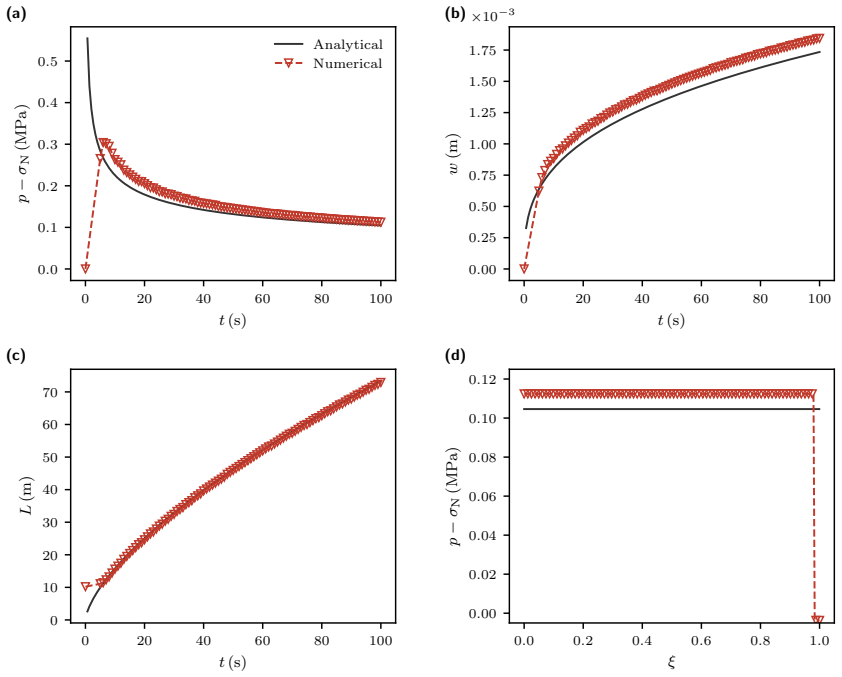
Summary. The paper develops a dual-continuum phase-field model for hydraulic fracturing in double-porosity media, with independent mesoscale crack pressure pc and micropore pressure pp derived from microporomechanics (effective stiffness, Biot tensors, and Biot moduli degraded by the phase field). A modified fixed-stress split handles the two-pressure hydromechanical system; a phase-field indicator χ(v) gates fracture (Reynolds) flow to a damaged subdomain; and a variational inequality enforces non-negative pressures to capture fluid lag without front tracking. Plane-strain KGD verifications are reported against Garagash–Detournay asymptotics in the toughness-dominated (K), viscosity-dominated (M, Km≈0.59), and early-time lag (O) regimes, with spatial aperture and pressure profiles compared for several Km values.
Significance. If the formulation is robust, this is a genuine advance: existing phase-field hydraulic-fracture models have largely been limited to toughness-dominated or near-M regimes and cannot represent a sharp pressure drop or fluid lag under a smeared continuous pressure. The microporomechanical derivation of phase-field-dependent poroelastic coefficients, the two-pressure fixed-stress scheme, and the variational-inequality lag treatment are concrete technical contributions. Direct, external comparison to closed-form KGD solutions (injection pressure, aperture, length, and spatial profiles) is the right standard of evidence and is largely met for K and M. The work would open phase-field modeling to the viscosity-dominated conditions that dominate field injections.
major comments (3)
- §3.2, Eqs. (65)–(67): Fracture flow is gated by a hard threshold χ(v)=1 only for v≤vcr, with pc forced equal to pp outside that zone. The value of vcr used in any verification (especially the four lag cases of §4.5) is never stated, and no mesh- or threshold-sensitivity study is given for the fluid-front location ξf or lag length. Because the M- and O-vertex claims rest on resolving a sharp fluid front, and the authors themselves attribute lag underestimation partly to non-strict mass conservation across the pressurized/lag interface created by this construction, independence of the reported fronts from vcr and h must be demonstrated (or vcr fixed by a clear physical/numerical criterion and shown to be non-influential).
- §4.5, Figs. 8b,d,f,h: The model systematically underestimates lag size (simulated ξf more advanced than the Garagash family). The abstract and conclusions state that the model “accurately captures … transient fluid lag.” That wording overstates the evidence; either the claim should be qualified to match the documented bias, or the mass-conservation / cavitation treatment should be tightened so that lag length converges to the asymptotics before the accuracy claim is retained.
- Table 1 and §4.2–4.5: All KGD verifications set αm=0, ϕm=0, Kp=10^{-19} m² so leak-off and inter-scale exchange vanish. The dual-continuum machinery is then used mainly to allow pc≠pp and to gate fracture flow. That is legitimate for impermeable KGD benchmarks, but the paper’s framing as a double-porosity model for realistic viscosity-dominated fracturing is not yet supported by any case with nonzero matrix storage/exchange. At least one permeable double-porosity demonstration (or an explicit statement that verification is impermeable-only and double-porosity exchange remains untested) is needed so the central claim is not read as broader than the evidence.
minor comments (5)
- Introduction: “viscousity-dominated” is a typo (should be “viscosity-dominated”).
- §2.2, Eq. (26): The argument list of Eℓ is written “Eℓ(ε, , ζc, ζp, v)” with a missing field; clean the notation.
- §3.1: Unconditional stability of fixed-stress is cited for single-porosity isotropic cases (Kim et al.); a short remark that the two-pressure anisotropic extension (53)–(56) is used without a new stability proof would set expectations correctly.
- Fig. 7 caption: “(c) and (d)” are labeled inconsistently with the body text (“phase-field (b) and pressure (c)”); align labels.
- Throughout: report the numerical value of vcr, the shape factor S (if used), and whether gravity is active in the KGD runs so results are reproducible.
Circularity Check
No circular derivation: dual-continuum state equations come from external microporomechanics literature and are verified against independent Garagash/Detournay KGD asymptotics, not against fitted or self-defined targets.
full rationale
The paper’s load-bearing claims are (i) a variational dual-continuum phase-field formulation with independent pc and pp whose effective tensors and Biot moduli are obtained from two-scale microporomechanics, and (ii) numerical reproduction of closed-form KGD solutions in the K-, M-, and O-vertex regimes. The state equations (1), (15)–(19) and free-energy construction (Appendix A) are taken from Pichler & Dormieux (2010) and Dormieux et al. (2006b) and specialized to a phase-field-degraded Ceff; they are not reverse-engineered from the target fracture curves. The fixed-stress split is an extension of Kim et al. (2011); the variational inequality for non-negative pressure is a standard KKT treatment. Verification (§4) compares injection pressure, aperture, length, and profiles to the external analytical solutions of Garagash & Detournay (2005) and Garagash (2006a,b) with parameters chosen only to place Km in the desired regime (Table 1–2); no coefficients are fitted to those asymptotics and then re-presented as predictions. Self-citations (You & Yoshioka 2023, 2025) supply prior single-continuum aperture and degradation machinery but are not used as uniqueness theorems or as the sole justification of the dual-pressure lag results. The free threshold vcr and lag underestimation noted by the skeptic are numerical-robustness issues, not circular reductions of a claimed first-principles result to its own inputs. Therefore the derivation chain is self-contained against external benchmarks and exhibits no circularity of the enumerated kinds.
Axiom & Free-Parameter Ledger
free parameters (5)
- phase-field length scale ℓ =
1.0 m
- fracture-domain threshold vcr
- characteristic element size h in cubic-law permeability =
0.5 m
- mass-transfer shape factor S and matrix permeability Km in inter-scale exchange
- degradation residual κ =
1e-8
axioms (7)
- domain assumption Francfort–Marigo variational brittle fracture regularized by Bourdin phase-field energy with no-tension (Freddi–Royer-Carfagni) strain split.
- domain assumption Two-scale microporomechanics state equations of Pichler & Dormieux (2010) / Dormieux et al. (2006) for double-porosity media with independent pc, pp.
- domain assumption Darcy flow at both meso and micro scales; fracture permeability from cubic (Reynolds) law with aperture w=ε1 h.
- ad hoc to paper Fixed-stress split remains convergent for the two-pressure anisotropic-Biot system under the two stress equalities (53)–(56).
- ad hoc to paper Mesocrack volume fraction φc is negligible and micropore porosity is invariant under damage (∂φp/∂v=0).
- domain assumption Fluid cannot sustain tension: pc≥0, pp≥0 enforced by variational inequality (KKT complementarity).
- ad hoc to paper Verification media are impermeable and non-porous (Kp=10^{-19} m^2, αm=0, ϕm=0) so leak-off and double-porosity exchange vanish.
invented entities (3)
-
Dual-continuum phase-field continuum with independent mesocrack pressure pc and micropore pressure pp degraded by v
no independent evidence
-
Phase-field indicator χ(v) gating the fracture-flow residual
no independent evidence
-
Two-pressure fixed-stress stabilization operators (Eqs. 59–64)
no independent evidence
read the original abstract
The phase-field model regularizes sharp fractures into a diffuse representation, blurring the boundary between the fracture and the intact material. This blurring makes it difficult to capture distinct domain processes in hydraulic fracturing, where Reynolds flow governs the fracture and Darcy flow describes the surrounding porous matrix. Consequently, the blurred delineation artificially smears the pressure field across the fracture--matrix interface, which is acceptable in toughness-dominated hydraulic fracturing regimes where pressure drops within the fracture are negligible. However, in viscosity-dominated regimes, typically for actual subsurface injections due to high injection rates, the fluid pressure drops more drastically, and the fluid front may even lag behind the propagating fracture tip, a phenomenon that a smeared pressure field cannot capture. Despite its relevance, the viscosity-dominated regime has not been addressed by any existing phase-field models to date, likely due to its numerical instability. In this study, we propose a dual--continuum phase-field model based on double-porosity microporomechanics that explicitly separates mesoscale crack pressure from micropore pressure. The framework provides a variationally consistent formulation alongside phase-field--dependent poroelasticity. To ensure the numerical stability of the hydromechanical coupling, a fixed-stress split scheme is modified for two independent fluid pressures, while a variational inequality constraint is applied to reproduce fluid lag. Verified against the closed-form solutions in toughness-dominated, viscosity-dominated, and early-time transitional regimes, the model accurately captures complex fluid flow behavior and transient fluid lag within the fracture, and opens a new frontier for applying phase-field models to realistic viscosity-dominated hydraulic fracturing.
Figures




Reference graph
Works this paper leans on
-
[1]
Comptes rendus
A micromechanical analysis of damage propagation in fluid-saturated cracked media , author=. Comptes rendus. M
-
[2]
Nature materials , volume=
Solvent control of crack dynamics in a reversible hydrogel , author=. Nature materials , volume=. 2006 , publisher=
2006
-
[3]
Journal of Applied Mechanics , volume=
Effect of solvent diffusion on crack-tip fields and driving force for fracture of hydrogels , author=. Journal of Applied Mechanics , volume=. 2015 , publisher=
2015
-
[4]
Biophysical Journal , volume=
Cavitation induced fracture of intact brain tissue , author=. Biophysical Journal , volume=. 2022 , publisher=
2022
-
[5]
Journal of Fluid Mechanics , volume=
Three-dimensional buoyant hydraulic fractures: constant release from a point source , author=. Journal of Fluid Mechanics , volume=. 2022 , publisher=
2022
-
[6]
Phase-field modelling of dynamic hydraulic fracturing in porous media using a strain-based crack width formulation , journal =. 2024 , issn =. doi:https://doi.org/10.1016/j.cma.2024.117113 , url =
-
[7]
International Journal of Plasticity , volume=
Microporomechanics of quasi-brittle rocks: Theoretical formulations and analytical simulations , author=. International Journal of Plasticity , volume=. 2023 , publisher=
2023
-
[8]
Journal of Applied Mechanics , volume=
2014 Drucker medal paper: A derivation of the theory of linear poroelasticity from chemoelasticity , author=. Journal of Applied Mechanics , volume=. 2015 , publisher=
2014
-
[9]
International journal for numerical and analytical methods in geomechanics , volume=
Cracking risk of partially saturated porous media—Part I: Microporoelasticity model , author=. International journal for numerical and analytical methods in geomechanics , volume=. 2010 , publisher=
2010
-
[10]
Tao You and Keita Yoshioka , keywords =. On poroelastic strain energy degradation in the variational phase-field models for hydraulic fracture , journal =. 2023 , issn =. doi:https://doi.org/10.1016/j.cma.2023.116305 , url =
-
[11]
Length scale and mesh bias sensitivity of phase-field models for brittle and cohesive fracture , journal =. 2019 , issn =. doi:https://doi.org/10.1016/j.engfracmech.2019.106532 , url =
-
[12]
International Journal for Numerical Methods in Engineering , doi=
Reconstruct lower-dimensional crack paths from phase-field point cloud , author=. International Journal for Numerical Methods in Engineering , doi=. 2023 , pages=
2023
-
[13]
Society of Petroleum Engineers Journal , volume=
Numerical simulation of water-oil flow in naturally fractured reservoirs , author=. Society of Petroleum Engineers Journal , volume=. 1976 , publisher=
1976
-
[14]
Computer Methods in Applied Mechanics and Engineering , volume=
A generalised phase field model for fatigue crack growth in elastic--plastic solids with an efficient monolithic solver , author=. Computer Methods in Applied Mechanics and Engineering , volume=. 2022 , publisher=
2022
-
[15]
Computer Methods in Applied Mechanics and Engineering , volume=
Electromechanical phase-field fracture modelling of piezoresistive CNT-based composites , author=. Computer Methods in Applied Mechanics and Engineering , volume=. 2023 , publisher=
2023
-
[16]
Journal of the Mechanics and Physics of Solids , volume=
Crack nucleation and propagation of electromagneto-thermo-mechanical fracture in bulk superconductors during magnetization , author=. Journal of the Mechanics and Physics of Solids , volume=. 2023 , publisher=
2023
-
[17]
Computer Methods in Applied Mechanics and Engineering , volume=
Phase-field modeling of electromechanical fracture in piezoelectric solids: Analytical results and numerical simulations , author=. Computer Methods in Applied Mechanics and Engineering , volume=. 2021 , publisher=
2021
-
[18]
Bo Yin and Michael Kaliske. A ductile phase-field model based on degrading the fracture toughness: T heory and implementation at small strain. Computer Methods in Applied Mechanics and Engineering. 2020. doi:https://doi.org/10.1016/j.cma.2020.113068
-
[19]
Modeling dynamic fracture of solids with a phase-field regularized cohesive zone model
Vinh Phu Nguyen and Jian-Ying Wu. Modeling dynamic fracture of solids with a phase-field regularized cohesive zone model. Computer Methods in Applied Mechanics and Engineering. 2018. doi:https://doi.org/10.1016/j.cma.2018.06.015
-
[20]
P. Carrara and M. Ambati and R. Alessi and L. De Lorenzis. A framework to model the fatigue behavior of brittle materials based on a variational phase-field approach. Computer Methods in Applied Mechanics and Engineering. 2020. doi:https://doi.org/10.1016/j.cma.2019.112731
-
[21]
Computer Methods in Applied Mechanics and Engineering , volume=
A phase field formulation for hydrogen assisted cracking , author=. Computer Methods in Applied Mechanics and Engineering , volume=. 2018 , publisher=
2018
-
[22]
Computer Methods in Applied Mechanics and Engineering , volume=
Chemo-mechanical phase-field modeling of dissolution-assisted fracture , author=. Computer Methods in Applied Mechanics and Engineering , volume=. 2020 , publisher=
2020
-
[23]
Journal of the Mechanics and Physics of Solids , volume=
A phase field formulation for dissolution-driven stress corrosion cracking , author=. Journal of the Mechanics and Physics of Solids , volume=. 2021 , publisher=
2021
-
[24]
A locally conservative enriched
Lee, Sanghyun and Lee, Young-Ju and Wheeler, Mary F , journal=. A locally conservative enriched. 2016 , publisher=
2016
-
[25]
2020 , publisher=
Wheeler, Mary F and Wick, Thomas and Lee, Sanghyun , journal=. 2020 , publisher=
2020
-
[26]
2013 , publisher=
Mixed finite element methods and applications , author=. 2013 , publisher=
2013
-
[27]
Computer Methods in Applied Mechanics and Engineering , volume=
Variational phase-field fracture modeling with interfaces , author=. Computer Methods in Applied Mechanics and Engineering , volume=. 2021 , publisher=
2021
-
[28]
Computational Mechanics , volume=
Stabilized mixed formulation for phase-field computation of deviatoric fracture in elastic and poroelastic materials , author=. Computational Mechanics , volume=. 2020 , publisher=
2020
-
[29]
International Journal for Numerical Methods in Engineering , volume=
On the optimization of the fixed-stress splitting for Biot's equations , author=. International Journal for Numerical Methods in Engineering , volume=. 2019 , publisher=
2019
-
[30]
Computer Methods in Applied Mechanics and Engineering , volume=
Space--time finite element approximation of the Biot poroelasticity system with iterative coupling , author=. Computer Methods in Applied Mechanics and Engineering , volume=. 2017 , publisher=
2017
-
[31]
Computer Methods in Applied Mechanics and Engineering , volume=
Variational modeling of hydromechanical fracture in saturated porous media: A micromechanics-based phase-field approach , author=. Computer Methods in Applied Mechanics and Engineering , volume=. 2022 , publisher=
2022
-
[32]
International Journal for Numerical and Analytical Methods in Geomechanics , volume=
Simulation of coupled multiphase flow and geomechanics in porous media with embedded discrete fractures , author=. International Journal for Numerical and Analytical Methods in Geomechanics , volume=. 2021 , publisher=
2021
-
[33]
Journal of the Mechanics and Physics of Solids , keywords =
Freddi, Francesco and Royer-Carfagni, Gianni , doi =. Journal of the Mechanics and Physics of Solids , keywords =
-
[34]
International Journal of Fracture , pages=
Nucleation under multi-axial loading in variational phase-field models of brittle fracture , author=. International Journal of Fracture , pages=. 2021 , publisher=
2021
-
[35]
Interfaces and free boundaries , volume=
Numerical implementation of the variational formulation for quasi-static brittle fracture , author=. Interfaces and free boundaries , volume=
-
[36]
Computer Methods in Applied Mechanics and Engineering , volume=
Validation simulations for the variational approach to fracture , author=. Computer Methods in Applied Mechanics and Engineering , volume=. 2015 , publisher=
2015
-
[37]
Communications on Pure and Applied Mathematics , Year =
Optimal approximations by piecewise smooth functions and associated variational problems , Author =. Communications on Pure and Applied Mathematics , Year =
-
[38]
Yoshioka, Keita and Mollaali, Mostafa , publisher =
-
[39]
Journal of Engineering Mechanics , volume=
Plane-strain propagation of a fluid-driven crack in a permeable rock with fracture toughness , author=. Journal of Engineering Mechanics , volume=. 2010 , publisher=
2010
-
[40]
Journal of Fluid Mechanics , volume=
The near-tip region of a fluid-driven fracture propagating in a permeable elastic solid , author=. Journal of Fluid Mechanics , volume=. 2003 , publisher=
2003
-
[41]
Computers and Geotechnics , volume=
Modelling of preferential gas flow in heterogeneous and saturated bentonite based on phase field method , author=. Computers and Geotechnics , volume=. 2019 , publisher=
2019
-
[42]
Journal of Geophysical Research: Solid Earth , volume=
Phase field model of fluid-driven fracture in elastic media: Immersed-fracture formulation and validation with analytical solutions , author=. Journal of Geophysical Research: Solid Earth , volume=. 2017 , publisher=
2017
-
[43]
Computer Methods in Applied Mechanics and Engineering , volume=
Phase-field modeling of fluid-driven dynamic cracking in porous media , author=. Computer Methods in Applied Mechanics and Engineering , volume=. 2019 , publisher=
2019
-
[44]
Engineering Geology , volume=
A phase-field modeling approach of fracture propagation in poroelastic media , author=. Engineering Geology , volume=. 2018 , publisher=
2018
-
[45]
Applied Mathematical Modelling , volume=
Hydraulic fracturing modeling using the enriched numerical manifold method , author=. Applied Mathematical Modelling , volume=. 2018 , publisher=
2018
-
[46]
2000 , publisher=
Theory of linear poroelasticity with applications to geomechanics and hydrogeology , author=. 2000 , publisher=
2000
-
[47]
Christian Miehe and Martina Hofacker and Fabian Welschinger. A phase field model for rate-independent crack propagation: R obust algorithmic implementation based on operator splits. Computer Methods in Applied Mechanics and Engineering. 2010. doi:https://doi.org/10.1016/j.cma.2010.04.011
-
[48]
Computational Mechanics , keywords =
Ambati, Marreddy and Gerasimov, Tymofiy and. Computational Mechanics , keywords =. doi:10.1007/s00466-014-1109-y , isbn =
-
[49]
Engineering Geology , volume=
On the hydraulic fracturing in naturally-layered porous media using the phase field method , author=. Engineering Geology , volume=. 2020 , publisher=
2020
-
[50]
Theoretical and Applied Fracture Mechanics , volume=
Investigation on crack initiation and propagation in hydraulic fracturing of bedded shale by hybrid phase-field modeling , author=. Theoretical and Applied Fracture Mechanics , volume=. 2020 , publisher=
2020
-
[51]
Engineering Fracture Mechanics , volume=
Phase-field modeling of hydro-thermally induced fracture in thermo-poroelastic media , author=. Engineering Fracture Mechanics , volume=. 2021 , publisher=
2021
-
[52]
Computer Methods in Applied Mechanics and Engineering , volume=
Phase-field method of crack branching during SC-CO2 fracturing: A new energy release rate criterion coupling pore pressure gradient , author=. Computer Methods in Applied Mechanics and Engineering , volume=. 2022 , publisher=
2022
-
[53]
Engineering with Computers , pages=
Three-dimensional phase field feature of longitudinal hydraulic fracture propagation in naturally layered rocks under stress boundaries , author=. Engineering with Computers , pages=. 2022 , publisher=
2022
-
[54]
Computer Methods in Applied Mechanics and Engineering , volume=
Phase-field modelling of interface failure in brittle materials , author=. Computer Methods in Applied Mechanics and Engineering , volume=. 2019 , publisher=
2019
-
[55]
o rr and Franz Dammaß and René de Borst and Markus K \
Arne Claus Hansen-D \"o rr and Franz Dammaß and René de Borst and Markus K \"a stner. Phase-field modeling of crack branching and deflection in heterogeneous media. Engineering Fracture Mechanics. 2020. doi:https://doi.org/10.1016/j.engfracmech.2020.107004
-
[56]
Computers and Geotechnics , volume=
Remote hydraulic fracturing at weak interfaces , author=. Computers and Geotechnics , volume=. 2025 , publisher=
2025
-
[57]
Npj Computational Materials , volume=
Phase field modeling with large driving forces , author=. Npj Computational Materials , volume=. 2023 , publisher=
2023
-
[58]
Journal of the Mechanics and Physics of Solids , volume=
Micromechanics-based variational phase-field modeling of fatigue fracture , author=. Journal of the Mechanics and Physics of Solids , volume=. 2025 , publisher=
2025
-
[59]
Acta Materialia , volume=
Quantitative high driving force phase-field model for multi-grain structures , author=. Acta Materialia , volume=. 2023 , publisher=
2023
-
[60]
Phase-Field Simulation of Hydraulic Fracturing by
Feng, Yixuan and Haugen, Kjetil and Firoozabadi, Abbas , journal=. Phase-Field Simulation of Hydraulic Fracturing by. 2021 , publisher=
2021
-
[61]
o rr and Franz Dammaß and René de Borst and Markus K \
Arne Claus Hansen-D \"o rr and Franz Dammaß and René de Borst and Markus K \"a stner. Erratum to “Phase-field modeling of crack branching and deflection in heterogeneous media” [Eng. Fract. Mech. 232 (2020) 107004]. Engineering Fracture Mechanics. 2020. doi:https://doi.org/10.1016/j.engfracmech.2020.107449
-
[62]
Journal of Natural Gas Science and Engineering , volume=
Numerical investigation of multizone hydraulic fracture propagation in porous media: New insights from a phase field method , author=. Journal of Natural Gas Science and Engineering , volume=. 2019 , publisher=
2019
-
[63]
Journal of the Mechanics and Physics of Solids , volume=
Orthogonal decomposition of anisotropic constitutive models for the phase field approach to fracture , author=. Journal of the Mechanics and Physics of Solids , volume=. 2023 , publisher=
2023
-
[64]
Computer Methods in Applied Mechanics and Engineering , volume=
Identifying the crack path for the phase field approach to fracture with non-maximum suppression , author=. Computer Methods in Applied Mechanics and Engineering , volume=. 2016 , publisher=
2016
-
[65]
Proceedings of the 38th Workshop on Geothermal Reservoir Engineering , year=
A variational approach to the modeling and numerical simulation of hydraulic fracturing under in-situ stresses , author=. Proceedings of the 38th Workshop on Geothermal Reservoir Engineering , year=
-
[66]
Computer Methods in Applied Mechanics and Engineering , volume=
Phase field modeling of frictional slip with slip weakening/strengthening under non-isothermal conditions , author=. Computer Methods in Applied Mechanics and Engineering , volume=. 2021 , publisher=
2021
-
[67]
Journal of the Mechanics and Physics of Solids , volume=
On the effective stress in unsaturated porous continua with double porosity , author=. Journal of the Mechanics and Physics of Solids , volume=. 2009 , publisher=
2009
-
[68]
International Journal of Geomechanics , volume=
Hydromechanical modeling of unsaturated flow in double porosity media , author=. International Journal of Geomechanics , volume=. 2016 , publisher=
2016
-
[69]
Computer Methods in Applied Mechanics and Engineering , volume=
A consistent phase field model for hydraulic fracture propagation in poroelastic media , author=. Computer Methods in Applied Mechanics and Engineering , volume=. 2020 , publisher=
2020
-
[70]
International Journal of Fracture , volume=
A multi-resolution approach to hydraulic fracture simulation , author=. International Journal of Fracture , volume=. 2022 , publisher=
2022
-
[71]
International Journal of Geomechanics , volume=
Propagation regimes of fluid-driven fractures in impermeable rocks , author=. International Journal of Geomechanics , volume=. 2004 , publisher=
2004
-
[72]
International Journal for Numerical Methods in Engineering , volume=
A phase-field method for modeling cracks with frictional contact , author=. International Journal for Numerical Methods in Engineering , volume=. 2020 , publisher=
2020
-
[73]
doi:10.5281/zenodo.7092676 , url =
Lars Bilke and Thomas Fischer and Dmitri Naumov and Christoph Lehmann and Renchao Lu and Boyan Meng and Karsten Rink and Norbert Grunwald and Jörg Buchwald and Christian Silbermann and Robert Habel and Linda Günther and Mostafa Mollaali and Tobias Meisel and Jakob Randow and Sophia Einspänner and Haibing Shao and Kata Kurgyis and Olaf Kolditz and Jaime Ga...
-
[74]
Part III
Phase field modeling of fracture in multi-physics problems. Part III. Crack driving forces in hydro-poro-elasticity and hydraulic fracturing of fluid-saturated porous media , author=. Computer Methods in Applied Mechanics and Engineering , volume=. 2016 , publisher=
2016
-
[75]
Journal of the Mechanics and Physics of Solids , volume=
Minimization principles for the coupled problem of Darcy--Biot-type fluid transport in porous media linked to phase field modeling of fracture , author=. Journal of the Mechanics and Physics of Solids , volume=. 2015 , publisher=
2015
-
[76]
Innovative Numerical Approaches for Multi-Field and Multi-Scale Problems: In Honor of Michael Ortiz's 60th Birthday , pages=
Universal meshes for the simulation of brittle fracture and moving boundary problems , author=. Innovative Numerical Approaches for Multi-Field and Multi-Scale Problems: In Honor of Michael Ortiz's 60th Birthday , pages=. 2016 , publisher=
2016
-
[77]
International Journal of Rock Mechanics and Mining Sciences , volume=
Experimental characterization and micromechanical modeling of damage-induced permeability variation in Beishan granite , author=. International Journal of Rock Mechanics and Mining Sciences , volume=. 2014 , publisher=
2014
-
[78]
Rock mechanics and rock engineering , volume=
Micromechanical modeling of anisotropic damage-induced permeability variation in crystalline rocks , author=. Rock mechanics and rock engineering , volume=. 2014 , publisher=
2014
-
[79]
International Journal of Rock Mechanics and Mining Sciences , volume=
Experimental investigation and micromechanical analysis of damage and permeability variation in brittle rocks , author=. International Journal of Rock Mechanics and Mining Sciences , volume=. 2010 , publisher=
2010
-
[80]
International Journal of Solids and Structures , volume=
Micromechanical analysis of damage in saturated quasi brittle materials , author=. International Journal of Solids and Structures , volume=. 2012 , publisher=
2012
discussion (0)
Sign in with ORCID, Apple, or X to comment. Anyone can read and Pith papers without signing in.