REVIEW 2 major objections 1 minor 64 references
Extended Thermodynamics and Throttling Process of Charged AdS Black Holes in ModMax-dRGT Massive Gravity with Sharma-Mittal Entropy
T0 review · 2 major / 1 minor · reviewed 2026-06-26 · grok-4.3
Pith's one-line read ModMax nonlinearities expand the cooling domain for charged AdS black holes in massive gravity by shifting inversion to smaller radii.
desk verdict Routine substitution of three known ingredients into AdS black hole thermodynamics, with the entropy replacement left unexamined. read the letter →
The pith
A machine-rendered reading of the paper's core claim, the machinery that carries it, and where it could break.
The reading
What carries the argument
The inversion curve of the Joule-Thomson expansion in extended phase space, modified by the ModMax nonlinearity parameter γ and Sharma-Mittal entropy parameters.
What would settle it
A direct computation of the inversion radius as a function of the ModMax parameter γ to check whether it decreases and enlarges the cooling domain.
Extended reading notes
Core claim
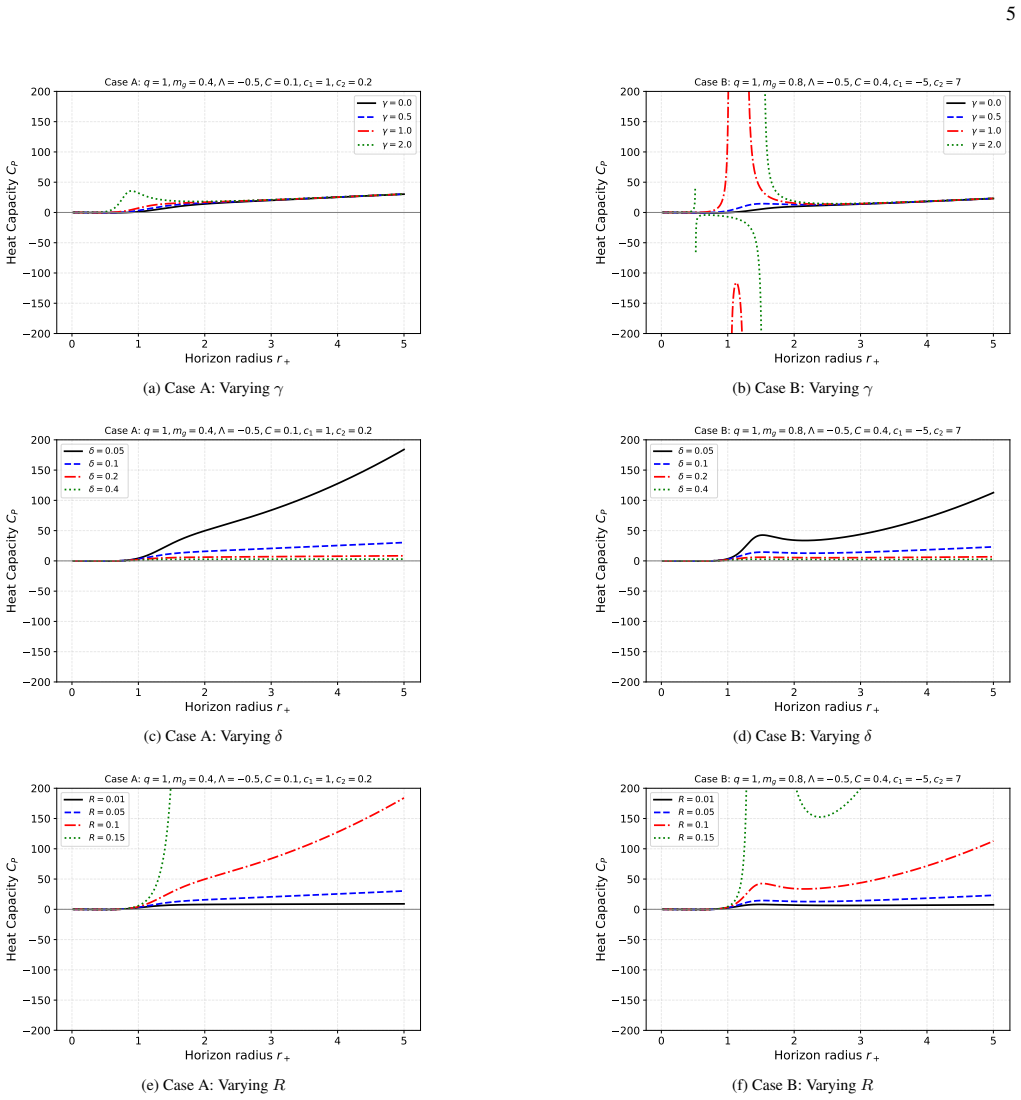
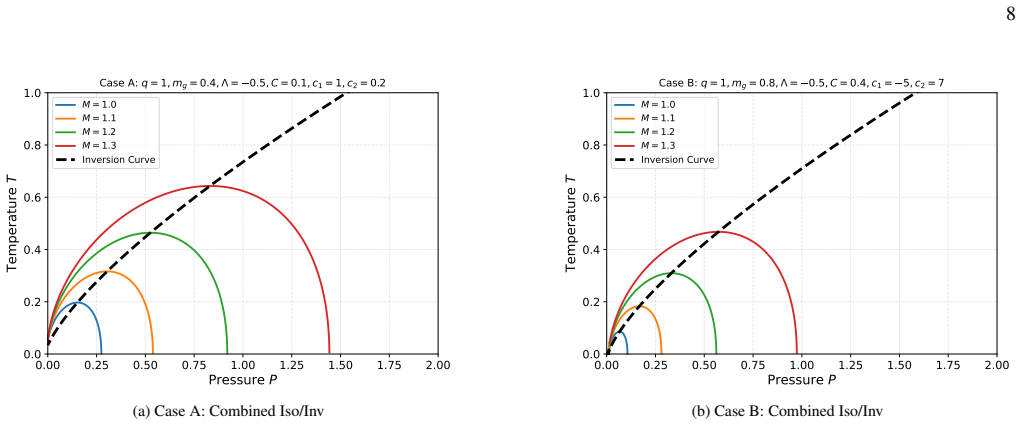
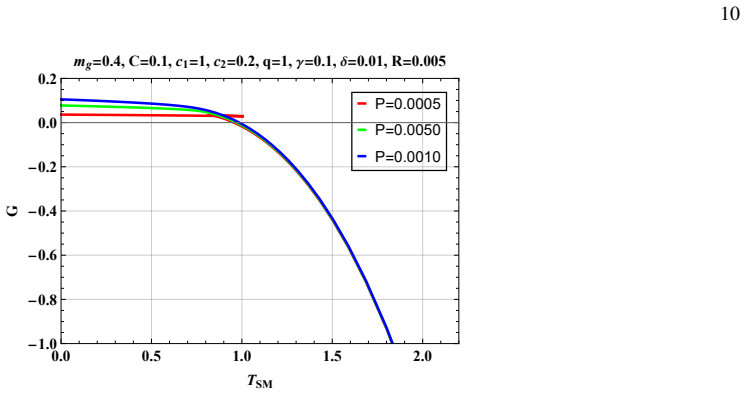
The conformal nonlinearities of the ModMax field expand the physically accessible cooling domain by shifting the inversion transition to smaller horizon radii. While the Sharma-Mittal parameters critically govern local thermodynamic stability and the inversion radius, the global inversion phase boundary remains fundamentally dictated by the massive graviton background. An analysis of the Gibbs free energy uncovers a van der Waals-like first-order phase transition characterized by a distinct swallow-tail structure.
Load-bearing premise
The generalised Sharma-Mittal entropy correctly accounts for non-extensive statistical correlations in this black hole system.
Editorial extensions
If this is right
- The physically accessible cooling domain enlarges with increasing ModMax nonlinearity.
- Local thermodynamic stability and inversion radius are controlled by Sharma-Mittal parameters δ and R.
- The global inversion phase boundary is set by the massive graviton background.
- A first-order phase transition appears with swallow-tail structure in the Gibbs free energy.
Reading between the lines
- Thermodynamic observables can act as diagnostics to distinguish the separate contributions of nonlinear electrodynamics, non-extensive entropy, and massive gravity.
- The observed decoupling of effects suggests that similar combined models may allow independent tuning of different thermodynamic features.
Signed reviews
Editorial analysis
A structured set of objections, weighed in public.
Referee Report
Summary. The paper claims to derive exact analytical expressions for the modified Hawking temperature, specific heat, Joule-Thomson coefficient, and equation of state for four-dimensional charged AdS black holes in the combined ModMax nonlinear electrodynamics and dRGT massive gravity framework, using the generalised Sharma-Mittal entropy in extended phase space. It reports that ModMax nonlinearity γ expands the cooling domain by shifting the inversion transition to smaller radii, that δ and R govern local stability and inversion radius while massive gravity sets the global boundary, and that the Gibbs free energy exhibits a van der Waals-like first-order phase transition with swallow-tail structure, with a claimed physical decoupling of the three modifications.
Significance. If the entropy substitution and derivations are shown to be consistent, the results would illustrate how nonlinear electrodynamics, massive gravity, and non-extensive entropy separately affect inversion curves and phase transitions, offering potential diagnostics for black hole modifications. The work does not provide machine-checked proofs, reproducible code, or parameter-free derivations.
major comments (2)
- [Abstract and entropy introduction] Abstract (paragraph on entropy choice) and the section introducing the thermodynamic quantities: the central claims rest on substituting the area law with the generalised Sharma-Mittal entropy S_δ,R while retaining the standard extended first law dM = T dS + V dP + Φ dQ + … without any derivation or consistency check against the ModMax stress-energy tensor, the dRGT graviton mass terms, or the resulting Smarr relation; this substitution is load-bearing for all reported analytical expressions, stability conclusions, and the inversion/phase-transition results.
- [Abstract and throttling-process analysis] Abstract and throttling-process analysis: the statements that γ 'expands the physically accessible cooling domain' and that 'clear physical decoupling' occurs in the critical regime are presented as outcomes of the calculation, yet no explicit verification is supplied that δ and R are not adjusted post-hoc to produce the reported inversion radius and stability behaviors, raising the possibility that the results reduce to input choices by construction.
minor comments (1)
- [Introduction or entropy section] Notation for the Sharma-Mittal parameters δ and R should be defined explicitly at first use with their physical interpretation, and any relation to the standard Bekenstein-Hawking entropy should be stated.
Simulated Author's Rebuttal
We thank the referee for the careful reading of our manuscript and the constructive comments. We respond to the major comments point by point below.
read point-by-point responses
-
Referee: [Abstract and entropy introduction] Abstract (paragraph on entropy choice) and the section introducing the thermodynamic quantities: the central claims rest on substituting the area law with the generalised Sharma-Mittal entropy S_δ,R while retaining the standard extended first law dM = T dS + V dP + Φ dQ + … without any derivation or consistency check against the ModMax stress-energy tensor, the dRGT graviton mass terms, or the resulting Smarr relation; this substitution is load-bearing for all reported analytical expressions, stability conclusions, and the inversion/phase-transition results.
Authors: The extended first law is postulated in the extended phase space as the fundamental relation, with temperature defined by T = (∂M/∂S) holding the other extensive variables fixed. Substituting the Sharma-Mittal form for S modifies the resulting T and equation of state in a manner consistent with this definition. The Smarr relation then follows directly from Euler homogeneity applied to the scaling properties of the extended thermodynamic variables, independent of the explicit functional form of S. The metric and mass function are determined by the field equations involving the ModMax stress-energy and dRGT terms, after which the thermodynamic quantities are obtained from the first law; no re-derivation of the stress-energy tensor is needed for the entropy substitution, which is a standard phenomenological step in the literature on generalized entropies. We maintain that the procedure is internally consistent and do not plan to alter the derivations. revision: no
-
Referee: [Abstract and throttling-process analysis] Abstract and throttling-process analysis: the statements that γ 'expands the physically accessible cooling domain' and that 'clear physical decoupling' occurs in the critical regime are presented as outcomes of the calculation, yet no explicit verification is supplied that δ and R are not adjusted post-hoc to produce the reported inversion radius and stability behaviors, raising the possibility that the results reduce to input choices by construction.
Authors: The inversion temperature, Joule-Thomson coefficient, and critical points are obtained from the closed-form analytical expressions in which γ, δ, R, and the massive gravity parameters appear as independent variables. The reported effects are demonstrated by explicit differentiation and by comparing families of curves in which one class of parameters is varied while the others are held fixed (including the limiting cases that recover the standard entropy). The functional dependence itself produces the observed expansion of the cooling domain under γ and the separation of influences in the critical regime; no auxiliary tuning of δ or R is performed to force these outcomes. revision: no
Circularity Check
No significant circularity; derivations are model-driven but independent
full rationale
The paper derives exact analytical expressions for temperature, specific heat, Joule-Thomson coefficient and equation of state after substituting the Sharma-Mittal entropy into the extended first law. Parameters δ and R enter as explicit inputs that modify the resulting formulas; the reported effects on inversion radius, stability and swallow-tail structure are direct algebraic consequences of those formulas rather than fits performed on the output quantities. No self-citation chain, uniqueness theorem, or ansatz smuggling is invoked to justify the entropy choice or the central claims. The derivation chain therefore remains self-contained once the entropy model is accepted as given.
Assumptions & free parameters
free parameters (2)
- γ (ModMax nonlinearity)
- δ, R (Sharma-Mittal)
assumptions (2)
- domain assumption Extended phase space formalism remains valid when combining ModMax, dRGT and Sharma-Mittal entropy
- ad hoc to paper Sharma-Mittal entropy correctly captures non-extensive correlations for these black holes
Cite this review
Pith. "Pith review of Extended Thermodynamics and Throttling Process of Charged AdS Black Holes in ModMax-dRGT Massive Gravity with Sharma-Mittal Entropy." pith.science (2026). https://pith.science/paper/BOC5QKP2
@misc{pith2026260626210,
  author       = {Pith},
  title        = {Pith review of: Extended Thermodynamics and Throttling Process of Charged AdS Black Holes in ModMax-dRGT Massive Gravity with Sharma-Mittal Entropy},
  year         = {2026},
  howpublished = {\url{https://pith.science/paper/BOC5QKP2}},
  note         = {Machine review of arXiv:2606.26210}
}
abstract
We investigate the extended thermodynamics, including the Joule-Thomson expansion and $P-V$ criticality, of a four-dimensional charged anti-de Sitter (AdS) black hole within the combined framework of ModMax nonlinear electrodynamics and dRGT-like massive gravity. Operating in the extended phase space and employing the generalised Sharma-Mittal entropy to account for non-extensive statistical correlations, we derive exact analytical expressions for the modified Hawking temperature, specific heat, Joule-Thomson coefficient, and the equation of state. Our analysis of the throttling process reveals that the conformal nonlinearities of the ModMax field ($\gamma$) expand the physically accessible cooling domain by shifting the inversion transition to smaller horizon radii. While the Sharma-Mittal parameters ($\delta$, $R$) critically govern local thermodynamic stability and the inversion radius, the global inversion phase boundary remains fundamentally dictated by the massive graviton background. Furthermore, an analysis of the Gibbs free energy uncovers a van der Waals-like first-order phase transition characterized by a distinct swallow-tail structure. We observe a clear physical decoupling in the critical regime: ModMax nonlinearities modify the critical phase boundary by suppressing electromagnetic interactions, Sharma-Mittal parameters dictate the relative thermal stability of competing phases, and massive gravity governs the overarching macroscopic phase landscape. These results highlight the sensitivity of thermodynamic phase phenomena as robust diagnostic tools for distinguishing nonlinear and non-extensive modifications to black hole physics.
Figures


Figures from the paper (4 more)


Reference graph
Works this paper leans on
-
[1]
J. D. Bekenstein, Black holes and entropy, Phys. Rev. D7, 2333 (1973)
1973
-
[2]
S. W. Hawking, Particle Creation by Black Holes, Commun. Math. Phys.43, 199 (1975), [Erratum: Commun.Math.Phys. 46, 206 (1976)]
1975
-
[3]
Enthalpy and the Mechanics of AdS Black Holes
D. Kastor, S. Ray, and J. Traschen, Enthalpy and the Mechanics of AdS Black Holes, Class. Quant. Grav.26, 195011 (2009), arXiv:0904.2765 [hep-th]
work page Pith review arXiv 2009
-
[4]
S. W. Hawking and D. N. Page, Thermodynamics of Black Holes in anti-De Sitter Space, Commun. Math. Phys.87, 577 (1983)
1983
- [5]
-
[6]
Reentrant Phase Transitions in Rotating AdS Black Holes
N. Altamirano, D. Kubiznak, and R. B. Mann, Reentrant phase transitions in rotating anti–de Sitter black holes, Phys. Rev. D88, 101502 (2013), arXiv:1306.5756 [hep-th]
work page Pith review arXiv 2013
- [7]
-
[8]
P-V criticality of charged AdS black holes
D. Kubiznak and R. B. Mann, P-V criticality of charged AdS black holes, JHEP07, 033, arXiv:1205.0559 [hep-th]
Show all 64 references
-
[9]
N. J. Gogoi and P. Phukon, Thermodynamic geometry of 5D $R $-charged black holes in extended thermodynamic space, Phys. Rev. D 103, 126008 (2021)
2021
-
[10]
N. J. Gogoi and P. Phukon, Thermodynamic topology of 4D dyonic AdS black holes in different ensembles, Phys. Rev. D108, 066016 (2023), arXiv:2304.05695 [hep-th]
2023
-
[11]
N. J. Gogoi, G. K. Mahanta, and P. Phukon, Geodesics in geometrothermodynamics (GTD) type II geometry of 4D asymptotically anti-de-Sitter black holes, Eur. Phys. J. Plus138, 345 (2023)
2023
-
[12]
N. J. Gogoi and P. Phukon, Thermodynamic topology of 4D Euler–Heisenberg-AdS black hole in different ensembles, Phys. Dark Univ. 44, 101456 (2024), arXiv:2312.13577 [hep-th]
2024
-
[13]
N. J. Gogoi, S. Acharjee, and P. Phukon, Lyapunov exponents and phase transition of Hayward AdS black hole, Eur. Phys. J. C84, 1144 (2024), arXiv:2404.03947 [hep-th]
2024
-
[14]
¨Okc¨u and E
¨O. ¨Okc¨u and E. Aydıner, Joule–Thomson expansion of the charged AdS black holes, Eur. Phys. J. C77, 24 (2017), arXiv:1611.06327 [gr-qc]
2017 arXiv
-
[15]
D. J. Gogoi, Y . Sekhmani, D. Kalita, N. J. Gogoi, and J. Bora, Joule-Thomson Expansion and Optical Behaviour of Reissner-Nordstr¨om- Anti-de Sitter Black Holes in Rastall Gravity Surrounded by a Quintessence Field, Fortsch. Phys.71, 2300010 (2023), arXiv:2306.02881 [gr-qc]
2023
-
[16]
Chabab, H
M. Chabab, H. El Moumni, S. Iraoui, K. Masmar, and S. Zhizeh, Joule-Thomson Expansion of RN-AdS Black Holes inf(R)gravity, LHEP1, 05 (2018), arXiv:1804.10042 [gr-qc]
2018 arXiv
-
[17]
Liu, Joule-thomson expansion of vanished cooling region for five-dimensional neutral Gauss-Bonnet AdS black hole, Gen
T.-Y . Liu, Joule-thomson expansion of vanished cooling region for five-dimensional neutral Gauss-Bonnet AdS black hole, Gen. Rel. Grav.56, 140 (2024)
2024
-
[18]
Yasir, T
M. Yasir, T. Lining, X. Tiecheng, and A. Ditta, Thermal geometries and the Joule–Thomson expansion of modified charged and slowly rotating black holes, Front. in Phys.11, 1170683 (2023)
2023
-
[19]
Chaudhary, A
S. Chaudhary, A. Jawad, and M. Yasir, Thermodynamic geometry and Joule-Thomson expansion of black holes in modified theories of gravity, Phys. Rev. D105, 024032 (2022)
2022
-
[20]
Alessa, A
N. Alessa, A. Mehmood, and M. U. Shahzad, Interplay of String Clouds and Non-Singular Cores: Universal Topological Classification and Joule-Thomson Dynamics of Hayward-Letelier AdS Black Holes, Int. J. Theor. Phys.65, 152 (2026)
2026
-
[21]
Ahmed, A
F. Ahmed, A. Al-Badawi, and E. O. Silva, Thermal analysis, Joule-Thomson expansion and Hawking sparsity of Mod(A)Max-AdS black hole immersed in a cloud of strings, Phys. Lett. B876, 140448 (2026), arXiv:2602.18488 [physics.gen-ph]
2026
-
[22]
Sekhmani, Z
Y . Sekhmani, Z. Dahbi, A. Najim, and A. Waqdim, Joule–Thomson expansion of 5-dimensional R-charged black holes, Annals Phys. 444, 169060 (2022)
2022
-
[23]
K. V . Rajani, C. L. A. Rizwan, A. Naveena Kumara, M. S. Ali, and D. Vaid, Joule–Thomson expansion of regular Bardeen AdS black hole surrounded by static anisotropic matter field, Phys. Dark Univ.32, 100825 (2021), arXiv:2002.03634 [gr-qc]
2021
-
[24]
Qi, X.-M
D.-J. Qi, X.-M. Jiao, and H.-L. Li, The influence of constrained charge on Joule–Thomson effect and butterfly effect, Eur. Phys. J. Plus 141, 136 (2026)
2026
-
[25]
Fatima, A
G. Fatima, A. Eid, J. Rayimbaev, and S. Muminov, Joule–Thomson expansion of black hole in Cotton gravity coupled to nonlinear electrodynamics, Phys. Dark Univ.49, 102045 (2025)
2025
-
[26]
Media and T
N. Media and T. I. Singh, Joule-Thomson Expansion of Kerr-Newman-de Sitter Black Hole Under Lorentz Violation Theory, Int. J. Theor. Phys.64, 82 (2025)
2025
-
[27]
Liu, Y .-Z
F. Liu, Y .-Z. Du, R. Zhao, and H.-F. Li, The phase transitions and Joule–Thomson processes of charged de Sitter black holes with cloud of string and quintessence, Chin. J. Phys.95, 371 (2025)
2025
-
[28]
M. R. Shahzad, R. H. Ali, G. Abbas, and W.-X. Ma, Thermal Aspects and Joule–Thomson Expansion of ModMax Black Hole, Eur. Phys. J. Plus139, 453 (2024)
2024
-
[29]
M. U. Shahzad, A. Mehmood, R. Gohar, and A. ¨Ovg¨un, Joule Thomson expansion, Maxwell equal area law and topological interpretation of Phantom RN AdS black holes, New Astron.110, 102225 (2024)
2024
-
[30]
M. R. Alipour, S. Noori Gashti, M. A. S. Afshar, and J. Sadeghi, Cooling and heating regions of Joule-Thomson expansion for AdS black holes: Einstein-Maxwell-power-Yang-Mills and Kerr Sen black holes, Gen. Rel. Grav.57, 61 (2025), arXiv:2402.02257 [hep-th]. 13
2025
-
[31]
Zhang, H
M.-Y . Zhang, H. Chen, H. Hassanabadi, Z.-W. Long, and H. Yang, Critical behavior and Joule-Thomson expansion of charged AdS black holes surrounded by exotic fluid with modified Chaplygin equation of state*, Chin. Phys. C48, 065101 (2024), arXiv:2401.17589 [gr-qc]
2024
-
[32]
Li, J.-Y
N. Li, J.-Y . Li, and B.-Y . Su, The Joule–Thomson and Joule–Thomson-Like Effects of the Black Holes in a Cavity, Fortsch. Phys.71, 2200166 (2023), arXiv:2306.15959 [gr-qc]
2023
-
[33]
Du, X.-Y
Y .-Z. Du, X.-Y . Liu, Y . Zhang, L. Zhao, and Q. Gu, Nonlinearity effect on Joule–Thomson expansion of Einstein–Power–Yang–Mills AdS black hole, Eur. Phys. J. C83, 426 (2023), arXiv:2302.13547 [hep-th]
2023
-
[34]
Y . Guo, H. Xie, and Y .-G. Miao, Joule-Thomson effect of AdS black holes in conformal gravity, Nucl. Phys. B993, 116280 (2023), arXiv:2301.03004 [gr-qc]
2023
-
[35]
Sekhmani, R
Y . Sekhmani, R. Myrzakulov, and R. Ali, Joule–Thomson expansion of black holes in STU supergravity, Int. J. Mod. Phys. A38, 2350176 (2023)
2023
-
[36]
Zhang, H
M.-Y . Zhang, H. Chen, H. Hassanabadi, Z.-W. Long, and H. Yang, Joule-Thomson expansion of charged dilatonic black holes*, Chin. Phys. C47, 045101 (2023), arXiv:2209.00868 [gr-qc]
2023
-
[37]
Assrary, J
M. Assrary, J. Sadeghi, and M. E. Zomorrodian, The effect of nonlinear electrodynamics on Joule-Thomson expansion of a 5-dimensional charged AdS black hole in Einstein-Gauss-Bonnet gravity, Nucl. Phys. B977, 115727 (2022)
2022
-
[38]
Y . Cao, H. Feng, J. Tao, and Y . Xue, Black holes in a cavity: Heat engine and Joule-Thomson expansion, Gen. Rel. Grav.54, 105 (2022), arXiv:2201.07584 [gr-qc]
2022
-
[39]
J.-T. Xing, Y . Meng, and X.-M. Kuang, Joule-Thomson expansion for hairy black holes, Phys. Lett. B820, 136604 (2021)
2021
-
[40]
Y . Meng, B. B. Chen, and J. Tang, Cooling–heating phase transition of the Euler–Heisenberg-AdS black hole, Mod. Phys. Lett. A36, 2150165 (2021)
2021
-
[41]
Zhang, M
C.-M. Zhang, M. Zhang, and D.-C. Zou, Joule–Thomson expansion of Born–Infeld AdS black holes in consistent 4D Ein- stein–Gauss–Bonnet gravity, Mod. Phys. Lett. A37, 2250063 (2022), arXiv:2106.00183 [hep-th]
2022
-
[42]
Ghaffarnejad, E
H. Ghaffarnejad, E. Ghasami, E. Yaraie, and M. Farsam, Thermodynamic Phase Transition and Joule Thomson Adiabatic Expansion for dS/AdS Bardeen Black Holes with Consistent 4D Gauss-Bonnet Gravity, Iran. J. Astron. Astrophys.9, 1 (2022), arXiv:2010.05697 [hep-th]
2022
-
[43]
Jawad, M
A. Jawad, M. Yasir, and S. Rani, Joule–Thomson expansion and quasinormal modes of regular non-minimal magnetic black hole, Mod. Phys. Lett. A35, 2050298 (2020)
2020
-
[44]
Z.-W. Feng, X. Zhou, G. He, S.-Q. Zhou, and S.-Z. Yang, Joule–Thomson expansion of higher dimensional nonlinearly AdS black hole with power Maxwell invariant source, Commun. Theor. Phys.73, 065401 (2021), arXiv:2009.02172 [gr-qc]
2021
-
[45]
Y . Meng, J. Pu, and Q.-Q. Jiang, P-V criticality and Joule-Thomson expansion of charged AdS black holes in the Rastall gravity, Chin. Phys. C44, 065105 (2020)
2020
-
[46]
S. Guo, Y . Han, and G.-P. Li, Joule–Thomson expansion of a specific black hole inf(R)gravity coupled with Yang–Mills field, Class. Quant. Grav.37, 085016 (2020)
2020
-
[47]
Hegde, A
K. Hegde, A. Naveena Kumara, C. L. Ahmed Rizwan, A. K. M., M. S. Ali, and S. Punacha, Thermodynamics, phase transition and Joule–Thomson expansion of 4-D Gauss–Bonnet AdS black hole, Int. J. Mod. Phys. A39, 2450080 (2024), arXiv:2003.08778 [gr-qc]
2024
-
[48]
C. H. Nam, Effect of massive gravity on Joule–Thomson expansion of the charged AdS black hole, Eur. Phys. J. Plus135, 259 (2020)
2020
-
[49]
Lan, Joule-Thomson expansion of neutral AdS black holes in massive gravity, Nucl
S.-Q. Lan, Joule-Thomson expansion of neutral AdS black holes in massive gravity, Nucl. Phys. B948, 114787 (2019)
2019
-
[50]
Cisterna, S.-Q
A. Cisterna, S.-Q. Hu, and X.-M. Kuang, Joule-Thomson expansion in AdS black holes with momentum relaxation, Phys. Lett. B797, 134883 (2019), arXiv:1808.07392 [gr-qc]
2019
-
[51]
Rizwan C
A. Rizwan C. L., N. Kumara A., D. Vaid, and K. M. Ajith, Joule-Thomson expansion in AdS black hole with a global monopole, Int. J. Mod. Phys. A33, 1850210 (2019), arXiv:1805.11053 [gr-qc]
2019 arXiv
-
[52]
Mo and G.-Q
J.-X. Mo and G.-Q. Li, Effects of Lovelock gravity on the Joule–Thomson expansion, Class. Quant. Grav.37, 045009 (2020), arXiv:1805.04327 [gr-qc]
2020 arXiv
-
[53]
Mo, G.-Q
J.-X. Mo, G.-Q. Li, S.-Q. Lan, and X.-B. Xu, Joule-Thomson expansion ofd-dimensional charged AdS black holes, Phys. Rev. D98, 124032 (2018), arXiv:1804.02650 [gr-qc]
2018 arXiv
-
[54]
Ghaffarnejad, E
H. Ghaffarnejad, E. Yaraie, and M. Farsam, Quintessence Reissner Nordstr ¨om Anti de Sitter Black Holes and Joule Thomson effect, Int. J. Theor. Phys.57, 1671 (2018), arXiv:1802.08749 [gr-qc]
2018
-
[55]
de Rham, G
C. de Rham, G. Gabadadze, and A. J. Tolley, Resummation of Massive Gravity, Phys. Rev. Lett.106, 231101 (2011), arXiv:1011.1232 [hep-th]
2011 arXiv
-
[56]
de Rham, G
C. de Rham, G. Gabadadze, and A. J. Tolley, Ghost free Massive Gravity in the St ¨uckelberg language, Phys. Lett. B711, 190 (2012), arXiv:1107.3820 [hep-th]
2012 arXiv
-
[57]
Zhang and X.-Z
H. Zhang and X.-Z. Li, Ghost free massive gravity with singular reference metrics, Phys. Rev. D93, 124039 (2016), arXiv:1510.03204 [gr-qc]
2016 arXiv
-
[58]
Y .-F. Cai, G. Cheng, J. Liu, M. Wang, and H. Zhang, Features and stability analysis of non-Schwarzschild black hole in quadratic gravity, JHEP01, 108, arXiv:1508.04776 [hep-th]
-
[59]
Bandos, K
I. Bandos, K. Lechner, D. Sorokin, and P. K. Townsend, Nonlinear duality-invariant conformal extension of maxwell’s equations, Phys. Rev. D102, 121703(R) (2020)
2020
-
[60]
Eslam Panah, Black hole solutions in theory of ModMax-dRGT-like massive gravity, Phys
B. Eslam Panah, Black hole solutions in theory of ModMax-dRGT-like massive gravity, Phys. Lett. B868, 139711 (2025), arXiv:2507.05864 [gr-qc]
2025
-
[61]
Sayahian Jahromi, S
A. Sayahian Jahromi, S. A. Moosavi, H. Moradpour, J. P. Morais Grac ¸a, I. P. Lobo, I. G. Salako, and A. Jawad, Generalized entropy formalism and a new holographic dark energy model, Phys. Lett. B780, 21 (2018), arXiv:1802.07722 [gr-qc]
2018 arXiv
-
[62]
C. V . Johnson, Holographic heat engines, Classical and Quantum Gravity31, 205002 (2014)
2014
-
[63]
Kubiz ˇn´ak and R
D. Kubiz ˇn´ak and R. B. Mann, P- v criticality of charged ads black holes, Journal of High Energy Physics2012, 1 (2012)
2012
-
[64]
J. W. York Jr, Black-hole thermodynamics and the euclidean einstein action, Physical Review D33, 2092 (1986)
Reviewed June 26, 2026 · model on record in the stance chip above.
Discussion (0). Continue with ORCID to comment.