REVIEW 4 major objections 4 minor 66 references
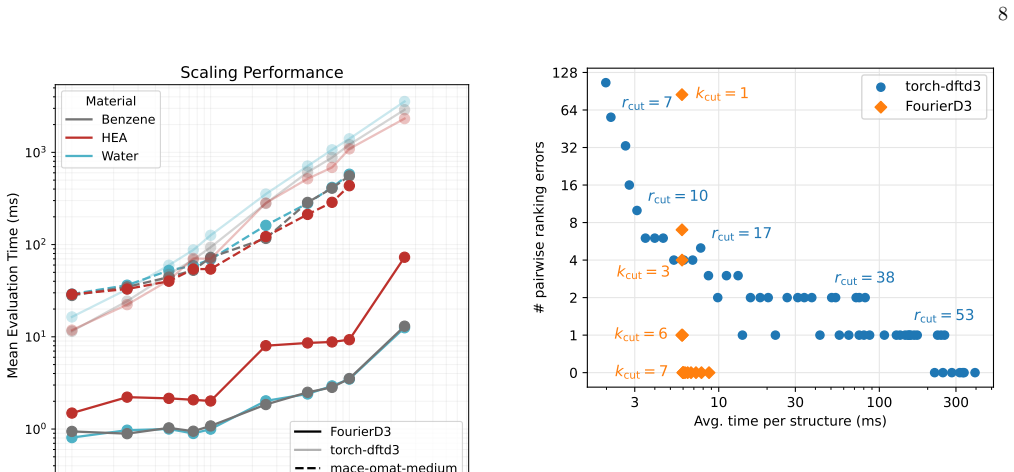
FourierD3 resolves the DFT-D3 dispersion correction into atom-centred low-rank factors and evaluates it by particle-mesh Ewald summation, giving O(N log N) cost with no real-space cutoff on the dispersion sum.
Reviewed by Pith at T0; open to challenge. T0 means a machine referee read the full paper against a public rubric. the ladder, T0–T4 →
T0 review · deepseek-v4-flash
2026-08-02 00:08 UTC pith:BODM3GHP
load-bearing objection Low-rank tensor decomposition of D3's C6 reference makes SPME work for environment-dependent dispersion, but the claim to reproduce the full D3 correction rests on an unverified modified coordination-number model. the 4 major comments →
A fast summation method for the DFT-D3 dispersion correction
The pith
A machine-rendered reading of the paper's core claim, the machinery that carries it, and where it could break.
Core claim
FourierD3 establishes that the environment-dependent D3 pair coefficient C6_ij(theta_i, theta_j) is accurately separable in practice: the reference C6 tensor, organised as a symmetric block matrix over chemical species and reference coordination numbers, has a low-rank eigendecomposition, with rank below 10 for conventional systems and saturating at 21 even for 100 species. Using that decomposition, C6_ij is replaced by a sum over factors lambda_l C6_l,i(theta_i) C6_l,j(theta_j), and each factor is summed on a reciprocal-space mesh via smooth particle-mesh Ewald structure factors. With a modified coordination-number function that matches standard D3 at short range but vanishes smoothly at th
What carries the argument
The central object is the functional tensor decomposition of the DFT-D3 reference C6 coefficient tensor. Treating C6,ref as a symmetric block matrix over element pairs and reference coordination environments, an offline eigendecomposition yields scalar weights lambda_l and atom-centred factor functions C6_l,i(theta_i), so the non-separable coefficient C6_ij(theta_i, theta_j) becomes a sum of products of one-atom factors. That restores the atom-centred separability required by Ewald-style summation: each factor is charged onto a mesh and contracted with the analytic Fourier transform of the damped 1/r^6 + 1/r^8 potential, giving O(N log N) structure-factor summation. A second ingredient is a
Load-bearing premise
The load-bearing premise is that the modified coordination-number function used by FourierD3 reproduces standard DFT-D3 coordination numbers closely enough that energies and forces match the original D3 model within chemical accuracy; the paper reports maximum CN and derivative errors of 0.0025 and 0.0020 against the standard function with a 20 Å cutoff, but does not compare energies directly to the original model.
What would settle it
Run FourierD3 and a conventional D3 implementation (with the standard coordination-number function at a fixed 20 Å cutoff, the usual default) on a benchmark set spanning molecules, liquids, and molecular crystals with identical damping parameters; if mean absolute energy errors exceed roughly 1 meV/atom or force errors exceed a few meV/Å, the modified coordination-number function is not faithful enough to be a drop-in replacement for D3. A second check: a 50-element high-entropy alloy should still reach 0.01% C6 accuracy with rank near 21; if the rank grows much larger or the runtime exceeds d
If this is right
- Machine-learning force fields can carry a fully converged DFT-D3 correction at near-constant overhead, eliminating both the uncontrolled truncation error and the large-neighbour-list slowdown that currently force a choice between speed and accuracy.
- Because the only real-space neighbour list needed is the short coordination-number list, the correction reuses the list a local MLFF already constructs, making it effectively free during a molecular dynamics step.
- The stability ranking of SiO2 polymorphs is recovered only when the dispersion sum is fully converged; at standard MLFF cutoffs (about 7–10 Å) the ranking is wrong, and direct summation needs about 54 Å to converge.
- Liquid-water densities from FourierD3 match a converged 15 Å D3 treatment to about 0.2%, whereas a 6 Å cutoff systematically underestimates the density by 2–3%.
- The same functional tensor decomposition transfers to other environment-dependent dispersion models whose coefficients depend continuously on atom-centred features, extending the fast-summation treatment beyond D3.
Where Pith is reading between the lines
- A direct energy-and-force comparison of FourierD3 against the original D3 model — not just against the modified CN function — would settle whether the 0.0025 maximum CN error translates into chemical accuracy; the paper's benchmarks compare FourierD3 with itself at different cutoffs, not with original D3 energies.
- The decomposition's rank saturating at 21 regardless of the number of elements suggests a compact, transferable representation of long-range dispersion across the periodic table, which could be reused as input features for surrogate dispersion models or for training MLFFs with explicit non-local physics.
- Because the decomposition is backend-agnostic, substituting multilevel summation or fast multipole methods would extend FourierD3 to non-periodic and mixed-boundary geometries without changing the central factorisation.
- A practical consequence the authors leave implicit: PBE-trained MLFF datasets could be augmented with fully converged D3 labels at low cost, letting the short-range model consistently absorb the dispersion correction without retraining.
Editorial analysis
A structured set of objections, weighed in public.
Referee Report
Summary. The paper introduces FourierD3, a reciprocal-space (SPME) implementation of the DFT-D3 dispersion correction for periodic systems. The central idea is a low-rank functional decomposition of the environment-dependent C6 coefficients (Eqs. 19–22), which restores atom-centered separability and enables particle-mesh evaluation in O(N log N) time without a real-space cutoff on the dispersion sum. To make the coordination number (CN) well-defined, the authors introduce a modified CN function (Eq. 18). They report algebraic convergence to an Ewald reference, near-constant evaluation times for systems up to 10,000 atoms, and physical demonstrations (SiO2 polymorph ranking, water density, layered graphene) showing the consequences of real-space truncation. The paper claims to evaluate the full D3 correction at marginal cost relative to an MLFF neighbor list.
Significance. If the claims hold, FourierD3 is a timely and valuable contribution for MLFF workflows that currently truncate D3 or pay large neighbor-list costs. The mathematical low-rank decomposition is elegant, the error analysis of the summation itself is internally consistent, and the paper ships open-source code. The applications convincingly show that dispersion truncation can change qualitative predictions (SiO2 phase ordering, water density). However, the headline claim that FourierD3 evaluates the actual DFT-D3 correction is not yet established: the method evaluates a D3-like model with a modified CN function, and the validation strategy does not isolate the resulting model change from the summation error. The paper needs additional benchmarks and a correction of an internal inconsistency in the modified CN function before it can be accepted.
major comments (4)
- [§IIC and App. VIA (Eq. 18)] The modified CN function does not behave as claimed. In Eq. (18), at r = Rcut the quadratic term gives t_ij(Rcut) = 17, so θ_ij(Rcut) = [1 + exp(-17(4Rcov/(3Rcut)-1))]^(-1), which is not zero for typical covalent radii (e.g., Rcov ≈ 1.31 Å, Rcut = 6 Å gives θ ≈ 6×10^-6), and then θ = 0 for r > Rcut. The function therefore has a jump discontinuity at Rcut and its derivative is also discontinuous. This contradicts the statements in §IIC and App. VIA that the function "converges smoothly to zero at Rcut" and "eliminates the truncation discontinuity." The equation should be revised (e.g., by adding a smooth step factor or making t diverge at Rcut) or the text should be corrected.
- [§IIC, §IIIB (Eq. 18)] The central fidelity of the CN modification to the actual DFT-D3 model is not benchmarked. The consistency test in §IIIB compares FourierD3 with torch-dftd3 using the same modified CN function, so it measures only summation error, not model error. The only evidence for fidelity is the reported maximum CN error of 0.0025 and derivative error of 0.0020 relative to standard D3 with a 20 Å CN cutoff. These small CN deviations do not by themselves establish that energies and forces match DFT-D3 within chemical accuracy: errors can be amplified by the interpolation weights L_p^i, the C6/C8 damping functions, and the accumulation over all pairs. Since the original CN has no convergent infinite-cutoff limit (App. VIA), Eq. (18) is a genuine model change. Please report a direct energy/force comparison between FourierD3 and an unmodified DFT-D3 implementation (e.g., original CN at a fixed 20 Å cut
- [§IIIB, Figs. 2 and 8] The "converged Ewald reference" used throughout the convergence studies is FourierD3 itself at high kcut (kcut = 9.0 Å^-1). Thus Figs. 2 and 8 demonstrate self-consistency of the reciprocal-space summation, not absolute accuracy of the model. Because both the real-space and FourierD3 calculations use the same modified CN function, systematic model errors cancel, and the reported MAEs do not bound the error relative to DFT-D3. Please state this limitation explicitly or provide an independent reference, for example direct summation with the original D3 at very large cutoffs, or analytic results for simple periodic lattices.
- [§II Eq. (26), App. VIB] The analytical Fourier transform of φ_{X,Y} is essential for evaluating Eq. (26), but the manuscript only states that it "can be derived analytically via contour integration" and does not give the resulting expression or a derivation. Without this, the central algorithm is not reproducible from the paper alone, even though code is available. Please include the explicit formula, or a detailed derivation in an appendix.
minor comments (4)
- [Throughout] There are many LaTeX macro artifacts and missing spaces, e.g., "FourierD3FourierD3" in the abstract and body text, and garbled equation formatting. The manuscript needs a careful proofreading pass.
- [Reference [56]] Reference [56] appears to cite the PFP paper, not the torch-dftd3 library discussed in §IIIB. Please verify and correct this citation.
- [Fig. 5] The label 'Converged' in Fig. 5 is ambiguous; clarify that it refers to the FourierD3 result, and state the statistical uncertainty for all density values, not just for one curve.
- [§IIIB] The statement that "the only real-space cutoff that remains is the short coordination-number cutoff" should be qualified: the SPME mesh spacing is an additional discretization parameter, and the 6.0 Å CN cutoff is chosen to coincide with typical MLFF cutoffs rather than being a fundamental property of the D3 model.
Circularity Check
No significant circularity: the fast-summation derivation is self-contained; the missing energy-level comparison against original D3 is a validation gap, not a circular reduction.
full rationale
The paper's central derivation transforms the D3 pairwise energy into a separable low-rank form (Eqs. 6-9, 19-26) and then applies SPME. This is a mathematical re-expression: if the tensor decomposition were exact, Eq. (26) would be algebraically identical to the D3 energy with the modified coordination-number function. The decomposition error is measured directly on the C6,ref tensor (Sec. IIIA), not fitted to downstream energies. The consistency check against torch-dftd3 (Sec. IIIB) intentionally uses the same modified CN function, so it isolates the summation error; that is a legitimate cross-method verification of the fast summation, not a circular prediction. The 'converged Ewald reference' is the converged limit of the same model, which is standard practice for measuring discretization error. The main weakness is that the paper does not directly benchmark energies/forces against the original DFT-D3 model, only CN and CN-derivative errors (max 0.0025 and 0.0020). This is a correctness/validation risk, not a circularity: the modified CN function is a genuine model change, and the paper does not claim the consistency benchmark validates original-D3 fidelity. Self-citations (e.g., MACE works) are contextual and not load-bearing for the mathematical claim. No step in the derivation reduces to its own inputs by construction.
Axiom & Free-Parameter Ledger
free parameters (5)
- Low-rank decomposition tolerance =
0.01% maximum relative error (default)
- Low-rank truncation rank ℓ_max =
≤21 for up to 100 species; <10 for fewer than 10 species
- Modified CN cutoff radius Rcut =
6 Å
- Modified CN shape parameters =
Rmid = (Rcov + Rcut)/2; exponent t(r) = 1/6 + ((r - Rmid)/(Rcut - Rmid))^2 for r > Rmid
- Reciprocal-space cutoff kcut =
9.0 Å^-1 (reference), 7 Å^-1 (SiO2), 10 Å^-1 (graphene), 30 Å^-1 (SiO2 reference)
axioms (5)
- domain assumption D3 pair coefficients are a smooth function of coordination numbers only, C(θ_i, θ_j), admitting an accurate low-rank functional decomposition.
- domain assumption The C6 reference tensor is highly compressible: rank ≤21 gives max relative error below 0.01% for up to 100 species.
- standard math Poisson summation and SPME interpolation are valid, and the Fourier transform of the damped potential φ_{X,Y} used in Eq. (26) is correct.
- ad hoc to paper The modified coordination-number function (Eq. 18) reproduces standard D3 coordination numbers closely enough that energies and forces are unchanged to within acceptable accuracy.
- domain assumption Standard D3 has no convergent infinite-cutoff limit, making a modified CN necessary.
invented entities (1)
-
Modified coordination-number function θ^{FourierD3}(r)
no independent evidence
read the original abstract
The DFT-D3 dispersion correction is routinely added to machine learning force fields (MLFFs) trained on dispersion-deficient functionals such as PBE. Its environment-dependent pair coefficients, however, break the atom-centered separability that fast summation methods require, forcing practitioners either to truncate D3 or to accept a substantial slowdown. We introduce FourierD3, a method that uses a functional low-rank decomposition to restore this separability and enable particle-mesh evaluation in $O(N\log N)$ time without a real-space cutoff on the dispersion sum.
Figures




Reference graph
Works this paper leans on
-
[1]
R. Drautz, Atomic cluster expansion for accurate and transferable interatomic potentials, Physical Review B 99, 10.1103/PhysRevB.99.014104 (2019). 13
-
[2]
I. Batatia, D. P. Kovács, G. N. C. Simm, C. Ortner, and G. Csányi, MACE: Higher order equivariant message passing neural networks for fast and accurate force fields (2022), arXiv:2206.07697 [cs.LG]
Pith/arXiv arXiv 2022
-
[3]
Y. Lysogorskiy, A. Bochkarev, and R. Drautz, Graph atomic cluster expansion for foundational machine learn- ing interatomic potentials, npj Computational Materials 12, 10.1038/s41524-026-01979-1 (2026)
-
[4]
Batatia, P
I. Batatia, P. Benner, Y. Chiang, A. M. Elena, D. P. Kovács, J. Riebesell, X. R. Advincula, M. Asta, M. Avaylon, W. J. Baldwin, F. Berger, N. Bernstein, A. Bhowmik, F. Bigi, S. M. Blau, V. Cărare, M. Ceriotti, S. Chong, J. P. Darby, S. De, F. D. Pia, V. L. Deringer, R. Elijošius, Z. El-Machachi, E. Fako, F. Falcioni, A. C. Ferrari, J. L. A. Gardner, M. J....
2025
-
[5]
D. P. Kovács, J. H. Moore, N. J. Browning, I. Bata- tia, J. T. Horton, Y. Pu, V. Kapil, W. C. Witt, I.-B. Magdău, D. J. Cole, and G. Csányi, MACE-OFF: Short- range transferable machine learning force fields for or- ganic molecules, Journal of the American Chemical So- ciety147, 17598 (2025)
2025
-
[7]
S. Batzner, A. Musaelian, L. Sun, M. Geiger, J. P. Mailoa, M. Kornbluth, N. Molinari, T. E. Smidt, and B. Kozinsky, E(3)-equivariant graph neural networks for data-efficient and accurate interatomic potentials, Na- ture Communications13, 10.1038/s41467-022-29939-5 (2022)
-
[8]
R. Zubatyuk, J. S. Smith, J. Leszczynski, and O. Isayev, Accurate and transferable multitask prediction of chemical properties with an atoms-in-molecules neural network, Science Advances5, 10.1126/sciadv.aav6490 (2019)
-
[9]
D. M. Anstine, R. Zubatyuk, and O. Isayev, AIMNet2: a neural network potential to meet your neutral, charged, organic, and elemental-organic needs, Chemical Science 16, 10228 (2025)
2025
-
[10]
A. Tkatchenko, R. A. DiStasio, R. Car, and M. Schef- fler, Accurate and efficient method for Many-Body van der Waals interactions, Physical Review Letters108, 10.1103/PhysRevLett.108.236402 (2012)
-
[11]
A. D. Becke and E. R. Johnson, Exchange-hole dipole moment and the dispersion interaction revisited, The Journal of Chemical Physics127, 10.1063/1.2795701 (2007)
-
[12]
A. Tkatchenko and M. Scheffler, Accurate molecular van derWaalsinteractionsfromground-stateelectrondensity and free-atom reference data, Physical Review Letters 102, 10.1103/PhysRevLett.102.073005 (2009)
-
[13]
Grimme, Semiempirical GGA-type density functional constructed with a long-range dispersion correction, Journal of Computational Chemistry27, 1787 (2006)
S. Grimme, Semiempirical GGA-type density functional constructed with a long-range dispersion correction, Journal of Computational Chemistry27, 1787 (2006)
2006
-
[14]
S. Grimme, J. Antony, S. Ehrlich, and H. Krieg, A con- sistent and accurate ab initio parametrization of den- sity functional dispersion correction (dft-d) for the 94 elements h-pu, The Journal of Chemical Physics132, 10.1063/1.3382344 (2010)
-
[15]
Grimme, S
S. Grimme, S. Ehrlich, and L. Goerigk, Effect of the damping function in dispersion corrected density func- tional theory, Journal of Computational Chemistry32, 1456 (2011)
2011
-
[16]
M. Dion, H. Rydberg, E. Schröder, D. C. Langreth, and B. I. Lundqvist, Van der waals density functional for gen- eral geometries, Phys. Rev. Lett.92, 246401 (2004)
2004
-
[17]
Peverati and D
R. Peverati and D. G. Truhlar, Improving the accuracy of hybrid meta-gga density functionals by range separation, The Journal of Physical Chemistry Letters2, 2810–2817 (2011)
2011
-
[18]
Y. Wang, P. Verma, X. Jin, D. G. Truhlar, and X. He, Revised m06 density functional for main-group and transition-metal chemistry, Proceedings of the National Academy of Sciences115, 10257–10262 (2018)
2018
-
[19]
O.A.VydrovandT.VanVoorhis,Nonlocalvanderwaals density functional: The simpler the better, The Journal of Chemical Physics133, 10.1063/1.3521275 (2010)
-
[20]
Piana, K
S. Piana, K. Lindorff-Larsen, R. M. Dirks, J. K. Salmon, R. O. Dror, and D. E. Shaw, Evaluating the effects of cut- offs and treatment of long-range electrostatics in protein folding simulations, PLoS ONE7, e39918 (2012)
2012
-
[21]
Norberg and L
J. Norberg and L. Nilsson, On the truncation of long- range electrostatic interactions in dna, Biophysical Jour- nal79, 1537 (2000)
2000
-
[22]
Patra, M
M. Patra, M. Karttunen, M. Hyvönen, E. Falck, P. Lindqvist, and I. Vattulainen, Molecular dynamics simulations of lipid bilayers: Major artifacts due to trun- cating electrostatic interactions, Biophysical Journal84, 3636 (2003)
2003
-
[23]
Khabibrakhmanov, M
A. Khabibrakhmanov, M. Gori, C. Müller, and A. Tkatchenko, Noncovalent interactions in density func- tional theory: All the charge density we do not see, Jour- nal of the American Chemical Society147, 40763 (2025)
2025
-
[24]
Linse and H
P. Linse and H. C. Andersen, Truncation of coulombic in- teractions in computer simulations of liquids, The Jour- nal of Chemical Physics85, 3027 (1986)
1986
-
[25]
Sega and C
M. Sega and C. Dellago, Long-range dispersion effects on the water/vapor interface simulated using the most common models, The Journal of Physical Chemistry B 121, 3798 (2017)
2017
-
[26]
M. A. Gebbie, A. M. Smith, H. A. Dobbs, A. A. Lee, G. G. Warr, X. Banquy, M. Valtiner, M. W. Rutland, J. N. Israelachvili, S. Perkin, and R. Atkin, Long range electrostatic forces in ionic liquids, Chemical Communi- cations53, 1214 (2017)
2017
-
[27]
A. Schlaich and B. Coasne, Dispersion truncation affects the phase behavior of bulk and confined fluids: Coexis- tence, adsorption, and criticality, The Journal of Chem- ical Physics150, 10.1063/1.5085431 (2019)
-
[28]
T. W. Ko, J. A. Finkler, S. Goedecker, and J. Behler, 14 A fourth-generation high-dimensional neural network potential with accurate electrostatics including non- local charge transfer, Nature Communications12, 10.1038/s41467-020-20427-2 (2021)
-
[29]
D. S. King, D. Kim, P. Zhong, and B. Cheng, Ma- chine learning of charges and long-range interactions from energies and forces, Nature Communications16, 10.1038/s41467-025-63852-x (2025)
-
[30]
B. Cheng, Latent ewald summation for machine learning of long-range interactions, npj Computational Materials 11, 10.1038/s41524-025-01577-7 (2025)
-
[31]
O. T. Unke, S. Chmiela, M. Gastegger, K. T. Schütt, H. E. Sauceda, and K.-R. Müller, SpookyNet: Learning force fields with electronic degrees of freedom and nonlo- cal effects, Nature Communications12, 10.1038/s41467- 021-27504-0 (2021)
doi:10.1038/s41467- 2021
-
[32]
K. K. Huguenin-Dumittan, P. Loche, N. Haoran, and M. Ceriotti, Physics-inspired equivariant descriptors of nonbonded interactions, The Journal of Physical Chem- istry Letters14, 9612 (2023)
2023
-
[33]
I. Batatia, W. J. Baldwin, D. Kuryla, J. Hart, E. Ka- soar, A. M. Elena, H. Moore, M. J. Gawkowski, B. X. Shi, V. Kapil, P. Kourtis, I.-B. Magdău, and G. Csányi, MACE-POLAR-1: A polarisable electrostatic foundation model for molecular chemistry (2026), arXiv:2602.19411 [cs.LG]
arXiv 2026
-
[34]
E. R. Khajehpasha, J. A. Finkler, T. D. Kühne, and S. A. Ghasemi, CENT2: Improved charge equilibration via neural network technique, Physical Review B105, 10.1103/PhysRevB.105.144106 (2022)
-
[35]
E. Kocer, A. Singraber, J. A. Finkler, P. Misof, T. W. Ko, C. Dellago, and J. Behler, Iterative charge equilibra- tion for fourth-generation high-dimensional neural net- work potentials, The Journal of Chemical Physics162, 10.1063/5.0252566 (2025)
-
[36]
Ying and Z
P. Ying and Z. Fan, Combining the D3 dispersion correc- tion with the neuroevolution machine-learned potential, JournalofPhysics: CondensedMatter36,125901(2023)
2023
-
[37]
N. T. P. Tu, N. Rezajooei, E. R. Johnson, and C. N. Rowley, A neural network potential with rigorous treat- ment of long-range dispersion, Digital Discovery2, 718 (2023)
2023
-
[38]
E. Moerman, A. Kabylda, A. Khabibrakhmanov, and A. Tkatchenko, Mbd-ml: Many-body dispersion from machine learning for molecules and materials (2026), arXiv:2602.22086 [cs.LG]
arXiv 2026
-
[39]
Darden, D
T. Darden, D. York, and L. Pedersen, Particle mesh Ewald: AnN·log(N)methodforEwaldsumsinlargesys- tems, The Journal of Chemical Physics98, 10089 (1993)
1993
-
[40]
Essmann, L
U. Essmann, L. Perera, M. L. Berkowitz, T. Darden, H. Lee, and L. G. Pedersen, A smooth particle mesh Ewald method, The Journal of Chemical Physics103, 8577 (1995)
1995
-
[41]
Eastwood, R
J. Eastwood, R. Hockney, and D. Lawrence, P3M3DP- the three-dimensional periodic particle-particle/particle- mesh program, Computer Physics Communications35, C (1984)
1984
-
[42]
E. Caldeweyher, C. Bannwarth, and S. Grimme, Exten- sion of the D3 dispersion coefficient model, The Journal of Chemical Physics147, 10.1063/1.4993215 (2017)
-
[43]
E. Caldeweyher, S. Ehlert, A. Hansen, H. Neugebauer, S. Spicher, C. Bannwarth, and S. Grimme, A gener- ally applicable atomic-charge dependent London disper- sion correction, The Journal of Chemical Physics150, 10.1063/1.5090222 (2019)
-
[44]
Caldeweyher, J.-M
E. Caldeweyher, J.-M. Mewes, S. Ehlert, and S. Grimme, Extension and evaluation of the D4 London-dispersion modelforperiodicsystems,PhysicalChemistryChemical Physics22, 8499 (2020)
2020
-
[45]
Eisenschitz and F
R. Eisenschitz and F. London, Über das Verhältnis der van der Waalsschen Kräfte zu den homöopolaren Bindungskräften, Zeitschrift für Physik60, 491 (1930)
1930
-
[46]
Greengard and V
L. Greengard and V. Rokhlin, A fast algorithm for par- ticle simulations, Journal of Computational Physics73, 325 (1987)
1987
-
[47]
D. J. Hardy, M. A. Wolff, J. Xia, K. Schulten, and R. D. Skeel, Multilevel summation with B-spline inter- polation for pairwise interactions in molecular dynam- ics simulations, The Journal of Chemical Physics144, 10.1063/1.4943868 (2016)
-
[48]
E. T. Walters, M. Mohebifar, E. R. Johnson, and C. N. Rowley, Evaluating the london dispersion coefficients of protein force fields using the exchange-hole dipole mo- ment model, The Journal of Physical Chemistry B122, 6690 (2018)
2018
-
[49]
M. J. Abraham, T. Murtola, R. Schulz, S. Páll, J. C. Smith, B. Hess, and E. Lindahl, GROMACS: High per- formance molecular simulations through multi-level par- allelism from laptops to supercomputers, SoftwareX1-2, 19 (2015)
2015
-
[50]
A. P. Thompson, H. M. Aktulga, R. Berger, D. S. Bolin- tineanu, W. M. Brown, P. S. Crozier, P. J. in ’t Veld, A. Kohlmeyer, S. G. Moore, T. D. Nguyen, R. Shan, M. J. Stevens, J. Tranchida, C. Trott, and S. J. Plimpton, LAMMPS - a flexible simulation tool for particle-based materials modeling at the atomic, meso, and continuum scales, Comp. Phys. Comm.271,...
2022
-
[51]
Loche, K
P. Loche, K. K. Huguenin-Dumittan, M. Honarmand, Q. Xu, E. Rumiantsev, W. B. How, M. F. Langer, and M.Ceriotti,Fastandflexiblelong-rangemodelsforatom- istic machine learning, The Journal of Chemical Physics 162, 142501 (2025)
2025
-
[52]
Pyykkö and M
P. Pyykkö and M. Atsumi, Molecular single-bond cova- lent radii for elements 1–118, Chemistry – A European Journal15, 186 (2008)
2008
-
[53]
C. Lanczos, An iteration method for the solution of the eigenvalue problem of linear differential and integral op- erators, Journal of Research of the National Bureau of Standards45, 255 (1950)
1950
-
[54]
Virtanen, R
P. Virtanen, R. Gommers, T. E. Oliphant, M. Haber- land, T. Reddy, D. Cournapeau, E. Burovski, P. Pe- terson, W. Weckesser, J. Bright, S. J. van der Walt, M. Brett, J. Wilson, K. J. Millman, N. Mayorov, A. R. J. Nelson, E. Jones, R. Kern, E. Larson, C. J. Carey, İ. Po- lat, Y. Feng, E. W. Moore, J. VanderPlas, D. Laxalde, J. Perktold, R. Cimrman, I. Henri...
2020
-
[55]
Paszke, S
A. Paszke, S. Gross, F. Massa, A. Lerer, J. Bradbury, G. Chanan, T. Killeen, Z. Lin, N. Gimelshein, L. Antiga, A. Desmaison, A. Köpf, E. Yang, Z. DeVito, M. Raison, A. Tejani, S. Chilamkurthy, B. Steiner, L. Fang, J. Bai, and S. Chintala, PyTorch: An imperative style, high- performance deep learning library (2019)
2019
-
[56]
S. Takamoto, C. Shinagawa, D. Motoki, K. Nak- ago, W. Li, I. Kurata, T. Watanabe, Y. Yayama, 15 H. Iriguchi, Y. Asano, T. Onodera, T. Ishii, T. Kudo, H. Ono, R. Sawada, R. Ishitani, M. Ong, T. Yamaguchi, T. Kataoka, A. Hayashi, and T. Ibuka, Pfp: Universal neural network potential for material discovery (2021), arXiv:2106.14583 [cond-mat.mtrl-sci]
Pith/arXiv arXiv 2021
-
[57]
ACEsuit, MACE foundations: Pretrained MACE mod- els,https://github.com/ACEsuit/mace-foundations (2024), gitHub repository
2024
-
[58]
Batatia, C
I. Batatia, C. Lin, J. Hart, E. Kasoar, A. M. Elena, S. W. Norwood, T. Wolf, and G. Csányi, Cross learning be- tween electronic structure theories for unifying molecu- lar, surface, and inorganic crystal foundation force fields (2025)
2025
-
[59]
M. K. Horton, P. Huck, R. X. Yang, J. M. Munro, S. Dwaraknath, A. M. Ganose, R. S. Kingsbury, M. Wen, J. X. Shen, T. S. Mathis, A. D. Kaplan, K. Berket, J. Riebesell, J. George, A. S. Rosen, E. W. C. Spotte- Smith, M. J. McDermott, O. A. Cohen, A. Dunn, M. C. Kuner, G.-M. Rignanese, G. Petretto, D. Waroquiers, S. M. Griffin, J. B. Neaton, D. C. Chrzan, M....
2025
-
[60]
P.Ong, G.Hautier, W.Chen, W.D.Richards, S
A.Jain, S. P.Ong, G.Hautier, W.Chen, W.D.Richards, S. Dacek, S. Cholia, D. Gunter, D. Skinner, G. Ceder, and K. A. Persson, Commentary: The Materials Project: A materials genome approach to accelerating materials innovation, APL Materials1, 10.1063/1.4812323 (2013)
-
[61]
O’Neill, B
N. O’Neill, B. X. Shi, W. J. Baldwin, W. C. Witt, G. Csányi, J. D. Gale, A. Michaelides, and C. Schran, Towards routine condensed phase simulations with delta- learned coupled cluster accuracy: Application to liquid water, Journal of Chemical Theory and Computation21, 11710 (2025)
2025
-
[62]
X. R. Advincula, Y. Litman, K. D. Fong, W. C. Witt, C. Schran, and A. Michaelides, How reactive is water at the nanoscale and how to control it?, Science Advances 12, eaeb5772 (2026)
2026
-
[63]
N. ONeill, B. X. Shi, W. J. Baldwin, A. P. Bartok, C. J. Pickard, A. Michaelides, G. Csanyi, and T. C. Berkel- bach, How reproducible are first-principles simulations of liquid water?, arXiv preprint arXiv:2605.28798 (2026)
Pith/arXiv arXiv 2026
-
[64]
X. Chen, F. Tian, C. Persson, W. Duan, and N.-x. Chen, Interlayer interactions in graphites, Scientific reports3, 3046 (2013)
2013
-
[65]
Qamar, M
M. Qamar, M. Mrovec, Y. Lysogorskiy, A. Bochkarev, and R. Drautz, Atomic cluster expansion for quantum- accurate large-scale simulations of carbon, Journal of chemical theory and computation19, 5151 (2023)
2023
-
[66]
D. J. Hardy, J. E. Stone, and K. Schulten, Multilevel summation of electrostatic potentials using graphics pro- cessing units, Parallel Computing35, 164 (2009)
2009
-
[67]
D. J. Hardy, Z. Wu, J. C. Phillips, J. E. Stone, R. D. Skeel, and K. Schulten, Multilevel summation method for electrostatic force evaluation, Journal of Chemical The- ory and Computation11, 766 (2015)
2015
discussion (0)
Sign in with ORCID, Apple, or X to comment. Anyone can read and Pith papers without signing in.