REVIEW 3 major objections 6 minor 38 references
A VR teleoperation system predicts pick-and-place intent from hand and head motion, reducing robot reaction delay by 0.6–1.4 seconds.
Reviewed by Pith at T0; open to challenge. T0 means a machine referee read the full paper against a public rubric. the ladder, T0–T4 →
T0 review · deepseek-v4-flash
2026-08-01 23:55 UTC pith:BOEANNBY
load-bearing objection AHEAD is a genuine integrated contribution to VR teleoperation with a real user study, but the headline reaction-time numbers rest on thresholds calibrated on cued-reach data and a model chosen on the same LOSO folds; still worth refereeing. the 3 major comments →
AHEAD: Anticipatory Hand-Driven Teleoperation via Human Intent Prediction
The pith
A machine-rendered reading of the paper's core claim, the machinery that carries it, and where it could break.
Core claim
The paper claims that goal-based teleoperation can be anticipatory: the robot watches the operator's ongoing hand motion, predicts the next pick and the next place, and begins moving as soon as its prediction is reliable, rather than waiting for an explicit command. Offline, the phase-specific classifier achieves 76% Top1/90% Top3 accuracy for grasp objects and 76%/91% for placement slots, with predictions crossing an 80% reliability threshold earlier and at larger hand-target distances than a nearest-object heuristic. A distance-gated policy uses two thresholds—one for a local set of nearby candidates, one for the single top candidate—to preview and then commit, with hysteresis to avoid jit
What carries the argument
The load-bearing mechanism is a phase-specific intent predictor coupled to a distance-gated controller. The predictor represents the operator's right hand as a 21-joint graph per frame, processes 30-frame (0.5 s) windows with a graph attention network, concatenates head-pose features as a gaze proxy, and cross-attends hand features against geometric scene tokens (cuboids for objects, spheres for slots). The controller gates robot motion on hand-to-target distance: outside the neighbor-reliable distance the robot idles, inside it previews above a local ambiguity set, and inside the identity-reliable distance it commits to the single top target; confidence hysteresis (0.65 for 0.1 s) prevents
Load-bearing premise
AHEAD's preview and commit triggers rely on distance thresholds measured offline on a five-participant VR dataset where targets were cued in red; the system assumes these thresholds, and the accuracy-distance curves behind them, transfer to new operators and a different scene layout without recalibration.
What would settle it
Run a user study with objects spaced more densely or sparsely than in the calibration scene and measure the time from hand-off-start to robot motion start. If the reaction-time advantage over the nearest-object baseline shrinks or disappears when spacing changes, the transferred thresholds are the weak link. A cheaper check: record prediction accuracy versus palm-to-target distance on the live system for new users and see whether the 0.8 accuracy threshold moves.
If this is right
- The 0.6 s and 1.4 s reaction-time savings mean the robot is already moving while the operator is still reaching, making goal-based teleoperation feel closer to direct control.
- Because the predictor uses head-centric 3D motion plus geometric scene tokens rather than meshes or point clouds, it is instance-agnostic and lightweight enough to run far faster than the tracking frame rate.
- The two-stage decoupled training (pre-grasp object prediction, post-grasp slot prediction) is what allows the model to specialize to the different motion statistics of reaching versus transport and placement.
- Even when the intent predictor is occasionally wrong, the preview-commit state machine keeps robot motion within the correct region and lets corrective hand movements re-select the target, so the task still completes.
- The neighbor-reliability threshold, by moving toward a small local candidate set rather than a single object, is what preserves stability when multiple objects are close together.
Where Pith is reading between the lines
- A testable extension is to transfer the two distance thresholds to a new workspace with different object density; if the 0.8-accuracy crossing point shifts, the controller would need online calibration of the thresholds from the prediction confidence curves.
- The work suggests that anticipatory teleoperation could be applied to other goal-based primitives (push, insert, pour) by swapping the cue signal from grasp and release events to the appropriate interaction event.
- Because the scene is represented by cuboids and spheres, the same intent predictor could be trained on synthetic scenes and, combined with markerless pose estimation, deployed in unstructured settings without recollecting data.
- The head-centric coordinate frame and instance-agnostic tokens imply the model may transfer across workspaces with the same gross geometry; a direct test would be to train on one tabletop arrangement and run on a visibly different one, which the user study partially does but with a single layout.
Editorial analysis
A structured set of objections, weighed in public.
Referee Report
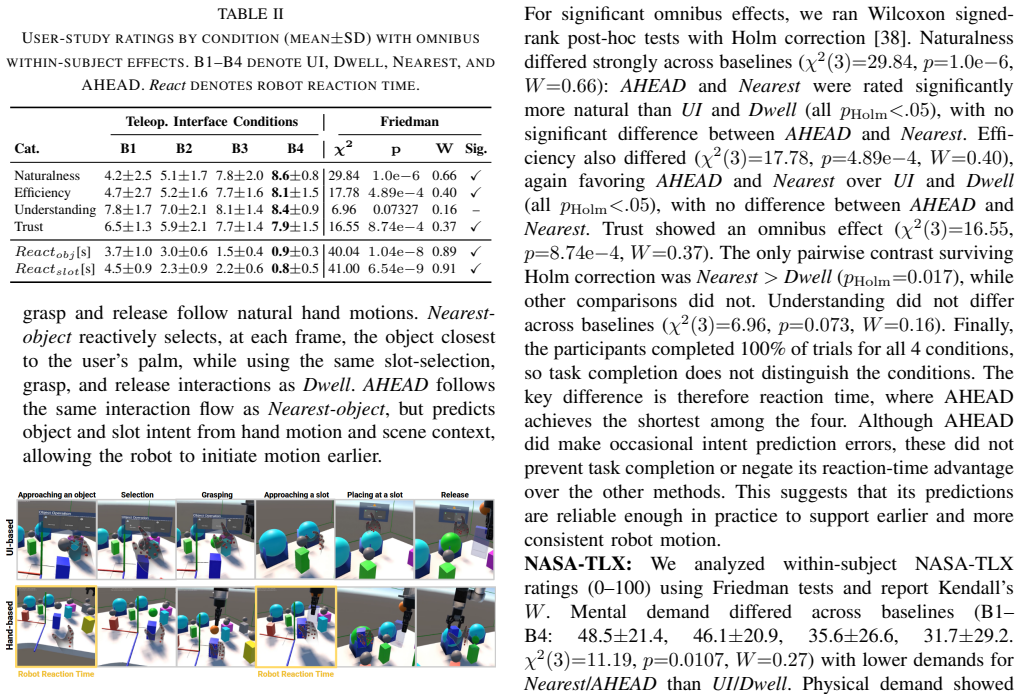
Summary. AHEAD is a VR teleoperation system that predicts operator intent (grasp object, placement slot) from short windows of 3D hand joints, head pose, and scene context using phase-specific attention-based classifiers. A distance-gated preview/commit state machine converts these predictions into early robot motion without explicit commands. Offline leave-one-subject-out evaluation reports 76% Top1 accuracy for both object and slot prediction and earlier crossing distances than a nearest heuristic. A 15-participant within-subject user study reports that AHEAD reduces robot reaction time by 0.6 s (object) and 1.4 s (slot) relative to the Nearest baseline and lowers perceived workload.
Significance. If the results hold, AHEAD offers a practical middle ground between direct teleoperation and explicit goal-based supervisory control, potentially reducing operator burden while improving responsiveness. The user study is a well-structured within-subject comparison with appropriate nonparametric omnibus tests and counterbalancing. The paper also includes a reliability analysis with Wilson confidence intervals and a full system description. However, the offline evaluation has a selection-bias issue in threshold calibration and model selection, and no code or data are released, weakening reproducibility. The core user-study claim is plausible and important, but the offline evidence supporting design choices needs re-analysis.
major comments (3)
- [Sec. IV-A and III-D.1] The distance thresholds d_Top1_acc=0.8 and d_Top3_acc=0.8 are calibrated on the LOSO test folds, and the same folds are used to select the Decoupled variant over Unified. Thus the reported T1/T3 Cross distances, Lead50 values, and the model-choice argument are optimistically biased: the thresholds and architecture are chosen from the same data used to evaluate them. To support the offline claims, the calibration and model selection should be nested inside the LOSO loop (e.g., thresholds chosen on the training folds of each split and then evaluated on the held-out fold). Without this, the size of the early-prediction advantage in Table I is not a reliable out-of-sample estimate.
- [Sec. III-D.1 vs III-D.2] Calibration bins use palm–ground-truth-target distance, but the runtime policy gates on distance to the predicted Top1 centroid (d(t) = ||p_palm(t) - c_i1(t)||). When the prediction is incorrect, these distances differ, and the trigger can occur earlier or later than the 0.8-accuracy calibration implies. The paper does not quantify this mismatch. The authors should either calibrate on the predicted-distance distribution or report an analysis of how often the runtime trigger distance deviates from the calibration distance and what the resulting reliability is. Without this, the claim that the system operates at the intended reliability level in the user study is not directly supported.
- [Table II and Sec. IV-C] The central reaction-time claim (0.6 s object, 1.4 s slot vs. Nearest) is supported only by omnibus Friedman tests. The paper reports post-hoc tests for Naturalness, Efficiency, Trust, and some TLX subscales, but not for the reaction-time measures. Given that the abstract states quantitative relative improvements, the authors should report Holm-corrected Wilcoxon pairwise results for React_obj and React_slot, at least for AHEAD vs. Nearest and AHEAD vs. Dwell. This is necessary to establish that the differences are statistically reliable at the pair level.
minor comments (6)
- [General] No code or data are released. Providing the dataset and model code, or at least a detailed pseudo-code of the calibration and policy, would substantially improve reproducibility and enable independent verification of the threshold-selection issue.
- [Fig. 4] Figure 4 shows red/green dotted lines for the thresholds but the actual distance values are not listed on the figure. Adding the numeric values (e.g., d_Top1, d_Top3) would make the policy clearer.
- [Sec. III-D.1] The text says 'values reported in Table I' after defining the thresholds, but Table I reports crossing times/distances, not the threshold distances directly. Clarify which numbers correspond to d_Top1_acc=0.8 and d_Top3_acc=0.8.
- [Abstract] The phrase 'relative to baselines' is vague. Specify that the 0.6 s and 1.4 s reductions are relative to the Nearest hand-driven baseline, as the comparison in Table II suggests.
- [Sec. IV-B] The user study uses a fixed layout of six objects and six slots, whereas the offline dataset samples 5–10 objects/slots. The authors should briefly discuss whether this difference could affect the model's behavior in the user study, for example, due to changed ambiguity levels.
- [Sec. IV-A Discussion] The sentence 'we successfully deploy the model in teleoperation with unseen users and a different scene, whilst keeping d_Top1_acc=0.8 and d_Top3_acc=0.8 unchanged' is a strong claim. The user study supports that the system works, but no online accuracy or trigger-distance measurements are reported. A direct measurement of crossing distances or accuracy in the user study scene would make this claim more rigorous.
Circularity Check
Threshold calibration is self-referential, but the central reaction-time claim rests on independent user-study measurements; no load-bearing circularity.
specific steps
-
self definitional
[Sec. III-D.1 and Sec. IV-A ('Reliability Analysis of T1/T3 Cross')]
"We then set d Top1 acc=0.8 and d Top3 acc=0.8 to the distances at which the corresponding accuracy exceeds 0.80 (values reported in Table I). ... These crossing-bin estimates show that the selected policy thresholds in Sec. III-D place the controller at the intended reliability level suitable for proactive control."
The thresholds are defined as the distances at which validation accuracy crosses 0.80, so the later 'reliability analysis' that reports ~0.815/0.813 accuracy at those same crossing bins is a restatement of the definition rather than an independent confirmation. As a calibration check this is harmless, but as evidence that the thresholds 'place the controller at the intended reliability level' it is circular. It does not affect the central claim: the user-study reaction times are physical measurements taken with these fixed thresholds, so the reaction-time reduction is not derived from the threshold accuracy.
full rationale
AHEAD is an empirical systems paper. The intent predictor is evaluated by leave-one-subject-out cross-validation, and the user-study reaction times are direct measurements comparing four interface conditions; neither claim is derived by construction from the model's training objective. The only self-referential element is the calibration/validation loop around d_Top1_acc=0.8 and d_Top3_acc=0.8: the thresholds are set as the distances where validation accuracy crosses 0.8, and the paper then cites the ~0.8 accuracy at those same crossing bins as evidence that the controller operates at the intended reliability. That is a definitional tautology, but it is not load-bearing for the headline reaction-time result, which is independently measured on 15 unseen users with a different scene layout. No uniqueness theorem, ansatz-via-citation, or fitted-parameter-as-prediction pattern appears. The paper's own limitation statement concedes limited cross-layout generalization, which is a validity concern rather than a circularity concern. Overall circularity is minimal.
Axiom & Free-Parameter Ledger
free parameters (5)
- Distance-gated reliability thresholds d_Top1 and d_Top3 =
Distances at which validation Top1/Top3 accuracy exceeds 0.80; numeric values not stated in text
- Hysteresis latch confidence and persistence =
0.65 confidence; 0.1 s persistence
- Neighborhood radius r_nbr =
0.3 m
- Temporal window size T and evaluation stride =
T=30 frames (0.5 s); stride 5 in evaluation
- Intent classifier weights =
Learned, not enumerated
axioms (5)
- domain assumption A 0.5 s window of hand/head motion and scene context contains enough information to predict the next grasp object and slot.
- domain assumption Head-forward ray is a sufficient proxy for gaze direction.
- domain assumption ArUco/ChArUco tracking provides accurate object poses and calibration for real-to-sim consistency.
- domain assumption Instance-agnostic cuboid/sphere scene encoding is sufficient; object identity and mesh details are not needed.
- domain assumption Distance-gated preview-and-commit motion is safe and stable on the real robot.
read the original abstract
Direct hand-driven teleoperation maps an operator's hand motion to robot end-effector commands at every frame, enabling precise control, but it requires constant monitoring and correction during approach, grasp, and placement, which can be slow and fatiguing. For repetitive pick-and-place tasks, supervisory (goal-based) teleoperation simplifies this process: the operator specifies goals/waypoints, and the robot executes the motion using planning algorithms. Yet, this introduces latency, as the robot must wait for the next command before it can plan and act. "How can we reduce robot reaction time while lowering operator workload?" To tackle this question, we present AHEAD, a real-time VR teleoperation system that anticipates operator intent to enable proactive, hand-driven control. In a digital twin, the operator performs pick-and-place naturally, using hand motion to convey high-level commands rather than a continuous robot trajectory. AHEAD processes a short window of 3D hand and head signals together with scene context through an attention-based classifier to predict the intended grasp object and placement slot. A state machine converts intent predictions into stable robot goals, enabling early motion while remaining stable under noisy predictions and corrective hand movements. AHEAD's intent prediction module achieves Top1 accuracy: 76% for grasp objects and 76% for target slots. Moreover, our user study shows AHEAD reduces robot reaction latency by 0.6 s (object) and 1.4 s (slot) relative to baselines. Participants also reported lower operator load, indicating faster robot responses while maintaining low operator effort in practice.
Figures


Reference graph
Works this paper leans on
-
[1]
N. R. Council,Virtual Reality: Scientific and Technological Chal- lenges, N. I. Durlach and A. S. Mavor, Eds. Washington, DC: The National Academies Press, 1995
1995
-
[2]
Teleoperation and visualization interfaces for remote intervention in space,
P. Kazanzides, B. P. Vagvolgyi, W. Pryor, A. Deguet, S. Leonard, and L. L. Whitcomb, “Teleoperation and visualization interfaces for remote intervention in space,”Frontiers in Robotics and AI, vol. 8, 2021
2021
-
[3]
Anyteleop: A general vision-based dexterous robot arm- hand teleoperation system,
Y . Qin, W. Yang, B. Huang, K. V . Wyk, H. Su, X. Wang, Y .-W. Chao, and D. Fox, “Anyteleop: A general vision-based dexterous robot arm- hand teleoperation system,” 2024
2024
-
[4]
Open- television: Teleoperation with immersive active visual feedback,
X. Cheng, J. Li, S. Yang, G. Yang, and X. Wang, “Open- television: Teleoperation with immersive active visual feedback,” arXiv:2407.01512, 2024
Pith/arXiv arXiv 2024
-
[5]
Open teach: A versatile teleoperation system for robotic manipulation,
A. Iyer, Z. Peng, Y . Dai, I. Guzey, S. Haldar, S. Chintala, and L. Pinto, “Open teach: A versatile teleoperation system for robotic manipulation,” 2024
2024
-
[6]
The da vinci telerobotic surgical system: the virtual operative field and telepresence surgery,
G. H. Ballantyne and F. Moll, “The da vinci telerobotic surgical system: the virtual operative field and telepresence surgery,”Surgical Clinics of North America, vol. 83, no. 6, pp. 1293–1304, 12 2003
2003
-
[7]
The impacts of unreliable autonomy in human-robot collaboration on shared and supervisory control for remote manipulation,
T.-C. Lin, A. U. Krishnan, and Z. Li, “The impacts of unreliable autonomy in human-robot collaboration on shared and supervisory control for remote manipulation,”IEEE Robotics and Automation Letters, vol. 8, no. 8, pp. 4641–4648, 2023
2023
-
[8]
Multi-modal user interface for multi-robot control in underground environments,
S. Chen, M. J. O’Brien, F. Talbot, J. Williams, B. Tidd, A. Pitt, and R. C. Arkin, “Multi-modal user interface for multi-robot control in underground environments,” inIEEE/RSJ IROS, 2022, pp. 9995– 10 002
2022
-
[9]
Fast explicit-input assistance for teleoperation in clutter,
N. Walker, X. Yang, A. Garg, M. Cakmak, D. Fox, and C. P ´erez- D’Arpino, “Fast explicit-input assistance for teleoperation in clutter,” inIEEE/RSJ IROS, 2024, pp. 9270–9276
2024
-
[10]
Inferring goals with gaze during teleoperated manipulation,
R. M. Aronson, N. Almutlak, and H. Admoni, “Inferring goals with gaze during teleoperated manipulation,” inIEEE/RSJ IROS, 2021, pp. 7307–7314
2021
-
[11]
Landmark-based goal recognition for shared autonomy: A framework for enhanced teleoperation,
G. Lorthioir, M. Benallegue, R. Cisneros-Lim ´on, and I. G. Ram ´ırez- Alpizar, “Landmark-based goal recognition for shared autonomy: A framework for enhanced teleoperation,” inIEEE/RSJ IROS, 2025, pp. 16 523–16 530
2025
-
[12]
Mixed reality teleoperation assistance for direct control of humanoids,
L. Penco, K. Momose, S. McCrory, D. Anderson, N. Kitchel, D. Calvert, and R. J. Griffin, “Mixed reality teleoperation assistance for direct control of humanoids,”IEEE Robotics and Automation Letters, vol. 9, no. 2, pp. 1937–1944, 2024
1937
-
[13]
Egopat3dv2: Predicting 3d action target from 2d egocentric vision for human-robot interaction,
I. Fang, Y . Chen, Y . Wang, J. Zhang, Q. Zhang, J. Xu, X. He, W. Gao, H. Su, Y . Li, and C. Feng, “Egopat3dv2: Predicting 3d action target from 2d egocentric vision for human-robot interaction,” inIEEE Int. Conf. Robot. Autom. (ICRA), 2024, pp. 3036–3043
2024
-
[14]
Ego- centric action recognition by capturing hand-object contact and object state,
T. Shiota, M. Takagi, K. Kumagai, H. Seshimo, and Y . Aono, “Ego- centric action recognition by capturing hand-object contact and object state,” inIEEE/CVF Winter Conf. Appl. Comput. Vis. (WACV), 2024, pp. 6527–6537
2024
-
[15]
Handson- VLM: Vision-language models for hand-object interaction prediction,
C. Bao, J. Xu, X. Wang, A. Gupta, and H. Bharadhwaj, “Handson- VLM: Vision-language models for hand-object interaction prediction,” Transactions on Machine Learning Research, 2025
2025
-
[16]
Hand tracking overview,
Meta, “Hand tracking overview,” Meta Horizon OS Developers (Unity Documentation), Dec. 2024, accessed: 2026-02-15. [Online]. Available: https://developers.meta.com/horizon/documentation/unity/ unity-handtracking-overview/
2024
-
[17]
Hand tracking (mrtk3),
Microsoft, “Hand tracking (mrtk3),” Microsoft Learn (Mixed Reality Toolkit 3 Documentation), May 2023, last updated: 2023-05-31. Accessed: 2026-02-15. [Online]. Available: https://learn.microsoft.com/en-us/windows/mixed-reality/ mrtk-unity/mrtk3-input/packages/input/hand-tracking
2023
-
[18]
Development of nasa-tlx (task load index): Results of empirical and theoretical research,
S. G. Hart and L. E. Staveland, “Development of nasa-tlx (task load index): Results of empirical and theoretical research,” inHuman Mental Workload, ser. Advances in Psychology. North-Holland, 1988, vol. 52, pp. 139–183
1988
-
[19]
Gello: A general, low- cost, and intuitive teleoperation framework for robot manipulators,
P. Wu, Y . Shentu, Z. Yi, X. Lin, and P. Abbeel, “Gello: A general, low- cost, and intuitive teleoperation framework for robot manipulators,” in IEEE/RSJ IROS, 2024, pp. 12 156–12 163
2024
-
[20]
Homie: Humanoid loco-manipulation with isomorphic exoskeleton cockpit,
Q. Ben, F. Jia, J. Zeng, J. Dong, D. Lin, and J. Pang, “Homie: Humanoid loco-manipulation with isomorphic exoskeleton cockpit,” arXiv preprint arXiv:2502.13013, 2025
Pith/arXiv arXiv 2025
-
[21]
J. Guo, J. Luo, Z. Wei, Y . Hou, Z. Xu, X. Lin, C. Gao, and L. Shao, “Telepreview: A user-friendly teleoperation system with virtual arm assistance for enhanced effectiveness,” 2025. [Online]. Available: https://arxiv.org/abs/2412.13548
Pith/arXiv arXiv 2025
-
[22]
Task-level authoring for remote robot teleoperation,
E. Senft, M. Hagenow, K. Welsh, R. Radwin, M. Zinn, M. Gleicher, and B. Mutlu, “Task-level authoring for remote robot teleoperation,” Frontiers in Robotics and AI, vol. 8, p. 707149, 2021
2021
-
[23]
Holoassist: an egocentric human interaction dataset for interactive ai assistants in the real world,
X. Wang, T. Kwon, M. Rad, B. Pan, I. Chakraborty, S. Andrist, D. Bohus, A. Feniello, B. Tekin, F. V . Frujeri,et al., “Holoassist: an egocentric human interaction dataset for interactive ai assistants in the real world,” inIEEE/CVF Conf. Comput. Vis. Pattern Recognit. (CVPR), 2023, pp. 20 270–20 281
2023
-
[24]
Joint hand motion and interaction hotspots prediction from egocentric videos,
S. Liu, S. Tripathi, S. Majumdar, and X. Wang, “Joint hand motion and interaction hotspots prediction from egocentric videos,” inIEEE/CVF Conf. Comput. Vis. Pattern Recognit. (CVPR), 2022
2022
-
[25]
The invisible egohand: 3d hand forecasting through egobody pose estimation,
M. Hatano, Z. Zhu, H. Saito, and D. Damen, “The invisible egohand: 3d hand forecasting through egobody pose estimation,” 2025
2025
-
[26]
So predictable! continuous 3d hand trajectory prediction in virtual reality,
N. M. Gamage, D. Ishtaweera, M. Weigel, and A. Withana, “So predictable! continuous 3d hand trajectory prediction in virtual reality,” inACM UIST, 2021, pp. 332–343
2021
-
[27]
Automatic generation and detection of highly reliable fiducial markers under occlusion,
S. Garrido-Jurado, R. Mu ˜noz-Salinas, F. J. Madrid-Cuevas, and M. J. Mar´ın-Jim´enez, “Automatic generation and detection of highly reliable fiducial markers under occlusion,”Pattern Recognition, vol. 47, no. 6, pp. 2280–2292, 2014
2014
-
[28]
Pos3r: 6d pose estimation for unseen objects made easy,
W. Deng, D. Campbell, C. Sun, J. Zhang, S. Kanitkar, M. E. Shaffer, and S. Gould, “Pos3r: 6d pose estimation for unseen objects made easy,” inIEEE/CVF Conf. Comput. Vis. Pattern Recognit. (CVPR), 2025, pp. 16 818–16 828
2025
-
[29]
Openxr hand skeleton in interaction sdk,
Meta, “Openxr hand skeleton in interaction sdk,” Meta Horizon OS Developers (Unity Documentation), Nov. 2024, accessed: 2026-01-25. [Online]. Available: https://developers.meta.com/horizon/ documentation/unity/unity-isdk-openxr-hand/
2024
-
[30]
Animating rotation with quaternion curves,
K. Shoemake, “Animating rotation with quaternion curves,”SIG- GRAPH Comput. Graph., vol. 19, no. 3, p. 245–254, 1985
1985
-
[31]
Touch hand grab interactions,
Meta, “Touch hand grab interactions,” Meta Horizon OS Developers (Unity Documentation), Nov. 2025, accessed: 2026-01-25. [Online]. Available: https://developers.meta.com/horizon/documentation/unity/ unity-isdk-touch-hand-grab-interaction/
2025
-
[32]
How attentive are graph attention networks?
S. Brody, U. Alon, and E. Yahav, “How attentive are graph attention networks?” inInt. Conf. Learn. Represent. (ICLR), 2022
2022
-
[33]
Attention is all you need,
A. Vaswani, N. Shazeer, N. Parmar, J. Uszkoreit, L. Jones, A. N. Gomez, L. u. Kaiser, and I. Polosukhin, “Attention is all you need,” inAdv. Neural Inf. Process. Syst. (NIPS), vol. 30, 2017
2017
-
[34]
Rectified linear units improve restricted boltzmann machines,
V . Nair and G. Hinton, “Rectified linear units improve restricted boltzmann machines,” inInt. Conf. Mach. Learn. (ICML), 2010, p. 807–814
2010
-
[35]
Onnx runtime,
O. R. developers, “Onnx runtime,” https://onnxruntime.ai/, 2021
2021
-
[36]
Probable inference, the law of succession, and statistical inference,
E. Wilson, “Probable inference, the law of succession, and statistical inference,”Journal of the American Statistical Association, vol. 22, no. 158, pp. 209–212, 1927
1927
-
[37]
The problem ofmrankings,
M. Kendall and B. Smith, “The problem ofmrankings,”The Annals of Mathematical Statistics, vol. 10, no. 3, pp. 275–287, 1939
1939
-
[38]
A simple sequentially rejective multiple test procedure,
S. Holm, “A simple sequentially rejective multiple test procedure,” Scandinavian Journal of Statistics, vol. 6, no. 2, pp. 65–70, 1979
1979
discussion (0)
Sign in with ORCID, Apple, or X to comment. Anyone can read and Pith papers without signing in.