Hybrid stars with hyperons: structure based on QCD sum rule coupling constants
Pith reviewed 2026-06-26 15:22 UTC · model grok-4.3
The pith
Coupling constants taken from QCD sum rules fix the hadronic sector of hybrid stars that include hyperons and a quark core.
A machine-rendered reading of the paper's core claim, the machinery that carries it, and where it could break.
Core claim
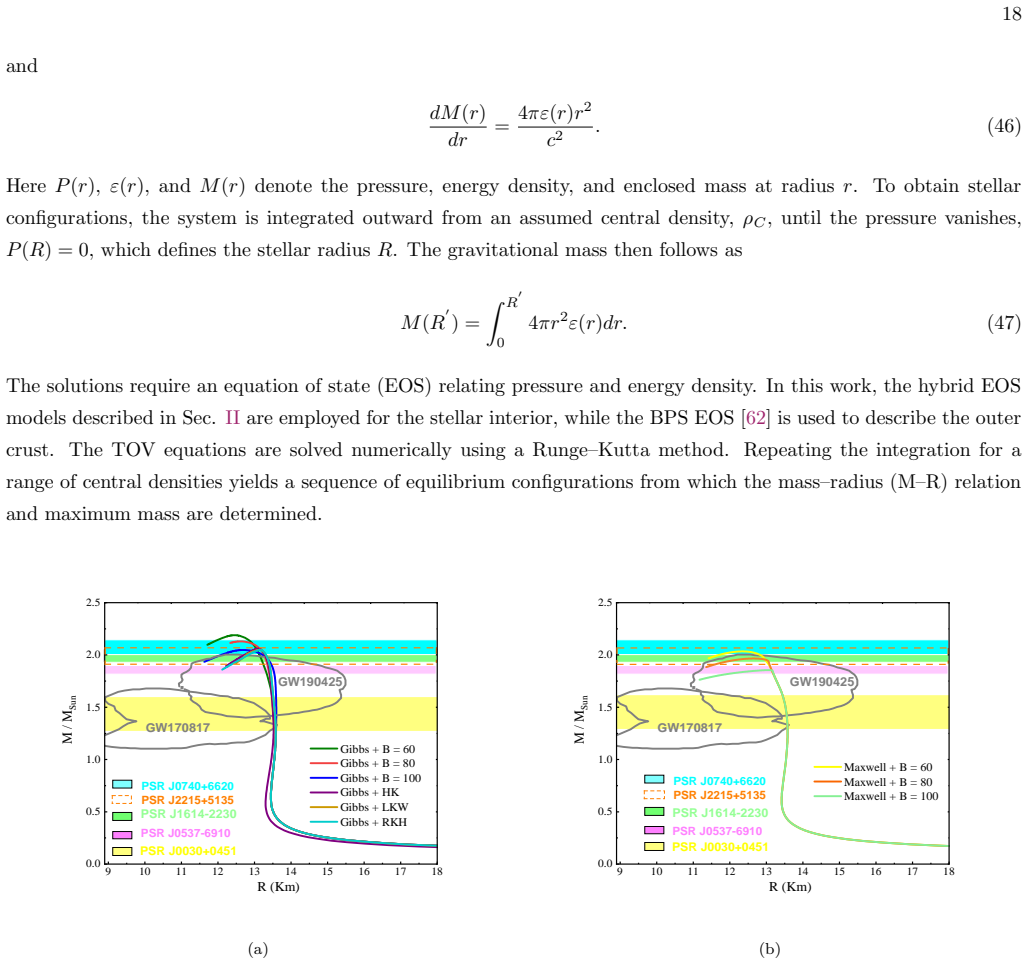
QCD sum rules supply the coupling constants that set the single-particle potentials and the beta-equilibrium equation of state for the hadronic phase containing nucleons and hyperons; when this EOS is joined to MIT bag or NJL quark matter via Gibbs or Maxwell constructions, the hybrid-star models produce definite mass-radius relations and tidal deformabilities.
What carries the argument
QCDSR-derived coupling constants inside the relativistic mean-field sigma-omega-rho model for the hyperon-containing hadronic phase, which fix the EOS before it is matched to the quark models.
If this is right
- Mass-radius relations from the two quark models can be compared directly with NICER or future X-ray radius measurements.
- Computed tidal deformabilities supply concrete targets for gravitational-wave signals from binary mergers.
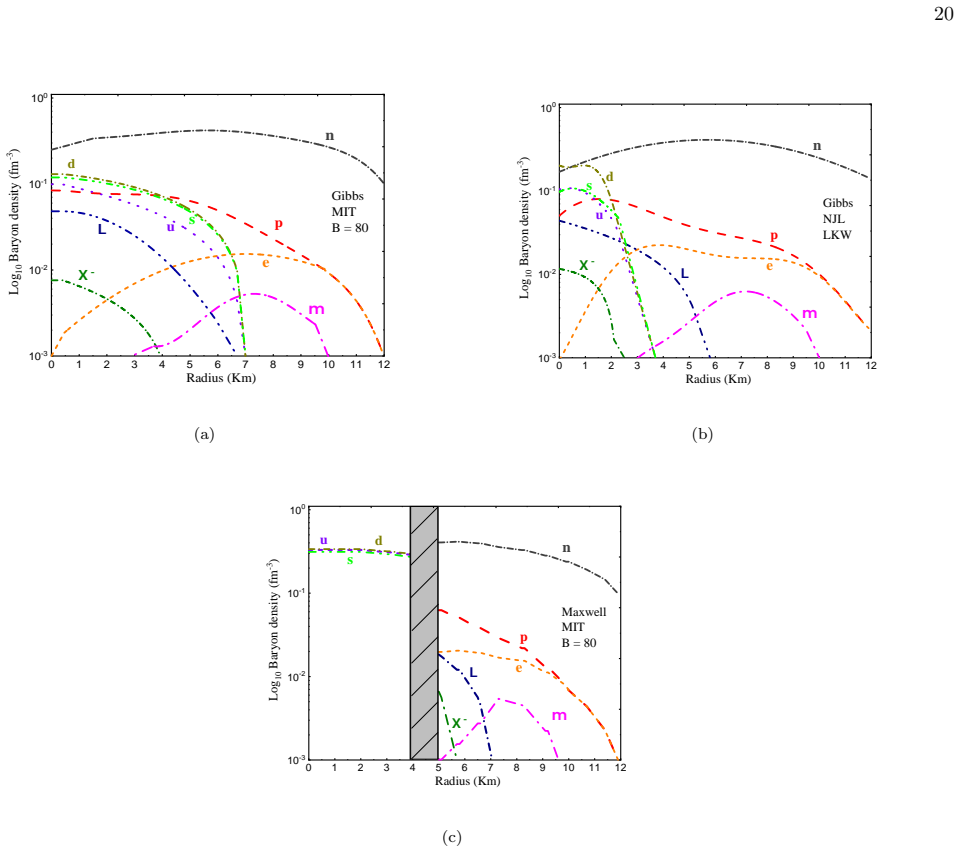
- Radial profiles of hyperon and quark fractions indicate the density at which each species appears inside the star.
- Differences between Gibbs and Maxwell constructions appear as distinct features in the mass-radius plane.
Where Pith is reading between the lines
- If the QCDSR couplings remain reliable at higher densities, the same constants could be reused for other hyperon-rich systems such as hypernuclei or neutron-star crusts.
- The two quark models produce overlapping but not identical tidal ranges, suggesting that future high-precision deformability data could discriminate between bag and NJL descriptions.
- The framework supplies a route to replace purely phenomenological hyperon couplings with sum-rule values in any beta-equilibrium EOS calculation.
Load-bearing premise
The coupling constants derived from QCD sum rules accurately constrain the single-particle potentials of nucleons and hyperons in the hadronic phase under beta equilibrium.
What would settle it
A measured radius for a 1.4-solar-mass compact object that lies outside the bands produced by both the MIT-bag and NJL versions of the EOS would rule out the quantitative predictions.
Figures
read the original abstract
We present a comprehensive study of hybrid stars composed of hadrons, leptons, and quarks within a relativistic mean-field framework. Using coupling constants derived from QCD sum rules (QCDSR), we first determine the bulk properties of nuclear matter and evaluate the single-particle potentials of nucleons and hyperons to constrain the hadronic sector. The equation of state (EOS) under beta equilibrium is then constructed employing the $\sigma-\omega-\rho$ model for the hadronic phase, while the quark phase is described using both the MIT bag model and the Nambu-Jona-Lasinio (NJL) model. The hadron-quark phase transition is analyzed through both Gibbs and Maxwell constructions. Based on resulting EOSs, we obtain the mass-radius relations of hybrid stars, investigate particle fractions and their radial distributions, and calculate the tidal Love number ($\mathcal{K}_{2}$) and the dimensionless tidal deformability ($\varLambda$). Our results provide quantitative predictions relevant for comparison with current multimessenger astrophysical observations.
Editorial analysis
A structured set of objections, weighed in public.
Referee Report
Summary. The manuscript constructs equations of state for hybrid stars containing hyperons using a relativistic mean-field (σ-ω-ρ) model for the hadronic phase whose coupling constants are taken from QCD sum rules, combined with MIT bag and NJL descriptions of the quark phase. Gibbs and Maxwell constructions are employed for the hadron-quark transition; the resulting EOSs are used to compute mass-radius relations, particle fractions, and tidal deformabilities (Σ2 and Λ) under beta equilibrium for comparison with multimessenger observations.
Significance. The explicit use of QCDSR-derived couplings supplies a more microscopic foundation for the hadronic interactions than purely phenomenological fits, which is a methodological strength. If the central extrapolation holds, the quantitative M-R and tidal predictions could furnish testable constraints on the high-density EOS. The work therefore has potential relevance for interpreting NICER, LIGO/Virgo, and future multimessenger data, provided the density-range limitations of the input couplings are addressed.
major comments (1)
- [Abstract] Abstract (hadronic-sector paragraph): the statement that QCDSR couplings 'accurately constrain the single-particle potentials of nucleons and hyperons in the hadronic phase under beta equilibrium' is load-bearing for the entire subsequent EOS construction and for the location of the hadron-quark transition. QCDSR evaluations are performed near saturation density; the manuscript provides no quantified uncertainty propagation or density-dependent rescaling when these constants are extrapolated to the several-times-saturation densities relevant for hybrid-star cores. This directly affects hyperon onset, hadronic stiffness, and the resulting tidal deformability curves.
minor comments (2)
- Notation for the tidal quantities (Σ2 and Λ) should be defined explicitly on first use and cross-referenced to the standard definitions in the literature.
- The abstract lists both Gibbs and Maxwell constructions but does not indicate which (or both) results are shown in the mass-radius and tidal-deformability figures; a brief statement clarifying the presentation would improve readability.
Simulated Author's Rebuttal
We thank the referee for the thorough review and valuable feedback on our manuscript. The major comment is addressed point by point below. We agree that additional discussion of the extrapolation limitations is warranted and will revise accordingly to strengthen the presentation.
read point-by-point responses
-
Referee: [Abstract] Abstract (hadronic-sector paragraph): the statement that QCDSR couplings 'accurately constrain the single-particle potentials of nucleons and hyperons in the hadronic phase under beta equilibrium' is load-bearing for the entire subsequent EOS construction and for the location of the hadron-quark transition. QCDSR evaluations are performed near saturation density; the manuscript provides no quantified uncertainty propagation or density-dependent rescaling when these constants are extrapolated to the several-times-saturation densities relevant for hybrid-star cores. This directly affects hyperon onset, hadronic stiffness, and the resulting tidal deformability curves.
Authors: We agree that QCDSR evaluations are performed near saturation density and that their application to several-times-saturation densities in the hybrid-star cores involves extrapolation, which is standard in RMF models but requires careful qualification. The manuscript highlights the microscopic foundation provided by QCDSR-derived couplings relative to phenomenological fits, and the single-particle potentials are evaluated at saturation to fix the parameters before extending the model. However, the current version does not include explicit uncertainty propagation or density-dependent rescaling. In the revised manuscript we will add a dedicated paragraph in the hadronic-sector section discussing the validity range of the QCDSR couplings, citing literature on their high-density applications, and providing a qualitative assessment of how variations could influence hyperon onset and tidal deformability. This addresses the concern without changing the core calculations. revision: yes
Circularity Check
No significant circularity; QCDSR couplings and standard models provide independent inputs
full rationale
The derivation begins with coupling constants taken from QCD sum rules as external input to fix the RMF hadronic sector and single-particle potentials, then applies standard MIT bag and NJL descriptions to the quark phase, followed by Gibbs/Maxwell constructions and standard TOV integration for mass-radius and tidal quantities. No equation or step reduces by construction to a prior fitted quantity, self-citation chain, or renamed ansatz; the final observables are computed outputs from the assembled EOS rather than tautological restatements of the input couplings. The paper is therefore self-contained against external benchmarks.
Axiom & Free-Parameter Ledger
free parameters (2)
- QCDSR coupling constants
- MIT bag constant
axioms (2)
- domain assumption Beta equilibrium and charge neutrality determine the particle fractions
- domain assumption The sigma-omega-rho model with hyperons describes the hadronic phase
Reference graph
Works this paper leans on
-
[1]
µf µ2 f − 5 2 m2 f q µ2 f −m 2 f + 3 2 m4 f ln µf + q µ2 f −m 2 f mf # + αc 2π3
MIT bag model We begin by providing an overview of the MIT bag model [39]. The thermodynamic potential for quarks of flavor f = u, d, s at zero temperature is expressed as follows: Ωf(µf) =− 1 4π2 " µf µ2 f − 5 2 m2 f q µ2 f −m 2 f + 3 2 m4 f ln µf + q µ2 f −m 2 f mf # + αc 2π3 " 3 µf q µ2 f −m 2 f −m 2 f ln µf + q µ2 f −m 2 f mf 2 ...
-
[2]
The NJL model This section presents the three-flavor formulation of the Nambu–Jona-Lasinio (NJL) model. The Lagrangian most frequently employed within this framework is expressed as [43], L= ¯q(i/∂−ˆm)q+L sym +L det.(31) q= (u, d, s) T denote a quark field comprising three distinct flavors, and let the associated quark mass matrix be given by ˆm=diag(m u,...
-
[3]
Given the presence of quarks, the electron mass can be regarded as negligible; consequently, electrons are modeled as a massless, non-interacting fermionic gas
Electrons and Beta Equilibrium The weak decay process (d↔u+e+ ¯ν e ↔s) occurring within the quark matter results in the generation of electrons in this medium. Given the presence of quarks, the electron mass can be regarded as negligible; consequently, electrons are modeled as a massless, non-interacting fermionic gas. And consequently, Pe = µ4 e 12π2 , ϵ...
2001
-
[4]
Remarks on Super-Novae and Cosmic Rays,
W. Baade and F. Zwicky, “Remarks on Super-Novae and Cosmic Rays,” Phys. Rev.46, no.1, 76 (1934)
1934
-
[5]
An Equation of State for Nuclear and Higher-Density Matter Based on a Relativistic Mean-Field Theory,
S. A. Chin and J. D. Walecka, “An Equation of State for Nuclear and Higher-Density Matter Based on a Relativistic Mean-Field Theory,” Phys. Lett. B52, 24-28 (1974)
1974
-
[6]
Neutron star properties with relativistic equations of state,
H. Huber, F. Weber, M. K. Weigel and C. Schaab, “Neutron star properties with relativistic equations of state,” Int. J. Mod. Phys. E7, 301-340 (1998) [arXiv:nucl-th/9711025 [nucl-th]]
Pith/arXiv arXiv 1998
-
[7]
Phases of dense matter in neutron stars,
H. Heiselberg and M. Hjorth-Jensen, “Phases of dense matter in neutron stars,” Phys. Rept.328, 237-327 (2000) [[arXiv:nucl-th/9902033 [nucl-th]]
Pith/arXiv arXiv 2000
-
[8]
Neutron star structure and the equation of state,
J. M. Lattimer and M. Prakash, “Neutron star structure and the equation of state,” Astrophys. J.550, 426 (2001) [arXiv:astro-ph/0002232 [astro-ph]]
Pith/arXiv arXiv 2001
-
[9]
Strange quark matter and compact stars,
F. Weber, “Strange quark matter and compact stars,” Prog. Part. Nucl. Phys.54, 193-288 (2005) [arXiv:astro-ph/0407155 [astro-ph]]
Pith/arXiv arXiv 2005
-
[10]
Masses, Radii, and the Equation of State of Neutron Stars,
F. ¨Ozel and P. Freire, “Masses, Radii, and the Equation of State of Neutron Stars,” Ann. Rev. Astron. Astrophys.54, 401-440 (2016) [arXiv:1603.02698 [astro-ph.HE]]
Pith/arXiv arXiv 2016
-
[11]
Shapiro Delay Measurement of A Two Solar Mass Neutron Star,
P. Demorest, T. Pennucci, S. Ransom, M. Roberts and J. Hessels, “Shapiro Delay Measurement of A Two Solar Mass Neutron Star,” Nature467, 1081-1083 (2010) [arXiv:1010.578 [astro-ph.HE]]
2010
-
[12]
The NANOGrav 11-year Data Set: High-precision timing of 45 Millisecond Pulsars,
Z. Arzoumanianet al.[NANOGrav], “The NANOGrav 11-year Data Set: High-precision timing of 45 Millisecond Pulsars,” Astrophys. J. Suppl.235, no.2, 37 (2018) [arXiv:1801.01837 [astro-ph.HE]]
Pith/arXiv arXiv 2018
-
[13]
Relativistic Shapiro delay measurements of an extremely massive millisecond pulsar,
H. T. Cromartieet al.[NANOGrav], “Relativistic Shapiro delay measurements of an extremely massive millisecond pulsar,” Nature Astron.4, no.1, 72-76 (2019) [arXiv:1904.06759 [astro-ph.HE]]
arXiv 2019
-
[14]
Refined Mass and Geometric Measurements of the High-mass PSR J0740+6620,
E. Fonseca, H. T. Cromartie, T. T. Pennucci, P. S. Ray, A. Y. Kirichenko, S. M. Ransom, P. B. Demorest, I. H. Stairs, Z. Arzoumanian and L. Guillemot,et al.“Refined Mass and Geometric Measurements of the High-mass PSR J0740+6620,” Astrophys. J. Lett.915, no.1, L12 (2021) [arXiv:2104.00880 [astro-ph.HE]]
arXiv 2021
-
[15]
PSR J0952−0607: The Fastest and Heaviest Known Galactic Neutron Star,
R. W. Romani, D. Kandel, A. V. Filippenko, T. G. Brink and W. Zheng, “PSR J0952−0607: The Fastest and Heaviest Known Galactic Neutron Star,” Astrophys. J. Lett.934, no.2, L17 (2022) [arXiv:2207.05124 [astro-ph.HE]]
arXiv 2022
-
[16]
Pinning down the superfluid and measuring masses using pulsar glitches,
W. C. G. Ho, C. M. Espinoza, D. Antonopoulou and N. Andersson, “Pinning down the superfluid and measuring masses using pulsar glitches,” Science Adv. 1, e1500578 (2015) [arXiv:1510.00395 [astro-ph.SR]]
Pith/arXiv arXiv 2015
-
[17]
Return of the Big Glitcher: NICER timing and glitches of PSR J0537−6910,
W. C. G. Ho, C. M. Espinoza, Z. Arzoumanian, T. Enoto, T. Tamba, D. Antonopoulou, M. l. Bejger, S. Guillot, B. Haskell and P. S. Ray, “Return of the Big Glitcher: NICER timing and glitches of PSR J0537−6910,” Mon. Not. Roy. Astron. Soc.498, no.4, 4605-4614 (2020) [arXiv:2009.00030 [astro-ph.HE]]
arXiv 2020
-
[18]
Properties of the binary neutron star merger GW170817,
B. P. Abbottet al.[LIGO Scientific and Virgo], “Properties of the binary neutron star merger GW170817,” Phys. Rev. X 9, no.1, 011001 (2019) [arXiv:1805.11579 [gr-qc]]
Pith/arXiv arXiv 2019
-
[19]
GW190425: Observation of a Compact Binary Coalescence with Total Mass∼3.4M ⊙,
B. P. Abbottet al.[LIGO Scientific and Virgo], “GW190425: Observation of a Compact Binary Coalescence with Total Mass∼3.4M ⊙,” Astrophys. J. Lett.892, no.1, L3 (2020) [arXiv:2001.01761 [astro-ph.HE]]
arXiv 2020
-
[20]
Constraining neutron star tidal Love numbers with gravitational wave detectors,
E. E. Flanagan and T. Hinderer, “Constraining neutron star tidal Love numbers with gravitational wave detectors,” Phys. Rev. D77, 021502 (2008) [arXiv:0709.1915 [astro-ph]]. 23
Pith/arXiv arXiv 2008
-
[21]
Tidal Love numbers of neutron stars,
T. Hinderer, “Tidal Love numbers of neutron stars,” Astrophys. J.677, 1216-1220 (2008) [arXiv:0711.2420 [astro-ph]]
Pith/arXiv arXiv 2008
-
[22]
GW170817: Measurements of neutron star radii and equation of state,
B. P. Abbottet al.[LIGO Scientific and Virgo], “GW170817: Measurements of neutron star radii and equation of state,” Phys. Rev. Lett.121, no.16, 161101 (2018) [arXiv:1805.11581 [gr-qc]]
Pith/arXiv arXiv 2018
-
[23]
Y. Lim and J. W. Holt, “Bayesian modeling of the nuclear equation of state for neutron star tidal deformabilities and GW170817,” Eur. Phys. J. A55, no.11, 209 (2019) [arXiv:1902.05502 [nucl-th]]
arXiv 2019
-
[24]
T. Malik, N. Alam, M. Fortin, C. Providˆ encia, B. K. Agrawal, T. K. Jha, B. Kumar and S. K. Patra, “GW170817: constraining the nuclear matter equation of state from the neutron star tidal deformability,” Phys. Rev. C98, no.3, 035804 (2018) [arXiv:1805.11963 [nucl-th]]
Pith/arXiv arXiv 2018
-
[25]
AN ICERview of PSR J0030+0451: Implications for the dense matter equation of state,
G. Raaijmakers, T. E. Riley, A. L. Watts, S. K. Greif, S. M. Morsink, K. Hebeler, A. Schwenk, T. Hinderer, S. Nissanke and S. Guillot,et al.“AN ICERview of PSR J0030+0451: Implications for the dense matter equation of state,” Astrophys. J. Lett.887, no.1, L22 (2019) [arXiv:1912.05703 [astro-ph.HE]]
arXiv 2019
-
[26]
The Radius of PSR J0740+6620 from NICER and XMM-Newton Data,
M. C. Miller, F. K. Lamb, A. J. Dittmann, S. Bogdanov, Z. Arzoumanian, K. C. Gendreau, S. Guillot, W. C. G. Ho, J. M. Lattimer and M. Loewenstein,et al.“The Radius of PSR J0740+6620 from NICER and XMM-Newton Data,” Astrophys. J. Lett.918, no.2, L28 (2021) [arXiv:2105.06979 [astro-ph.HE]]
Pith/arXiv arXiv 2021
-
[27]
Neutron star tidal deformability and equation of state constraints,
K. Chatziioannou, “Neutron star tidal deformability and equation of state constraints,” Gen. Rel. Grav.52, no.11, 109 (2020) [arXiv:2006.03168 [gr-qc]]
arXiv 2020
-
[28]
A. Li, Z. Miao, S. Han and B. Zhang, “Constraints on the maximum mass of neutron stars with a quark core from GW170817 and NICER PSR J0030+0451 data,” Astrophys. J.913, no.1, 27 (2021) [arXiv:2103.15119 [astro-ph.HE]]
arXiv 2021
-
[29]
Hyperonic nuclear matter in Bruckner theory,
H. J. Schulze, M. Baldo, U. Lombardo, J. Cugnon and A. Lejeune, “Hyperonic nuclear matter in Bruckner theory,” Phys. Rev. C57, 704-713 (1998)
1998
-
[30]
On the appearance of hyperons in neutron stars,
H. Djapo, B. J. Schaefer and J. Wambach, “On the appearance of hyperons in neutron stars,” Phys. Rev. C81, 035803 (2010) [arXiv:0811.2939 [nucl-th]]
Pith/arXiv arXiv 2010
-
[31]
I. Vida˜ na, “Hyperons in Neutron Stars,” J. Phys. Conf. Ser.668, no.1, 012031 (2016) [arXiv:1509.03587 [nucl-th]]
Pith/arXiv arXiv 2016
-
[32]
D. Lonardoni, F. Pederiva and S. Gandolfi, “Accurate determination of the interaction between Λ hyperons and nucleons from auxiliary field diffusion Monte Carlo calculations,” Phys. Rev. C89, no.1, 014314 (2014) [arXiv:1312.3844 [nucl-th]]
Pith/arXiv arXiv 2014
-
[33]
A. M. A. Looee, M. Shahrbaf and H. R. Moshfegh, “Hyperons in Neutron Stars across the Observed Mass Range: Insights from ΛN and ΛΛ Interactions within a Microscopic Framework,” Astrophys. J.997, no.1, 26 (2026) [arXiv:2509.12881 [nucl-th]]
arXiv 2026
-
[34]
Relativistic mean field theory and the high density nuclear equation of state,
H. Mueller and B. D. Serot, “Relativistic mean field theory and the high density nuclear equation of state,” Nucl. Phys. A606, 508-537 (1996) [arXiv:nucl-th/9603037 [nucl-th]]
Pith/arXiv arXiv 1996
-
[35]
A Theory of highly condensed matter,
J. D. Walecka, “A Theory of highly condensed matter,” Annals Phys.83, 491-529 (1974)
1974
-
[36]
H. Uechi, “Properties of Nuclear and Neutron Matter and Thermodynamic Consistency in a Nonlinear Mean-field Approx- imation,” Nucl. Phys. A780, 247-273 (2006) [arXiv:nucl-th/0604026 [nucl-th]]
Pith/arXiv arXiv 2006
-
[37]
Impact of QCD sum rules coupling constants on neutron stars structure,
F. M. Jangal, H. R. Moshfegh and K. Azizi, “Impact of QCD sum rules coupling constants on neutron stars structure,” Eur. Phys. J. C85, no.6, 691 (2025) [[arXiv:2501.01234 [hep-ph]]
arXiv 2025
-
[38]
Equation of state of hypernuclear matter: impact of hyperon–scalar-meson couplings,
G. Colucci and A. Sedrakian, “Equation of state of hypernuclear matter: impact of hyperon–scalar-meson couplings,” Phys. Rev. C87, 055806 (2013) [arXiv:1302.6925 [nucl-th]]
Pith/arXiv arXiv 2013
-
[39]
Neutron Stars Are Giant Hypernuclei?,
N. K. Glendenning, “Neutron Stars Are Giant Hypernuclei?,” Astrophys. J.293, 470-493 (1985)
1985
-
[40]
Rotating hybrid stars with color-flavor-locked quark matter,
D. Sen and G. Chaudhuri, “Rotating hybrid stars with color-flavor-locked quark matter,” J. Phys. G49, no.7, 075201 (2022) [arXiv:2205.00338 [nucl-th]]
arXiv 2022
-
[41]
First order phase transitions with more than one conserved charge: Consequences for neutron stars,
N. K. Glendenning, “First order phase transitions with more than one conserved charge: Consequences for neutron stars,” Phys. Rev. D46, 1274-1287 (1992)
1992
-
[42]
Comments on New Extended Model of Hadrons,
D. Basu and P. Ghose, “Comments on New Extended Model of Hadrons,” Phys. Rev. D12, 4006 (1975)
1975
-
[43]
Hybrid stars with the color dielectric and the MIT bag models,
C. Maieron, M. Baldo, G. F. Burgio and H. J. Schulze, “Hybrid stars with the color dielectric and the MIT bag models,” Phys. Rev. D70, 043010 (2004) [arXiv:nucl-th/0404089 [nucl-th]]. 24
Pith/arXiv arXiv 2004
-
[44]
Hybrid star within the framework of a lowest-order constraint variational method,
S. Khanmohamadi, H. R. Moshfegh and S. Atashbar Tehrani, “Hybrid star within the framework of a lowest-order constraint variational method,” Phys. Rev. D101, no.2, 023004 (2020) [arXiv:1907.12029 [nucl-th]]
arXiv 2020
-
[45]
Constraining values of bag constant for strange star candi- dates,
A. Aziz, S. Ray, F. Rahaman, M. Khlopov and B. K. Guha, “Constraining values of bag constant for strange star candi- dates,” Int. J. Mod. Phys. D28, no.13, 1941006 (2019) [arXiv:1906.00063 [gr-qc]]
Pith/arXiv arXiv 2019
-
[46]
Hadronization in the SU(3) Nambu-Jona-Lasinio model,
P. Rehberg, S. P. Klevansky and J. Hufner, “Hadronization in the SU(3) Nambu-Jona-Lasinio model,” Phys. Rev. C53, 410-429 (1996) [arXiv:hep-ph/9506436 [hep-ph]]
Pith/arXiv arXiv 1996
-
[47]
NJL model analysis of quark matter at large density,
M. Buballa, “NJL model analysis of quark matter at large density,” Phys. Rept.407, 205-376 (2005) [arXiv:hep-ph/0402234 [hep-ph]]
Pith/arXiv arXiv 2005
-
[48]
QCD phenomenology based on a chiral effective Lagrangian,
T. Hatsuda and T. Kunihiro, “QCD phenomenology based on a chiral effective Lagrangian,” Phys. Rept.247, 221-367 (1994) [arXiv:hep-ph/9401310 [hep-ph]]
Pith/arXiv arXiv 1994
-
[49]
Meson properties at finite temper- ature and baryon density,
M. Lutz, S. Klimt and W. Weise, “ Meson properties at finite temper- ature and baryon density,” Nuclear Physics A, 542(4), 521-558
-
[50]
K. Azizi, Y. Sarac and H. Sundu, “Analysis ofP + c (4380) andP + c (4450) as pentaquark states in the molecular picture with QCD sum rules,” Phys. Rev. D95, no.9, 094016 (2017) [arXiv:1612.07479 [hep-ph]]
Pith/arXiv arXiv 2017
-
[51]
Meson baryon couplings from QCD sum rules,
T. Doi, Y. Kondo and M. Oka, “Meson baryon couplings from QCD sum rules,” Phys. Rept.398, 253-279 (2004) [arXiv:hep- ph/0311117 [hep-ph]]
arXiv 2004
-
[52]
Strong couplings of negative and positive parity nucleons to the heavy baryons and mesons,
K. Azizi, Y. Sarac and H. Sundu, “Strong couplings of negative and positive parity nucleons to the heavy baryons and mesons,” Phys. Rev. D92, no.1, 014022 (2015) [arXiv:1506.00809 [hep-ph]]
Pith/arXiv arXiv 2015
-
[53]
Scalar-meson - baryon coupling constants in QCD sum rules,
G. Erkol, R. G. E. Timmermans, M. Oka and T. A. Rijken, “Scalar-meson - baryon coupling constants in QCD sum rules,” Phys. Rev. C73, 044009 (2006) [arXiv:nucl-th/0603058 [nucl-th]]
Pith/arXiv arXiv 2006
-
[55]
Vector meson-baryon strong coupling contants in light cone QCD sum rules,
T. M. Aliev, A. ¨Ozpineci, M. Savci and V. S. Zamiralov, “Vector meson-baryon strong coupling contants in light cone QCD sum rules,” Phys. Rev. D80, 016010 (2009) [arXiv:0905.4664 [hep-ph]]
Pith/arXiv arXiv 2009
-
[56]
Analysis of the verticesρN N,ρΣΣ andρΞΞ with light-cone QCD sum rules,
Z. G. Wang, “Analysis of the verticesρN N,ρΣΣ andρΞΞ with light-cone QCD sum rules,” Phys. Rev. D75, 054020 (2007) [arXiv:hep-ph/0701176 [hep-ph]]
Pith/arXiv arXiv 2007
-
[57]
Vector-meson-baryon coupling constants in QCD sum rules,
G. Erkol, R. G. E. Timmermans and T. A. Rijken, “Vector-meson-baryon coupling constants in QCD sum rules,” Phys. Rev. C74, 045201 (2006)
2006
-
[58]
QCD sum rules for the coupling constants of vector mesons to octet baryons,
V. S. Zamiralov, A. ¨Ozpineci and G. Erkol, “QCD sum rules for the coupling constants of vector mesons to octet baryons,” Moscow Univ. Phys. Bull.68, 205-209 (2013)
2013
-
[59]
Recent Progress in Quantum Hadrodynamics,
B. D. Serot and J. D. Walecka, “Recent Progress in Quantum Hadrodynamics,” Int. J. Mod. Phys. E6, 515 (1997)
1997
-
[60]
Properties of strange hadronic matter in bulk and in finite systems,
J. Schaffner-Bielich and A. Gal, “Properties of strange hadronic matter in bulk and in finite systems,” Physical Review C [https://arxiv.org/abs/nucl-th/0005060v2]
-
[61]
Static solutions of Einstein’s field equations for spheres of fluid,
R. C. Tolman, “Static solutions of Einstein’s field equations for spheres of fluid,” Phys. Rev.55, 364-373 (1939)
1939
-
[62]
On massive neutron cores,
J. R. Oppenheimer and G. M. Volkoff, “On massive neutron cores,” Phys. Rev.55, 374-381 (1939)
1939
-
[63]
The Intrabinary Shock and Companion Star of Redback Pulsar J2215+5135,
A. G. Sullivan and R. W. Romani, “The Intrabinary Shock and Companion Star of Redback Pulsar J2215+5135,” Astro- phys. J.974, no.2, 315 (2024) [arXiv:2405.13889 [astro-ph.HE]]
arXiv 2024
-
[64]
M. C. Miller, F. K. Lamb, A. J. Dittmann, S. Bogdanov, Z. Arzoumanian, K. C. Gendreau, S. Guillot, A. K. Harding, W. C. G. Ho and J. M. Lattimer,et al.“PSR J0030+0451 Mass and Radius fromN ICERData and Implications for the Properties of Neutron Star Matter,” Astrophys. J. Lett.887, no.1, L24 (2019) [arXiv:1912.05705 [astro-ph.HE]]
Pith/arXiv arXiv 2019
-
[65]
The ground state of matter at high densities: Equation of state and stellar models,
G. Baym, C. Pethick and P. Sutherland, “The ground state of matter at high densities: Equation of state and stellar models,” Astrophysical Journal, vol. 170, p.299 (1971)
1971
-
[66]
Some Problems of Geodynamics,
H. Love, “Some Problems of Geodynamics,” Nature 89, 471–472 (1912)
1912
-
[67]
Tidal deformability of neutron and hyperon stars within relativistic mean field equations of state,
B. Kumar, S. K. Biswal and S. K. Patra, “Tidal deformability of neutron and hyperon stars within relativistic mean field equations of state,” Phys. Rev. C95, no.1, 015801 (2017) [arXiv:1609.08863 [nucl-th]]. 25
Pith/arXiv arXiv 2017
-
[68]
Quark stars in massive gravity might be candidates for the mass gap objects,
J. Sedaghat, B. Eslam Panah, R. Moradi, S. M. Zebarjad and G. H. Bordbar, “Quark stars in massive gravity might be candidates for the mass gap objects,” Eur. Phys. J. C84, no.2, 171 (2024) [arXiv:2402.14040 [gr-qc]]
arXiv 2024
discussion (0)
Sign in with ORCID, Apple, or X to comment. Anyone can read and Pith papers without signing in.