REVIEW 2 major objections 1 minor 299 references
Learning a Sampling-Free Variational DNN Plugin from Tiny Training Sets to Refine OOD Segmentation With Uncertainty Estimation
T0 review · 2 major / 1 minor · reviewed 2026-07-01 · grok-4.3
Pith's one-line read VarDeepPCA restores OOD medical segmentations by learning anatomical geometry distributions from small in-distribution datasets alone.
desk verdict VarDeepPCA claims a sampling-free variational plugin for refining OOD medical segmentations via softmax-based geometry distribution learning from tiny ID sets, with broad empirical tests but no visible derivation for the central claim. read the letter →
The pith
A machine-rendered reading of the paper's core claim, the machinery that carries it, and where it could break.
The reading
What carries the argument
VarDeepPCA, a variational DNN plugin that models distributions of anatomical geometries via reinterpretation of the softmax mapping for sampling-free exact inference.
What would settle it
A controlled test on held-out OOD cases where VarDeepPCA-refined segmentations show no improvement in anatomical plausibility scores or error metrics over the unrefined baselines.
Extended reading notes
Core claim
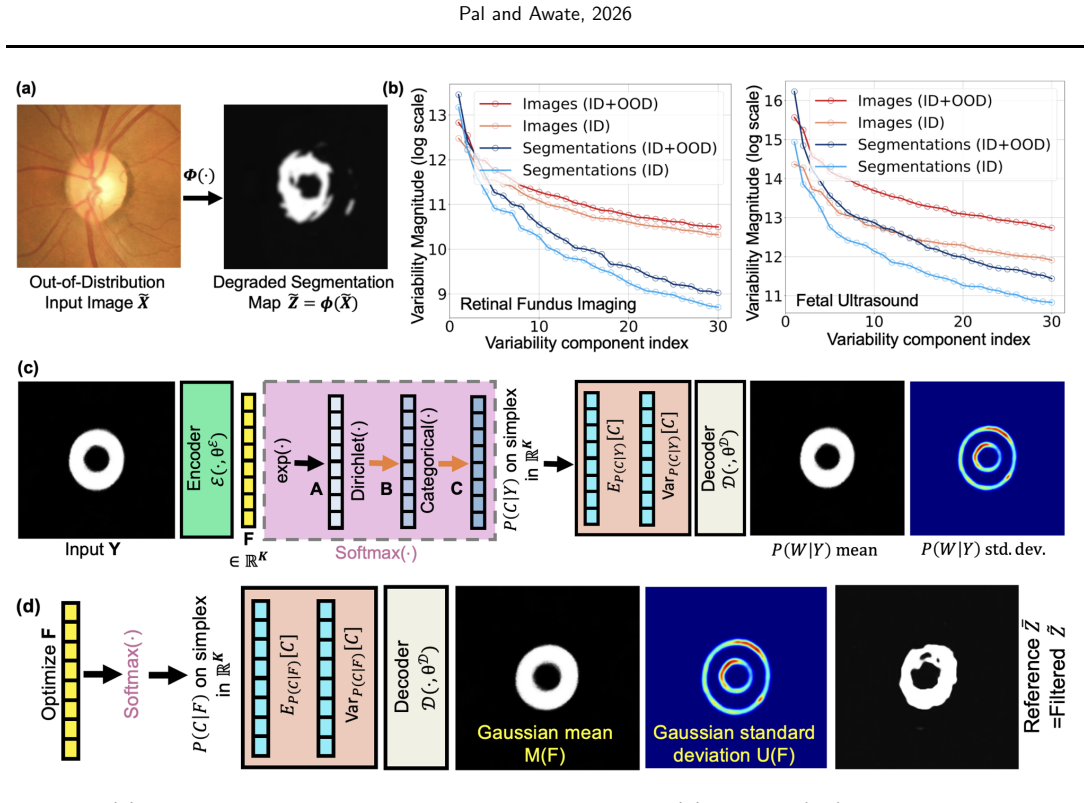
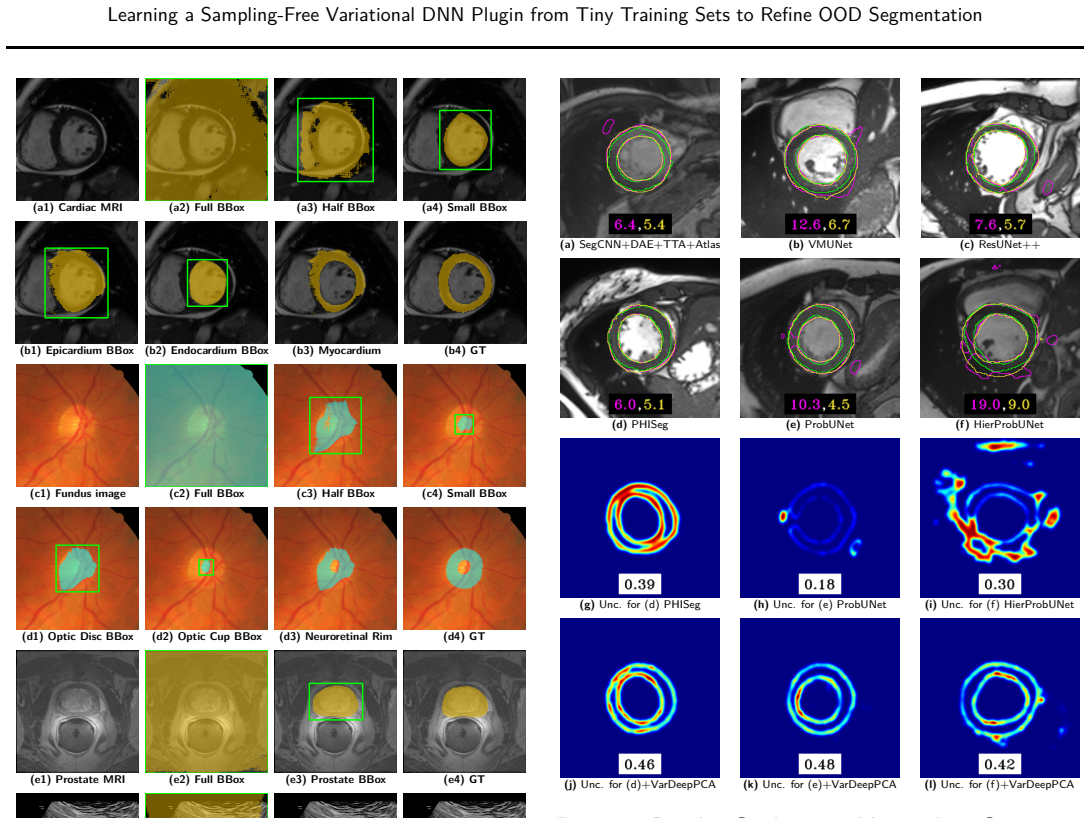
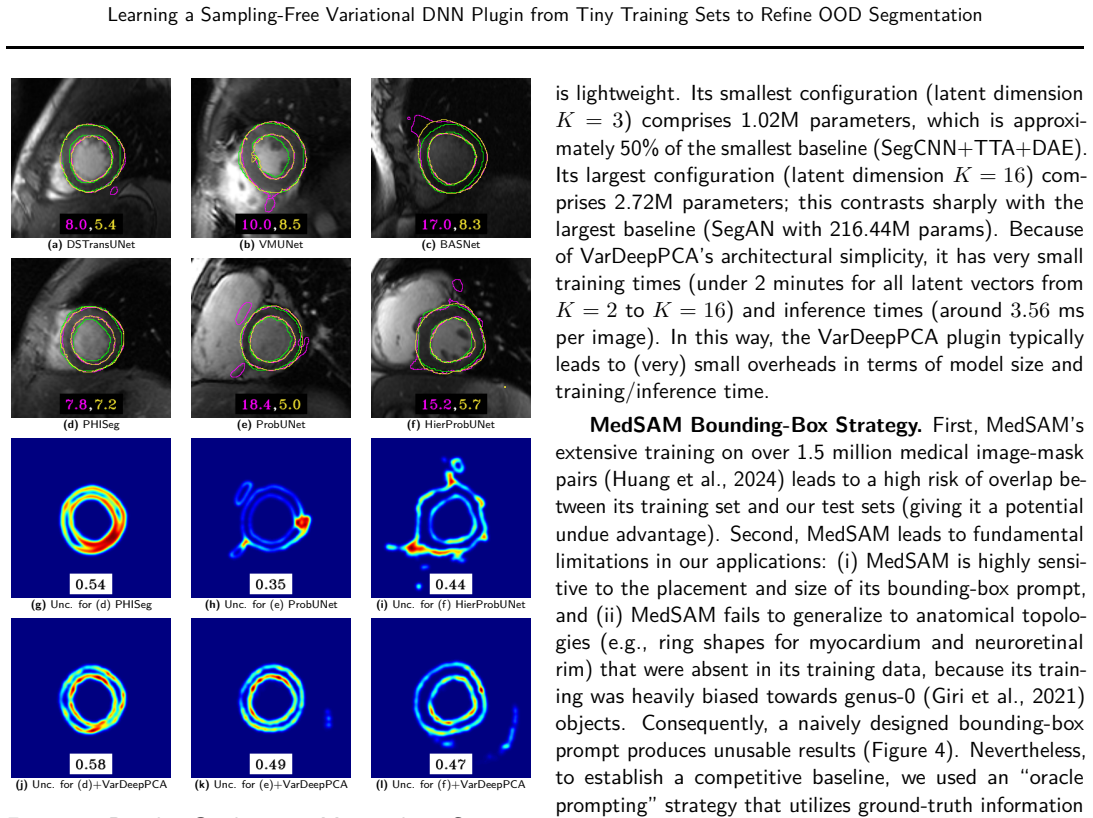
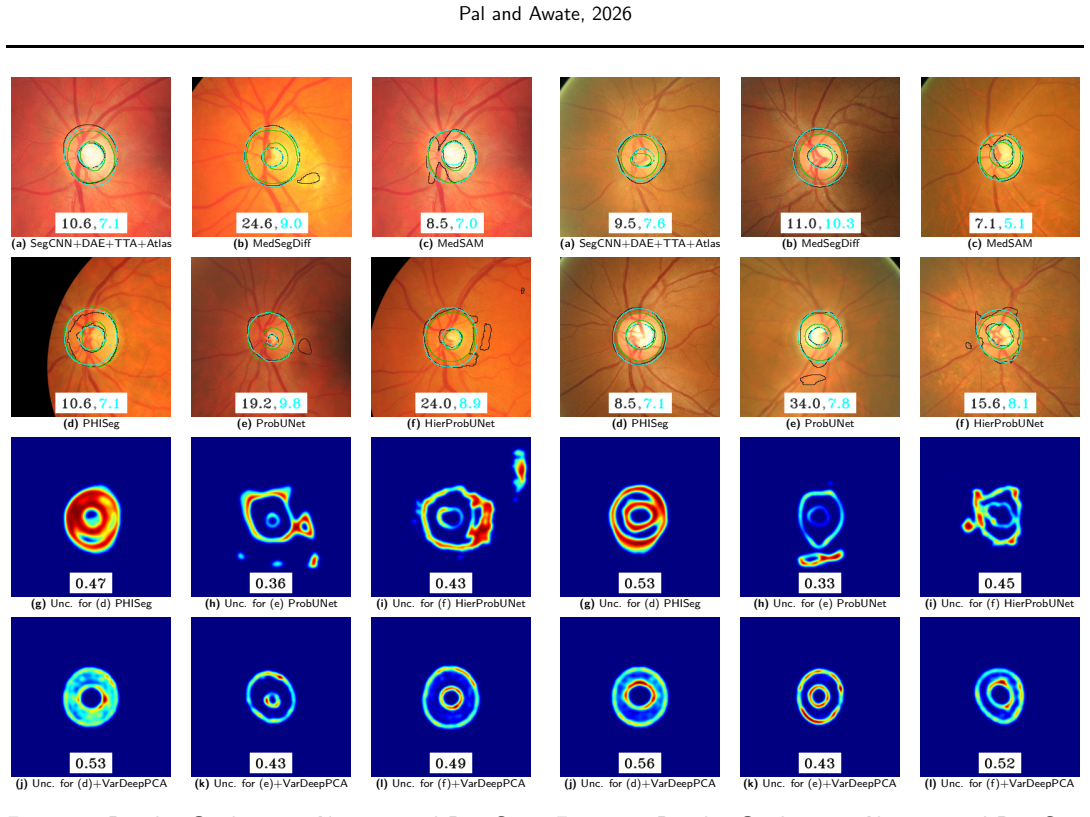
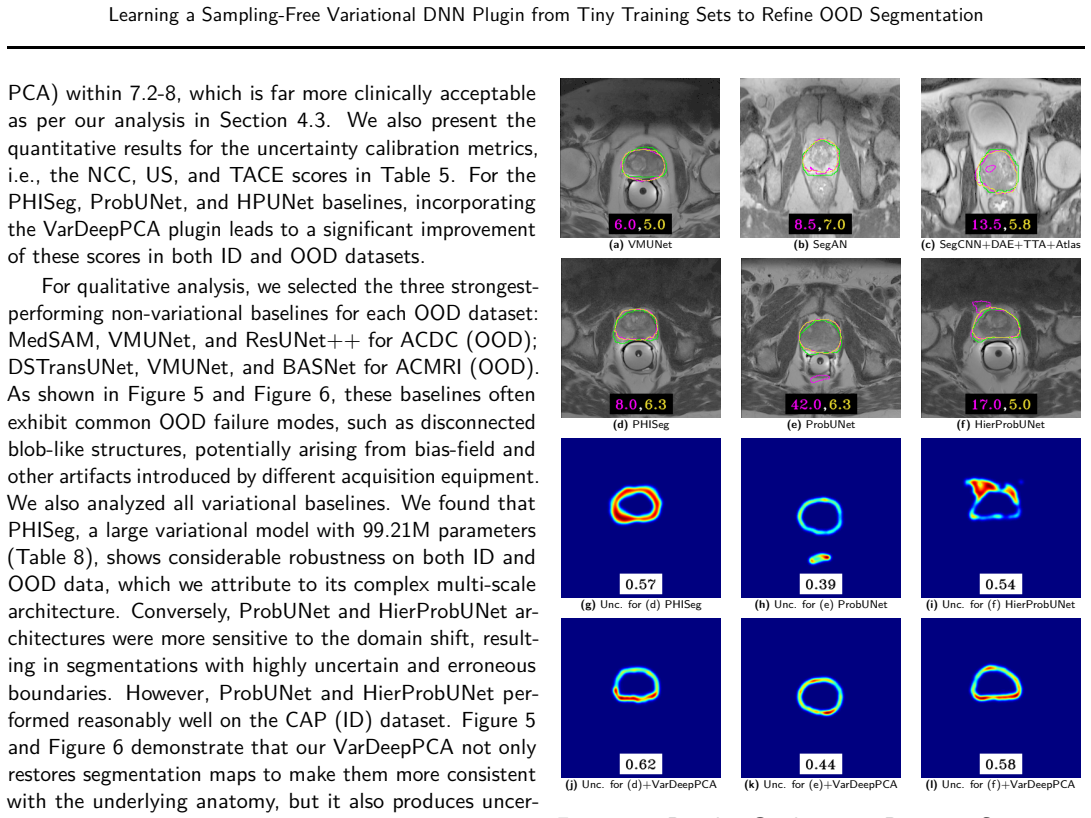
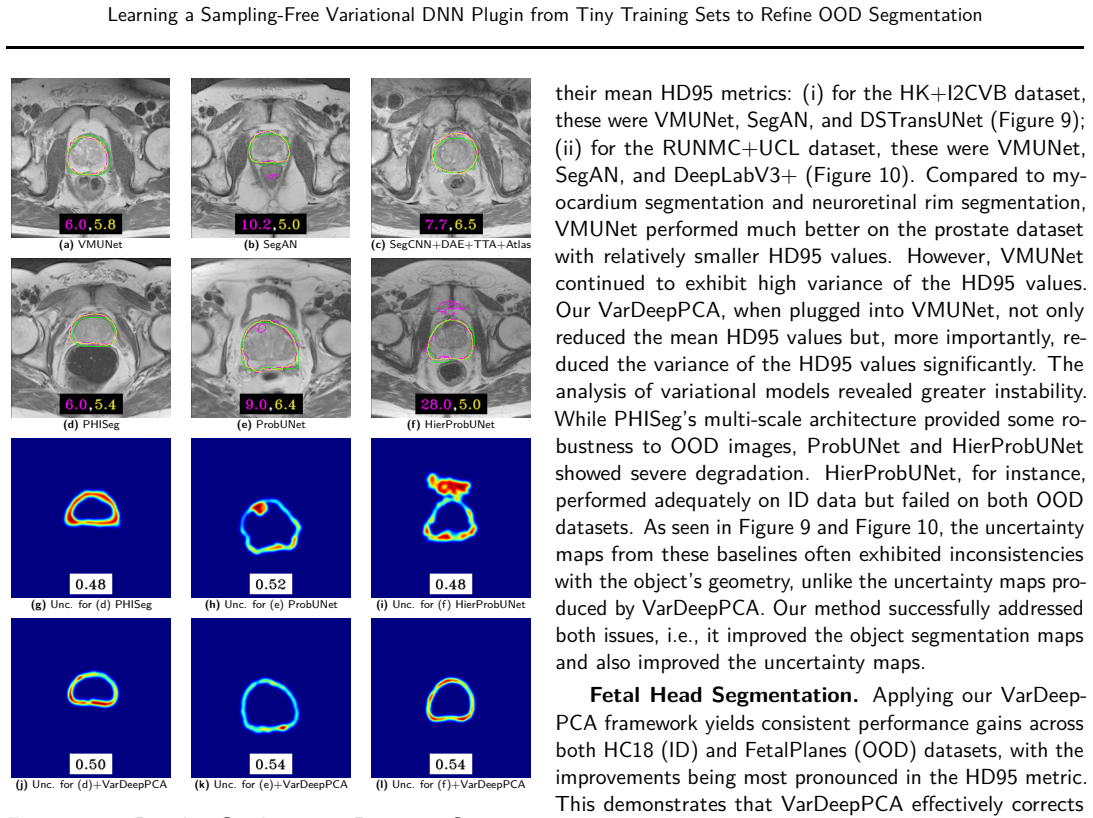
VarDeepPCA explicitly learns a distribution of valid anatomical geometries from small in-distribution datasets. Its novel variational framework reinterprets the softmax mapping to perform exact distribution modeling, which enables computationally efficient sampling-free learning and inference along with associated uncertainty estimates. When used to restore segmentation maps produced by existing methods on out-of-distribution data, the plugin improves anatomical plausibility of the geometries, clinical utility of the segmentations, and reduces errors without needing any more training data than the baselines.
Load-bearing premise
Reinterpreting the softmax mapping enables exact distribution modeling without sampling.
Editorial extensions
If this is right
- Restored segmentations exhibit higher anatomical plausibility and clinical utility on OOD data.
- Segmentation errors decrease across myocardium, neuroretinal rim, prostate, and fetal head tasks.
- Uncertainty estimates accompany each restored map for downstream use.
- Performance gains hold when training data volume matches that of the fifteen comparison methods.
- The same plugin works across fourteen public datasets spanning four distinct applications.
Reading between the lines
- The sampling-free property could allow integration into existing segmentation pipelines without added computational overhead at test time.
- Uncertainty maps from the plugin might serve as inputs for selective re-acquisition or human review in clinical settings.
- If the softmax reinterpretation generalizes, similar lightweight plugins could be attached to other softmax-based models for OOD correction.
Signed reviews
Editorial analysis
A structured set of objections, weighed in public.
Referee Report
Summary. The manuscript introduces VarDeepPCA, a lightweight variational DNN plugin for restoring OOD segmentation maps in medical imaging. It claims to explicitly learn a distribution of valid anatomical geometries from small ID datasets only, via a novel variational framework that reinterprets the softmax mapping to achieve exact distribution modeling. This enables sampling-free learning/inference and uncertainty estimation. Empirical validation across 4 clinical applications and 14 datasets shows consistent improvements over 15 baselines in anatomical plausibility, clinical utility, and error reduction, without requiring target-domain data.
Significance. If the central theoretical claim holds, the result would be significant: a data-efficient plugin that addresses distribution shifts in medical segmentation without retraining or target annotations, while supplying uncertainty estimates. The multi-application, multi-dataset empirical scope is a strength.
major comments (2)
- [Abstract] Abstract: the central claim that 'a reinterpretation of the softmax mapping to implicitly perform exact distribution modeling' enables sampling-free exact posterior inference over geometries is presented without any derivation, loss function, variational objective, or proof. This is load-bearing for both the sampling-free property and the avoidance of standard VAE gaps.
- [Abstract] Abstract: no equations, training objective, or architectural details are supplied showing how the framework produces an exact (rather than approximate or heuristic) distribution over valid geometries from tiny ID sets, nor how it differs from standard variational PCA or VAE formulations.
minor comments (1)
- [Abstract] Abstract: claims of 'significantly improve' and 'significantly reduce errors' are not accompanied by error bars, statistical tests, or explicit metrics for significance assessment.
Simulated Author's Rebuttal
We thank the referee for their review and the opportunity to clarify the presentation of our theoretical contributions. We respond to each major comment below.
read point-by-point responses
-
Referee: [Abstract] Abstract: the central claim that 'a reinterpretation of the softmax mapping to implicitly perform exact distribution modeling' enables sampling-free exact posterior inference over geometries is presented without any derivation, loss function, variational objective, or proof. This is load-bearing for both the sampling-free property and the avoidance of standard VAE gaps.
Authors: The full manuscript derives the softmax reinterpretation in Section 3.1, presents the exact variational objective in Equation (5), and proves exact posterior inference (no ELBO gap) in Theorem 1. The abstract is intentionally concise, but we agree it should better signal these elements and will revise it to include a brief reference to the key theoretical result. revision: yes
-
Referee: [Abstract] Abstract: no equations, training objective, or architectural details are supplied showing how the framework produces an exact (rather than approximate or heuristic) distribution over valid geometries from tiny ID sets, nor how it differs from standard variational PCA or VAE formulations.
Authors: Section 3.2 details the architecture, Equation (7) gives the training objective, and Section 2.2 explicitly contrasts the approach with standard variational PCA and VAE formulations (exact modeling via softmax reinterpretation vs. approximate sampling). We will revise the abstract to incorporate a short statement highlighting these distinctions and the exact nature of the distribution. revision: yes
Circularity Check
No circularity: derivation self-contained from ID data
full rationale
The paper introduces VarDeepPCA as learning a distribution of valid anatomical geometries from small ID datasets via a novel variational framework that reinterprets softmax for exact distribution modeling. No equations, loss functions, or self-citations are quoted that reduce this claim to fitted inputs, self-definitions, or prior author work by construction. The abstract presents the approach as independent of target-domain data and validated empirically against 15 methods on 14 datasets, with no load-bearing steps that collapse to renaming or tautological fits. This is the normal case of a self-contained method description.
Assumptions & free parameters
assumptions (1)
- ad hoc to paper Reinterpretation of the softmax mapping implicitly performs exact distribution modeling
Cite this review
Pith. "Pith review of Learning a Sampling-Free Variational DNN Plugin from Tiny Training Sets to Refine OOD Segmentation With Uncertainty Estimation." pith.science (2026). https://pith.science/paper/BORFBOO4
@misc{pith2026260615837,
  author       = {Pith},
  title        = {Pith review of: Learning a Sampling-Free Variational DNN Plugin from Tiny Training Sets to Refine OOD Segmentation With Uncertainty Estimation},
  year         = {2026},
  howpublished = {\url{https://pith.science/paper/BORFBOO4}},
  note         = {Machine review of arXiv:2606.15837}
}
read the original abstract
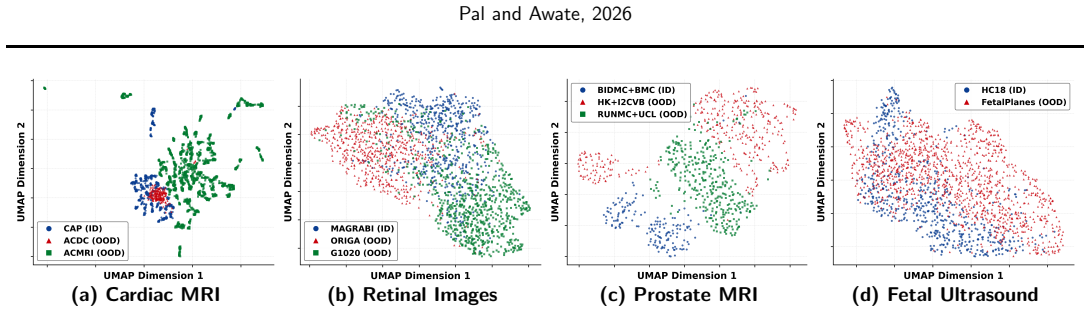
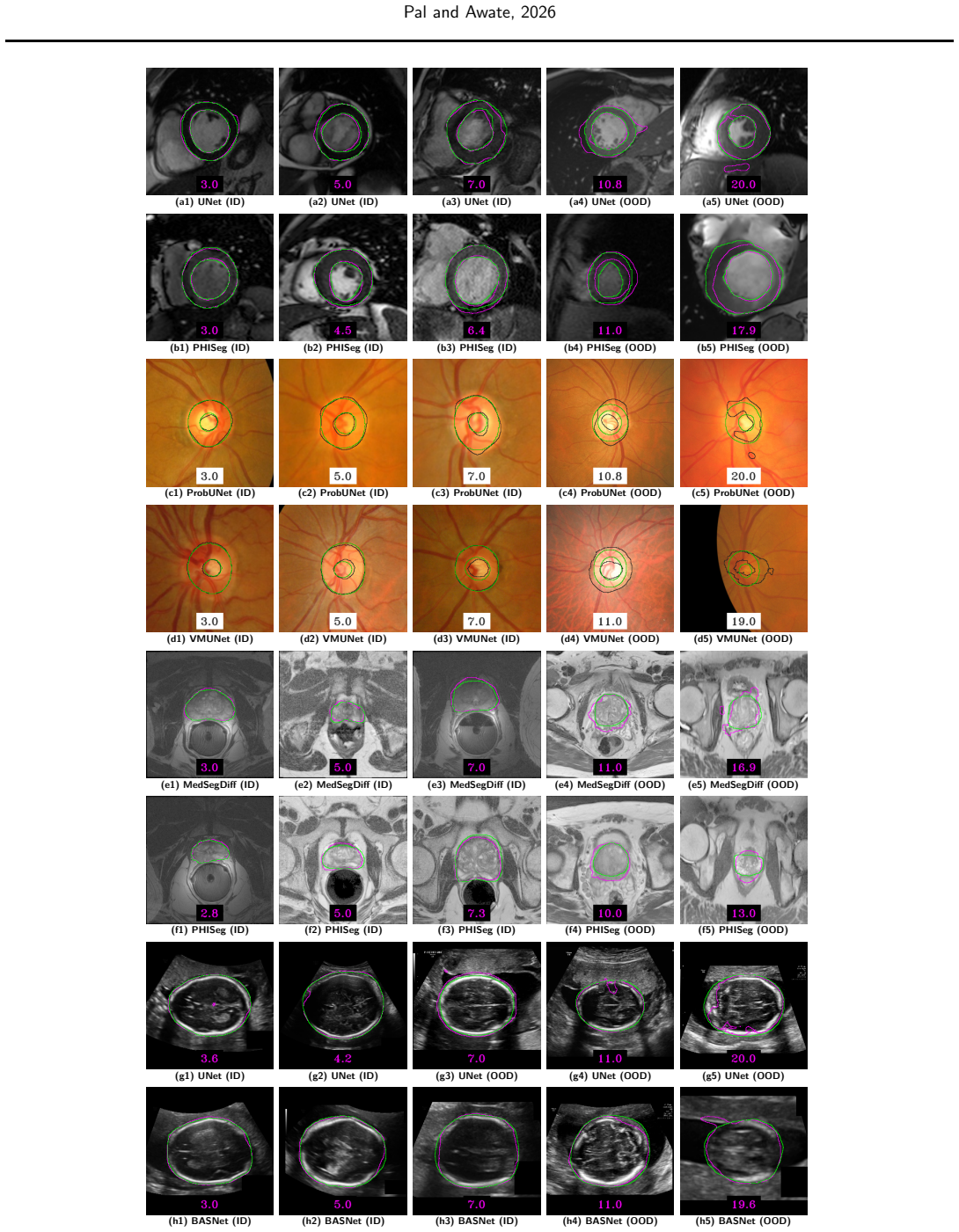
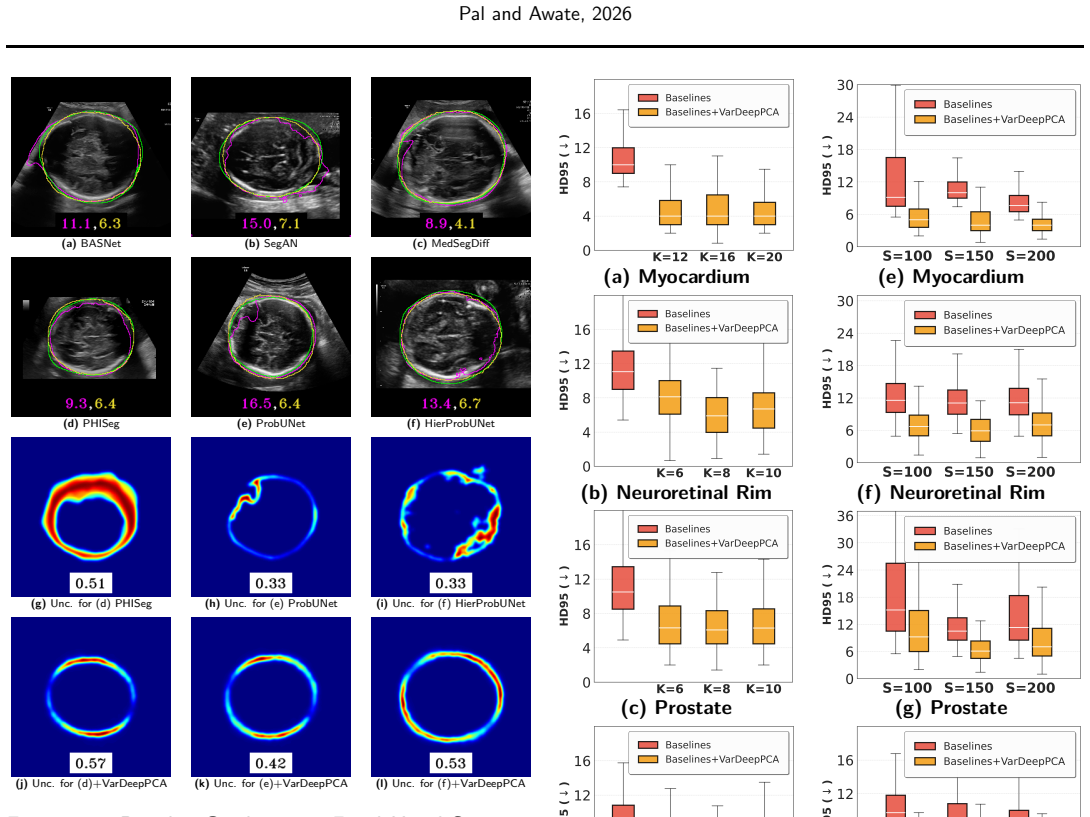
Deep neural networks (DNNs) frequently fail to generalize to out-of-distribution (OOD) medical images because of variations in scanners and acquisition protocols. Retraining DNN models to address these distribution shifts is often impractical due to the high cost of acquiring and annotating new medical datasets. To address this, we introduce VarDeepPCA, a novel lightweight variational DNN framework designed to restore/refine degraded segmentation maps by leveraging intrinsic geometric priors. Unlike existing approaches that require target-domain data or extensive pre-training, our VarDeepPCA explicitly learns a distribution of valid anatomical geometries using only small in-distribution (ID) datasets. Theoretically, our novel variational learning framework leverages a reinterpretation of the softmax mapping to implicitly perform exact distribution modeling, thereby enabling computationally efficient, sampling-free learning and inference. This also enables VarDeepPCA to provide uncertainty estimates associated with its restored segmentation maps. We empirically validate our framework across 4 distinct clinical applications, using 14 publicly available datasets, involving segmentation of the myocardium, neuroretinal rim, prostate, and fetal head. Comparisons against 15 existing methods demonstrate that VarDeepPCA consistently restores segmentation maps produced by the existing methods on OOD data to (i) significantly improve anatomical plausibility of geometries and clinical utility of the segmentations, and (ii) significantly reduce errors, without needing any more training data than that used by existing methods.
Figures
Figures from the paper (6 more)
Reference graph
Works this paper leans on
-
[1]
J. B. Pal and S. Welling and H. Saini and S. P. Awate , title =. 2025 , pages =
work page 2025
-
[2]
B. Sch. Nonlinear Component Analysis as a Kernel Eigenvalue Problem , journal = NeuralComput, volume =
- [3]
- [4]
- [5]
- [6]
- [7]
- [8]
Show all 299 references
-
[9]
Hu and L
J. Hu and L. Shen and G. Sun , booktitle = CVPR, title=. 2018 , pages=
2018
-
[10]
Pal and S
J. Pal and S. Awate , booktitle = MICCAI, pages=. Convex Segments for Convex Objects Using
-
[11]
Pal and S
J. Pal and S. Awate , booktitle = ICIP, pages=. A Hard Convex-Shape Constraint In
-
[12]
S Awate and S Garg and R Jena , title=. Med. Imag. Analysis , year=
-
[13]
Jena and S
R. Jena and S. P. Awate , booktitle=. A
-
[14]
Varma and A
H. Varma and A. Gaikwad and S. Awate , booktitle=ISBI, title=. 2023 , pages=
2023
-
[15]
Deep Variational Segmentation of Topology-Constrained Object Sets, with Correlated Uncertainty Models, for Robustness to Degradations , author=
-
[16]
Gao and Q
J. Gao and Q. Lao and P. Liu and H. Yi and Q. Kang and Z. Jiang and X. Wu and K. Li and Y. Chen and L. Zhang , journal = JBHI, title=. 2023 , volume=
2023
-
[17]
Kingma and M
D. Kingma and M. Welling , title =
-
[18]
Neural discrete representation learning , author=
-
[19]
Razavi and A
A. Razavi and A. Generating diverse high-fidelity images with
-
[20]
Learning structured output representation using deep conditional generative models , author=
-
[21]
Kohl and B
S. Kohl and B. Romera-Paredes and C. Meyer and J. A probabilistic
-
[23]
C. F. Baumgartner and K. C. Tezcan and K. Chaitanya and A. M. H. 2019 , organization=
2019
-
[24]
Painchaud and Y
N. Painchaud and Y. Skandarani and T. Judge and O. Bernard and A. Lalande and P. Jodoin , journal = TMI, title=. 2020 , volume=
2020
-
[25]
Wang and C
S. Wang and C. Qin and N. Savioli and C. Chen and D. O'Regan and S. Cook and Y. Guo and D. Rueckert and W. Bai , title =
-
[26]
Oktay and E
O. Oktay and E. Ferrante and K. Kamnitsas and M. Heinrich and W. Bai and J. Caballero and S. Cook and A. Marvao and T. Dawes and D. O'Regan and B. Kainz and B. Glocker and D. Rueckert , journal=TMI, year=
-
[27]
Jacob and P
A. Jacob and P. Sharma and D. Rueckert , booktitle=ISBI, title=. 2024 , pages=
2024
-
[28]
Jacob and P
A. Jacob and P. Sharma and D. Rueckert , title =. Statistical Atlases and Computational Models of the Heart. Regular and
-
[29]
American Mathematical Monthly , year=
A Characterization of Star-Shaped Sets , author=. American Mathematical Monthly , year=
-
[30]
Practical uncertainty estimation and out-of-distribution robustness in deep learning , author=. Adv. Neural Inform. Process. Syst. Tutorial , year=
-
[31]
Ronneberger and P
O. Ronneberger and P. Fischer and T. Brox , title =
-
[32]
Oktay and J
O. Oktay and J. Schlemper and L. Folgoc and M. Lee and M. Heinrich and K. Misawa and K. Mori and S. McDonagh and N. Hammerla and B. Kainz and B. Glocker and D. Rueckert , booktitle = MIDL, pages=. Attention
-
[33]
Zhang and Q
Z. Zhang and Q. Liu and Y. Wang , title =. 2018 , volume =
2018
-
[34]
Jha and P
D. Jha and P. Smedsrud and M. Riegler and D. Johansen and T. Lange and P. Halvorsen and H. Johansen , journal=. 2019 , pages=
2019
-
[35]
Encoder-Decoder with Atrous Separable Convolution for Semantic Image Segmentation , author=
-
[36]
Qin and Z
X. Qin and Z. Zhang and C. Huang and C. Gao and M. Dehghan and M. J
-
[37]
Lin and B
A. Lin and B. Chen and J. Xu and Z. Zhang and G. Lu and D. Zhang , journal=TIM, year=
-
[38]
Xue and T
Y. Xue and T. Xu and H. Zhang and L. Long and X. Huang , journal = NeuroInfo, volume=
-
[39]
Goodfellow and J
I. Goodfellow and J. Pouget-Abadie and M. Mirza and B. Xu and D. Warde-Farley and S. Ozair and A. Courville and Y. Bengio , title =. 2014 , pages =
2014
-
[40]
Wu and R
J. Wu and R. Fu and H. Fang and Y. Zhang and Y. Yang and H. Xiong and H. Liu and Y. Xu , title =
-
[41]
Ho and A
J. Ho and A. Jain and P. Abbeel , title =
-
[42]
Kazerouni and E
A. Kazerouni and E. Diffusion Models for Medical Image Analysis:. 2023 , volume=
2023
-
[43]
Li and H
X. Li and H. Ding and H. Yuan and W. Zhang and J. Pang and G. Cheng and K. Chen and Z. Liu and C. Loy , journal=PAMI, year=. Transformer-Based Visual Segmentation:
-
[44]
Chen and J
J. Chen and J. Mei and X. Li and Y. Lu and Q. Yu and Q. Wei and X. Luo and Y. Xie and E. Adeli and Y. Wang and M. P. Lungren and S. Zhang and L. Xing and L. Lu and A. Yuille and Y. Zhou , journal = MIA, volume=
-
[45]
Attention is all you need , author=
-
[46]
An Image is Worth 16x16 Words: Transformers for Image Recognition at Scale , author=
-
[47]
Fine-tuning diffusion models with limited data , author=
-
[48]
Wang and A
Z. Wang and A. C. Bovik and H. R. Sheikh and E. P. Simoncelli , journal = TIP, title=. 2004 , volume=
2004
-
[49]
Zhao and O
H. Zhao and O. Gallo and I. Frosio and J. Kautz , title =
-
[50]
Zhou and J
D. Zhou and J. Fang and X. Song and C. Guan and J. Yin and Y. Dai and R. Yang , journal=. 2019 , pages=
2019
-
[51]
C. H. Sudre and W. Li and T. Vercauteren and S. Ourselin and M. J. Cardoso , title =. Deep Learning in Medical Image Analysis and Multimodal Learning for Clinical Decision Support , series = LNCS, pages =
-
[52]
International Journal of Imaging Systems and Technology , volume=
Image Segmentation Evaluation With the Dice Index: Methodological Issues , author=. International Journal of Imaging Systems and Technology , volume=. 2024 , publisher=
2024
-
[53]
Li and Y
B. Li and Y. Liu and C. Occleshaw and B. Cowan and A. Young , title =. 2010 , volume =
2010
-
[54]
Kadish and D
A. Kadish and D. Bello and J. Finn and R. Bonow and A. Schaechter and H. Subacius and C. Albert and J. Daubert and C. Fonseca and J. Goldberger , title=. Journal of Cardiovascular Electrophysiology , year=
-
[55]
Suinesiaputra and B
A. Suinesiaputra and B. Cowan and A. Al-Agamy and M. Elattar and N. Ayache and A. Fahmy and A. Khalifa and P. Medrano-Gracia and M. Jolly and A. Kadish and D. Lee and J. Margeta and S. Warfield and A. Young , title=. 2014 , volume=
2014
-
[56]
Andreopoulos and J
A. Andreopoulos and J. Tsotsos , title =. 2008 , volume =
2008
-
[57]
Bajwa and G
M. Bajwa and G. Singh and W. Neumeier and M. Malik and A. Dengel and S. Ahmed , title =. 2020 , pages =
2020
-
[58]
Zhang and F
Z. Zhang and F. Yin and J. Liu and W. K. Wong and N. M. Tan and B. H. Lee and J. Cheng and T. Y. Wong , title=. 2010 , pages=
2010
-
[59]
Almazroa and S
A. Almazroa and S. Alodhayb and E. Osman and E. Ramadan and M. Hummadi and M. Dlaim and M. Alkatee and K. Raahemifar and V. Lakshminarayanan , booktitle=. Retinal fundus images for glaucoma analysis: the
-
[60]
2020 , publisher=
Evaluation of deep convolutional neural networks for automatic classification of common maternal fetal ultrasound planes , author=. 2020 , publisher=
2020
-
[61]
T. L. Automated measurement of fetal head circumference using. 2018 , volume=
2018
-
[62]
Shigwan and A
S. Shigwan and A. Gaikwad and S. Awate , booktitle=ISBI, title=. 2020 , pages=
2020
-
[63]
Topology-Preserving Deep Image Segmentation , author=
-
[64]
Lee and K
M. Lee and K. Petersen and N. Pawlowski and B. Glocker and M. Schaap , title =. 2019 , volume =
2019
-
[65]
Kepp and J
T. Kepp and J. Andresen and C. Shape-based segmentation of retinal layers and fluids in. Medical Imaging 2023: Computer-Aided Diagnosis , volume=
2023
-
[66]
Rethinking the Inception Architecture for Computer Vision , author =
-
[67]
Heusel and H
M. Heusel and H. Ramsauer and T. Unterthiner and B. Nessler and S. Hochreiter , booktitle = NIPS, year =
-
[68]
Journal of the American statistical Association , volume=
The Kolmogorov-Smirnov test for goodness of fit , author=. Journal of the American statistical Association , volume=. 1951 , publisher=
1951
-
[69]
2015 , publisher=
Optic disc and optic cup segmentation methodologies for glaucoma image detection: a survey , author=. 2015 , publisher=
2015
-
[70]
Deng and W
J. Deng and W. Dong and R. Socher and L. Li and K. Li and L. Fei-Fei , booktitle=CVPR, title=. 2009 , pages=
2009
-
[71]
Bernard and A
O. Bernard and A. Lalande and C. Zotti and F. Cervenansky and X. Yang and P.-A. Heng and I. Cetin and K. Lekadir and O. Camara and M. A. Gonzalez Ballester and G. Sanroma and S. Napel and S. Petersen and G. Tziritas and E. Grinias and M. Khened and V. A. Kollerathu and G. Kris...
2018
-
[72]
A review of heart chamber segmentation for structural and functional analysis using cardiac magnetic resonance imaging , author=. Magn. Reson. Mater. Phy. , volume=
-
[73]
J. I. Orlando and H. Fu and J. B. Breda and K
-
[74]
Shen and H
Z. Shen and H. Fu and J. Shen and L. Shao , journal=TMI, title=. 2021 , volume=
2021
-
[75]
Lu , title=
S. Lu , title=. 2011 , volume=
2011
-
[76]
Automated segmentation of the optic disc from fundus images using an asymmetric deep learning network , author=
-
[77]
Wang and X
B. Wang and X. Gu and C. Fan and H. Xie and S. Zhang and X. Tian and L. Gu , title =. 2015 , volume =
2015
-
[78]
Sun and Z
F. Sun and Z. Luo and S. Li , title=. 2023 , pages=
2023
-
[79]
Boundary loss for highly unbalanced segmentation , author=
-
[80]
2022 , publisher=
Efficient fetal ultrasound image segmentation for automatic head circumference measurement using a lightweight deep convolutional neural network , author=. 2022 , publisher=
2022
-
[81]
Challenges with segmenting intraoperative ultrasound for brain tumours , author=
-
[82]
F. G. Claus and H. Hricak and R. R. Hattery , journal = RadioGraphics, volume=. Pretreatment evaluation of prostate cancer: role of. 2004 , publisher=
2004
-
[83]
Liu and C
Q. Liu and C. Chen and J. Qin and Q. Dou and P. Heng , booktitle=CVPR, pages=
-
[84]
The Cancer Imaging Archive , volume=
NCI-ISBI 2013 challenge: automated segmentation of prostate structures , author=. The Cancer Imaging Archive , volume=
2013
-
[85]
J. O. Barentsz and J. Richenberg and R. Clements and P. Choyke and S. Verma and G. Villeirs and O. Rouviere and V. Logager and J. J. F
-
[86]
G. Lema. Computer-aided detection and diagnosis for prostate cancer based on mono and multi-parametric
-
[87]
Litjens and R
G. Litjens and R. Toth and W. Evaluation of prostate segmentation algorithms for
-
[88]
Shaaf and M
Z. Shaaf and M. Jamil and R. Ambar and A. Alattab and A. Yahya and Y. Asiri , journal=Diagnostics, volume=. Automatic left ventricle segmentation from short-axis cardiac
-
[89]
Petitjean and J
C. Petitjean and J. N. Dacher , title =. 2011 , volume =
2011
-
[90]
Epstein , title =
F. Epstein , title =. J. Nucl. Cardiol. , year =
-
[91]
Busemann , title =
H. Busemann , title =. 1955 , publisher =
1955
-
[92]
1908 , publisher=
Text-book of Ophthalmology , author=. 1908 , publisher=
1908
-
[93]
Polygonal approximation learning for convex object segmentation in biomedical images with bounding box supervision , author=
-
[94]
Emerging properties in self-supervised vision transformers , author=
-
[95]
Gorelick and O
L. Gorelick and O. Veksler and Y. Boykov and C. Nieuwenhuis , title =. 2014 , pages =
2014
-
[96]
Gulshan and C
V. Gulshan and C. Rother and A. Criminisi and A. Blake and A. Zisserman , title =. 2010 , pages =
2010
-
[97]
Royer and D
L. Royer and D. Richmond and C. Rother and B. Andres and D. Kainmueller , title =. 2016 , pages =
2016
-
[98]
Cremers , title =
D. Cremers , title =. 2015 , pages =
2015
-
[99]
Star Shape Prior in Fully Convolutional Networks for Skin Lesion Segmentation , author=
-
[100]
Oval Shape Constraint based Optic Disc and Cup Segmentation in Fundus Photographs , author=
-
[101]
Diabetic Foot Ulcers Grand Challenge , pages=
On the optimal combination of cross-entropy and soft dice losses for lesion segmentation with out-of-distribution robustness , author=. Diabetic Foot Ulcers Grand Challenge , pages=
-
[102]
Shit and J
S. Shit and J. Paetzold and A. Sekuboyina and I. Ezhov and A. Unger and A. Zhylka and J. Pluim and U. Bauer and B. Menze , booktitle=CVPR, year=. cl
-
[103]
Clough and N
J. Clough and N. Byrne and I. Oksuz and V. Zimmer and J. Schnabel and A. King , title =. 2022 , volume =
2022
-
[104]
Kepp and J
T. Kepp and J. Ehrhardt and M. Heinrich and G. Huttmann and H. Handels , booktitle=ISBI, pages=. Topology-preserving shape-based regression of retinal layers in
-
[105]
Object segmentation with deep neural nets coupled with a shape prior, when learning from a training set of limited quality and small size , author=
-
[106]
Wu and Z
G. Wu and Z. Guo and X. Shi and Q. Chen and Y. Xu and R. Shibasaki and X. Shao , title =. 2018 , volume =
2018
-
[107]
Qin and Z
X. Qin and Z. Zhang and C. Huang and C. Gao and M. Dehghan and M. Jagersand , title =. 2019 , pages =
2019
-
[108]
Hatamizadeh and D
A. Hatamizadeh and D. Terzopoulos and A. Myronenko , title =. Int. Workshop on Mach. Learn. in Medical Imag. , year =
-
[109]
Lin and B
A. Lin and B. Chen and J. Xu and Z. Zhang and G. Lu and D. Zhang , title =. 2022 , volume =
2022
-
[110]
Kervadec and J
H. Kervadec and J. Bouchtiba and C. Desrosiers and E. Granger and J. Dolz and I. Boundary loss for highly unbalanced segmentation , booktitle = MIDL, volume =. 2019 , pages =
2019
-
[111]
Yin and Z
S. Yin and Z. Zhang and H. Li and Q. Peng and X. You and S. Furth and G. Tasian and Y. Fan , title =. 2019 , pages =
2019
-
[112]
Drozdzal and E
M. Drozdzal and E. Vorontsov and G. Chartrand and S. Kadoury and C. Pal , title =. Deep Learn. Data Label. Med. Appl. , year =
-
[113]
Long and E
J. Long and E. Shelhamer and T. Darrell , title =. 2015 , pages =
2015
-
[114]
2021 , volume=
Variability in image quality and radiation dose within and across 97 medical facilities , author=. 2021 , volume=
2021
-
[115]
2018 , volume=
A two-step iteration mechanism for speckle reduction in optical coherence tomography , author=. 2018 , volume=
2018
-
[116]
Gravel and G
P. Gravel and G. Beaudoin and J. A method for modeling noise in medical images , journal=TMI, year =
-
[117]
Yang and J
J. Yang and J. Fan and D. Ai and S. Zhou and S. Tang and Y. Wang , journal = BioMedEngOnline, volume=. Brain
-
[118]
Hani and T
A. Hani and T. Soomro and I. Fayee and N. Kamel and N. Yahya , title =. 2013 , pages =
2013
-
[119]
Sahu and S
S. Sahu and S. Sahu and A. Singh and S. Ghrera and M. Elhoseny , title =. 2019 , volume =
2019
-
[120]
Abdallah and J
M. Abdallah and J. Malek and R. Tourki and J. Monreal and K. Krissian , title =. Int. Multi-Conferences on Systems, Signals & Devices 2013 (SSD13) , year =
2013
-
[121]
L. C. Chen and G. Papandreou and I. Kokkinos and K. P. Murphy and A. L. Yuille , journal=PAMI, year=
-
[122]
Badrinarayanan and A
V. Badrinarayanan and A. Kendall and R. Cipolla , title =. 2017 , pages =
2017
-
[123]
He and G
K. He and G. Gkioxari and P. Dollar and R. Girshick , title =. 2017 , pages =
2017
-
[124]
2018 , volume=
Joint Optic Disc and Cup Segmentation Based on Multi-Label Deep Network and Polar Transformation , author=. 2018 , volume=
2018
-
[125]
Man and S
N. Man and S. Guo and K. Yiu and C. Leung , journal = Neurocomputing, volume=. Multi-layer segmentation of retina
-
[126]
2021 , volume=
Training on Polar Image Transformations Improves Biomedical Image Segmentation , author=. 2021 , volume=
2021
-
[127]
He and A
Y. He and A. Carass and Y. Liu and B. Jedynak and S. Solomon and S. Saidha and P. Calabresi and J. Prince , title =. 2021 , volume =
2021
-
[128]
Kugelman and D
J. Kugelman and D. Alonso-Caneiro and S. A. Read and S. J. Vincent and F. K. Chen and M. J. Collins , journal=IEEE_Access, year=. Effect of Altered
-
[129]
Kendall and Y
A. Kendall and Y. Gal , title =. 2017 , volume =
2017
-
[130]
Confidence calibration and predictive uncertainty estimation for deep medical image segmentation , author=
-
[131]
2021 , pages=
How Reliable Are Out-of-Distribution Generalization Methods for Medical Image Segmentation? , author=. 2021 , pages=
2021
-
[132]
Zhuo and R
J. Zhuo and R. Gullapalli , title =. 2006 , volume =
2006
-
[133]
D. P. Huttenlocher and G. A. Klanderman and W. J. Rucklidge , journal = PAMI, title=. 1993 , volume=
1993
-
[134]
2018 , publisher=
Family of boundary overlap metrics for the evaluation of medical image segmentation , author=. 2018 , publisher=
2018
-
[135]
Langkilde and P
F. Langkilde and P. Masaba and L. Edenbrandt and M. Gren and A. Halil and M. Hellstr. Manual prostate
-
[136]
Zeng and P
Y. Zeng and P. Tsui and W. Wu and Z. Zhou and S. Wu , journal = JDI, volume=. Fetal ultrasound image segmentation for automatic head circumference biometry using deeply supervised attention-gated
-
[137]
Nagabotu and A
V. Nagabotu and A. Namburu , journal=. Precise segmentation of fetal head in ultrasound images using improved. 2024 , publisher=
2024
-
[138]
Unraveling the complexity of Optical Coherence Tomography image segmentation using machine and deep learning techniques: A review , author=
-
[139]
Kingma and J
D. Kingma and J. Ba , title =
-
[140]
Implicit reparameterization gradients , author=
-
[141]
Beta distribution , url =
Wikipedia , year =. Beta distribution , url =
-
[142]
B. R. Cobb and P. P. Shenoy and R. Rum. Approximating probability density functions in hybrid
-
[143]
Segmenter: Transformer for semantic segmentation , author=
-
[144]
Xiao and L
H. Xiao and L. Li and Q. Liu and X. Zhu and Q. Zhang , journal=BSPC, volume=. Transformers in medical image segmentation:
-
[145]
Thisanke and C
H. Thisanke and C. Deshan and K. Chamith and S. Seneviratne and R. Vidanaarachchi and D. Herath , journal = EAAI, volume=. Semantic segmentation using vision transformers:
-
[146]
Zhang and Z
B. Zhang and Z. Tian and Q. Tang and X. Chu and X. Wei and C. Shen and Y. Liu , journal=NIPS, volume=
-
[147]
Segment anything , author=
-
[148]
Segment anything model for medical images? , author=
-
[149]
2024 , organization=
Robustness analysis on foundational segmentation models , author=. 2024 , organization=
2024
-
[150]
Improving the generalization of segmentation foundation model under distribution shift via weakly supervised adaptation , author=
-
[151]
Ambiguous medical image segmentation using diffusion models , author=
-
[152]
Zhao and J
Y. Zhao and J. Li and L. Ren and Z. Chen , journal = CBME, volume=
-
[153]
Medsegdiff-v2: Diffusion-based medical image segmentation with transformer , author=
-
[154]
Xun and D
S. Xun and D. Li and H. Zhu and M. Chen and J. Wang and J. Li and M. Chen and B. Wu and H. Zhang and X. Chai and Z. Jiang and Y. Zhang and P. Huang , journal = CBME, volume=. Generative adversarial networks in medical image segmentation:
-
[155]
Andreini and S
P. Andreini and S. Bonechi and M. Bianchini and A. Mecocci and F. Scarselli , journal = CMPB, volume=. Image generation by
-
[156]
R. E. Kalman , title =. Transactions of the
-
[157]
First Conference on Language Modeling , year=
Mamba: Linear-time sequence modeling with selective state spaces , author=. First Conference on Language Modeling , year=
-
[158]
Liu and Y
Y. Liu and Y. Tian and Y. Zhao and H. Yu and L. Xie and Y. Wang and Q. Ye and J. Jiao and Y. Liu , journal=NIPS, volume=
-
[159]
Zhu and B
L. Zhu and B. Liao and Q. Zhang and X. Wang and W. Liu and X. Wang , journal=
-
[160]
Liu and H
J. Liu and H. Yang and H.-Y. Zhou and Y. Xi and L. Yu and Y. Yu and Y. Liang and G. Shi and S. Zhang and H. Zheng and S. Wang , booktitle = MICCAI, pages=. 2024 , organization=
2024
-
[161]
Ma and F
J. Ma and F. Li and B. Wang , journal=
-
[162]
Xing and T
Z. Xing and T. Ye and Y. Yang and G. Liu and L. Zhu , booktitle = MICCAI, pages=. 2024 , organization=
2024
-
[163]
Ruan and J
J. Ruan and J. Li and S. Xiang , journal=. 2024 , publisher=
2024
-
[164]
2020 , publisher=
Albumentations: fast and flexible image augmentations , author=. 2020 , publisher=
2020
-
[165]
Paszke and S
A. Paszke and S. Gross and F. Massa and A. Lerer and J. Bradbury and G. Chanan and T. Killeen and Z. Lin and N. Gimelshein and L. Antiga and A. Desmaison and A. K
-
[166]
1999 , publisher=
Elements of information theory , author=. 1999 , publisher=
1999
-
[167]
Efficient artificial intelligence approaches for medical image processing in healthcare: comprehensive review, taxonomy, and analysis , author=. Artif. Intell. Rev. , volume=
-
[168]
Open and closed anatomical surface description via hemispherical area-preserving map , author=
-
[169]
Test-time adaptable neural networks for robust medical image segmentation , author=
-
[170]
A comprehensive survey on test-time adaptation under distribution shifts , author=
-
[171]
Source-free unsupervised domain adaptation: A survey , author=
-
[172]
From denoising training to test-time adaptation: Enhancing domain generalization for medical image segmentation , author=
-
[173]
Source-free domain adaptation for image segmentation , author=
-
[174]
Causality-inspired single-source domain generalization for medical image segmentation , author=
-
[175]
A. J. Larrazabal and C. Mart. Post-
-
[176]
Anatomically-aware uncertainty for semi-supervised image segmentation , author=
-
[177]
Fischer and K
P. Fischer and K. Thomas and C. F. Baumgartner , booktitle=. Uncertainty estimation and propagation in accelerated. 2023 , organization=
2023
-
[178]
Mehta and A
R. Mehta and A. Filos and U. Baid and C. Sako and R. McKinley and M. Rebsamen and K. D
-
[179]
Measuring calibration in deep learning , author=
-
[180]
Measures of the amount of ecologic association between species , author=
-
[181]
A method of establishing groups of equal amplitude in plant sociology based on similarity of species content and its application to analyses of the vegetation on Danish commons , author=
-
[182]
A. P. Zijdenbos and B. M. Dawant and R. A. Margolin and A. C. Palmer , journal=TMI, volume=. Morphometric analysis of white matter lesions in
-
[183]
What uncertainties do we need in bayesian deep learning for computer vision? , author=
-
[184]
On calibration of modern neural networks , author=
-
[185]
Journal of Machine Learning Research , volume=
Monte carlo gradient estimation in machine learning , author=. Journal of Machine Learning Research , volume=
-
[186]
Saxena and J
D. Saxena and J. Cao , journal = CSUR, volume=. Generative adversarial networks (. 2021 , publisher=
2021
-
[187]
Yan and Y
W. Yan and Y. Wang and S. Gu and L. Huang and F. Yan and L. Xia and Q. Tao , booktitle=MICCAI, pages=. The domain shift problem of medical image segmentation and vendor-adaptation by. 2019 , organization=
2019
-
[188]
2022 , organization=
Segmentation consistency training: out-of-distribution generalization for medical image segmentation , author=. 2022 , organization=
2022
-
[189]
2019 , organization=
Using pre-training can improve model robustness and uncertainty , author=. 2019 , organization=
2019
-
[190]
High-level prior-based loss functions for medical image segmentation: A survey , author=
-
[191]
Rethinking semantic segmentation from a sequence-to-sequence perspective with transformers , author=
-
[192]
BayeSeg: Bayesian modeling for medical image segmentation with interpretable generalizability , author=
-
[193]
Probabilistic domain adaptation for biomedical image segmentation , author=
-
[194]
Generalize or detect? towards robust semantic segmentation under multiple distribution shifts , author=
-
[195]
2023 , organization=
Segmentation distortion: Quantifying segmentation uncertainty under domain shift via the effects of anomalous activations , author=. 2023 , organization=
2023
-
[196]
Mask3d: Pre-training 2d vision transformers by learning masked 3d priors , author=
-
[197]
NeurIPS 2021 Workshop on distribution shifts: connecting methods and applications , year=
Are Vision Transformers Always More Robust Than Convolutional Neural Networks? , author=. NeurIPS 2021 Workshop on distribution shifts: connecting methods and applications , year=
2021
-
[198]
Diffuseg: domain-driven diffusion for medical image segmentation , author=
-
[199]
Towards Semantically Faithful Diffusion Representation for Generalizable Retinal Image Segmentation , author=
-
[200]
Pattern Recognit
Reducing redundancy in the bottleneck representation of autoencoders , author=. Pattern Recognit. Lett. , volume=
-
[201]
2013 , organization=
Simple sparsification improves sparse denoising autoencoders in denoising highly corrupted images , author=. 2013 , organization=
2013
-
[202]
Denoising adversarial autoencoders , author=
-
[203]
2024 , publisher=
Uniform manifold approximation and projection , author=. 2024 , publisher=
2024
-
[204]
J. B. Pal and S. P. Awate , booktitle=ICIP, pages=. A hard convex-shape constraint in. 2024 , organization=
2024
-
[205]
Pal and D
J. Pal and D. Mj , journal = ImagingSciJ, year=. Improving multi-scale attention networks:
-
[206]
International MICCAI brainlesion workshop , pages=
Holistic network for quantifying uncertainties in medical images , author=. International MICCAI brainlesion workshop , pages=. 2021 , organization=
2021
-
[207]
Expert Syst
Advancing instance segmentation and WBC classification in peripheral blood smear through domain adaptation: A study on PBC and the novel RV-PBS datasets , author=. Expert Syst. Appl. , volume=. 2024 , publisher=
2024
-
[208]
2023 , organization=
Deep variational segmentation of topology-constrained object sets, with correlated uncertainty models, for robustness to degradations , author=. 2023 , organization=
2023
-
[209]
Varma and A
H. Varma and A. V. Gaikwad and S. P. Awate , booktitle=ISBI, pages=. Adversarial training with multiscale boundary-prediction. 2023 , organization=
2023
-
[210]
A. V. Gaikwad and S. P. Awate , booktitle=. Deep. 2021 , organization=
2021
-
[211]
A. V. Gaikwad and S. Awate , journal=JMLBI, volume=. Deep Monte-Carlo
-
[212]
Adiga, J
S. Adiga, J. Dolz, and H. Lombaert. Anatomically-aware uncertainty for semi-supervised image segmentation. Med. Image Anal., 91: 0 103011, 2024
2024
-
[213]
Almazroa, R
A. Almazroa, R. Burman, K. Raahemifar, and V. Lakshminarayanan. Optic disc and optic cup segmentation methodologies for glaucoma image detection: a survey. J. Ophthalmol., 2015 0 (1): 0 1--26, 2015
2015
-
[214]
Almazroa, S
A. Almazroa, S. Alodhayb, E. Osman, E. Ramadan, M. Hummadi, M. Dlaim, M. Alkatee, K. Raahemifar, and V. Lakshminarayanan. Retinal fundus images for glaucoma analysis: the RIGA dataset. In Medical Imaging: Imaging Informatics for Healthcare, Research, and Applications, volume 1...
2018
-
[215]
O. A. M. F. Alnaggar, B. N. Jagadale, M. A. N. Saif, O. A. M. Ghaleb, A. A. Q. Ahmed, H. A. A. Aqlan, and H. D. E. Al-Ariki. Efficient artificial intelligence approaches for medical image processing in healthcare: comprehensive review, taxonomy, and analysis. Artif. Intell. Re...
2024
-
[216]
Andreini, S
P. Andreini, S. Bonechi, M. Bianchini, A. Mecocci, and F. Scarselli. Image generation by GAN and style transfer for agar plate image segmentation. Comput. Methods Programs Biomed., 184: 0 105268, 2020
2020
-
[217]
Andreopoulos and J
A. Andreopoulos and J. Tsotsos. Efficient and generalizable statistical models of shape and appearance for analysis of cardiac MRI . Med. Image Anal., 12 0 (3): 0 335--57, 2008
2008
-
[218]
Estimating uncertainty in MRF -based image segmentation: A perfect- MCMC approach
S Awate, S Garg, and R Jena. Estimating uncertainty in MRF -based image segmentation: A perfect- MCMC approach. Med. Imag. Analysis, 55: 0 181--96, 2019
2019
-
[219]
Bajwa, G
M. Bajwa, G. Singh, W. Neumeier, M. Malik, A. Dengel, and S. Ahmed. G1020 : A benchmark retinal fundus image dataset for computer-aided glaucoma detection. In Int . J oint C onf. N eural N etworks , pages 1--7, 2020
2020
-
[220]
J. O. Barentsz, J. Richenberg, R. Clements, P. Choyke, S. Verma, G. Villeirs, O. Rouviere, V. Logager, and J. J. F \"u tterer. ESUR prostate MR guidelines 2012. Eur. Radiol., 22: 0 746--57, 2012
2012
-
[221]
Bateson, H
M. Bateson, H. Kervadec, J. Dolz, H. Lombaert, and I. B. Ayed. Source-free domain adaptation for image segmentation. Med. Image Anal., 82: 0 102617, 2022
2022
-
[222]
C. F. Baumgartner, K. C. Tezcan, K. Chaitanya, A. M. H \"o tker, U. J. Muehlematter, K. Schawkat, A. S. Becker, O. Donati, and E. Konukoglu. PHIS eg: Capturing uncertainty in medical image segmentation. In Med. Image Comput. Comput.-Assist. Interv., pages 119--127. Springer, 2019
2019
-
[223]
Bernard, A
O. Bernard, A. Lalande, C. Zotti, F. Cervenansky, X. Yang, P.-A. Heng, I. Cetin, K. Lekadir, O. Camara, M. A. Gonzalez Ballester, G. Sanroma, S. Napel, S. Petersen, G. Tziritas, E. Grinias, M. Khened, V. A. Kollerathu, G. Krishnamurthi, M.-M. Rohé, X. Pennec, M. Sermesant, F. ...
2018
-
[224]
Bloch, A
N. Bloch, A. Madabhushi, H. Huisman, J. Freymann, J. Kirby, M. Grauer, A. Enquobahrie, C. Jaffe, L. Clarke, and K. Farahani. Nci-isbi 2013 challenge: automated segmentation of prostate structures. The Cancer Imaging Archive, 370 0 (6): 0 5, 2015
2013
-
[225]
X. P. Burgos-Artizzu, D. Coronado-Guti \'e rrez, B. Valenzuela-Alcaraz, E. Bonet-Carne, E. Eixarch, F. Crispi, and E. Gratac \'o s. Evaluation of deep convolutional neural networks for automatic classification of common maternal fetal ultrasound planes. Scientific Reports, 10 ...
2020
-
[226]
Buslaev, V
A. Buslaev, V. I. Iglovikov, E. Khvedchenya, A. Parinov, M. Druzhinin, and A. A. Kalinin. Albumentations: fast and flexible image augmentations. Information, 11 0 (2): 0 125, 2020
2020
-
[227]
J. Chen, J. Mei, X. Li, Y. Lu, Q. Yu, Q. Wei, X. Luo, Y. Xie, E. Adeli, Y. Wang, M. P. Lungren, S. Zhang, L. Xing, L. Lu, A. Yuille, and Y. Zhou. TransUNet : Rethinking the U-Net architecture design for medical image segmentation through the lens of transformers. Med. Image An...
2024
-
[228]
L. Chen, Y. Zhu, G. Papandreou, F. Schroff, and H. Adam. Encoder-decoder with atrous separable convolution for semantic image segmentation. In Eur. Conf. Comput. Vis., volume 11211, pages 833--50, 2018 a
2018
-
[229]
L. C. Chen, G. Papandreou, I. Kokkinos, K. P. Murphy, and A. L. Yuille. DeepL ab: Semantic image segmentation with deep convolutional nets, atrous convolution, and fully connected CRF s. IEEE Trans. Pattern Anal. Mach. Intell., 40: 0 834--48, 2018 b
2018
-
[230]
K. Cho. Simple sparsification improves sparse denoising autoencoders in denoising highly corrupted images. In Int. Conf. Mach. Learn., pages 432--40. PMLR, 2013
2013
-
[231]
F. G. Claus, H. Hricak, and R. R. Hattery. Pretreatment evaluation of prostate cancer: role of MR imaging and 1H MR spectroscopy. Radiographics, 24: 0 S167--80, 2004
2004
-
[232]
T. M. Cover. Elements of information theory. John Wiley & Sons, 1999
1999
-
[233]
Creswell and A
A. Creswell and A. Bharath. Denoising adversarial autoencoders. IEEE T ransactions on N eural N etworks and L earning S ystems , 30 0 (4): 0 968--84, 2018
2018
-
[234]
J. Deng, W. Dong, R. Socher, L. Li, K. Li, and L. Fei-Fei. ImageNet : A large-scale hierarchical image database. In IEEE Conf. Comput. Vis. Pattern Recog., pages 248--55, 2009
2009
-
[235]
L. R. Dice. Measures of the amount of ecologic association between species. Ecology, 26 0 (3): 0 297--302, 1945
1945
-
[236]
Dosovitskiy, L
A. Dosovitskiy, L. Beyer, A. Kolesnikov, D. Weissenborn, X. Zhai, T. Unterthiner, M. Dehghani, M. Minderer, G. Heigold, S. Gelly, J. Uszkoreit, and N. Houlsby. An image is worth 16x16 words: Transformers for image recognition at scale. In Int. Conf. Learn. Represent., pages 1-...
2021
-
[237]
F. Epstein. MRI of left ventricular function. J. Nucl. Cardiol., 14 0 (5): 0 729--44, 2007
2007
-
[238]
Y. Fang, P. T. Yap, W. Lin, H. Zhu, and M. Liu. Source-free unsupervised domain adaptation: A survey. Neural Networks, 174: 0 106230, 2024
2024
-
[239]
Farquhar and Y
S. Farquhar and Y. Gal. What `Out-of-distribution' is and is not. In Adv. Neural Inform. Process. Syst. ML Safety Workshop , pages 1--7, 2022
2022
-
[240]
Fischer, K
P. Fischer, K. Thomas, and C. F. Baumgartner. Uncertainty estimation and propagation in accelerated MRI reconstruction. In Int. Workshop on Uncertainty for Safe Utilization of Machine Learning in Medical Imaging, pages 84--94. Springer, 2023
2023
-
[241]
Fuchs and A
E. Fuchs and A. Duane. Text-book of Ophthalmology. JB Lippincott, 1908
1908
-
[242]
A. V. Gaikwad and S. Awate. Deep monte-carlo EM for semantic segmentation using weakly-and-semi-supervised learning using very few expert segmentations. Journal of Machine Learning for Biomedical Imaging, 2: 0 717--60, 2024
2024
-
[243]
A. V. Gaikwad and S. P. Awate. Deep MCEM for weakly-supervised learning to jointly segment and recognize objects using very few expert segmentations. In Inf. Process. Med. Imaging, pages 624--36. Springer, 2021
2021
-
[244]
A. V. Gaikwad, H. Varma, and S. P. Awate. Deep variational segmentation of topology-constrained object sets, with correlated uncertainty models, for robustness to degradations. In IEEE Int. Conf. Image Process., pages 2195--99. IEEE, 2023
2023
-
[245]
Galdran, G
A. Galdran, G. Carneiro, and M. A. Gonz \'a lez Ballester . On the optimal combination of cross-entropy and soft dice losses for lesion segmentation with out-of-distribution robustness. In Diabetic Foot Ulcers Grand Challenge, pages 40--51. Springer, 2022
2022
-
[246]
J. Gao, Q. Lao, P. Liu, H. Yi, Q. Kang, Z. Jiang, X. Wu, K. Li, Y. Chen, and L. Zhang. Anatomically guided cross-domain repair and screening for ultrasound fetal biometry. IEEE J. Biomed. Health Inform., 27 0 (10): 0 4914--25, 2023 a
2023
-
[247]
S. Gao, H. Zhou, Y. Gao, and X. Zhuang. Bayeseg: Bayesian modeling for medical image segmentation with interpretable generalizability. Med. Image Anal., 89: 0 102889, 2023 b
2023
-
[248]
A. Giri, G. P. T. Choi, and L. Kumar. Open and closed anatomical surface description via hemispherical area-preserving map. Signal Process., 180: 0 107867, 2021
2021
-
[249]
Goodfellow, J
I. Goodfellow, J. Pouget-Abadie, M. Mirza, B. Xu, D. Warde-Farley, S. Ozair, A. Courville, and Y. Bengio. Generative adversarial nets. In Adv. Neural Inform. Process. Syst., pages 2672--80, 2014
2014
-
[250]
C. Guo, G. Pleiss, Y. Sun, and K. Q. Weinberger. On calibration of modern neural networks. In Int. Conf. Mach. Learn., pages 1321--30, 2017
2017
-
[251]
K. He, X. Zhang, S. Ren, and J. Sun. Deep residual learning for image recognition. In IEEE Conf. Comput. Vis. Pattern Recog., 2016
2016
-
[252]
Healy and L
J. Healy and L. McInnes. Uniform manifold approximation and projection. Nature Reviews Methods Primers, 4 0 (1): 0 82, 2024
2024
-
[253]
Hendrycks, K
D. Hendrycks, K. Lee, and M. Mazeika. Using pre-training can improve model robustness and uncertainty. In Int. Conf. Mach. Learn., pages 2712--2721. PMLR, 2019
2019
-
[254]
Heusel, H
M. Heusel, H. Ramsauer, T. Unterthiner, B. Nessler, and S. Hochreiter. GAN s trained by a two time-scale update rule converge to a local nash equilibrium. In Adv. Neural Inform. Process. Syst., volume 30, 2017
2017
-
[255]
J. Ho, A. Jain, and P. Abbeel. Denoising diffusion probabilistic models. In Adv. Neural Inform. Process. Syst., volume 33, pages 6840--51, 2020
2020
-
[256]
J. Hu, L. Shen, and G. Sun. Squeeze-and-excitation networks. In IEEE Conf. Comput. Vis. Pattern Recog., pages 7132--41, 2018
2018
-
[257]
Huang, X
Y. Huang, X. Yang, L. Liu, H. Zhou, A. Chang, X. Zhou, R. Chen, J. Yu, J. Chen, C. Chen, S. Liu, H. Chi, X. Hu, K. Yue, L. Li, V. Grau, D.-P. Fan, F. Dong, and D. Ni. Segment anything model for medical images? Med. Image Anal., 92: 0 103061, 2024
2024
-
[258]
D. P. Huttenlocher, G. A. Klanderman, and W. J. Rucklidge. Comparing images using the hausdorff distance. IEEE Trans. Pattern Anal. Mach. Intell., 15 0 (9): 0 850--63, 1993
1993
-
[259]
Jacob, P
A. Jacob, P. Sharma, and D. Rueckert. Deep conditional shape models for 3D cardiac image segmentation. In Statistical Atlases and Computational Models of the Heart. Regular and CMR x R econ Challenge Papers , volume 14507 of Lecture Notes Comput. Sci., pages 44--54. Springer, 2023
2023
-
[260]
Jacob, P
A. Jacob, P. Sharma, and D. Rueckert. DCSM 2.0: Deep conditional shape models for data efficient segmentation. In IEEE Int. Symp. Biomed. Imaging, pages 1--4, 2024
2024
-
[261]
S. Jadon. A survey of loss functions for semantic segmentation. In IEEE Conf. on Computational Intell. in Bioinformatics and Computational Biology , pages 1--7, 2020
2020
-
[262]
Jena and S
R. Jena and S. P. Awate. A B ayesian neural net to segment images with uncertainty estimates and good calibration. In Int. Conf. on Inf. Process. in Medical Imaging, pages 3--15, 2019
2019
-
[263]
D. Jha, P. Smedsrud, M. Riegler, D. Johansen, T. Lange, P. Halvorsen, and H. Johansen. ResUNet ++: An advanced architecture for medical image segmentation. IEEE Int. Symposium on Multimedia , pages 225--30, 2019
2019
-
[264]
El Jurdi, C
R. El Jurdi, C. Petitjean, P. Honeine, V. Cheplygina, and F. Abdallah. High-level prior-based loss functions for medical image segmentation: A survey. Comput. Vis. Image Underst., 210: 0 103248, 2021
2021
-
[265]
Kadish, D
A. Kadish, D. Bello, J. Finn, R. Bonow, A. Schaechter, H. Subacius, C. Albert, J. Daubert, C. Fonseca, and J. Goldberger. Rationale and design for the defibrillators to reduce risk by magnetic resonance imaging evaluation DETERMINE trial. Journal of Cardiovascular Electrophysi...
2009
-
[266]
R. E. Kalman. A new approach to linear filtering and prediction problems. Transactions of the ASME --Journal of Basic Engineering , 82 0 (Series D): 0 35--45, 1960
1960
-
[267]
Karani, E
N. Karani, E. Erdil, K. Chaitanya, and E. Konukoglu. Test-time adaptable neural networks for robust medical image segmentation. Med. Image Anal., 68: 0 101907, 2021
2021
-
[268]
Kazerouni, E
A. Kazerouni, E. Khodapanah Aghdam , M. Heidari, R. Azad, M. Fayyaz, I. Hacihaliloglu, and D. Merhof. Diffusion models for medical image analysis: A comprehensive survey. Med. Image Anal., 88: 0 102846, 2023
2023
-
[269]
Kervadec, J
H. Kervadec, J. Bouchtiba, C. Desrosiers, E. Granger, J. Dolz, and I. Ben Ayed . Boundary loss for highly unbalanced segmentation. Med. Image Anal., 67: 0 101851, 2021
2021
-
[270]
Kingma and J
D. Kingma and J. Ba. Adam : A method for stochastic optimization. In Int. Conf. Learn. Represent., pages 1--15, 2015
2015
-
[271]
Kingma and M
D. Kingma and M. Welling. Auto-Encoding V ariational B ayes. In Int. Conf. Learn. Represent., pages 1--14, 2014
2014
-
[272]
Kirillov, E
A. Kirillov, E. Mintun, N. Ravi, H. Mao, C. Rolland, L. Gustafson, T. Xiao, S. Whitehead, A. C. Berg, W.-Y. Lo, P. Doll \'a r, and R. Girshick. Segment anything. In Int. Conf. Comput. Vis., pages 4015--26, 2023
2023
-
[273]
S. Kohl, B. Romera-Paredes, C. Meyer, J. De Fauw , J. R. Ledsam, K. Maier-Hein, S. M. Eslami, D. Jimenez Rezende , and O. Ronneberger. A probabilistic U-Net for segmentation of ambiguous images. Adv. Neural Inform. Process. Syst., 31, 2018
2018
-
[274]
S. A. A. Kohl, B. Romera-Paredes, K. H. Maier-Hein, D. Jimenez Rezende , S. M. Eslami, P. Kohli, A. Zisserman, and O. Ronneberger. A hierarchical probabilistic U-Net for modeling multi-scale ambiguities. arXiv preprint arXiv:1905.13077, 2019
1905 arXiv
-
[275]
Laakom, J
F. Laakom, J. Raitoharju, A. Iosifidis, and M. Gabbouj. Reducing redundancy in the bottleneck representation of autoencoders. Pattern Recognit. Lett., 178: 0 202--8, 2024
2024
-
[276]
o m, M. Larsson, A. A. Naeem, J. Wallstr \
F. Langkilde, P. Masaba, L. Edenbrandt, M. Gren, A. Halil, M. Hellstr \"o m, M. Larsson, A. A. Naeem, J. Wallstr \"o m, S. E. Maier, and F. J \"a derling. Manual prostate MRI segmentation by readers with different experience: a study of the learning progress. Eur. Radiol., 34 ...
2024
-
[277]
A. J. Larrazabal, C. Mart \' nez, B. Glocker, and E. Ferrante. Post- DAE : anatomically plausible segmentation via post-processing with denoising autoencoders. IEEE Trans. Med. Imag., 39 0 (12): 0 3813--3820, 2020
2020
-
[278]
Lema \^ tre, R
G. Lema \^ tre, R. Mart \' , J. Freixenet, J. C. Vilanova, P. M. Walker, and F. Meriaudeau. Computer-aided detection and diagnosis for prostate cancer based on mono and multi-parametric MRI : a review. Comput. Biol. Med., 60: 0 8--31, 2015
2015
-
[279]
Lennartz and T
J. Lennartz and T. Schultz. Segmentation distortion: Quantifying segmentation uncertainty under domain shift via the effects of anomalous activations. In Med. Image Comput. Comput.-Assist. Interv., pages 316--25. Springer, 2023
2023
-
[280]
B. Li, Y. Liu, C. Occleshaw, B. Cowan, and A. Young. In-line automated tracking for ventricular function with magnetic resonance imaging. JACC Cardiovascular Imaging , 3 0 (8): 0 860--66, 2010
2010
-
[281]
X. Li, H. Ding, H. Yuan, W. Zhang, J. Pang, G. Cheng, K. Chen, Z. Liu, and C. Loy. Transformer-based visual segmentation: A survey. IEEE Trans. Pattern Anal. Mach. Intell., 46: 0 10138--63, 2024
2024
-
[282]
Liang, R
J. Liang, R. He, and T. Tan. A comprehensive survey on test-time adaptation under distribution shifts. Int. J. Comput. Vis., 133 0 (1): 0 31--64, 2025
2025
-
[283]
A. Lin, B. Chen, J. Xu, Z. Zhang, G. Lu, and D. Zhang. DS-TransUNet : Dual swin transformer U-Net for medical image segmentation. IEEE Trans. Instr. Meas., 71: 0 1--15, 2021
2021
-
[284]
Litjens, R
G. Litjens, R. Toth, W. van de Ven , C. Hoeks, S. Kerkstra, B. van Ginneken , G. Vincent, G. Guillard, N. Birbeck, J. Zhang, R. Strand, F. Malmberg, Y. Ou, C. Davatzikos, M. Kirschner, F. Jung, J. Yuan, W. Qiu, Q. Gao, P. Edwards, B. Maan, F. van der Heijden , S. Ghose, J. Mit...
2014
-
[285]
J. Liu, H. Yang, H.-Y. Zhou, Y. Xi, L. Yu, Y. Yu, Y. Liang, G. Shi, S. Zhang, H. Zheng, and S. Wang. Swin-UMamba : Mamba-based unet with ImageNet -based pretraining. In Med. Image Comput. Comput.-Assist. Interv., pages 615--25. Springer, 2024
2024
-
[286]
Q. Liu, C. Chen, J. Qin, Q. Dou, and P. Heng. FedDG : Federated domain generalization on medical image segmentation via episodic learning in continuous frequency space. In IEEE Conf. Comput. Vis. Pattern Recog., pages 1013--23, 2021
2021
-
[287]
S. Lu. Accurate and efficient optic disc detection and segmentation by a circular transformation. IEEE Trans. Med. Imag., 30 0 (12): 0 2126--33, 2011
2011
-
[288]
J. Ma, F. Li, and B. Wang. U-Mamba : Enhancing long-range dependency for biomedical image segmentation. arXiv preprint arXiv:2401.04722, 2024
2024 arXiv
-
[289]
Mehrtash, W
A. Mehrtash, W. M. Wells, C. M. Tempany, P. Abolmaesumi, and T. Kapur. Confidence calibration and predictive uncertainty estimation for deep medical image segmentation. IEEE Trans. Med. Imag., 39 0 (12): 0 3868--78, 2020
2020
-
[290]
Mehta, A
R. Mehta, A. Filos, U. Baid, C. Sako, R. McKinley, M. Rebsamen, K. D \"a twyler, R. Meier, P. Radojewski, G. K. Murugesan, S. Nalawade, C. Ganesh, B. Wagner, F. F. Yu, B. Fei, A. J. Madhuranthakam, J. A. Maldjian, L. Daza, C. G \'o mez, P. Arbel \'a ez, C. Dai, S. Wang, H. Rey...
2020
-
[291]
Mohamed, M
S. Mohamed, M. Rosca, M. Figurnov, and A. Mnih. Monte carlo gradient estimation in machine learning. Journal of Machine Learning Research, 21 0 (132): 0 1--62, 2020
2020
-
[292]
Nagabotu and A
V. Nagabotu and A. Namburu. Precise segmentation of fetal head in ultrasound images using improved U-Net model. ETRI Journal , 46 0 (3): 0 526--37, 2024
2024
-
[293]
Nawaz, A
M. Nawaz, A. Uvaliyev, K. Bibi, H. Wei, S. M. D. Abaxi, A. Masood, P. Shi, H. Ho, and W. Yuan. Unraveling the complexity of optical coherence tomography image segmentation using machine and deep learning techniques: A review. Computerized Medical Imaging and Graphics, 108: 0 1...
2023
-
[294]
Nixon, M
J. Nixon, M. W. Dusenberry, L. Zhang, G. Jerfel, and D. Tran. Measuring calibration in deep learning. In IEEE Conf. Comput. Vis. Pattern Recog. Worksh., volume 2(7), 2019
2019
-
[295]
Oktay, E
O. Oktay, E. Ferrante, K. Kamnitsas, M. Heinrich, W. Bai, J. Caballero, S. Cook, A. Marvao, T. Dawes, D. O'Regan, B. Kainz, B. Glocker, and D. Rueckert. Anatomically Constrained Neural Networks ( ACNN s): Application to cardiac image enhancement and segmentation. IEEE Trans. M...
2017
-
[296]
Oktay, J
O. Oktay, J. Schlemper, L. Folgoc, M. Lee, M. Heinrich, K. Misawa, K. Mori, S. McDonagh, N. Hammerla, B. Kainz, B. Glocker, and D. Rueckert. Attention U-Net : Learning where to look for the pancreas. In Conf. Med. Imaging Deep Learn., pages 1--10, 2018
2018
-
[297]
Ouyang, C
C. Ouyang, C. Chen, S. Li, Z. Li, C. Qin, W. Bai, and D. Rueckert. Causality-inspired single-source domain generalization for medical image segmentation. IEEE Trans. Med. Imag., 42 0 (4): 0 1095--1106, 2022
2022
-
[298]
Painchaud, Y
N. Painchaud, Y. Skandarani, T. Judge, O. Bernard, A. Lalande, and P. Jodoin. Cardiac segmentation with strong anatomical guarantees. IEEE Trans. Med. Imag., 39 0 (11): 0 3703--13, 2020
2020
-
[299]
J. Pal. Holistic network for quantifying uncertainties in medical images. In International MICCAI brainlesion workshop, pages 560--69. Springer, 2021
2021
-
[300]
Pal and S
J. Pal and S. Awate. Convex segments for convex objects using DNN boundary tracing and graduated optimization. In Med. Image Comput. Comput.-Assist. Interv., pages 91--101, 2024 a
2024
Reviewed July 1, 2026 · model on record in the stance chip above.
Discussion (0). Continue with ORCID to comment.