REVIEW 2 major objections 4 minor 2 cited by
Factorisation schemes for proton PDFs
T0 review · 2 major / 4 minor · reviewed 2026-08-10 · deepseek-v4-flash
Pith's one-line read All the major NLO factorisation schemes for proton PDFs reduce to one general form with a few discrete coefficients, and switching schemes can shift LHC cross-section shapes by more than the usual scale-variation uncertainty does.
desk verdict A genuinely useful synthesis of NLO PDF factorisation schemes, with a solid analytic core and a conditional numerical tail that the authors themselves flag. read the letter →
The pith
A machine-rendered reading of the paper's core claim, the machinery that carries it, and where it could break.
The reading
What carries the argument
The load-bearing object is the transformation kernel $K^{\overline{\mathrm{MS}}\to\mathrm{FS}}_{ab}(z)$, which converts $\overline{\mathrm{MS}}$ PDFs into another factorisation scheme by a convolution integral performed at each scale. Every kernel is decomposed into standard pieces — the plus-distributions $D_k$, $\log(1-z)$ and $\log z$ terms, a rational polynomial $P(z)$, and a $\delta(1-z)$ term — and the paper shows that all studied schemes are recovered from one general four-kernel template (Eqs. 69–72) by choosing small discrete values for the coefficients $a$, $b$, $c$ and fixing the diagonal delta terms through the momentum sum rule. The template captures the threshold logarithms that dominate the differences: schemes with the largest $a_{qq}$ and $a_{gg}$ values absorb the double-log $D_1$ soft-gluon terms into the PDFs, leaving the Drell–Yan and Higgs coefficient functions asymptotically constant in Mellin space, while schemes with smaller coefficients leave those terms in the coefficient functions.
What would settle it
Recompute the transformed PDFs and the Z-plus-jet and Higgs-plus-jet ratios using the alternative construction the paper does not use — transform the $\overline{\mathrm{MS}}$ input at the starting scale, then evolve each PDF with that scheme's modified DGLAP kernels — and compare the between-scheme spread with the local-transformation results of Figs. 14 and 15; if the spread drops below the scale-variation band or the low-$x$ gluon enhancement disappears, the reported scheme dependence is an artifact of the transformation prescription rather than a property of the schemes themselves.
Extended reading notes
Core claim
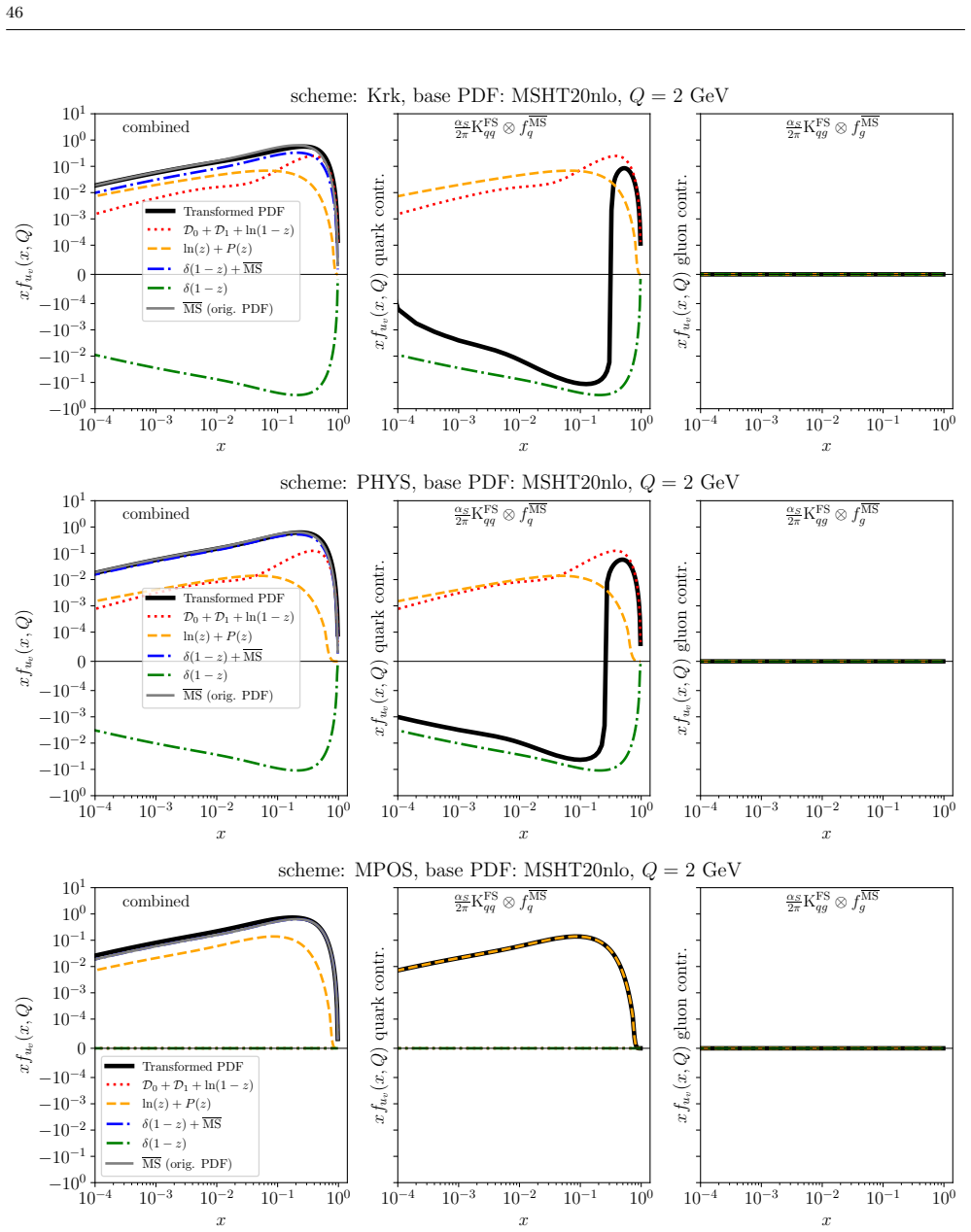
The paper's central claim is unification: at NLO, every factorisation scheme it studies is obtained from $\overline{\mathrm{MS}}$ by convolution with kernels $K_{qq}$, $K_{qg}$, $K_{gq}$, $K_{gg}$ that share one common structure (Eqs. 69–72), and the differences between schemes reduce to the values of a few discrete coefficients ($a_{qq}, a_{gg} \in \{0,1,2\}$; $a_{qg}, a_{gq} \in \{1,2\}$; the remaining $b$ and $c$ coefficients in $\{0,1\}$), with the diagonal delta-function terms fixed by the momentum sum rule. Two exceptions are noted: the DIS-scheme gluon kernels, fixed by a local momentum-conservation convention, and the Aversa gluon kernel, which uses a single rational term. On the authors' reading, 'the domain of interest for factorisation-scheme variation within the literature is much smaller than might initially be assumed' (Sec. 5). The supporting numerical claim is that the choice matters at the LHC: the transformed low-$x$ gluon can be an order of magnitude larger at low scales, and for Z-plus-jet and Higgs-plus-jet production the scheme-to-scheme spread reaches roughly 30% and 20% respectively in some regions, exceeding the factorisation-scale variation band.
Load-bearing premise
The quantitative conclusions — the order-of-magnitude low-$x$ gluon enhancement and the 20–30% cross-section shifts — are computed by taking $\overline{\mathrm{MS}}$-fitted PDFs and transforming them locally at every scale, which is only one of three inequivalent ways to define PDFs in an alternative scheme, and the paper states that its conclusions may not apply to the other two.
Editorial extensions
If this is right
- The space of NLO factorisation schemes in the literature is far smaller than it appears: the studied schemes differ only through a handful of discrete coefficients in one general kernel form.
- For Z-plus-jet and Higgs-plus-jet observables, the scheme-to-scheme spread exceeds the factorisation-scale variation band in several kinematic regions, so scale variation alone can understate the theoretical uncertainty of an NLO prediction.
- The choice of scheme modifies the valence-quark number sum rules at $\mathcal{O}(\alpha_s)$ and makes them scale-dependent in most schemes, which must be handled if PDFs are fitted in those schemes.
- Heavy-quark PDFs turn negative just above their mass thresholds in every studied scheme when they are generated perturbatively, so positivity cannot be assumed as a universal property of alternative factorisation schemes.
Reading between the lines
- Because all studied schemes sit in one small discrete parameter space, a systematic scan of that space would define a complete scheme-envelope uncertainty for LHC processes; the paper samples only the schemes that happen to exist in the literature, not the full space its template spans.
- The reported 20–30% shifts are tied to the paper's transformation-at-each-scale prescription; transforming at the input scale and evolving in the scheme instead could redistribute the effect between the PDFs and the DGLAP evolution, and checking whether the shifts survive is the most direct test of how intrinsic to the schemes they are.
- The heavy-quark negativity just above threshold suggests a pragmatic remedy the paper mentions only in passing: moving the flavour-number transition above the quark mass would very likely restore positivity without disturbing the unification, since the transformation kernels themselves are unchanged.
Signed reviews
Editorial analysis
A structured set of objections, weighed in public.
Referee Report
Summary. This paper presents a systematic comparison of NLO factorisation schemes for proton PDFs, collecting the definitions of the Dis, Krk/KrkDy, Dpos/Pos/Mpos/Mposδ, A versa, and Phys schemes in a common notation and expressing each transformation kernel in a unified decomposition of distributions, logarithms, rational functions, and delta-function terms (Tables 1–4). The main analytical result is that, after neglecting the polynomial piece P(z), all considered kernels are special cases of a common parametric form (Eqs. 69–72) with a handful of discrete coefficients. The paper further derives the corresponding coefficient functions for DIS, Drell–Yan and Higgs production (Tables 5–7), studies the momentum and number sum rules, examines positivity using an adaptation of the argument of [46], and presents numerical results for PDFs transformed from CT18NLO, NNPDF40MC and MSHT20nlo PDFs. These are used to compute LO Z+jet and H+jet cross-sections, finding that scheme-to-scheme variation can exceed the conventional MS factorisation-scale uncertainty, especially at low pT.
Significance. The analytical unification, if correct, is a valuable contribution: it reduces the space of scheme choices to a small set of discrete parameters and provides a common language for future scheme proposals. The tabulated kernels and coefficient functions will serve as a reference. The numerical work is carefully validated: two independent convolution codes agree to order 10^{-5}, the momentum sum rule is reproduced to approximately 10^{-6}, and the Krk and Phys implementations are checked against original codes. The paper also gives a fair presentation of the limitations of its numerical study, noting explicitly that only method (iii) for defining scheme PDFs is used. The positivity analysis extends the argument of [46] to alternative schemes and is appropriately labelled preliminary. Taken together, the paper is a useful and reliable resource, provided the phenomenological claims are properly scoped.
major comments (2)
- [Sec. 3 (methods), Sec. 4, Sec. 5] The central quantitative conclusion of Sec. 4, that factorisation-scheme variation can exceed the factorisation-scale uncertainty, is obtained exclusively with PDFs defined by method (iii): MS PDFs evolved in MS and transformed locally at each scale via Eq. (5). The three methods are inequivalent (Sec. 3), and the paper explicitly acknowledges in Sec. 5 that the conclusions may not apply to methods (i) and (ii). This is not a mere technicality: Sec. 3.2.3 reports that the NLO gluon contribution is comparable to the LO term for the Krk and Mpos schemes at Q = 2 GeV, and Appendix D shows that the perturbative inversion fails at Q = 1.3 GeV. A PDF fitted or evolved in the scheme would carry these large low-scale corrections through the DGLAP evolution to LHC scales, so the 20–30% cross-section shifts in Figs. 14 and 15 may be partly artefacts of applying the transformation only at high scales. To support the Sec. 4 claim as stated, the authors should either perform a consistency test using method (ii) (transform at the input scale and evolve with the modified DGLAP kernels) for at least the most extreme schemes (Krk, Mpos), or substantially soften the abstract and Sec. 4 conclusions to state clearly that the numerical estimates apply only to method (iii). The analytical unification is unaffected, but the phenomenological claim is load-bearing and currently under-supported.
- [Sec. 5, Eqs. (69–72)] The unified form of Eqs. (69–72) is obtained after setting the polynomial piece P(z) to zero. For the Mpos scheme, P(z) is not a numerically suppressed detail: the qq and gg kernels in Tables 1 and 4 consist solely of the soft-function terms 350/3 z^2(1−z)^2, which are the scheme's defining momentum-conservation mechanism, and Fig. 8b shows that this choice produces an O(1) difference in the momentum-fraction distribution relative to Mposδ. Consequently, the statement that Mpos is a special case of Eq. (69) is only an approximation that omits the term that distinguishes the scheme. The conclusion that the 'domain of interest for factorisation-scheme variation within the literature is much smaller than might initially be assumed' therefore needs either a quantitative demonstration that P(z) is negligible for all considered schemes (which Fig. 8b contradicts for Mpos), or a more cautious wording that the unified form captures only the distributional and logarithmic content of the kernels.
minor comments (4)
- [Sec. 3.2.3] The sentence 'we show the decomposition of the transformed gluon PDFs in in Fig. 4' contains a duplicated 'in'.
- [Eq. (33), Tables 1–4] The sign convention for the delta-function term (the decomposition writes '- Δ δ(1−z)' but the tables list positive values under a '-δ(1−z)' heading) should be explained explicitly the first time the decomposition is used.
- [Throughout] The scheme name is spelled inconsistently: 'A versa' in the text and tables, 'Aversa' in figure captions and the appendix; please unify.
- [Sec. 3.5.1, Eq. (49)] The modified cumulant of Eq. (49) places the absolute value inside the integral, which is a strengthening of the criterion in [46]; the text notes this only in a footnote, but since the subsequent numerical comparison uses this modified criterion, its role should be highlighted in the main discussion.
Circularity Check
No circularity: the paper's scheme unification is a summary of external kernels, and its numerical spreads are computed from external PDFs without any fitted or derived quantity reducing to an input.
full rationale
The central analytical claim, Eqs. (69)-(72), is explicitly a compact parametrization of the transformation kernels tabulated in Tables 1-4, drawn from the literature; it is presented as an observation that the considered schemes fit a common form, not as a prediction derived from that form. The numerical comparisons use PDFs fitted externally in the MS scheme (CT18NLO, NNPDF40MC, MSHT20nlo) and apply the literature transformation kernels via Eq. (5); no parameter is fitted to the output and no 'predicted' quantity is constructed from the quantity being claimed. The paper's acknowledged limitation that method (iii) for obtaining scheme PDFs may differ from methods (i) and (ii) is a scope restriction, not a circular step: it does not make the reported spreads equal by construction to an input, it only means the quantitative conclusion is conditional on the chosen method. Self-citations appear where the Krk scheme is defined from earlier work by the same authors, but that is background definitional context, and the kernels themselves are independently tabulated and numerically checked against the original code. The perturbative-inversion test of Appendix D is a validation, not a load-bearing derivation. No reduction of a claimed result to its own input was found.
Assumptions & free parameters
assumptions (5)
- domain assumption Collinear QCD factorisation with neglected higher-twist terms (Eqs. 1-2).
- domain assumption NLO truncation of transformation kernels and validity of perturbative inversion (Eq. 6, Eq. 9, Appendix D).
- domain assumption Variable-flavour-number scheme with sudden activation of heavy-quark kernels at threshold (Eqs. 27-28).
- domain assumption External MS PDF sets (CT18NLO, NNPDF40MC, MSHT20nlo) are accurate representations of the proton.
- ad hoc to paper Modified positivity criterion with absolute value inside the cumulant integral (Eq. 49).
Cite this review
Pith. "Pith review of Factorisation schemes for proton PDFs." pith.science (2026). https://pith.science/paper/BPIXGGCR
@misc{pith2026250118289,
  author       = {Pith},
  title        = {Pith review of: Factorisation schemes for proton PDFs},
  year         = {2026},
  howpublished = {\url{https://pith.science/paper/BPIXGGCR}},
  note         = {Machine review of arXiv:2501.18289}
}
abstract
Beyond leading-order, perturbative QCD requires a choice of factorisation scheme to define the parton distribution functions (PDFs) and hard-process cross-section. The modified minimal-subtraction ($\overline{\mathrm{MS}}$) scheme has long been adopted as the default choice due to its simplicity. Alternative schemes have been proposed with specific purposes, including, recently, PDF positivity and NLO parton-shower matching. In this paper we assemble these schemes in a common notation for the first time. We perform a detailed comparison of their features, both analytically and numerically, and estimate the resulting factorisation-scheme uncertainty for LHC phenomenology.
Figures


Figures from the paper (28 more)




Forward citations
Cited by 2 Pith papers
-
What are the consequences of independent factorization and renormalization scales?
Independent factorization and renormalization scales are inconsistent with simultaneously preserving RG invariance, Ward identities, and PDF sum rules in generalized pole subtraction schemes.
-
Next-to-leading order evolution of structure functions without PDFs
The authors build a complete NLO momentum-space DGLAP evolution for a six-observable physical basis of DIS structure functions and compare its numerical results with conventional PDF-based evolution.
Reference graph
Works this paper leans on
-
[46]
A. Candido, S. Forte, T. Giani, and F. Hekhorn,Eur. Phys. J. C84 (2024), no. 3 335,2308.00025
arXiv 2024
-
[1]
Altarelli, R
G. Altarelli, R. K. Ellis, and G. Martinelli,Nucl. Phys. B 143 (1978) 521, [Erratum:Nucl. Phys. B146 (1978) 544]
1978
-
[2]
W. A. Bardeen, A. J. Buras, D. W. Duke, and T. Muta, Phys. Rev. D18 (1978) 3998
1978
-
[3]
Altarelli, R
G. Altarelli, R. K. Ellis, and G. Martinelli,Nucl. Phys. B 157 (1979) 461–497
1979
-
[4]
Curci, W
G. Curci, W. Furmanski, and R. Petronzio,Nucl. Phys. B 175 (1980) 27–92
1980
-
[5]
Furmanski and R
W. Furmanski and R. Petronzio,Z. Phys. C11 (1982) 293
1982
-
[6]
H. D. Politzer,Nucl. Phys. B194 (1982) 493–512
1982
-
[7]
P. M. Stevenson and H. D. Politzer,Nucl. Phys. B277 (1986) 758–763. 29Where the input PDF used a single grid we have split the grid at the heavy-flavour thresholds to accommodate the an- ticipated discontinuities in the transformed PDFs, as outlined in Sec. 2.1.5. 38 10□4 10□3 10□2 10□1 100 x −100 −10□1 −10□2 −10□3 −10□4 0 10□4 10□3 10□2 10□1 100 101 xfuv...
1986
Show all 100 references
-
[8]
Ramalho and G
A. Ramalho and G. F. Sterman,Phys. Rev. D29 (1984) 2517
1984
-
[9]
G. F. Sterman,Nucl. Phys. B281 (1987) 310–364
1987
-
[10]
Aurenche, R
P. Aurenche, R. Baier, M. Fontannaz, and D. Schiff, Nucl. Phys. B286 (1987) 509–552
1987
-
[11]
Aurenche, R
P. Aurenche, R. Baier, A. Douiri, M. Fontannaz, and D. Schiff,Nucl. Phys. B286 (1987) 553–591
1987
-
[12]
Aversa, M
F. Aversa, M. Greco, P. Chiappetta, and J. P. Guillet, Phys. Lett. B211 (1988) 465
1988
-
[13]
Aversa, P
F. Aversa, P. Chiappetta, M. Greco, and J. P. Guillet, Nucl. Phys. B327 (1989) 105
1989
-
[14]
Chyla,Nucl
J. Chyla,Nucl. Phys. B321 (1989) 374–386
1989
- [15]
-
[16]
Jadach, W
S. Jadach, W. Płaczek, S. Sapeta, A. Siódmok, and M. Skrzypek,JHEP 10 (2015) 052, 1503.06849
2015 arXiv
-
[17]
Jadach, W
S. Jadach, W. Płaczek, S. Sapeta, A. Siódmok, and M. Skrzypek, Eur. Phys. J. C 76 (2016), no. 12 649, 1606.00355
2016 arXiv
-
[18]
Jadach, G
S. Jadach, G. Nail, W. Płaczek, S. Sapeta, A. Siódmok, and M. Skrzypek,Eur. Phys. J. C77 (2017), no. 3 164, 1607.06799
2017 arXiv
-
[19]
Jadach, A
S. Jadach, A. Kusina, W. Płaczek, M. Skrzypek, and M. Slawinska, Phys. Rev. D 87 (2013), no. 3 034029, 1103.5015
2013 arXiv
- [20]
- [21]
-
[22]
E. G. Oliveira, A. D. Martin, and M. G. Ryskin,JHEP 11 (2013) 156, 1310.8289
2013 arXiv
-
[23]
G. T. Bodwin,Phys. Rev. D31 (1985) 2616, [Erratum: Phys. Rev. D34 (1986) 3932]
1985
-
[24]
J. C. Collins, D. E. Soper, and G. F. Sterman,Nucl. Phys. B 261 (1985) 104–142
1985
-
[25]
J. C. Collins, Phys. Rev. D 58 (1998) 094002, hep-ph/9806259
1998 arXiv
-
[26]
Buckley, J
A. Buckley, J. Ferrando, S. Lloyd, K. Nordström, B. Page, M. Rüfenacht, M. Schönherr, and G. Watt, Eur. Phys. J. C75 (2015) 132, 1412.7420
2015 arXiv
-
[27]
Altarelli and G
G. Altarelli and G. Parisi, Nucl. Phys. B 126 (1977) 298–318
1977
-
[28]
V. N. Gribov and L. N. Lipatov,Sov. J. Nucl. Phys.15 (1972) 438–450
1972
-
[29]
Y. L. Dokshitzer,Sov. Phys. JETP46 (1977) 641–653
1977
-
[30]
C. D. White and R. S. Thorne, Eur. Phys. J. C 45 (2006) 179–192, hep-ph/0507244
2006 arXiv
-
[31]
Lappi, H
T. Lappi, H. Mäntysaari, H. Paukkunen, and M. Tevio, Eur. Phys. J. C84 (2024), no. 1 84,2304.06998
2024 arXiv
-
[32]
Lappi, H
T. Lappi, H. Mäntysaari, H. Paukkunen, and M. Tevio, Eur. Phys. J. C85 (2025), no. 4 429,2412.09589
2025 arXiv
-
[33]
J. C. Collins and D. E. Soper,Nucl. Phys. B194 (1982) 445–492
1982
-
[34]
M. Buza, Y. Matiounine, J. Smith, and W. L. van Neer- ven,Eur. Phys. J. C1(1998) 301–320,hep-ph/9612398
1998 arXiv
-
[35]
Stavreva, F
T. Stavreva, F. I. Olness, I. Schienbein, T. Jezo, A. Kusina, K. Kovarik, and J. Y. Yu,Phys. Rev. D85 (2012) 114014, 1203.0282
2012 arXiv
-
[36]
Bertone, A
V. Bertone, A. Glazov, A. Mitov, A. Papanastasiou, and M. Ubiali,JHEP 04 (2018) 046, 1711.03355
2018 arXiv
-
[37]
M. A. G. Aivazis, F. I. Olness, and W.-K. Tung,Phys. Rev. D 50 (1994) 3085–3101, hep-ph/9312318
1994 arXiv
-
[38]
M. A. G. Aivazis, J. C. Collins, F. I. Olness, and W.-K. Tung, Phys. Rev. D 50 (1994) 3102–3118, hep-ph/9312319
1994 arXiv
-
[39]
R. S. Thorne and R. G. Roberts,Phys. Rev. D57(1998) 6871–6898, hep-ph/9709442
1998 arXiv
-
[40]
R. S. Thorne, Phys. Rev. D 73 (2006) 054019, hep-ph/0601245
2006 arXiv
- [41]
-
[42]
Brocket al., Rev
CTEQ Collaboration, R. Brocket al., Rev. Mod. Phys. 67 (1995) 157–248
1995
-
[43]
A. D. Martin, R. G. Roberts, W. J. Stirling, and R. S. Thorne, Phys. Lett. B 443 (1998) 301–307, hep-ph/9808371
1998 arXiv
-
[44]
Catani and M
S. Catani and M. H. Seymour,Nucl. Phys. B485(1997) 291–419, [Erratum: Nucl. Phys. B 510 (1998) 503], hep-ph/9605323
1997 arXiv
-
[45]
Collins, T
J. Collins, T. C. Rogers, and N. Sato,Phys. Rev. D105 (2022), no. 7 076010,2111.01170
2022 arXiv
- [47]
- [48]
- [49]
- [50]
- [51]
- [52]
-
[53]
H. L. Lai, J. Botts, J. Huston, J. G. Morfin, J. F. Owens, J.-W. Qiu, W. K. Tung, and H. Weerts,Phys. Rev. D 51 (1995) 4763–4782, hep-ph/9410404
1995 arXiv
-
[54]
H. L. Lai, J. Huston, S. Kuhlmann, F. I. Olness, J. F. Owens, D. E. Soper, W. K. Tung, and H. Weerts,Phys. Rev. D 55 (1997) 1280–1296, hep-ph/9606399
1997 arXiv
-
[55]
CTEQ Collaboration, H. L. Lai, J. Huston, S. Kuhlmann, J. Morfin, F. I. Olness, J. F. Owens, J. Pumplin, and W. K. Tung, Eur. Phys. J. C 12 (2000) 375–392, hep-ph/9903282
2000 arXiv
- [56]
-
[57]
Cruz-Martinez, S
J. Cruz-Martinez, S. Forte, N. Laurenti, T. R. Rabe- mananjara, and J. Rojo, JHEP 09 (2024) 088, 2406.12961
2024 arXiv
-
[58]
Bailey, T
S. Bailey, T. Cridge, L. A. Harland-Lang, A. D. Martin, and R. S. Thorne,Eur. Phys. J. C81 (2021), no. 4 341, 2012.04684
2021 arXiv
-
[59]
Collins, Foundations of Perturbative QCD, vol
J. Collins, Foundations of Perturbative QCD, vol. 32 of Cambridge Monographs on Particle Physics, Nuclear Physics and Cosmology. Cambridge University Press, 2011
2011
-
[60]
Private communication with John Collins
-
[61]
NNPDF Collaboration, R. D. Ball, V. Bertone, F. Cerutti, L. Del Debbio, S. Forte, A. Guffanti, J. I. La- torre, J. Rojo, and M. Ubiali,Nucl. Phys. B855 (2012) 153–221, 1107.2652
2012 arXiv
-
[62]
Diehl and P
M. Diehl and P. Stienemeier,Eur. Phys. J. Plus 135 (2020), no. 2 211,1904.10722
2020 arXiv
-
[63]
A. D. Martin, W. J. Stirling, R. S. Thorne, and G. Watt, Eur. Phys. J. C63 (2009) 189–285, 0901.0002
2009 arXiv
-
[64]
Altarelli, S
G. Altarelli, S. Forte, and G. Ridolfi,Nucl. Phys. B534 (1998) 277–296, hep-ph/9806345
1998 arXiv
-
[65]
Abramowicz et al., Eur
H1, ZEUS Collaboration, H. Abramowicz et al., Eur. Phys. J. C75 (2015), no. 12 580,1506.06042
2015 arXiv
-
[66]
R. D. Ball, L. Del Debbio, S. Forte, A. Guffanti, J. I. La- torre, J. Rojo, and M. Ubiali,Nucl. Phys. B838 (2010) 136–206, 1002.4407
2010 arXiv
-
[67]
NNPDF Collaboration, R. D. Ball, L. Del Debbio, S. Forte, A. Guffanti, J. I. Latorre, A. Piccione, J. Rojo, and M. Ubiali,Nucl. Phys. B 809 (2009) 1–63, [Erra- tum: Nucl. Phys. B 816 (2009) 293], 0808.1231
2009 arXiv
-
[68]
Pumplin, D
J. Pumplin, D. R. Stump, J. Huston, H. L. Lai, P. M. Nadolsky, and W. K. Tung, JHEP 07 (2002) 012, hep-ph/0201195
2002 arXiv
-
[69]
NNPDF Collaboration, R. D. Ballet al., Eur. Phys. J. C 82 (2022), no. 5 428,2109.02653
2022 arXiv
-
[70]
Kusina, F
A. Kusina, F. I. Olness, I. Schienbein, T. Jezo, K. Ko- varik, T. Stavreva, and J. Y. Yu, Phys. Rev. D 88 (2013), no. 7 074032,1306.6553
2013 arXiv
-
[71]
Bertoneet al., Eur
xFitter Developers Team Collaboration, V. Bertoneet al., Eur. Phys. J. C77 (2017), no. 12 837,1707.05343
2017 arXiv
-
[72]
Abramowicz et al., Eur
H1, ZEUS Collaboration, H. Abramowicz et al., Eur. Phys. J. C73 (2013), no. 2 2311,1211.1182
2013 arXiv
-
[73]
A. M. Cooper-Sarkar, PoS DIS2010 (2010) 023, 1006.4471
2010 arXiv
-
[74]
Gauld, A
R. Gauld, A. Huss, and G. Stagnitto,Phys. Rev. Lett. 130 (2023), no. 16 161901, [Erratum: Phys.Rev.Lett. 132, 159901 (2024)],2208.11138
2023 arXiv
-
[75]
Caletti, A
S. Caletti, A. J. Larkoski, S. Marzani, and D. Reichelt, Eur. Phys. J. C82 (2022), no. 7 632,2205.01109
2022 arXiv
- [76]
-
[77]
Caola, R
F. Caola, R. Grabarczyk, M. L. Hutt, G. P. Salam, L. Scyboz, and J. Thaler, Phys. Rev. D 108 (2023), no. 9 094010,2306.07314
2023 arXiv
-
[78]
Catani and L
S. Catani and L. Trentadue,Nucl. Phys. B327 (1989) 323–352
1989
-
[79]
Catani, M
S. Catani, M. L. Mangano, P. Nason, and L. Trentadue, Nucl. Phys. B478 (1996) 273–310, hep-ph/9604351
1996 arXiv
-
[80]
Contopanagos, E
H. Contopanagos, E. Laenen, and G. F. Sterman,Nucl. Phys. B 484 (1997) 303–330, hep-ph/9604313
1997 arXiv
- [81]
-
[82]
A. V. Manohar, Phys. Rev. D 68 (2003) 114019, hep-ph/0309176
2003 arXiv
- [83]
- [84]
- [85]
-
[86]
Bonvini, S
M. Bonvini, S. Forte, and G. Ridolfi,Nucl. Phys. B847 (2011) 93–159, 1009.5691
2011 arXiv
-
[87]
Bonvini, S
M. Bonvini, S. Forte, M. Ghezzi, and G. Ridolfi,Nucl. Phys. B 861 (2012) 337–360, 1201.6364
2012 arXiv
- [88]
-
[89]
Curci and M
G. Curci and M. Greco,Phys. Lett. B 92 (1980) 175– 178
1980
- [90]
- [91]
- [92]
- [93]
-
[94]
Aaboudet al., Eur
ATLAS Collaboration, M. Aaboudet al., Eur. Phys. J. C 77 (2017), no. 6 361,1702.05725
2017 arXiv
-
[95]
CMS Collaboration, A. M. Sirunyanet al., Eur. Phys. J. C 78 (2018), no. 11 965,1804.05252
2018 arXiv
-
[96]
M.Cacciari,G.P.Salam,andG.Soyez, JHEP 04(2008) 063, 0802.1189
2008 arXiv
-
[97]
C. R. Harris, K. J. Millman, S. J. van der Walt, R. Gom- mers, P. Virtanen, D. Cournapeau, E. Wieser, J. Tay- lor, S. Berg, N. J. Smith, R. Kern, M. Picus, S. Hoyer, M. H. van Kerkwijk, M. Brett, A. Haldane, J. F. del Río, M. Wiebe, P. Peterson, P. Gérard-Marchant, K. Shep- pa...
2020
-
[98]
Virtanen, R
P. Virtanen, R. Gommers, T. E. Oliphant, M. Haber- land, T. Reddy, D. Cournapeau, E. Burovski, P. Pe- terson, W. Weckesser, J. Bright, S. J. van der Walt, M.Brett,J.Wilson,K.J.Millman,N.Mayorov,A.R.J. Nelson, E. Jones, R. Kern, E. Larson, C. J. Carey, İ. Po- lat, Y. Feng, E. W...
2020
-
[99]
Meurer, C
A. Meurer, C. P. Smith, M. Paprocki, O. Čertík, S. B. Kirpichev, M. Rocklin, A. Kumar, S. Ivanov, J. K. Moore, S. Singh, T. Rathnayake, S. Vig, B. E. Granger, R. P. Muller, F. Bonazzi, H. Gupta, S. Vats, F. Johans- son, F. Pedregosa, M. J. Curry, A. R. Terrel, v. Roučka, A. Sa...
2017
-
[100]
http://mpmath.org/
The mpmath development team,mpmath: a Python li- brary for arbitrary-precision floating-point arithmetic (version 1.3.0), 2023. http://mpmath.org/
2023
Reviewed August 10, 2026 · model on record in the stance chip above.
Discussion (0). Continue with ORCID to comment.