REVIEW 4 major objections 4 minor 42 references
High-fidelity two-qubit gates with transmon qubits using bipolar flux pulses and tunable couplers
T0 review · 4 major / 4 minor · reviewed 2026-08-05 · deepseek-v4-flash
Pith's one-line read Bipolar flux pulses plus a tunable coupler yield 99.48% transmon two-qubit gates
desk verdict Credible 99.48% CPhase demonstration on a tunable-coupler transmon device; the abstract overclaims an 8-qubit validation and the 99.9% projection leans on an unproven echo assumption. read the letter →
The pith
A machine-rendered reading of the paper's core claim, the machinery that carries it, and where it could break.
The reading
What carries the argument
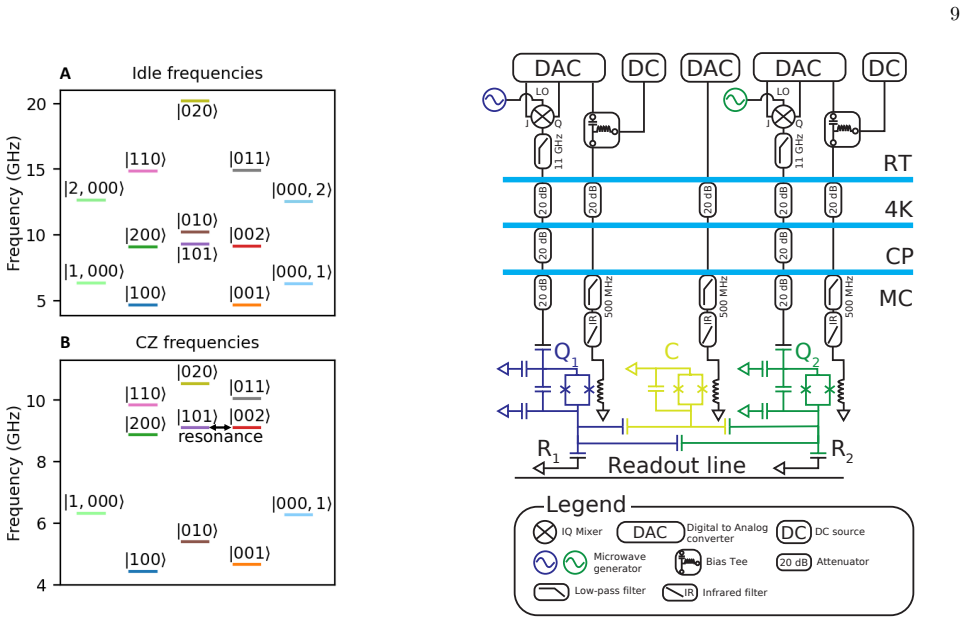
The central object is the bipolar net-zero flux pulse: a positive Gaussian-smoothed pulse followed by an equal negative pulse on one qubit. Each strong pulse drives the non-adiabatic |101⟩↔|200⟩ population exchange while the detuned tunable coupler supplies effective coupling strength g~CZ up to 40 MHz; the opposite-polarity second pulse cancels the net flux and refocuses low-frequency noise in an echo-like manner. The machinery also includes the coupler's energy-level engineering: keeping the coupler more than 1 GHz detuned makes the leakage-state overlap grow as g1c^2/Delta^2 while the desired coupling grows as g1c^2/Delta, so strong coupling is possible with under 1% leakage overlap and s
What would settle it
Deliberately add low-frequency flux noise on Q1 while interleaving the CPhase gate, and see whether the measured fidelity degrades as if dephasing were set by the echo time (48.5 microseconds) or the Ramsey time (4.5 microseconds); a scaling closer to Ramsey invalidates the sub-1e-3 error projection.
Extended reading notes
Core claim
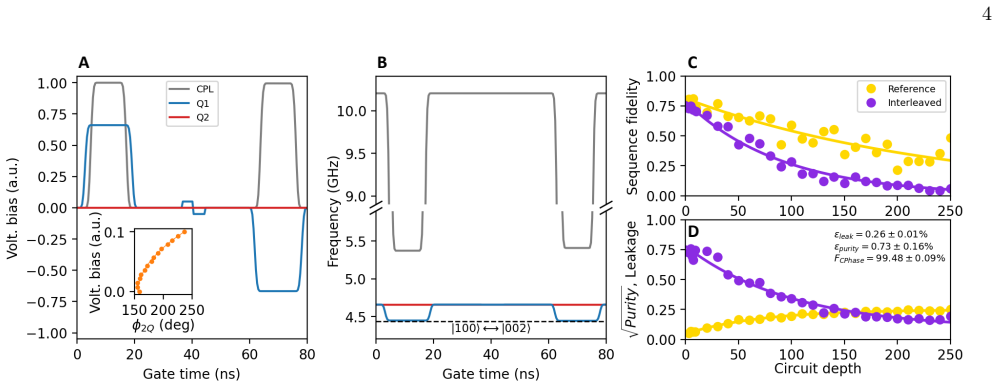
The central claim is that a CPhase gate can be executed as a three-step diabatic protocol: bring |101⟩ into resonance with |200⟩ with a positive flux pulse while the tunable coupler strengthens the effective coupling; apply a weak bipolar pulse of adjustable amplitude a_int to set the conditional phase; then apply a negative pulse of the same shape to complete the exchange and echo low-frequency flux noise. Because the two strong pulses have opposite polarity, their net flux is zero, so long-timescale flux-line distortions do not build up; because the coupler is kept strongly detuned, the computational states hybridize with coupler leakage states by under 1% while still giving an effective c
Load-bearing premise
The simulated 99.9% projection assumes the bipolar pulse pair fully cancels low-frequency flux noise during the ~100-ns gate, so the qubit keeps its long echo dephasing time (48.5 microseconds) rather than its short Ramsey time (4.5 microseconds); if that cancellation is incomplete, the simulated 3.4e-4 decoherence error is optimistic.
Editorial extensions
If this is right
- Arbitrary CPhase angles, including non-Clifford fractional phases, can be calibrated by a single intermediate-pulse amplitude, so a continuous family of two-qubit gates is available without waveform redesign.
- Residual ZZ coupling below 5 kHz lets qubits idle and run simultaneous single-qubit gates with small frequency detunings, easing frequency crowding on multi-qubit chips.
- Net-zero flux waveforms reject long-timescale flux-line distortions, so the gate does not require pre-distortion corrections and is reproducible on programmable control hardware.
- Leakage to coupler-associated states is predicted below 1e-6 for 20-ns Gaussian-smoothed pulses, and coherence simulations put the floor near 3.4e-4, so the remaining gap to 99.9% is a pulse-shaping problem, not an architecture problem.
Reading between the lines
- If the echo-like cancellation is as complete as assumed, the gate error should be nearly independent of the amplitude of slow flux noise on Q1; injecting low-frequency noise and measuring XEB fidelity would test this directly.
- The three-step pulse template (strong +, weak phase-setting, strong −) is not tied to transmon specifics; fixed-frequency qubit platforms with a tunable coupler and comparable anharmonicity could reuse the same calibration logic.
- Amplitude-only phase setting suggests variational or randomized circuits that need many different two-qubit phases could be compiled in situ without retiming the pulse clock.
- The abstract claims 8-qubit validation while the body reports a 4-qubit processor; the scheme's crosstalk behaviour at 8 qubits, with each coupler parked at the ZZ-free point, remains an open check.
Signed reviews
Editorial analysis
A structured set of objections, weighed in public.
Referee Report
Summary. The manuscript presents a flux-pulse scheme for CPhase gates on transmon qubits with a tunable coupler. A bipolar net-zero pulse pair drives a diabatic |101>–|200> exchange, and an intermediate weak bipolar pulse sets the conditional phase. The authors report a measured CPhase fidelity of 99.48(9)% from interleaved XEB on a two-qubit device, with residual ZZ below 5 kHz. They decompose the cycle error into leakage and purity components, and Lindblad simulations indicate a decoherence error of 3.4e-4 for 40-ns pulses, from which they claim 99.9% fidelity is achievable. The gate is also implemented on a 4-qubit processor with CZ fidelities 99.13–99.34%. The core experimental claim is directly benchmarked; the main concerns are the unsupported forward-looking simulation projection and several internal inconsistencies in the reported error-budget arithmetic.
Significance. If the measured result stands, the 99.48(9)% CPhase fidelity is competitive with the current state of the art, and the combination of tunable-coupler isolation (ZZ<5 kHz), bipolar net-zero pulsing, and a two-parameter calibration protocol is practically valuable. The paper includes a direct interleaved XEB measurement with explicit leakage and purity decomposition, and experimental validation on a 4-qubit processor. The main caveat is that the forward-looking '99.9% / error <1e-4' projection rests on an unvalidated echo-protection assumption; the measured central result is not affected by this caveat.
major comments (4)
- [Leakage and decoherence contribution to gate errors (Eq. 5, Table I)] The Lindblad simulation sets Q1's pure dephasing from T2E,gate=48.5 us rather than T2R,gate=4.5 us, invoking the built-in echo of the bipolar pulse. This is load-bearing for the simulated 1-F=3.4e-4 and the subsequent '99.9% fidelity is achievable' statement. However, the gate is not a simple free-precession echo: during each 20-ns pulse the system traverses the |101>–|200> avoided crossing with time-dependent detunings and population exchange, and the +V and -V segments have different instantaneous frequencies and coupler participation. A quasi-static flux offset therefore need not cancel to first order. The text itself notes that the 20-ns delay is not echo protected. If the effective dephasing is closer to T2R,gate, the simulated error becomes roughly an order of magnitude larger and the 99.9% projection is unsupported. Please either rerun the simulation with a conservative T2R-based
- [CPhase implementation (Eq. 4)] The factor 1.5 in Eq. (4) is not derived. It is the only element that brings the extracted decoherence error (0.03(0.18)%) into agreement with the simulation (3.4e-4); with a factor of 1, the estimate is 0.18(0.18)%. Because the subsequent sentence states that the simulation 'compares well' with the experimental estimate, the choice of 1.5 appears to be made to match the simulation. Please provide an explicit timing/error-budget derivation for the factor, or replace the estimate with a direct measurement of the unprotected delay contribution.
- [CPhase implementation (Eq. 3, Fig. 2c)] The reported fidelity is inconsistent with Eq. (3). With reference error 0.29(2)% and interleaved cycle error 0.81(3)%, p=p2/p1=0.9948. Substituting into Eq. (3) with D=4 gives F=0.9961, i.e., 99.61%, not 99.48(9)%. The quoted 99.48% corresponds to p itself. Please correct Eq. (3), redefine D, or clarify the definition of 'fidelity'; the headline number must be consistent with the stated formula.
- [Abstract and Fig. 3b / Conclusion] The abstract claims numerical simulations show an error below 1e-4 is achievable, while the body reports 1-F=3.4e-4 for the 40-ns gate and states '99.9% fidelity is achievable' (1e-3). Figure 3b shows values near 3e-4, not below 1e-4. These quantitative claims need to be harmonized; the 1e-4 statement is not supported by the data shown in the manuscript.
minor comments (4)
- [CPhase implementation] Typo: 'complete |100> <-> |200> transition' should be '|101> <-> |200>'.
- [Scalability / Table II] Typo: 'Table II ummarizes' should be 'summarizes'.
- [Abstract] The phrase 'systems energy levels' should be 'system's energy levels'; the phrase 'time-scale control pulse reproducibility' is awkward and could be clarified.
- [Data Availability] The statement 'available from the corresponding author upon reasonable request' is not ideal for reproducibility; consider depositing the XEB data and simulation scripts in a public repository.
Circularity Check
No significant circularity: central 99.48% fidelity is a measured XEB result; numerical projections rest on stated coherence assumptions rather than on fitted outputs.
full rationale
The paper's central experimental claim is a measured interleaved cross-entropy benchmarking fidelity of 99.48(9)% for a bipolar-pulse tunable-coupler CPhase gate. XEB is an external randomized benchmarking protocol, and the quoted fidelity is not derived from the model or from the simulation; therefore it is not circular. The residual ZZ coupling (<5 kHz) is measured directly via conditional-phase Ramsey experiments, and the arbitrary CPhase-angle sweep is measured by quantum state tomography. The numerical projection of error below 1e-3 is a stated model result: the Lindblad simulation uses the independently measured echo dephasing time T2E,gate = 48.5 µs for Q1, with the explicitly stated assumption that the bipolar pulse suppresses low-frequency flux noise. This is a testable physical assumption, not a redefinition of the target; if the echo is incomplete the projection would be optimistic, but that is a correctness/risk issue, not circularity. The apparent agreement between simulation (3.4e-4) and the experimental decoherence estimate (3.3e-4) involves Eq. (4), where the 1.5 coefficient is not fully derived in the text; however, it is consistent with three 20-ns unprotected delays (60 ns) relative to a 40-ns reference cycle, and it functions as an error attribution rather than as the source of the main measured fidelity. Self-citations (Refs. 37-42) concern device fabrication, readout hardware, and IMPA, and are not load-bearing premises of the gate derivation. No circular step can be exhibited.
Assumptions & free parameters
free parameters (5)
- Strong pulse amplitude V =
calibrated in situ (no numeric value reported)
- Intermediate pulse amplitude a_int =
calibrated in situ; swept in Fig. 2a inset
- Pulse duration tp and delay td =
20 ns each in both devices
- Factor 1.5 in Eq. (4) =
1.5
- Coupler coherence times T1,c and T_phi,c =
1 microsecond (assumed)
assumptions (5)
- standard math The circuit is described by a Duffing oscillator Hamiltonian with rotating-wave approximation (Eq. 1).
- domain assumption Dispersive coupling conditions gjc << Delta_jc for qubit-coupler detuning, and g1c ~ g2c >> g12.
- domain assumption The |101>-|200> transition is effectively two-level with coupling gCZ; single- and two-photon subspace Hamiltonians (Eqs. A4-A5) capture the relevant dynamics, and the |020> state can be neglected.
- ad hoc to paper The intermediate weak pulse does not interfere with the strong exchange pulses; the acquired phase is additive and independently calibratable.
- domain assumption Bipolar net-zero pulsing provides built-in echo-like protection against low-frequency flux noise, justifying the use of echo dephasing time T2E rather than Ramsey T2R in the simulation.
Cite this review
Pith. "Pith review of High-fidelity two-qubit gates with transmon qubits using bipolar flux pulses and tunable couplers." pith.science (2026). https://pith.science/paper/BQQ4Q2RO
@misc{pith2026250904965,
  author       = {Pith},
  title        = {Pith review of: High-fidelity two-qubit gates with transmon qubits using bipolar flux pulses and tunable couplers},
  year         = {2026},
  howpublished = {\url{https://pith.science/paper/BQQ4Q2RO}},
  note         = {Machine review of arXiv:2509.04965}
}
abstract
High-fidelity two-qubit gates are essential for scalable quantum computing. We present a scheme based on superconducting transmon qubits and a control pulse delivery protocol that enables arbitrary controlled-phase gates modulated solely by an independent arbitrary waveform generator pulse. We combined a tunable coupler design with bipolar flux-pulsing to demonstrate a high-fidelity gate with a peak performance of $99.5\%$. Our gates inherit the advantages of both approaches: minimal residual ZZ coupling, built-in echo-like low-frequency noise protection, and time-scale control pulse reproducibility, while remaining easy to calibrate. We optimize the system energy levels to mitigate leakage to the coupler and suppress residual interactions. Numerical simulations of the scheme as three qutrits indicate that an error below $1 \times 10^{-3}$ is achievable. We confirm the scalability potential of the proposed scheme on high-fidelity 4-qubit and 8-qubit quantum processors
Figures


Figures from the paper (3 more)


Reference graph
Works this paper leans on
-
[1]
Y. Kim, A. Eddins, S. Anand, K. X. Wei, E. Van Den Berg, S. Rosenblatt, H. Nayfeh, Y. Wu, M. Zale- tel, K. Temme, et al., Nature 618, 500 (2023)
work page 2023
-
[2]
Preskill, Quantum 2, 79 (2018)
J. Preskill, Quantum 2, 79 (2018)
2018
-
[3]
R. Acharya, D. A. Abanin, L. Aghababaie-Beni, I. Aleiner, T. I. Andersen, M. Ansmann, F. Arute, K. Arya, A. Asfaw, N. Astrakhantsev, J. Atalaya, R. Babbush, D. Bacon, B. Ballard, J. C. Bardin, J. Bausch, A. Bengtsson, A. Bilmes, S. Blackwell, S. Boixo, G. Bortoli, A. Bourassa, J. Bovaird, L. Brill, M. Broughton, D. A. Browne, B. Buchea, B. B. Buck- ley, D...
work page 2025
-
[4]
I. N. Moskalenko, I. A. Simakov, N. N. Abramov, A. A. Grigorev, D. O. Moskalev, A. A. Pishchimova, N. S. Smirnov, E. V. Zikiy, I. A. Rodionov, and I. S. Besedin, npj Quantum Information 8, 130 (2022)
work page 2022
-
[5]
I. A. Simakov, G. S. Mazhorin, I. N. Moskalenko, N. N. Abramov, A. A. Grigorev, D. O. Moskalev, A. A. Pishchi- mova, N. S. Smirnov, E. V. Zikiy, I. A. Rodionov, et al., PRX Quantum 4, 040321 (2023)
work page 2023
-
[6]
J. Koch, T. M. Yu, J. Gambetta, A. A. Houck, D. I. Schuster, J. Majer, A. Blais, M. H. Devoret, S. M. Girvin, and R. J. Schoelkopf, Physical Review A 76, 042319 (2007)
work page 2007
-
[7]
I. S. Besedin, M. A. Gorlach, N. N. Abramov, I. Tsitsilin, I. N. Moskalenko, A. A. Dobronosova, D. O. Moskalev, A. R. Matanin, N. S. Smirnov, I. A. Rodionov, et al., Physical Review B 103, 224520 (2021)
work page 2021
-
[8]
W. Cai, J. Han, F. Mei, Y. Xu, Y. Ma, X. Li, H. Wang, Y. Song, Z.-Y. Xue, Z.-q. Yin, et al., Physical review letters 123, 080501 (2019)
work page 2019
Show all 42 references
-
[9]
A. H. Karamlou, I. T. Rosen, S. E. Muschinske, C. N. Barrett, A. Di Paolo, L. Ding, P. M. Harrington, M. Hays, R. Das, D. K. Kim, et al., Nature 629, 561 (2024)
2024
-
[10]
Neill, P
C. Neill, P. Roushan, M. Fang, Y. Chen, M. Kolodru- betz, Z. Chen, A. Megrant, R. Barends, B. Campbell, B. Chiaro, et al., Nature Physics 12, 1037 (2016)
2016
-
[11]
F. W. Strauch, P. R. Johnson, A. J. Dragt, C. J. Lobb, J. R. Anderson, and F. C. Wellstood, Physical Review Letters 91, 167005 (2003)
2003
-
[12]
DiCarlo, J
L. DiCarlo, J. M. Chow, J. M. Gambetta, L. S. Bishop, B. R. Johnson, D. I. Schuster, J. Majer, A. Blais, L. Frun- zio, S. M. Girvin, and R. J. Schoelkopf, Nature 460, 240244 (2009)
2009
-
[13]
Foxen, C
B. Foxen, C. Neill, A. Dunsworth, P. Roushan, B. Chiaro, A. Megrant, J. Kelly, Z. Chen, K. Satzinger, R. Barends, F. Arute, K. Arya, R. Babbush, D. Bacon, J. Bardin, S. Boixo, D. Buell, B. Burkett, Y. Chen, R. Collins, 11 E. Farhi, A. Fowler, C. Gidney, M. Giustina, R. Graff, ...
2020
-
[14]
J. M. Martinis and M. R. Geller, Physical Review A 90, 022307 (2014)
2014
-
[15]
Barends, C
R. Barends, C. Quintana, A. Petukhov, Y. Chen, D. Kafri, K. Kechedzhi, R. Collins, O. Naaman, S. Boixo, F. Arute, K. Arya, D. Buell, B. Burkett, Z. Chen, B. Chiaro, A. Dunsworth, B. Foxen, A. Fowler, C. Gid- ney, M. Giustina, R. Graff, T. Huang, E. Jeffrey, J. Kelly, P. Klimov...
2019
-
[16]
J. A. Schreier, A. A. Houck, J. Koch, D. I. Schuster, B. R. Johnson, J. M. Chow, J. M. Gambetta, J. Ma- jer, L. Frunzio, M. H. Devoret, S. M. Girvin, and R. J. Schoelkopf, Physical Review B 77, 180502 (2008)
2008
-
[17]
Bylander, S
J. Bylander, S. Gustavsson, F. Yan, F. Yoshihara, K. Harrabi, G. Fitch, D. G. Cory, Y. Nakamura, J.-S. Tsai, and W. D. Oliver, Nature Physics 7, 565570 (2011)
2011
-
[18]
R. H. Koch, D. P. DiVincenzo, and J. Clarke, Physical Review Letters 98, 267003 (2007)
2007
-
[19]
F. Yan, J. Bylander, S. Gustavsson, F. Yoshihara, K. Harrabi, D. G. Cory, T. P. Orlando, Y. Nakamura, J.- S. Tsai, and W. D. Oliver, Physical Review B 85, 174521 (2012)
2012
-
[20]
Foxen, J
B. Foxen, J. Y. Mutus, E. Lucero, E. Jeffrey, D. Sank, R. Barends, K. Arya, B. Burkett, Y. Chen, Z. Chen, B. Chiaro, A. Dunsworth, A. Fowler, C. Gidney, M. Giustina, R. Graff, T. Huang, J. Kelly, P. Klimov, A. Megrant, O. Naaman, M. Neeley, C. Neill, C. Quin- tana, P. Roushan,...
2019
-
[21]
M. Rol, F. Battistel, F. Malinowski, C. Bultink, B. Tarasinski, R. Vollmer, N. Haider, N. Muthusubra- manian, A. Bruno, B. Terhal, and L. DiCarlo, Physical Review Letters 123, 120502 (2019)
2019
-
[22]
C. K. Andersen, A. Remm, S. Lazar, S. Krinner, N. Lacroix, G. J. Norris, M. Gabureac, C. Eichler, and A. Wallraff, Nature Physics 16, 875880 (2020)
2020
-
[23]
Negrneac, H
V. Negrneac, H. Ali, N. Muthusubramanian, F. Battistel, R. Sagastizabal, M. Moreira, J. Marques, W. Vlothuizen, M. Beekman, C. Zachariadis, N. Haider, A. Bruno, and L. DiCarlo, Physical Review Letters 126, 220502 (2021)
2021
-
[24]
Scarato, K
C. Scarato, K. Hanke, A. Remm, S. Lazr, N. Lacroix, D. C. Zanuz, A. Flasby, A. Wallraff, and C. Hellings, Re- alizing a continuous set of two-qubit gates parameterized by an idle time (2025), arXiv:2503.11204 [quant-ph]
2025
-
[25]
F. Yan, P. Krantz, Y. Sung, M. Kjaergaard, D. L. Camp- bell, T. P. Orlando, S. Gustavsson, and W. D. Oliver, Physical Review Applied 10, 054062 (2018)
2018
-
[26]
Boixo, S
S. Boixo, S. V. Isakov, V. N. Smelyanskiy, R. Babbush, N. Ding, Z. Jiang, M. J. Bremner, J. M. Martinis, and H. Neven, Nature Physics 14, 595600 (2018)
2018
-
[27]
Arute, K
F. Arute, K. Arya, R. Babbush, D. Bacon, J. C. Bardin, R. Barends, R. Biswas, S. Boixo, F. G. S. L. Brandao, D. A. Buell, B. Burkett, Y. Chen, Z. Chen, B. Chiaro, R. Collins, W. Courtney, A. Dunsworth, E. Farhi, B. Foxen, A. Fowler, C. Gidney, M. Giustina, R. Graff, K. Guerin,...
2019
-
[28]
P. Zhao, D. Lan, P. Xu, G. Xue, M. Blank, X. Tan, H. Yu, and Y. Yu, Physical Review Applied 16, 024037 (2021)
2021
-
[29]
P. Zhao, K. Linghu, Z. Li, P. Xu, R. Wang, G. Xue, Y. Jin, and H. Yu, PRX Quantum 3, 020301 (2022)
2022
-
[30]
Y. Sung, L. Ding, J. Braumller, A. Vepslinen, B. Kannan, M. Kjaergaard, A. Greene, G. O. Samach, C. McNally, D. Kim, A. Melville, B. M. Niedzielski, M. E. Schwartz, J. L. Yoder, T. P. Orlando, S. Gustavsson, and W. D. Oliver, Physical Review X 11, 021058 (2021)
2021
-
[31]
Y. Xu, J. Chu, J. Yuan, J. Qiu, Y. Zhou, L. Zhang, X. Tan, Y. Yu, S. Liu, J. Li, F. Yan, and D. Yu, Physical Review Letters 125, 240503 (2020)
2020
-
[32]
Wallman, C
J. Wallman, C. Granade, R. Harper, and S. T. Flammia, New Journal of Physics 17, 113020 (2015)
2015
-
[33]
Johansson, P
J. Johansson, P. Nation, and F. Nori, Computer Physics Communications 184, 12341240 (2013)
2013
-
[34]
Jozsa, Journal of Modern Optics 41, 23152323 (1994)
R. Jozsa, Journal of Modern Optics 41, 23152323 (1994)
1994
-
[35]
Motzoi, J
F. Motzoi, J. M. Gambetta, P. Rebentrost, and F. K. Wilhelm, Physical Review Letters 103, 110501 (2009)
2009
-
[36]
Lucero, J
E. Lucero, J. Kelly, R. C. Bialczak, M. Lenander, M. Mariantoni, M. Neeley, A. D. OConnell, D. Sank, H. Wang, M. Weides, J. Wenner, T. Yamamoto, A. N. Cleland, and J. M. Martinis, Physical Review A 82, 042339 (2010)
2010
-
[37]
A. R. Matanin, K. I. Gerasimov, E. S. Moiseev, N. S. Smirnov, A. I. Ivanov, E. I. Malevannaya, V. I. Polo- zov, E. V. Zikiy, A. A. Samoilov, I. A. Rodionov, et al., Physical Review Applied 19, 034011 (2023)
2023
-
[38]
N. S. Smirnov, E. A. Krivko, A. A. Solovyova, A. I. Ivanov, and I. A. Rodionov, Scientific Reports 14, 7326 (2024)
2024
-
[39]
D. O. Moskalev, E. V. Zikiy, A. A. Pishchimova, D. A. Ezenkova, N. S. Smirnov, A. I. Ivanov, N. D. Korshakov, and I. A. Rodionov, Scientific Reports 13, 4174 (2023)
2023
-
[40]
A. A. Pishchimova, N. S. Smirnov, D. A. Ezenkova, E. A. Krivko, E. V. Zikiy, D. O. Moskalev, A. I. Ivanov, N. D. Korshakov, and I. A. Rodionov, Scientific Reports 13, 6772 (2023)
2023
-
[41]
Zikiy, A
E. Zikiy, A. Ivanov, N. Smirnov, D. Moskalev, V. Polo- zov, A. Matanin, E. Malevannaya, V. Echeistov, T. Kon- stantinova, and I. Rodionov, Scientific Reports 13, 15536 (2023)
2023
-
[42]
Moskaleva, N
D. Moskaleva, N. Smirnov, D. Moskalev, A. Ivanov, A. Matanin, D. Baklykov, M. Teleganov, V. Polozov, V. Echeistov, E. Malevannaya, et al., Applied Physics 12 Letters 125 (2024)
2024
Reviewed August 5, 2026 · model on record in the stance chip above.
Discussion (0). Continue with ORCID to comment.