REVIEW 4 major objections 5 minor 25 references
RealDeal: Enhancing Realism and Details in Brain Image Generation via Image-to-Image Diffusion Models
T0 review · 4 major / 5 minor · reviewed 2026-08-06 · deepseek-v4-flash
Pith's one-line read A patch-based image-to-image diffusion refiner restores the fine anatomy, texture, and scan noise that latent diffusion compression removes from brain MRIs.
desk verdict RealDeal is a practical, novel post-hoc refiner for LDM brain MRIs with large reported metric gains, but the improved-anatomy claim is unmeasured and the evaluation needs strengthening before the headline numbers can be trusted. read the letter →
The pith
A machine-rendered reading of the paper's core claim, the machinery that carries it, and where it could break.
The reading
What carries the argument
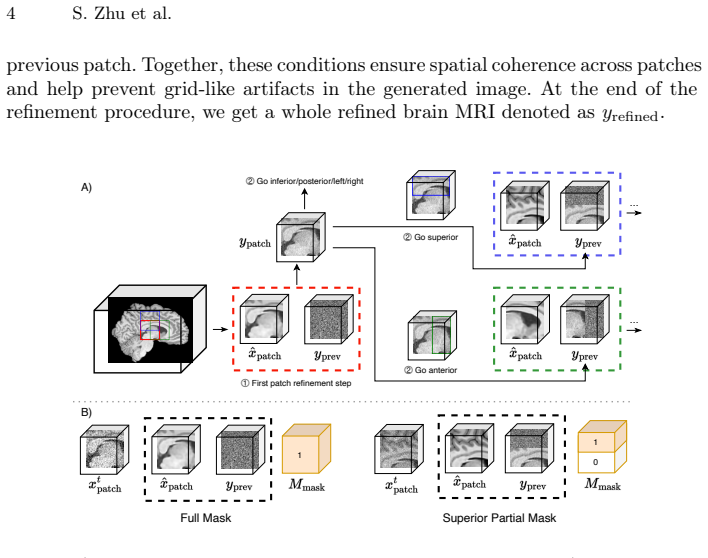
The load-bearing piece is a 3D patch-based image-to-image diffusion model, built on the Palette-style conditional diffusion framework, whose network predicts the noise residual of an image patch while being conditioned on two inputs: the matching coarse patch from the LDM output and the partially restored patch from the previous refinement step. During training, the model sees randomly masked versions of the original image as the 'previous patch' target, with full masks used 10% of the time and partial masks 90% of the time; the diffusion loss is applied only on the masked region. At inference, this design lets the model add realistic noise, edges, and texture locally while the coarse condition anchors global anatomy and the previous-patch condition enforces spatial coherence across the traversal.
What would settle it
Compute whole-brain and regional segmentation overlap (e.g., Dice scores for cortical and subcortical structures) between real HCP images, LDM-generated images, and RealDeal-refined images; if refinement improves FID and LPIPS but does not improve (or even lowers) Dice overlap, the paper's claim of restored anatomical fidelity is contradicted, and an expert-blinded rating of anatomical plausibility would offer a weaker but still decisive check.
Extended reading notes
Core claim
RealDeal's central claim is that an image-to-image diffusion model trained on image patches, conditioned on the LDM's coarse output and on previously refined neighboring patches, can restore the high-frequency content lost during latent compression while keeping the global anatomy intact. The model is trained to predict the noise residual added to an originally sharp image patch, with the loss computed only inside a randomly selected mask; at inference, it traverses the volume patch by patch, starting from the center, so each new patch is guided by the coarse anatomy and by already-refined neighbors, preventing discontinuities and grid artifacts. The authors report that refined images are perceptually closer to the originals (LPIPS 0.029 vs 0.078), carry a more similar noise distribution (KL divergence 0.149 vs 0.775), recover sharpness (Laplacian variance 0.0111 vs 0.0063), and show higher texture similarity, while fully synthetic images achieve FID 17.30 vs 46.62, coverage 0.763 vs 0.311, and density 0.492 vs 0.172 relative to real images.
Load-bearing premise
The load-bearing premise is that conditioning the refiner on the coarse LDM output preserves the true anatomy while the model adds only realistic high-frequency detail and noise, rather than hallucinating texture that merely mimics MRI noise.
Editorial extensions
If this is right
- If RealDeal works as claimed, synthetic brain MRIs become substantially harder to distinguish from real scans, directly improving the value of generated data for augmentation, anomaly detection, and counterfactual reasoning pipelines.
- Because the refiner is conditioned only on the LDM output, it can be bolted onto any existing latent diffusion-based brain MRI generator without retraining that generator.
- The new metrics (KL divergence of noise distributions, Laplacian variance, HOG texture similarity) give future work a direct way to check whether a refiner has restored scan-acquisition realism, not just perceptual similarity.
- The restored noise and sharpness imply that refined images will exercise downstream models in the same low-level statistics as real scans, which is relevant to any clinical tool trained on MRI intensities.
Reading between the lines
- A direct anatomical check would be the natural next experiment: if RealDeal genuinely improves anatomical fidelity, then segmentation overlap (e.g., Dice scores for cortical and subcortical structures) between refined synthetic images and real images should rise along with FID; the paper does not measure this, so its 'anatomical accuracy' claim currently rests on perceptual metrics rather than an
- The traversal strategy (center-first, then neighbors) and the 10%/90% mask balance are design choices that the paper does not ablate; a plausible test is whether a different traversal order changes the rate of grid artifacts or the quality of peripheral patches.
- Generalizing from HCP's high-quality, standardized T1 scans to clinical-acquisition data, other contrasts, or lower resolutions is an untested extension; if RealDeal's gains shrink under realistic degradation, its utility as a universal refinement module would be narrower than the paper's framing implies.
Editorial analysis
A structured set of objections, weighed in public.
Referee Report
Summary. The paper proposes RealDeal, a two-stage pipeline in which a 3D patch-based image-to-image diffusion model (Section 2.2, Eq. (1)) refines LDM-generated brain MRI volumes by conditioning on the coarse LDM output patch and on previously restored patches. Training uses full or partial masks and a masked noise-prediction loss. Experiments on HCP T1-weighted images report lower LPIPS, KL noise divergence, and HOG distance, higher Laplacian sharpness on reconstructions, and lower FID with higher coverage and density on synthetic images (Tables 1-3). The authors conclude that RealDeal improves realism and anatomical fidelity relative to LDM output.
Significance. The refinement idea is practical and the reported gains are large (e.g., FID from 46.62 to 17.30 in Table 3). If the anatomical-fidelity claim were substantiated, RealDeal would be a useful post-hoc module for LDM pipelines. The paper explicitly defines a priori metrics for noise, sharpness, and texture, and the improvements on these metrics are consistent with the method's design. However, the core clinical claim of anatomical fidelity is currently supported only indirectly, and the quantitative evidence has statistical limitations.
major comments (4)
- [Section 2.2 and Conclusion] The central claim that RealDeal 'preserves the global anatomical structure' and improves 'anatomical fidelity' is not measured. Eq. (1) supervises only noise prediction; nothing in the objective constrains refined anatomy to match the conditioning patch. The quantitative evidence for synthetic images (Table 3) is distribution-level (FID, coverage, density), which can improve even if the refiner hallucinates or erases structures, and Tables 1-2 are computed on reconstructions, not synthetic images. The paper needs an anatomical accuracy evaluation, such as segmentation Dice on cortical or subcortical structures, ventricle volume, or landmark error, on synthetic images before the anatomical-fidelity claim can stand.
- [Section 2.2] Training conditions on autoencoder reconstructions of real images, while inference conditions on fully synthetic LDM samples; the paper provides no evidence that these condition distributions match. If they do not match, the model may produce realistic-looking high-frequency content while altering anatomy. A concrete test would be to compute the distance between reconstruction-conditioned and synthetic-conditioned inputs (e.g., feature statistics or density estimates), or to fine-tune on synthetic-condition pairs and compare the resulting metrics.
- [Section 3.2 and Table 3] The synthetic-image evaluation uses only 20 generated images and reports no confidence intervals or significance tests. FID on 20 samples has high variance, and the patch-based FID strategy (following the LPIPS patch sampling) is not standard full-volume FID; the 'Orig.' FID row (2.48) shows that even original-versus-original patches do not yield zero FID, so the scale must be interpreted carefully. Please report bootstrap confidence intervals, significance tests, and a precise description of how FID is computed on patches.
- [Section 3.2 and Tables 1-2] The newly proposed metrics (KL of ANTS-extracted noise, Laplacian variance, HOG L2 distance) measure exactly the properties RealDeal is designed to inject. Improvement on these metrics is therefore expected from the method's construction and does not by itself establish clinical or perceptual value. Independent validation, such as a radiologist rating study or a downstream task (e.g., segmentation performance), is needed to support the claimed clinical utility.
minor comments (5)
- [Table 1 and Section 3.2] 'Textual Similarity' should be 'Textural Similarity'; the same typo appears in the table heading and surrounding text.
- [Section 2.2 and Figure 2] The description of yprev is underspecified: at training yprev is a mix of the original patch and Gaussian noise, while at inference it is a previously restored patch; please state explicitly how the mask and the partially restored image are chosen during inference and how this matches the training distribution.
- [Section 3.1] The unit '0.7 mm3' should be written as '0.7 mm^3'; check the unit notation.
- [Section 3.2] The sentence 'we then sample 20 LDM-generated images' is ambiguous; clarify whether these 20 are the same test subjects used in Table 1 or newly generated samples, and how many patch samples per volume are used for FID, coverage, and density.
- [Section 4] The closing claim that RealDeal 'has the potential to transform clinical care in neurological disorders' is speculative and not supported by the presented experiments; please soften or provide supporting evidence.
Circularity Check
No circular derivation: RealDeal's central synthetic-image claim is tested with external, non-fitted FID/coverage/density metrics, while the reconstructed-image diagnostics and self-defined detail metrics are not load-bearing inputs to the main claim.
full rationale
The derivation chain is not circular. RealDeal's central claim—that refining LDM-synthesized volumes improves fidelity to the real-image distribution—is evaluated on fully synthetic inputs with external, pre-trained distribution metrics (FID, coverage, density; Table 3 and supplement Tables 5-6). These metrics are not used as training losses and cannot be satisfied by construction; the refiner was trained on reconstruction-conditioned pairs (Section 2.2, Eq. 1), so the synthetic-condition evaluation is a genuine out-of-distribution test. The reconstructed-image results (Tables 1-2) are a held-out diagnostic of the same condition-target type used in training, and the newly proposed noise/sharpness/texture metrics are defined a priori to measure the high-frequency structure the model is designed to add; this lowers their independent evidentiary weight but does not make any equation reduce to its input. The claim that global anatomy is preserved (Section 2.2) is an unmeasured assumption and a correctness risk, not a circular derivation. Author self-citations are peripheral and non-load-bearing; no uniqueness theorem or ansatz is imported from them.
Assumptions & free parameters
free parameters (5)
- Mask schedule ratio =
10% full masks, 90% partial masks
- Patch size =
64^3 voxels
- Noise schedule endpoints =
beta_start=0.0015, beta_end=0.0205
- Evaluation sample size =
20 test images per condition
- k for coverage/density =
k=10 (also k=5,20 in supplement)
assumptions (5)
- standard math The Gaussian diffusion forward process and the denoising objective correctly model conditional image generation.
- domain assumption The LDM output preserves global anatomical structure, and conditioning the refiner on it prevents anatomical distortion.
- domain assumption ANTS-extracted noise in white matter is a valid proxy for realistic imaging noise.
- domain assumption Laplacian variance and HOG L2 distance measure sharpness and textural realism relevant to clinical image quality.
- domain assumption The HCP T1w dataset is representative for evaluating brain MRI realism.
Cite this review
Pith. "Pith review of RealDeal: Enhancing Realism and Details in Brain Image Generation via Image-to-Image Diffusion Models." pith.science (2026). https://pith.science/paper/BR4NDH47
@misc{pith2026250718830,
  author       = {Pith},
  title        = {Pith review of: RealDeal: Enhancing Realism and Details in Brain Image Generation via Image-to-Image Diffusion Models},
  year         = {2026},
  howpublished = {\url{https://pith.science/paper/BR4NDH47}},
  note         = {Machine review of arXiv:2507.18830}
}
read the original abstract
We propose image-to-image diffusion models that are designed to enhance the realism and details of generated brain images by introducing sharp edges, fine textures, subtle anatomical features, and imaging noise. Generative models have been widely adopted in the biomedical domain, especially in image generation applications. Latent diffusion models achieve state-of-the-art results in generating brain MRIs. However, due to latent compression, generated images from these models are overly smooth, lacking fine anatomical structures and scan acquisition noise that are typically seen in real images. This work formulates the realism enhancing and detail adding process as image-to-image diffusion models, which refines the quality of LDM-generated images. We employ commonly used metrics like FID and LPIPS for image realism assessment. Furthermore, we introduce new metrics to demonstrate the realism of images generated by RealDeal in terms of image noise distribution, sharpness, and texture.
Figures


Figures from the paper (7 more)


Reference graph
Works this paper leans on
-
[1]
In: Medical Imaging with Deep Learning
Bieder, F., Wolleb, J., Durrer, A., Sandkuehler, R., Cattin, P.C.: Memory-Efficient 3D Denoising Diffusion Models for Medical Image Processing. In: Medical Imaging with Deep Learning. pp. 552–567. PMLR (2024) 1, 2
work page 2024
-
[2]
arXiv Preprint arXiv:2009.00713 (2020) 3
Chen, N., Zhang, Y., Zen, H., Weiss, R.J., Norouzi, M., Chan, W.: WaveGrad: Estimating Gradients for Waveform Generation. arXiv Preprint arXiv:2009.00713 (2020) 3
arXiv 2020
-
[3]
In: The Twelfth International Conference on Learning Representations (2023) 2
Ding, Z., Zhang, M., Wu, J., Tu, Z.: Patched Denoising Diffusion Models for High- Resolution Image Synthesis. In: The Twelfth International Conference on Learning Representations (2023) 2
work page 2023
-
[4]
In: MICCAI Workshop on Deep Generative Models
Durrer, A., Wolleb, J., Bieder, F., Friedrich, P., Melie-Garcia, L., Ocampo Pineda, M.A., Bercea, C.I., Hamamci, I.E., Wiestler, B., Piraud, M., et al.: Denoising Diffusion Models for 3D Healthy Brain Tissue Inpainting. In: MICCAI Workshop on Deep Generative Models. pp. 87–97. Springer (2024) 1
work page 2024
-
[5]
In: MICCAI Work- shop on Deep Generative Models
Friedrich, P., Wolleb, J., Bieder, F., Durrer, A., Cattin, P.C.: WDM: 3D Wavelet Diffusion Models for High-Resolution Medical Image Synthesis. In: MICCAI Work- shop on Deep Generative Models. pp. 11–21. Springer (2024) 1
work page 2024
-
[6]
arXiv Preprint arXiv:2310.10765 (2023) 1
Gu, Y., Yang, J., Usuyama, N., Li, C., Zhang, S., Lungren, M.P., Gao, J., Poon, H.: BiomedJourney: Counterfactual Biomedical Image Generation by Instruction- Learning from Multimodal Patient Journeys. arXiv Preprint arXiv:2310.10765 (2023) 1
arXiv 2023
-
[7]
Advances in Neural Information Processing Systems30 (2017) 2, 5, 6, 9
Heusel, M., Ramsauer, H., Unterthiner, T., Nessler, B., Hochreiter, S.: GANs Trained by a Two Time-Scale Update Rule Converge to a Local Nash Equilib- rium. Advances in Neural Information Processing Systems30 (2017) 2, 5, 6, 9
work page 2017
-
[8]
Advances in Neural Information Processing Systems33, 6840–6851 (2020) 1
Ho, J., Jain, A., Abbeel, P.: Denoising Diffusion Probabilistic Models. Advances in Neural Information Processing Systems33, 6840–6851 (2020) 1
work page 2020
Show all 25 references
-
[9]
In: Proceedings of the Computer Vision and Pattern Recognition Conference
Jiang, W., Jangid, D.K., Lee, S.J., Sheikh, H.R.: Latent Patched Efficient Diffusion Model For High Resolution Image Synthesis. In: Proceedings of the Computer Vision and Pattern Recognition Conference. pp. 6372–6378 (2025) 2
2025
-
[10]
In: 2024 IEEE International Symposium on Biomedical Imaging (ISBI)
Jin, Y., Dwyer, M.B., Fletcher, P.T.: Measuring Feature Dependency of Neural Networks by Collapsing Feature Dimensions in The Data Manifold. In: 2024 IEEE International Symposium on Biomedical Imaging (ISBI). pp. 1–5. IEEE (2024) 1
2024
-
[11]
In: Medical Imaging with Deep Learning (2025) 1
Jin, Y., Zhu, S., Fletcher, T.: Feature Attribution for Deep Learning Models through Total Variance Decomposition. In: Medical Imaging with Deep Learning (2025) 1
2025
-
[12]
Scientific Reports 13(1), 7303 (2023) 1, 2
Khader, F., Müller-Franzes, G., Tayebi Arasteh, S., Han, T., Haarburger, C., Schulze-Hagen, M., Schad, P., Engelhardt, S., Baeßler, B., Foersch, S., et al.: De- noising Diffusion Probabilistic Models for 3D Medical Image Generation. Scientific Reports 13(1), 7303 (2023) 1, 2
2023
-
[13]
Advances in Neural Information Processing Sys- tems 25 (2012) 5
Krizhevsky, A., Sutskever, I., Hinton, G.E.: ImageNet Classification with Deep Convolutional Neural Networks. Advances in Neural Information Processing Sys- tems 25 (2012) 5
2012
-
[14]
Journal of Magnetic Resonance Imaging31(1), 192–203 (2010) 6
Manjón, J.V., Coupé, P., Martí-Bonmatí, L., Collins, D.L., Robles, M.: Adaptive Non-Local Means Denoising of MR Images with Spatially Varying Noise Levels. Journal of Magnetic Resonance Imaging31(1), 192–203 (2010) 6
2010
-
[15]
In: International Conference on Machine Learning
Naeem, M.F., Oh, S.J., Uh, Y., Choi, Y., Yoo, J.: Reliable Fidelity and Diversity Metrics for Generative Models. In: International Conference on Machine Learning. pp. 7176–7185. PMLR (2020) 6, 7 Title Suppressed Due to Excessive Length 11
2020
-
[16]
In: MICCAI Workshop on Deep Generative Models
Pinaya, W.H., Tudosiu, P.D., Dafflon, J., Da Costa, P.F., Fernandez, V., Nachev, P., Ourselin, S., Cardoso, M.J.: Brain Imaging Generation with Latent Diffusion Models. In: MICCAI Workshop on Deep Generative Models. pp. 117–126. Springer (2022) 1, 2
2022
-
[17]
In: Proceedings of the IEEE/CVF Conference on Computer Vision and Pattern Recognition
Rombach, R., Blattmann, A., Lorenz, D., Esser, P., Ommer, B.: High-Resolution Image Synthesis with Latent Diffusion Models. In: Proceedings of the IEEE/CVF Conference on Computer Vision and Pattern Recognition. pp. 10684–10695 (2022) 1, 3, 7
2022
-
[18]
In: ACM SIGGRAPH 2022 Con- ference Proceedings
Saharia, C., Chan, W., Chang, H., Lee, C., Ho, J., Salimans, T., Fleet, D., Norouzi, M.: Palette: Image-to-Image Diffusion Models. In: ACM SIGGRAPH 2022 Con- ference Proceedings. pp. 1–10 (2022) 2, 3
2022
-
[19]
IEEE Transactions on Pattern Analysis and Machine Intelligence 45(4), 4713–4726 (2022) 3
Saharia, C., Ho, J., Chan, W., Salimans, T., Fleet, D.J., Norouzi, M.: Image Super- Resolution via Iterative Refinement. IEEE Transactions on Pattern Analysis and Machine Intelligence 45(4), 4713–4726 (2022) 3
2022
-
[20]
In: International Conference on Medi- cal Image Computing and Computer-Assisted Intervention
Shrivastava, A., Fletcher, P.T.: NASDM: Nuclei-Aware Semantic Histopathology Image Generation Using Diffusion Models. In: International Conference on Medi- cal Image Computing and Computer-Assisted Intervention. pp. 786–796. Springer (2023) 1
2023
-
[21]
arXiv Preprint arXiv:2504.09322 (2025) 1
Spears, T., Zhu, S., Jin, Y., Shrivastava, A., Fletcher, P.T.: MedIL: Implicit Latent Spaces for Generating Heterogeneous Medical Images at Arbitrary Resolutions. arXiv Preprint arXiv:2504.09322 (2025) 1
2025 arXiv
-
[22]
NeuroImage 80, 62–79 (2013) 5
Van Essen, D.C., Smith, S.M., Barch, D.M., Behrens, T.E., Yacoub, E., Ugurbil, K.: The WU-Minn Human Connectome Project: an Overview. NeuroImage 80, 62–79 (2013) 5
2013
-
[23]
Advances in Neural Information Processing Systems36, 72137–72154 (2023) 2
Wang, Z., Jiang, Y., Zheng, H., Wang, P., He, P., Wang, Z., Chen, W., Zhou, M., et al.: Patch Diffusion: Faster and More Data-Efficient Training of Diffusion Mod- els. Advances in Neural Information Processing Systems36, 72137–72154 (2023) 2
2023
-
[24]
In: CVPR (2018) 2, 5, 9
Zhang, R., Isola, P., Efros, A.A., Shechtman, E., Wang, O.: The Unreasonable Effectiveness of Deep Features as a Perceptual Metric. In: CVPR (2018) 2, 5, 9
2018
-
[25]
In: Medical Imaging with Deep Learning (2025) 1 12 S
Zhu, S., Jin, Y., Zawar, I., Fletcher, P.T.: Point-Based Shape Representation Gen- eration with a Correspondence-Preserving Diffusion Model. In: Medical Imaging with Deep Learning (2025) 1 12 S. Zhu et al. RealDeal: Supplement Material 1 Training Details We use 1,113 subjects,...
2025
Reviewed August 6, 2026 · model on record in the stance chip above.
Discussion (0). Sign in to comment.