REVIEW 1 major objections 47 references
MindAdapter calibrates pretrained brain-to-visual decoding models for new subjects by freezing the global alignment backbone and adding a lightweight nonlinear residual adapter tuned on few shared stimuli.
Reviewed by Pith at T0; open to challenge. T0 means a machine referee read the full paper against a public rubric. the ladder, T0–T4 →
T0 review · grok-4.3
2026-06-30 13:27 UTC pith:BR6UEIAR
load-bearing objection MindAdapter is a clean engineering split of frozen coarse alignment plus lightweight residual adapter for few-shot cross-subject brain decoding, but the strength of the claim rests entirely on whether the NSD experiments show clear gains over simple baselines. the 1 major comments →
MindAdapter: Few-Shot Parameter-Efficient Residual Calibration of Cross-Subject Brain-to-Visual Decoding Models
The pith
A machine-rendered reading of the paper's core claim, the machinery that carries it, and where it could break.
Core claim
MindAdapter adopts a decoupled linear-residual cascade alignment paradigm by freezing a pretrained explicit brain functional alignment backbone and introducing a lightweight nonlinear residual adapter, thereby disentangling global cross-subject correspondence from subject-specific residual corrections for fine-grained spatial and semantic calibration. A topology-anchored dual-stream manifold constraint preserves global representational stability, with shared stimuli serving as topological pins under voxel-level supervision and a semantic stream enforcing consistency through a frozen vision-language decoder on unpaired brain data.
What carries the argument
decoupled linear-residual cascade alignment paradigm with topology-anchored dual-stream manifold constraint
Load-bearing premise
The pretrained explicit brain functional alignment backbone already captures stable global cross-subject correspondence that remains effective when frozen during subject-specific adaptation.
What would settle it
If the residual adapter produces no measurable gain in reconstruction or retrieval metrics over the frozen backbone alone when both are evaluated on held-out subjects in the Natural Scenes Dataset using the same small set of shared stimuli, the separation of global and residual components would lose its claimed advantage.
If this is right
- Cross-subject visual reconstruction accuracy improves substantially on the Natural Scenes Dataset.
- Retrieval accuracy also rises when calibration uses only a few shared stimuli.
- The global representational geometry learned in pretraining stays intact after adaptation.
- The framework supplies a data-efficient route to personalized brain-to-visual decoding.
Where Pith is reading between the lines
- The same residual-adapter pattern might reduce data needs in other cross-subject neuroimaging alignment problems.
- If the manifold constraint holds across datasets, the minimal number of shared stimuli required could drop even lower.
- Extending the dual-stream idea to motor or auditory decoding could test whether global-versus-residual separation applies beyond vision.
Editorial analysis
A structured set of objections, weighed in public.
Referee Report
Summary. The paper introduces MindAdapter, a few-shot parameter-efficient framework for calibrating pretrained cross-subject brain-to-visual decoding models. It uses a frozen explicit brain functional alignment backbone with a lightweight nonlinear residual adapter and a topology-anchored dual-stream manifold constraint to correct subject-specific residuals while preserving global geometry, claiming substantial improvements in reconstruction and retrieval accuracy on the Natural Scenes Dataset (NSD) with only a few shared stimuli.
Significance. If the claimed improvements are validated with rigorous experiments including baselines and ablations, this approach could offer a practical solution for personalized brain decoding in BCI applications by enabling efficient adaptation with minimal data, addressing inter-individual variability without retraining the entire model.
major comments (1)
- [Abstract] Abstract: The abstract asserts substantial improvement on NSD but supplies no quantitative numbers, baselines, error bars, ablation results, or details on how the manifold constraints are implemented or optimized; the central claim cannot be evaluated from the provided text.
Simulated Author's Rebuttal
We thank the referee for their constructive feedback. We address the single major comment below and agree that the abstract would benefit from additional quantitative detail to better support the central claims.
read point-by-point responses
-
Referee: [Abstract] Abstract: The abstract asserts substantial improvement on NSD but supplies no quantitative numbers, baselines, error bars, ablation results, or details on how the manifold constraints are implemented or optimized; the central claim cannot be evaluated from the provided text.
Authors: We agree that the abstract would be strengthened by including concrete quantitative results. In the revised version we will update the abstract to report key metrics from our NSD experiments (e.g., relative gains in reconstruction fidelity and retrieval accuracy versus the frozen backbone and standard baselines) while remaining within length limits. Implementation and optimization details of the topology-anchored dual-stream manifold constraint are already provided in Section 3.3 and the supplementary material; we will add a brief parenthetical reference in the abstract if space allows. Error bars and ablation studies appear in the main results (Figures 3–5 and Tables 1–2) and will be cross-referenced. revision: yes
Circularity Check
No significant circularity identified
full rationale
The paper describes MindAdapter as an empirical engineering framework consisting of a frozen pretrained backbone, a lightweight nonlinear residual adapter, and a topology-anchored dual-stream manifold constraint using shared stimuli. The central claim of improved few-shot cross-subject reconstruction and retrieval on the NSD dataset is presented as an experimental outcome, not as a mathematical derivation or prediction that reduces by construction to fitted inputs, self-citations, or renamed ansatzes. No load-bearing equations, uniqueness theorems, or self-referential definitions are invoked in the provided text; the method's design choices are independent of the reported performance gains.
Axiom & Free-Parameter Ledger
axioms (1)
- domain assumption A pretrained explicit brain functional alignment backbone already captures stable global cross-subject correspondence
invented entities (2)
-
lightweight nonlinear residual adapter
no independent evidence
-
topology-anchored dual-stream manifold constraint
no independent evidence
read the original abstract
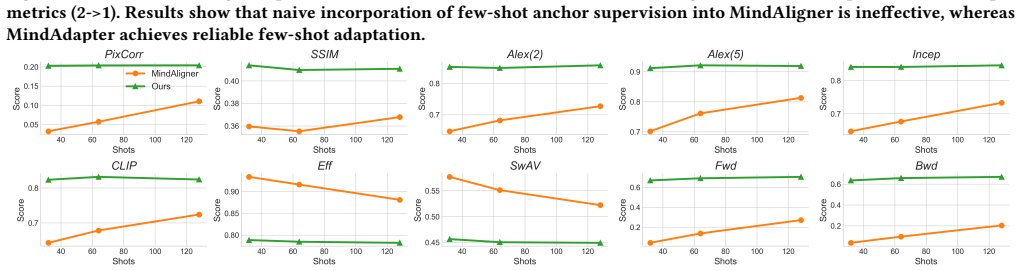
Cross-subject brain-to-visual decoding remains a core challenge in brain-computer interfaces due to severe inter-individual variability that induces systematic subject-specific functional misalignment. To address this issue, we propose MindAdapter, a parameter-efficient few-shot calibration framework for pretrained brain-to-visual decoding models. MindAdapter adopts a decoupled linear-residual cascade alignment paradigm by freezing a pretrained explicit brain functional alignment backbone (coarse) and introducing a lightweight nonlinear residual adapter (fine), thereby disentangling global cross-subject correspondence from subject-specific residual corrections for fine-grained spatial and semantic calibration. To further preserve global representational stability, we design a topology-anchored dual-stream manifold constraint, where a small set of shared stimuli serves as topological pins with voxel-level paired supervision, while a semantic stream enforces consistency through a frozen vision-language decoder on unpaired brain data. Together, MindAdapter efficiently injects subject-specific corrections while maintaining the global representational geometry learned during pretraining. Experiments on the Natural Scenes Dataset (NSD) demonstrate that MindAdapter substantially improves cross-subject visual reconstruction and retrieval accuracy using only a few shared stimuli, offering a practical and data-efficient solution for personalized brain-to-visual decoding.
Figures




Reference graph
Works this paper leans on
-
[1]
Emily J Allen, Ghislain St-Yves, Yihan Wu, Jesse L Breedlove, Jacob S Prince, Logan T Dowdle, Matthias Nau, Brad Caron, Franco Pestilli, Ian Charest, et al
-
[2]
A massive 7T fMRI dataset to bridge cognitive neuroscience and artificial intelligence.Nature neuroscience25, 1 (2022), 116–126
work page 2022
- [3]
-
[4]
Arnab Bhattacharjee, Zaid Zada, Haocheng Wang, Bobbi Aubrey, Werner Doyle, Patricia Dugan, Daniel Friedman, Orrin Devinsky, Adeen Flinker, Peter J Ra- madge, et al. 2025. Aligning brains into a shared space improves their alignment with large language models.Nature Computational Science(2025), 1–10
work page 2025
-
[5]
Mathilde Caron, Ishan Misra, Julien Mairal, Priya Goyal, Piotr Bojanowski, and Armand Joulin. 2020. Unsupervised learning of visual features by contrasting cluster assignments.Advances in neural information processing systems33 (2020), 9912–9924
work page 2020
-
[6]
Tianrun Chen, Lanyun Zhu, Chaotao Deng, Runlong Cao, Yan Wang, Shangzhan Zhang, Zejian Li, Lingyun Sun, Ying Zang, and Papa Mao. 2023. Sam-adapter: Adapting segment anything in underperformed scenes. InProceedings of the IEEE/CVF International Conference on Computer Vision. 3367–3375
work page 2023
-
[7]
Z Chen, J Qing, T Xiang, WL Yue, and JH Zhou. 2023. Seeing beyond the brain: Conditional diffusion model with sparse masked modeling for vision decoding. InProceedings of the IEEE/CVF Conference on Computer Vision and Pattern Recognition. 22710–22720
work page 2023
-
[8]
Kamalaker Dadi, Gaël Varoquaux, Antonia Machlouzarides-Shalit, Krzysztof J Gorgolewski, Demian Wassermann, Bertrand Thirion, and Arthur Mensch. 2020. Fine-grain atlases of functional modes for fMRI analysis.NeuroImage221 (2020), 117126
work page 2020
-
[9]
Yuqin Dai, Zhouheng Yao, Chunfeng Song, Qihao Zheng, Weijian Mai, Kunyu Peng, Shuai Lu, Wanli Ouyang, Jian Yang, and Jiamin Wu. [n. d.]. MindAligner: Explicit Brain Functional Alignment for Cross-Subject Visual Decoding from Limited fMRI Data. InForty-second International Conference on Machine Learning
- [10]
-
[11]
Tomoyasu Horikawa and Yukiyasu Kamitani. 2017. Generic decoding of seen and imagined objects using hierarchical visual features.Nature communications 8, 1 (2017), 15037
work page 2017
-
[12]
Edward J Hu, Yelong Shen, Phillip Wallis, Zeyuan Allen-Zhu, Yuanzhi Li, Shean Wang, Lu Wang, Weizhu Chen, et al. 2022. Lora: Low-rank adaptation of large language models.ICLR1, 2 (2022), 3
work page 2022
- [13]
-
[14]
Alex Krizhevsky, Ilya Sutskever, and Geoffrey E Hinton. 2012. Imagenet classifi- cation with deep convolutional neural networks.Advances in neural information processing systems25 (2012)
work page 2012
- [15]
-
[16]
Brian Lester, Rami Al-Rfou, and Noah Constant. 2021. The Power of Scale for Parameter-Efficient Prompt Tuning. InProceedings of the 2021 Conference on Empirical Methods in Natural Language Processing. Association for Computational Linguistics
work page 2021
-
[17]
Chong Li, Xuelin Qian, Yun Wang, Jingyang Huo, Xiangyang Xue, Yanwei Fu, and Jianfeng Feng. 2025. Enhancing Cross-Subject fMRI-to-Video Decoding with Global-Local Functional Alignment. InEuropean Conference on Computer Vision. Springer, 353–369
work page 2025
-
[18]
Sikun Lin, Thomas Sprague, and Ambuj K Singh. 2022. Mind reader: Recon- structing complex images from brain activities.Advances in Neural Information Processing Systems35 (2022), 29624–29636
work page 2022
-
[19]
Tsung-Yi Lin, Michael Maire, Serge Belongie, James Hays, Pietro Perona, Deva Ramanan, Piotr Dollár, and C Lawrence Zitnick. 2014. Microsoft coco: Common objects in context. InComputer Vision–ECCV 2014: 13th European Conference, Zurich, Switzerland, September 6-12, 2014, Proceedings, Part V 13. Springer, 740– 755
work page 2014
-
[20]
Jiaxiang Liu, Tianxiang Hu, Jiawei Du, Ruiyuan Zhang, Joey Tianyi Zhou, and Zuozhu Liu. 2025. Kpl: Training-free medical knowledge mining of vision- language models. InProceedings of the AAAI Conference on Artificial Intelligence, Vol. 39. 18852–18860
work page 2025
-
[21]
Jiaxiang Liu, Tianxiang Hu, Yan Zhang, Yang Feng, Jin Hao, Junhui Lv, and Zuozhu Liu. 2023. Parameter-efficient transfer learning for medical visual ques- tion answering.IEEE Transactions on Emerging Topics in Computational Intelli- gence8, 4 (2023), 2816–2826
work page 2023
-
[22]
Y Lu, C Du, Q Zhou, D Wang, and H He. 2023. Minddiffuser: Controlled image reconstruction from human brain activity with semantic and structural diffusion. InProceedings of the 31st ACM International Conference on Multimedia. 5899– 5908
work page 2023
-
[23]
Laurens van der Maaten and Geoffrey Hinton. 2008. Visualizing data using t-SNE. Journal of machine learning research9, Nov (2008), 2579–2605
work page 2008
- [24]
-
[25]
Yuren Mao, Yuhang Ge, Yijiang Fan, Wenyi Xu, Yu Mi, Zhonghao Hu, and Yunjun Gao. 2025. A survey on lora of large language models.Frontiers of Computer Science19, 7 (2025), 197605
work page 2025
-
[26]
Georgios Mentzelopoulos, Evangelos Chatzipantazis, Ashwin G Ramayya, Michelle J Hedlund, Vivek P Buch, Kostas Daniilidis, Konrad P Kording, and Flavia Vitale. 2024. Neural decoding from stereotactic EEG: accounting for electrode variability across subjects.Advances in Neural Information Processing Systems37 (2024), 108600–108624
work page 2024
-
[27]
Thomas Naselaris, Kendrick N Kay, Shinji Nishimoto, and Jack L Gallant. 2011. Encoding and decoding in fMRI.Neuroimage56, 2 (2011), 400–410
work page 2011
- [28]
-
[29]
Furkan Ozcelik and Rufin VanRullen. 2023. Natural scene reconstruction from fMRI signals using generative latent diffusion.Scientific Reports13, 1 (2023), 15666
work page 2023
-
[30]
C. Qian, X. Sun, Y. Wang, X. Zheng, Y. Wang, and G. Pan. 2020. Binless kernel machine: Modeling spike train transformation for cognitive neural prostheses. Neural Computation32, 10 (2020), 1863–1900
work page 2020
-
[32]
Learning transferable visual models from natural language supervision. (2021), 8748–8763
work page 2021
-
[33]
Alec Radford, Jong Wook Kim, Chris Hallacy, Aditya Ramesh, Gabriel Goh, Sand- hini Agarwal, Girish Sastry, Amanda Askell, Pamela Mishkin, Jack Clark, et al
-
[34]
Learning transferable visual models from natural language supervision. In ICML. PMLR, 8748–8763
-
[35]
Shima Rastegarnia, Marie St-Laurent, Elizabeth DuPre, Basile Pinsard, and Pierre Bellec. 2023. Brain decoding of the Human Connectome Project tasks in a dense individual fMRI dataset.NeuroImage283 (2023), 120395
work page 2023
-
[36]
Sylvestre-Alvise Rebuffi, Hakan Bilen, and Andrea Vedaldi. 2017. Learning multiple visual domains with residual adapters.Advances in neural information processing systems30 (2017)
work page 2017
-
[37]
Paul Scotti, Atmadeep Banerjee, Jimmie Goode, Stepan Shabalin, Alex Nguyen, Aidan Dempster, Nathalie Verlinde, Elad Yundler, David Weisberg, Kenneth Nor- man, et al. 2024. Reconstructing the mind’s eye: fMRI-to-image with contrastive learning and diffusion priors.Advances in Neural Information Processing Systems 36 (2024)
work page 2024
-
[38]
P. S. Scotti, M. Tripathy, C. K. T. Villanueva, R. Kneeland, T. Chen, A. Narang, C. Santhirasegaran, J. Xu, T. Naselaris, and K. A. et al. Norman. 2024. MindEye2: Shared-Subject Models Enable fMRI-To-Image With 1 Hour of Data. InICML
work page 2024
-
[39]
K Seeliger, U Güçlü, L Ambrogioni, Y Güçlütürk, and MA Van Gerven. 2018. Generative adversarial networks for reconstructing natural images from brain activity.NeuroImage181 (2018), 775–785
work page 2018
-
[40]
Guobin Shen, Dongcheng Zhao, Xiang He, Linghao Feng, Yiting Dong, Jihang Wang, Qian Zhang, and Yi Zeng. [n. d.]. Neuro-Vision to Language: Enhancing Brain Recording-based Visual Reconstruction and Language Interaction. InThe Thirty-eighth Annual Conference on Neural Information Processing Systems
-
[41]
Yi-Lin Sung, Jaemin Cho, and Mohit Bansal. 2022. Vl-adapter: Parameter-efficient transfer learning for vision-and-language tasks. InProceedings of the IEEE/CVF conference on computer vision and pattern recognition. 5227–5237
work page 2022
-
[42]
Christian Szegedy, Vincent Vanhoucke, Sergey Ioffe, Jon Shlens, and Zbigniew Wojna. 2016. Rethinking the inception architecture for computer vision. In Jiaxiang Liu, Jiawei Du, Xupeng Chen, Guoqi Li, Jiang Cai, Simon Fong, and Mingkun Xu Proceedings of the IEEE conference on computer vision and pattern recognition. 2818–2826
work page 2016
-
[43]
Yu Takagi and Shinji Nishimoto. 2023. High-resolution image reconstruction with latent diffusion models from human brain activity. (2023), 14453–14463
work page 2023
-
[44]
Mingxing Tan and Quoc Le. 2019. Efficientnet: Rethinking model scaling for convolutional neural networks. InICML. PMLR, 6105–6114
work page 2019
-
[45]
Zhibo Tian, Ruijie Quan, Fan Ma, Kun Zhan, and Yi Yang. 2025. BRAINGUARD: Privacy-Preserving Multisubject Image Reconstructions from Brain Activities. In Proceedings of the AAAI Conference on Artificial Intelligence, Vol. 39. 14414–14422
work page 2025
-
[46]
S. Wang, S. Liu, Z. Tan, and X. Wang. 2024. Mindbridge: A cross-subject brain decoding framework. (2024), 11333–11342
work page 2024
-
[47]
Zhou Wang, Alan C Bovik, Hamid R Sheikh, and Eero P Simoncelli. 2004. Image quality assessment: from error visibility to structural similarity.IEEE transactions on image processing13, 4 (2004), 600–612
work page 2004
-
[48]
Chuyang Zhou, Ziao Ji, Daochang Liu, Dongang Wang, Chenyu Wang, and Chang Xu. 2025. Rest2Visual: Predicting Visually Evoked fMRI from Resting- State Scans.arXiv preprint arXiv:2509.13612(2025). A Metrics Following prior work [8, 34, 35], we evaluate the image reconstruc- tion results based on eight metrics, which are categorized into low-level and high-le...
discussion (0)
Sign in with ORCID, Apple, or X to comment. Anyone can read and Pith papers without signing in.