REVIEW 4 major objections 5 minor 2 cited by
Probing missing physics from inspiralling compact binaries via time-frequency tracks
T0 review · 4 major / 5 minor · reviewed 2026-08-06 · deepseek-v4-flash
Pith's one-line read The paper claims that a consistency test built from stacked time-frequency energies along scaled orbital-frequency tracks can flag departures from general relativity in inspiralling compact binaries.
desk verdict Useful idea, undercalibrated statistics: the time-frequency stacking test flags gross GR violations cleanly, but the 3σ threshold is built on 100 same-waveform injections and a template-only width, so the quoted significances are not yet trustworthy. read the letter →
The pith
A machine-rendered reading of the paper's core claim, the machinery that carries it, and where it could break.
The reading
What carries the argument
The load-bearing object is the scaled orbital-frequency track $f_\alpha(t,\vec\lambda)=\alpha\, f_{\rm orbital}(t,\vec\lambda)$ (Eq. 1) together with the stacked energy $S(\alpha)=\sum |\tilde X(t, f=f_\alpha(t,\vec\lambda))|^2$ (Eq. 2) built from the synchroextracted time-frequency map. Sliding $\alpha$ moves the track up and down in frequency, so the peak at $\alpha\approx2$ collects the quadrupole-mode energy and values near $\alpha\approx3$ would collect octupole content. The argument is carried by reducing these profiles to the scalar areas $\Lambda_Y$ and $\Lambda_S$ (Eq. 3) and comparing them through the distance $D_Y^S$ measured in units of $\sigma_S$, the width of the template-sided distribution. That distance is the statistic that must separate GR-consistent signals (within $3\sigma_S$) from signals with missing physics (beyond $3\sigma_S$).
What would settle it
Repeat the 100-injection GR background using noise realizations drawn from a different detector configuration or from real quiet data, and check whether the $D_Y^S$ values still stay below $3\sigma_S$; if GR injections are flagged above the expected rate, the $\sigma_S$ calibration is wrong. A quick decisive check is to run the pipeline on a confidently GR event with a long inspiral, such as GW170608, and see whether the quadrupole-only template returns a distance within $3\sigma_S$.
Extended reading notes
Core claim
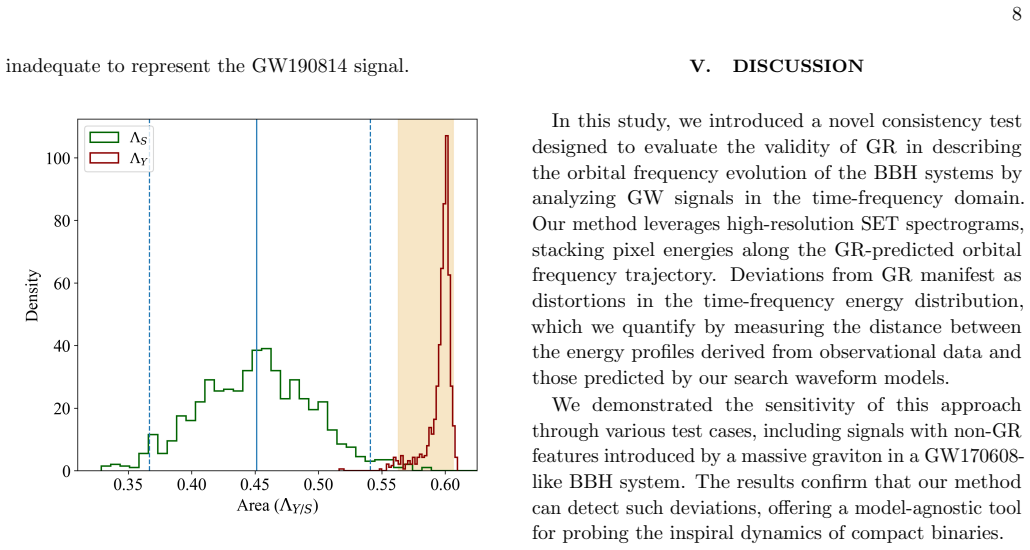
On the paper's own terms, the central discovery is that the area under the energy-versus-frequency-scaling curve is a sensitive, model-agnostic diagnostic of whether a gravitational-wave signal evolved as the template assumes. For each posterior sample, the pipeline computes an orbital-frequency track, builds a high-resolution time-frequency map, and sums pixel energies along scaled copies of that track; the resulting $S(\alpha)$ and $Y(\alpha)$ curves are reduced to the areas $\Lambda_S$ and $\Lambda_Y$. The distance $D_Y^S = |\Lambda_Y - \langle \Lambda_S\rangle|$, quoted in units of the width $\sigma_S$ of the template-area distribution, separates GR-consistent data from data containing unmodeled physics: 100 GR-consistent injections give values in the range $0.08$-$2.37\,\sigma_S$, while a massive-graviton non-GR signal gives $3.75\,\sigma_S$, an eccentric binary gives $5.84\,\sigma_S$, and GW190814 recovered with a quadrupole-only template gives $3.24\,\sigma_S$ (dropping to $2.14\,\sigma_S$ once higher modes are included). The authors conclude that noise does not hamper the test.
Load-bearing premise
The load-bearing premise is that the spread of template-area values, and the 3-sigma cutoff set by 100 general-relativity injections in stationary Gaussian noise, correctly measure how much scatter the data-side areas would show for a true GR signal; if noise inflates the data-side areas beyond what the template spread captures, the reported significances are not reliable.
Editorial extensions
If this is right
- The test is theory-agnostic: it flags departures in orbital-frequency evolution without requiring a specific alternative theory to generate a comparison waveform.
- It is most sensitive for low- to moderate-mass binaries, whose long inspiral accumulates a longer track and a larger contrast between the data and template energy profiles.
- Applied to GW190814, the distance drops from $3.24\,\sigma_S$ with a quadrupole-only template to $2.14\,\sigma_S$ with a template that includes higher modes, identifying higher multipoles as the missing physics.
- Because the distance is quoted in units of $\sigma_S$, the paper argues the test is robust to the choice of power spectral density used for whitening.
- The same pipeline can be run on the full catalog of events to search systematically for unmodeled physics in future observing runs.
Reading between the lines
- Beyond the paper, the same $\alpha$-stacking could be windowed around $\alpha\approx3$ to isolate octupole radiation directly, rather than detecting it only through the quadrupole-window area mismatch.
- Beyond the paper, the $3\sigma_S$ calibration rests on stationary Gaussian noise; a robustness check would rebuild the background with real quiet detector stretches or nonstationary noise injections, which the paper does not perform.
- Beyond the paper, the statistic's dependence on chirp mass and SNR is testable: a catalog application should show whether the scatter of $D_Y^S$ follows the template-width prediction across events.
- Beyond the paper, since the tracks come from posterior samples of a GR template, strong non-GR phase deformations could bias the posterior itself; an iterative track extraction or a non-GR-parameterized search would separate detection from parameter bias.
Editorial analysis
A structured set of objections, weighed in public.
Referee Report
Summary. The paper proposes a theory-agnostic consistency test of general relativity based on time-frequency energy tracks. For a gravitational-wave signal y(t), Bayesian parameter estimation with a GR template is performed; for 1000 posterior samples, scaled orbital-frequency tracks f_alpha(t,lambda)=alpha f_orb(t,lambda) are used to stack synchroextracting-transform pixel energies into curves Y(alpha) (data) and S(alpha) (template). The areas under these curves over alpha in [1.6,2.4] define Lambda_Y and Lambda_S, and the test statistic D_Y^S=|Lambda_Y-<Lambda_S>|/sigma_S is measured in units of the width sigma_S of the template Lambda_S distribution. The method is demonstrated on a massive-graviton injection (3.76 sigma_S), a numerical-relativity eccentric-binary injection (5.84 sigma_S), and GW190814 analyzed with a quadrupole-only template (3.24 sigma_S) and with a higher-modes template (2.14 sigma_S). A GR background built from 100 stationary-Gaussian-noise realizations of the same IMRPhenomXP injection shows distances in [0.08,2.37] sigma_S, leading the authors to claim that noise does not hamper the test.
Significance. If the statistical calibration were sound, this would be a useful and conceptually novel addition to the consistency-test toolkit: it is theory-agnostic, does not require an alternative waveform model, and it is explicitly applied to real public data. The design is a genuine null test against external injections and real data, so concerns about circularity are not supported by the manuscript. The use of SET rather than CWT is a sensible technical choice, and the paper makes clear that the track is derived from posterior parameters of the GR template, which is standard for consistency tests. The main weakness is that the quoted significances are not calibrated statistical statements, and the paper's own Appendix B acknowledges the load-bearing asymmetry between Lambda_Y and Lambda_S. The gross mismatches shown are visually compelling, but the central claim that the test remains valid in the presence of noise needs a properly constructed null distribution.
major comments (4)
- [II.B, Eq. (4), Appendix B] The statistic in Eq. (4) is normalized by sigma_S, the width of the template Lambda_S distribution over posterior samples, but the null hypothesis that must be calibrated is the distance between Lambda_Y and Lambda_S when the data are a GR signal plus noise. As Appendix B itself states, Lambda_S has no noise contribution while Lambda_Y does, so sigma_S does not measure the expected scatter of D_Y^S under the null. The observation that the 100 GR realizations scatter up to 2.37 sigma_S confirms that noise adds dispersion beyond sigma_S; therefore '3 sigma' in Fig. 4 is a label, not a calibrated false-alarm threshold. Please normalize by the null distribution of D_Y^S estimated from noise realizations, or derive it analytically.
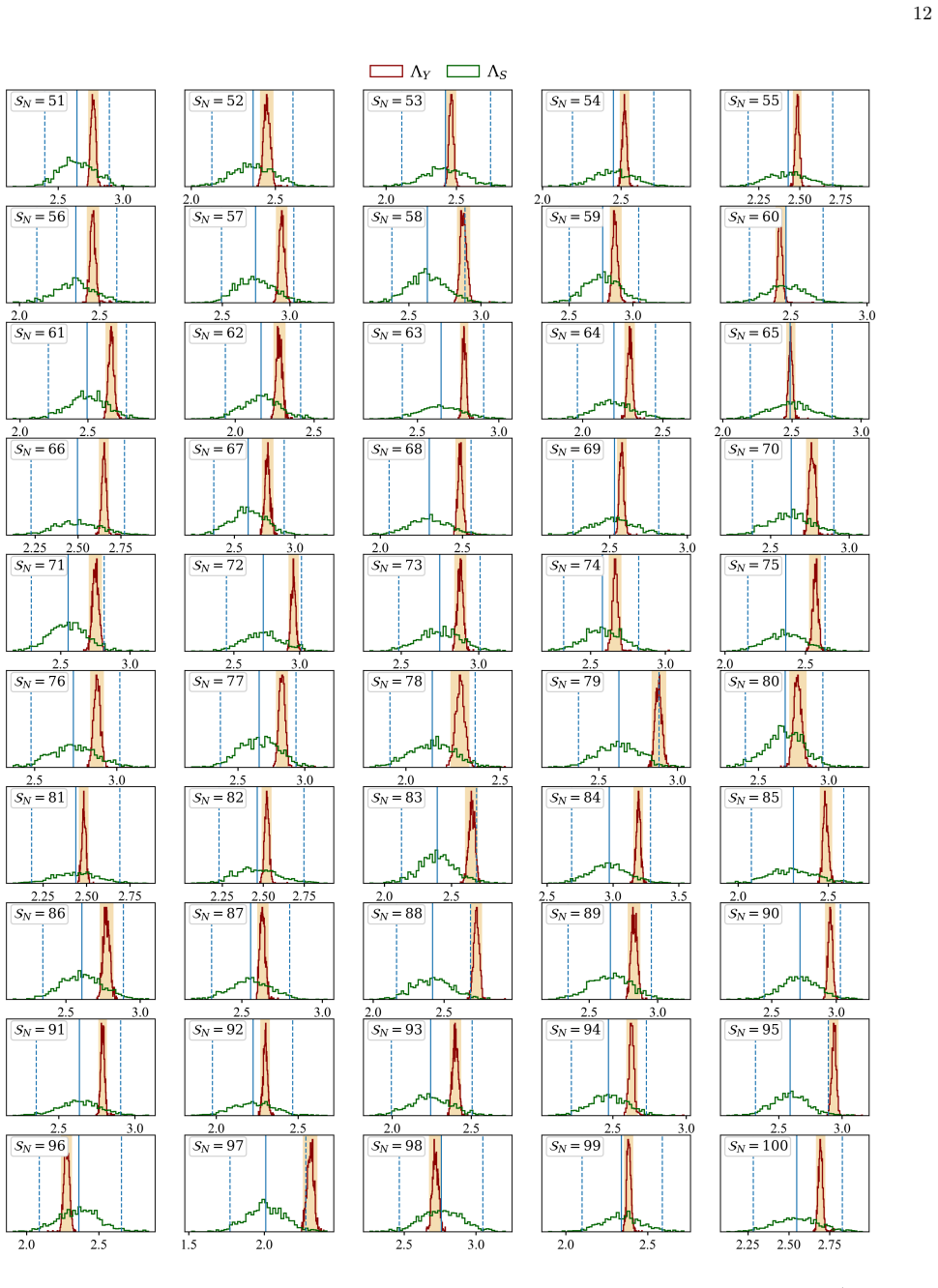
- [II.C, Fig. 4, Table I] Section II.C calibrates the threshold with only 100 stationary-Gaussian noise realizations of the same IMRPhenomXP injection. With zero observed draws above 3 sigma_S, the 95% upper limit on the tail probability at that threshold is roughly 3/100 = 3%, much larger than the 0.27% probability of a Gaussian 3-sigma excursion; the reported 'within the 3 sigma limit' statement is therefore not statistically supported. Moreover, using an identical injected waveform in every realization means the background does not include variation over binary parameters or waveform systematics, so it cannot validate robustness of the test to the mismodeling it is designed to detect. The authors should report an empirical p-value based on a substantially larger background and, ideally, a set of injections spanning the prior.
- [III, eccentric BBH analysis] Section III changes the integration range for the eccentric case, stating that the area should not be restricted to alpha in [1.6,2.4] 'since all the energy in the TF plane is derived from the signal in the absence of noise.' This means the 5.84 sigma_S value for the eccentric injection is not computed with the same statistic as the GR background, which uses noisy injections and the restricted alpha range, so the comparison in Fig. 4 and Table I is not apples-to-apples. If the eccentric analysis is intended as a proof of principle for gross mismatches, the claim of exceeding the 3-sigma background threshold should be demonstrated under the same noise and integration-range conditions as the background.
- [II.B, Step 6] Section II.B Step 6 states that D_Y^S = 3.75 sigma_S puts the Lambda_Y distribution 'outside the 99.999% confidence interval' of the Lambda_S distribution. A 3.75-sigma Gaussian excursion corresponds to roughly 99.98-99.99% confidence, not 99.999%, so the quoted probability is numerically overstated. The same section quotes D_Y^S = 3.75 sigma_S while Table I lists the average as 3.76 sigma_S; the source of this small discrepancy should be clarified, and any confidence statement should be tied to the calibrated null distribution rather than to a Gaussian assumption.
minor comments (5)
- [II.A, Eq. (2)-(3)] The discrete alpha range [alpha_min, alpha_max] and step size used in Eq. (2), the integration limits in Eq. (3), and the SET parameters (wavelet family, central frequency, number of voices, and sampling) are not specified; without these values the analysis is not reproducible.
- [Table I caption] Table I caption calls GW190814 an 'injection'; it is real data, and the row labels '(2,2) mode' and '(2,2)+(3,3) modes' are inaccurate for IMRPhenomXP and IMRPhenomXPHM, which contain more harmonic content than those two modes.
- [Fig. 4 caption] The caption claims D_Y^S is 'not susceptible to the choice of the power spectral density' because it is expressed in units of sigma_S; this claim is not justified, as sigma_S itself is derived from posterior samples obtained with a specific PSD.
- [II.B, Step 6] The text says 1000 posterior samples are used but does not state whether they are thinned to reduce autocorrelation from nested sampling; correlated samples would make the quoted distribution widths and distances appear more precise than they are.
- [IV, GW190814] The sentence reporting GW190412 results (D_Y^S = 1.42 sigma_S and 1.06 sigma_S) appears without context or a figure; please add a reference or analysis details so the reader can assess this comparison.
Circularity Check
No significant circularity; the consistency test is calibrated against external injections and real data, and its statistic is not fitted to the outcome.
full rationale
The paper's central chain is self-contained: the consistency statistic D_Y^S compares the data-derived time-frequency energy integral ΛY against the template-derived distribution ΛS, and neither quantity is fitted to the claim being tested. The GR background in Sec. II.C is an external null calibration using 100 stationary-Gaussian noise realizations with an identical IMRPhenomXP injection, and the non-GR, eccentric, and GW190814 cases are separate injections or real data. Appendix B explicitly notes that ΛY receives a noise contribution that ΛS does not, which is a statistical limitation rather than a definitional circularity, because the paper tests the net behavior empirically against the 3σS band. The only self-citation is Ref. [54] for the S(α) scaling construction, but that is an independent published method with stated assumptions and is used as a tool rather than as evidence for the test's conclusions. No equation reduces to its own input, and no fitted parameter is renamed as a prediction. The 3σ threshold is derived from an empirical background, not from the same data used to claim a deviation, so the derivation chain remains non-circular.
Assumptions & free parameters
free parameters (4)
- α integration range =
[1.6, 2.4] for quadrupole cases; unspecified wider range for the eccentric case
- significance threshold =
3σS
- number of posterior samples =
1000
- SET and wavelet parameters =
not specified
assumptions (5)
- domain assumption The GR template's orbital frequency evolution f_orbital(t, λ) computed from posterior masses and spins is a valid predictor of the signal's true frequency track under the null hypothesis.
- domain assumption The synchroextracting transform (SET) provides a statistically unbiased, high-resolution time-frequency representation in which the signal energy is localized near the true instantaneous frequency.
- domain assumption The 100 stationary Gaussian noise realizations (and the 10 shown) are representative of the null distribution of the distance statistic.
- domain assumption IMRPhenomXP is an accurate GR model for quasi-circular binaries, so any systematic template error is subdominant to the effects being searched.
- domain assumption The posterior samples from Bilby/Dynesty are representative of the parameter uncertainty and the chain is converged.
Cite this review
Pith. "Pith review of Probing missing physics from inspiralling compact binaries via time-frequency tracks." pith.science (2026). https://pith.science/paper/BRXSAXDF
@misc{pith2026250721566,
  author       = {Pith},
  title        = {Pith review of: Probing missing physics from inspiralling compact binaries via time-frequency tracks},
  year         = {2026},
  howpublished = {\url{https://pith.science/paper/BRXSAXDF}},
  note         = {Machine review of arXiv:2507.21566}
}
read the original abstract
The orbital evolution of binary black hole (BBH) systems is determined by the component masses and spins of the black holes and the governing gravity theory. Gravitational wave (GW) signals from the evolution of BBH orbits offer an unparalleled opportunity for examining the predictions of General Relativity (GR) and for searching for missing physics in the current waveform models. We present a method of stacking up the time-frequency pixel energies through the orbital frequency evolution with the flexibility of gradually shifting the orbital frequency curve along the frequency axis. We observe a distinct energy peak corresponding to the GW signal's quadrupole mode. If an alternative theory of gravity is considered and the analysis of the BBH orbital evolution is executed following GR, the energy distribution on the time-frequency plane will be significantly different. We propose a new consistency test to check whether our theoretical waveform explains the BBH orbital evolution. Through the numerical simulation of beyond-GR theory of gravity and utilizing the framework of second-generation interferometers, we demonstrate the efficiency of this new method in detecting any possible departure from GR. Finally, when applied to an eccentric BBH system and GW190814, which shows the signatures of higher-order multipoles, our method provides an exquisite probe of missing physics in the GR waveform models.
Figures


Figures from the paper (6 more)




Forward citations
Cited by 2 Pith papers
-
Improved Constraints on Non-Kerr Deviations from Binary Black Hole Inspirals Using GWTC-4 Data
GWTC-4 inspirals yield tighter constraints on Johannsen parameters α13 and ε3, both consistent with zero and thus with the Kerr geometry.
-
Improved Constraints on Non-Kerr Deviations from Binary Black Hole Inspirals Using GWTC-4 Data
Bayesian constraints from GWTC-4 binary black hole inspirals show Johannsen metric deformation parameters α13 and ε3 consistent with zero, supporting the Kerr hypothesis.
Reference graph
Works this paper leans on
-
[54]
Unveiling the spectrum of inspiralling binary black holes,
Soumen Roy, Anand S. Sengupta, and K. G. Arun, “Unveiling the spectrum of inspiralling binary black holes,” Phys. Rev. D 103, 064012 (2021), arXiv:1910.04565 [gr- qc]
arXiv 2021
-
[1]
Observation of Gravitational Waves from a Binary Black Hole Merger,
B. P. Abbott et al. (LIGO Scientific, Virgo), “Observation of Gravitational Waves from a Binary Black Hole Merger,” Phys. Rev. Lett. 116, 061102 (2016), arXiv:1602.03837 [gr-qc]
arXiv 2016
-
[2]
B. P. Abbott et al. (LIGO Scientific, Virgo), “GWTC-1: A Gravitational-Wave Transient Catalog of Compact Binary Mergers Observed by LIGO and Virgo during the First and Second Observing Runs,” Phys. Rev. X 9, 031040 (2019), arXiv:1811.12907 [astro-ph.HE]
arXiv 2019
-
[3]
R. Abbott et al. (LIGO Scientific, Virgo), “GWTC-2: Compact Binary Coalescences Observed by LIGO and Virgo During the First Half of the Third Observing Run,” Phys. Rev. X 11, 021053 (2021), arXiv:2010.14527 [gr-qc]
arXiv 2021
-
[4]
R. Abbott et al. (KAGRA, VIRGO, LIGO Scientific), “GWTC-3: Compact Binary Coalescences Observed by LIGO and Virgo during the Second Part of the Third Observing Run,” Phys. Rev. X 13, 041039 (2023), arXiv:2111.03606 [gr-qc]
arXiv 2023
-
[5]
J. Aasi et al. (LIGO Scientific), “Advanced LIGO,” Class. Quant. Grav. 32, 074001 (2015), arXiv:1411.4547 [gr-qc]
arXiv 2015
-
[6]
Advanced Virgo: a second- generation interferometric gravitational wave detector,
F. Acernese et al. (VIRGO), “Advanced Virgo: a second- generation interferometric gravitational wave detector,” Class. Quant. Grav. 32, 024001 (2015), arXiv:1408.3978 [gr-qc]
arXiv 2015
-
[7]
Tests of general relativity with GW150914,
B. P. Abbott et al. (LIGO Scientific, Virgo), “Tests of general relativity with GW150914,” Phys. Rev. Lett. 116, 221101 (2016), [Erratum: Phys.Rev.Lett. 121, 129902 (2018)], arXiv:1602.03841 [gr-qc]
arXiv 2016
Show all 75 references
-
[8]
Tests of General Relativity with GW170817,
B. P. Abbott et al. (LIGO Scientific, Virgo), “Tests of General Relativity with GW170817,” Phys. Rev. Lett. 123, 011102 (2019), arXiv:1811.00364 [gr-qc]
2019 arXiv
-
[9]
Tests of General Relativity with the Binary Black Hole Signals from the LIGO-Virgo Catalog GWTC-1,
B. P. Abbott et al. (LIGO Scientific, Virgo), “Tests of General Relativity with the Binary Black Hole Signals from the LIGO-Virgo Catalog GWTC-1,” Phys. Rev. D 100, 104036 (2019), arXiv:1903.04467 [gr-qc]
2019 arXiv
-
[10]
Tests of general relativity with binary black holes from the second LIGO- Virgo gravitational-wave transient catalog,
R. Abbott et al. (LIGO Scientific, Virgo), “Tests of general relativity with binary black holes from the second LIGO- Virgo gravitational-wave transient catalog,” Phys. Rev. D 103, 122002 (2021), arXiv:2010.14529 [gr-qc]
2021 arXiv
-
[11]
Tests of General Relativity with GWTC-3,
R. Abbott et al. (LIGO Scientific, VIRGO, KAGRA), “Tests of General Relativity with GWTC-3,” (2021), arXiv:2112.06861 [gr-qc]
2021 arXiv
-
[12]
Cosimo Bambi, Black Holes: A Laboratory for Testing Strong Gravity (Springer, 2017)
2017
-
[13]
Dynamical Chern- Simons Modified Gravity. I. Spinning Black Holes in the Slow-Rotation Approximation,
Nicolas Yunes and Frans Pretorius, “Dynamical Chern- Simons Modified Gravity. I. Spinning Black Holes in the Slow-Rotation Approximation,” Phys. Rev. D 79, 084043 (2009), arXiv:0902.4669 [gr-qc]
2009 arXiv
-
[14]
Rotating Black Holes in Dilatonic Einstein-Gauss- Bonnet Theory,
Burkhard Kleihaus, Jutta Kunz, and Eugen Radu, “Rotating Black Holes in Dilatonic Einstein-Gauss- Bonnet Theory,” Phys. Rev. Lett. 106, 151104 (2011), arXiv:1101.2868 [gr-qc]
2011 arXiv
-
[15]
Circularization versus eccentrification in inter- mediate mass ratio inspirals inside dark matter spikes,
Niklas Becker, Laura Sagunski, Lukas Prinz, and Saeed Rastgoo, “Circularization versus eccentrification in inter- mediate mass ratio inspirals inside dark matter spikes,” Phys. Rev. D 105, 063029 (2022), arXiv:2112.09586 [gr- qc]
2022 arXiv
-
[16]
Astronomical tests for quantum black hole structure,
Steven B. Giddings, “Astronomical tests for quantum black hole structure,” Nature Astron. 1, 0067 (2017), arXiv:1703.03387 [gr-qc]
2017 arXiv
-
[17]
Periodic orbits and their gravitational wave radiations in a polymer black hole in loop quantum gravity,
Ze-Yi Tu, Tao Zhu, and Anzhong Wang, “Periodic orbits and their gravitational wave radiations in a polymer black hole in loop quantum gravity,” Phys. Rev. D 108, 024035 (2023), arXiv:2304.14160 [gr-qc]
2023 arXiv
-
[18]
Dynamical bo- son stars,
Steven L. Liebling and Carlos Palenzuela, “Dynamical bo- son stars,” Living Rev. Rel. 26, 1 (2023), arXiv:1202.5809 [gr-qc]
2023 arXiv
-
[19]
Fundamental Theoretical Bias in Gravitational Wave Astrophysics and the Parameterized Post-Einsteinian Framework,
Nicolas Yunes and Frans Pretorius, “Fundamental Theoretical Bias in Gravitational Wave Astrophysics and the Parameterized Post-Einsteinian Framework,” Phys. Rev. D 80, 122003 (2009), arXiv:0909.3328 [gr-qc]
2009 arXiv
-
[20]
Testing post-Newtonian theory with gravitational wave observations,
K. G. Arun, Bala R. Iyer, M. S. S. Qusailah, and B. S. Sathyaprakash, “Testing post-Newtonian theory with gravitational wave observations,” Class. Quant. Grav. 23, L37–L43 (2006), arXiv:gr-qc/0604018
2006 arXiv
-
[21]
TIGER: A data analysis pipeline for testing the strong- field dynamics of general relativity with gravitational wave signals from coalescing compact binaries,
Michalis Agathos, Walter Del Pozzo, Tjonnie G. F. Li, Chris Van Den Broeck, John Veitch, and Salvatore Vitale, “TIGER: A data analysis pipeline for testing the strong- field dynamics of general relativity with gravitational wave signals from coalescing compact binaries,” Phys....
2014 arXiv
-
[22]
An improved parametrized test of general relativity using the IMR- PhenomX waveform family: Including higher harmonics and precession,
Soumen Roy, Maria Haney, Geraint Pratten, Peter T. H. Pang, and Chris Van Den Broeck, “An improved parametrized test of general relativity using the IMR- PhenomX waveform family: Including higher harmonics and precession,” arXiv e-prints , arXiv:2504.21147 (2025), arXiv:2504.2...
2025
-
[23]
Tests of general relativity with gravitational-wave observations using a flexible theory-independent method,
Ajit Kumar Mehta, Alessandra Buonanno, Roberto Cotesta, Abhirup Ghosh, Noah Sennett, and Jan Stein- hoff, “Tests of general relativity with gravitational-wave observations using a flexible theory-independent method,” Phys. Rev. D 107, 044020 (2023), arXiv:2203.13937 [gr- qc]
2023 arXiv
-
[24]
Testing the binary black hole nature of a compact binary coalescence,
N. V. Krishnendu, K. G. Arun, and Chandra Kant Mishra, “Testing the binary black hole nature of a compact binary coalescence,” Phys. Rev. Lett. 119, 091101 (2017), arXiv:1701.06318 [gr-qc]
2017 arXiv
-
[25]
Testing general relativity using higher-order modes of gravitational waves from binary black holes,
Anna Puecher, Chinmay Kalaghatgi, Soumen Roy, Yoshinta Setyawati, Ish Gupta, B. S. Sathyaprakash, and Chris Van Den Broeck, “Testing general relativity using higher-order modes of gravitational waves from binary black holes,” Phys. Rev. D 106, 082003 (2022), arXiv:2205.09062 [gr-qc]
2022 arXiv
-
[26]
Octupolar test of gen- eral relativity,
Parthapratim Mahapatra, “Octupolar test of gen- eral relativity,” Phys. Rev. D 109, 024050 (2024), arXiv:2306.04703 [gr-qc]
2024 arXiv
-
[27]
Parametrized multipolar gravitational waveforms 14 for testing general relativity: Amplitude corrections up to 2PN order,
Parthapratim Mahapatra and Shilpa Kastha, “Parametrized multipolar gravitational waveforms 14 for testing general relativity: Amplitude corrections up to 2PN order,” Phys. Rev. D 109, 084069 (2024), arXiv:2311.04672 [gr-qc]
2024 arXiv
-
[28]
Black-hole Spectroscopy by Making Full Use of Gravitational-Wave Modeling,
Richard Brito, Alessandra Buonanno, and Vivien Raymond, “Black-hole Spectroscopy by Making Full Use of Gravitational-Wave Modeling,” Phys. Rev. D 98, 084038 (2018), arXiv:1805.00293 [gr-qc]
2018 arXiv
-
[29]
Tests of general relativity in the nonlinear regime: A parametrized plunge-merger- ringdown gravitational waveform model,
Elisa Maggio, Hector O. Silva, Alessandra Buonanno, and Abhirup Ghosh, “Tests of general relativity in the nonlinear regime: A parametrized plunge-merger- ringdown gravitational waveform model,” Phys. Rev. D 108, 024043 (2023), arXiv:2212.09655 [gr-qc]
2023 arXiv
-
[30]
Observational Black Hole Spectroscopy: A time-domain multimode analysis of GW150914,
Gregorio Carullo, Walter Del Pozzo, and John Veitch, “Observational Black Hole Spectroscopy: A time-domain multimode analysis of GW150914,” Phys. Rev. D 99, 123029 (2019), [Erratum: Phys.Rev.D 100, 089903 (2019)], arXiv:1902.07527 [gr-qc]
2019 arXiv
-
[31]
Testing the no-hair theorem with GW150914,
Maximiliano Isi, Matthew Giesler, Will M. Farr, Mark A. Scheel, and Saul A. Teukolsky, “Testing the no-hair theorem with GW150914,” Phys. Rev. Lett. 123, 111102 (2019), arXiv:1905.00869 [gr-qc]
2019 arXiv
-
[32]
Testing general relativity via direct measurement of black hole kicks,
Parthapratim Mahapatra, Marc Favata, and K. G. Arun, “Testing general relativity via direct measurement of black hole kicks,” Phys. Rev. D 110, 084041 (2024), arXiv:2308.08319 [gr-qc]
2024 arXiv
-
[33]
Testing general relativity with gravitational-wave catalogs: The insidious nature of waveform systematics,
Christopher J. Moore, Eliot Finch, Riccardo Buscicchio, and Davide Gerosa, “Testing general relativity with gravitational-wave catalogs: The insidious nature of waveform systematics,” iScience 24, 102577 (2021), arXiv:2103.16486 [gr-qc]
2021 arXiv
-
[34]
Accumulating Errors in Tests of General Relativity with Gravitational Waves: Overlapping Signals and Inaccurate Waveforms,
Qian Hu and John Veitch, “Accumulating Errors in Tests of General Relativity with Gravitational Waves: Overlapping Signals and Inaccurate Waveforms,” Astrophys. J. 945, 103 (2023), arXiv:2210.04769 [gr-qc]
2023 arXiv
-
[35]
Potential observations of false deviations from general relativity in gravitational wave signals from binary black holes,
Peter T. H. Pang, Juan Calder´ on Bustillo, Yifan Wang, and Tjonnie G. F. Li, “Potential observations of false deviations from general relativity in gravitational wave signals from binary black holes,” Phys. Rev. D 98, 024019 (2018), arXiv:1802.03306 [gr-qc]
2018 arXiv
-
[36]
Effect of ignoring eccentricity in testing general relativity with gravitational waves,
Purnima Narayan, Nathan K. Johnson-McDaniel, and Anuradha Gupta, “Effect of ignoring eccentricity in testing general relativity with gravitational waves,” Phys. Rev. D 108, 064003 (2023), arXiv:2306.04068 [gr-qc]
2023 arXiv
-
[37]
Eccentricity-induced systematic error on parametrized tests of general relativity: Hierarchical Bayesian inference applied to a binary black hole popula- tion,
Pankaj Saini, Sajad A. Bhat, Marc Favata, and K. G. Arun, “Eccentricity-induced systematic error on parametrized tests of general relativity: Hierarchical Bayesian inference applied to a binary black hole popula- tion,” Phys. Rev. D 109, 084056 (2024), arXiv:2311.08033 [gr-qc]
2024 arXiv
-
[38]
Systematic biases due to waveform mismodeling in parametrized post-Einsteinian tests of general relativity: The impact of neglecting spin precession and higher modes,
Rohit S. Chandramouli, Kaitlyn Prokup, Emanuele Berti, and Nicol´ as Yunes, “Systematic biases due to waveform mismodeling in parametrized post-Einsteinian tests of general relativity: The impact of neglecting spin precession and higher modes,” Phys. Rev. D 111, 044026 (2025),...
2025 arXiv
-
[39]
BayesWave: Bayesian Inference for Gravitational Wave Bursts and Instrument Glitches,
Neil J. Cornish and Tyson B. Littenberg, “BayesWave: Bayesian Inference for Gravitational Wave Bursts and Instrument Glitches,” Class. Quant. Grav. 32, 135012 (2015), arXiv:1410.3835 [gr-qc]
2015 arXiv
-
[40]
Reconstructing gravita- tional wave signals from binary black hole mergers with minimal assumptions,
Sudarshan Ghonge, Katerina Chatziioannou, James A. Clark, Tyson Littenberg, Margaret Millhouse, Laura Cadonati, and Neil Cornish, “Reconstructing gravita- tional wave signals from binary black hole mergers with minimal assumptions,” Phys. Rev. D 102, 064056 (2020), arXiv:2003....
2020 arXiv
-
[41]
Constraint likelihood analysis for a network of gravitational wave detectors,
S. Klimenko, S. Mohanty, M. Rakhmanov, and G. Mitselmakher, “Constraint likelihood analysis for a network of gravitational wave detectors,” Phys. Rev. 72, 122002 (2005), arXiv:gr-qc/0508068 [gr-qc]
2005 arXiv
-
[42]
Method for detection and reconstruc- tion of gravitational wave transients with networks of advanced detectors,
S. Klimenko et al., “Method for detection and reconstruc- tion of gravitational wave transients with networks of advanced detectors,” Phys. Rev. D93, 042004 (2016), arXiv:1511.05999 [gr-qc]
2016 arXiv
-
[43]
Nonorthogonal wavelet transformation for reconstructing gravitational wave signals,
Soumen Roy, “Nonorthogonal wavelet transformation for reconstructing gravitational wave signals,” Phys. Rev. Res. 4, 033078 (2022), arXiv:2201.01526 [gr-qc]
2022 arXiv
-
[44]
Hidden-Sector Modifications to Gravitational Waves From Binary Inspirals,
Stephon Alexander, Evan McDonough, Robert Sims, and Nicolas Yunes, “Hidden-Sector Modifications to Gravitational Waves From Binary Inspirals,” Class. Quant. Grav. 35, 235012 (2018), arXiv:1808.05286 [gr-qc]
2018 arXiv
-
[45]
Gravitational dipole radiations from binary systems,
J. M. Gerard and Y. Wiaux, “Gravitational dipole radiations from binary systems,” Phys. Rev. D 66, 024040 (2002), arXiv:gr-qc/0109062
2002 arXiv
-
[46]
Spinning-black-hole binaries: The orbital hang up,
Manuela Campanelli, C. O. Lousto, and Y. Zlochower, “Spinning-black-hole binaries: The orbital hang up,” Phys. Rev. D 74, 041501 (2006), arXiv:gr-qc/0604012
2006 arXiv
-
[47]
The binary black hole explorer: on-the-fly visualizations of precessing binary black holes,
Vijay Varma, Leo C. Stein, and Davide Gerosa, “The binary black hole explorer: on-the-fly visualizations of precessing binary black holes,” Class. Quant. Grav. 36, 095007 (2019), arXiv:1811.06552 [astro-ph.HE]
2019
-
[48]
Spin induced orbital precession and its modulation of the gravitational wave forms from merging binaries,
Theocharis A. Apostolatos, Curt Cutler, Gerald J. Sussman, and Kip S. Thorne, “Spin induced orbital precession and its modulation of the gravitational wave forms from merging binaries,” Phys. Rev. D49, 6274–6297 (1994)
1994
-
[49]
Simple Model of Complete Precessing Black-Hole-Binary Gravitational Waveforms,
Mark Hannam, Patricia Schmidt, Alejandro Boh´ e, Le ¨ ıla Haegel, Sascha Husa, Frank Ohme, Geraint Pratten, and Michael P¨ urrer, “Simple Model of Complete Precessing Black-Hole-Binary Gravitational Waveforms,” Phys. Rev. Lett. 113, 151101 (2014), arXiv:1308.3271 [gr-qc]
2014 arXiv
-
[50]
Envi- ronmental Effects for Gravitational-wave Astrophysics,
Enrico Barausse, Vitor Cardoso, and Paolo Pani, “Envi- ronmental Effects for Gravitational-wave Astrophysics,” J. Phys. Conf. Ser. 610, 012044 (2015), arXiv:1404.7140 [astro-ph.CO]
2015 arXiv
-
[51]
Compact binary coalescences in dense gaseous environments can pose as ones in vacuum,
Soumen Roy and Rodrigo Vicente, “Compact binary coalescences in dense gaseous environments can pose as ones in vacuum,” Phys. Rev. D 111, 084037 (2025), arXiv:2410.16388 [gr-qc]
2025 arXiv
-
[52]
First Constraints on Compact Binary Environments from LIGO-Virgo Data,
Giada Caneva Santoro, Soumen Roy, Rodrigo Vicente, Maria Haney, Ornella Juliana Piccinni, Walter Del Pozzo, and Mario Martinez, “First Constraints on Compact Binary Environments from LIGO-Virgo Data,” Phys. Rev. Lett. 132, 251401 (2024), arXiv:2309.05061 [gr-qc]
2024 arXiv
-
[53]
GW190814: 15 Gravitational Waves from the Coalescence of a 23 Solar Mass Black Hole with a 2.6 Solar Mass Compact Object,
R. Abbott et al. (LIGO Scientific, Virgo), “GW190814: 15 Gravitational Waves from the Coalescence of a 23 Solar Mass Black Hole with a 2.6 Solar Mass Compact Object,” Astrophys. J. Lett. 896, L44 (2020), arXiv:2006.12611 [astro-ph.HE]
2020 arXiv
-
[55]
GW190412: Observation of a Binary-Black-Hole Coalescence with Asymmetric Masses,
R. Abbott et al. (LIGO Scientific, Virgo), “GW190412: Observation of a Binary-Black-Hole Coalescence with Asymmetric Masses,” Phys. Rev. D 102, 043015 (2020), arXiv:2004.08342 [astro-ph.HE]
2020 arXiv
-
[56]
Decomposition of hardy functions into square integrable wavelets of constant shape,
A. Grossmann and J. Morlet, “Decomposition of hardy functions into square integrable wavelets of constant shape,” SIAM Journal on Mathematical Analysis 15, 723–736 (1984), https://doi.org/10.1137/0515056
1984 doi
-
[57]
Synchroex- tracting transform,
Gang Yu, Mingjin Yu, and Chuanyan Xu, “Synchroex- tracting transform,” IEEE Transactions on Industrial Electronics 64, 8042–8054 (2017)
2017
-
[58]
High-order synchrosqueezing transform for multicomponent signals analysis—with an application to gravitational-wave signal,
Duong-Hung Pham and Sylvain Meignen, “High-order synchrosqueezing transform for multicomponent signals analysis—with an application to gravitational-wave signal,” IEEE Transactions on Signal Processing 65, 3168– 3178 (2017)
2017
-
[59]
Bounding the mass of the graviton using gravitational wave observations of inspiralling compact binaries,
Clifford M. Will, “Bounding the mass of the graviton using gravitational wave observations of inspiralling compact binaries,” Phys. Rev. D 57, 2061–2068 (1998), arXiv:gr- qc/9709011
1998
-
[60]
Barsotti, S
L. Barsotti, S. Gras, M. Evans, and P. Fritschel, The updated Advanced LIGO design curve , LIGO Technical Note T1800044-v5 (LIGO Scientific Collaboration, 2018) updated from T0900288-v3
2018
-
[61]
Prospects for early localization of gravitational-wave signals from compact binary coalescences with advanced detectors,
Alessandro Manzotti and Alexander Dietz, “Prospects for early localization of gravitational-wave signals from compact binary coalescences with advanced detectors,” arXiv e-prints , arXiv:1202.4031 (2012), arXiv:1202.4031 [gr-qc]
2012 arXiv
-
[62]
LIGO Algorithm Library - LALSuite,
LIGO Scientific Collaboration, “LIGO Algorithm Library - LALSuite,” free software (GPL) (2023)
2023
-
[63]
BILBY: A user-friendly Bayesian inference library for gravitational-wave astronomy,
Gregory Ashton et al. , “BILBY: A user-friendly Bayesian inference library for gravitational-wave astronomy,” Astrophys. J. Suppl. 241, 27 (2019), arXiv:1811.02042 [astro-ph.IM]
2019 arXiv
-
[64]
Dynesty: a dynamic nested sampling package for estimating bayesian posteriors and evidences,
Joshua S. Speagle, “Dynesty: a dynamic nested sampling package for estimating bayesian posteriors and evidences,” Mon. Not. Roy. Astron. Soc. 493, 3132–3158 (2020), arXiv:1904.02180 [astro-ph.IM]
2020 arXiv
-
[65]
Computationally efficient models for the dominant and subdominant harmonic modes of precessing binary black holes,
Geraint Pratten et al. , “Computationally efficient models for the dominant and subdominant harmonic modes of precessing binary black holes,” Phys. Rev. D 103, 104056 (2021), arXiv:2004.06503 [gr-qc]
2021 arXiv
-
[66]
Probing eccentric higher-order modes through an effective chirp-mass model,
Ravikiran Hegde, Nirban Bose, and Archana Pai, “Probing eccentric higher-order modes through an effective chirp-mass model,” Phys. Rev. D 110, 044026 (2024), arXiv:2310.13662 [gr-qc]
2024 arXiv
-
[67]
LIGO Detector Characterization in the first half of the fourth Observing run,
S. Soni, B. K. Berger, D. Davis, et al. (LIGO Scientific Collaboration), “LIGO Detector Characterization in the first half of the fourth Observing run,” (2024), arXiv:2409.02831 [astro-ph.IM]
2024
-
[68]
Catalog of 174 Binary Black Hole Simulations for Gravitational Wave Astronomy,
Abdul H. Mroue et al., “Catalog of 174 Binary Black Hole Simulations for Gravitational Wave Astronomy,” Phys. Rev. Lett. 111, 241104 (2013), arXiv:1304.6077 [gr-qc]
2013 arXiv
-
[69]
The SXS Collaboration catalog of binary black hole simulations,
Michael Boyle et al. , “The SXS Collaboration catalog of binary black hole simulations,” Class. Quant. Grav. 36, 195006 (2019), arXiv:1904.04831 [gr-qc]
2019 arXiv
-
[70]
GWTC-2.1: Deep extended catalog of compact binary coalescences observed by LIGO and Virgo during the first half of the third observing run,
R. Abbott et al. (LIGO Scientific, VIRGO), “GWTC-2.1: Deep extended catalog of compact binary coalescences observed by LIGO and Virgo during the first half of the third observing run,” Phys. Rev. D 109, 022001 (2024), arXiv:2108.01045 [gr-qc]
2024 arXiv
-
[71]
Open Data from the Third Observing Run of LIGO, Virgo, KAGRA, and GEO,
R. Abbott et al. (KAGRA, VIRGO, LIGO Scientific), “Open Data from the Third Observing Run of LIGO, Virgo, KAGRA, and GEO,” Astrophys. J. Suppl. 267, 29 (2023), arXiv:2302.03676 [gr-qc]
2023 arXiv
-
[72]
Array programming with NumPy,
Charles R. Harris et al. , “Array programming with NumPy,” Nature 585, 357–362 (2020), arXiv:2006.10256 [cs.MS]
2020 arXiv
-
[73]
SciPy 1.0–Fundamental Algorithms for Scientific Computing in Python,
Pauli Virtanen et al., “SciPy 1.0–Fundamental Algorithms for Scientific Computing in Python,” Nat. Meth. 17, 261 (2020), arXiv:1907.10121 [cs.MS]
2020 arXiv
-
[74]
Matplotlib: A 2D Graphics Environ- ment,
John D. Hunter, “Matplotlib: A 2D Graphics Environ- ment,” Comput. Sci. Eng. 9, 90–95 (2007)
2007
-
[75]
Theory of communication. Part 1: The analysis of information,
Dennis Gabor, “Theory of communication. Part 1: The analysis of information,” Journal of the Institution of Electrical Engineers-Part III: Radio and Communication Engineering 93, 429–441 (1946)
1946
Reviewed August 6, 2026 · model on record in the stance chip above.
Discussion (0). Sign in to comment.