REVIEW 4 major objections 5 minor 45 references
QGAN-based data augmentation for hybrid quantum-classical neural networks
T0 review · 4 major / 5 minor · reviewed 2026-08-07 · deepseek-v4-flash
Pith's one-line read QGAN-generated data boosts hybrid quantum-classical classifiers beyond classical GANs
desk verdict The customized augmentation strategy tunes itself on the test set and then reports accuracy on that same test set, which undermines the paper's central comparison. read the letter →
The pith
A machine-rendered reading of the paper's core claim, the machinery that carries it, and where it could break.
The reading
What carries the argument
The load-bearing component is the QGAN generator: a parameterized quantum circuit built from $R_y(\theta)$ and $R_z(\theta)$ rotation gates and CNOT entanglements, whose measurement outcomes are post-processed by a classical neural network to produce synthetic images. The generator is trained with the parameter-shift rule while the discriminator is a classical fully connected network trained with backpropagation. In the customized strategy, a sampling module computes $R[i] = E[i]/E_{\text{total}}$ from the classifier's per-class error counts and a filter module keeps a generated sample only when the classifier assigns it the intended class with confidence above a threshold $\tau$, so the augmentation budget flows to the classes where the model is weakest.
What would settle it
Retrain the customized pipeline with a held-out validation set replacing the test set for computing per-class error rates and confidence thresholds, then measure accuracy on a test set never touched during augmentation; if the reported gains disappear or fall to the level of uniform augmentation, the central comparison for the customized strategy is an artifact of test-set leakage.
Extended reading notes
Core claim
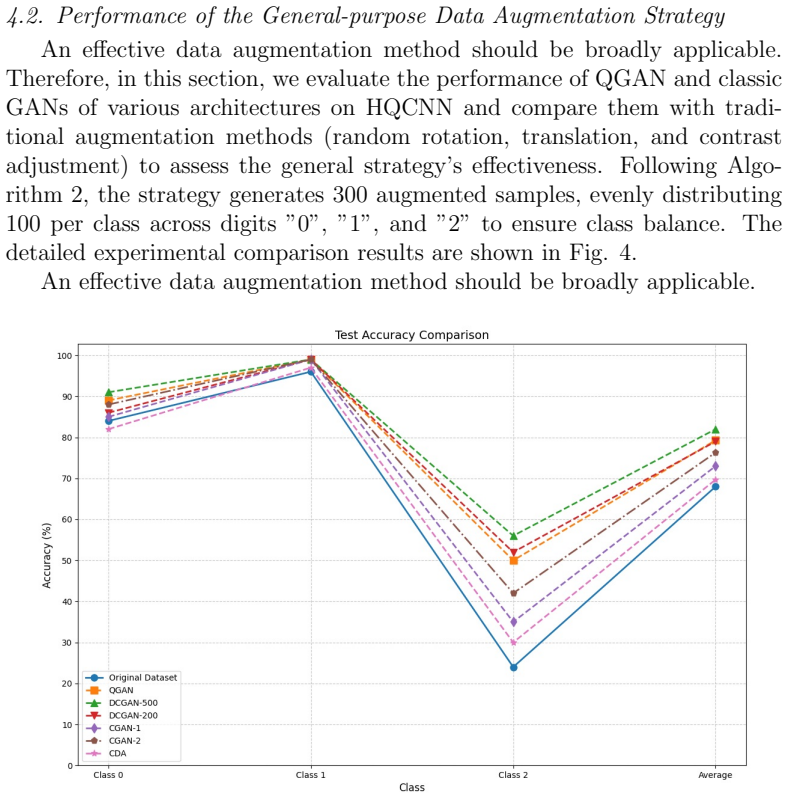
The central claim is that a QGAN whose generator is a variational quantum circuit (rotation gates and CNOT entanglements followed by a classical post-processing network), trained adversarially against a classical discriminator, produces synthetic images that improve HQCNN classification accuracy more than classical GANs or conventional augmentation. The paper reports that on MNIST restricted to digits 0, 1, and 2 with 100 training samples per class, the QGAN-augmented HQCNN outperforms GAN-1 and GAN-2 by 6.3 and 3 percentage points, and at 200 training iterations reaches 84% accuracy, matching a DCGAN trained for 500 iterations while using fewer than half the parameters. The customized strategy uses the current classifier's per-class error counts, computed on the test set, to allocate generated samples to weak classes and to set confidence thresholds for filtering. The paper also reports that, under fixed sample budgets, adding more samples to underperforming categories helps more than raising the quality threshold for those categories.
Load-bearing premise
The customized strategy's reported gains rest on using the test set to decide how many synthetic samples to generate for each class and to tune confidence thresholds, with final accuracy measured on that same test set; if this leaks information, the reported improvements are inflated.
Editorial extensions
If this is right
- Any HQCNN can apply the general augmentation strategy without architecture changes, because it only requires retraining the existing classifier on the union of the original and QGAN-generated data.
- The customized strategy implies that augmentation budgets should be concentrated on classes where the classifier errs, and the paper's experiments report that this beats uniform class-balanced augmentation.
- At equal training iterations, a quantum generator can match a deeper convolutional generator with far fewer parameters, suggesting NISQ-era circuits are usable for generative augmentation.
- Conventional augmentation such as rotation, translation, and contrast adjustment gives only limited gains for HQCNNs with angle encoding, so the paper positions quantum-native generation as the more effective alternative.
Reading between the lines
- The confidence-filtering idea implies a general principle for augmentation under data scarcity: budget samples to a model's error modes rather than keeping classes balanced, a principle that classical GAN pipelines could adopt as well.
- The parameter-efficiency comparison suggests quantum circuits may encode image structure more compactly than convolutional generators; isolating the cause would require ablating the CNOT entanglements and the rotation encoding.
- The experiments stop at a three-class, 100-sample-per-class MNIST subset; the natural next test is whether the advantage survives larger augmentation budgets, more classes, or higher-resolution images.
- A clean evaluation of the customized strategy would use a held-out validation set for the per-class allocation and thresholds, with a separate test set used only for the final accuracy measurement.
Editorial analysis
A structured set of objections, weighed in public.
Referee Report
Summary. The manuscript proposes a data augmentation framework that uses quantum generative adversarial networks (QGANs) to generate synthetic training samples for hybrid quantum-classical neural networks (HQCNNs). It describes a general augmentation strategy and a customized strategy that allocates generated samples and adjusts confidence thresholds based on the model's per-class errors. Experiments on a three-class MNIST subset (digits 0, 1, 2) with 100 training and 100 test images per class compare QGAN-based augmentation with classical GANs (GAN-1, GAN-2, DCGAN) and conventional augmentation. The paper claims that QGAN augmentation improves HQCNN accuracy by 6.3 and 3 percentage points over classical GANs and that QGAN achieves performance comparable to DCGAN with fewer parameters.
Significance. If the empirical claims were valid, the framework would be a timely contribution to quantum data augmentation for hybrid quantum-classical models. The proposed architecture is clearly described, and the idea of steering generation toward error-prone classes is sensible. However, the paper's central evidence is not reliable: the customized strategy leaks test-set information into the augmentation design, the headline accuracy differences are reported without error bars or multiple seeds, and no code or data are provided. These issues are load-bearing because they directly affect the validity of the main conclusions.
major comments (4)
- [Algorithm 3 (Section 3.4)] The customized strategy in Algorithm 3 uses the test set to design the augmentation and then evaluates on the same test set. In steps 2–6, the pretrained model M is evaluated on Dtest, per-class errors E[i] are accumulated, and the allocation R[i] = E[i]/Etotal is computed from test labels. In step 11, these error counts adjust the per-class confidence thresholds τ. The generator is then trained to match the error-derived distribution, and generated samples are filtered using M's predictions and the adjusted thresholds. Section 4.3 then reports accuracy of the retrained model M′ on the same Dtest. Because test labels influenced which classes received more synthetic samples and which samples were accepted, the reported accuracy gains are not unbiased estimates of generalization. The comparisons in Sections 4.3.1 and 4.3.2 therefore do not establish the advantage of the customized strategy or the superiority of QGAN. A clean protocol would use a validation split (or cross-validation) for these design choices.
- [Section 4.2] The headline comparison is based on single-run accuracies without error bars, multiple seeds, or statistical tests. Section 4.2 reports that QGAN improved classification accuracy by 6.3 and 3 percentage points over GAN-1 and GAN-2. On a 300-sample test set, a 3-percentage-point difference corresponds to about 9 images, so the difference could easily arise from chance. No standard deviations, training seeds, or significance tests are reported, and no code or data are released to allow reproduction. The claim that QGAN 'outperforms' classical GANs is therefore not supported by the reported evidence.
- [Section 4.3.2 and Table 1] The statement that QGAN achieves comparable performance to DCGAN 'with half the parameters' is imprecise. Table 1 lists QGAN with 1,510,212 parameters and DCGAN with 3,346,476 parameters, i.e., about 45%, not half. The comparison also mixes different training epochs (200 for QGAN, 200/500 for DCGAN) and different model architectures. In Section 4.3.2, DCGAN at 500 epochs reaches 88.3% accuracy while QGAN at 200 epochs reaches 84%, so the 'comparable performance' claim needs to be defined or qualified.
- [Section 4.3.1] The comparison between the customized and general augmentation strategies is not controlled. The general strategy (Algorithm 2) generates 100 samples per class without confidence filtering, while the customized strategy (Algorithm 3) uses an error-derived allocation and threshold-based filtering. These two differences are confounded, so the observed accuracy improvement cannot be attributed to the 'customized' element alone. Combined with the test-set leakage identified above, the conclusion that the customized strategy 'highlights the value' of the proposed approach is not established.
minor comments (5)
- [Section 4.2] The sentence 'An effective data augmentation method should be broadly applicable.' appears twice in succession.
- [Data Availability] The Data Availability statement says 'No data was used for the research described in the article,' but the experiments use the MNIST dataset and generated samples; this should be corrected or clarified.
- [Section 4.3.1 (around Table 3)] The text contains a stray fragment: 'adversarial network (QGAN) as an example: This experiment uses samples generated by the quantum generative adversarial network (QGAN) as an example:' which should be removed.
- [Algorithm 3, step 9] The notation 'generate 3 Ni samples' is ambiguous; it should be written as '3 × Ni' or '3Ni' to avoid confusion.
- [Abstract] The abstract states 'Quantum neural networks converge faster and achieve higher accuracy than classical models' without qualification; this is an overgeneralization and should be hedged or supported with a citation.
Circularity Check
Algorithm 3 tunes augmentation on Dtest and reports accuracy on the same Dtest, so the customized-strategy gains are partly built into the evaluation.
-
fitted input called prediction
[Section 3.4, Algorithm 3 (steps 2-6 and 11); evaluated in Section 4.3]
"2: for each y ∈ Dtest do 3: Predict y′ with M ; if y′ ̸= y, then E[y] ← E[y] + 1 4: end for 5: Etotal ← P i E[i]; for each class i, compute R[i] ← E[i]/Etotal ... 11: Compute the specific confidence threshold τ for the class: a. If E[i] is large: τ = τ − α ∗ R[i] b. If E[i] is small: τ = τ + β ∗ R[i]"
The customized pipeline reads test labels to compute per-class errors E[i], derives the synthetic-sample allocation R[i] = E[i]/Etotal, and adjusts the per-class acceptance threshold τ from those same errors. Steps 12-14 then filter generated samples using M's predictions and this test-derived τ, step 20 retrains M on Dtrain ∪ Daug, and Section 4.3 measures the retrained model's accuracy on the same Dtest. The test set therefore determines how many samples each class receives and which samples are accepted; the reported accuracy is not an independent estimate of generalization. The comparison between customized and general augmentation (Fig. 5) and between GAN variants under customized augmentation (Fig. 6) is biased by this test-set information.
full rationale
The paper contains no formal derivation chain: QGAN and HQCNN are standard architectures and the loss function in Eq. (4) is the usual GAN objective. The general-purpose strategy (Algorithm 2) is a conventional generate-then-retrain pipeline with fixed 100-sample-per-class allocation and no test-set input; its QGAN-vs-classical-GAN comparison in Section 4.2 is not circular. No load-bearing self-citation or imported uniqueness theorem appears. The only significant circular defect is in the customized strategy (Algorithm 3): per-class error counts, sample allocation proportions, and confidence thresholds are all computed from Dtest, and the final model is then evaluated on that same Dtest. Thus the claimed benefits of the customized strategy (and the customized-strategy comparisons in Figures 5-7) reduce in part to test-set fitting. The abstract-level claim that QGAN matches DCGAN with half the parameters is supported by parameter counts and the non-leaking general-strategy results, but the customized-strategy evidence is invalidated. Because the central advertised advantage of the tailored augmentation scheme is not independently measured, the score is 6 rather than 0; the QGAN generation itself is not circular.
Assumptions & free parameters
free parameters (4)
- Number of generated samples Ngen =
300
- Per-class sample allocation R[i] =
45/11/244 for classes 0/1/2
- Confidence threshold adjustments alpha, beta, tau =
Not reported
- QGAN and HQCNN hyperparameters =
Not specified
assumptions (4)
- standard math Standard quantum mechanics: Born rule, unitary gates, and measurement collapse as stated in Sec. 2.
- domain assumption QGAN training with a classical discriminator and VQC generator converges to a useful generator in this setting.
- domain assumption Angle encoding preserves class information after classical CNN feature extraction.
- ad hoc to paper Using the test set to allocate augmentation samples does not compromise the reported test accuracy.
Cite this review
Pith. "Pith review of QGAN-based data augmentation for hybrid quantum-classical neural networks." pith.science (2026). https://pith.science/paper/BSDLSHPC
@misc{pith2026250524780,
  author       = {Pith},
  title        = {Pith review of: QGAN-based data augmentation for hybrid quantum-classical neural networks},
  year         = {2026},
  howpublished = {\url{https://pith.science/paper/BSDLSHPC}},
  note         = {Machine review of arXiv:2505.24780}
}
read the original abstract
Quantum neural networks converge faster and achieve higher accuracy than classical models. However, data augmentation in quantum machine learning remains underexplored. To tackle data scarcity, we integrate quantum generative adversarial networks (QGANs) with hybrid quantum-classical neural networks (HQCNNs) to develop an augmentation framework. We propose two strategies: a general approach to enhance data processing and classification across HQCNNs, and a customized strategy that dynamically generates samples tailored to the HQCNN's performance on specific data categories, improving its ability to learn from complex datasets. Simulation experiments on the MNIST dataset demonstrate that QGAN outperforms traditional data augmentation methods and classical GANs. Compared to baseline DCGAN, QGAN achieves comparable performance with half the parameters, balancing efficiency and effectiveness. This suggests that QGANs can simplify models and generate high-quality data, enhancing HQCNN accuracy and performance. These findings pave the way for applying quantum data augmentation techniques in machine learning.
Figures


Figures from the paper (4 more)


Reference graph
Works this paper leans on
-
[1]
Feynman, Simulating physics with computers, CRc Press, 2018
R.P. Feynman, Simulating physics with computers, CRc Press, 2018
work page 2018
-
[2]
J. Biamonte, P. Wittek, N. Pancotti, Quantum machine learning, Nat. 549 (2017) 195–202, https://dx.doi.org/10.1038/nature23474
- [3]
-
[4]
V. Havl ´ ıˇ cek, A.D. Sinayskiy, K. Temme, Supervised learning with quantum-enhanced feature spaces, Nat. 567 (2019) 209-212, https: //dx.doi.org/10.1038/s41586-019-0980-2 . 19
-
[5]
M. Sajjan, J. Li, R. Selvarajan, Quantum machine learning for chem- istry and physics, Chem. Soc. Rev. 51 (15) (2022) 6475-6573, https: //dx.doi.org/10.1039/D2CS00203E
-
[6]
J. Liu, K.H. Lim, K.L. Wood, Hybrid quantum-classical convolutional neural networks, Sci China Phys Mech. 64 (9) (2021) 290311, https: //dx.doi.org/10.1007/s11433-021-1734-3
- [7]
-
[8]
F. Fan, Y. Shi, T. Guggemos, Hybrid quantum-classical convolu- tional neural network model for image classification, IEEE Trans. Neu- ral Netw. Learn. Syst. 2023, https://dx.doi.org/10.1109/TNNLS. 2023.3312170
arXiv 2023
Show all 45 references
-
[9]
Liang, W
Y. Liang, W. Peng, Z.J. Zheng, A hybrid quantum–classical neural network with deep residual learning, Neural Networks. 143 (2021) 133- 147, https://dx.doi.org/10.1016/j.neunet.2021.05.028
2021 doi
-
[10]
Paquet, F
E. Paquet, F. Soleymani, QuantumLeap: Hybrid quantum neural net- work for financial predictions, Expert Syst. Appl. 195 (2022) 116583, https://dx.doi.org/10.1016/j.eswa.2022.116583
2022
-
[11]
Gircha, A.S
A.I. Gircha, A.S. Boev, K. Avchaciov, Hybrid quantum-classical ma- chine learning for generative chemistry and drug design, Sci. Rep. 13 (1) (2023) 8250, https://dx.doi.org/10.1038/s41598-023-32703-4
2023 doi
-
[12]
Preskill, Quantum computing in the NISQ era and beyond, Quan- tum
J. Preskill, Quantum computing in the NISQ era and beyond, Quan- tum. 2 (2018) 79, https://dx.doi.org/10.22331/q-2018-08-06-79
2018 doi
-
[13]
Bharti, A
K. Bharti, A. Cervera-Lierta, T.H. Kyaw, Noisy intermediate-scale quantum algorithms, Rev. Mod. Phys. 94 (1) (2022) 015004, https: //dx.doi.org/10.1103/RevModPhys.94.015004
2022 doi
-
[14]
Shorten, T.M
C. Shorten, T.M. Khoshgoftaar, A survey on image data augmentation for deep learning, J. Big Data. 6 (1) (2019) 1-48, https://dx.doi. org/10.1186/s40537-019-0197-0 . 20
2019 doi
-
[15]
Nielsen, I.L
M.A. Nielsen, I.L. Chuang, Quantum computation and quantum infor- mation, Cambridge University Press, 2010
2010
-
[16]
Nokhwal, S
S. Nokhwal, S. Nokhwal, S. Pahune, Quantum generative adversarial networks: Bridging classical and quantum realms, Proceedings of the 2024 8th International Conference on Intelligent Systems, Metaheuris- tics & Swarm Intelligence, 2024: 105-109, https://dx.doi.org/10. 1145/366...
2024
-
[17]
Dallaire-Demers, N
P.L. Dallaire-Demers, N. Killoran, Quantum generative adversarial net- works, Phys. Rev. A. 98 (1) (2018) 012324, https://dx.doi.org/10. 1103/PhysRevA.98.012324
2018
-
[18]
Lloyd, C
S. Lloyd, C. Weedbrook, Quantum generative adversarial learning, Phys. Rev. Lett. 121 (4) (2018) 040502, https://dx.doi.org/10. 1103/PhysRevLett.121.040502
2018
-
[19]
Zoufal, A
C. Zoufal, A. Lucchi, S. Woerner, Quantum generative adversar- ial networks for learning and loading random distributions, npj Quantum Inf. 5 (1) (2019) 103, https://dx.doi.org/10.1038/ s41534-019-0223-2
2019
-
[20]
Riofrio, O
C.A. Riofrio, O. Mitevski, C. Jones, A characterization of quantum generative models, ACM Trans. Quantum Comput. 5 (2) (2024) 1-34, https://dx.doi.org/10.1145/3655027
2024 doi
-
[21]
Hibat-Allah, M
M. Hibat-Allah, M. Mauri, J. Carrasquilla, A framework for demon- strating practical quantum advantage: comparing quantum against classical generative models, Commun. Phys. 7 (1) (2024) 68, https: //dx.doi.org/10.1038/s42005-024-01552-6
2024 doi
-
[22]
Benedetti, E
M. Benedetti, E. Grant, L. Wossnig, Adversarial quantum circuit learn- ing for pure state approximation, New J. Phys. 21 (4) (2019) 043023, https://dx.doi.org/10.1088/1367-2630/ab14b5
2019 doi
-
[23]
J. Zeng, Y. Wu, J.G. Liu, Learning and inference on generative adversarial quantum circuits, Phys. Rev. A. 99 (5) (2019) 052306, https:/dx.doi.org/10.1103/PhysRevA.99.052306
2019 doi
-
[24]
Ahmed, C
S. Ahmed, C. S´ anchez Mu˜ noz, F. Nori, Quantum state to- mography with conditional generative adversarial networks, Phys. 21 Rev. Lett. 127 (14) (2021) 140502, https://dx.doi.org/10.1103/ PhysRevLett.127.140502
2021
-
[25]
Niu, A.Zlokapa, M
M.Y. Niu, A.Zlokapa, M. Broughton, Entangling quantum generative adversarial networks, Phys. Rev. Lett. 128 (22) (2022) 220505, https: //dx.doi.org/10.1103/PhysRevLett.128.220505
2022 doi
-
[26]
J. Li, R.O. Topaloglu, S. Ghosh, Quantum generative models for small molecule drug discovery, IEEE Trans. Quant. Eng. 2 (2021) 1-8,https: //dx.doi.org/10.1109/TQE.2021.3104804
2021
-
[27]
D. Herr, B. Obert, M. Rosenkranz, Anomaly detection with variational quantum generative adversarial networks, Quantum Sci. Technol. 6 (4) (2021) 045004, https://dx.doi.org/10.1088/2058-9565/ac0d4d
2021 doi
-
[28]
H. Situ, Z. He, Y. Wang, Quantum generative adversarial network for generating discrete distribution, Inform. Sciences. 538 (2020) 193-208, https://dx.doi.org/10.1016/j.ins.2020.05.127
2020 doi
-
[29]
Broadbent, E
A. Broadbent, E. Kashefi, Parallelizing quantum circuits, Theor. Com- put. Sci. 410 (26) (2009) 2489-2510, https://dx.doi.org/10.1016/ j.tcs.2008.12.046
2009
-
[30]
Bennett, G
C.H. Bennett, G. Brassard, Quantum cryptography: Public key dis- tribution and coin tossing, Theor. Comput. Sci. 560 (2014) 7–11, https://dx.doi.org/10.1016/j.tcs.2014.05.025
2014 doi
-
[31]
Bouwmeester, J.W
D. Bouwmeester, J.W. Pan, Experimental quantum teleportation, Nat. 390 (6660) (1997) 575-579, https://dx.doi.org/10.1038/37539
1997 doi
-
[32]
Sim, P.D
S. Sim, P.D. Johnson, A. Aspuru-Guzik, Expressibility and entan- gling capability of parameterized quantum circuits for hybrid quantum- classical algorithms, Adv. Quantum Technol. 2 (12) (2019) 1900070, https://dx.doi.org/10.1002/qute.201900070
2019 doi
-
[33]
Abbas, D
A. Abbas, D. Sutter, C. Zoufal, The power of quantum neural networks, Adv. Nat. Comput. Sci. 1 (6) (2021) 403-409, https://dx.doi.org/ 10.1038/s43588-021-00084-1
2021 doi
-
[34]
Chen, T.C
S.Y.C. Chen, T.C. Wei, C. Zhang, Quantum convolutional neural net- works for high energy physics data analysis, Phys. Rev. Res. 4 (1) 22 (2022) 013231, https://dx.doi.org/10.1103/PhysRevResearch.4. 013231
2022 doi
-
[35]
S.Y.C. Chen, S. Yoo, Y.L.L. Fang, Quantum long short-term mem- ory, ICASSP 2022-2022 IEEE International Conference on Acous- tics, Speech and Signal Processing (ICASSP). IEEE, 2022: 8622-8626, https://dx.doi.org/10.1109/ICASSP43922.2022.9747369
2022
-
[36]
Qi, S.Y.C
C.H.H Yang, J. Qi, S.Y.C. Chen, Decentralizing feature extraction with quantum convolutional neural network for automatic speech recog- nition, ICASSP 2021-2021 IEEE International Conference on Acous- tics, Speech and Signal Processing (ICASSP). IEEE, 2021: 6523-6527, https://...
2021
-
[37]
Generative visual ma- nipulation on the natural image manifold[C]
Zhu J-Y, Kr¨ ahenb¨ uhl P, Shechtman E, et al. Generative visual ma- nipulation on the natural image manifold[C]. European conference on computer vision, 2016: 597-613. J.Y. Zhu, P. Kr¨ ahenb¨ uhl, E. Shecht- man, Generative visual manipulation on the natural image manifold, C...
2016 doi
-
[38]
A.V.D. Oord, S. Dieleman, H. Zen, Wavenet: A generative model for raw audio, 12 (2016), https://dx.doi.org/10.48550/arXiv.1609. 03499
2016 doi
-
[39]
Gulrajani, F
I. Gulrajani, F. Ahmed, M. Arjovsky, Improved training of wasserstein gans, Adv. Neural Inf. Process. Syst. 30 (2017)
2017
-
[40]
Goodfellow, J
I.J. Goodfellow, J. Pouget-Abadie, M. Mirza, Generative adversarial nets, Adv. Neural Inf. Process. Syst. 27 (2014)
2014
-
[41]
Huang, Y
H.L. Huang, Y. Du, M. Gong, Experimental quantum generative ad- versarial networks for image generation, Phys. Rev. Appl. 16 (2) (2021) 024051, https://dx.doi.org/10.1103/PhysRevApplied.16.024051
2021 doi
-
[42]
Mitarai, M
K. Mitarai, M. Negoro, M. Kitagawa, Quantum circuit learning, Phys. Rev. A. 98 (3) (2018) 032309, https://dx.doi.org/10.1103/ PhysRevA.98.032309. 23
2018
-
[43]
Li, The mnist database of handwritten digit images for machine learning research, IEEE Signal Process
D. Li, The mnist database of handwritten digit images for machine learning research, IEEE Signal Process. Mag. 29 (6) (2012) 141–142, https://dx.doi.org/10.1109/MSP.2012.2211477
2012
- [44]
- [45]
Reviewed August 7, 2026 · model on record in the stance chip above.
Discussion (0). Sign in to comment.