BeLink: Biomedical Entity Linking Meets Generative Re-Ranking
Pith reviewed 2026-05-22 06:37 UTC · model grok-4.3
The pith
Instruction-tuned open-source generative models improve biomedical entity linking accuracy and speed when used for re-ranking.
A machine-rendered reading of the paper's core claim, the machinery that carries it, and where it could break.
Core claim
Instruction-tuning of open-source generative models offers an effective solution when applied at the re-ranking stage of the biomedical entity linking pipeline through a set-wise formulation that enables fast and accurate candidate selection, yielding 3 to 24 percent gains in linking accuracy and reduced inference time on multiple benchmarks.
What carries the argument
A set-wise instruction-tuning formulation on open-source generative models that performs candidate selection by choosing the correct entity from a provided set during re-ranking.
If this is right
- Linking accuracy rises by 3 to 24 percent across tested benchmarks.
- Inference time drops relative to existing state-of-the-art re-ranking approaches.
- The re-ranker integrates into a modular end-to-end system suitable for practical applications.
- Open-source generative models become viable for efficient biomedical entity linking tasks.
Where Pith is reading between the lines
- The same set-wise tuning approach could transfer to entity linking tasks outside biomedicine if the selection mechanism proves domain-agnostic.
- Pairing this re-ranker with stronger initial candidate generators might compound the accuracy gains.
- Faster inference could support real-time biomedical entity linking in clinical note processing workflows.
Load-bearing premise
That a set-wise instruction-tuning formulation on open-source generative models will reliably produce fast and accurate candidate selection across multiple biomedical entity linking benchmarks without post-hoc tuning or specific dataset characteristics.
What would settle it
A new biomedical entity linking benchmark or dataset where the re-ranking method shows no accuracy improvement or no reduction in inference time compared with prior state-of-the-art re-rankers.
Figures

read the original abstract
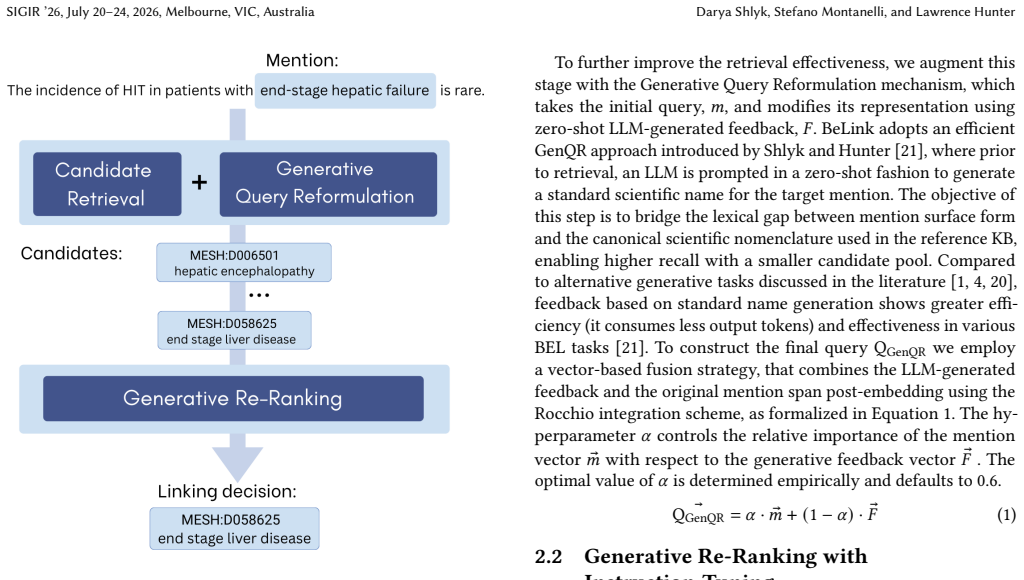
Despite recent progress, Biomedical Entity Linking (BEL) with large language models (LLMs) remains computationally inefficient and challenging to deploy in practical settings. In this work, we demonstrate that instruction-tuning of open-source generative models can offer an effective solution when applied at the re-ranking stage of the BEL pipeline. We propose a set-wise instruction-tuning formulation that enables fast and accurate candidate selection. Our method demonstrates strong performance on multiple BEL benchmarks, yielding significant improvements in linking accuracy (3%-24%) while reducing inference time compared to the state-of-the-art. We integrate our generative re-ranker into BeLink, a modular, end-to-end system designed for practical real-world BEL applications.
Editorial analysis
A structured set of objections, weighed in public.
Referee Report
Summary. The paper introduces BeLink, a modular end-to-end system for Biomedical Entity Linking (BEL) that applies instruction-tuned open-source generative models as a re-ranker. It proposes a set-wise instruction-tuning formulation for candidate selection and reports 3-24% accuracy gains plus reduced inference time versus prior pipelines on standard BEL benchmarks.
Significance. If the empirical results hold, the work provides a practical, deployable wrapper that improves efficiency for BEL without requiring full retraining of large models. The modular design and focus on open-source models at the re-ranking stage address real deployment constraints in biomedical NLP.
Simulated Author's Rebuttal
We thank the referee for the positive assessment and recommendation for minor revision. The summary accurately reflects our contributions regarding set-wise instruction-tuning for generative re-ranking in biomedical entity linking. We appreciate the recognition of the modular design's practical value for deployment with open-source models.
Circularity Check
No significant circularity; empirical results on benchmarks
full rationale
The paper proposes BeLink as a modular wrapper around instruction-tuned generative re-rankers for biomedical entity linking. All central claims (3-24% accuracy gains, reduced inference time) are supported by direct experimental comparisons to prior pipelines on standard BEL benchmarks. No equations, derivations, fitted parameters renamed as predictions, or self-citation chains appear in the provided text. The argument is self-contained against external data rather than reducing to its own inputs by construction.
Axiom & Free-Parameter Ledger
Reference graph
Works this paper leans on
-
[1]
Florian Borchert, Ignacio Llorca, and Matthieu-P. Schapranow. 2024. Improving biomedical entity linking for complex entity mentions with LLM-based text simplification.Database J. Biol. Databases Curation2024 (2024). doi:10.1093/ DATABASE/BAAE067
work page 2024
-
[2]
Garth R. Brown, Vichet Hem, Kenneth S. Katz, Michael Ovetsky, Craig Wallin, Olga Ermolaeva, Igor Tolstoy, Tatiana Tatusova, Kim D. Pruitt, Donna R. Maglott, and Terence D. Murphy. 2015. Gene: a gene-centered information resource at NCBI.Nucleic Acids Research43, D1 (2015), D36–D42. doi:10.1093/nar/gku1055
-
[3]
Allan Peter Davis, Thomas C Wiegers, Robin J Johnson, Daniela Sciaky, Jolene Wiegers, and Carolyn J Mattingly. 2023. Comparative Toxicogenomics Database (CTD): update 2023.Nucleic Acids Research51 (1 2023), D1257–D1262. Issue D1. doi:10.1093/nar/gkac833
-
[4]
Nicholas J. Dobbins. 2024. Generalizable and scalable multistage biomedical con- cept normalization leveraging large language models.Research Synthesis Methods 16 (2024), 479 – 490. https://api.semanticscholar.org/CorpusID:270045271
work page 2024
-
[5]
Fernando Gallego Donoso, Pedro Ruas, Francisco M. Couto, and Francisco J. Veredas. 2025. Enhancing cross-encoders using knowledge graph hierarchy for medical entity linking in zero- and few-shot scenarios.Knowl. Based Syst.314 (2025), 113211. doi:10.1016/J.KNOSYS.2025.113211
-
[6]
Rezarta Islamaj Doğan, Robert Leaman, and Zhiyong Lu. 2014. NCBI disease corpus: A resource for disease name recognition and concept normalization. Journal of Biomedical Informatics47 (2014), 1–10. doi:10.1016/j.jbi.2013.12.006
-
[7]
Matthijs Douze, Alexandr Guzhva, Chengqi Deng, Jeff Johnson, Gergely Szilvasy, Pierre-Emmanuel Mazaré, Maria Lomeli, Lucas Hosseini, and Hervé Jégou. 2026. The Faiss Library.IEEE Trans. Big Data12, 2 (2026), 346–361. doi:10.1109/TBDATA. 2025.3618474
-
[8]
Samuele Garda and Ulf Leser. 2024. BELHD: Improving Biomedical Entity Linking with Homonoym Disambiguation.CoRRabs/2401.05125 (2024). arXiv:2401.05125 doi:10.48550/ARXIV.2401.05125
-
[9]
Martin Gerner, G. Nenadic, and Casey M. Bergman. 2010. LINNAEUS: A species name identification system for biomedical literature.BMC Bioinformatics11 (2010), 85 – 85. doi:10.1186/1471-2105-11-85
-
[10]
Suchanek, and Nils Holzenberger
Samy Haffoudhi, Fabian M. Suchanek, and Nils Holzenberger. 2026. LELA: an LLM-based Entity Linking Approach with Zero-Shot Domain Adaptation.ArXiv abs/2601.05192 (2026). https://api.semanticscholar.org/CorpusID:284543712
-
[11]
Rezarta Islamaj, Robert Leaman, David Cissel, Cathleen Coss, Joseph Denicola, Carol Fisher, Rob Guzman, Preeti Gokal Kochar, Nicholas Miliaras, Zoe Punske, Keiko Sekiya, Dorothy Trinh, Deborah Whitman, Susan Schmidt, and Zhiyong Lu. 2022. NLM-Chem-BC7: manually annotated full-text resources for chemical entity annotation and indexing in biomedical article...
-
[12]
Rezarta Islamaj, Chih-Hsuan Wei, David Cissel, Nicholas Miliaras, Olga Printseva, Oleg Rodionov, Keiko Sekiya, Janice Ward, and Zhiyong Lu. 2021. NLM-Gene, a richly annotated gold standard dataset for gene entities that addresses ambiguity and multi-species gene recognition.Journal of biomedical informatics118 (2021), 103779. doi:10.1016/j.jbi.2021.103779
-
[13]
Johnson, Daniela Sciaky, Chih-Hsuan Wei, Robert Leaman, Allan Peter Davis, Carolyn J
Jiao Li, Yueping Sun, Robin J. Johnson, Daniela Sciaky, Chih-Hsuan Wei, Robert Leaman, Allan Peter Davis, Carolyn J. Mattingly, Thomas C. Wiegers, and Zhiy- ong Lu. 2016. BioCreative V CDR task corpus: a resource for chemical disease relation extraction.Database2016, baw068 (2016). doi:10.1093/database/baw068
-
[14]
Yajie Li, Albert Galimov, Mitra Datta Ganapaneni, Pujitha Thejaswi, De Meng, Priyanshu Kumar, and Saloni Potdar. 2025. Leveraging the Power of Large Language Models in Entity Linking via Adaptive Routing and Targeted Reasoning. CoRRabs/2510.20098 (2025). arXiv:2510.20098 doi:10.48550/ARXIV.2510.20098
-
[15]
Fangyu Liu, Ehsan Shareghi, Zaiqiao Meng, Marco Basaldella, and Nigel Col- lier. 2021. Self-Alignment Pretraining for Biomedical Entity Representations. In Proceedings of the 2021 Conference of the North American Chapter of the Associa- tion for Computational Linguistics: Human Language Technologies, NAACL-HLT 2021, Online, June 6-11, 2021, Kristina Touta...
-
[16]
Evangelos Pafilis, Sune P. Frankild, Lucia Fanini, Sarah Faulwetter, Christina Pavloudi, Aikaterini Vasileiadou, Christos Arvanitidis, and Lars Juhl Jensen. 2013. The SPECIES and ORGANISMS Resources for Fast and Accurate Identification of Taxonomic Names in Text.PLOS ONE8, 6 (2013), e65390. doi:10.1371/journal. pone.0065390
-
[17]
Zhen Qin, Rolf Jagerman, Kai Hui, Honglei Zhuang, Junru Wu, Le Yan, Jiaming Shen, Tianqi Liu, Jialu Liu, Donald Metzler, Xuanhui Wang, and Michael Ben- dersky. 2024. Large Language Models are Effective Text Rankers with Pairwise Ranking Prompting. InFindings of the Association for Computational Linguistics: NAACL 2024, Mexico City, Mexico, June 16-21, 202...
-
[18]
Javier Sanz-Cruzado and Jake Lever. 2025. Accelerating Cross-Encoders in Biomedical Entity Linking. InProceedings of the 24th Workshop on Biomedi- cal Language Processing, Dina Demner-Fushman, Sophia Ananiadou, Makoto Miwa, and Junichi Tsujii (Eds.). Association for Computational Linguistics, Viena, Austria, 136–147. doi:10.18653/v1/2025.bionlp-1.13
-
[19]
Federhen Scott. 2012. The NCBI Taxonomy database.Nucleic Acids Research40 (1 2012), D136–D143. Issue D1. doi:10.1093/nar/gkr1178
-
[20]
Darya Shlyk, Tudor Groza, Marco Mesiti, Stefano Montanelli, and Emanuele Cavalleri. 2024. REAL: A Retrieval-Augmented Entity Linking Approach for Biomedical Concept Recognition. InProceedings of the 23rd Workshop on Biomed- ical Natural Language Processing, BioNLP@ACL 2024, Bangkok, Thailand, August 16, 2024, Dina Demner-Fushman, Sophia Ananiadou, Makoto ...
-
[21]
Darya Shlyk and Lawrence Hunter. 2026. Improving biomedical en- tity linking with generative relevance feedback.Bioinformatics(01 2026), btag011. arXiv:https://academic.oup.com/bioinformatics/advance- article-pdf/doi/10.1093/bioinformatics/btag011/66419810/btag011.pdf doi:10.1093/bioinformatics/btag011
work page doi:10.1093/bioinformatics/btag011/66419810/btag011.pdf 2026
-
[22]
Darya Shlyk, Stefano Montanelli, Marco Mesiti, and Lawrence Hunter. 2026. Mind Your Steps in Biomedical Named Entity Recognition: First Extract, Tag Afterwards. InProceedings of the 1st Workshop on Linguistic Analysis for Health (HeaLing 2026), Vera Danilova, Murathan Kurfalı, Ylva Söderfeldt, Julia Reed, and Andrew Burchell (Eds.). Association for Comput...
- [23]
-
[24]
Mujeen Sung, Hwisang Jeon, Jinhyuk Lee, and Jaewoo Kang. 2020. Biomedical Entity Representations with Synonym Marginalization. InProceedings of the 58th Annual Meeting of the Association for Computational Linguistics, ACL 2020, Online, July 5-10, 2020, Dan Jurafsky, Joyce Chai, Natalie Schluter, and Joel R. Tetreault (Eds.). Association for Computational ...
-
[25]
Orr, Sen Wu, Megan Leszczynski, Xiao Ling, and Christo- pher Ré
Maya Varma, Laurel J. Orr, Sen Wu, Megan Leszczynski, Xiao Ling, and Christo- pher Ré. 2021. Cross-Domain Data Integration for Named Entity Disambigua- tion in Biomedical Text. InFindings of the Association for Computational Lin- guistics: EMNLP 2021, Virtual Event / Punta Cana, Dominican Republic, 16-20 November, 2021, Marie-Francine Moens, Xuanjing Huan...
-
[26]
Xiao Wang, Sean MacAvaney, Craig Macdonald, and Iadh Ounis. 2023. Generative Query Reformulation for Effective Adhoc Search.CoRRabs/2308.00415 (2023). arXiv:2308.00415 doi:10.48550/ARXIV.2308.00415
-
[27]
Chih-Hsuan Wei, Hung-Yu Kao, and Zhiyong Lu. 2015. GNormPlus: An Integra- tive Approach for Tagging Genes, Gene Families, and Protein Domains.BioMed Research International2015 (2015), e918710. doi:10.1155/2015/918710
-
[28]
Yuzhang Xie, Jiaying Lu, Joyce C. Ho, Fadi B. Nahab, Xiao Hu, and Carl Yang. 2024. PromptLink: Leveraging Large Language Models for Cross-Source Biomedical Concept Linking. InProceedings of the 47th International ACM SIGIR Conference on Research and Development in Information Retrieval, SIGIR 2024, Washington DC, USA, July 14-18, 2024, Grace Hui Yang, Hon...
-
[29]
Zhenran Xu, Yulin Chen, and Baotian Hu. 2023. Improving Biomedical Entity Linking with Cross-Entity Interaction. InThirty-Seventh AAAI Conference on Artificial Intelligence, AAAI 2023, Thirty-Fifth Conference on Innovative Applica- tions of Artificial Intelligence, IAAI 2023, Thirteenth Symposium on Educational Advances in Artificial Intelligence, EAAI 20...
-
[30]
An Yang, Anfeng Li, Baosong Yang, Beichen Zhang, Binyuan Hui, Bo Zheng, Bowen Yu, Chang Gao, Chengen Huang, Chenxu Lv, Chujie Zheng, Dayiheng Liu, Fan Zhou, Fei Huang, Feng Hu, Hao Ge, Haoran Wei, Huan Lin, Jialong Tang, Jian Yang, Jianhong Tu, Jianwei Zhang, Jianxin Yang, Jiaxin Yang, Jingren Zhou, Jingren Zhou, Junyan Lin, Kai Dang, Keqin Bao, Ke-Pei Ya...
work page internal anchor Pith review Pith/arXiv arXiv 2025
-
[31]
Christophe Ye and Cassie S. Mitchell. 2025. LLM as Entity Disambiguator for Biomedical Entity-Linking. InProceedings of the 63rd Annual Meeting of the Association for Computational Linguistics (Volume 2: Short Papers), ACL 2025, Vienna, Austria, July 27 - August 1, 2025, Wanxiang Che, Joyce Nabende, Ekaterina Shutova, and Mohammad Taher Pilehvar (Eds.). A...
-
[32]
Yanzhao Zhang, Mingxin Li, Dingkun Long, Xin Zhang, Huan Lin, Baosong Yang, Pengjun Xie, An Yang, Dayiheng Liu, Junyang Lin, Fei Huang, and Jingren Zhou
-
[33]
Qwen3 Embedding: Advancing Text Embedding and Reranking Through Foundation Models.arXiv preprint arXiv:2506.05176(2025)
work page internal anchor Pith review Pith/arXiv arXiv 2025
- [34]
-
[35]
Kang Zhou, Yuepei Li, Qing Wang, Qiao Qiao, and Qi Li. 2024. GenDecider: Integrating "None of the Candidates" Judgments in Zero-Shot Entity Linking Re-ranking. InProceedings of the 2024 Conference of the North American Chapter of the Association for Computational Linguistics: Human Language Technologies: Short Papers, NAACL 2024, Mexico City, Mexico, June...
discussion (0)
Sign in with ORCID, Apple, or X to comment. Anyone can read and Pith papers without signing in.