REVIEW 3 major objections 6 minor 1 cited by
Chaotic rotation and evolution of asteroids and small planets in high-eccentricity orbits around white dwarfs
T0 review · 3 major / 6 minor · reviewed 2026-08-14 · deepseek-v4-flash
Pith's one-line read Asteroids on highly eccentric orbits around white dwarfs can break themselves apart through chaotic spin-up before entering the Roche radius, the paper argues.
desk verdict A worthwhile mechanism proposal that deserves a referee, but the self-regulation that makes it work is supported by only a single chaotic run. read the letter →
The pith
A machine-rendered reading of the paper's core claim, the machinery that carries it, and where it could break.
The reading
What carries the argument
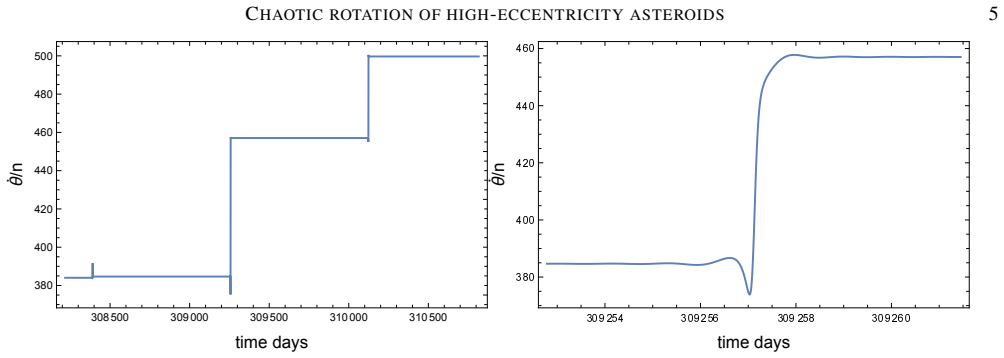
The load-bearing object is the one-dimensional spin-orbit equation $\ddot{\theta} + \frac{3}{2}n^2\sigma \frac{\sin(2\theta-2\nu)}{(1-e\cos E)^3}=0$, where $\sigma=(B-A)/C$ is the triaxiality parameter and $\nu$, $E$ are the true and eccentric anomalies. It is integrated over thousands of orbits at $e>0.95$ with adaptive step sizes that resolve periastron passages. The output is sampled apoastron to apoastron, and the sequence of spin rates and spin kicks is treated as a random process; ARMA(1,2) and GARCH(1,1) fits, together with kick-versus-spin maps, reveal the bounded asymmetric kick distribution that produces self-regulation.
What would settle it
A full three-dimensional integration with obliquity and tidal torques for a Proteus-like body on a 1.5 au, e=0.99 orbit around a 0.6 solar-mass white dwarf, run for 10,000 orbits; if the spin rate never reaches the critical fission value, the YORP-less fission claim is falsified.
Extended reading notes
Core claim
The paper's central claim is that highly eccentric, elongated asteroids around white dwarfs are driven into chaotic rotation by periastron impulses, and this chaotic rotation can reach centrifugal fission before the body enters the Roche radius. The spin kicks are random but measurably asymmetric: at low spin rates prograde impulses are larger, at high spin rates retrograde impulses are larger, so the spin rate is self-regulated and stays prograde and bounded. As a result, the secular orbital changes that would follow from symmetric kicks—semimajor-axis shrinkage and eccentricity growth—are reduced or nullified. The authors call this YORP-less rotational fission, meaning a spin-up that does not rely on radiation-driven effects, and argue it supplies debris to white dwarfs without rapidly depleting the small-body population.
Load-bearing premise
The calculations assume the asteroid's rotation is planar and one-dimensional, with zero tilt and no tidal forces; if real three-dimensional tumbling or tidal dissipation damps the chaotic spin-up, the fission mechanism, self-regulation, and predicted debris supply would not operate at the described rates.
Editorial extensions
If this is right
- Debris from rotational fission would populate a radial region extending beyond the white dwarf's Roche radius, not just material disrupted inside it.
- The orbital eccentricity needed for a minor planet to contribute to white dwarf pollution is slightly lower than previously thought, because fission sets in before tidal break-up.
- Because the spin process is self-regulated, the semimajor-axis shrinkage and eccentricity growth expected from symmetric impulses are reduced or nullified, allowing a steady stream of impactors without rapidly depleting the small-body population.
- The spin-rate evolution is weakly stationary and bounded from below in the prograde direction, so high-eccentricity asteroids can remain in a chaotic but stable rotational state for long times.
Reading between the lines
- A consequence the paper leaves open: the same mechanism could apply to super-Earth exoplanets on eccentric white-dwarf orbits, where the orbital feedback terms scale with mass and would be much larger.
- A testable distinction from tidal-only models is that polluted white dwarfs may show debris at radial distances beyond the Roche radius; searching for such material would test whether YORP-less fission operates.
- Because more prolate bodies produce larger and more asymmetric spin kicks, the mechanism predicts that triaxiality, not just orbit and size, controls which bodies break up; bodies with higher triaxiality should fission at lower eccentricity.
Signed reviews
Editorial analysis
A structured set of objections, weighed in public.
Referee Report
Summary. This paper studies the coupled spin-orbit evolution of triaxial asteroids on highly eccentric (e > 0.95) orbits around white dwarfs. The authors integrate a one-dimensional coplanar rigid-body equation, treat the periastron torques as impulsive, and derive energy and angular-momentum conservation equations (Eqs. 5-8) that link changes in rotation rate to changes in semimajor axis and eccentricity. They report that a 9000-orbit simulation shows chaotic, bounded prograde rotation with an asymmetric impulse distribution, leading to the claims that (i) chaotic spin-up can drive rotational fission outside the Roche radius at lower eccentricities than tidal disruption, and (ii) the asymmetric impulse distribution may be self-regulating, reducing or nullifying the secular orbital decay and providing a steady debris supply to polluted white dwarfs. The evidence for the central statistical claims is a single long realization plus Monte-Carlo impulse histograms at two fixed velocities; the authors explicitly concede that the stochastic fits are inadequate and that the long-term orbital effect is not verified.
Significance. If established, the proposed YORP-less rotational fission outside the Roche radius would be a genuinely new channel for producing debris around white dwarfs, with consequences for the radial distribution of debris and the eccentricity threshold for pollution. The analytic conservation-law derivations, Eqs. (5)-(8), are transparent, internally consistent, and free of fitted parameters, and the impulse approximation is well matched to the e > 0.95 regime. The Monte-Carlo impulse histograms are a useful first probe of the distribution of periastron spin updates. However, the paper's headline conclusions about self-regulation and a steady debris stream currently rest on a single chaotic trajectory, despite the authors' own statements in Sections 5 and 6 that the evidence is insufficient. As a first exploration the paper is valuable, but the statistical foundations and model-robustness checks needed to support the central claims are not yet present.
major comments (3)
- [§4, Fig. 4 (left); §5] The self-regulation claim and the resulting cancellation of orbital decay rest on the asymmetry of the impulse map inferred from a single 9000-orbit realization. Equation (6) shows that the secular change of the semimajor axis depends on E[2ω dω + dω^2]; a small conditional bias E[dω|ω] at high ω can change the sign of the drift, so the sign and magnitude of this bias are load-bearing. In a chaotic system with a short Lyapunov time, one trajectory cannot establish the invariant distribution or the stationarity of this bias. The authors themselves state in Section 5 that "our limited numerical experiments are not sufficient to verify this" and in Section 6 that they "are unable to obtain a likelihood of rotational fission." A revision should present an ensemble of long integrations with varied initial conditions, report the distribution of impulse maps, estimate E[dω|ω] with uncertainties, and propagate these statistics through Eqs. (6) and (8) to give the expected drift of a and e. Without this, the claims of "self-regulated" rotation and "reduced or nullified" orbital decay are unsupported.
- [§4, Eqs. (3)-(4)] The formal characterization of the rotation velocity as a random time process is not robust. The authors report that ARMA(1,2) fit parameters "vary between simulations," that the ARMA model does not "adequately represent" the velocity curve, and that the GARCH variance parameter is "perhaps of limited use" for the observed concave impulse distribution. These admissions mean the fitted stochastic models are descriptive summaries of single runs rather than validated models of the process. Please provide a quantitative goodness-of-fit assessment or an alternative state-dependent model of the conditional distribution of dω given ω, and test it on independent realizations, before claiming a formal random-process characterization.
- [§2, §6] The fission-outside-Roche mechanism is sensitive to the assumptions of coplanar, one-dimensional rotation and neglect of tidal dissipation. The paper states that the 1D model "is likely to slightly overestimate the associated acceleration," but no quantitative estimate of this overestimate is given, and Section 6 notes tidal dissipation in tumbling asteroids without a concrete assessment of its effect on the spin-up rate. If three-dimensional tumbling or tidal damping substantially reduces the chaotic spin-up, the mechanism may not operate at the claimed rates. Please include a sensitivity analysis (for example, a 3D tumbling model, a range of triaxiality and inertia values, or an order-of-magnitude tidal-damping bound) to show that the fission threshold is still reached under less idealized assumptions.
minor comments (6)
- [§5, Eq. (8)] In deriving Eq. (8), the term proportional to (1 − e^2) da/a from the angular-momentum variation is dropped without comment; for e > 0.95 this is a small correction, but the authors should state the condition under which this approximation is valid.
- [§5] There is a typo in the sentence "Our limited numerical experiments are nor sufficient to verify this"; it should read "are not sufficient."
- [Fig. 4 caption] The caption for Fig. 4 should specify the initial conditions and integration parameters for the 9000-orbit run (these currently appear only in the body text).
- [§4, Eq. (4)] For the GARCH(1,1) unconditional variance κ/(1 − α1 − β1) to be finite and the process weakly stationary, the condition should be stated as α1 + β1 < 1, not simply that α1 and β1 lie between 0 and 1.
- [§2] The phrase "for non-vanishing parameters of triaxiality σ" is unclear; it would read more clearly as "for nonzero triaxiality σ" or "for finite triaxiality σ."
- [References] The two "Handbook of Exoplanets" entries (Vanderburg & Rappaport 2018 and Zuckerman & Young 2018) lack chapter or article numbers; please check the journal's reference style.
Circularity Check
No significant circularity: the central spin-orbit coupling derivation is self-contained, and the stochastic models are descriptive fits, not predictive inputs.
full rationale
The paper's derivation chain is not circular. Equation (1) is a standard planar rigid-body rotation ODE from Danby (1962); its parameters are adopted physical constants rather than fitted to the target phenomena. The velocity impulses domega are obtained by direct numerical integration, and the orbital-update equations (5)-(8) follow from conservation of total energy and angular momentum; no term in these equations is defined in terms of the claimed outcome. The fitted ARMA(1,2) and GARCH(1,1) models in Section 4 are explicitly judged inadequate by the authors ('we do not find the fitted ARMA(1,2) process to adequately represent the simulated velocity curve') and are not used to generate the fission or self-regulation conclusions. The asymmetry and self-regulation claim is an empirical reading of the simulated return map (Fig. 4, left), not an input assumption or fitted target; the paper even cautions that its limited numerical experiments are not sufficient to verify the orbital effect and that the authors are 'unable to obtain a likelihood of rotational fission.' The only relevant self-citation (Makarov et al. 2018, for tidal dissipation scaling) is used as supporting physical input, not as a load-bearing uniqueness theorem, and that cited result does not contain the present paper's conclusions. The statistical robustness of the single-trajectory evidence is a correctness concern, not a circularity.
Assumptions & free parameters
free parameters (5)
- Semimajor axis a =
1.5 au
- Triaxiality sigma = (B-A)/C =
0.05
- Coefficient of inertia xi =
0.35
- Initial spin and orientation (theta(0), theta'(0)) =
Varied, e.g., theta'(0) = 800 n to 801 n
- Orbital eccentricity e =
0.99 for main runs
assumptions (4)
- standard math The planar spin-orbit ODE (Eq. 1), with torque proportional to sigma and inversely proportional to (1 - e cos E)^3, is the correct dynamical model for a triaxial body orbiting a point mass.
- domain assumption The impulse approximation: all significant spin-orbit interaction occurs during the periastron passage, so apoastron samples and delta-omega impulses sufficiently describe the process.
- domain assumption Tidal dissipation in the asteroid and star is negligible on the timescales considered (Eq. 5 conserves total mechanical energy).
- ad hoc to paper The asymmetric, finite-support distribution of velocity impulses inferred from one 9000-orbit integration is a stable, generic property of the chaotic system.
Cite this review
Pith. "Pith review of Chaotic rotation and evolution of asteroids and small planets in high-eccentricity orbits around white dwarfs." pith.science (2026). https://pith.science/paper/BSNWSHRT
@misc{pith2026190804612,
  author       = {Pith},
  title        = {Pith review of: Chaotic rotation and evolution of asteroids and small planets in high-eccentricity orbits around white dwarfs},
  year         = {2026},
  howpublished = {\url{https://pith.science/paper/BSNWSHRT}},
  note         = {Machine review of arXiv:1908.04612}
}
abstract
Observed planetary debris in white dwarf atmospheres predominately originate from the destruction of small bodies on highly eccentric ($>0.99$) orbits. Despite their importance, these minor planets have coupled physical and orbital evolution which has remained largely unexplored. Here, we present a novel approach for estimating the influence of fast chaotic rotation on the orbital evolution of high-eccentricity triaxial asteroids, and formally characterize the propagation of their angular rotation velocities and orbital elements as random time processes. By employing the impulse approximation, we demonstrate that the violent gravitational interactions during periastron passages transfer energy between the orbit and asteroid's rotation. If the distribution of spin impulses were symmetric around zero, then the net result would be a secular decrease of the semimajor axis and a further increase of the eccentricity. We find evidence, however, that the chaotic rotation may be self-regulated in such a manner that these effects are reduced or nullified. We discover that asteroids on highly eccentric orbits can break themselves apart --- in a type of YORP-less rotational fission --- without actually entering the Roche radius, with potentially significant consequences for the distribution of debris and energy requirements for gravitational scattering in metal-polluted white dwarf planetary systems. This mechanism provides a steady stream of material impacting a white dwarf without rapidly depleting the number of small bodies in the stellar system.
Figures


Forward citations
Cited by 1 Pith paper
-
A White Dwarf with Transiting Circumstellar Material Far Outside the Roche Limit
ZTF J0139+5245 is a white dwarf whose recurring 15-25 day, 20-45% deep transits every 107.2 days reveal circumstellar planetary debris orbiting far outside the Roche limit.
Reference graph
Works this paper leans on
-
[1]
C., & Bloch, A
Adams, F. C., & Bloch, A. M.\ 2013, ApJL, 777, L30
2013
-
[2]
C., & Siegelman, R.\ 1986, ApJ, 302, 462
Alcock, C., Fristrom, C. C., & Siegelman, R.\ 1986, ApJ, 302, 462
1986
-
[3]
V., & Rafikov, R
Bochkarev, K. V., & Rafikov, R. R.\ 2011, ApJ, 741, 36
2011
-
[4]
J., & Wyatt, M
Bonsor, A., Mustill, A. J., & Wyatt, M. C.\ 2011, MNRAS, 414, 930
2011
-
[5]
Bonsor, A., & Veras, D.\ 2015, MNRAS, 454, 53
2015
-
[6]
Bonsor, A., & Xu, S.\ 2017, Astrophysics and Space Science Library, 229
2017
-
[7]
C., Veras, D., & G \"a nsicke, B
Brown, J. C., Veras, D., & G \"a nsicke, B. T.\ 2017, MNRAS, 468, 1575
2017
- [8]
Show all 87 references
-
[9]
Danby, J.M.A. 1962. Fundamentals of Celestial Mechanics. MacMillan, New York
1962
-
[10]
H., Walsh, K
Debes, J. H., Walsh, K. J., & Stark, C.\ 2012, ApJ, 747, 148
2012
-
[11]
Dosopoulou, F., & Kalogera, V.\ 2016a, ApJ, 825, 70
-
[12]
Dosopoulou, F., & Kalogera, V.\ 2016b, ApJ, 825, 71
-
[13]
Efroimsky, M.\ 2012, ApJ, 746, 150
2012
-
[14]
Farihi, J.\ 2016, New Astronomy Reviews, 71, 9
2016
-
[15]
E., & Saha, P.\ 2005, AJ, 130, 295
Flynn, A. E., & Saha, P.\ 2005, AJ, 130, 295
2005
-
[16]
Frewen, S. F. N., & Hansen, B. M. S.\ 2014, MNRAS, 439, 2442
2014
-
[17]
Gallet, F., Bolmont, E., Mathis, S., Charbonnel, C., & Amard, L.\ 2017, A&A, 604, A112
2017
-
[18]
S., Farihi, J., et al.\ 2012, ApJ, 749, 154
Girven, J., Brinkworth, C. S., Farihi, J., et al.\ 2012, ApJ, 749, 154
2012
-
[19]
M., Benecchi, S
Grundy, W. M., Benecchi, S. D., Porter, S. B., Noll, K. S.\ 2014, Icarus, 237, 1
2014
-
[20]
D.\ 1963, Icarus, 2, 440
Hadjidemetriou, J. D.\ 1963, Icarus, 2, 440
1963
-
[21]
S., & Portegies Zwart, S
Hamers, A. S., & Portegies Zwart, S. F.\ 2016, MNRAS, 462, L84
2016
-
[22]
Harrison, J. H. D., Bonsor, A., & Madhusudhan, N.\ 2018, MNRAS, 479, 3814
2018
-
[23]
A., G \"a nsicke, B
Hollands, M. A., G \"a nsicke, B. T., & Koester, D.\ 2018, MNRAS, 477, 93
2018
-
[24]
D.\ 2014, Annual Review of Earth and Planetary Sciences, 42, 45
Jura, M., & Young, E. D.\ 2014, Annual Review of Earth and Planetary Sciences, 42, 45
2014
-
[25]
J., Bromley B
Kenyon S. J., Bromley B. C., 2017a, ApJ, 844, 116
-
[26]
J., Bromley B
Kenyon S. J., Bromley B. C., 2017b, ApJ, 850, 50
-
[27]
T., & Farihi, J.\ 2014, A&A, 566, A34
Koester, D., G \"a nsicke, B. T., & Farihi, J.\ 2014, A&A, 566, A34
2014
-
[28]
V., & Shevchenko, I
Kouprianov, V. V., & Shevchenko, I. I.\ 2005, Icarus, 176, 224
2005
-
[29]
Kunitomo, M., Ikoma, M., Sato, B., Katsuta, Y., & Ida, S.\ 2011, ApJ, 737, 66
2011
-
[30]
Livio, M., & Soker, N.\ 1984, MNRAS, 208, 763
1984
-
[31]
Madappatt, N., De Marco, O., & Villaver, E.\ 2016, MNRAS, 463, 104
2016
-
[32]
V., Berghea, C
Makarov, V. V., Berghea, C. T., Efroimsky, M. \ 2018, , 857, 142
2018
-
[33]
J., et al
Manser, C. J., et al. \ 2019, Science, 364, 66
2019
-
[34]
V., & Shevchenko, I
Melnikov, A. V., & Shevchenko, I. I.\ 2008, CMDA, 101, 31
2008
-
[35]
D., Rafikov, R
Metzger, B. D., Rafikov, R. R., & Bochkarev, K. V.\ 2012, MNRAS, 423, 505
2012
-
[36]
R.\ 2018, ApJ, 857, 135
Miranda, R., & Rafikov, R. R.\ 2018, ApJ, 857, 135
2018
-
[37]
J., & Villaver, E.\ 2012, ApJ, 761, 121
Mustill, A. J., & Villaver, E.\ 2012, ApJ, 761, 121
2012
-
[38]
J., Villaver, E., Veras, D., G \"a nsicke, B
Mustill, A. J., Villaver, E., Veras, D., G \"a nsicke, B. T., Bonsor, A. \ 2018, MNRAS, 476, 3939
2018
-
[39]
M.\ 1998, A&A, 335, L85
Nelemans, G., & Tauris, T. M.\ 1998, A&A, 335, L85
1998
-
[40]
S.\ 2013, MNRAS, 432, 500
Nordhaus, J., & Spiegel, D. S.\ 2013, MNRAS, 432, 500
2013
-
[41]
Omarov, T. B. 1962, Izv. Astrofiz. Inst. Acad. Nauk. KazSSR, 14, 66
1962
-
[42]
L., Thirouin, A., Campo Bagatin, A., et al.\ 2012, MNRAS, 419, 2315
Ortiz, J. L., Thirouin, A., Campo Bagatin, A., et al.\ 2012, MNRAS, 419, 2315
2012
-
[43]
Parriott, J., & Alcock, C.\ 1998, ApJ, 501, 357
1998
-
[44]
J., Veras, D., Holman, M
Payne, M. J., Veras, D., Holman, M. J., G\" a nsicke, B. T.\ 2016, MNRAS, 457, 217
2016
-
[45]
J., Veras, D., G \"a nsicke, B
Payne, M. J., Veras, D., G \"a nsicke, B. T., & Holman, M. J.\ 2017, MNRAS, 464, 2557
2017
-
[46]
J.\ 2017, ApJ, 834, 116
Petrovich, C., & Mu \ n oz, D. J.\ 2017, ApJ, 834, 116
2017
-
[47]
Polishook, D., Moskovitz, N., Thirouin, A., et al.\ 2017, Icarus, 297, 126
2017
-
[48]
W., Scheirich, P., et al.\ 2005, Icarus, 173, 108
Pravec, P., Harris, A. W., Scheirich, P., et al.\ 2005, Icarus, 173, 108
2005
-
[49]
R.\ 2011a, MNRAS, 416, L55
Rafikov, R. R.\ 2011a, MNRAS, 416, L55
-
[50]
R.\ 2011b, ApJL, 732, L3
Rafikov, R. R.\ 2011b, ApJL, 732, L3
-
[51]
R., & Garmilla, J
Rafikov, R. R., & Garmilla, J. A.\ 2012, ApJ, 760, 123
2012
-
[52]
Rao S., et al., 2018, A&A, 618, A18
2018
-
[53]
L., Martin, R
Smallwood, J. L., Martin, R. G., Livio, M., & Lubow, S. H.\ 2018, MNRAS, 480, 57
2018
-
[54]
Soker, N.\ 1998, AJ, 116, 1308
1998
-
[55]
S., & Madhusudhan, N.\ 2012, ApJ, 756, 132
Spiegel, D. S., & Madhusudhan, N.\ 2012, ApJ, 756, 132
2012
-
[56]
E., De Marco, O., Wood, P., Galaviz, P., & Passy, J.-C.\ 2016, MNRAS, 458, 832
Staff, J. E., De Marco, O., Wood, P., Galaviz, P., & Passy, J.-C.\ 2016, MNRAS, 458, 832
2016
-
[57]
P., Naoz, S., & Zuckerman, B.\ 2017, ApJL, 844, L16
Stephan, A. P., Naoz, S., & Zuckerman, B.\ 2017, ApJL, 844, L16
2017
-
[58]
P., Naoz, S., & Gaudi, B
Stephan, A. P., Naoz, S., & Gaudi, B. S.\ 2018, AJ, 156, 128
2018
-
[59]
D., & Loeb, A.\ 2015, MNRAS, 448, 188
Stone, N., Metzger, B. D., & Loeb, A.\ 2015, MNRAS, 448, 188
2015
- [60]
-
[61]
& Rasio, F
Valsecchi, F. & Rasio, F. A.\ 2014, ApJ, 786, 102
2014
-
[62]
A., Rappaport, S., et al.\ 2015, Nature, 526, 546
Vanderburg, A., Johnson, J. A., Rappaport, S., et al.\ 2015, Nature, 526, 546
2015
-
[63]
A.\ 2018, Handbook of Exoplanets, 37
Vanderburg, A., & Rappaport, S. A.\ 2018, Handbook of Exoplanets, 37
2018
-
[64]
C., Mustill, A
Veras, D., Wyatt, M. C., Mustill, A. J., Bonsor, A., & Eldridge, J. J.\ 2011, MNRAS, 417, 2104
2011
-
[65]
D., & Tout, C
Veras, D., Hadjidemetriou, J. D., & Tout, C. A.\ 2013a, MNRAS, 435, 2416
-
[66]
A., G\" a nsicke, B
Veras, D., Jacobson, S. A., G\" a nsicke, B. T.\ 2014a, MNRAS, 445, 2794
-
[67]
T.\ 2014b, MNRAS, 445, 4175
Veras, D., Shannon, A., G\" a nsicke, B. T.\ 2014b, MNRAS, 445, 4175
-
[68]
M., Bonsor, A., G\" a nsicke, B
Veras, D., Leinhardt, Z. M., Bonsor, A., G\" a nsicke, B. T.\ 2014c, MNRAS, 445, 2244
-
[69]
T.\ 2015a, MNRAS, 451, 2814
Veras, D., Eggl, S., G \"a nsicke, B. T.\ 2015a, MNRAS, 451, 2814
-
[70]
M., Eggl, S., G \"a nsicke, B
Veras, D., Leinhardt, Z. M., Eggl, S., G \"a nsicke, B. T.\ 2015b, MNRAS, 451, 3453
-
[71]
Veras, D.\ 2016, Royal Society Open Science, 3, 150571
2016
-
[72]
J., G \"a nsicke, B
Veras, D., Mustill, A. J., G \"a nsicke, B. T., et al.\ 2016, MNRAS, 458, 394
2016
-
[73]
\ 2019a, MNRAS, 485, 708
Veras, D., Higuchi, A., Ida, S. \ 2019a, MNRAS, 485, 708
-
[74]
Veras, D. et al. \ 2019b, MNRAS, In Press
-
[75]
Villaver, E., & Livio, M.\ 2007, ApJ, 661, 1192
2007
-
[76]
Villaver, E., & Livio, M.\ 2009, ApJL, 705, L81
2009
-
[77]
J., & Siess, L.\ 2014, ApJ, 794, 3
Villaver, E., Livio, M., Mustill, A. J., & Siess, L.\ 2014, ApJ, 794, 3
2014
-
[78]
F., Chesley, S
Vokrouhlick \'y , D., Bottke, W. F., Chesley, S. R., et al.\ 2015, Asteroids IV, 509
2015
-
[79]
J., Michel, P., Richardson, D
Walsh, K. J., Michel, P., Richardson, D. C.\ 2008, Nature, 454, 188
2008
-
[80]
D., Harris, A
Warner, B. D., Harris, A. W., Pravec, P.\ 2009, Icarus, 202, 134
2009
-
[81]
T., Farihi, J., Tout, C
Wickramasinghe, D. T., Farihi, J., Tout, C. A., Ferrario, L., & Stancliffe, R. J.\ 2010, MNRAS, 404, 1984
2010
-
[82]
J., Mignard, F.\ 1984, Icarus, 58, 137
Wisdom, J., Peale, S. J., Mignard, F.\ 1984, Icarus, 58, 137
1984
-
[83]
Wisdom, J.\ 1987, , 94, 1350
1987
-
[84]
C., Farihi, J., Pringle, J
Wyatt, M. C., Farihi, J., Pringle, J. E., & Bonsor, A.\ 2014, MNRAS, 439, 3371
2014
-
[85]
D.\ 2018, Handbook of Exoplanets, 14
Zuckerman, B., & Young, E. D.\ 2018, Handbook of Exoplanets, 14
2018
-
[86]
N., H\" u nsch, M.\ 2003, ApJ, 596, 477
Zuckerman, B., Koester, D., Reid, I. N., H\" u nsch, M.\ 2003, ApJ, 596, 477
2003
-
[87]
Zuckerman, B., Melis, C., Klein, B., Koester, D., & Jura, M.\ 2010, ApJ, 722, 725
2010
Reviewed August 14, 2026 · model on record in the stance chip above.
Discussion (0). Continue with ORCID to comment.