REVIEW 101 references
MRI turbulence in neutron stars mixes on a scale ten times smaller than subgrid models assume, so dimensional closures only work qualitatively.
Reviewed by Pith at T0; open to challenge. T0 means a machine referee read the full paper against a public rubric. the ladder, T0–T4 →
T0 review · grok-4.5
2026-07-31 14:24 UTC pith:BSZZEKE6
load-bearing objection Useful coefficient measurements that challenge common GRLES closures, with the main caveat the authors already flag: the headline ratio may still be resolution-limited.
Transport Properties of the MRI in Differentially Rotating Neutron Stars
The pith
A machine-rendered reading of the paper's core claim, the machinery that carries it, and where it could break.
Core claim
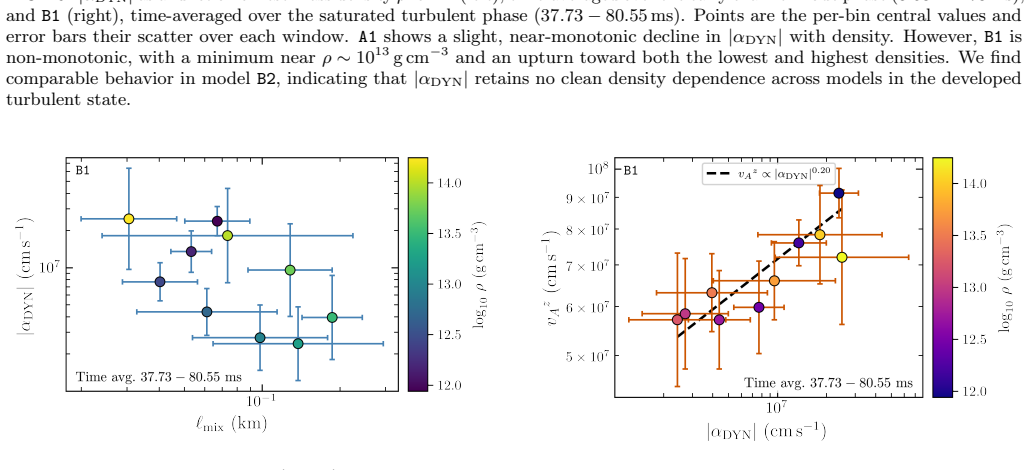
At saturation, the effective mixing length of MRI-driven turbulence in differentially rotating neutron stars is largely independent of density and satisfies ℓ_mix ≈ (10^{-2}–10^{-1}) λ_MRI—roughly an order of magnitude below the common subgrid assumption ℓ_mix ∼ λ_MRI—while α_DYN correlates only shallowly with v_A; both coefficients are highly intermittent, so dimensional-analysis transport coefficients reproduce MRI effects only qualitatively and fully resolved GRMHD is required for quantitative predictions.
What carries the argument
Direct extraction of residual Maxwell stress and turbulent electromotive force from azimuthally averaged, fully resolved GRMHD snapshots, closed as a Smagorinsky-type eddy viscosity ν_T = ℓ_mix c_s and a mean-field α-dynamo coefficient; the measured ratio ℓ_mix/λ_MRI is the central diagnostic.
Load-bearing premise
That the measured saturated ratio of mixing length to MRI wavelength is a physical property of the turbulence rather than an artifact of the grid, even though the saturated MRI wavelength itself is only a few cells across.
What would settle it
A higher-resolution suite of the same models in which the quality factor is substantially increased and the saturated value of ℓ_mix/λ_MRI is shown either to stay near 0.01–0.1 or to rise toward unity.
If this is right
- Subgrid models that set ℓ_mix ∼ λ_MRI systematically overestimate turbulent angular-momentum transport in neutron-star interiors.
- Density-dependent mixing-length prescriptions used in many GR large-eddy simulations are not supported by the measured turbulence.
- Collapse time, large-scale field growth, and outflow launching in merger remnants cannot be predicted quantitatively from dimensional closures alone.
- The same order-of-magnitude offset and intermittency appear in both collapsing and long-lived models once MRI turbulence is established.
Where Pith is reading between the lines
- If the ratio remains small at higher resolution, calibrated LES for BNS remnants will need a reduced transport length rather than a simple rescaling of existing closures.
- The absence of a clean density trend for ℓ_mix suggests that merger-remnant LES should treat the mixing length as a global fraction of the local driving scale, not a local function of ρ.
- Intermittency of α_DYN implies that mean-field dynamo terms in long-term remnant evolutions may need stochastic or spatially fluctuating amplitudes.
Editorial analysis
A structured set of objections, weighed in public.
Circularity Check
No circularity: transport coefficients are measured from resolved stresses/EMFs and compared to external dimensional-analysis benchmarks that the data then violate.
full rationale
The paper’s load-bearing results are direct extractions of α_vis, ν_T/ℓ_mix, and α_DYN from azimuthally averaged Maxwell stress and fluctuation EMF in fully evolved GRMHD runs (Eqs. 23, 25, 27), not quantities forced by a closure that is then re-read as a prediction. Dimensional-analysis expectations (ℓ_mix ∼ λ_MRI, α_DYN ∼ v_A) and the ℓ_mix(ρ) GRLES ansatz appear only as external comparison targets; the saturated data are reported to deviate from those targets by roughly an order of magnitude and to be density-independent for ℓ_mix. Citations to the group’s prior GRLES framework define what is being tested, not the measured values. Power-law fits (α_vis(ρ), v_Az(|α_DYN|)) are descriptive summaries of the same measurements, not fitted inputs recycled as predictions. Resolution and transferability concerns about ℓ_mix/λ_MRI are real scientific caveats but are not circularity. No self-definitional loop, uniqueness import, or ansatz-smuggling reduces the central claims to their inputs.
Axiom & Free-Parameter Ledger
free parameters (4)
- Initial vector-potential amplitude Ain and pressure cutoff Pcut =
Model-dependent (e.g. Ain=4.57–28.98 in code units)
- Differential-rotation length  = A/ϖ_e = 1 =
1
- Saturated-phase time windows for averaging =
Model-dependent intervals marked in Figs. 6 and 14
- Density-bin edges [ρ_glob_min, ρ_glob_max] =
10 bins; ρ_min=1e-6, ρ_max=0.75 ρ_max,0
axioms (7)
- domain assumption Ideal GRMHD (perfect conductivity, no neutrinos, no resistivity) on a dynamical spacetime evolved with Z4c + constrained transport.
- domain assumption Γ=2 polytropic initial data and Γ-law evolution adequately represent the thermodynamics for transport-coefficient extraction.
- domain assumption j-constant rotation law is a sufficient proxy for post-merger differential rotation when measuring MRI transport.
- domain assumption Azimuthal averages commute with covariant derivatives because non-axisymmetric metric structure is subdominant (axisymmetric background).
- domain assumption Turbulent Maxwell stress dominates Reynolds stress; residual stress may be closed with a relativistic eddy-viscosity (Smagorinsky-type) model using vturb=cs.
- domain assumption λ_MRI = 2π v_Az/|Ω| with Newtonian weak-field v_Az is an adequate order-of-magnitude proxy for the driving scale when forming ℓ_mix/λ_MRI.
- standard math Standard 3+1 GRMHD conservation laws, Maxwell equations, and Reynolds/Favre decompositions.
read the original abstract
We perform three-dimensional, high-resolution, general-relativistic magnetohydrodynamics (GRMHD) simulations of the magnetorotational instability (MRI) in differentially rotating neutron stars. We consider both high-mass models which collapse either promptly, or due to the outward transport of angular momentum removing rotational support, and lower-mass models, which remain stable even after solid-body rotation has been achieved. We measure effective transport coefficients of the resulting turbulent flow, shear-viscosity $\alpha_{\rm vis}$, mixing-length $\ell_{\rm mix}$, and mean-field dynamo $\alpha_{\rm DYN}$-parameter, and their correlations with mean-flow parameters, such as rest-mass density $\rho$, characteristic wavelength of the MRI $\lambda_{\rm MRI}$, and vertical Alfv\'en velocity $v_A$. At saturation, $\ell_{\rm mix}$ and $\alpha_{\rm DYN}$ correlate with $\lambda_{\rm MRI}$ and $v_A$ respectively, as expected from dimensional analysis. However, both quantities show deviations of roughly an order of magnitude from the values predicted on the basis of these correlations. They are also highly intermittent in space and time. The mixing length is found to be largely independent of density, calling into question the $\ell_{\rm mix}(\rho)$ ansatz used in many general-relativistic large-eddy simulations. Our results show that, while the effects of MRI-induced turbulence might be qualitatively reproduced by simulations that employ transport coefficients chosen using dimensional-analysis considerations, fully-resolved GRMHD simulations are needed to make quantitative predictions.
Figures




Reference graph
Works this paper leans on
-
[1]
This ties the turbulent transport directly to the viscous-disc framework, in whichα vis is the single free parameter [19, 52, 68]
Shakura-Sunyaev normalizationα vis Normalizing the mean mixed Maxwell stress by the pressure gives the relativistic analogue of the classical accretion-disc parameter [50], αvis = −b ϖbϕ vol P vol ,(23) where both averages are volume-weighted. This ties the turbulent transport directly to the viscous-disc framework, in whichα vis is the single free parame...
-
[2]
Let Di be the covariant derivative ofγij, with connection Γkij = 1 2 γkl(∂iγjl + ∂jγil −∂ lγij)
Turbulent viscosityν T and mixing lengthℓmix We close the trace-free residual stress with the rela- tivistic eddy-viscosity (Smagorinsky-type) model [53, 87]. Let Di be the covariant derivative ofγij, with connection Γkij = 1 2 γkl(∂iγjl + ∂jγil −∂ lγij). The trace-free rate of strain of the mean Eulerian velocity is Σij = 1 2 (Divj +D jvi)− 1 3 Dkvk γij....
-
[3]
j-constant
Mean-field dynamo coefficientα DYN We keep only the leadingα-term in Eq.(20) and project onto the mean field. This gives the least-squares estimate αDYN = ⟨Ei⟩vol ⟨Bi⟩vol ⟨Bi⟩vol ⟨Bi⟩vol .(27) On the grid, we build the covariant turbulent EMF from the Eulerian velocityvi = V i/W (Eq. (2)) and the fluc- tuations δQ = Q− ⟨Q⟩vol. It is Ei = ϵijk δv jδB k, wi...
-
[4]
B. P. Abbottet al.(LIGO Scientific Collaboration and Virgo Collaboration), GW170817: Observation of gravi- tational waves from a binary neutron star inspiral, Phys. Rev. Lett.119, 161101 (2017), arXiv:1710.05832 [gr-qc]
Pith/arXiv arXiv 2017
-
[5]
B. P. Abbottet al.(LIGO Scientific Collaboration and Virgo Collaboration and Fermi GBM and INTEGRAL), Gravitational waves and gamma-rays from a binary neu- tron star merger: GW170817 and GRB 170817A, Astro- 19 FIG. 14. Time evolution of the four transport coefficients (αvis, λMRI, ℓmix/λMRI, and |αDYN|/vz A rows) for A1, B2, and A2 (columns), with curves ...
Pith/arXiv arXiv 2017
-
[6]
D. Kasen, B. Metzger, J. Barnes, E. Quataert, and E. Ramírez-Ruiz, Origin of the heavy elements in binary neutron-star mergers from a gravitational-wave event, Nature551, 80 (2017), arXiv:1710.05463 [astro-ph.HE]
Pith/arXiv arXiv 2017
-
[7]
B. D. Metzger, Kilonovae, Living Rev. Relativ.23, 1 (2020), arXiv:1910.01617 [astro-ph.HE]
Pith/arXiv arXiv 2020
-
[8]
M. Shibata and K. Ury¯ u, Simulation of merging binary neutron stars in full general relativity:Γ = 2case, Phys. Rev. D61, 064001 (2000), arXiv:gr-qc/9911058
Pith/arXiv arXiv 2000
-
[9]
T. W. Baumgarte, S. L. Shapiro, and M. Shibata, On the maximum mass of differentially rotating neutron stars, Astrophys. J. Lett.528, L29 (2000), arXiv:astro- ph/9910565
arXiv 2000
-
[10]
H.-T. Janka, K. Langanke, A. Marek, G. Martínez-Pinedo, and B. Müller, Theory of core-collapse supernovae, Phys. Rep.442, 38 (2007), arXiv:astro-ph/0612072
Pith/arXiv arXiv 2007
-
[11]
Rembiasz, J
T. Rembiasz, J. Guilet, M. Obergaulinger, P. Cerdá- Durán, M. Aloy, and E. Müller, On the maximum mag- netic field amplification by the magnetorotational insta- bility in core-collapse supernovae, Monthly Notices of the Royal Astronomical Society460, 3316 (2016)
2016
-
[12]
M.D.Duez, Y.T.Liu, S.L.Shapiro, M.Shibata,andB.C. 20 FIG. 15. αvis vs ρ plot similar to Fig. 8, forA2 (left) and B2 (right). B2 (15.27 − 32.07 ms) reproduces the same monotonic density dependence, αvis ∝ρ −0.41, supporting the generality of the trend across models. However,A2 (0.23 − 0.30 ms) collapses before MRI-driven turbulence develops and never estab...
Pith/arXiv arXiv 2006
-
[13]
K. Kiuchi, P. Cerdá-Durán, K. Kyutoku, Y. Sekiguchi, and M. Shibata, Efficient magnetic-field amplification due to the Kelvin–Helmholtz instability in binary neu- tron star mergers, Phys. Rev. D92, 124034 (2015), arXiv:1509.09205 [astro-ph.HE]
Pith/arXiv arXiv 2015
-
[14]
K. Kiuchi, K. Kyutoku, Y. Sekiguchi, and M. Shibata, Global simulations of strongly magnetized remnant mas- sive neutron stars formed in binary neutron star mergers, Phys. Rev. D97, 124039 (2018), arXiv:1710.01311 [astro- ph.HE]
Pith/arXiv arXiv 2018
-
[15]
K. Kiuchi, A. Reboul-Salze, M. Shibata, and Y. Sekiguchi, A large-scale magnetic field produced by a solar-like dy- namo in binary neutron star mergers, Nat. Astron.8, 298 (2024), arXiv:2306.15721 [astro-ph.HE]
Pith/arXiv arXiv 2024
-
[16]
K. Kiuchi, A. Reboul-Salze, Y. Sekiguchi, and M. Shibata, A magnetar formation in binary neutron star merger (2026), arXiv:2606.11299 [astro-ph.HE]
Pith/arXiv arXiv 2026
-
[17]
E. R. Most and E. Quataert, Flares, jets, and quasiperi- odic outbursts from neutron star merger remnants, Astro- phys. J. Lett.947, L15 (2023), arXiv:2303.08062 [astro- ph.HE]
Pith/arXiv arXiv 2023
-
[18]
Combi and D
L. Combi and D. M. Siegel, Jets from neutron-star merger remnants and massive blue kilonovae, Phys. Rev. Lett. 131, 231402 (2023)
2023
-
[19]
C. Musolino, L. Rezzolla, and E. R. Most, On the impact of neutrinos on the launching of relativistic jets from “magnetars” produced in neutron star mergers, Astrophys. J. Lett.984, L61 (2025), arXiv:2410.06253 [astro-ph.HE]
Pith/arXiv arXiv 2025
-
[20]
S. A. Balbus and J. F. Hawley, A powerful local shear 21 instability in weakly magnetized disks. i. linear analysis, Astrophys. J.376, 214 (1991)
1991
-
[21]
S. A. Balbus and J. F. Hawley, Instability, turbulence, and enhanced transport in accretion disks, Rev. Mod. Phys.70, 1 (1998)
1998
-
[22]
S. A. Balbus, Enhanced angular momentum transport in accretion disks, Annu. Rev. Astron. Astrophys.41, 555 (2003), arXiv:astro-ph/0306208
Pith/arXiv arXiv 2003
-
[23]
S. Akiyama, J. C. Wheeler, D. L. Meier, and I. Lichten- stadt, The magnetorotational instability in core-collapse supernova explosions, Astrophys. J.584, 954 (2003), arXiv:astro-ph/0208128
Pith/arXiv arXiv 2003
-
[24]
M. Obergaulinger, P. Cerdá-Durán, E. Müller, and M. A. Aloy, Semi-global simulations of the magneto-rotational instability in core collapse supernovae, Astron. Astrophys. 498, 241 (2009), arXiv:0811.1652 [astro-ph]
Pith/arXiv arXiv 2009
-
[25]
Mösta, C
P. Mösta, C. D. Ott, D. Radice, L. F. Roberts, E. Schnet- ter, and R. Haas, A large-scale dynamo and magneto- turbulence in rapidly rotating core-collapse supernovae, Nature528, 376 (2015)
2015
-
[26]
A. Reboul-Salze, J. Guilet, R. Raynaud, and M. Bugli, A global model of the magnetorotational instability in protoneutron stars, Astron. Astrophys.645, A109 (2021), arXiv:2005.03567 [astro-ph.HE]
Pith/arXiv arXiv 2021
-
[27]
R. Raynaud, J. Guilet, H.-T. Janka, and T. Gastine, Mag- netar formation through a convective dynamo in protoneu- tron stars, Sci. Adv.6, eaay2732 (2020), arXiv:2003.06662 [astro-ph.HE]
Pith/arXiv arXiv 2020
-
[28]
T. A. Thompson, E. Quataert, and A. Burrows, Viscosity and rotation in core-collapse supernovae, Astrophys. J. 620, 861 (2005), arXiv:astro-ph/0403224
Pith/arXiv arXiv 2005
-
[29]
A. Burrows, L. Dessart, E. Livne, C. D. Ott, and J. Mur- phy, Simulations of magnetically driven supernova and hypernova explosions in the context of rapid rotation, Astrophys. J.664, 416 (2007), arXiv:astro-ph/0702539
Pith/arXiv arXiv 2007
-
[30]
M. A. Aloy and M. Obergaulinger, Relativistic outflows in gamma-ray bursts, inRevista Mexicana de Astronomía y Astrofísica Serie de Conferencias, Vol. 30 (2007) pp. 96–103
2007
-
[31]
M. Bugli, J. Guilet, M. Obergaulinger, P. Cerdá-Durán, and M. A. Aloy, The impact of non-dipolar magnetic fields in core-collapse supernovae, Mon. Not. R. Astron. Soc. 492, 58 (2020), arXiv:1909.02824 [astro-ph.HE]
Pith/arXiv arXiv 2020
-
[32]
Bugli, J
M. Bugli, J. Guilet, and M. Obergaulinger, Three- dimensional core-collapse supernovae with complex mag- netic structures - I. explosion dynamics, Mon. Not. R. Astron. Soc.507, 443 (2021)
2021
-
[33]
M. A. Aloy and M. Obergaulinger, Magnetorotational core collapse of possible gamma-ray burst progenitors - II. formation of protomagnetars and collapsars, Mon. Not. R. Astron. Soc.500, 4365 (2021)
2021
-
[34]
Powell, B
J. Powell, B. Müller, D. R. Aguilera-Dena, and A. Heger, Three dimensional magnetorotational core-collapse super- nova explosions of a 39 solar mass progenitor star, Mon. Not. R. Astron. Soc.522, 6070 (2023)
2023
-
[35]
B. Giacomazzo, L. Rezzolla, and N. Stergioulas, Collapse of differentially rotating neutron stars and cosmic censor- ship, Phys. Rev. D84, 024022 (2011), arXiv:1105.0122 [gr-qc]
Pith/arXiv arXiv 2011
-
[36]
C. Palenzuela, R. Aguilera-Miret, F. Carrasco, R. Ciolfi, J. V. Kalinani, W. Kastaun, B. Miñano, and D. Viganò, Turbulent magnetic field amplification in binary neu- tron star mergers, Phys. Rev. D106, 023013 (2022), arXiv:2112.08413 [gr-qc]
Pith/arXiv arXiv 2022
-
[37]
R. Aguilera-Miret, C. Palenzuela, F. Carrasco, and D. Vi- ganò, Role of turbulence and winding in the development of large-scale, strong magnetic fields in long-lived rem- nants of binary neutron star mergers, Phys. Rev. D108, 103001 (2023), arXiv:2307.04837 [astro-ph.HE]
Pith/arXiv arXiv 2023
-
[38]
R. Aguilera-Miret, J.-E. Christian, S. Rosswog, and C. Palenzuela, Robustness of magnetic field amplifica- tion in neutron star mergers, Mon. Not. R. Astron. Soc. 542, 3067 (2025), arXiv:2504.10604 [astro-ph.HE]
arXiv 2025
-
[39]
E. M. Gutiérrez, D. Radice, J. Fields, and J. M. Stone, Turbulent dynamo action in binary neutron star mergers (2026), arXiv:2601.20953 [astro-ph.HE]
arXiv 2026
-
[40]
L. Baiotti, B. Giacomazzo, and L. Rezzolla, Accurate evolutions of inspiralling neutron-star binaries: Prompt and delayed collapse to a black hole, Phys. Rev. D78, 084033 (2008), arXiv:0804.0594 [gr-qc]
Pith/arXiv arXiv 2008
-
[41]
Shibata, S
M. Shibata, S. Fujibayashi, and Y. Sekiguchi, Long-term evolution of a merger-remnant neutron star in general relativistic magnetohydrodynamics: Effect of magnetic winding, Phys. Rev. D103, 043022 (2021)
2021
-
[42]
D. M. Siegel, R. Ciolfi, A. I. Harte, and L. Rezzolla, Magnetorotational instability in relativistic hypermas- sive neutron stars, Phys. Rev. D87, 121302 (2013), arXiv:1302.4368 [gr-qc]
Pith/arXiv arXiv 2013
-
[43]
K. Kiuchi, S. Fujibayashi, K. Hayashi, K. Kyutoku, Y. Sekiguchi, and M. Shibata, Self-consistent picture of the mass ejection from a one second long binary neutron star merger leaving a short-lived remnant in a general-relativistic neutrino-radiation magnetohydrody- namic simulation, Phys. Rev. Lett.131, 011401 (2023), arXiv:2211.07637 [astro-ph.HE]
Pith/arXiv arXiv 2023
-
[44]
Eichler, M
D. Eichler, M. Livio, T. Piran, and D. N. Schramm, Nucleosynthesis, neutrino bursts and gamma-rays from coalescing neutron stars, Nature340, 126 (1989)
1989
-
[45]
Narayan, B
R. Narayan, B. Paczyński, and T. Piran, Gamma-ray bursts as the death throes of massive binary stars, Astro- phys. J. Lett.395, L83 (1992)
1992
-
[46]
Piran, The physics of gamma-ray bursts, Rev
T. Piran, The physics of gamma-ray bursts, Rev. Mod. Phys.76, 1143 (2004), arXiv:astro-ph/0405503
Pith/arXiv arXiv 2004
-
[47]
P. Kumar and B. Zhang, The physics of gamma-ray bursts and relativistic jets, Phys. Rep.561, 1 (2015), arXiv:1410.0679 [astro-ph.HE]
Pith/arXiv arXiv 2015
-
[48]
L. Sun, M. Ruiz, S. L. Shapiro, and A. Tsokaros, Jet launching from binary neutron star mergers: Incorporat- ing neutrino transport and magnetic fields, Phys. Rev. D 105, 104028 (2022), arXiv:2202.12901 [astro-ph.HE]
Pith/arXiv arXiv 2022
-
[49]
Gottliebet al., Large-scale evolution of seconds-long relativistic jets from black hole-neutron star mergers, As- trophys
O. Gottliebet al., Large-scale evolution of seconds-long relativistic jets from black hole-neutron star mergers, As- trophys. J. Lett.954, L21 (2023)
2023
-
[50]
J. Bamber, A. Tsokaros, M. Ruiz, and S. L. Shapiro, Jetlike structures in low-mass binary neutron star merger remnants, Phys. Rev. D110, 024046 (2024), arXiv:2405.03705 [astro-ph.HE]
Pith/arXiv arXiv 2024
-
[51]
Radice, General-relativistic large-eddy simulations of binary neutron star mergers, Astrophys
D. Radice, General-relativistic large-eddy simulations of binary neutron star mergers, Astrophys. J. Lett.838, L2 (2017), arXiv:1703.02046 [astro-ph.HE]
Pith/arXiv arXiv 2017
-
[52]
F. Carrasco, D. Viganò, and C. Palenzuela, Gradi- ent subgrid-scale model for relativistic MHD large- eddy simulations, Phys. Rev. D101, 063003 (2020), arXiv:1908.01419 [physics.comp-ph]
Pith/arXiv arXiv 2020
-
[53]
N. I. Shakura and R. A. Sunyaev, Black holes in binary systems. observational appearance, Astron. Astrophys. 24, 337 (1973)
1973
-
[54]
M. E. Pessah, C.-K. Chan, and D. Psaltis, The funda- 22 mental difference between shearα-viscosity and turbulent magnetorotational stresses, Mon. Not. R. Astron. Soc. 383, 683 (2008), arXiv:astro-ph/0612404
Pith/arXiv arXiv 2008
-
[55]
R. F. Penna, A. Sądowski, A. K. Kulkarni, and R. Narayan, The Shakura–Sunyaev viscosity prescription with variable α(r), Mon. Not. R. Astron. Soc.428, 2255 (2013), arXiv:1211.0526 [astro-ph.HE]
Pith/arXiv arXiv 2013
-
[56]
D. Radice, Binary neutron star merger simulations with a calibrated turbulence model, Symmetry12, 1249 (2020), arXiv:2005.09002 [astro-ph.HE]
Pith/arXiv arXiv 2020
-
[57]
D. Radice and S. Bernuzzi, Ab-initio general-relativistic neutrino-radiation hydrodynamics simulations of long- lived neutron star merger remnants to neutrino cooling timescales,Astrophys.J.959,46(2023),arXiv:2306.13709 [astro-ph.HE]
arXiv 2023
-
[58]
Hayashi, S
K. Hayashi, S. Fujibayashi, K. Kawaguchi, K. Kiuchi, K.Kyutoku,andM.Shibata,General-relativisticneutrino- radiation magnetohydrodynamic simulation of seconds- long black hole-neutron star mergers, Phys. Rev. D106, 023008 (2022)
2022
-
[59]
D. Radice and I. Hawke, Turbulence modelling in neutron star merger simulations, Living Rev. Comput. Astrophys. 10, 1 (2024), arXiv:2402.03224 [astro-ph.HE]
Pith/arXiv arXiv 2024
-
[60]
W. Cook, B. Daszuta, J. Fields, P. Hammond, S. Albanesi, F. Zappa, S. Bernuzzi, and D. Radice, GR-Athena++: General-relativistic magnetohydrodynamics simulations of neutron star spacetimes, Astrophys. J. Suppl. Ser.277, 3 (2025), arXiv:2311.04989 [gr-qc]
Pith/arXiv arXiv 2025
-
[61]
B. Daszuta, F. Zappa, W. Cook, D. Radice, S. Bernuzzi, and V. Morozova, GR-Athena++: Puncture evolutions on vertex-centered oct-tree adaptive mesh refinement, Astrophys. J. Suppl. Ser.257, 25 (2021), arXiv:2101.08289 [gr-qc]
Pith/arXiv arXiv 2021
-
[62]
B. Daszuta and W. Cook, Gr-athena++: magnetohydro- dynamical evolution with dynamical space-time (2024), arXiv:2406.05126 [gr-qc]
Pith/arXiv arXiv 2024
-
[63]
B. Daszuta, S. Bernuzzi, M. Jacobi, E. M. Gutiérrez, P. Hammond, W. Cook, and D. Radice, GR-Athena++: Binary neutron star merger simulations with neutrino transport (2026), arXiv:2602.18290 [gr-qc]
arXiv 2026
-
[64]
K. Kiuchi, General relativistic magnetohydrodynamics simulations for binary neutron star mergers, arXiv e- prints 10.48550/arXiv.2405.10081 (2024), published 2025 in: New Frontiers in GRMHD Simulations, Springer, DOI:10.1007/978-981-97-8522-3_16, arXiv:2405.10081 [astro-ph.HE]
work page internal anchor Pith review Pith/arXiv arXiv doi:10.48550/arxiv.2405.10081 2024
-
[65]
Y. Mizuno and L. Rezzolla, General-relativistic magne- tohydrodynamic equations: The bare essential, inNew Frontiers in GRMHD Simulations(Springer Nature Sin- gapore, 2025) pp. 3–28, arXiv:2404.13824 [astro-ph.HE]
Pith/arXiv arXiv 2025
-
[66]
T. W. Baumgarte and S. L. Shapiro,Numerical Relativity: Solving Einstein’s Equations on the Computer(Cambridge University Press, 2010)
2010
-
[67]
Rezzolla and O
L. Rezzolla and O. Zanotti,Relativistic Hydrodynamics (Oxford University Press, Oxford, 2013)
2013
-
[68]
J. M. Bardeen, W. H. Press, and S. A. Teukolsky, Ro- tating black holes: Locally nonrotating frames, energy extraction, and scalar synchrotron radiation, Astrophys. J.178, 347 (1972)
1972
-
[69]
W. Cook, R. K. Joshi, S. Bernuzzi, B. Haskell, and J. Fields, Turbulence in magnetized neutron stars, Mon. Not. R. Astron. Soc.547, stag136 (2026), arXiv:2506.08037 [astro-ph.HE]
Pith/arXiv arXiv 2026
-
[70]
V. Paschalidis and N. Stergioulas, Rotating stars in rela- tivity, Living Rev. Relativ.20, 7 (2017), arXiv:1612.03050 [astro-ph.HE]
Pith/arXiv arXiv 2017
-
[71]
Frank, A
J. Frank, A. King, and D. J. Raine,Accretion Power in Astrophysics, 3rd ed. (Cambridge University Press, Cambridge, 2002)
2002
-
[72]
M. D. Duez, Y. T. Liu, S. L. Shapiro, and B. C. Stephens, Relativistic magnetohydrodynamics in dynamical space- times: Numerical methods and tests, Phys. Rev. D72, 024028 (2005), arXiv:astro-ph/0503420
Pith/arXiv arXiv 2005
-
[73]
S. C. Noble, J. H. Krolik, and J. F. Hawley, Depen- dence of inner accretion disk stress on parameters: The Schwarzschild case, Astrophys. J.711, 959 (2010), arXiv:1001.4809 [astro-ph.HE]
Pith/arXiv arXiv 2010
-
[74]
J. F. Hawley, X. Guan, and J. H. Krolik, Assessing quan- titative results in accretion simulations: From local to global, Astrophys. J.738, 84 (2011), arXiv:1103.5987 [astro-ph.HE]
Pith/arXiv arXiv 2011
-
[75]
J. F. Hawley, S. A. Richers, X. Guan, and J. H. Krolik, Testing convergence for global accretion disks, Astrophys. J.772, 102 (2013), arXiv:1306.0243 [astro-ph.HE]
Pith/arXiv arXiv 2013
-
[76]
T. Rembiasz, M. Obergaulinger, P. Cerdá-Durán, E. Müller, and M. A. Aloy, Termination of the magne- torotational instability via parasitic instabilities in core- collapse supernovae, Mon. Not. R. Astron. Soc.456, 3782 (2016), arXiv:1508.04799 [astro-ph.SR]
Pith/arXiv arXiv 2016
-
[77]
M. Miravet-Tenés, M. Obergaulinger, P. Cerdá-Durán, J. A. Font, and M. Ruiz, Subgrid modelling of MRI-driven turbulence in differentially rotating neutron stars, Mon. Not. R. Astron. Soc.545, 10.1093/mnras/staf2081 (2026), arXiv:2509.07081 [astro-ph.HE]
arXiv 2026
-
[78]
Sagaut and C
P. Sagaut and C. Cambon,Homogeneous Turbulence Dy- namics, 2nd ed. (Springer International Publishing, Cham, 2018)
2018
-
[79]
D. Viganò, R. Aguilera-Miret, F. Carrasco, B. Miñano, and C. Palenzuela, GRMHD large-eddy simulations with gradient subgrid-scale model, Phys. Rev. D101, 123019 (2020), arXiv:2004.00870 [gr-qc]
Pith/arXiv arXiv 2020
-
[80]
R. Aguilera-Miret, D. Viganò, and C. Palenzuela, Uni- versality of the turbulent magnetic field in hypermassive neutron stars produced by binary mergers, Astrophys. J. Lett.926, L31 (2022), arXiv:2112.08406 [gr-qc]
Pith/arXiv arXiv 2022
discussion (0)
Sign in with ORCID, Apple, or X to comment. Anyone can read and Pith papers without signing in.