REVIEW 3 major objections 5 minor 22 references
A Closed-Form Analytical Solution for Optimal Coordination of Connected and Automated Vehicles
T0 review · 3 major / 5 minor · reviewed 2026-08-14 · deepseek-v4-flash
Pith's one-line read This paper derives a complete closed-form optimal acceleration for connected vehicles that respects rear-end safety.
desk verdict This paper extends the authors' earlier Hamiltonian framework to include a rear-end safety constraint and offers explicit arc formulas, but the 'complete closed-form' claim rests on an unproven assertion about the switching structure. read the letter →
The pith
A machine-rendered reading of the paper's core claim, the machinery that carries it, and where it could break.
The reading
What carries the argument
The central object is the augmented state vector $x_i = [p_i, v_i, s_i]^T$, where $s_i = \xi_i (p_k - p_i)$ is the signed distance to the immediately preceding vehicle. This turns the rear-end safety constraint into a pure state constraint, $\delta_i(t) - s_i(t) \leq 0$ with $\delta_i(t) = \gamma_i + \rho_i v_i(t)$. The argument then applies the standard Hamiltonian and Euler--Lagrange machinery, introducing Lagrange multipliers for the active arcs and corner conditions at junction points, and pieces together the admissible arcs to satisfy all interior and boundary conditions.
What would settle it
Construct a preceding-vehicle speed profile that alternates between strong deceleration and acceleration before the exit time, so that the following vehicle's safety constraint becomes active, inactive, and then active again. If the closed-form piecing procedure cannot produce a trajectory meeting the terminal position and all constraints, the claim of completeness fails.
Extended reading notes
Core claim
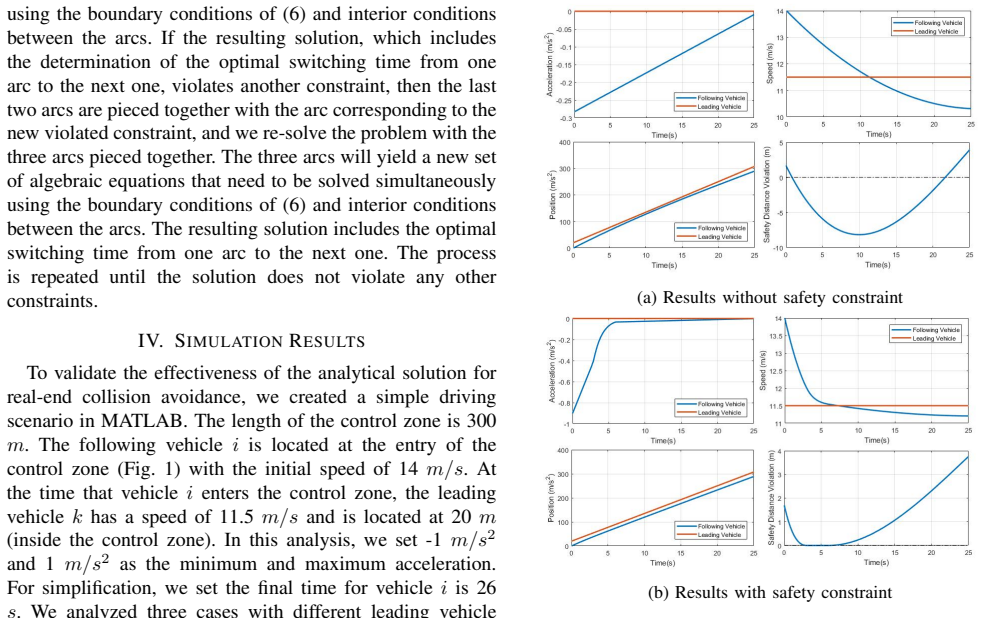
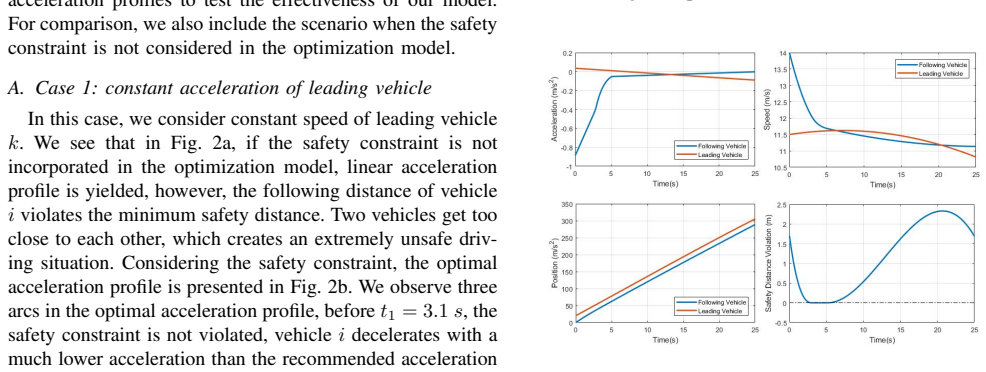
For each vehicle with fixed entry and exit times, given initial states, and a known preceding-vehicle trajectory, the acceleration that minimizes the L2 norm subject to control bounds, speed bounds, and the rear-end safety constraint $s_i(t) \geq \gamma_i + \rho_i v_i(t)$ is a concatenation of arcs: free driving, where acceleration is affine in time as in (14)--(16); a safety-active arc where $s_i(t) = \gamma_i + \rho_i v_i(t)$; a control-active arc where acceleration equals its minimum or maximum; and a speed-active arc where speed equals its lower bound. The arcs are pieced together at switching times determined by interior constraints and boundary conditions, and the switching structure is checked iteratively until no constraint is violated. The paper validates this construction in three simulation cases with different preceding-vehicle acceleration profiles.
Load-bearing premise
The solution assumes the optimal trajectory always follows the enumerated one-way sequence of arc types—free driving, then a safety-active interval, then a control-bound interval, then a speed-bound interval—so a trajectory that returns to an already-used constraint is not represented.
Editorial extensions
If this is right
- Each vehicle can compute its optimal acceleration profile in real time by solving a set of algebraic equations for the switching times, rather than running an iterative numerical optimizer.
- Coordination frameworks that fix an intersection crossing schedule can now include rear-end safety in the lower-level energy-minimization step without changing the upper-level sequencing.
- The safe-distance model with a speed-dependent headway term allows the method to adapt to varying safety policies across vehicles or scenarios.
- The closed-form structure may serve as a baseline to benchmark numerical optimal control solvers in the same class of problems.
Reading between the lines
- A natural next test is whether the one-pass arc-enumeration remains complete when a constraint becomes active, then inactive, then active again within the same vehicle trajectory; the paper's closing argument does not explicitly rule out such repeated activation.
- The same augmented-state technique could be extended to heterogeneous safety functions, e.g., nonlinear distance policies, though the resulting arcs would no longer be polynomial.
- If the closed form extends to multiple vehicles in a platoon, the algebraic switching-time equations could be coupled through the preceding-vehicle trajectory, which may introduce new structural conditions not present in the single-follower case.
Signed reviews
Editorial analysis
A structured set of objections, weighed in public.
Referee Report
Summary. The paper studies a lower-level optimal control problem for a connected and automated vehicle following a known preceding vehicle through a control zone. The dynamics are a double integrator augmented by a spacing state, with control limits, speed limits, and a rear-end safety constraint that is linear in speed. The authors claim a complete closed-form solution in which the optimal acceleration is a concatenation of unconstrained polynomial arcs and arcs where the safety constraint, control bound, or speed bound is active, with switching times determined by algebraic equations from boundary and interior conditions. Three simulation cases with different leading-vehicle acceleration profiles are presented to illustrate the construction.
Significance. If the closed-form solution is correct, it would be a useful building block for online decentralized CAV coordination: the solution is free of fitted parameters, the safe-distance constants and reaction constant are exogenous model inputs, and the unconstrained version has been experimentally validated in prior work by the authors. The paper makes a clear contribution by incorporating the rear-end safety constraint as a state constraint and providing explicit arc formulas. However, the central 'complete' claim rests on an unproved switching-structure enumeration, and Eq. (17) contains a sign error; these issues must be resolved before the result can be relied upon.
major comments (3)
- [Section III, closing paragraph] The paper's proof of completeness is a single sentence: 'The process is repeated until the solution does not violate any other constraints.' No argument is given that the active set sequence is single-pass, that no two constraints bind on a common interval, or that re-entry into an already-active constraint cannot occur. The enumerated cases are visibly incomplete: a safety-active arc never exits to v_max or u_i,max, there is no corner condition for simultaneous safety and control/speed constraints, and re-entry into the safety constraint is absent. Because the switching times are determined by the junction conditions (20)-(21), which differ by exit type, these missing configurations change the algebraic equations defining the candidate. The claim that the solution is 'complete' is therefore not established.
- [Equation (17)] The definition of N_i contains a sign inconsistency. With s_i = xi_i (p_k - p_i), the safety constraint is gamma_i + rho_i v_i - s_i = gamma_i + rho_i v_i - xi_i p_k + xi_i p_i, as in the first expression in (17). The immediately following expression, gamma_i + rho_i v_i - xi_i (p_k + p_i), has the wrong sign on p_i. This error propagates into the junction conditions (20)-(21) and should be corrected before the arc formulas are used.
- [Section IV and Section III] No sufficiency verification or independent numerical optimal control comparison is provided. The three simulations illustrate feasibility of the constructed arc sequence, but they do not demonstrate that the constructed trajectory minimizes (6) among all feasible controls, and they do not exercise the missing switching configurations identified above. A comparison against a numerical optimal control solver, such as direct collocation, would either corroborate the closed-form candidate or reveal the missing arc cases.
minor comments (5)
- [Section IV] The phrase 'real-end collision avoidance' should read 'rear-end collision avoidance'.
- [Section III, around Eq. (20)] There is a typo: 'influence fundtions' should be 'influence functions', and the terms 'Lagrange multiplier' and 'Lagrange multiplier constant' are used inconsistently.
- [Section II] The notation is inconsistent: 't_f^i' is sometimes written as 't_m^i', and the phrase 'assigned time for vehicle i to exits' should be corrected; these should be harmonized throughout.
- [Equation (7)] The Hamiltonian introduces mu_c and mu_d for the speed bound constraints, but the text does not state which multiplier corresponds to which speed bound; a brief sentence defining these multipliers would improve clarity.
- [Section IV] The simulation description would be easier to reproduce if the parameter values (initial positions, speeds, xi_i, gamma_i, rho_i, v_min, v_max, u_i,min, u_i,max) were collected in a table, and if each subfigure in Figs. 2-4 were explicitly referenced in the text.
Circularity Check
No significant circularity: the closed-form derivation is self-contained and no fitted input is relabeled as a prediction.
full rationale
The paper derives the candidate optimal control from the Hamiltonian and Euler-Lagrange necessary conditions within the paper itself. The unconstrained arc (14)-(16) is obtained by solving the co-state equations, not imported as an unexamined premise from the authors' prior work; earlier papers appear only as background and experimental validation. The rear-end safety arc is constructed by enforcing the active constraint: with δ_i=γ_i+ρ_i v_i and s_i=ξ_i(p_k-p_i), setting δ_i-s_i=0 and requiring its first derivative to vanish yields u_i=ξ_i(v_k-v_i)/ρ_i (Eq. 19). This is a direct differentiation of the constraint, not a fitted relation. Switching times and integration constants are determined by the boundary and interior junction conditions (e.g., Eqs. 17-21) and the fixed terminal position; no parameter is calibrated to produce the reported trajectories. The simulation section illustrates the derived solution and does not invert data into parameters. The paper's self-citations to earlier coordination frameworks are contextual and are in any case supported by the self-contained derivation here. The main weakness—the asserted rather than proved exhaustiveness of the arc-switching enumeration in Section III—is a completeness/correctness concern, not a circularity, because it does not reduce the result to its input by construction.
Assumptions & free parameters
assumptions (5)
- domain assumption Vehicle dynamics are a double integrator for position and speed, augmented by a distance state with ˙s_i = xi_i (v_k - v_i), as in Eq. (2).
- domain assumption The minimum safe distance is affine in the follower's speed: delta_i = gamma_i + rho_i v_i, as in Eq. (5).
- domain assumption The preceding vehicle trajectory (p_k(t), v_k(t)) is available and treated as an exogenous input when optimizing vehicle i.
- standard math Pontryagin's minimum principle, the Euler-Lagrange equations, and the Bryson-Ho state-constraint junction conditions are valid for this problem.
- ad hoc to paper The optimal solution is a concatenation of the enumerated arcs: unconstrained, safety-active, control-bound, and speed-bound, each visited at most once in the order considered.
Cite this review
Pith. "Pith review of A Closed-Form Analytical Solution for Optimal Coordination of Connected and Automated Vehicles." pith.science (2026). https://pith.science/paper/BTIJ5HVK
@misc{pith2026190805159,
  author       = {Pith},
  title        = {Pith review of: A Closed-Form Analytical Solution for Optimal Coordination of Connected and Automated Vehicles},
  year         = {2026},
  howpublished = {\url{https://pith.science/paper/BTIJ5HVK}},
  note         = {Machine review of arXiv:1908.05159}
}
read the original abstract
In earlier work, a decentralized optimal control framework was established for coordinating online connected and automated vehicles (CAVs) in merging roadways, urban intersections, speed reduction zones, and roundabouts. The dynamics of each vehicle were represented by a double integrator and the Hamiltonian analysis was applied to derive an analytical solution that minimizes the L2-norm of the control input. However, the analytical solution did not consider the rear-end collision avoidance constraint. In this paper, we derive a complete, closed-form analytical solution that includes the rear-end safety constraint in addition to the state and control constraints. We augment the double integrator model that represents a vehicle with an additional state corresponding to the distance from its preceding vehicle. Thus, the rear-end collision avoidance constraint is included as a state constraint. The effectiveness of the solution is illustrated through simulation.
Figures

Figures from the paper (1 more)

Reference graph
Works this paper leans on
-
[1]
A duality framework for stochastic optimal con- trol of complex systems,
A. A. Malikopoulos, “A duality framework for stochastic optimal con- trol of complex systems,” IEEE Transactions on Automatic Control , vol. 61, no. 10, pp. 2756–2765, 2016
work page 2016
-
[2]
Revisiting street intersections using slot- based systems,
R. Tachet, P. Santi, S. Sobolevsky, L. I. Reyes-Castro, E. Frazzoli, D. Helbing, and C. Ratti, “Revisiting street intersections using slot- based systems,” PLOS ONE , vol. 11, no. 3, 2016
work page 2016
-
[3]
Multiagent traffic management: a reservation-based intersection control mechanism,
K. Dresner and P. Stone, “Multiagent traffic management: a reservation-based intersection control mechanism,” in Proceedings of the Third International Joint Conference on Autonomous Agents and Multiagents Systems , 2004, pp. 530–537
work page 2004
-
[4]
An MPC-Based Approach to Provable System-Wide Safety and Liveness of Autonomous Ground Traffic,
K.-D. Kim and P. Kumar, “An MPC-Based Approach to Provable System-Wide Safety and Liveness of Autonomous Ground Traffic,” IEEE Transactions on Automatic Control , vol. 59, no. 12, pp. 3341– 3356, 2014
work page 2014
-
[5]
Least Restrictive Supervisors for Intersection Collision Avoidance: A Scheduling Approach,
A. Colombo and D. Del Vecchio, “Least Restrictive Supervisors for Intersection Collision Avoidance: A Scheduling Approach,” IEEE Transactions on Automatic Control , vol. 60, no. 6, pp. 1515–1527, 2015
work page 2015
-
[6]
Model Predictive Control of Vehicles on Urban Roads for Improved Fuel Economy,
M. Kamal, M. Mukai, J. Murata, and T. Kawabe, “Model Predictive Control of Vehicles on Urban Roads for Improved Fuel Economy,” IEEE Transactions on Control Systems Technology , vol. 21, no. 3, pp. 831–841, 2013
work page 2013
-
[7]
A Vehicle-Intersection Coordination Scheme for Smooth Flows of Traf- fic Without Using Traffic Lights,
M. Kamal, J. Imura, T. Hayakawa, A. Ohata, and K. Aihara, “A Vehicle-Intersection Coordination Scheme for Smooth Flows of Traf- fic Without Using Traffic Lights,” IEEE Transactions on Intelligent Transportation Systems, no. 99, 2014
work page 2014
-
[8]
Autonomous Coopera- tive Driving: a Velocity-Based Negotiation Approach for Intersection Crossing,
G. R. D. Campos, P. Falcone, and J. Sjoberg, “Autonomous Coopera- tive Driving: a Velocity-Based Negotiation Approach for Intersection Crossing,” in 16th International IEEE Conference on Intelligent Trans- portation Systems , no. Itsc, 2013, pp. 1456–1461
work page 2013
Show all 22 references
-
[9]
Decentral- ized model predictive control for smooth coordination of automated vehicles at intersection,
X. Qian, J. Gregoire, A. De La Fortelle, and F. Moutarde, “Decentral- ized model predictive control for smooth coordination of automated vehicles at intersection,” in2015 European Control Conference (ECC). IEEE, 2015, pp. 3452–3458
2015
-
[10]
Cooperative receding horizon conflict resolution at traffic intersec- tions,
G. R. Campos, P. Falcone, H. Wymeersch, R. Hult, and J. Sjoberg, “Cooperative receding horizon conflict resolution at traffic intersec- tions,” in 2014 IEEE 53rd Annual Conference on Decision and Control (CDC), 2014, pp. 2932–2937
2014
-
[11]
A Survey on Coordination of Connected and Automated Vehicles at Intersections and Merging at Highway On-Ramps,
J. Rios-Torres and A. A. Malikopoulos, “A Survey on Coordination of Connected and Automated Vehicles at Intersections and Merging at Highway On-Ramps,”IEEE Transactions on Intelligent Transportation Systems, vol. 18, no. 5, pp. 1066–1077, 2017
2017
-
[12]
Decentralized optimal path planning and coordination for connected and automated vehicles at signalized-free intersections,
A. A. Malikopoulos and L. Zhao, “Decentralized optimal path planning and coordination for connected and automated vehicles at signalized-free intersections,” in 58th IEEE Conference on Decision and Control, 2019
2019
-
[13]
Online Optimal Control of Connected Vehicles for Efficient Traffic Flow at Merging Roads,
J. Rios-Torres, A. A. Malikopoulos, and P. Pisu, “Online Optimal Control of Connected Vehicles for Efficient Traffic Flow at Merging Roads,” in 2015 IEEE 18th International Conference on Intelligent Transportation Systems, 2015, pp. 2432–2437
2015
-
[14]
Automated and Cooperative Vehicle Merging at Highway On-Ramps,
J. Rios-Torres and A. A. Malikopoulos, “Automated and Cooperative Vehicle Merging at Highway On-Ramps,” IEEE Transactions on Intelligent Transportation Systems , vol. 18, no. 4, pp. 780–789, 2017
2017
-
[15]
Optimal vehicle trajectory planning in the context of cooperative merging on highways,
I. A. Ntousakis, I. K. Nikolos, and M. Papageorgiou, “Optimal vehicle trajectory planning in the context of cooperative merging on highways,” Transportation Research Part C: Emerging Technologies , vol. 71, pp. 464–488, 2016
2016
-
[16]
Optimal control and coordination of connected and automated vehicles at urban traffic intersections,
Y . Zhang, A. A. Malikopoulos, and C. G. Cassandras, “Optimal control and coordination of connected and automated vehicles at urban traffic intersections,” in Proceedings of the American Control Conference , 2016, pp. 6227–6232
2016
-
[17]
Optimal control of connected and automated vehicles at roundabouts: An investigation in a mixed-traffic environment,
L. Zhao, A. A. Malikopoulos, and J. Rios-Torres, “Optimal control of connected and automated vehicles at roundabouts: An investigation in a mixed-traffic environment,” in 15th IF AC Symposium on Control in Transportation Systems, 2018, pp. 73–78
2018
-
[18]
A scaled smart city for experimental validation of connected and automated vehicles,
A. Stager, L. Bhan, A. A. Malikopoulos, and L. Zhao, “A scaled smart city for experimental validation of connected and automated vehicles,” in 15th IF AC Symposium on Control in Transportation Systems , 2018, pp. 130–135
2018
-
[19]
A decentralized energy-optimal control framework for connected automated vehicles at signal-free intersections,
A. A. Malikopoulos, C. G. Cassandras, and Y . Zhang, “A decentralized energy-optimal control framework for connected automated vehicles at signal-free intersections,” Automatica, vol. 93, pp. 244–256, 2018
2018
-
[20]
Opti- mal control for speed harmonization of automated vehicles,
A. A. Malikopoulos, S. Hong, B. Park, J. Lee, and S. Ryu, “Opti- mal control for speed harmonization of automated vehicles,” IEEE Transactions on Intelligent Transportation Systems , vol. 20, no. 7, pp. 2405–2417, 2019
2019
-
[21]
Online identification and stochastic control for autonomous internal com- bustion engines,
A. A. Malikopoulos, P. Y . Papalambros, and D. N. Assanis, “Online identification and stochastic control for autonomous internal com- bustion engines,” Journal of Dynamic Systems, Measurement, and Control, vol. 132, no. 2, pp. 024 504–024 504, 2010
2010
-
[22]
A. E. Bryson and Y . C. Ho, Applied optimal control: optimization, estimation and control . CRC Press, 1975
1975
Reviewed August 14, 2026 · model on record in the stance chip above.
Discussion (0). Continue with ORCID to comment.