REVIEW 2 major objections 7 minor 28 references
Consensus Maximization Tree Search Revisited
T0 review · 2 major / 7 minor · reviewed 2026-08-14 · deepseek-v4-flash
Pith's one-line read This paper claims that two new techniques, NAPA and DIBP, accelerate A* tree search for consensus maximization by avoiding redundant paths and dimension-sensitive pruning, preserving global optimality and producing speedups of over 1000x…
desk verdict Clean algorithmic improvements to exact consensus maximization that deliver real speedups on linear problems, but the homography results rest on a local inner solver and so do not certify global optimality. read the letter →
The pith
A machine-rendered reading of the paper's core claim, the machinery that carries it, and where it could break.
The reading
What carries the argument
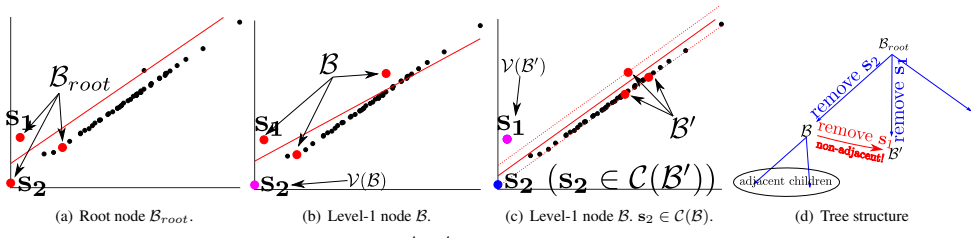
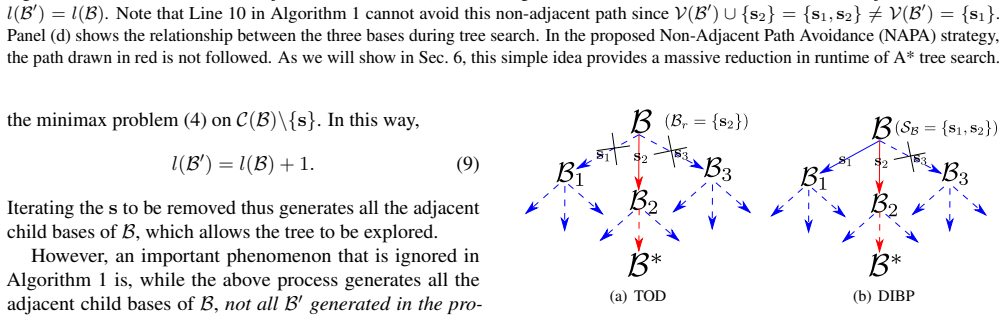
The object that carries the argument is the basis tree of an LP-type problem. A basis is a minimal subset whose minimax residual equals that of its superset; each node has a violation set $V(B)$ of points whose residual exceeds the minimax value, and its level is $\ell(B)=|V(B)|$. Two bases are adjacent when their violation sets differ by exactly one point, and the earlier algorithm expanded nodes by computing $\tau(C(B)\setminus\{s\})$ for each $s$ in the current basis, which can produce a non-adjacent node whose level is not larger than the parent's. NAPA restores the intended search graph with the simple level test $\ell(B')>\ell(B)$. DIBP replaces the single-point test with a growing subset $S_B$: it adds points with the largest residual under a cheap upper-bound solution and uses the admissible heuristic bound $h_{\mathrm{ins}}(B|S_B)>g(B)$ to certify that $S_B$ contains a true outlier, so all branches not removing a point of $S_B$ can be pruned. The level test is what makes DIBP cheap, because the elements added to $S_B$ are often exactly the ones that generated repeated or non-adjacent nodes.
What would settle it
Take a small homography instance whose inner constrained minimax problems have known lower residuals than the local optimizer returns; if the search then prunes the branch containing the true optimum or returns a feasible basis with suboptimal consensus, the central claim fails. Concretely, run A*-NAPA-DIBP on a benchmark with a known optimal consensus, once with the local inner solver and once with a certified global inner solver, and check whether both return the same consensus value.
Extended reading notes
Core claim
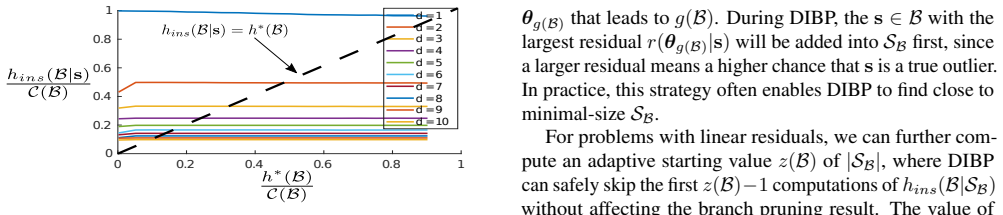
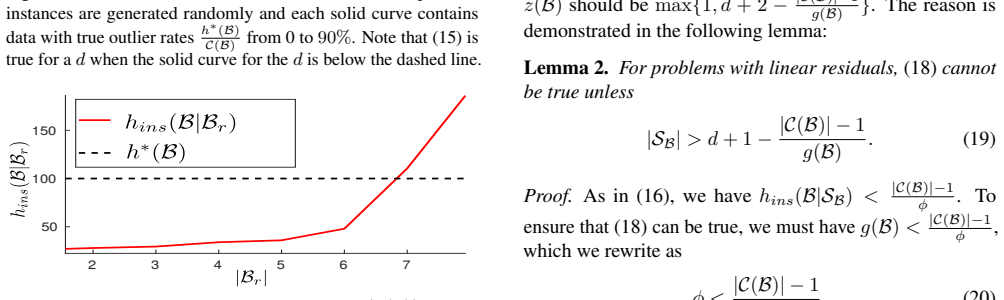
Consensus maximization is NP-hard, but exact A* tree search is fixed-parameter tractable and can be made practical on moderate inputs by removing two inefficiencies. In the basis tree of the LP-type formulation, a child basis generated by removing one point from the current basis and solving a minimax problem is not always an adjacent child: its violation set can coincide with a basis at the same or lower level. Since tree search only needs adjacent paths, every generated basis $B'$ with level $\ell(B') \le \ell(B)$ can be discarded without changing the optimal solution. The existing True Outlier Detection (TOD) branch pruning decides whether a single point is a true outlier by comparing heuristic bounds, but this decision is systematically unreliable when the outlier rate or dimension is high; DIBP instead greedily accumulates points into a set $S_B$ certified to contain at least one true outlier, a weaker and more frequently satisfiable demand. The paper reports that A*-NAPA-DIBP returns the globally optimal solution on all tested KITTI and homography benchmarks, with speedups of hundreds to more than a thousand times over prior A* variants.
Load-bearing premise
Every minimax subproblem and its constrained version must be solved to global optimality, but the paper's non-linear experiments use a local numerical optimizer with no global optimality guarantee, so a non-global solution anywhere along the search would invalidate the level test, the heuristic bounds, and the optimality certificate.
Editorial extensions
If this is right
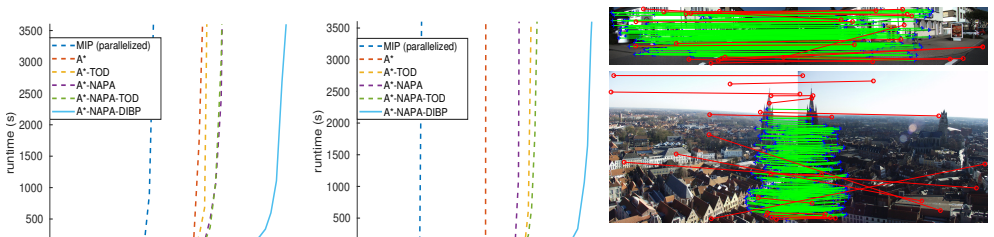
- A*-NAPA-DIBP solves linearized fundamental matrix estimation on KITTI frames with 13 to 22 outliers in 2 to 8 seconds, whereas A* and A*-TOD often exceed 2 hours; if correct, exact robust fitting becomes usable on realistic two-view geometry problems.
- The speedups preserve the fixed-parameter tractability guarantee of tree search, so the returned solution carries a certificate of global optimality rather than an approximation guarantee.
- NAPA reduces the number of unique nodes generated by large factors, and DIBP further collapses branching; the two gains are separate and combine, making the full method faster than either technique alone on every reported benchmark.
- Because the level test and DIBP are stated for any LP-type problem with pseudo-convex residuals, the same acceleration should transfer to other consensus maximization tasks beyond linear regression and fundamental matrix estimation, and the paper demonstrates the transfer to homography estimation.
Reading between the lines
- NAPA's insight that generated children with non-increasing levels are redundant generalizes to any tree search over LP-type bases: any expansion violating strict level increase is outside the adjacency graph and can be pruned in other LP-type solvers, not just consensus maximization.
- DIBP suggests a general pruning principle: instead of certifying a single required object, certify any subset that contains at least one required object, because the larger the subset the weaker the certificate needed; this trade-off is exactly what DIBP exploits by growing $S_B$ greedily.
- A testable extension is to replace the residual-based ordering of additions to $S_B$ with data-dependent priorities; if DIBP's gains depend on reaching a certified $S_B$ early, better ordering could reduce the number of constrained minimax solves further.
- Since the paper's runtime is dominated by inner minimax solves, substituting a faster certified global solver for the local optimizer used in the non-linear experiments could extend the same acceleration to residual models where inner solves are currently the bottleneck.
Signed reviews
Editorial analysis
A structured set of objections, weighed in public.
Referee Report
Summary. This paper revisits A* tree search for exact consensus maximization and proposes two accelerations. The first, NAPA (Non-Adjacent Path Avoidance), observes that when a child B' is generated from B by solving on C(B)\setminus{s}, its violation set satisfies V(B')⊆V(B)∪{s}; if B' is not adjacent to B then l(B')≤l(B), so the generated node can be discarded without losing the adjacent path needed for optimality. The second, DIBP (Dimension-Insensitive Branch Pruning), replaces TOD's search for a single true outlier with a search for a subset S_B of the current basis that must contain at least one true outlier; if condition hins(B|S_B)>g(B) is met, all child branches except those corresponding to points in S_B can be pruned. The authors provide Lemmas 1 and 2 on when TOD is weak and when DIBP can safely start from a larger candidate set, and they evaluate the resulting A*-NAPA-DIBP algorithm on synthetic robust linear regression, linearized fundamental matrix estimation on KITTI, and homography estimation. They report speedups of several orders of magnitude over previous A* and A*-TOD variants, with all KITTI fundamental-matrix instances solved in under 10 seconds.
Significance. If the issues below are addressed, the paper is a meaningful contribution. NAPA is a clean, apparently sound observation about the consensus maximization tree structure, and the reported empirical gains are large. DIBP is a natural and promising extension of TOD that is experimentally much more effective on challenging instances. The release of demo code is a strength, and the synthetic and KITTI fundamental-matrix experiments provide convincing evidence for the linear-residual setting. The theoretical novelty is modest — both techniques build directly on the authors' earlier TPAMI tree search — but the practical acceleration is substantial and the paper is clearly written. The main risk is that the homography experiments, which are the only nonlinear demonstration, currently do not support the global-optimality claim because the inner problems are solved with a local optimizer. Fixed within the manuscript's scope, the paper would be a solid step toward practical exact consensus maximization.
major comments (2)
- [Sec. 6.3, Table 2; Sec. 2.2, Eqs. (4), (14)] The homography experiments are load-bearing for the claim that NAPA and DIBP work beyond linear residuals, but the inner minimax problems (4) and (14) are solved with MATLAB fminimax, a local optimizer that provides no global optimality certificate. Section 2.2 asserts that problem (4) has a unique optimal solution and can be solved efficiently with standard solvers, and the A* optimality argument, the NAPA discard rule (Algorithm 3, line 11), and the DIBP pruning test (18) all depend on the computed basis, violation set, and level being the exact LP-type quantities. If fminimax returns a non-global solution, the violation set V(B), the level l(B), the heuristic hins, and the upper bound g(B) are all incorrect, so the 'globally optimal' homography results in Table 2 are not supported by the evidence presented. The linearized fundamental-matrix experiments in Section 6.2 use an exact vertex-to-vertex solver and are not affected. Please either use an exact global solver for the non-linear minimax subproblems or explicitly restrict the global-optimality claims to the linear-residual experiments and present Section 6.3 as a heuristic demonstration.
- [Sec. 4.2, Eq. (18); Algorithm 3, line 14] The correctness of DIBP is asserted but not formally established. The paper defines hins(B|S_B) by analogy with hins(B|s) and claims that condition (18) identifies a subset S_B containing at least one true outlier, but it never states or proves the subset analogue of the TOD equivalence (11) — namely that h*(B|S_B)>h*(B) holds exactly when S_B contains a point outside the largest feasible subset of C(B) — nor does it prove that hins(B|S_B) is an admissible lower bound on h*(B|S_B). Because DIBP prunes |B|-|S_B| branches on the basis of (18), this missing argument is load-bearing. Please add a formal lemma with proof, or an explicit reduction to the TOD proof in [6].
minor comments (7)
- [Sec. 3, paragraph after Eq. (10)] The sentence 'the repeated basis check heuristic in Algorithm 1 assumes that the level of the child node B' is always lower than the parent B by 1' appears to be a typo: along an adjacent edge the child's level is l(B)+1, not lower. Please correct this, as it obscures the NAPA argument.
- [Sec. 6.1, Fig. 5] Please state how many random instances each curve in Figure 5 averages over and include error bars or variance information; it is currently unclear whether each point is a single run.
- [Sec. 6.2, Table 1 caption] The speedup row uses '>6400' for timed-out baselines; since the exact termination time is unknown, these are lower bounds. Please state this explicitly in the caption or text.
- [Sec. 6.3] The claim that 'the value of φ in the non-linear case was usually also much smaller' is not supported by any measurement in the paper. Please provide the actual φ values or a reference.
- [Sec. 4.2, Lemma 1] The quantity φ is described as the 'average size of all Brem during Algorithm 2,' but the average is not specified precisely (over what set of bases or runs). Please define it formally before Lemma 1.
- [Algorithm 3, lines 8–18] When l(B')≤l(B), the generated B' is discarded but s is not added to S_B, whereas Section 5 says s can be added to S_B 'even though it leads to repeated bases.' Please clarify whether the non-adjacent case is intentionally treated differently from the repeated-basis case and why.
- [General] There are several typos, including 'non-adjacenct' in the algorithm list, 'seach' in Section 6.2, and 'algebaric' in Section 6.2. Please proofread.
Circularity Check
No significant circularity: the new NAPA and DIBP techniques are algorithmic extensions backed by prior proven lemmas, not by fitted inputs or self-defined predictions.
full rationale
The paper's central claims are two algorithmic accelerations for A* consensus-maximization tree search. NAPA is justified as a graph-theoretic observation: in the basis tree, any basis reachable from the root has an adjacent path, so non-adjacent generated bases are redundant. This is supported by the cited external result of Matousek on the basis tree, not by restating the conclusion as a premise. DIBP extends the TOD pruning argument to subsets: condition (18) is a logical consequence of admissibility of hins and the upper-bound property of g, which are prior theorems from the authors' TPAMI work [6]. Those theorems are parameter-free mathematical statements with stated assumptions (pseudo-convex residuals, non-degeneracy) that do not include the target DIBP result; the paper even sketches the admissibility argument. This is legitimate independent support rather than circular self-citation. No parameter is fitted to the experimental data and then renamed as a prediction; the reported speedups are direct runtime comparisons. The one substantive concern is that in the nonlinear homography experiments the inner minimax problems (4)/(14) are solved with MATLAB fminimax, a local optimizer, so the claimed global optimality of those results is not fully verified. That is a correctness or verification risk, not a circularity: it does not reduce the paper's conclusion to its inputs by construction. Therefore the derivation chain is not circular, and the appropriate score is 0.
Assumptions & free parameters
assumptions (4)
- domain assumption Residual r is pseudo-convex and data S is non-degenerate.
- standard math Bases of the LP-type problem form a tree and every basis is reachable by a path of adjacent bases (Matousek).
- domain assumption hins is an admissible heuristic and g(B) is an upper bound of h*(B).
- domain assumption Constrained minimax problems (14) are LP-type and are solved exactly by standard solvers.
Cite this review
Pith. "Pith review of Consensus Maximization Tree Search Revisited." pith.science (2026). https://pith.science/paper/BTP6UC7Q
@misc{pith2026190802021,
  author       = {Pith},
  title        = {Pith review of: Consensus Maximization Tree Search Revisited},
  year         = {2026},
  howpublished = {\url{https://pith.science/paper/BTP6UC7Q}},
  note         = {Machine review of arXiv:1908.02021}
}
read the original abstract
Consensus maximization is widely used for robust fitting in computer vision. However, solving it exactly, i.e., finding the globally optimal solution, is intractable. A* tree search, which has been shown to be fixed-parameter tractable, is one of the most efficient exact methods, though it is still limited to small inputs. We make two key contributions towards improving A* tree search. First, we show that the consensus maximization tree structure used previously actually contains paths that connect nodes at both adjacent and non-adjacent levels. Crucially, paths connecting non-adjacent levels are redundant for tree search, but they were not avoided previously. We propose a new acceleration strategy that avoids such redundant paths. In the second contribution, we show that the existing branch pruning technique also deteriorates quickly with the problem dimension. We then propose a new branch pruning technique that is less dimension-sensitive to address this issue. Experiments show that both new techniques can significantly accelerate A* tree search, making it reasonably efficient on inputs that were previously out of reach.
Figures
Figures from the paper (2 more)
Reference graph
Works this paper leans on
-
[6]
Efficient globally optimal consensus maximisation with tree search
Tat-Jun Chin, Pulak Purkait, Anders Eriksson, and David Suter. Efficient globally optimal consensus maximisation with tree search. IEEE Transactions on Pattern Analysis and Machine Intelligence (TPAMI), 39(4):758–772, 2017
work page 2017
-
[1]
Optimal point placement for mesh smoothing
Nina Amenta, Marshall Bern, and David Eppstein. Optimal point placement for mesh smoothing. Journal of Algorithms, 30(2):302–322, 1999
work page 1999
-
[2]
De- terministic consensus maximization with biconvex program- ming
Zhipeng Cai, Tat-Jun Chin, Huu Le, and David Suter. De- terministic consensus maximization with biconvex program- ming. In European Conference on Computer Vision (ECCV), 2018
work page 2018
-
[3]
E. W. Cheney. Introduction to Approximation Theory . McGraw-Hill, 1966
work page 1966
-
[4]
Tat-Jun Chin, Zhipeng Cai, and Frank Neumann. Robust fitting in computer vision: Easy or hard? In European Con- ference on Computer Vision (ECCV), 2018
work page 2018
-
[5]
Efficient globally optimal consensus maximisation with tree search
Tat-Jun Chin, Pulak Purkait, Anders Eriksson, and David Suter. Efficient globally optimal consensus maximisation with tree search. In Computer Vision and Pattern Recognition (CVPR), 2015
work page 2015
-
[7]
Matching with prosac- progressive sample consensus
Ondrej Chum and Jiri Matas. Matching with prosac- progressive sample consensus. In Computer Vision and Pat- tern Recognition (CVPR), 2005
work page 2005
-
[8]
Ondˇrej Chum, Jiˇr´ı Matas, and Josef Kittler. Locally optimized RANSAC. In Joint Pattern Recognition Symposium, 2003
work page 2003
Show all 28 references
-
[9]
Robust fitting for multiple view geometry
Olof Enqvist, Erik Ask, Fredrik Kahl, and Kalle ˚Astr¨om. Robust fitting for multiple view geometry. In European Con- ference on Computer Vision (ECCV), 2012
2012
-
[10]
Quasiconvex programming
David Eppstein. Quasiconvex programming. Combinatorial and Computational Geometry, 52(3):287–331, 2005
2005
-
[11]
Fischler and Robert C
Martin A. Fischler and Robert C. Bolles. Random sample consensus: a paradigm for model fitting with applications to image analysis and automated cartography. Communications of the ACM, 24(6):381–395, 1981
1981
-
[12]
Are we ready for autonomous driving? the kitti vision benchmark suite
Andreas Geiger, Philip Lenz, and Raquel Urtasun. Are we ready for autonomous driving? the kitti vision benchmark suite. In Computer Vision and Pattern Recognition (CVPR), 2012
2012
-
[13]
Multiple View Ge- ometry in Computer Vision
Richard Hartley and Andrew Zisserman. Multiple View Ge- ometry in Computer Vision . Cambridge University Press, 2003
2003
-
[14]
An exact penalty method for locally convergent maximum consensus
Huu Le, Tat-Jun Chin, and David Suter. An exact penalty method for locally convergent maximum consensus. In Com- puter Vision and Pattern Recognition (CVPR), 2017
2017
-
[15]
A practical algorithm for L∞ triangulation with outliers
Hongdong Li. A practical algorithm for L∞ triangulation with outliers. In Computer Vision and Pattern Recognition (CVPR), 2007
2007
-
[16]
Consensus set maximization with guaranteed global optimality for robust geometry estimation
Hongdong Li. Consensus set maximization with guaranteed global optimality for robust geometry estimation. In Interna- tional Conference on Computer Vision (ICCV), 2009
2009
-
[17]
Object recognition from local scale-invariant features
David G Lowe. Object recognition from local scale-invariant features. In International Conference on Computer Vision (ICCV), 1999
1999
-
[18]
Matouˇsek
Jiˇr´ı. Matouˇsek. On geometric optimization with few vio- lated constraints. Discrete and Computational Geometry , 14(4):365–384, 1995
1995
-
[19]
Numerical Optimization
Jorge Nocedal and Stephen Wright. Numerical Optimization. Springer Science & Business Media, 2006
2006
-
[20]
A polynomial- time bound for matching and registration with outliers
Carl Olsson, Olof Enqvist, and Fredrik Kahl. A polynomial- time bound for matching and registration with outliers. In Computer Vision and Pattern Recognition (CVPR), 2008
2008
-
[21]
Efficient optimization for L∞-problems using pseudoconvexity
Carl Olsson, Anders P Eriksson, and Fredrik Kahl. Efficient optimization for L∞-problems using pseudoconvexity. In International Conference on Computer Vision (ICCV), 2007
2007
-
[22]
Guaranteed outlier removal for rotation search
Alvaro Parra Bustos and Tat-Jun Chin. Guaranteed outlier removal for rotation search. In International Conference on Computer Vision (ICCV), 2015
2015
-
[23]
Maxi- mum consensus parameter estimation by reweighted L1 meth- ods
Pulak Purkait, Christopher Zach, and Anders Eriksson. Maxi- mum consensus parameter estimation by reweighted L1 meth- ods. In Energy Minimization Methods in Computer Vision and Pattern Recognition (EMMCVPR), 2017
2017
-
[24]
USAC: a universal framework for random sample consensus
Rahul Raguram, Ondrej Chum, Marc Pollefeys, Jiri Matas, and Jan-Michael Frahm. USAC: a universal framework for random sample consensus. IEEE Transactions on Pattern Analysis and Machine Intelligence (TPAMI) , 35(8):2022– 2038, 2013
2022
-
[25]
A combinatorial bound for lin- ear programming and related problems
Micha Sharir and Emo Welzl. A combinatorial bound for lin- ear programming and related problems. InAnnual Symposium on Theoretical Aspects of Computer Science, 1992
1992
-
[26]
Guided-MLESAC: Faster image transform estimation by using matching priors
Ben J Tordoff and David W Murray. Guided-MLESAC: Faster image transform estimation by using matching priors. IEEE Transactions on Pattern Analysis and Machine Intelligence (TPAMI), 27(10):1523–1535, 2005
2005
-
[27]
VLFeat: An open and portable library of computer vision algorithms
Andrea Vedaldi and Brian Fulkerson. VLFeat: An open and portable library of computer vision algorithms. In ACM International Conference on Multimedia, 2010
2010
-
[28]
Deterministically maximizing feasible subsystems for robust model fitting with unit norm constraints
Yinqiang Zheng, Shigeki Sugimoto, and Masatoshi Okutomi. Deterministically maximizing feasible subsystems for robust model fitting with unit norm constraints. In Computer Vision and Pattern Recognition (CVPR), 2011
2011
Reviewed August 14, 2026 · model on record in the stance chip above.
Discussion (0). Continue with ORCID to comment.