Joint inference of weak lensing convergence map and cosmology with diffusion models
Pith reviewed 2026-07-01 03:22 UTC · model grok-4.3
The pith
Diffusion models learn to jointly sample convergence maps and cosmological parameters from weak lensing shear fields.
A machine-rendered reading of the paper's core claim, the machinery that carries it, and where it could break.
Core claim
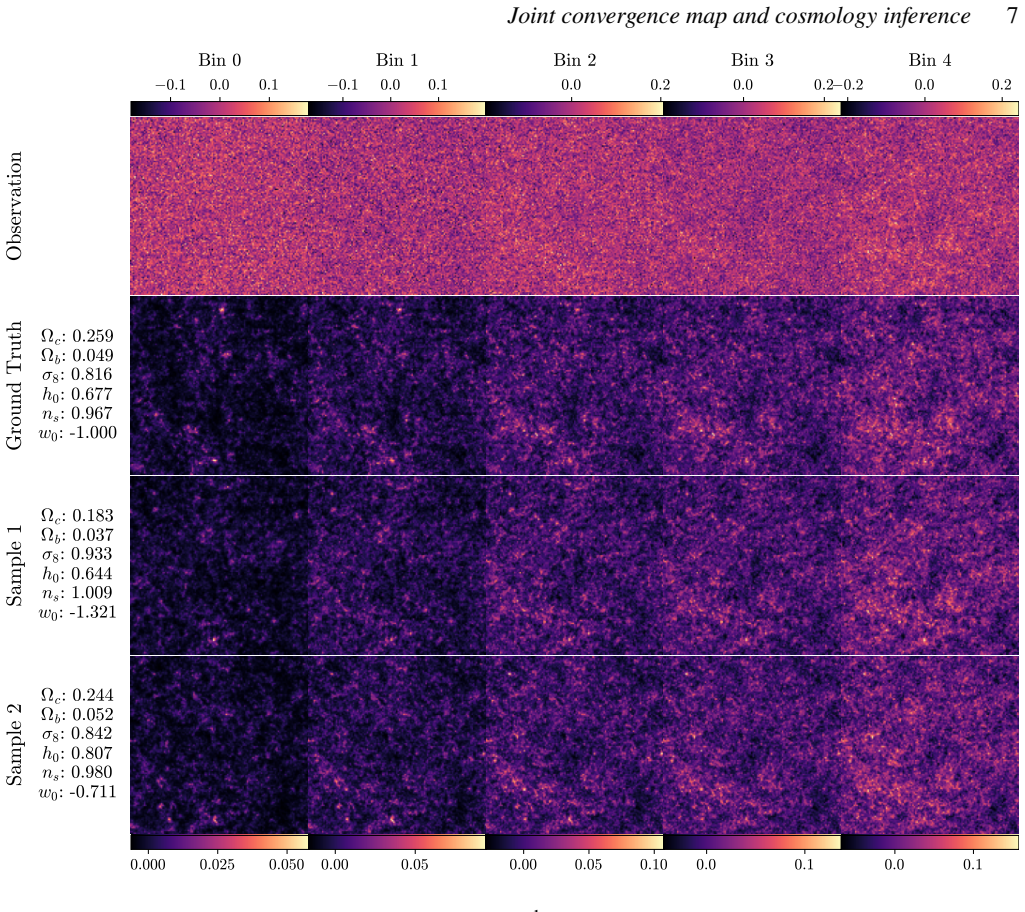
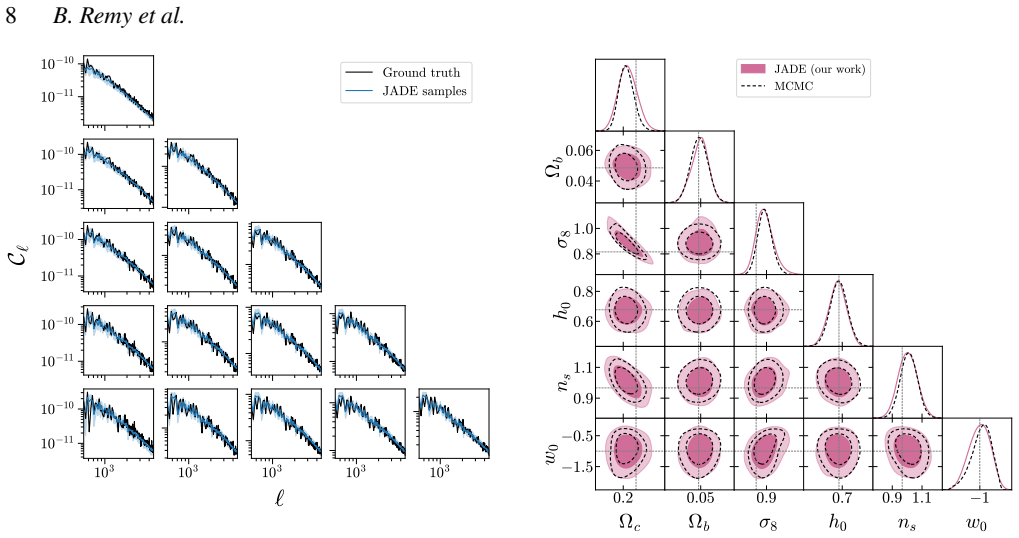
The central claim is that implicit inference via diffusion models can generate accurate posterior samples of both convergence maps and cosmological parameters conditioned on observed noisy shear, with the samples reproducing correct two-point and non-Gaussian one-point statistics and yielding posteriors consistent with those from traditional MCMC.
What carries the argument
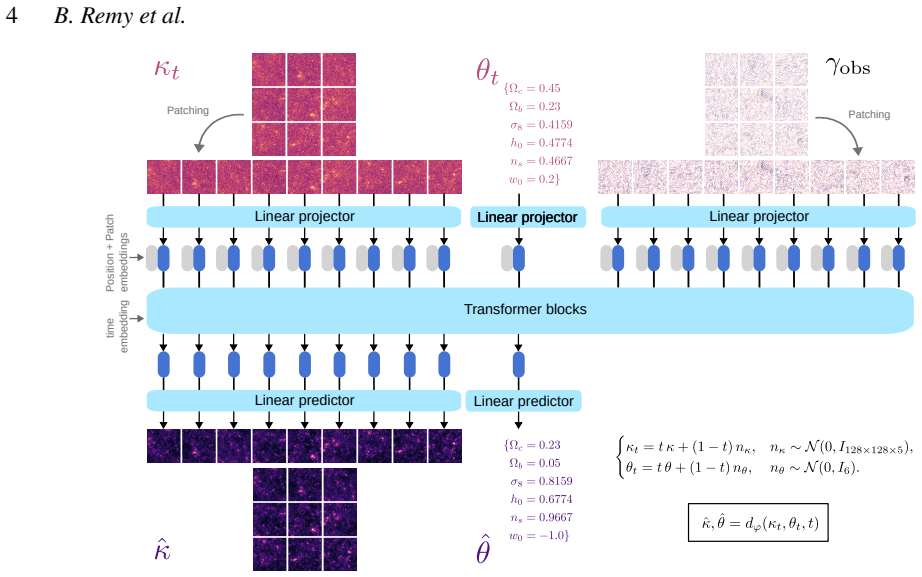
A transformer-based diffusion model that treats the convergence field in pixel space and cosmological parameters as tokens in a single sequence for joint multimodal processing.
If this is right
- The inferred convergence maps reproduce the correct two-point statistics as well as the one-point distribution of the true fields.
- Cosmological parameter posteriors match those obtained from traditional MCMC sampling on the same data.
- The approach works without requiring a differentiable forward model for gradient-based sampling.
- Full field-level joint inference becomes feasible for simulators that cannot be differentiated.
Where Pith is reading between the lines
- The same trained network could be applied directly to real weak lensing survey data once the training simulations are upgraded to include more realistic effects.
- The method could be extended to condition on additional observables such as galaxy positions or other probes within the same sequence architecture.
- Similar diffusion-based implicit inference might reduce the computational cost of field-level analyses in other high-dimensional cosmological settings.
Load-bearing premise
The log-normal fields in a wCDM cosmology used to generate the training simulations are representative of the data the model will later see.
What would settle it
Running the trained model on shear fields generated from a different simulation suite that includes baryonic physics or a different cosmology and checking whether the output maps and parameter posteriors remain statistically consistent with the input truth.
Figures
read the original abstract
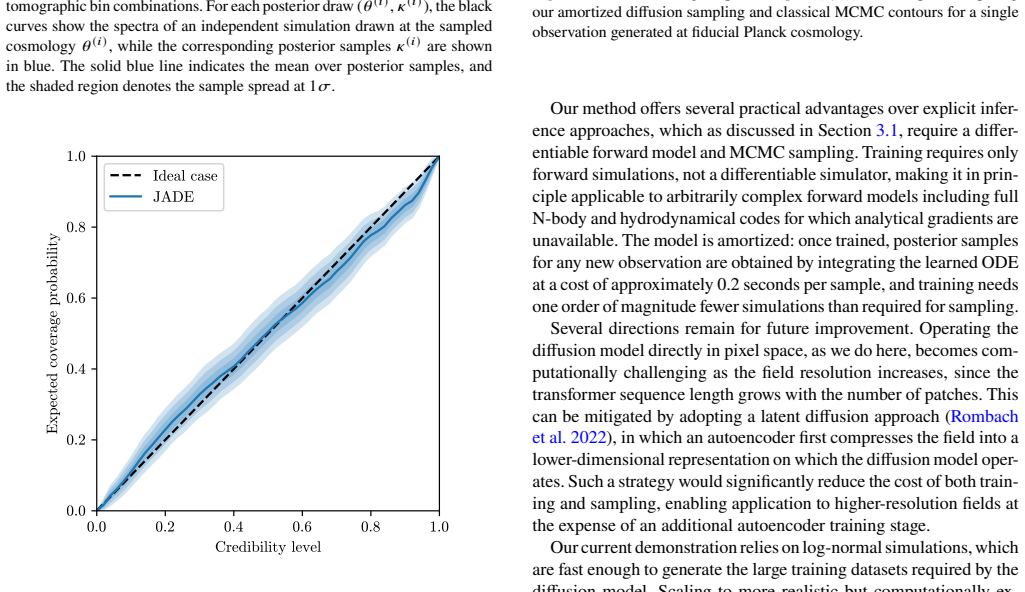
We present a method for joint inference of cosmological parameters and convergence maps from weak lensing observations, targeting the full posterior conditioned on the observed shear field. Our approach uses implicit inference with diffusion models, learning the joint distribution from simulations, without the need to have an explicit and differentiable forward model for gradient-based MCMC sampling. We introduce a transformer-based architecture that operates in pixel space and treats cosmological parameters as additional tokens in a unified sequence, enabling efficient multimodal processing within a single network. At inference time, the trained model generates posterior samples of joint convergence maps and cosmological parameters conditioned on observed noisy shear fields. We demonstrate the method on simulated weak lensing data generated from log-normal fields in a wcdm cosmology. The model accurately reconstructs convergence maps and recovers cosmological posteriors that agree with traditional MCMC, while remaining well calibrated across the prior, with a MIRA calibration score of $0.635 \pm 0.017$ on the joint posterior (where $0.667$ is optimal). The inferred fields reproduce the correct two-point statistics as well as non-Gaussian statistics such as the one-point distribution. This work establishes diffusion-based implicit inference as a viable route toward full field-level cosmological analyses, paving the way for applications to more realistic, non-differentiable simulators.
Editorial analysis
A structured set of objections, weighed in public.
Referee Report
Summary. The manuscript presents a diffusion-model approach to implicit inference for jointly sampling weak-lensing convergence maps and cosmological parameters conditioned on noisy shear observations. A transformer architecture processes pixel-space shear data together with cosmological-parameter tokens; the model is trained on log-normal wCDM simulations and is shown to produce posterior samples whose marginals agree with MCMC, achieve a MIRA calibration score of 0.635 ± 0.017, and reproduce both two-point and one-point statistics of the convergence field.
Significance. If the reported agreement and calibration hold under more realistic forward models, the method would constitute a practical route to field-level cosmological inference for simulators that are neither differentiable nor analytically tractable, which is a recognized bottleneck for Stage-IV surveys.
major comments (2)
- [Abstract] Abstract: the claim that the inferred posteriors 'agree with traditional MCMC' is not accompanied by any quantitative measure (e.g., posterior mean offsets, credible-interval coverage, or KL divergence) beyond the single MIRA scalar; without these numbers it is impossible to judge whether the agreement is sufficient to support the central methodological claim.
- [Abstract] Abstract and methods description: no information is supplied on training-set size, convergence diagnostics, or regularization against the log-normal approximation used to generate the training fields; because the learned joint distribution is defined entirely by these simulations, the absence of such details leaves open the possibility that reported performance is tied to the specific generative model rather than to the diffusion architecture itself.
minor comments (1)
- [Abstract] The acronym 'wcdm' appears in lowercase in the abstract while 'wCDM' is conventional; consistent capitalization would aid readability.
Simulated Author's Rebuttal
We thank the referee for their constructive comments and positive recommendation for minor revision. We address each major comment point by point below.
read point-by-point responses
-
Referee: [Abstract] Abstract: the claim that the inferred posteriors 'agree with traditional MCMC' is not accompanied by any quantitative measure (e.g., posterior mean offsets, credible-interval coverage, or KL divergence) beyond the single MIRA scalar; without these numbers it is impossible to judge whether the agreement is sufficient to support the central methodological claim.
Authors: We agree that the abstract would benefit from additional quantitative measures of agreement beyond the MIRA calibration score. In the revised manuscript we will add explicit metrics such as posterior mean offsets and credible-interval coverage probabilities (computed from the existing MCMC comparison runs) to provide a more rigorous quantification of the agreement. revision: yes
-
Referee: [Abstract] Abstract and methods description: no information is supplied on training-set size, convergence diagnostics, or regularization against the log-normal approximation used to generate the training fields; because the learned joint distribution is defined entirely by these simulations, the absence of such details leaves open the possibility that reported performance is tied to the specific generative model rather than to the diffusion architecture itself.
Authors: We agree that these details should be stated explicitly. In the revised manuscript we will expand the methods section to report the training-set size, training convergence diagnostics, and a brief discussion of the log-normal approximation and its implications for the reported results. revision: yes
Circularity Check
No significant circularity
full rationale
The paper trains a diffusion model on external simulations (log-normal wCDM fields) to learn the joint posterior over maps and parameters, then evaluates reconstruction accuracy, posterior agreement with MCMC, and calibration (MIRA score) on held-out simulations from the same distribution. No load-bearing step reduces by the paper's equations to a fitted quantity renamed as prediction, a self-definitional relation, or a self-citation chain. The reported results are direct empirical outcomes of the trained network on the simulation test set; the forward-looking caveat about representativeness for real data is explicitly separated from the internal validity claims.
Axiom & Free-Parameter Ledger
axioms (1)
- domain assumption Weak lensing convergence fields can be approximated by log-normal random fields in a wCDM cosmology for the purpose of generating training simulations.
Reference graph
Works this paper leans on
-
[1]
Monthly Notices of the Royal Astronomical Society: Letters , volume=
Posterior sampling of the initial conditions of the universe from non-linear large scale structures using score-based generative models , author=. Monthly Notices of the Royal Astronomical Society: Letters , volume=. 2024 , publisher=
2024
-
[2]
Astronomy & Astrophysics , volume=
Probabilistic mass-mapping with neural score estimation , author=. Astronomy & Astrophysics , volume=. 2023 , publisher=
2023
-
[3]
Weak lensing for precision cosmology
Weak Lensing for Precision Cosmology. , keywords =. doi:10.1146/annurev-astro-081817-051928 , archivePrefix =. 1710.03235 , primaryClass =
work page internal anchor Pith review Pith/arXiv arXiv doi:10.1146/annurev-astro-081817-051928
-
[4]
2026 , eprint=
Back to Basics: Let Denoising Generative Models Denoise , author=. 2026 , eprint=
2026
-
[5]
2015 , eprint=
U-Net: Convolutional Networks for Biomedical Image Segmentation , author=. 2015 , eprint=
2015
-
[6]
2021 , eprint=
An Image is Worth 16x16 Words: Transformers for Image Recognition at Scale , author=. 2021 , eprint=
2021
-
[7]
Zeghal, Justine and Lanzieri, Denise and Lanusse, François and Boucaud, Alexandre and Louppe, Gilles and Aubourg, Eric and Bayer, Adrian E. , year=. Simulation-based inference benchmark for weak lensing cosmology , volume=. doi:10.1051/0004-6361/202452410 , journal=
-
[8]
and Boucaud, Alexandre and Starck, Jean-Luc and Lanusse, François , year=
Lanzieri, Denise and Zeghal, Justine and Lucas Makinen, T. and Boucaud, Alexandre and Starck, Jean-Luc and Lanusse, François , year=. Optimal neural summarization for full-field weak lensing cosmological implicit inference , volume=. doi:10.1051/0004-6361/202451535 , journal=
-
[9]
Clerkin, L. and Kirk, D. and Manera, M. and Lahav, O. and Abdalla, F. and Amara, A. and Bacon, D. and Chang, C. and Gaztañaga, E. and Hawken, A. and Jain, B. and Joachimi, B. and Vikram, V. and Abbott, T. and Allam, S. and Armstrong, R. and Benoit-Lévy, A. and Bernstein, G. M. and Bernstein, R. A. and Bertin, E. and Brooks, D. and Burke, D. L. and Rosell,...
-
[10]
Xavier, Henrique S. and Abdalla, Filipe B. and Joachimi, Benjamin , year=. Improving lognormal models for cosmological fields , volume=. Monthly Notices of the Royal Astronomical Society , publisher=. doi:10.1093/mnras/stw874 , number=
-
[11]
2023 , eprint=
Attention Is All You Need , author=. 2023 , eprint=
2023
-
[12]
2021 , eprint=
Learning Transferable Visual Models From Natural Language Supervision , author=. 2021 , eprint=
2021
-
[13]
2025 , eprint=
AION-1: Omnimodal Foundation Model for Astronomical Sciences , author=. 2025 , eprint=
2025
-
[14]
Monthly Notices of the Royal Astronomical Society , volume=
A lognormal model for the cosmological mass distribution , author=. Monthly Notices of the Royal Astronomical Society , volume=. 1991 , publisher=
1991
-
[15]
NeurIPS 2024 Workshop: Machine Learning and the Physical Sciences , year=
Joint cosmological parameter inference and initial condition reconstruction with Stochastic Interpolants , author=. NeurIPS 2024 Workshop: Machine Learning and the Physical Sciences , year=
2024
-
[16]
Proceedings of the IEEE/CVF international conference on computer vision , pages=
Scalable diffusion models with transformers , author=. Proceedings of the IEEE/CVF international conference on computer vision , pages=
-
[17]
Stochastic Interpolants: A Unifying Framework for Flows and Diffusions
Stochastic interpolants: A unifying framework for flows and diffusions , author=. arXiv preprint arXiv:2303.08797 , year=
work page internal anchor Pith review Pith/arXiv arXiv
-
[18]
Monthly Notices of the Royal Astronomical Society , volume=
Primordial non-Gaussianity without tails--how to measure f NL with the bulk of the density PDF , author=. Monthly Notices of the Royal Astronomical Society , volume=. 2020 , publisher=
2020
-
[19]
Likelihood-free inference with neural compression of DES SV weak lensing map statistics , volume=
Jeffrey, Niall and Alsing, Justin and Lanusse, François , year=. Likelihood-free inference with neural compression of DES SV weak lensing map statistics , volume=. Monthly Notices of the Royal Astronomical Society , publisher=. doi:10.1093/mnras/staa3594 , number=
-
[20]
James Bradbury and Roy Frostig and Peter Hawkins and Matthew James Johnson and Chris Leary and Dougal Maclaurin and George Necula and Adam Paszke and Jake Vander
-
[21]
Jonathan Heek and Anselm Levskaya and Avital Oliver and Marvin Ritter and Bertrand Rondepierre and Andreas Steiner and Marc van
-
[22]
2018 , eprint=
A Conceptual Introduction to Hamiltonian Monte Carlo , author=. 2018 , eprint=
2018
-
[23]
2011 , eprint=
The No-U-Turn Sampler: Adaptively Setting Path Lengths in Hamiltonian Monte Carlo , author=. 2011 , eprint=
2011
-
[24]
Handbook of Markov Chain Monte Carlo , ISBN=
Brooks, Steve and Gelman, Andrew and Jones, Galin and Meng, Xiao-Li , year=. Handbook of Markov Chain Monte Carlo , ISBN=. doi:10.1201/b10905 , publisher=
-
[25]
2023 , eprint=
Field-level inference of cosmic shear with intrinsic alignments and baryons , author=. 2023 , eprint=
2023
-
[26]
2019 , eprint=
Systematic-free inference of the cosmic matter density field from SDSS3-BOSS data , author=. 2019 , eprint=
2019
-
[27]
Monthly Notices of the Royal Astronomical Society , volume=
Bayesian physical reconstruction of initial conditions from large-scale structure surveys , author=. Monthly Notices of the Royal Astronomical Society , volume=. 2013 , publisher=
2013
-
[28]
2021 , eprint=
Score-Based Generative Modeling through Stochastic Differential Equations , author=. 2021 , eprint=
2021
-
[29]
2020 , eprint=
Denoising Diffusion Probabilistic Models , author=. 2020 , eprint=
2020
-
[30]
Doeser, Ludvig and Ata, Metin and Jasche, Jens , year=. Learning the Universe: learning to optimize cosmic initial conditions with non-differentiable structure formation models , volume=. Monthly Notices of the Royal Astronomical Society , publisher=. doi:10.1093/mnras/staf1289 , number=
-
[31]
The DESI Experiment Part I: Science,Targeting, and Survey Design
The DESI experiment part I: Science, targeting, and survey design , author=. arXiv preprint arXiv:1611.00036 , year=
work page internal anchor Pith review Pith/arXiv arXiv
-
[32]
Euclid Definition Study Report
Euclid definition study report , author=. arXiv preprint arXiv:1110.3193 , year=
work page internal anchor Pith review Pith/arXiv arXiv
-
[33]
The Astrophysical Journal , volume=
LSST: from science drivers to reference design and anticipated data products , author=. The Astrophysical Journal , volume=. 2019 , publisher=
2019
-
[34]
arXiv preprint arXiv:2304.04785 , year=
Field-level inference of cosmic shear with intrinsic alignments and baryons , author=. arXiv preprint arXiv:2304.04785 , year=
-
[35]
arXiv preprint arXiv:2412.00968 , year=
Probing primordial non-Gaussianity by reconstructing the initial conditions , author=. arXiv preprint arXiv:2412.00968 , year=
-
[36]
Monthly Notices of the Royal Astronomical Society , volume=
Bayesian field-level inference of primordial non-Gaussianity using next-generation galaxy surveys , author=. Monthly Notices of the Royal Astronomical Society , volume=. 2023 , publisher=
2023
-
[37]
arXiv preprint arXiv:2603.15732 , year=
Field-Level Inference from Galaxies: BAO Reconstruction , author=. arXiv preprint arXiv:2603.15732 , year=
-
[38]
Diffusion Posterior Sampling for General Noisy Inverse Problems
Diffusion posterior sampling for general noisy inverse problems , author=. arXiv preprint arXiv:2209.14687 , year=
work page internal anchor Pith review Pith/arXiv arXiv
-
[39]
The Astrophysical Journal Letters , volume=
Deep optical galaxy counts with the Keck Telescope , author=. The Astrophysical Journal Letters , volume=
-
[40]
International Conference on Machine Learning , pages=
Sampling-based accuracy testing of posterior estimators for general inference , author=. International Conference on Machine Learning , pages=. 2023 , organization=
2023
-
[41]
The Astrophysical Journal , volume=
The high latitude spectroscopic survey on the Nancy Grace Roman Space Telescope , author=. The Astrophysical Journal , volume=. 2022 , publisher=
2022
-
[42]
ArXiv e-prints , pages=
Wide-field infrarred survey telescope-astrophysics focused telescope assets WFIRST-AFTA 2015 report , author=. ArXiv e-prints , pages=
2015
-
[43]
Proceedings of the IEEE/CVF conference on computer vision and pattern recognition , pages=
High-resolution image synthesis with latent diffusion models , author=. Proceedings of the IEEE/CVF conference on computer vision and pattern recognition , pages=
-
[44]
Monthly Notices of the Royal Astronomical Society , volume=
Dark energy survey year 3 results: likelihood-free, simulation-based w cdm inference with neural compression of weak-lensing map statistics , author=. Monthly Notices of the Royal Astronomical Society , volume=. 2025 , publisher=
2025
-
[45]
Journal of Cosmology and Astroparticle Physics , volume=
CosmoGridV1: a simulated ��CDM theory prediction for map-level cosmological inference , author=. Journal of Cosmology and Astroparticle Physics , volume=. 2023 , publisher=
2023
-
[46]
Astrophysics Source Code Library , pages=
FLASK: Full-sky Lognormal Astro-fields Simulation Kit , author=. Astrophysics Source Code Library , pages=
-
[47]
arXiv preprint arXiv:2302.01942 , year=
Glass: Generator for large scale structure , author=. arXiv preprint arXiv:2302.01942 , year=
- [48]
-
[49]
2023 , eprint=
Flow Matching for Generative Modeling , author=. 2023 , eprint=
2023
-
[50]
arXiv preprint arXiv:2001.10993 , year=
Constraining neutrino masses with weak-lensing multiscale peak counts , author=. arXiv preprint arXiv:2001.10993 , year=
-
[51]
Monthly Notices of the Royal Astronomical Society , volume=
A new approach to observational cosmology using the scattering transform , author=. Monthly Notices of the Royal Astronomical Society , volume=. 2020 , publisher=
2020
-
[52]
Physical Review D , volume=
Constraining neutrino mass with the tomographic weak lensing one-point probability distribution function and power spectrum , author=. Physical Review D , volume=. 2019 , publisher=
2019
-
[53]
Physical Review D—Particles, Fields, Gravitation, and Cosmology , volume=
Probing cosmology with weak lensing Minkowski functionals , author=. Physical Review D—Particles, Fields, Gravitation, and Cosmology , volume=. 2012 , publisher=
2012
-
[54]
Monthly Notices of the Royal Astronomical Society , volume=
Cosmological parameters from lensing power spectrum and bispectrum tomography , author=. Monthly Notices of the Royal Astronomical Society , volume=. 2004 , publisher=
2004
-
[55]
Neural posterior estimation with differentiable simulators, 2022
Neural posterior estimation with differentiable simulators , author=. arXiv preprint arXiv:2207.05636 , year=
-
[56]
Kaiser, Nick and Squires, Gordon , month =. 1993 , journal =. doi:10.1086/172297 , issn =
-
[57]
Kilbinger, Martin , number =. 2015 , journal =. doi:10.1088/0034-4885/78/8/086901 , issn =
-
[58]
Monthly Notices of the Royal Astronomical Society , volume=
Likelihood-free inference with neural compression of DES SV weak lensing map statistics , author=. Monthly Notices of the Royal Astronomical Society , volume=. 2021 , publisher=
2021
-
[59]
Decoupled Weight Decay Regularization
Decoupled weight decay regularization , author=. arXiv preprint arXiv:1711.05101 , year=
work page internal anchor Pith review Pith/arXiv arXiv
-
[60]
Adam: A Method for Stochastic Optimization
Adam: A method for stochastic optimization , author=. arXiv preprint arXiv:1412.6980 , year=
work page internal anchor Pith review Pith/arXiv arXiv
-
[61]
Advances in Neural Information Processing Systems , volume=
Autoregressive image generation without vector quantization , author=. Advances in Neural Information Processing Systems , volume=
-
[62]
Advances in neural information processing systems , volume=
Root mean square layer normalization , author=. Advances in neural information processing systems , volume=
-
[63]
GLU Variants Improve Transformer
Glu variants improve transformer , author=. arXiv preprint arXiv:2002.05202 , year=
work page internal anchor Pith review Pith/arXiv arXiv 2002
-
[64]
Neurocomputing , volume=
Roformer: Enhanced transformer with rotary position embedding , author=. Neurocomputing , volume=. 2024 , publisher=
2024
-
[65]
Findings of the Association for Computational Linguistics: EMNLP 2020 , pages=
Query-key normalization for transformers , author=. Findings of the Association for Computational Linguistics: EMNLP 2020 , pages=
2020
-
[66]
Proceedings of the thirteenth international conference on artificial intelligence and statistics , pages=
Understanding the difficulty of training deep feedforward neural networks , author=. Proceedings of the thirteenth international conference on artificial intelligence and statistics , pages=. 2010 , organization=
2010
-
[67]
Forty-first international conference on machine learning , year=
Scaling rectified flow transformers for high-resolution image synthesis , author=. Forty-first international conference on machine learning , year=
-
[68]
Advances in neural information processing systems , volume=
Elucidating the design space of diffusion-based generative models , author=. Advances in neural information processing systems , volume=
-
[69]
arXiv preprint arXiv:2211.03812 , year=
Posterior samples of source galaxies in strong gravitational lenses with score-based priors , author=. arXiv preprint arXiv:2211.03812 , year=
-
[70]
nature , volume=
Array programming with NumPy , author=. nature , volume=. 2020 , publisher=
2020
-
[71]
2026 , eprint=
MIRA: A Score for Conditional Distribution Accuracy and Model Comparison , author=. 2026 , eprint=
2026
-
[72]
arXiv preprint arXiv:2404.09636 , year=
All-in-one simulation-based inference , author=. arXiv preprint arXiv:2404.09636 , year=
-
[73]
arXiv preprint arXiv:2602.10065 , year=
Dark Energy Survey Year 6 Results: Cosmological Constraints from Cosmic Shear , author=. arXiv preprint arXiv:2602.10065 , year=
-
[74]
Astronomy & Astrophysics , volume=
KiDS-Legacy: Cosmological constraints from cosmic shear with the complete Kilo-Degree Survey , author=. Astronomy & Astrophysics , volume=. 2025 , publisher=
2025
-
[75]
The Dark Energy Camera All Data Everywhere cosmic shear project V: Constraints on cosmology and astrophysics from 270 million galaxies across 13,000 deg \^
Anbajagane, D and Chang, C and Drlica-Wagner, A and Tan, CY and Adamow, M and Gruendl, RA and Secco, LF and Zhang, Z and Becker, MR and Ferguson, PS and others , journal=. The Dark Energy Camera All Data Everywhere cosmic shear project V: Constraints on cosmology and astrophysics from 270 million galaxies across 13,000 deg \^
-
[76]
Physical Review D , volume=
Hyper Suprime-Cam Year 3 results: Cosmology from cosmic shear two-point correlation functions , author=. Physical Review D , volume=. 2023 , publisher=
2023
-
[77]
2026 , eprint=
Towards Practical Field-Level Inference for Weak Lensing , author=. 2026 , eprint=
2026
-
[78]
Hunter, J. D. , Title =. Computing in Science & Engineering , Volume =
-
[79]
Petri, A. , year=. Mocking the weak lensing universe: The LensTools Python computing package , volume=. doi:10.1016/j.ascom.2016.06.001 , journal=
discussion (0)
Sign in with ORCID, Apple, or X to comment. Anyone can read and Pith papers without signing in.