REVIEW 4 major objections 5 minor 1 cited by
Digital Phenotyping for Adolescent Mental Health: A Feasibility Study Employing Machine Learning to Predict Mental Health Risk From Active and Passive Smartphone Data
T0 review · 4 major / 5 minor · reviewed 2026-08-10 · deepseek-v4-flash
Pith's one-line read The paper claims that combining active self-reports with passive smartphone sensor data outperforms either source alone in predicting adolescent mental-health risk, with balanced accuracies up to 0.77 under leave-one-subject-out…
desk verdict A useful feasibility result for integrated smartphone phenotyping, but a load-bearing ambiguity about whether contrastive pretraining is subject-disjoint makes the headline accuracies hard to trust until the authors clarify. read the letter →
The pith
A machine-rendered reading of the paper's core claim, the machinery that carries it, and where it could break.
The reading
What carries the argument
The load-bearing mechanism is a two-stage neural architecture. A contrastive pretraining phase uses triplet margin loss on unlabeled daily feature vectors—anchor day from one user, positive day from the same user, negative day from a different user—so that same-user days cluster together and different-user days separate, stabilising user-specific behavioural representations against day-to-day noise. A small neural-network classifier is then fine-tuned on the labelled risk categories, with class weighting to handle imbalance. The evaluation protocol is leave-one-subject-out cross-validation with balanced accuracy as the primary metric, and SHAP values are used to identify which active and passive features drive predictions.
What would settle it
Retrain the triplet-loss pretraining from scratch on only the 102 training subjects inside each leave-one-subject-out fold while keeping the rest of the pipeline identical; if balanced accuracy falls from 0.67 toward the 0.65 no-pretraining level, or the 0.77 suicidal-ideation figure drops, the reported pretraining benefit depends on seeing the held-out user's unlabeled data. A second check is to freeze the trained pipeline and test it on a completely new school cohort, since the study currently validates on the same 103 students who supplied the training labels.
Extended reading notes
Core claim
The central claim is that integrating active self-reports (mood, sleep quality, loneliness, confidence) with passive sensor data (step count, location entropy, ambient light, app usage, background noise) predicts adolescent mental-health risk better than either stream alone in a non-clinical population. The authors report that the combined model outperformed active-only and passive-only models under leave-one-subject-out cross-validation, with mean balanced accuracies of 0.71 for high-risk Strengths and Difficulties Questionnaire scores, 0.67 for insomnia, 0.77 for suicidal ideation, and 0.70 for eating disorders. They also report that a contrastive pretraining step, which pulls together daily feature vectors from the same user and pushes apart vectors from different users, improved mean balanced accuracy from 0.65 without pretraining to 0.67 with it. This is a feasibility claim about a screening tool, not a clinical-diagnosis claim.
Load-bearing premise
The generalisation result rests on the held-out student's data never entering the contrastive pretraining step; the paper does not state whether pretraining is refit inside each leave-one-subject-out fold, and if it is not, the reported balanced accuracies overstate how the model would perform on a genuinely new person.
Editorial extensions
If this is right
- A school could run a two-week app-based monitoring period and use the combined model to rank students for follow-up, without requiring the student to have already sought help.
- Because passive sensing keeps collecting data even as self-report engagement declines, a deployed tool would not lose most of its signal when teenagers stop answering daily prompts.
- The contrastive pretraining step offers a template for small cohorts: learn stable per-user representations from unlabeled phone data, then fine-tune on a modest number of labelled cases.
- The same app-based pipeline could screen several risk domains at once rather than one disorder, since the model produced usable balanced accuracy for four distinct outcomes.
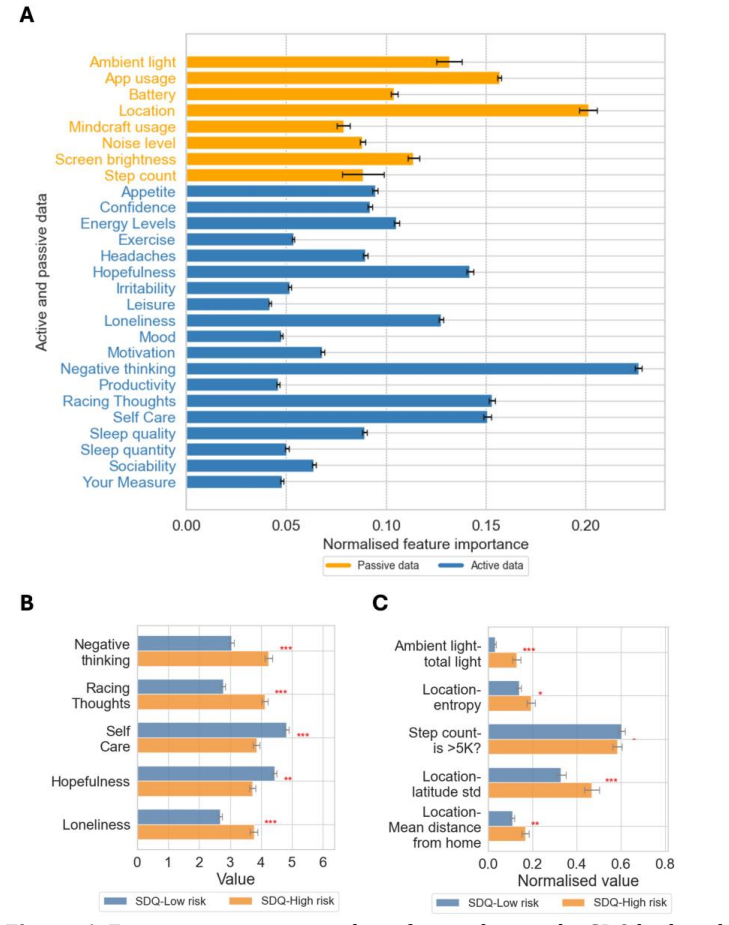
- The interpretable features—negative thinking, racing thoughts, self-care, location entropy, step count, ambient light—give clinicians concrete behavioural markers to look at when a student is flagged.
Reading between the lines
- If the subject-independent pretraining assumption holds, the same contrastive pretraining could be run on large unlabeled smartphone datasets from the general population, then fine-tuned on smaller labelled clinical cohorts, which would make the approach far cheaper to scale.
- The passive-only insomnia result was near chance (0.44), which suggests that for sleep problems the active self-report questions carry most of the predictive value; a practical screening app might assign different sensor weightings per outcome rather than one fixed combination.
- Because model accuracy fell near the clinical thresholds (SDQ 9–16, SCI 9–16), an application would be better used to triage clearly high-risk and clearly low-risk students than to adjudicate borderline cases; returning a continuous risk score instead of a binary label would be a direct test of that boundary behaviour.
Editorial analysis
A structured set of objections, weighed in public.
Referee Report
Summary. The paper reports a feasibility study of digital phenotyping for adolescent mental health risk prediction. A sample of 103 adolescents from three London schools used the Mindcraft app for 14 days, contributing active self-report data and passive smartphone sensor data. The authors develop a machine-learning pipeline with a contrastive-learning pretraining phase (triplet loss) followed by supervised fine-tuning, and evaluate it with leave-one-subject-out cross-validation using balanced accuracy as the primary metric. They report that integrating active and passive data outperforms either data source alone, with balanced accuracies of 0.71 for SDQ high risk, 0.67 for insomnia, 0.77 for suicidal ideation, and 0.70 for eating disorders. They also report that contrastive pretraining improves balanced accuracy over no pretraining (0.67 vs 0.65, P<.001). SHAP analysis highlights negative thinking, racing thoughts, location entropy, and step count as important predictors. The authors conclude that integrated active and passive smartphone data can support early detection of mental health risk in adolescents.
Significance. If the findings are valid, this is a useful feasibility contribution: it demonstrates a multi-outcome digital phenotyping pipeline in a non-clinical adolescent sample, with an evaluation design that includes leave-one-subject-out cross-validation, a chance-level reference line, benchmark models, and interpretability analysis. The passive sensing feature set is documented in detail, and the engagement analyses provide practical information for future deployments. The central claims are, however, conditional on two unresolved methodological issues: the possibility that the contrastive pretraining phase leaks held-out subjects' data into the embedding model, and the use of repeated runs of the same cross-validation folds as independent samples in statistical tests. Both issues are fixable within the scope of the manuscript, but they are load-bearing for the generalization claims.
major comments (4)
- [Machine Learning Workflow and Model Development; Evaluation and Benchmarking] The manuscript does not state whether the contrastive pretraining phase is refit on the training users for each leave-one-subject-out (LOSO) fold or performed once on all 103 users. This matters because triplet pretraining is identity-aware: the loss explicitly pulls together different days of the same user and pushes apart different users. If pretraining is run on the full sample, the held-out user's unlabeled day-level sensor data influence the embedding network before supervised fine-tuning, which breaks the subject-independence that LOSO is supposed to guarantee. The t-SNE in Figure 1B, which shows '10 test users' clustering more tightly after pretraining, is consistent with those users having been seen during pretraining. The authors must state the exact pretraining protocol. If pretraining was not refit per fold, they must re-run the evaluation with pretraining confined to the training folds only. This is the load-bearing premise behind the reported balanced accuracies (0.71, 0.67, 0.77, 0.70) and the claim of generalization to unseen individuals.
- [Figure 4; Evaluation and Benchmarking] The significance tests in Figure 4 and the associated text treat the 10 repetitions of LOSO cross-validation as independent samples. Since LOSO folds are determined by the user partitions, the 10 repetitions are almost certainly the same folds with different random seeds or initialization, so the repeated measurements for each user are not independent. Using a paired test across these repetitions inflates the effective sample size by a factor of 10 (or more), which explains very small P values such as P=.003 for the combined-vs-active comparison and P<.001 for the pretraining comparison. The authors should perform subject-level inference, for example a permutation test that randomizes outcome labels at the subject level or a bootstrap resampled by participant, and report the resulting P values and confidence intervals. The magnitude of the pretraining benefit (0.67 vs 0.65) is small, so the corrected inference might change the conclusion.
- [Model Interpretability: Active and Passive Data Contributions; Figure 6] The SHAP analysis shows that the top active-data predictors for SDQ high-risk status are daily self-reports of negative thinking, racing thoughts, self-care, hopefulness, and loneliness. These items are conceptually very close to the emotional and behavioral content of the SDQ outcome itself. Consequently, part of the reported prediction performance for SDQ—and, to a lesser extent, for the other outcomes—may reflect self-report predicting self-report rather than digital phenotyping from behavioral data. This does not invalidate the passive-data findings (e.g., location entropy, step count), which provide a more independent signal, but it does weaken the claim that 'integration' provides novel predictive value beyond the active self-reports. The authors should run a sensitivity analysis excluding the overlapping active items, or explicitly temper the digital-phenotyping interpretation to account for this circularity.
- [Results: Performance of Models Predicting Mental Health Outcomes; Figure 4A] The passive-data model for insomnia is reported as achieving a balanced accuracy of 0.44, which is below the chance level of 0.50. This is an unusual and unexplained result; it suggests either a coding error, a feature-leakage problem in the opposite direction, or an artifact of the small and selectively sensor-enabled sample (67 participants). The authors should explain this finding, report the corresponding confusion matrix or error analysis, and address whether the passive data pipeline is reliable for this outcome. As it stands, the below-chance result casts some doubt on the quality of the passive data features and the evaluation protocol, even though the combined model performs better.
minor comments (5)
- [Methods: Recruitment and Data Collection; Table 1/Table 2] The sentence 'The proportions of participants classified as high-risk for each mental health outcome are summarised in Table 1' refers to the passive sensor feature table; these proportions actually appear in Table 2 (demographics and mental health measures). Please correct the cross-reference.
- [Table 2; Abbreviations] The label 'EDEQ-15' in Table 2 is not defined and is inconsistent with the 'ED-15' abbreviation used elsewhere in the text. Please use one name consistently and define it at first use.
- [Methods: Evaluation and Benchmarking; Figure 4A] The manuscript describes '10 repetitions of leave-one-subject-out cross-validation' without explaining what is repeated. Please clarify in the text or figure caption that these are repeated runs with different random seeds on the same LOSO folds, so readers understand the nature of the variability reported as '±' values.
- [Results: Recruitment and App Usage; Figure 2D] The statement '36 users opted not to enable any sensors' is potentially important for interpreting the 67-user subset; please state explicitly how many of those 36 still contributed active data, since the comparative analyses are restricted to the 67 participants with both data types.
- [Abstract; Results] The abstract and Figure 4B report the pretraining comparison as '0.67 vs 0.65, P<.001' but do not state which outcome or feature set this average is taken over. Please specify whether this is averaged across all four outcomes and all three feature sets, or a particular configuration, so readers can interpret the claim.
Circularity Check
No significant circularity: the reported predictions are not defined in terms of the labels, and the derivation does not reduce to its inputs.
full rationale
The paper's derivation chain is self-contained with respect to circularity. The outcome labels (SDQ high-risk, insomnia, suicidal ideation, eating-disorder risk) are defined by validated questionnaire thresholds, while the model inputs are a separate set of active daily self-report ratings and passive sensor features engineered independently of the labels. No feature is constructed from the outcome definition, and no fitted parameter is renamed as a prediction. The central comparison—combined active+passive versus single-modality models—is a genuine empirical benchmark against CatBoost and a no-pretraining MLP, so the contrastive-pretraining advantage is not forced by construction. The only self-citation (reference 36) supports app technical specifications and is not load-bearing for any predictive claim. A potential methodological ambiguity is whether the contrastive pretraining phase is refit inside each leave-one-subject-out fold or run once on all participants; if the latter, held-out users' unlabeled data could influence the embedding model, which would be a validation-leakage concern rather than a circularity demonstrated by the paper's text. Since the paper does not state that pretraining includes the held-out user, this cannot be exhibited as a specific circular reduction under the required standard. Likewise, the overlap between active self-report features (e.g., negative thinking) and the self-report-derived SDQ label reflects shared measurement method, but the features are not the SDQ items and the SDQ threshold is not defined in terms of the active features, so it is not self-definitional circularity. Overall, no step in the claimed derivation chain equates a prediction to an input by construction.
Assumptions & free parameters
free parameters (4)
- Class weight parameter =
not reported
- Triplet margin =
not reported
- MLP architecture and training hyperparameters =
not reported
- Step count binarization thresholds =
5,000 / 7,000 / 10,000 steps
assumptions (4)
- domain assumption The self-report cutoffs (SDQ >=16, SCI <=16, ED-15 >2.69, PHQ-9 item >=1) correctly classify high-risk status for the four mental health outcomes.
- domain assumption Sensor non-use is ignorable for the combined-data analysis.
- domain assumption Leave-one-subject-out splitting is applied to the entire pipeline, including the unsupervised contrastive pretraining stage.
- domain assumption 14 days of data, with heavy attrition in active reports, provides sufficiently stable daily behavioral representations.
Cite this review
Pith. "Pith review of Digital Phenotyping for Adolescent Mental Health: A Feasibility Study Employing Machine Learning to Predict Mental Health Risk From Active and Passive Smartphone Data." pith.science (2026). https://pith.science/paper/BVJKRMJV
@misc{pith2026250108851,
  author       = {Pith},
  title        = {Pith review of: Digital Phenotyping for Adolescent Mental Health: A Feasibility Study Employing Machine Learning to Predict Mental Health Risk From Active and Passive Smartphone Data},
  year         = {2026},
  howpublished = {\url{https://pith.science/paper/BVJKRMJV}},
  note         = {Machine review of arXiv:2501.08851}
}
read the original abstract
Background: Adolescents are particularly vulnerable to mental disorders, with over 75% of cases manifesting before the age of 25. Research indicates that only 18 to 34% of young people experiencing high levels of depression or anxiety symptoms seek support. Digital tools leveraging smartphones offer scalable and early intervention opportunities. Objective: Using a novel machine learning framework, this study evaluated the feasibility of integrating active and passive smartphone data to predict mental disorders in non-clinical adolescents. Specifically, we investigated the utility of the Mindcraft app in predicting risks for internalising and externalising disorders, eating disorders, insomnia and suicidal ideation. Methods: Participants (N=103; mean age 16.1 years) were recruited from three London schools. Participants completed the Strengths and Difficulties Questionnaire, the Eating Disorders-15 Questionnaire, Sleep Condition Indicator Questionnaire and indicated the presence/absence of suicidal ideation. They used the Mindcraft app for 14 days, contributing active data via self-reports and passive data from smartphone sensors. A contrastive pretraining phase was applied to enhance user-specific feature stability, followed by supervised fine-tuning. The model evaluation employed leave-one-subject-out cross-validation using balanced accuracy as the primary metric. Results: The integration of active and passive data achieved superior performance compared to individual data sources, with mean balanced accuracies of 0.71 for SDQ-High risk, 0.67 for insomnia, 0.77 for suicidal ideation and 0.70 for eating disorders. The contrastive learning framework stabilised daily behavioural representations, enhancing predictive robustness. This study demonstrates the potential of integrating active and passive smartphone data with advanced machine-learning techniques for predicting mental health risks.
Figures

Forward citations
Cited by 1 Pith paper
-
A Computational Ethical Framework for Financial Digital Phenotyping for Mental Health
Ethical rules for financial digital phenotyping can be written as deontic temporal constraints whose violations Z3 proves unsatisfiable inside the formal model.
Reference graph
Works this paper leans on
-
[1]
The mental health of young people: the view from primary care
Mughal F, England E. The mental health of young people: the view from primary care. British Journal of General Practice; 2016. p. 502-3
work page 2016
-
[2]
Kessler RC, Berglund P, Demler O, Jin R, Merikangas KR, Walters EE. Lifetime prevalence and age -of-onset distributions of DSM -IV disorders in the National Comorbidity Survey Replication. Archives of general psychiatry. 2005;62(6):593-602
work page 2005
-
[3]
Polanczyk GV, Salum GA, Sugaya LS, Caye A, Rohde LA. Annual research review: A meta‐analysis of the worldwide prevalence of mental disorders in children and adolescents. Journal of child psychology and psychiatry. 2015;56(3):345-65
work page 2015
-
[4]
The global burden of disease study at 30 years
Murray CJ. The global burden of disease study at 30 years. Nature medicine. 2022;28(10):2019-26
work page 2022
-
[5]
Gulliver A, Griffiths KM, Christensen H. Perceived barriers and facilitators to mental health help-seeking in young people: a systematic review. BMC psychiatry. 2010;10:1-9
work page 2010
-
[6]
Childhood and adolescent psychiatric disorders as predictors of young adult disorders
Copeland WE, Shanahan L, Costello EJ, Angold A. Childhood and adolescent psychiatric disorders as predictors of young adult disorders. Archives of general psychiatry. 2009;66(7):764-72
work page 2009
-
[7]
Mathiesen KS, Sanson A, Stoolmiller M, Karevold E. The nature and predictors of undercontrolled and internalizing problem trajectories across early childhood. Journal of abnormal child psychology. 2009;37:209-22
work page 2009
-
[8]
Samek DR, Hicks BM. Externalizing disorders and environmental risk: Mechanisms of gene -environment interplay and strategies for intervention. Clinical Practice (London, England). 2014;11(5):537
work page 2014
Show all 64 references
-
[9]
Systematic review of the effects of schools and school environment interventions on health: evidence mapping and synthesis
Bonell C, Farah J, Harden A, Wells H, Parry W, Fletcher A, et al. Systematic review of the effects of schools and school environment interventions on health: evidence mapping and synthesis. Public Health Research. 2013;1(1)
2013
-
[10]
Anderson JK, Ford T, Soneson E, Coon JT, Humphrey A, Rogers M, et al. A systematic review of effectiveness and cost-effectiveness of school-based identification of children and young people at risk of, or currently experiencing mental health difficulti es. Psychological medici...
2019
-
[11]
Using science to sell apps: evaluation of mental health app store quality claims
Larsen ME, Huckvale K, Nicholas J, Torous J, Birrell L, Li E, et al. Using science to sell apps: evaluation of mental health app store quality claims. NPJ digital medicine. 2019;2(1):18
2019
-
[12]
Smartphones for smarter delivery of mental health programs: a systematic review
Donker T, Petrie K, Proudfoot J, Clarke J, Birch M-R, Christensen H. Smartphones for smarter delivery of mental health programs: a systematic review. Journal of medical Internet research. 2013;15(11):e247
2013
-
[13]
Mobile apps that promote emotion regulation, positive mental health, and well -being in the general population: systematic review and meta-analysis
Eisenstadt M, Liverpool S, Infanti E, Ciuvat RM, Carlsson C. Mobile apps that promote emotion regulation, positive mental health, and well -being in the general population: systematic review and meta-analysis. JMIR mental health. 2021;8(11):e31170
2021
-
[14]
lifestyle psychiatry
Firth J, Solmi M, Wootton RE, Vancampfort D, Schuch FB, Hoare E, et al. A meta‐ review of “lifestyle psychiatry”: the role of exercise, smoking, diet and sleep in the prevention and treatment of mental disorders. World psychiatry. 2020;19(3):360-80
2020
-
[15]
Development of a mobile phone app to support self-monitoring of emotional well-being: a mental health digital innovation
Rickard N, Arjmand H-A, Bakker D, Seabrook E. Development of a mobile phone app to support self-monitoring of emotional well-being: a mental health digital innovation. JMIR mental health. 2016;3(4):e6202
2016
-
[16]
Digital phenotyping: data-driven psychiatry to redefine mental health
Oudin A, Maatoug R, Bourla A, Ferreri F, Bonnot O, Millet B, et al. Digital phenotyping: data-driven psychiatry to redefine mental health. Journal of Medical Internet Research. 2023;25:e44502
2023
-
[17]
Digital phenotyping: technology for a new science of behavior
Insel TR. Digital phenotyping: technology for a new science of behavior. Jama. 2017;318(13):1215-6
2017
-
[18]
Harnessing smartphone -based digital phenotyping to enhance behavioral and mental health
Onnela J -P, Rauch SL. Harnessing smartphone -based digital phenotyping to enhance behavioral and mental health. Neuropsychopharmacology. 2016;41(7):1691-6
2016
-
[19]
Next -generation psychiatric assessment: Using smartphone sensors to mo nitor behavior and mental health
Ben-Zeev D, Scherer EA, Wang R, Xie H, Campbell AT. Next -generation psychiatric assessment: Using smartphone sensors to mo nitor behavior and mental health. Psychiatric rehabilitation journal. 2015;38(3):218. doi: 10.1037/prj0000130
2015 doi
-
[20]
Trajectories of depression: unobtrusive monitoring of depressive states by means of smartphone mobility traces analysis
Canzian L, Musolesi M, editors. Trajectories of depression: unobtrusive monitoring of depressive states by means of smartphone mobility traces analysis. Proceedings of the 2015 ACM international joint conference on pervasive and ubiquitous computing; 2015
2015
-
[21]
Next -generation psychiatric assessment: Using smartphone sensors to monitor behavior and mental health
Ben-Zeev D, Scherer EA, Wang R, Xie H, Campbell AT. Next -generation psychiatric assessment: Using smartphone sensors to monitor behavior and mental health. Psychiatric rehabilitation journal. 2015;38(3):218
2015
-
[22]
Cao J, Truong AL, Banu S, Shah AA, Sabharwal A, Moukaddam N. Tracking and predicting depressive symptoms of adolescents using smartphone -based self -reports, parental evaluations, and passive phone sensor data: development and usability study. JMIR mental health. 2020;7(1):e14045
2020
-
[23]
Faurholt-Jepsen M, Vinberg M, Frost M, Christensen EM, Bardram J, Kessing LV. Daily electronic monitoring of subjective and objective measures of illness activity in bipolar disorder using smartphones –the MONARCA II trial protocol: a randomized controlled single-blind paralle...
2014
-
[24]
Berrouiguet S, Ramírez D, Barrigón ML, Moreno -Muñoz P, Camacho RC, Baca - García E, et al. Combining continuous smartphone native sensors data capture and unsupervised data mining techniques for behavioral changes detection: a case series of the evidence-based behavior (eB2) ...
2018
-
[25]
CrossCheck: toward passive sensing and detection of mental health changes in people with schizophrenia
Wang R, Aung MS, Abdullah S, Brian R, Campbell AT, Choudhury T, et al., editors. CrossCheck: toward passive sensing and detection of mental health changes in people with schizophrenia. Proceedings of the 2016 ACM international joint conference on pervasive and ubiquitous compu...
2016
-
[26]
Using smartphones to monitor bipolar disorder symptoms: a pilot study
Beiwinkel T, Kindermann S, Maier A, Kerl C, Moock J, Barbian G, et al. Using smartphones to monitor bipolar disorder symptoms: a pilot study. JMIR mental health. 2016;3(1):e4560
2016
-
[27]
Passive sensing of prediction of moment -to-moment depressed mood among undergraduates with clinical levels of depression sample using smartphones
Jacobson NC, Chung YJ. Passive sensing of prediction of moment -to-moment depressed mood among undergraduates with clinical levels of depression sample using smartphones. Sensors. 2020;20(12):3572
2020
-
[28]
Towards early detection of depression through smartphone sensing
Opoku Asare K, Visuri A, Ferreira DS, editors. Towards early detection of depression through smartphone sensing. Adjunct Proceedings of the 2019 ACM International Joint Conference on Pervasive and Ubiquitous Computing and Proceedings of the 2019 ACM International Symposium on ...
2019
-
[29]
Toi Même, a mobile health platform for measuring bipolar illness activity: protocol for a feasibility study
Dargél AA, Mosconi E, Masson M, Plaze M, Taieb F, Von Platen C, et al. Toi Même, a mobile health platform for measuring bipolar illness activity: protocol for a feasibility study. JMIR Research Protocols. 2020;9(8):e18818
2020
-
[30]
Predicting Depression in Adolescents Using Mobile and Wearable Sensors: Multimodal Machine Learning –Based Exploratory Study
Mullick T, Radovic A, Shaaban S, Doryab A. Predicting Depression in Adolescents Using Mobile and Wearable Sensors: Multimodal Machine Learning –Based Exploratory Study. JMIR Formative Research. 2022;6(6):e35807
2022
-
[31]
Maharjan SM, Poudyal A, van Heerden A, Byanjankar P, Thapa A, Islam C, et al. Passive sensing on mobile devices to improve mental health services with adolescent and young mothers in low-resource settings: the role of families in feasibility and acceptability. BMC medical info...
2021
-
[32]
Predicting depressive symptoms using smartphone data
Ware S, Yue C, Morillo R, Lu J, Shang C, Bi J, et al. Predicting depressive symptoms using smartphone data. Smart Health. 2020;15:100093
2020
-
[33]
A mobile sensing app to monitor youth mental health: observational pilot study
MacLeod L, Suruliraj B, Gall D, Bessenyei K, Hamm S, Romkey I, et al. A mobile sensing app to monitor youth mental health: observational pilot study. JMIR mHealth and uHealth. 2021;9(10):e20638
2021
-
[34]
Smartphones, sensors, and machine learning to advance real-time prediction and interventions for suicide prevention: a review of current progress and next steps
Torous J, Larsen ME, Depp C, Cosco TD, Barnett I, Nock MK, et al. Smartphones, sensors, and machine learning to advance real-time prediction and interventions for suicide prevention: a review of current progress and next steps. Current psychiatry repor ts. 2018;20:1-6
2018
-
[35]
A linguistic analysis of suicide-related Twitter posts
O'dea B, Larsen ME, Batterham PJ, Calear AL, Christensen H. A linguistic analysis of suicide-related Twitter posts. Crisis. 2017
2017
-
[36]
Mindcraft, a Mobile Mental Health Monitoring Platform for Children and Young People: Development and Acceptability Pilot Study
Kadirvelu B, Bellido Bel T, Wu X, Burmester V, Ananth S, Cabral CC Branco B, et al. Mindcraft, a Mobile Mental Health Monitoring Platform for Children and Young People: Development and Acceptability Pilot Study. JMIR Formative Research. 2023;7:e44877
2023
-
[37]
The Strengths and Difficulties Questionnaire: a research note
Goodman R. The Strengths and Difficulties Questionnaire: a research note. Journal of child psychology and psychiatry. 1997;38(5):581-6
1997
-
[38]
Development, psychometric properties and preliminary clinical validation of a brief, session‐by‐session measure of eating disorder cognitions and behaviors: The ED‐15
Tatham M, Turner H, Mountford VA, Tritt A, Dyas R, Waller G. Development, psychometric properties and preliminary clinical validation of a brief, session‐by‐session measure of eating disorder cognitions and behaviors: The ED‐15. International Journal o f Eating Disorders. 2015...
2015
-
[39]
The PHQ‐9: validity of a brief depression severity measure
Kroenke K, Spitzer RL, Williams JB. The PHQ‐9: validity of a brief depression severity measure. Journal of general internal medicine. 2001;16(9):606-13
2001
-
[40]
Youth screening depression: Validation of the Patient Health Questionnaire-9 (PHQ-9) in a representative sample of adolescents
Fonseca-Pedrero E, Díez-Gómez A, Pérez-Albéniz A, Al-Halabí S, Lucas-Molina B, Debbané M. Youth screening depression: Validation of the Patient Health Questionnaire-9 (PHQ-9) in a representative sample of adolescents. Psychiatry Research. 2023;328:115486
2023
-
[41]
The Sleep Condition Indicator: a clinical screening tool to evaluate insomnia disorder
Espie CA, Kyle SD, Hames P, Gardani M, Fleming L, Cape J. The Sleep Condition Indicator: a clinical screening tool to evaluate insomnia disorder. BMJ open. 2014;4(3):e004183
2014
-
[42]
The Sleep Condition Indicator: reference values derived from a sample of 200 000 adults
Espie CA, Farias Machado P, Carl JR, Kyle SD, Cape J, Siriwardena AN, et al. The Sleep Condition Indicator: reference values derived from a sample of 200 000 adults. Journal of sleep research. 2018;27(3):e12643
2018
-
[43]
Using the Strengths and Difficulties Questionnaire (SDQ) to screen for child psychiatric disorders in a community sample
Goodman R, Ford T, Simmons H, Gatward R, Meltzer H. Using the Strengths and Difficulties Questionnaire (SDQ) to screen for child psychiatric disorders in a community sample. The British journal of psychiatry. 2000;177(6):534-9
2000
-
[44]
Eating Disorder‐15 (ED‐15): Factor structure, psychometric properties, and clinical validation
Rodrigues T, Vaz AR, Silva C, Conceição E, Machado PP. Eating Disorder‐15 (ED‐15): Factor structure, psychometric properties, and clinical validation. European Eating Disorders Review. 2019;27(6):682-91
2019
-
[45]
A unified approach to interpreting model predictions
Lundberg S. A unified approach to interpreting model predictions. arXiv preprint arXiv:170507874. 2017
2017
-
[46]
From local explanations to global understanding with explainable AI for trees
Lundberg SM, Erion G, Chen H, DeGrave A, Prutkin JM, Nair B, et al. From local explanations to global understanding with explainable AI for trees. Nature machine intelligence. 2020;2(1):56-67
2020
-
[47]
CatBoost: unbiased boosting with categorical features
Prokhorenkova L, Gusev G, Vorobev A, Dorogush AV, Gulin A. CatBoost: unbiased boosting with categorical features. Advances in neural information processing systems. 2018;31
2018
-
[48]
CatBoost for big data: an interdisciplinary review
Hancock JT, Khoshgoftaar TM. CatBoost for big data: an interdisciplinary review. Journal of big data. 2020;7(1):94
2020
-
[49]
Smartphone -based self- monitoring, treatment, and automatically generated data in children, adolescents, and young adults with psychiatric disorders: systematic review
Melbye S, Kessing LV, Bardram JE, Faurholt -Jepsen M. Smartphone -based self- monitoring, treatment, and automatically generated data in children, adolescents, and young adults with psychiatric disorders: systematic review. JMIR mental health. 2020;7(10):e17453
2020
-
[50]
Explainable Artificial Intelligence (XAI): Concepts, taxonomies, opportunities and challenges toward responsible AI
Arrieta AB, Díaz-Rodríguez N, Del Ser J, Bennetot A, Tabik S, Barbado A, et al. Explainable Artificial Intelligence (XAI): Concepts, taxonomies, opportunities and challenges toward responsible AI. Information fusion. 2020;58:82-115
2020
-
[51]
Digital phenotyping for monitoring mental disorders: systematic review
Bufano P, Laurino M, Said S, Tognetti A, Menicucci D. Digital phenotyping for monitoring mental disorders: systematic review. Journal of Medical Internet Research. 2023;25:e46778
2023
-
[52]
Digital phenotyping for mental health of college students: a clinical review
Melcher J, Hays R, Torous J. Digital phenotyping for mental health of college students: a clinical review. BMJ Ment Health. 2020;23(4):161-6
2020
-
[53]
Brief School - Based Interventions Targeting Student Mental Health or Well-Being: A Systematic Review and Meta-Analysis
Cohen KA, Ito S, Ahuvia IL, Yang Y, Zhang Y, Renshaw TL, et al. Brief School - Based Interventions Targeting Student Mental Health or Well-Being: A Systematic Review and Meta-Analysis. Clinical Child and Family Psychology Review. 2024:1-75
2024
-
[54]
The Patient Experience of the Future is Personalized: Using Technology to Scale an N of 1 Approach
Bucher A. The Patient Experience of the Future is Personalized: Using Technology to Scale an N of 1 Approach. Journal of Patient Experience. 2023;10:23743735231167975
2023
-
[55]
Ethical development of digital phenotyping tools for mental health applications: Delphi study
Martinez-Martin N, Greely HT, Cho MK. Ethical development of digital phenotyping tools for mental health applications: Delphi study. JMIR mHealth and uHealth. 2021;9(7):e27343
2021
-
[56]
Digital mental health for young people: a scoping review of ethical promises and challenges
Wies B, Landers C, Ienca M. Digital mental health for young people: a scoping review of ethical promises and challenges. Frontiers in digital health. 2021;3:697072
2021
-
[57]
A systematic review of reviews on the advantages of mHealth utilization in mental health services: A viable option for large populations in low-resource settings
Khosravi M, Azar G. A systematic review of reviews on the advantages of mHealth utilization in mental health services: A viable option for large populations in low-resource settings. Cambridge Prisms: Global Mental Health. 2024:1-20
2024
-
[58]
Healthcare information systems: data mining methods in the creation of a clinical recommender system
Duan L, Street WN, Xu E. Healthcare information systems: data mining methods in the creation of a clinical recommender system. Enterprise Information Systems. 2011;5(2):169-81. doi: 10.1080/17517575.2010.541287
2011
-
[59]
MyBehavior: automatic personalized health feedback from user behaviors and preferences using smartphones
Rabbi M, Aung MH, Zhang M, Choudhury T, editors. MyBehavior: automatic personalized health feedback from user behaviors and preferences using smartphones. 2015
2015
-
[60]
Recommender systems in the healthcare domain: state-of-the-art and research issues
Tran TNT, Felfernig A, Trattner C, Holzinger A. Recommender systems in the healthcare domain: state-of-the-art and research issues. Journal of Intelligent Information Systems. 2021;57(1):171-201
2021
-
[61]
The artificial intelligence clinician learns optimal treatment strategies for sepsis in intensive care
Komorowski M, Celi LA, Badawi O, Gordon AC, Faisal AA. The artificial intelligence clinician learns optimal treatment strategies for sepsis in intensive care. Nature medicine. 2018;24(11):1716-20
2018
-
[62]
A survey of recommendation systems: recommendation models, techniques, and application fields
Ko H, Lee S, Park Y, Choi A. A survey of recommendation systems: recommendation models, techniques, and application fields. Electronics. 2022;11(1):141
2022
-
[63]
Personalised Recommendations in Mental Health Apps: The Impact of Autonomy and Data Sharing
Pieritz S, Khwaja M, Faisal AA, Matic A, editors. Personalised Recommendations in Mental Health Apps: The Impact of Autonomy and Data Sharing. 2021
2021
-
[64]
Personality and Engagement with Digital Mental Health Interventions
Khwaja M, Pieritz S, Faisal AA, Matic A, editors. Personality and Engagement with Digital Mental Health Interventions. 2021
2021
Reviewed August 10, 2026 · model on record in the stance chip above.
Discussion (0). Continue with ORCID to comment.