REVIEW 3 major objections 2 minor 40 references
Reviewed by Pith at T0; open to challenge.
T0 means a machine referee read the full paper against a public rubric. The mark states how deep the mechanical check went, never who wrote it. the ladder, T0–T4 →
T0 review · grok-4.3
MODIP fine-tunes diffusion policies by using MPC in a world model to generate supervised targets that improve beyond behavioral cloning.
2026-06-27 13:42 UTC pith:BWUVATSD
load-bearing objection MODIP's efficiency shortcuts for world-model-guided fine-tuning of diffusion policies are a reasonable practical idea, but the abstract gives no evidence that the generated trajectories stay in-distribution or that the claimed gains are robust. the 3 major comments →
MODIP: Efficient Model-Based Optimization for Diffusion Policies
The pith
A machine-rendered reading of the paper's core claim, the machinery that carries it, and where it could break.
Core claim
MODIP performs offline-to-online fine-tuning of diffusion policies by training a world model, generating trajectories via model predictive control inside that model, and using those trajectories as supervised targets for the diffusion policy, thereby avoiding direct RL on the denoising process while preserving behavioral cloning simplicity.
What carries the argument
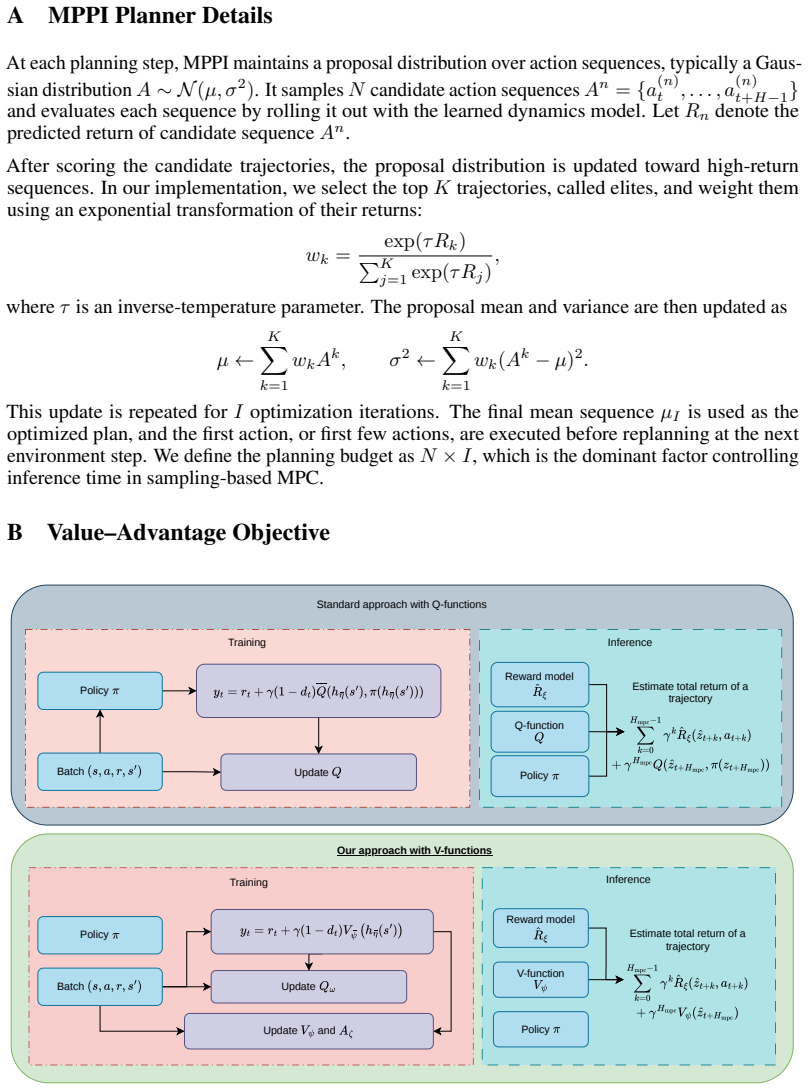
Model predictive control inside a learned world model that produces trajectories via terminal state values, which then serve as supervised fine-tuning targets for the diffusion policy.
Load-bearing premise
The world model must generate trajectories that stay high-quality and distributionally compatible with the diffusion policy so that supervised fine-tuning on them actually improves the policy instead of introducing bias or compounding errors.
What would settle it
If supervised fine-tuning on the MPC-generated trajectories produces lower task performance than the original behavioral-cloning diffusion policy on the same D4RL or RoboMimic benchmarks, the central claim would be falsified.
If this is right
- Diffusion policies can move from offline imitation to online adaptation without requiring full RL on the multi-step denoising process.
- World models supply an efficient bridge between imitation learning and model-based optimization for generative policies.
- Replacing policy-dependent state-action values with terminal state values makes MPC planning fast enough for repeated policy updates.
- Policy-independent TD targets reduce the cost of training critics that support the MPC planner.
Where Pith is reading between the lines
- The same model-based supervision pattern could be applied to other multi-step generative policies that are currently hard to fine-tune with RL.
- If the world model remains accurate in new environments, the method could reduce the amount of real-robot interaction needed for policy improvement.
- The separation of trajectory generation from direct policy optimization opens a route for combining planning-based methods with other expressive policy classes in continuous control.
Editorial analysis
A structured set of objections, weighed in public.
Referee Report
Summary. The paper proposes MODIP, a framework for offline-to-online fine-tuning of diffusion policies (DPs) that avoids direct RL on the multi-step denoising process. Instead, it trains a world model (WM), uses MPC within the WM to generate high-quality trajectories (with terminal state value rather than policy-dependent Q(s,a) and policy-independent TD targets for efficiency), and performs supervised fine-tuning of the DP on those trajectories. Experiments on D4RL (MuJoCo, Kitchen) and RoboMimic tasks are reported to show that MODIP improves DPs beyond BC and is competitive with or outperforms both DP RL fine-tuning methods and strong model-based baselines such as TD-MPC2.
Significance. If the central empirical claims hold after proper controls and validation, the work would offer a practically useful route to improving expressive diffusion policies while retaining the stability of behavioral cloning; the efficiency modifications (terminal-value MPC and policy-independent critics) are explicitly motivated and could reduce compute relative to full RL fine-tuning. The approach also demonstrates a concrete way to combine model-based planning with offline policy representations, which is a timely direction in robot learning.
major comments (3)
- [Abstract / Experiments] Abstract and Experiments section: the reported benchmark improvements on D4RL and RoboMimic are stated at a high level with no mention of error bars, number of seeds, statistical tests, or ablations that isolate the two efficiency modifications (terminal state value and policy-independent TD targets); without these, the central claim that MODIP improves upon BC while remaining competitive cannot be evaluated for robustness.
- [Method / WM-MPC fine-tuning] Method description (world-model MPC fine-tuning): the approach rests on the assumption that MPC-generated trajectories inside the learned WM are both higher-return and distributionally compatible with the support of the offline data used to train the diffusion policy, yet no quantitative diagnostic (state-visitation overlap, WM multi-step prediction error on held-out data, or return gap between MPC rollouts and the BC policy) is supplied to verify this assumption; any dynamics mismatch would inject model bias during the supervised fine-tuning step rather than genuine improvement.
- [Efficiency modifications] § on efficiency modifications: the choice of terminal state value (instead of Q(s,a)) and policy-independent TD targets is presented as reducing inference and training time, but the manuscript does not quantify the resulting wall-clock savings or show that these shortcuts preserve planning quality relative to a full Q-function baseline on the same tasks.
minor comments (2)
- [Preliminaries] Notation for the diffusion policy and world model should be introduced consistently in the preliminaries before being used in the method equations.
- [Experiments / Figures] Figure captions for the experimental results should explicitly state the number of evaluation episodes and random seeds used for each bar or curve.
Simulated Author's Rebuttal
We thank the referee for the constructive feedback highlighting areas where additional empirical rigor and validation would strengthen the manuscript. We address each major comment below and commit to revisions that incorporate the suggested improvements.
read point-by-point responses
-
Referee: [Abstract / Experiments] Abstract and Experiments section: the reported benchmark improvements on D4RL and RoboMimic are stated at a high level with no mention of error bars, number of seeds, statistical tests, or ablations that isolate the two efficiency modifications (terminal state value and policy-independent TD targets); without these, the central claim that MODIP improves upon BC while remaining competitive cannot be evaluated for robustness.
Authors: We agree that the current presentation lacks these details, which limits evaluation of robustness. In the revised manuscript we will report error bars across multiple random seeds (specifying the number used), include statistical significance tests where relevant, and add ablations that isolate the contributions of the terminal state value and policy-independent TD targets. These updates will appear in both the abstract and the experiments section. revision: yes
-
Referee: [Method / WM-MPC fine-tuning] Method description (world-model MPC fine-tuning): the approach rests on the assumption that MPC-generated trajectories inside the learned WM are both higher-return and distributionally compatible with the support of the offline data used to train the diffusion policy, yet no quantitative diagnostic (state-visitation overlap, WM multi-step prediction error on held-out data, or return gap between MPC rollouts and the BC policy) is supplied to verify this assumption; any dynamics mismatch would inject model bias during the supervised fine-tuning step rather than genuine improvement.
Authors: This concern is well-founded. Although the reported performance gains provide indirect support, we did not include explicit diagnostics. We will add quantitative verification in the revised method section, including WM multi-step prediction error on held-out data and return comparisons between MPC-generated trajectories and the BC policy, to confirm trajectory quality and distributional compatibility. revision: yes
-
Referee: [Efficiency modifications] § on efficiency modifications: the choice of terminal state value (instead of Q(s,a)) and policy-independent TD targets is presented as reducing inference and training time, but the manuscript does not quantify the resulting wall-clock savings or show that these shortcuts preserve planning quality relative to a full Q-function baseline on the same tasks.
Authors: We acknowledge the need for explicit quantification. The revised manuscript will include wall-clock timing measurements demonstrating the savings from each modification and will compare planning quality against a full Q-function baseline on the same tasks to confirm that the shortcuts do not degrade performance. revision: yes
Circularity Check
No circularity: method and claims rest on empirical validation rather than self-referential definitions or fitted inputs
full rationale
The paper describes MODIP as a framework that trains a world model, runs MPC inside it to produce trajectories, and performs supervised fine-tuning of the diffusion policy on those trajectories. No equations, derivations, or parameter-fitting steps are presented that reduce the claimed performance gain to a quantity defined by the method itself. The central improvement is asserted via experiments on D4RL and RoboMimic; the distributional-compatibility assumption is an empirical premise, not a definitional tautology. No self-citation chains, uniqueness theorems, or ansatzes imported from prior author work are invoked to close the argument. The derivation chain is therefore self-contained against external benchmarks.
Axiom & Free-Parameter Ledger
read the original abstract
Diffusion policies (DPs) have emerged as expressive policy representations for robot learning, often used with imitation learning methods such as behavioral cloning (BC). However, while their success has largely been confined to BC, direct reinforcement learning (RL) fine-tuning remains challenging because actions are generated through a multi-step denoising process. In this work, we propose MODIP, a framework for the offline-to-online fine-tuning of DPs. Rather than directly applying RL to the DPs, MODIP leverages a world model (WM) to guide policy adaptation and keeps the simplicity and stability of BC. We utilize model predictive control (MPC) to generate high-quality trajectories within the WM, and use them as supervised targets for fine-tuning the DP. To make MPC planning efficient, MODIP uses a terminal state value instead of a policy-dependent state-action value, reducing inference time. Additionally, MODIP trains critics with policy-independent TD targets, reducing training time. Experiments on D4RL (MuJoCo, Kitchen) and RoboMimic tasks show that MODIP improves diffusion policies beyond BC, and is competitive with or outperforms diffusion policy RL fine-tuning methods and strong model-based baselines such as TD-MPC2.
Figures


Reference graph
Works this paper leans on
-
[1]
Neurocomputing , volume=
Robot learning in the era of foundation models: A survey , author=. Neurocomputing , volume=. 2025 , publisher=
2025
-
[2]
Information theoretic
Williams, Grady and Wagener, Nolan and Goldfain, Brian and Drews, Paul and Rehg, James M and Boots, Byron and Theodorou, Evangelos A , booktitle=. Information theoretic. 2017 , organization=
2017
-
[3]
International Conference on Learning Representations , year =
Offline Reinforcement Learning with Implicit Q-Learning , author =. International Conference on Learning Representations , year =
-
[4]
Proceedings of the 40th International Conference on Machine Learning , series =
Efficient Online Reinforcement Learning with Offline Data , author =. Proceedings of the 40th International Conference on Machine Learning , series =. 2023 , publisher =
2023
-
[5]
Perrin-Gilbert, Nicolas , journal=
-
[6]
Conference on Robot Learning , year =
Wagenmaker, Andrew and Nakamoto, Mitsuhiko and Zhang, Yunchu and Park, Seohong and Yagoub, Waleed and Nagabandi, Anusha and Gupta, Abhishek and Levine, Sergey , title =. Conference on Robot Learning , year =
-
[7]
Assran, Mido and Bardes, Adrien and Fan, David and Garrido, Quentin and Howes, Russell and Muckley, Matthew and Rizvi, Ammar and Roberts, Claire and Sinha, Koustuv and Zholus, Artem and others , journal=
-
[8]
ArXiv , year=
Model Predictive Path Integral Control using Covariance Variable Importance Sampling , author=. ArXiv , year=
-
[9]
arXiv preprint arXiv:2305.20081 , year=
Efficient Diffusion Policies for Offline Reinforcement Learning , author=. arXiv preprint arXiv:2305.20081 , year=
-
[10]
arXiv preprint arXiv:2502.12631 , year=
Score-based diffusion policy compatible with reinforcement learning via optimal transport , author=. arXiv preprint arXiv:2502.12631 , year=
-
[11]
Advances in neural information processing systems , volume=
Bootstrap your own latent-a new approach to self-supervised learning , author=. Advances in neural information processing systems , volume=
-
[12]
arXiv preprint arXiv:2502.00361 , year=
Efficient Online Reinforcement Learning for Diffusion Policy , author=. arXiv preprint arXiv:2502.00361 , year=
-
[13]
Available: https://arxiv.org/abs/2412.13630
Policy decorator: Model-agnostic online refinement for large policy model , author=. arXiv preprint arXiv:2412.13630 , year=
-
[14]
Dong, Perry and Li, Qiyang and Sadigh, Dorsa and Finn, Chelsea , journal=
-
[15]
ICML , year=
Temporal Difference Learning for Model Predictive Control , author=. ICML , year=
-
[16]
From imitation to refinement-residual
Ankile, Lars and Simeonov, Anthony and Shenfeld, Idan and Torne, Marcel and Agrawal, Pulkit , booktitle=. From imitation to refinement-residual. 2025 , organization=
2025
-
[17]
Nakamoto, Mitsuhiko and Zhai, Simon and Singh, Anikait and Sobol Mark, Max and Ma, Yi and Finn, Chelsea and Kumar, Aviral and Levine, Sergey , journal=
-
[18]
Hansen-Estruch, Philippe and Kostrikov, Ilya and Janner, Michael and Kuba, Jakub Grudzien and Levine, Sergey , journal=
-
[19]
Finetuning offline world models in the real world, 2023
Finetuning offline world models in the real world , author=. arXiv preprint arXiv:2310.16029 , year=
-
[20]
Advances in neural information processing systems , volume=
Deep reinforcement learning in a handful of trials using probabilistic dynamics models , author=. Advances in neural information processing systems , volume=
-
[21]
Policy agnostic rl: Offline rl and online rl fine-tuning of any class and backbone , author=. arXiv preprint arXiv:2412.06685 , year=
-
[22]
Diffusion Policies as an Expressive Policy Class for Offline Reinforcement Learning
Diffusion policies as an expressive policy class for offline reinforcement learning , author=. arXiv preprint arXiv:2208.06193 , year=
work page internal anchor Pith review Pith/arXiv arXiv
-
[23]
International Conference on Learning Representations , volume=
Td-mpc2: Scalable, robust world models for continuous control , author=. International Conference on Learning Representations , volume=
-
[24]
Du, Maximilian and Song, Shuran , journal=
-
[25]
The International Journal of Robotics Research , pages=
Diffusion policy: Visuomotor policy learning via action diffusion , author=. The International Journal of Robotics Research , pages=. 2023 , publisher=
2023
-
[26]
Conference on Robot Learning (CoRL) , series =
Learning Off-Policy with Online Planning , author =. Conference on Robot Learning (CoRL) , series =. 2022 , editor =
2022
-
[27]
arXiv preprint arXiv:2503.18871 , year=
Bootstrapped model predictive control , author=. arXiv preprint arXiv:2503.18871 , year=
-
[28]
arXiv preprint arXiv:2012.05909 , year=
Blending MPC and Value Function Approximation for Efficient Reinforcement Learning , author =. International Conference on Learning Representations (ICLR) , year =. 2012.05909 , archivePrefix=
-
[29]
2023 , eprint =
Rohan Chitnis and Yingchen Xu and Bobak Hashemi and Lucas Lehnert and Urun Dogan and Zheqing Zhu and Olivier Delalleau , journal =. 2023 , eprint =
2023
-
[30]
Actor-Attention-Critic for Multi-Agent Reinforcement Learning
Actor-Attention-Critic for Multi-Agent Reinforcement Learning , author =. International Conference on Learning Representations (ICLR) , year =. 1810.02912 , archivePrefix=
work page internal anchor Pith review Pith/arXiv arXiv
-
[31]
Advances in neural information processing systems , volume=
When to trust your model: Model-based policy optimization , author=. Advances in neural information processing systems , volume=
-
[32]
2025 , eprint =
Haotian Lin and Pengcheng Wang and Jeff Schneider and Guanya Shi , journal =. 2025 , eprint =
2025
-
[33]
HAL-Inria , year =
Sobolev Diffusion Policy , author =. HAL-Inria , year =
-
[34]
International Conference on Learning Representations , volume=
Diffusion policy policy optimization , author=. International Conference on Learning Representations , volume=
-
[35]
Diffusion Model Predictive Control , author =. arXiv preprint , year =. 2410.05364 , archivePrefix=
-
[36]
Chandra, Akshay L and Nematollahi, Iman and Huang, Chenguang and Welschehold, Tim and Burgard, Wolfram and Valada, Abhinav , journal=
-
[37]
Zhou, Gaoyue and Pan, Hengkai and LeCun, Yann and Pinto, Lerrel , journal=
-
[38]
Advances in Neural Information Processing Systems , volume=
The surprising ineffectiveness of pre-trained visual representations for model-based reinforcement learning , author=. Advances in Neural Information Processing Systems , volume=
-
[39]
Learning for Dynamics and Control (L4DC) , year =
Objective Mismatch in Model-based Reinforcement Learning , author =. Learning for Dynamics and Control (L4DC) , year =
-
[40]
Exploring Model-based Planning with Policy Networks
Exploring model-based planning with policy networks , author=. arXiv preprint arXiv:1906.08649 , year=
work page internal anchor Pith review Pith/arXiv arXiv 1906
discussion (0)
Sign in with ORCID, Apple, or X to comment. Anyone can read and Pith papers without signing in.