Single-photon polarization tomography with an integrated metal-superconductor nanowire array
Reviewed by Pith T0 review T1 audit T2 compute T3 formal T4 reserved 2026-07-08 18:05 UTCglm-5.2pith:BZ4OKAF6record.jsonopen to challenge →

The pith
Four plasmonic nanowires do full photon polarization tomography
A machine-rendered reading of the paper's core claim, the machinery that carries it, and where it could break.
Core claim
The paper's central discovery is that by co-fabricating gold nanowires of specific geometric shapes (U-shaped for linear, S-shaped chiral for circular) directly on top of superconducting NbTiN nanowires within the same lithographic footprint, one creates individual single-photon detector pixels that are intrinsically selective to specific polarization states. Arranging four such pixels into an array yields an informationally complete measurement basis that can reconstruct arbitrary polarization qubits in parallel, without sequential measurements or external optics, at over 98% fidelity. The gold overlayer does not merely enhance absorption; it defines the quantum measurement operator itself,
What carries the argument
The mechanism is plasmonic near-field shaping by geometry-controlled gold nanowires. A U-shaped gold wire has structural anisotropy along one axis, concentrating the near field for linear polarization aligned with its open end while leaving the orthogonal polarization uncoupled. An S-shaped chiral meander lacks mirror symmetry, generating a handed near-field distribution that selectively couples to one circular polarization handedness. In both cases, the gold wire sits directly atop a NbTiN superconducting nanowire defined by the same lithographic step (the gold serves as a hard etch mask for the niobium-titanium-nitride layer), so the plasmonic resonator and the photon-counting element are.
If this is right
- Integrated quantum photonic circuits could incorporate on-chip polarization analysis at detector sites, eliminating the need for external waveplate-and-beamsplitter assemblies that currently limit scalability.
- The principle of engineering the measurement operator via near-field mode shaping could extend to other photonic degrees of freedom such as orbital angular momentum, spectral mode, or spatial mode, enabling multi-parameter single-photon detection on a single chip.
- Detector arrays with more pixels and optimized geometries (approaching the tetrahedral POVM with condition number 1.73 instead of the demonstrated 3.23) could reduce the photon budget required for 99% fidelity by roughly a factor of 3.5, bringing real-time quantum state monitoring closer to practical deployment.
- The metallic overlayer provides an additional electrical degree of freedom for co-design: its impedance and thermal properties could be tuned to optimize detector jitter and reset times independently of optical selectivity, addressing a key engineering trade-off in superconducting nanowire detectors.
Where Pith is reading between the lines
- The visibility values reported (approximately 0.27 for linear pixels, 0.5 for circular) are modest compared to bulk optical polarizers, and the 98% fidelity is achieved partly because the reconstruction algorithm compensates for low visibility through statistical accumulation. If the method is to be used for real-time quantum communication feedback rather than offline characterization, the millise
- The calibration stability assumption is critical for field deployment: if the plasmonic response of the gold nanowires drifts due to thermal cycling, oxidation, or fabrication variability across batches, the instrument matrix would need recalibration, potentially negating the integration advantage over conventional optics.
- The single-lithographic-step fabrication of gold-on-NbTiN nanowires is itself a process innovation: the self-aligned hard-mask approach ensures the plasmonic resonator and the superconducting detector share identical footprints, which may be more reproducible than approaches requiring separate alignment of metamaterial and detector layers.
Load-bearing premise
The tomography fidelity depends on calibrating the four-pixel instrument matrix using six known input polarizations and assuming that this calibration, along with each pixel's polarization-selective response, remains stable during measurement of unknown states. If the plasmonic responses drift or the pixels' overlap is miscalibrated, reconstruction fidelity degrades.
What would settle it
If the instrument matrix calibration drifts over time or across thermal cycles, or if the four-pixel POVM does not actually span the full polarization space during measurement of unknown states (due to unmodeled pixel cross-talk, spectral dependence, or fabrication variability), the 98% fidelity claim would not hold for states outside the calibration set.
Figures



read the original abstract
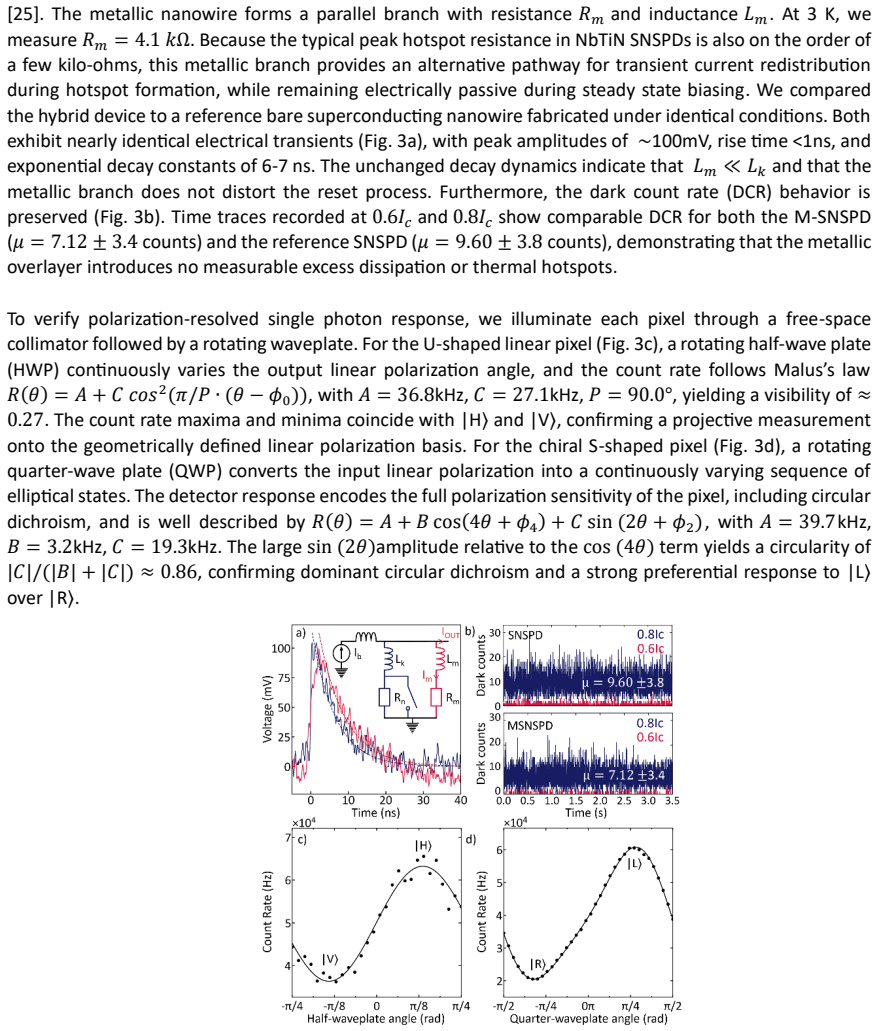
Light polarization is a primary degree of freedom for encoding quantum information. The scaling up of photonic quantum networks and computer architecture depends crucially on its precise characterization. This is typically achieved by placing external waveplates, polarizers, moving mounts, and recently metasurfaces, on top of the detectors. All these solutions complicate integration and scaling. Here we break convention with traditional architecture and present a monolithic, self-aligned metal-superconductor nanowire single photon detector (M-SNSPD) possessing intrinsic full polarization selectivity. Gold nanowires, co-fabricated atop NbTiN superconducting nanowires within the same lithographic footprint, act as polarization-selective plasmonic metamaterials inducing resonant absorption in the NbTiN. U-shaped wires provide linear polarization selectivity, while S-shaped meanders distinguish circular polarization, while retaining the high-count rates and low dark count rates of conventional SNSPDs. By arranging them into a four-pixel array we realize simultaneous projection onto four polarizations and demonstrate continuous polarization state tomography with an ensemble average fidelity exceeding 98%. Our approach opens new avenues towards scalable detector arrays with integrated plasmonic functionalities, for single photon polarimetry, imaging and spectroscopy.
Editorial analysis
A structured set of objections, weighed in public.
Referee Report
Summary. The manuscript presents a four-pixel array of metal-superconductor nanowire single-photon detectors (M-SNSPDs) that performs polarization state tomography without external polarizing optics. Gold nanowires co-fabricated atop NbTiN nanowires act as polarization-selective plasmonic elements: U-shaped geometries select linear polarizations, while chiral S-shaped meanders select circular polarization. The authors calibrate an instrument matrix using six known input states, then reconstruct nineteen test states via constrained maximum likelihood inversion, reporting an ensemble average fidelity exceeding 98%. The approach is supported by FDTD simulations matching reflection spectra, electrical performance comparisons with reference devices, and a Fisher information analysis of the measurement basis.
Significance. The concept of engineering the measurement operator directly into the superconducting nanowire absorption process is a genuine advance over external polarizing optics. The self-aligned fabrication process, preserving SNSPD timing and dark-count performance while adding plasmonic selectivity, is a notable strength. The Fisher information framework (Fig. 5) providing quantitative trade-offs between visibility, efficiency, and photon budget is a valuable contribution. The pixel-removal control (Fig. 5c) cleanly demonstrates that all four pixels are necessary for informationally complete tomography.
major comments (3)
- The 19 test states are not specified anywhere in the manuscript. Without knowing their distribution on the Poincaré sphere relative to the 6 calibration states (|H⟩, |V⟩, |D⟩, |A⟩, |R⟩, |L⟩), one cannot verify that the test set adequately probes poorly measured directions. If test states cluster near calibration states, the constrained maximum likelihood inversion would reconstruct them with artificially high fidelity. This is load-bearing for the central >98% fidelity claim. The authors should list all 19 test states (e.g., as Bloch sphere coordinates or density matrices) and confirm they are well-separated from the calibration set.
- No systematic uncertainty analysis is provided. The measured linear visibility is ~0.27 (Fig. 3c: A=36.8 kHz, C=27.1 kHz) and the condition number is κ≈3.23, indicating a weakly conditioned measurement. The paper's own model (Fig. 5a) identifies a high-count regime 'limited in practice by systematic calibration errors and residual POVM overlap,' but this floor is never quantified. The fidelity traces in Fig. 4b appear to flatten by ~100 ms, which may indicate approach to this systematic floor. The authors should provide: (i) error bars or confidence intervals on the ensemble average fidelity, (ii) individual state fidelities for all 19 test states, and (iii) an estimate of the systematic fidelity floor from calibration uncertainty propagation. Without these, the >98% claim cannot be distinguished from a calibration systematic artifact.
- The full analytical framework, including the Bayesian estimator and Fisher information analysis, is stated to be in Supplementary Information, which was not available for review. Key details—the exact form of the constrained maximum likelihood estimator, the POVM elements for each pixel, and the error propagation from instrument matrix to reconstructed state—are essential for evaluating the tomography claims. These should either be included in the main text or the Supplementary Information must be provided for proper assessment.
minor comments (6)
- Fig. 3c: The visibility of ~0.27 is substantially lower than the simulated ~0.4 (Fig. 2e). The authors attribute discrepancies to fabrication imperfections, but a brief quantitative discussion of this factor-of-~1.5 gap would strengthen the presentation.
- The condition number κ≈3.23 is mentioned without derivation. A brief statement of how it is computed from the instrument matrix would help readers assess the basis quality independently.
- Fig. 4b: The individual fidelity traces (light blue) are difficult to distinguish. Consider using a subset of representative traces or adding labels to improve readability.
- The paper states the array targets |H⟩, |V⟩, |D⟩, and |L⟩, but does not report the actual measured projection axes (i.e., the calibrated POVM elements) for each pixel. Including these would allow readers to verify the informationally complete claim and assess how closely the realized basis matches the design.
- Reference [12] is cited for 'concepts in quantum state tomography' but is a tutorial using intense light. A reference demonstrating single-photon tomography with conventional optics would be more directly comparable.
- The discussion mentions generalizability to spectral, spatial, or OAM degrees of freedom [27], but no quantitative argument is given. A brief note on what modifications would be needed would be relevant for scaling claims.
Simulated Author's Rebuttal
We thank the referee for a careful and constructive review. The referee's three major comments are all well-taken and identify genuine gaps in the manuscript that we will address in revision. We summarize our point-by-point responses below.
read point-by-point responses
-
Referee: The 19 test states are not specified anywhere in the manuscript. Without knowing their distribution on the Poincaré sphere relative to the 6 calibration states, one cannot verify that the test set adequately probes poorly measured directions.
Authors: The referee is correct that the test-state list is essential for evaluating the >98% fidelity claim, and its omission is an oversight on our part. We will include a complete table of all 19 test states as Bloch sphere coordinates (or equivalently, density matrix elements) in the revised manuscript. To preview: the 19 states are distributed across the Poincaré sphere with deliberate coverage of regions far from the calibration states, including states near the weakest measurement direction (the direction of lowest Fisher information, which lies between the |D⟩ and |L⟩ pixel axes). Several test states are chosen at large angular separations (>60°) from all six calibration states. We will also add a figure or table showing the angular separation between each test state and its nearest calibration state, confirming that the test set is not clustered near the calibration set. We agree that without this information the fidelity claim cannot be independently assessed. revision: yes
-
Referee: No systematic uncertainty analysis is provided. The measured linear visibility is ~0.27 and the condition number is κ≈3.23, indicating a weakly conditioned measurement. The paper's own model identifies a high-count regime limited by systematic calibration errors and residual POVM overlap, but this floor is never quantified. The authors should provide: (i) error bars or confidence intervals on the ensemble average fidelity, (ii) individual state fidelities for all 19 test states, and (iii) an estimate of the systematic fidelity floor from calibration uncertainty propagation.
Authors: This is a fair and important criticism. We will address all three requested items in the revised manuscript. (i) We will add error bars (or shaded confidence bands) to the ensemble average fidelity trace in Fig. 4b, computed from photon-counting (Poisson) statistics propagated through the constrained maximum likelihood estimator. (ii) We will provide a table or supplementary figure listing the individual reconstructed fidelity for each of the 19 test states at the final integration time (100 ms), so the reader can verify that no individual state is anomalously low or high. (iii) We will estimate the systematic fidelity floor by propagating the calibration uncertainty in the instrument matrix (arising from finite photon counts during calibration and from the measured visibility) through the inversion, and will report the resulting floor explicitly. We note that the referee's observation about the flattening of fidelity traces near 100 ms is consistent with approach to this systematic floor, and we will discuss this connection in the revised text. We acknowledge that the current manuscript does not distinguish the >98% figure from a possible calibration systematic artifact, and the requested analysis is necessary to do so. revision: yes
-
Referee: The full analytical framework, including the Bayesian estimator and Fisher information analysis, is stated to be in Supplementary Information, which was not available for review. Key details—the exact form of the constrained maximum likelihood estimator, the POVM elements for each pixel, and the error propagation from instrument matrix to reconstructed state—are essential for evaluating the tomography claims.
Authors: We agree that the Supplementary Information is essential for proper assessment and should have been provided with the initial submission. We will supply the complete Supplementary Information for the revised submission, containing: (a) the explicit POVM elements for each of the four pixels, derived from the calibrated count-rate response and normalized detection efficiencies; (b) the full form of the constrained maximum likelihood estimator, including the positivity and trace constraints on the reconstructed density matrix; and (c) the error propagation procedure from instrument-matrix uncertainty to reconstructed-state fidelity. In addition, to ensure the main text is self-contained for readers who do not consult the supplement, we will add a concise summary of the estimator form and POVM construction in the Methods or Tomography section of the main text, with full derivations deferred to the supplement. revision: yes
Circularity Check
No circularity found: the tomography fidelity is validated against externally prepared test states using a separately calibrated instrument matrix, with no self-citation chain or definitional reduction.
full rationale
The paper's central claim—>98% ensemble average fidelity for polarization state tomography—is validated against 19 externally prepared input states (using waveplates) that are independent of the 6-state calibration set. The instrument matrix is calibrated from the 6 known states, and unknown states are reconstructed via constrained maximum likelihood inversion. The theoretical framework (Fisher information, condition number analysis, V^{-2} scaling) uses standard quantum estimation theory with no self-citation chain. The FDTD simulations are compared against measured reflection spectra as independent validation. No step in the derivation chain reduces to its inputs by construction: the calibration states and test states are distinct sets, the theoretical model makes falsifiable predictions about photon budget scaling and fidelity plateaus (confirmed by the pixel-removal experiment in Fig. 5c), and no ansatz or prior result by the same authors is invoked as load-bearing. The concerns raised by the skeptic (low visibility V≈0.27, systematic error quantification, test-state separation) are correctness and methodology risks, not circularity. The derivation is self-contained against external benchmarks.
Axiom & Free-Parameter Ledger
free parameters (3)
- U-shaped nanowire geometry (dimensions, orientation) =
Not specified in main text
- S-shaped meander geometry (dimensions, chirality) =
Not specified in main text
- Instrument matrix calibration (6 input states) =
Calibrated from |H>, |V>, |D>, |A>, |R>, |L>
axioms (3)
- domain assumption FDTD simulations accurately model the plasmonic near-field coupling in the metal-superconductor structure
- domain assumption The equivalent circuit model (kinetic inductance Lk, metallic branch Rm/Lm) accurately describes the electrical dynamics
- standard math Constrained maximum likelihood inversion of the calibrated instrument matrix yields a physical Stokes vector
Reference graph
Works this paper leans on
-
[1]
Two polarization -entangled sources from the same semiconductor chip,
Kang, D., Kim, M., He, H. & Helmy, A. S. "Two polarization -entangled sources from the same semiconductor chip," Phys. Rev. A 92, 013821 (2015)
work page 2015
-
[2]
Long -distance quantum communication with atomic ensembles and linear optics,
Duan, L.-M., Lukin, M. D., Cirac, J. I. & Zoller, P . "Long -distance quantum communication with atomic ensembles and linear optics," Nature 414, 413–418 (2001)
work page 2001
-
[3]
A scheme for efficient quantum computation with linear optics,
Knill, E., Laflamme, R. & Milburn, G. J. "A scheme for efficient quantum computation with linear optics," Nature 409, 46–52 (2001)
work page 2001
-
[4]
Quantum cryptography: Public key distribution and coin tossing,
Bennett, C. H. & Brassard, G. "Quantum cryptography: Public key distribution and coin tossing," Theor. Comput. Sci. 560, 7–11 (2014; originally 1984)
work page 2014
-
[5]
Picosecond superconducting single-photon optical detector,
Gol'tsman, G. N. et al. "Picosecond superconducting single-photon optical detector," Appl. Phys. Lett. 79, 705–707 (2001)
work page 2001
-
[6]
Detecting single infrared photons with 93% system efficiency,
Marsili, F. et al. "Detecting single infrared photons with 93% system efficiency," Nat. Photonics 7, 210– 214 (2013)
work page 2013
-
[7]
Quantum detection by current carrying superconducting film,
Semenov, A. D., Gol'tsman, G. N. & Korneev, A. A. "Quantum detection by current carrying superconducting film," Physica C 351, 349–356 (2000)
work page 2000
-
[8]
Meng, Y . et al. "Fractal superconducting nanowires detect infrared single photons with 84% system detection efficiency, 1.02 polarization sensitivity, and 20.8 ps timing resolution," ACS Photonics 9, 1547–1553 (2022)
work page 2022
-
[9]
Universal response curve for nanowire superconducting single-photon detectors,
Renema, J. J. et al. "Universal response curve for nanowire superconducting single-photon detectors," Phys. Rev. B 87, 174526 (2013)
work page 2013
-
[10]
Xiao, Y . et al. "Ultralow-filling-factor superconducting nanowire single -photon detector utilizing a 2D photonic crystal," Photon. Res. 11, 2128–2135 (2023)
work page 2023
-
[11]
Superconducting-Nanowire Single -Photon Spectrometer Exploiting Cascaded Photonic Crystal Cavities,
Yun, Y . et al. "Superconducting-Nanowire Single -Photon Spectrometer Exploiting Cascaded Photonic Crystal Cavities," Phys. Rev. Appl. 13, 014061 (2020)
work page 2020
-
[12]
Concepts in quantum state tomography and classical implementation with intense light: a tutorial,
Toninelli, E., Ndagano, B., Vallés, A. et al. "Concepts in quantum state tomography and classical implementation with intense light: a tutorial," Adv. Opt. Photon. 11, 67–134 (2019)
work page 2019
-
[13]
Improvement of infrared single-photon detectors absorptance by integrated plasmonic structures,
Csete, M., Sipos, Á., Szalai, A. et al. "Improvement of infrared single-photon detectors absorptance by integrated plasmonic structures," Sci. Rep. 3, 2406 (2013)
work page 2013
-
[14]
Nanoantenna Enhancement for Telecom-Wavelength Superconducting Single Photon Detectors,
Heath, R. M., Tanner, M. G., Drysdale, T. D. et al. "Nanoantenna Enhancement for Telecom-Wavelength Superconducting Single Photon Detectors," Nano Lett. 15, 819–822 (2015)
work page 2015
-
[15]
Novotny, L. & Hecht, B. "Surface plasmons," Principles of Nano -Optics, Cambridge University Press, 369–413 (2012)
work page 2012
-
[16]
Akhlaghi, M. K., Schelew, E. & Young, J. F. "Waveguide integrated superconducting single -photon detectors implemented as near -perfect absorbers of coherent radiation," Nat. Commun. 6, 8233 (2015)
work page 2015
-
[17]
On -chip detection of non -classical light by scalable integration of single -photon detectors,
Najafi, F. et al. "On -chip detection of non -classical light by scalable integration of single -photon detectors," Nat. Commun. 6, 5873 (2015)
work page 2015
-
[18]
Basiri, A., Chen, X., Bai, J. et al. "Nature-inspired chiral metasurfaces for circular polarization detection and full-Stokes polarimetric measurements," Light Sci. Appl. 8, 78 (2019)
work page 2019
-
[19]
Fedotov, V. A., Schwanecke, A. S., Zheludev, N. I., Khardikov, V. V. & Prosvirnin, S. L. "Asymmetric transmission of light and enantiomerically sensitive plasmon resonance in planar chiral nanostructures," Nano Lett. 7, 1996–1999 (2007)
work page 1996
-
[20]
Gold Helix Photonic Metamaterial as Broadband Circular Polarizer,
Gansel, J. K. et al. "Gold Helix Photonic Metamaterial as Broadband Circular Polarizer," Nano Lett. 10, 3596–3603 (2010)
work page 2010
-
[21]
Hentschel, M. et al. "Chiral plasmonics," Sci. Adv. 3, e1602735 (2017)
work page 2017
-
[22]
Triple-helical nanowires by tomographic rotatory growth for chiral photonics,
Esposito, M., Tasco, V., Todisco, F. et al. "Triple-helical nanowires by tomographic rotatory growth for chiral photonics," Nat. Commun. 6, 6484 (2015)
work page 2015
-
[23]
Enhancing the nonlinear response of plasmonic nanowire antennas by engineering their terminations,
Hasan, S. B., Etrich, C., Filter, R., Rockstuhl, C. & Lederer, F. "Enhancing the nonlinear response of plasmonic nanowire antennas by engineering their terminations," Phys. Rev. B 88, 205125 (2013)
work page 2013
-
[24]
Miki, S., Yamashita, T., Terai, H. & Wang, Z. "High performance fiber -coupled NbTiN superconducting nanowire single photon detectors with Gifford -McMahon cryocooler," Opt. Express 21, 10208 –10214 (2013)
work page 2013
-
[25]
Modeling the electrical and thermal response of superconducting nanowire single -photon detectors,
Yang, J. K. W., Kerman, A. J., Dauler, E. A., Anant, V., Rosfjord, K. M. & Berggren, K. K. "Modeling the electrical and thermal response of superconducting nanowire single -photon detectors," IEEE Trans. Appl. Supercond. 17, 581–585 (2007)
work page 2007
-
[26]
Scalable on -chip quantum state tomography,
Titchener, J. G., Gräfe, M., Heilmann, R. et al. "Scalable on -chip quantum state tomography," npj Quantum Inf. 4, 19 (2018)
work page 2018
-
[27]
Entanglement of the orbital angular momentum states of photons,
Mair, A., Vaziri, A., Weihs, G. & Zeilinger, A. "Entanglement of the orbital angular momentum states of photons," Nature 412, 313–316 (2001)
work page 2001
-
[28]
Kimble, H. J. "The quantum internet," Nature 453, 1023–1030 (2008)
work page 2008
discussion (0)
Sign in with ORCID, Apple, or X to comment. Anyone can read and Pith papers without signing in.