REVIEW 3 major objections 5 minor 75 references
Predicting Space Groups of Double Perovskites by LLM with Dynamic Few-Shot Learning
T0 review · 3 major / 5 minor · reviewed 2026-08-15 · deepseek-v4-flash
Pith's one-line read An LLM agent with diversity-limited retrieval and rule-guided ranking improves rare space-group prediction for double perovskites, gaining 3.26 percentage points over the strongest composition-only baseline on minor space-group Top-1…
desk verdict A solid, honest LLM-retrieval method for imbalanced space-group prediction, but the ordering-surrogate train/test split is ambiguous and needs to be resolved before the headline numbers can be fully trusted. read the letter →
The pith
A machine-rendered reading of the paper's core claim, the machinery that carries it, and where it could break.
The reading
What carries the argument
The central object is DyRIS's two-stage decision loop. First, diversity-enhanced dynamic few-shot retrieval: a 161-dimensional composition embedding, built from DP-specific, site, B-site-derived, and Magpie features, with block weights tuned on training data, and each query retrieves its nearest training neighbors under the constraint that no space group contributes more than one in-context example. Second, rule-guided LLM inference: the LLM receives the retrieved examples plus B/B' ordering probabilities from a PyCaret surrogate, a Combined score $CS(s) = \log(1+n_{\mathrm{local}}(s)) \cdot n_{\mathrm{local}}(s)/(N_s+1)$, a Global fit $\mathrm{G_{fit}}(s)$ over six standardized features, and feature-wise z-consistency metrics ($z_{\mathrm{abs\_mean}}$, $z_{\mathrm{max\_abs}}$, $z_{\mathrm{best\_count}}$), while explicit rules retain candidates with high local density, replace them only on converging evidence, admit rare-ordering-compatible candidates when supported, and hold SG 14 and SG 225 to a higher Top-1 bar. The machinery's work is to convert a class-imbalanced nearest-neighbor problem into an evidence-combination problem that the LLM resolves per query.
What would settle it
Retrain the PyCaret ordering surrogate under a strict training/test split and rerun DyRIS at a 0.5 training ratio, then check whether Minor-SG Top-1 accuracy still beats CrabNet by 3.26 percentage points; a second check is to randomize the ordering probabilities supplied to the LLM and measure how much Minor-SG Top-1 changes, because if the gain persists, ordering evidence is not carrying the effect.
Extended reading notes
Core claim
On the paper's own terms, the central discovery is that space-group prediction on a heavily imbalanced double-perovskite dataset can be improved for the rare classes by making the LLM's evidence dynamic and class-balanced rather than relying on the model's static knowledge or a fixed training set. The proposed pipeline retrieves five in-context examples nearest to the query in a weighted composition embedding but enforces at most one example per space group, so the two majority classes, SG 14 and SG 225, which together account for 72% of the data, cannot dominate the prompt. It then hands the LLM a structured query containing B/B' ordering probabilities, a Combined score measuring local class density, Global fit and feature-wise z-consistency relative to each candidate's training distribution, and explicit instructions to rank the majority SGs at Top-1 only when multiple indicators agree. On five random 50/50 splits, the framework reaches 0.4266 Overall Top-1 accuracy and 0.3762 Minor-SG Top-1 accuracy, gains 3.26 percentage points over CrabNet on Minor-SG Top-1, and attains the best Overall Top-1 macro-F1 and Minor-SG metrics among the compared models. The paper's explanation for the gain is integration: retrieval narrows the candidate set, quantitative indicators stabilize decisions for classes with few samples, ordering information acts as a soft crystallographic prior that matters most when the candidate set is crowded, and bias control stops the majority classes from being overpicked.
Load-bearing premise
The load-bearing premise is that the B/B' ordering surrogate model used to supply soft ordering evidence is trained on the training split alone; if it was fitted on the full dataset, the ordering information for test queries would leak the very structures whose space groups are being predicted, and the reported minor-SG gains could be inflated.
Editorial extensions
If this is right
- At a 0.5 training-data ratio, DyRIS matches CrabNet on overall Top-1 accuracy while improving Minor-SG Top-1 by 3.26 percentage points and beating the strongest PyCaret baseline on Minor-SG Top-3.
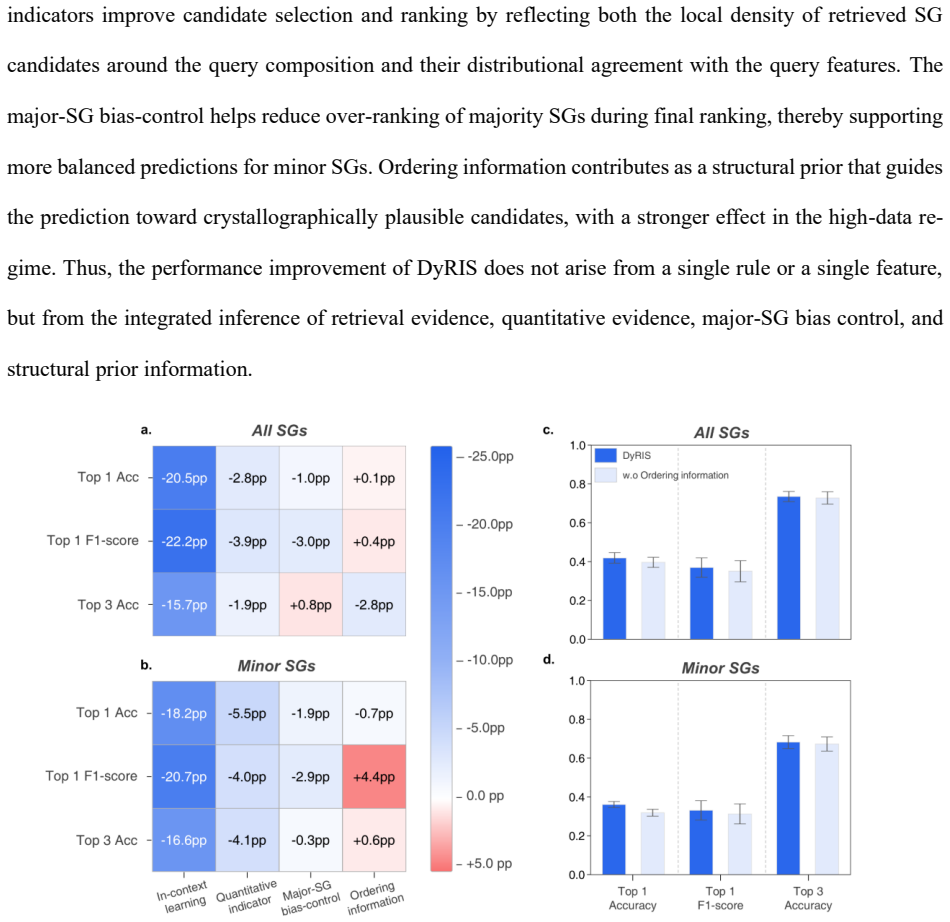
- The retrieved in-context examples are the load-bearing component: removing them drops Overall Top-3 accuracy from 0.6994 to 0.5424 and Overall Top-1 accuracy from 0.4266 to 0.2214.
- Quantitative indicators mainly stabilize minor-SG decisions: removing them decreases Minor-SG Top-1 accuracy by about 5.5 percentage points at a training-data ratio of 0.5.
- B/B' ordering information becomes a useful soft prior as data grow: at a training-data ratio of 0.8, removing it lowers Minor-SG Top-1 accuracy by about 4.2 percentage points.
- The final LLM ranking step outperforms conventional classifiers and learning-to-rank models trained on the same candidate evidence, with the largest gaps on Minor-SG Top-1 metrics.
Reading between the lines
- The same retrieval-diversity plus rule-guided ranking recipe should transfer to other imbalanced structure-prediction tasks, such as simple perovskites, Heusler compounds, or mineral paragenesis classes, where majority classes dominate and fixed embeddings are less reliable; the paper demonstrates it only on double perovskites.
- Because the paper leaves unclear whether the B/B' ordering surrogate is trained only on the training split, an immediate test is to retrain that surrogate under a strict split and see whether the minor-SG gains survive; if the surrogate saw test structures, the reported 3.26-point gain is an upper bound.
- The class-dependent ranking diagnosis suggests a cheap improvement: trust retrieval order for majority classes while applying evidence-integrated ranking for minor classes; the paper's own hybrid experiment is a heuristic first step in that direction.
Signed reviews
Editorial analysis
A structured set of objections, weighed in public.
Referee Report
Summary. The paper proposes DyRIS, an LLM-agent framework for predicting space groups of double perovskites from composition. DyRIS uses diversity-enhanced dynamic few-shot retrieval in a weighted feature embedding to select in-context examples while restricting per-SG representation, and a rule-guided inference step that combines B/B′ ordering probabilities from a PyCaret surrogate, quantitative indicators (Combined score, Global fit, z-consistency), and major-SG bias control to produce ranked Top-3 SGs. The authors evaluate on 3,528 thermodynamically filtered DP entries across 19 SG classes at data ratios 0.3/0.5/0.8, comparing against PyCaret, CrabNet, and CRYSPNet. They report competitive overall accuracy, best macro-F1 and minor-SG metrics at ratio 0.5, and a 3.26 percentage-point improvement in Minor-SG Top-1 accuracy over CrabNet. Ablations and replacement experiments indicate each component contributes, and the final rule-guided inference is not trivially replaced by supervised re-rankers. The paper also transparently documents a high-data limitation in which final ranking demotes correct major-SG Top-1 predictions.
Significance. If the results are reproducible, the paper makes a useful contribution to composition-based space-group prediction under severe class imbalance: it combines LLM in-context learning with crystallographic priors and provides a concrete instance where LLM-based rule inference outperforms conventional imbalanced-learning baselines for minor classes. Strengths include the systematic evaluation over repeated splits, the data-ratio sensitivity analysis, the component ablations, the replacement experiments with learned re-rankers, and the candid analysis of the high-data Top-1 degradation. The method is falsifiable in the sense that the prompt template and inference rules are fully specified in the SI, and the design choices are motivated. However, the absence of code and of repeated LLM sampling, together with an underspecified surrogate training protocol, currently prevents verification of the headline numerical claims.
major comments (3)
- [2.4.1 / SI S3] The construction of the B/B′ ordering surrogate does not explicitly state that the surrogate was trained only on the training split. Section S3 says the surrogate was evaluated on the test data and that ordering labels were derived from the same structure files whose SGs are the prediction target, but it does not report the surrogate's training split. If the surrogate was fit on the full dataset, the ordering probabilities injected into every DyRIS prompt would encode information derived from the test structures, which could inflate the reported minor-SG gains, particularly the 4.24 percentage-point ordering-ablation decrease at ratio 0.8 and the ratio-0.5 headline metrics. Please state unambiguously that the surrogate is trained exclusively on the training split or, if that is not the case, retrain it under the correct protocol and rerun the affected tables.
- [Table 1 / Section 3.1.1] The evaluation does not account for LLM sampling stochasticity. Table 1 sets temperature to 1.0, yet the reported mean ± standard deviation in Figures 2 and 3 and Tables 3 and 4 appears to be computed from a single LLM response per query per split. At temperature 1.0, the rule-guided inference is stochastic, so the five-split standard deviations reflect only split variability, not model stochasticity; the 'best' claims are therefore not supported by any measure of run-to-run variability. Please either run multiple LLM samples per query and aggregate, or lower the temperature and justify the single-sample protocol.
- [Section 3.1.1 / Table 3] The 'best across all metrics' claims are not accompanied by significance tests or confidence intervals. For example, at ratio 0.5 the Overall Top-1 macro-F1 difference between DyRIS and CrabNet is about 0.02 (0.3846 vs 0.365), which may be within the noise of five splits, and several Minor-SG Top-3 differences are small. Without paired tests or effect-size reporting, the superiority claims are not statistically established. Please add appropriate significance tests or clearly label differences as not statistically significant.
minor comments (5)
- [Table 3] The header of Table 3 appears corrupted: the column labels 'SG87 SG139 Minor SGs SG201' are not metric names. Please replace them with the six metric names listed in the caption or with a clear abbreviation and define the abbreviation in the table notes.
- [Section 3.1.2] The sentence 'we varied the training-data ratio from 0.3, 0.5, and 0.8' is ungrammatical; it should read 'to 0.3, 0.5, and 0.8' or 'at 0.3, 0.5, and 0.8'.
- [Section 2.3 / SI S2] The feature-block weighting procedure should state how each feature block is scaled before concatenation and before computing weighted distances. Without per-feature normalization, the 132-dimensional Magpie block may dominate the weighted Euclidean distance used for retrieval.
- [SI Table S3] The metric labeled 'Overall Top-1 accuracy' in Table S3 is actually an ordering-compatible coverage fraction, not a classification accuracy. Please rename the row to avoid confusion.
- [General reproducibility] The manuscript contains no code or data availability statement. Providing a repository with the feature construction, prompt templates, and evaluation scripts would substantially improve reproducibility of the LLM pipeline and the baseline comparisons.
Circularity Check
No significant circularity: DyRIS is evaluated on a held-out test set and no predicted quantity reduces to a fitted input by the paper's own equations.
full rationale
The central derivation chain is a standard supervised pipeline: the training split fits the feature-block weights, the ordering surrogate, and the baseline models, while the test split is held out for evaluation. DyRIS predictions are produced by retrieving labeled in-context examples from the training pool and asking the LLM to rank candidates using quantitative indicators computed from training distributions, so test SG labels enter only as ground truth for evaluation, not as prompt inputs. The feature-block weighting is selected on training-data macro-F1 (Section 2.3) and the major-SG bias control encodes a stated preference for minority classes, but neither is a fitted target renamed as a prediction; both are design choices whose effects are measured on held-out data. The only self-citation (ref. 35) is an example of LLM-based materials generation and is not load-bearing. SI Section 3 does not explicitly state the train/test protocol of the B/B' ordering surrogate, and if that surrogate were trained on the full dataset, its ordering evidence would leak test structure information into the prompts; however, the manuscript's statement that 'the training set was used to implement DyRIS' and the leave-one-out construction used for the learned re-ranking evidence suggest train-only use. Without a quoted equation or procedure that demonstrably feeds test labels into the prediction, this is a documentation and leakage risk rather than a demonstrated circular step. No circular step meeting the required evidence standard was found.
Assumptions & free parameters
free parameters (1)
- Feature-block embedding weights (a,b,c,d) =
not reported in paper
assumptions (5)
- domain assumption Thermodynamic stability filtering with E_hull <= 0.1 eV/atom identifies stable or metastable double perovskites.
- domain assumption The composition-based feature vector (DP-specific, site, B-site-derived, Magpie) captures information sufficient for space-group prediction.
- domain assumption The pretrained LLM gpt-5.4-mini contains reliable crystallographic and chemical knowledge for rule-guided inference.
- ad hoc to paper The hand-crafted rule-guided inference policies (Top-3 inclusion, ranking, major-SG bias control) are valid crystallographic constraints.
- domain assumption The test-set cap of 30 samples per space group provides a fair evaluation of minor-SG performance.
Cite this review
Pith. "Pith review of Predicting Space Groups of Double Perovskites by LLM with Dynamic Few-Shot Learning." pith.science (2026). https://pith.science/paper/BZLC2ON4
@misc{pith2026260810483,
  author       = {Pith},
  title        = {Pith review of: Predicting Space Groups of Double Perovskites by LLM with Dynamic Few-Shot Learning},
  year         = {2026},
  howpublished = {\url{https://pith.science/paper/BZLC2ON4}},
  note         = {Machine review of arXiv:2608.10483}
}
read the original abstract
Double perovskites (DPs) offer broad compositional tunability, but predicting the space groups (SGs) of stable structures remains difficult because available datasets are often strongly imbalanced toward dominant SG classes. We refer to dominant SG classes as major SGs and underrepresented classes as minor SGs. We introduce Dynamic and Diversity-enhanced Few-shot Retrieval and Rule-Guided Inference for Space-Group Prediction (DyRIS), an LLM-agent-based framework that predicts ranked SG candidates from a given DP composition. DyRIS uses diversity-enhanced dynamic few-shot prompting to retrieve relevant in-context examples while limiting the dominance of frequently represented SGs. It further incorporates rule-guided inference based on B/B' cation ordering, quantitative indicators, and major-SG bias control to refine and rank the final Top-3 SG candidates. We evaluate DyRIS on 3,528 thermodynamically filtered DP entries and compare it with composition-based and descriptor-based baselines. At a training-data ratio of 0.5, DyRIS achieves competitive overall accuracy while obtaining the best Overall Top-1 macro-F1 score and the best performance across all Minor-SG metrics. DyRIS improves Minor-SG Top-1 accuracy by 3.26 percentage points relative to CrabNet and achieves higher Minor-SG Top-3 accuracy than the strongest PyCaret-based baseline. Ablation studies show that diversity-enhanced retrieval, quantitative indicators, major-SG bias control, and B/B' ordering information each contribute to prediction performance. Additional experiments show that the final rule-guided inference step is not easily replaced by conventional classifier- or ranker-based models. These findings demonstrate the potential of combining retrieval-based LLM reasoning with crystallographic domain knowledge for SG prediction in imbalanced materials datasets.
Figures

Reference graph
Works this paper leans on
- [1]
-
[2]
Kumar, V., Kathiravan, A. & Jhonsi, M. A. Beyond lead halide perovskites: Crystal structure, bandgaps, photovoltaic properties and future stance of lead-free halide double perovskites. Nano Energy 125, 109523 (2024)
work page 2024
- [3]
-
[4]
Jin, L. et al. Ferromagnetic Double Perovskite Semiconductors with Tunable Properties. Advanced Science 9, 2104319 (2022)
work page 2022
-
[5]
Khalfin, S. & Bekenstein, Y. Advances in lead-free double perovskite nanocrystals, engineering band-gaps and enhancing stability through composition tunability. Nanoscale 11, 8665–8679 (2019)
work page 2019
-
[6]
Yin, W.-J. et al. Oxide perovskites, double perovskites and derivatives for electrocatalysis, photo- catalysis, and photovoltaics. Energy Environ. Sci. 12, 442–462 (2019)
work page 2019
-
[7]
Kung, P.-K. et al. Lead‐Free Double Perovskites for Perovskite Solar Cells. Solar RRL 4, 1900306 (2020)
work page 2020
-
[8]
Muscarella, L. A. & Hutter, E. M. Halide Double-Perovskite Semiconductors beyond Photovolta- ics. ACS Energy Lett. 7, 2128–2135 (2022)
work page 2022
Show all 75 references
-
[9]
Albalawi, H. et al. Study of optical and thermoelectric properties of double perovskites Cs2KTlX6 (X = Cl, Br, I) for solar cell and energy harvesting. Mater. Today Commun. 32, 104083 (2022)
2022
-
[10]
& Zhu, X
Tang, Q. & Zhu, X. Half-metallic double perovskite oxides: recent developments and future per- spectives. J. Mater. Chem. C Mater. 10, 15301–15338 (2022)
2022
-
[11]
W., Noor, N
Zanib, M., Iqbal, M. W., Noor, N. A., Ismayilova, N. A. & Saad H.-E, M. M. Study of optoelec- tronic, magnetic, and thermoelectric properties of Sr2XOsO6 (X = Y, Lu, Sc) double perovskites for spintronic and data storage devices. Mater. Chem. Phys. 329, 130026 (2025)
2025
-
[12]
& Zdorovets, M
Kozlovskiy, A., Kenzhina, I. & Zdorovets, M. Synthesis, phase composition and magnetic proper- ties of double perovskites of A(FeM)O4-x type (A=Ce; M=Ti). Ceram. Int. 45, 8669–8676 (2019)
2019
-
[13]
Qu, H. et al. B-site co-doping-induced symmetry breaking for enhanced optoelectronic properties in vacancy-ordered double perovskites. J. Mater. Chem.A. 2026; 14(27): 17197–17206. https://doi.org/10.1039/D5TA09254J (2026)
2026 doi
-
[14]
E., Ganose, A
Maughan, A. E., Ganose, A. M., Almaker, M. A., Scanlon, D. O. & Neilson, J. R. Tolerance Fac- tor and Cooperative Tilting Effects in Vacancy-Ordered Double Perovskite Halides. Chemistry of Materials 30, 3909–3919 (2018)
2018
-
[15]
Albrecht, E. K. & Karttunen, A. J. Structural principles of cation ordering and octahedral tilting in A-site ordered double perovskites: ferroelectric CaMnTi 2 O 6 as a model system. Dalton Transac- tions 51, 16508–16516 (2022)
2022
-
[16]
& Wolverton, C
Wang, Y., Baldassarri, B., Shen, J., He, J. & Wolverton, C. Landscape of Thermodynamic Stabili- ties of A 2 BB ′O 6 Compounds. Chemistry of Materials 36, 6816–6830 (2024)
2024
-
[17]
& Karppinen, M
Vasala, S. & Karppinen, M. A2B′B″O6 perovskites: A review. Progress in Solid State Chemistry 43, 1–36 (2015)
2015
-
[18]
Yadav, S., Kumar, D., Yadav, R. S. & Singh, A. K. Recent progress on optical properties of dou- ble perovskite phosphors. Progress in Solid State Chemistry 69, 100391 (2023)
2023
-
[19]
Octahedral tilting and B-site off-centering in halide per- ovskites are not coupled
Hylton-Farrington, C.M., Remsing, R.C. Octahedral tilting and B-site off-centering in halide per- ovskites are not coupled. Nat Commun 17, 4345 (2026). https://doi.org/10.1038/s41467-026- 70882-6
2026 doi
-
[20]
& Senn, M
Simpson, S. & Senn, M. S. Octahedral Tilting in Perovskite Polytypes. Chemistry of Materials 37, 4524–4533 (2025)
2025
-
[21]
& Naeimi-Sadigh, A
Sabagh Moeini, A., Shariatmadar Tehrani, F. & Naeimi-Sadigh, A. Machine learning-enhanced band gaps prediction for low-symmetry double and layered perovskites. Sci. Rep. 14, 26736 (2024)
2024
-
[22]
& Carvalho, P
Venkatraman, V. & Carvalho, P. A. On the value of popular crystallographic databases for ma- chine learning prediction of space groups. Acta Mater. 240, 118353 (2022)
2022
-
[23]
Liang, H., Stanev, V., Kusne, A. G. & Takeuchi, I. CRYSPNet: Crystal structure predictions via neural networks. Phys. Rev. Mater. 4, 123802 (2020)
2020
-
[24]
Zeni, C. et al. A generative model for inorganic materials design. Nature 639, 624–632 (2025)
2025
-
[25]
Li, K. et al. Probing out-of-distribution generalization in machine learning for materials. Commun. Mater. 6, 9 (2025)
2025
-
[26]
H., Mannodi-Kanakkithodi, A
Tenorio, M., Rahman, M. H., Mannodi-Kanakkithodi, A. & Chapman, J. Out-of-distribution ma- chine learning for materials discovery: Challenges and opportunities. Chemical Physics Reviews 7 (1), (2026)
2026
-
[27]
& Krishnan, N
Miret, S. & Krishnan, N. M. A. Enabling large language models for real-world materials discov- ery. Nat. Mach. Intell. 7, 991–998 (2025)
2025
-
[28]
& Reddy, C
Abhyankar, N., Kabra, S., Desai, S. & Reddy, C. K. LLEMA: Evolutionary Search with LLMs for Multi-Objective Materials Discovery. ICLR (2026)
2026
-
[29]
Jiang, X. et al. Applications of natural language processing and large language models in materials discovery. NPJ Comput. Mater. 11, 79 (2025)
2025
-
[30]
Zimmermann, Y. et al. 32 examples of LLM applications in materials science and chemistry: to- wards automation, assistants, agents, and accelerated scientific discovery. Mach. Learn. Sci. Tech- nol. 6, 030701 (2025)
2025
-
[31]
Zaki, M., Jayadeva, Mausam & Krishnan, N. M. A. MaScQA: investigating materials science knowledge of large language models. Digital Discovery 3, 313–327 (2024)
2024
-
[32]
Ahlawat, D., Mishra, V., Singh, S. et al. A family of large language models for materials research with insights into model adaptability in continued pretraining. Nat Mach Intell 8, 435–448 (2026). https://doi.org/10.1038/s42256-026-01199-8
2026 doi
-
[33]
& Fung, V
Jia, S., Zhang, C. & Fung, V. LLMatDesign: Autonomous Materials Discovery with Large Lan- guage Models. arXiv:2406.13163 (2024)
2024 arXiv
-
[34]
& Buehler, M
Ghafarollahi, A. & Buehler, M. J. ProtAgents: protein discovery via large language model multi- agent collaborations combining physics and machine learning. Digital Discovery 3, 1389–1409 (2024)
2024
-
[35]
& Ryu, S
Lee, I., Lee, J., Park, J., Lim, K. & Ryu, S. Enhanced Conditional Generation of Double Perov- skite by Knowledge-Guided Language Model Feedback. arXiv:2511.22307 (2025)
2025
-
[36]
Tawfik, S. A. et al. Machine learning-based discovery of vibrationally stable materials. NPJ Com- put. Mater. 9, 5 (2023)
2023
-
[37]
& Herrera, F
López, V., Fernández, A., García, S., Palade, V. & Herrera, F. An insight into classification with imbalanced data: Empirical results and current trends on using data intrinsic characteristics. Inf. Sci. (N. Y). 250, 113–141 (2013)
2013
-
[38]
Shannon, R. D. Revised effective ionic radii and systematic studies of interatomic distances in hal- ides and chalcogenides. Acta Crystallographica Section A 32, 751–767 (1976)
1976
-
[39]
Travis, W., Glover, E. N. K., Bronstein, H., Scanlon, D. O. & Palgrave, R. G. On the application of the tolerance factor to inorganic and hybrid halide perovskites: a revised system. Chem. Sci. 7, 4548–4556 (2016)
2016
-
[40]
Fu, W. T. & IJdo, D. J. W. On the space group of the double perovskite Ba2PrIrO6. J. Solid State Chem. 178, 1312–1316 (2005)
2005
-
[41]
& Etheridge, J
Li, W., Hao, M., Baktash, A., Wang, L. & Etheridge, J. The role of ion migration, octahedral tilt, and the A-site cation on the instability of Cs1-xFAxPbI3. Nat. Commun. 14, 8523 (2023)
2023
-
[42]
A., Protsenko, N
Bokov, A. A., Protsenko, N. P. & Ye, Z.-G. Relationship between ionicity, ionic radii and or- der/disorder in complex perovskites. Journal of Physics and Chemistry of Solids 61, 1519–1527 (2000)
2000
-
[43]
& Woodward, P
King, G. & Woodward, P. M. Cation ordering in perovskites. J. Mater. Chem. 20, 5785 (2010)
2010
-
[44]
Zhao, Y. et al. Machine Learning-Based Prediction of Crystal Systems and Space Groups from Inorganic Materials Compositions. ACS Omega 5, 3596–3606 (2020)
2020
-
[45]
& Wolverton, C
Ward, L., Agrawal, A., Choudhary, A. & Wolverton, C. A general-purpose machine learning framework for predicting properties of inorganic materials. NPJ Comput. Mater. 2, 16028 (2016)
2016
-
[46]
Li, Y., Dong, R., Yang, W. & Hu, J. Composition based crystal materials symmetry prediction us- ing machine learning with enhanced descriptors. Comput. Mater. Sci. 198, 110686 (2021)
2021
-
[47]
Liu, J. et al. What Makes Good In-Context Examples for GPT-3? in Proceedings of Deep Learn- ing Inside Out (DeeLIO 2022): The 3rd Workshop on Knowledge Extraction and Integration for Deep Learning Architectures 100–114 (Association for Computational Linguistics, Stroudsburg, P...
2022
-
[48]
& Gao, D
Zhu, Y., Wang, Z. & Gao, D. Gravitational fixed radius nearest neighbor for imbalanced problem. Knowl. Based. Syst. 90, 224–238 (2015)
2015
-
[49]
Z., Wallace, E., Feng, S., Klein, D
Zhao, T. Z., Wallace, E., Feng, S., Klein, D. & Singh, S. Calibrate Before Use: Improving Few- Shot Performance of Language Models. (2021)
2021
-
[50]
Gupta, K. et al. How Robust are LLMs to In-Context Majority Label Bias? (2023)
2023
-
[51]
& Morency, L.-P
Baltrusaitis, T., Ahuja, C. & Morency, L.-P. Multimodal Machine Learning: A Survey and Taxon- omy. IEEE Trans. Pattern Anal. Mach. Intell. 41, 423–443 (2019)
2019
-
[52]
& Geng, B
Zhao, F., Zhang, C. & Geng, B. Deep Multimodal Data Fusion. ACM Comput. Surv. 56, 1–36 (2024)
2024
-
[53]
& POEPPELMEIER, K
ANDERSON, M., GREENWOOD, K., TAYLOR, G. & POEPPELMEIER, K. B-cation arrange- ments in double perovskites. Progress in Solid State Chemistry 22, 197–233 (1993)
1993
-
[54]
P., Shaikh, M
Ghosh, A., Palanichamy, G., Trujillo, D. P., Shaikh, M. & Ghosh, S. Insights into Cation Ordering of Double Perovskite Oxides from Machine Learning and Causal Relations. Chemistry of Materi- als 34, 7563–7578 (2022)
2022
-
[55]
& Delany, S
Cunningham, P. & Delany, S. J. k-Nearest Neighbour Classifiers - A Tutorial. ACM Comput. Surv. 54, 1–25 (2022)
2022
-
[56]
LDBNN: A Local Density-based Nearest Neighbor Classifier
Carbonera, J. LDBNN: A Local Density-based Nearest Neighbor Classifier. in Proceedings of the 23rd International Conference on Enterprise Information Systems 395–401 (SCITEPRESS - Sci- ence and Technology Publications, 2021)
2021
-
[57]
& Massart, D
De Maesschalck, R., Jouan-Rimbaud, D. & Massart, D. L. The Mahalanobis distance. Chemomet- rics and Intelligent Laboratory Systems 50, 1–18 (2000)
2000
-
[58]
Y.-T., Kauwe, S
Wang, A. Y.-T., Kauwe, S. K., Murdock, R. J. & Sparks, T. D. Compositionally restricted atten- tion-based network for materials property predictions. NPJ Comput. Mater. 7, 77 (2021). Supporting Information Predicting Space Groups of Double Perovskites by LLM with Dynamic Few-S...
2021
-
[59]
In this study, oxidation states were assigned using a three-step procedure based primarily on charge neutrality
Composition-based feature construction 1.1 Oxidation-state assignment The construction of DP-specific features requires consistent assignment of oxidation states because Shan- non ionic radii depend on both oxidation state and coordination environment. In this study, oxidation...
-
[60]
The final composition -based feature vector consists of four feature blocks: site features, DP -specific features, B-site-derived features, and Magpie features
Feature-block weighting for embedding construction To construct a more informative embedding space for diversity -enhanced dynamic few-shot retrieval, we introduced feature-block weighting. The final composition -based feature vector consists of four feature blocks: site featu...
-
[61]
Therefore, ordering labels were assigned from the available structure files, including CIF and POSCAR files
B/B′ ordering surrogate model The collected DP dataset did not include explicit B/B′ cation-ordering labels. Therefore, ordering labels were assigned from the available structure files, including CIF and POSCAR files. We used pymatgen to analyze the local coordination environm...
-
[62]
Auxiliary terms that are not defined in the main text, including contradiction_count, SG_knn, and SG_fit, are defined within the prompt
Prompt and query template for rule-guided LLM inference The following prompt template was used for rule -guided LLM inference in DyRIS. Auxiliary terms that are not defined in the main text, including contradiction_count, SG_knn, and SG_fit, are defined within the prompt. The ...
-
[63]
z value z = (query_feature - SG_training_mean) / SG_training_std A smaller absolute z value means that the query feature is more typical of the candidate SG distribution
-
[64]
A larger combined_score means stronger local support
combined_score combined_score measures the local SG support around the query composition in the embedding space. A larger combined_score means stronger local support. combined_score is the primary anchor for determining Top-3 inclusion
-
[65]
global_fit global_fit = sqrt(z_tf^2 + z_of^2 + z_rA^2 + z_ratio^2 + z_Delta_rB^2 + z_Delta_EN^2) A smaller global_fit means that the query is more typical of the SG-wise training distribution
-
[66]
Interpret it as follows: - z_abs_mean: smaller is better
feature-wise z consistency feature-wise z consistency means that the absolute z values of the features are generally small and that there is no excessive mismatch in any specific feature. Interpret it as follows: - z_abs_mean: smaller is better. - z_max_abs: smaller is better....
-
[67]
Because rare ordering types are uncommon, the rare ordering probabilities given in the query may be numerically small
ordering probability Ordering probabilities are soft evidence for the B/B' ordering tendency. Because rare ordering types are uncommon, the rare ordering probabilities given in the query may be numerically small. A rare-ordering signal should not be ignored solely because its ...
-
[68]
This default Top-3 is the primary candidate set
Combined-score anchor Start from the three candidates with the highest combined_score. This default Top-3 is the primary candidate set
-
[69]
Candidates that appear in both the combined-score Top-3 and the KNN Top-3 should be strongly retained in the final Top-3
KNN-consensus retention Also consider the three earliest KNN retrieved candidates as independent local-analogy evidence. Candidates that appear in both the combined-score Top-3 and the KNN Top-3 should be strongly retained in the final Top-3
-
[70]
Boundary candidate comparison If the combined-score Top-3 and the KNN Top-3 disagree, compare candidates that appear in only one of the two groups. Prefer candidates supported by several converging signals: - compatibility with the dominant ordering or relevant rare ordering -...
-
[71]
When the other evidence is comparable, prefer candidates compatible with the dominant ordering
Role of ordering Ordering compatibility is important for Top-3 inclusion. When the other evidence is comparable, prefer candidates compatible with the dominant ordering. A rare-ordering-compatible candidate may be retained or promoted when a rare -ordering signal exists and th...
-
[72]
This setting used the same train/test splits as those used in Section 3.1.1
Performance of retrieval-only prediction To examine whether the retrieval stage alone is sufficient for SG prediction, we evaluated a retrieval-only setting at a training -data ratio of 0.5. This setting used the same train/test splits as those used in Section 3.1.1. The weigh...
-
[73]
To this end, we compared full DyRIS with DyRIS without ordering information at training-data ratios of 0.5 and 0.8
Effect and actionability of ordering information 6.1 Ordering ablation across training-data ratios Because the effect of ordering information was limited and mixed at a training-data ratio of 0.5, we further examined whether ordering information should be retained in the DyRIS...
-
[74]
In these cases, the DyRIS-selected Top-1 SG corresponds to the ground-truth SG
Quantitative-indicator analysis of minor-SG correction cases To examine how DyRIS corrected retrieval-only Top-1 errors for minor SGs, we analyzed cases in which the ground-truth label was a minor SG, the retrieval -only Top-1 prediction was incorrect, and the final DyRIS Top-...
-
[75]
First, the hybrid approach applies a DyRIS-aware Top-1 preservation rule
DyRIS–PyCaret hybrid heuristic The heuristic rules used for the DyRIS–PyCaret hybrid approach are summarized below. First, the hybrid approach applies a DyRIS-aware Top-1 preservation rule. If the Top-1 candidate predicted by DyRIS appears within the Top -2 candidates predicte...
Reviewed August 15, 2026 · model on record in the stance chip above.
Discussion (0). Continue with ORCID to comment.