REVIEW 4 major objections 5 minor 64 references
Unifying the Extremes: Developing a Unified Model for Detecting and Predicting Extremist Traits and Radicalization
T0 review · 4 major / 5 minor · reviewed 2026-08-10 · deepseek-v4-flash
Pith's one-line read Language scores predict extremist forum entry up to 10 months early
desk verdict A genuinely useful synthesis of psychometric scales into 11 factors, with public code and honest limitations, but the headline incel early-warning AUC is not yet evidence of trait-based prediction because of factor leakage and unmatched controls. read the letter →
The pith
A machine-rendered reading of the paper's core claim, the machinery that carries it, and where it could break.
The reading
What carries the argument
The Extremist Eleven factor model is the load-bearing object. It is built by encoding both posts and questionnaire items with a pretrained embedding model, scoring each 100-word chunk of a post by cosine similarity to each of 89 self-report items, mean-aggregating chunk scores to post scores, and then applying exploratory factor analysis across the pooled corpus; the eleven resulting orthogonal factors give each post, user, and forum an eleven-dimensional extremism profile. Those profiles are what power both the cross-ideology comparisons and the logistic-regression forecasts of future forum joining.
What would settle it
Re-run the incel prediction experiment with a factor model estimated only on pre-entry training posts and a control group matched on posting frequency, subreddit topics, and activity timing; if the pre-entry AUC drops to chance, the signal is an artifact of event definition or factor leakage rather than a marker of radicalization.
Extended reading notes
Core claim
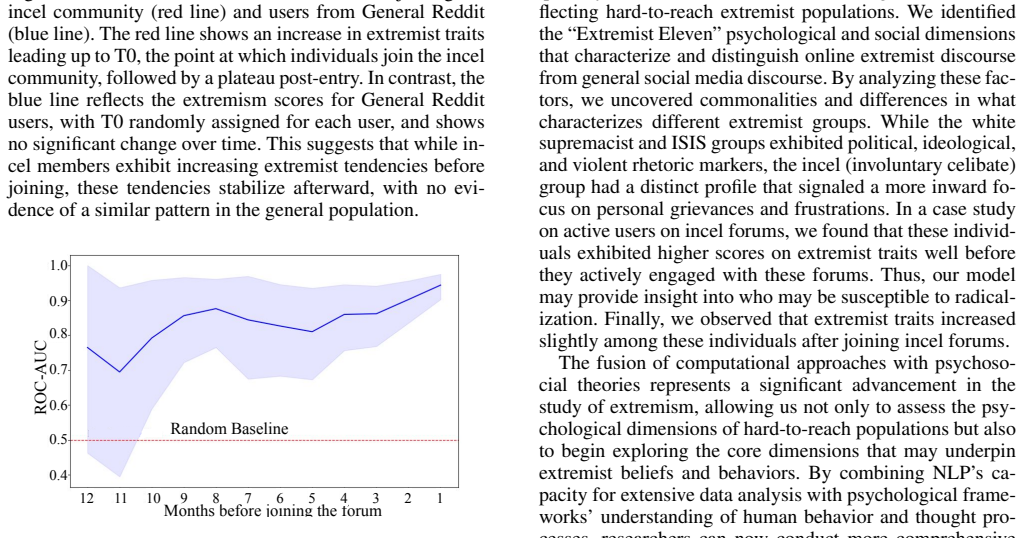
The paper's central claim is that a single unsupervised factor model, estimated from language alone, captures psychosocial dimensions shared across ideologically different forms of extremism and can detect them in individuals before they affiliate. The pipeline scores each post by cosine similarity against 89 first-person items from ten psychometric scales, aggregates the item scores, and runs exploratory factor analysis on the pooled corpus; Horn's parallel analysis selects eleven factors, named Revolutionary Attitude, Radical and Violent Intent, Social Dominance Orientation, Cold and Calculating, State Control, Moral Detachment, Nationalism, Dogmatism, Anti-capitalism, Xenophobia, and National Self-interest. Applied to 82 users who later joined incel forums and 100 general Reddit users, the average factor scores feed a logistic regression that separates future incel joiners from general users with AUC greater than 0.6 eight to ten months before the first incel post, rising to about 0.9 three to four months before. The same scores show that incel users' extremism levels climb in the months before joining and then plateau, rather than escalating inside the forum.
Load-bearing premise
The early-warning result rests on treating a user's first post in an incel subreddit as the moment of joining and treating a general Reddit user's first post in any new subreddit as a comparable 'join' event; if those two events are not comparable in topic, activity level, or timing, the model's separation could be about those differences rather than about extremism.
Editorial extensions
If this is right
- The reported AUC trajectory implies that ordinary, non-extremist post history contains detectable radicalization signals months before a user first participates in an extremist forum.
- The finding that extremism scores plateau after entry suggests that extremist forums are more likely gathering places for people already moving toward extremism than amplifiers that push members further once inside.
- Because the same eleven factors describe white supremacist, incel, and ISIS texts, researchers can compare ideologies on shared psychosocial dimensions rather than separate trait-specific models.
- Elevated radical-and-violent-intent and xenophobia scores in banned political subreddits indicate the factor model can also characterize communities, not just individuals.
Reading between the lines
- A direct extension the paper leaves open: apply the same pipeline to users who first join a non-extremist subreddit, matched on activity and topic, to test whether the advanced signal is specific to radicalization or common to any new-community entry.
- The factor model is estimated on the full pooled corpus, including the users later scored for prediction; re-estimating the factors on training folds only would show how much of the reported AUC depends on that in-sample measurement model.
- If the plateau after entry generalizes, the practical window for intervention is the pre-entry phase, because the model sees rising scores before the first contact and little further escalation afterward.
- A further testable consequence is that the same eleven factors should transfer to other radicalization contexts, such as first-time engagement with banned political subreddits or pro-ISIS material, with similar advance warning; if the transfer fails, the model may be capturing incel-specific language conventions rather than general extremism.
Signed reviews
Editorial analysis
A structured set of objections, weighed in public.
Referee Report
Summary. The paper proposes a unified, unsupervised framework for measuring extremism in online text. It embeds 89 items from 10 established extremism-related psychological scales, scores each post by cosine similarity to those items, and applies exploratory factor analysis to the pooled post-level scores to derive 11 orthogonal factors, the "Extremist Eleven." The framework is used to characterize White Supremacist, Incel, ISIS, Politosphere, and General Reddit discourse (RQ1, RQ2), and to predict whether users will later join an incel subreddit based on their pre-join language (RQ3). The reported prediction experiment uses the average Extremist Eleven scores in 100-word chunks, followed by 5-fold cross-validated logistic regression, and reports AUCs of about 0.6 at 8-10 months before joining, rising to about 0.9 by 3-4 months before joining. The paper also reports a LOESS-based comparison of extremism scores before and after joining, and a qualitative case study of one user's trajectory.
Significance. If the early-warning result holds, the paper would provide a valuable demonstration that theory-grounded, language-based psychosocial scores can signal radicalization risk before active engagement with an extremist forum. The methodological combination of established questionnaires, contextualized embeddings, and factor analysis is creative, and the authors share their code, which supports reproducibility. The use of multiple ideological communities (white supremacist, incel, ISIS) is a genuine strength, as is the explicit attempt to find cross-ideological common factors. However, the central RQ3 claim currently rests on two unsecured assumptions: that the factor representation is independent of the users being predicted, and that the comparison between incel-bound and general users is not driven by topic or activity differences. The paper's own r/Femcel false-positive example indicates that cosine similarity can reflect lexical overlap rather than the intended trait, so the predictive AUCs, as presented, do not yet establish trait-based early warning.
major comments (4)
- [Section 7, User-level Analysis (Fig. 6)] The control event for the 100 general users is defined as "the time when they post on any new forum (except the incel community)," while the positive event is first engagement with an incel subreddit; the two groups are not matched on pre-event topic distribution, posting volume, or calendar period. Because cosine similarity to first-person survey items can be driven by lexical and topical overlap (as the r/Femcel example in Table 3 demonstrates), the reported AUC could reflect differences in how often users discuss dating, loneliness, or frustration before joining rather than differences in the 11 extremism factors. A bag-of-words, topic-model, or LIWC baseline, or a topic/activity-matched control group, is needed to support the abstract's trait-based early-warning claim.
- [Section 6 (EFA) and Section 7 (Fig. 6)] The exploratory factor analysis is estimated once on the pooled corpus of 882,042 data points that includes the posts of the 82 incel and 100 general users later used in the prediction experiment, and the 5-fold cross-validation is applied only to the logistic-regression stage. Factor loadings are therefore not independent of the users being predicted; representation leakage can inflate the AUC. Please re-estimate the factor model inside the cross-validation, or estimate it on a training corpus excluding all target users, and report the difference.
- [Section 7, Figure 6] The prediction experiment uses only 82 positive and 100 negative users, but the paper does not report the number of posts per user-month, the fraction of users with posts in each pre-join month, or confidence intervals for the monthly AUC values. With this sample size, an AUC of ">0.6" at 8-10 months may not be distinguishable from chance; please report exact counts, per-month confidence intervals, and the effect of requiring a minimum number of posts per month.
- [Section 7, Figure 5] The LOESS comparison assigns T0 randomly for general users, whereas for incel users T0 is chosen as first engagement with an incel subreddit. Since the incel users already have elevated factor scores before T0, the pre-/post-joining comparison conflates selection (who joins) with amplification (what joining does). Please analyze within-user change around T0 with matched event times and report uncertainty in the LOESS trajectories.
minor comments (5)
- [Section 7, User-level Analysis] "Morever" should be "Moreover" in the first paragraph of the User-level Analysis.
- [Figure 6] The x-axis label appears garbled ("Months before joining the forum612 ..."); the month tick labels should be rendered cleanly from 12 down to 1.
- [Figure 7] The figure caption states that the quoted spans are "paraphrased extracts"; because these are presented as evidence of a user's trajectory, either use verbatim quotes (with anonymization) or clearly mark them as paraphrases in both the caption and the main text.
- [Section 4] The inclusion criteria for the 100 general Reddit users (active in at least 20 of 24 months) and the 82 incel users (engaged for at least 10 out of 12 consecutive months) are described in different places; a consolidated table of inclusion criteria and corpus sizes would improve reproducibility.
- [Ethics Checklist] The ethics checklist states that compute details appear in "§C," but the paper body does not reference this appendix; please add a cross-reference.
Circularity Check
The early-warning AUC is inflated by transductive leakage: the Extremist Eleven factor model is fit on the same incel and general users later classified, with cross-validation applied only to the logistic-regression stage.
-
fitted input called prediction
[Section 6, 'Exploratory Factor Analysis-based Scoring'; prediction in Section 7, 'Forecasting active engagement with an extremist community']
"We apply exploratory factor analysis (EFA) to the 89 extremism scale items pooled together across all the datasets combined: White Supremacist Forums, Incel Reddit, ISIS Articles, General Reddit, and Politosphere Reddit, resulting in 882,042 data points."
The EFA is run once on the pooled corpus that includes the Incel Reddit and General Reddit posts of the exact users later used in the RQ3 prediction experiment. The downstream evaluation ('We perform 5-fold stratified cross-validation, reporting the averages of the ROC-AUC across the five runs') splits only the logistic-regression stage; the factor loadings are not refit inside the folds. Hence the 11 Extremist-Eleven features for a held-out user were computed with a representation estimated from that user's own posts and the posts of the other test users. The AUC therefore measures, in part, how well the EFA has captured corpus-level differences between the incel and general groups from the test data itself, rather than an independent, out-of-sample signal of extremist traits.
full rationale
The central RQ3 claim is partially compromised by transductive leakage: the factor-analysis module that produces the 11 predictor scores is estimated once on all datasets, including the Incel Reddit and General Reddit users whose later joining is predicted, while the 5-fold cross-validation is applied only to the logistic-regression stage. This means the feature representation is not independent of the test users, so the AUC can reflect corpus-level separation absorbed by the EFA rather than a purely prospective trait signal. No other circularity was found. The self-citation of Varadarajan et al. (2024) for the cosine-similarity 'archetypes' scoring module is not circular: the method is described in the current paper, independently paralleled by Atari et al. (2023), and does not function as a uniqueness theorem or an unverified premise. The mismatch between the incel 'join' event (first post in an incel subreddit) and the general users' 'join' event (first post in any new subreddit) is a real construct-validity confound, but it is not a circularity because the paper's equations do not define the prediction in terms of the outcome. The prediction is not definitionally forced: labels are not used in the EFA, the logistic regression is cross-validated at the classifier level, and the factor scores carry independent face-validity content. The score of 5 reflects that the headline early-warning claim is weakened by the leakage but not reduced to a mere restatement of the input data.
Assumptions & free parameters
free parameters (2)
- factor_count =
11
- chunk_size =
100 words
assumptions (6)
- domain assumption The 89 survey items from ten published scales are valid indicators of extremism-related constructs in their original self-report use.
- ad hoc to paper Cosine similarity between a contextualized embedding of a post and an embedding of a first-person survey item measures the post's alignment with that item.
- domain assumption Pooled posts from Stormfront, incel subreddits, ISIS magazines, General Reddit, and Politosphere are sufficient to estimate a general factor structure of extremism.
- domain assumption A user's first post in an incel subreddit is a valid proxy for the onset of active radicalization.
- ad hoc to paper The factor model is stable across domains and is not driven by register or topic differences between forums.
- standard math Standard statistical criteria (KMO, Bartlett's test, Horn's parallel analysis) correctly determine factorability and factor count.
invented entities (1)
-
Extremist Eleven latent factors
Cite this review
Pith. "Pith review of Unifying the Extremes: Developing a Unified Model for Detecting and Predicting Extremist Traits and Radicalization." pith.science (2026). https://pith.science/paper/BZM24LHA
@misc{pith2026250104820,
  author       = {Pith},
  title        = {Pith review of: Unifying the Extremes: Developing a Unified Model for Detecting and Predicting Extremist Traits and Radicalization},
  year         = {2026},
  howpublished = {\url{https://pith.science/paper/BZM24LHA}},
  note         = {Machine review of arXiv:2501.04820}
}
abstract
The proliferation of ideological movements into extremist factions via social media has become a global concern. While radicalization has been studied extensively within the context of specific ideologies, our ability to accurately characterize extremism in more generalizable terms remains underdeveloped. In this paper, we propose a novel method for extracting and analyzing extremist discourse across a range of online community forums. By focusing on verbal behavioral signatures of extremist traits, we develop a framework for quantifying extremism at both user and community levels. Our research identifies 11 distinct factors, which we term ``The Extremist Eleven,'' as a generalized psychosocial model of extremism. Applying our method to various online communities, we demonstrate an ability to characterize ideologically diverse communities across the 11 extremist traits. We demonstrate the power of this method by analyzing user histories from members of the incel community. We find that our framework accurately predicts which users join the incel community up to 10 months before their actual entry with an AUC of $>0.6$, steadily increasing to AUC ~0.9 three to four months before the event. Further, we find that upon entry into an extremist forum, the users tend to maintain their level of extremism within the community, while still remaining distinguishable from the general online discourse. Our findings contribute to the study of extremism by introducing a more holistic, cross-ideological approach that transcends traditional, trait-specific models.
Figures


Figures from the paper (4 more)



Reference graph
Works this paper leans on
-
[1]
, " * write output.state after.block = add.period write newline
ENTRY address archivePrefix author booktitle chapter edition editor eid eprint howpublished institution isbn journal key month note number organization pages publisher school series title type volume year label extra.label sort.label short.list INTEGERS output.state before.all mid.sentence after.sentence after.block FUNCTION init.state.consts #0 'before.a...
-
[2]
write newline
" write newline "" before.all 'output.state := FUNCTION n.dashify 't := "" t empty not t #1 #1 substring "-" = t #1 #2 substring "--" = not "--" * t #2 global.max substring 't := t #1 #1 substring "-" = "-" * t #2 global.max substring 't := while if t #1 #1 substring * t #2 global.max substring 't := if while FUNCTION word.in bbl.in capitalize " " * FUNCT...
-
[3]
W.; Frenkel-Brunswik, E.; Levinson, D
Adorno, T. W.; Frenkel-Brunswik, E.; Levinson, D. J.; and Sanford, R. N. 1950. The authoritarian personality. Oxford, England: Harpers
work page 1950
-
[4]
Atari, M.; Omrani, A.; and Dehghani, M. 2023. Contextualized construct representation: leveraging psychometric scales to advance theory-driven text analysis
work page 2023
-
[5]
Awan, I. 2017. Cyber- Extremism : Isis and the Power of Social Media . Society, 54(2): 138--149
work page 2017
-
[6]
Becker, J. C. 2020. Ideology and the promotion of social change. Current Opinion in Behavioral Sciences, 34: 6--11
work page 2020
-
[7]
Bilewicz, M.; and Soral, W. 2020. Hate speech epidemic. The dynamic effects of derogatory language on intergroup relations and political radicalization. Political Psychology, 41: 3--33
work page 2020
-
[8]
Borum, R. 2011. Radicalization into violent extremism I : A review of social science theories. Journal of Strategic Security, 4(4): 7--36. Publisher: University of South Florida Board of Trustees
work page 2011
Show all 64 references
-
[9]
Stormfront
Bowman-Grieve, L. 2009. Exploring “Stormfront”: A virtual community of the radical right. Studies in conflict & terrorism, 32(11): 989--1007
2009
-
[10]
L.; and Markowitz, D
Boyd, R. L.; and Markowitz, D. M. 2024. Verbal behavior and the future of social science. American Psychologist
2024
-
[11]
L.; Pasca, P.; and Lanning, K
Boyd, R. L.; Pasca, P.; and Lanning, K. 2020. The personality panorama: Conceptualizing personality through big behavioural data. European Journal of Personality, 34(5): 599--612. \_eprint: https://onlinelibrary.wiley.com/doi/pdf/10.1002/per.2254
2020 doi
-
[12]
Caren, N.; Jowers, K.; and Gaby, S. 2012. A social movement online community: Stormfront and the white nationalist movement. In Media, movements, and political change, 163--193. Emerald Group Publishing Limited
2012
-
[13]
Cohen, K.; Johansson, F.; Kaati, L.; and Mork, J. C. 2014. Detecting linguistic markers for radical violence in social media. Terrorism and Political Violence, 26(1): 246--256
2014
-
[14]
Corner, E.; Taylor, H.; Van Der Vegt, I.; Salman, N.; Rottweiler, B.; Hetzel, F.; Clemmow, C.; Schulten, N.; and Gill, P. 2021. Reviewing the links between violent extremism and personality, personality disorders, and psychopathy. The Journal of Forensic Psychiatry & Psycholog...
2021
-
[15]
Dictionary, C. 2024. Hate Speech Cambridge Dictionary. https://dictionary.cambridge.org/us/dictionary/english/hate-speech
2024
-
[16]
Doering, S.; Davies, G.; and Corrado, R. 2023. Reconceptualizing ideology and extremism: Toward an empirically-based typology. Studies in Conflict & Terrorism, 46(6): 1009--1033. Publisher: Routledge \_eprint: https://doi.org/10.1080/1057610X.2020.1793452
2023
-
[17]
Dong, Y.; and Dumas, D. 2020. Are personality measures valid for different populations? A systematic review of measurement invariance across cultures, gender, and age. Personality and Individual Differences, 160: 109956
2020
-
[18]
Dragos, V.; Battistelli, D.; Etienne, A.; and Constable, Y. 2022. Angry or Sad ? Emotion Annotation for Extremist Content Characterisation. In Calzolari, N.; B \'e chet, F.; Blache, P.; Choukri, K.; Cieri, C.; Declerck, T.; Goggi, S.; Isahara, H.; Maegaard, B.; Mariani, J.; Ma...
2022
-
[19]
Egan, V.; Cole, J.; Cole, B.; Alison, L.; Alison, E.; Waring, S.; and Elntib, S. 2016. Can you identify violent extremists using a screening checklist and open-source intelligence alone? Journal of Threat Assessment and Management, 3(1): 21--36. Place: US Publisher: Educationa...
2016
-
[20]
Ellemers, N.; Kortekaas, P.; and Ouwerkerk, J. W. 1999. Self-categorisation, commitment to the group and group self-esteem as related but distinct aspects of social identity. European journal of social psychology, 29(2-3): 371--389
1999
-
[21]
Fifth Tribe . 2017. Kaggle ISIS Religious Texts v1. https://www.kaggle.com/datasets/fifthtribe/isis-religious-texts/data. Accessed: 2024-09-01
2017
-
[22]
FORCE11 . 2020. The FAIR Data principles. https://force11.org/info/the-fair-data-principles/
2020
-
[23]
Fortuna, P.; Soler, J.; and Wanner, L. 2020. Toxic, Hateful, Offensive or Abusive? What Are We Really Classifying? An Empirical Analysis of Hate Speech Datasets. In Calzolari, N.; B \'e chet, F.; Blache, P.; Choukri, K.; Cieri, C.; Declerck, T.; Goggi, S.; Isahara, H.; Maegaar...
2020
-
[24]
Gartenstein-Ross, D.; Zammit, A.; Chace-Donahue, E.; and Urban, M. 2023. Composite violent extremism: Conceptualizing attackers who increasingly challenge traditional categories of terrorism. Studies in Conflict & Terrorism, 1--27. Publisher: Routledge \_eprint: https://doi.or...
2023
-
[25]
Gaudette, T.; Scrivens, R.; and Venkatesh, V. 2022. The role of the internet in facilitating violent extremism: insights from former right-wing extremists. Terrorism and Political Violence, 34(7): 1339--1356
2022
-
[26]
W.; Wallach, H.; Iii, H
Gebru, T.; Morgenstern, J.; Vecchione, B.; Vaughan, J. W.; Wallach, H.; Iii, H. D.; and Crawford, K. 2021. Datasheets for datasets. Communications of the ACM, 64(12): 86--92
2021
-
[27]
Gorsuch, R. L. 1973. Using Bartlett's significance test to determine the number of factors to extract. Educational and Psychological Measurement, 33(2): 361--364
1973
-
[28]
Government of United Kingdom, C. . L. G., Ministry of Housing. 2024. New definition of extremism (2024). https://www.gov.uk/government/publications/new-definition-of-extremism-2024/new-definition-of-extremism-2024#further-context
2024
-
[29]
Grynkewich, A. G. 2008. Welfare as warfare: How violent non-state groups use social services to attack the state. Studies in Conflict & Terrorism, 31(4): 350--370. Publisher: Routledge \_eprint: https://doi.org/10.1080/10576100801931321
2008 doi
-
[30]
H.; and Williams, K
Hales, A. H.; and Williams, K. D. 2018. Marginalized individuals and extremism: The role of ostracism in openness to extreme groups. Journal of Social Issues, 74(1): 75--92. \_eprint: https://onlinelibrary.wiley.com/doi/pdf/10.1111/josi.12257
2018 doi
-
[31]
Hartung, M.; Klinger, R.; Schmidtke, F.; and Vogel, L. 2017. Ranking Right-Wing Extremist Social Media Profiles by Similarity to Democratic and Extremist Groups. In Balahur, A.; Mohammad, S. M.; and van der Goot, E., eds., Proceedings of the 8th Workshop on Computational Appro...
2017
-
[32]
K.; Sidanius, J.; Kteily, N.; Sheehy-Skeffington, J.; Pratto, F.; Henkel, K
Ho, A. K.; Sidanius, J.; Kteily, N.; Sheehy-Skeffington, J.; Pratto, F.; Henkel, K. E.; Foels, R.; and Stewart, A. L. 2015. The nature of social dominance orientation: Theorizing and measuring preferences for intergroup inequality using the new SDO₇ scale. Journal of personali...
2015
-
[33]
Hofmann, V.; Sch \"u tze, H.; and Pierrehumbert, J. B. 2022. The reddit politosphere: a large-scale text and network resource of online political discourse. In Proceedings of the International AAAI Conference on Web and Social Media, volume 16, 1259--1267
2022
-
[34]
Horn, J. L. 1965. A rationale and test for the number of factors in factor analysis. Psychometrika, 30: 179--185
1965
-
[35]
K.; and Webster, G
Jonason, P. K.; and Webster, G. D. 2010. The dirty dozen: a concise measure of the dark triad. Psychological assessment, 22(2): 420
2010
-
[36]
Jones, D. N. 2013. Psychopathy and machiavellianism predict differences in racially motivated attitudes and their affiliations. Journal of Applied Social Psychology, 43(S2): E367--E378. \_eprint: https://onlinelibrary.wiley.com/doi/pdf/10.1111/jasp.12035
2013 doi
-
[37]
Jungkunz, S.; Helbling, M.; and Osenbr \"u gge, N. 2024. Measuring political radicalism and extremism in surveys: Three new scales. Plos one, 19(5): e0300661
2024
-
[38]
Kaiser, H.; Rice, J.; Little, J.; and Mark, I. 1974. Educational and psychological measurement. American Psychological Association, 34: 111--7
1974
-
[39]
M.; Asal, V.; Walsh, J
Kearns, E. M.; Asal, V.; Walsh, J. I.; Federico, C.; and Lemieux, A. F. 2020. Political action as a function of grievances, risk, and social identity: An experimental approach. Studies in Conflict & Terrorism, 43(11): 941--958. Publisher: Routledge \_eprint: https://doi.org/10...
2020
-
[40]
Knight, S.; Woodward, K.; and Lancaster, G. L. 2017. Violent versus nonviolent actors: An empirical study of different types of extremism. Journal of Threat Assessment and Management, 4(4): 230
2017
-
[41]
Lee, S.; Shakir, A.; Koenig, D.; and Lipp, J. 2024. Open Source Strikes Bread - New Fluffy Embeddings Model
2024
-
[42]
Li, X.; and Li, J. 2023. AnglE-optimized Text Embeddings. arXiv preprint arXiv:2309.12871
2023 arXiv
-
[43]
MacAvaney, S.; Yao, H.-R.; Yang, E.; Russell, K.; Goharian, N.; and Frieder, O. 2019. Hate speech detection: Challenges and solutions. PloS one, 14(8): e0221152
2019
-
[44]
Mendelsohn, J.; Budak, C.; and Jurgens, D. 2021. Modeling Framing in Immigration Discourse on Social Media. In Toutanova, K.; Rumshisky, A.; Zettlemoyer, L.; Hakkani-Tur, D.; Beltagy, I.; Bethard, S.; Cotterell, R.; Chakraborty, T.; and Zhou, Y., eds., Proceedings of the 2021 ...
2021
-
[45]
Mendelsohn, J.; Tsvetkov, Y.; and Jurafsky, D. 2020. A framework for the computational linguistic analysis of dehumanization. Frontiers in artificial intelligence, 3: 55
2020
-
[46]
Moskalenko, S.; and McCauley, C. 2009. Measuring political mobilization: The distinction between activism and radicalism. Terrorism and political violence, 21(2): 239--260
2009
-
[47]
Obaidi, M.; Bergh, R.; Sidanius, J.; and Thomsen, L. 2018 a . The mistreatment of my people: Victimization by proxy and behavioral intentions to commit violence among Muslims in Denmark. Political Psychology, 39(3): 577--593
2018
-
[48]
R.; Kteily, N.; Thomsen, L.; and Sidanius, J
Obaidi, M.; Kunst, J. R.; Kteily, N.; Thomsen, L.; and Sidanius, J. 2018 b . Living under threat: Mutual threat perception drives anti-Muslim and anti-Western hostility in the age of terrorism. European Journal of Social Psychology, 48(5): 567--584
2018
-
[49]
W.; Ozer, S.; and Kunst, J
Obaidi, M.; Skaar, S. W.; Ozer, S.; and Kunst, J. R. 2022. Measuring extremist archetypes: Scale development and validation. PloS One, 17(7): e0270225
2022
-
[50]
Ozer, S.; and Bertelsen, P. 2018. Capturing violent radicalization: Developing and validating scales measuring central aspects of radicalization. Scandinavian Journal of Psychology, 59(6): 653--660
2018
-
[51]
Piot, P.; Mart \' n-Rodilla, P.; and Parapar, J. 2024. Metahate: A dataset for unifying efforts on hate speech detection. In Proceedings of the International AAAI Conference on Web and Social Media, volume 18, 2025--2039
2024
-
[52]
Police, R. C. M. 2009. Radicalization: A guide for the perplexed. National security criminal investigations
2009
-
[53]
H.; Blackburn, J.; Bradlyn, B.; De Cristofaro, E.; Stringhini, G.; Long, S.; Greenberg, S.; and Zannettou, S
Ribeiro, M. H.; Blackburn, J.; Bradlyn, B.; De Cristofaro, E.; Stringhini, G.; Long, S.; Greenberg, S.; and Zannettou, S. 2020. From Pick-Up Artists to Incels: A data-driven sketch of the manosphere. arXiv preprint arXiv:2001.07600
2020 arXiv
-
[54]
Schmid, A. P. 2022. Violent and non-violent extremism: two sides of the same coin?. JSTOR
2022
-
[55]
Shrestha, N. 2021. Factor analysis as a tool for survey analysis. American journal of Applied Mathematics and statistics, 9(1): 4--11
2021
-
[56]
Stephens, W.; Sieckelinck, S.; and Boutellier, H. 2021. Preventing violent extremism: A review of the literature. Studies in Conflict & Terrorism, 44(4): 346--361. Publisher: Routledge \_eprint: https://doi.org/10.1080/1057610X.2018.1543144
2021
-
[57]
H.; Marian, M.; Halmajan, A.; and Drugas, M
Trip, S.; Bora, C. H.; Marian, M.; Halmajan, A.; and Drugas, M. I. 2019. Psychological mechanisms involved in radicalization and extremism. A rational emotive behavioral conceptualization. Frontiers in psychology, 10: 437
2019
-
[58]
Törnberg, A.; and Törnberg, P. 2024. From echo chambers to digital campfires: The making of an online community of hate in Stormfront . In Social Processes of Online Hate . Routledge. ISBN 978-1-00-347214-8
2024
-
[59]
van der Vegt, I.; Mozes, M.; Kleinberg, B.; and Gill, P. 2021. The grievance dictionary: Understanding threatening language use. Behavior research methods, 1--15
2021
-
[60]
van Prooijen, J.-W.; and Krouwel, A. P. M. 2017. Extreme political beliefs predict dogmatic intolerance. Social Psychological and Personality Science, 8(3): 292--300. Publisher: SAGE Publications Inc
2017
-
[61]
V.; Dey, G.; Mangalik, S.; Bucur, A.-M.; Soni, N.; Rao, R.; Lanning, K.; Vallejo, I.; Flek, L.; Schwartz, H
Varadarajan, V.; Lahnala, A.; Ganesan, A. V.; Dey, G.; Mangalik, S.; Bucur, A.-M.; Soni, N.; Rao, R.; Lanning, K.; Vallejo, I.; Flek, L.; Schwartz, H. A.; Welch, C.; and Boyd, R. L. 2024. Archetypes and entropy: Theory -driven extraction of evidence for suicide risk. In Yates,...
2024
-
[62]
Weiss, H. 2003. A cross-national comparison of nationalism in Austria, the Czech and Slovac Republics, Hungary, and Poland. Political Psychology, 24(2): 377--401
2003
-
[63]
S.; and Pincus, A
Wiggins, J. S.; and Pincus, A. L. 1989. Conceptions of personality disorders and dimensions of personality. Psychological Assessment: A Journal of Consulting and Clinical Psychology, 1(4): 305--316
1989
-
[64]
Zakrisson, I. 2005. Construction of a short version of the Right-Wing Authoritarianism (RWA) scale. Personality and individual differences, 39(5): 863--872
2005
Reviewed August 10, 2026 · model on record in the stance chip above.
Discussion (0). Continue with ORCID to comment.