REVIEW 4 major objections 4 minor 118 references
Nucleation and propagation of fracture in viscoelastic elastomers: A complete phase-field theory
T0 review · 4 major / 4 minor · reviewed 2026-08-15 · deepseek-v4-flash
Pith's one-line read One phase-field theory now predicts both nucleation and propagation of fracture in viscoelastic elastomers.
desk verdict A genuine first: a phase-field theory for viscoelastic elastomers that pairs a strength surface with the equilibrium-energy Griffith condition, but the load-bearing δ^ε coefficient is imported rather than derived and the validation is partly circular. read the letter →
The pith
A machine-rendered reading of the paper's core claim, the machinery that carries it, and where it could break.
The reading
What carries the argument
The core object is the phase field z(X,t), an order parameter taking z=1 in intact material and z=0 in fractured material, coupled to an internal variable C_v that stores the viscous part of the deformation. The load-bearing identity is the reduced Griffith criticality condition -∂W^Eq/∂Γ0 = G_c, which says that crack growth is driven only by the equilibrium stored energy W^Eq competing with the fracture energy G_c. The strength of the elastomer enters through a Drucker-Prager-type strength surface F(S,F)=0, whose violation under uniform stress activates a driving force c_e inside the phase-field equation. These ingredients together generate the governing system (29)-(31): balance of linear momentum, the internal-variable evolution equation, and the phase-field equation with inequalities expressing irreversibility and the bounds 0≤z≤1.
What would settle it
Run pure-shear crack-nucleation tests on the same elastomer over stretch rates spanning at least six decades; if the critical stretch at which the pre-existing crack starts to grow changes by substantially more than experimental scatter, the theory's claim that only the equilibrium stored energy enters the Griffith condition is wrong.
Extended reading notes
Core claim
The paper claims that fracture in viscoelastic elastomers can be described by a single phase-field model in which the deformation field y(X,t), a tensorial internal variable C_v(X,t) tracking viscous relaxation, and a phase field z(X,t) evolve together under quasistatic loading. The key physical assertion is that the Griffith energy competition for crack growth involves only the equilibrium portion of the stored elastic energy—the energy that would remain if the material were held at fixed deformation until all viscous relaxation finished—and not the total stored or dissipated energy. Nucleation under spatially uniform stress is instead assigned to a strength surface F(S,F)=0 in stress-deformation space, which enters the phase-field equation through a constitutive driving force c_e. The full system, equations (29)-(31), is shown to reproduce experimental measurements of nucleation in the bulk, nucleation from large pre-existing cracks, and steady crack propagation, supporting the claim that the theory is complete for quasistatic loading.
Load-bearing premise
The theory assumes that the strength surface of a viscoelastic elastomer can be written as a single hypersurface in stress-deformation space with no explicit dependence on loading history or rate.
Editorial extensions
If this is right
- If the theory is correct, a single set of field equations can predict both crack nucleation and crack growth in viscoelastic elastomers under arbitrary quasistatic loads, with no need to prescribe a crack path in advance.
- The apparent rate dependence of tearing energy emerges naturally from viscous dissipation during loading, while the critical stretch at which a large crack starts to grow in pure shear is predicted to be essentially rate independent.
- Fracture nucleation from small flaws, notches, or other nonuniform stress states is predicted to be a mediation between the strength surface and the equilibrium-energy Griffith condition, so the theory interpolates between the two classical limiting criteria.
- All material inputs—viscoelastic parameters, uniaxial and hydrostatic strength, and fracture energy—can in principle be measured from standard experiments such as uniaxial tension, poker-chip tests, pure-shear tests, and trousers tests.
- The numerical scheme based on non-conforming finite elements in space and explicit Runge-Kutta time stepping provides a practical route to simulate finite-deformation, near-incompressible elastomer fracture at large strains.
Reading between the lines
- A natural next test would be to use the theory to predict the critical flaw size at which nucleation switches from strength-dominated to Griffith-dominated behavior, and to compare that prediction with the measured fracto-cohesive length scale in materials such as VHB 4905.
- Because the strength surface is assumed history independent, the theory is likely to break down at very high loading rates or under cyclic loading; a plausible extension would make the strength surface depend on a rate-sensitive internal variable rather than on time explicitly.
- The same phase-field structure could be adapted to fatigue by introducing a second internal variable that progressively degrades either the strength surface or the fracture energy with accumulated cycles, although the paper explicitly leaves non-monotonic loading for future work.
- If the equilibrium-energy Griffith condition holds generally, then measurements of the critical tearing energy at different rates can be used to infer the equilibrium stored energy of an elastomer, offering a new macroscopic route to test constitutive viscoelastic models.
Signed reviews
Editorial analysis
A structured set of objections, weighed in public.
Referee Report
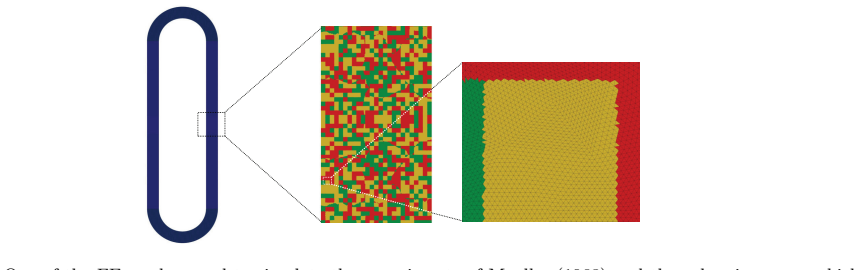
Summary. The paper develops a macroscopic phase-field theory of fracture nucleation and propagation in viscoelastic elastomers under quasistatic loading. It extends the Kumar-Francfort-Lopez-Pamies phase-field approach by coupling finite viscoelasticity (a two-potential model with internal variable C_v), a Drucker-Prager-type strength surface in stress-deformation space, and a Griffith criticality condition in which only the equilibrium free energy competes with the fracture energy. The governing equations are (29)-(31), and a numerical scheme based on Crouzeix-Raviart finite elements and explicit Runge-Kutta time stepping is presented. The theory is illustrated by simulations of uniaxial ring tests on polyurethane (Mueller 1968), pure-shear tests on VHB 4905 (Pharr et al. 2012), and trousers tests on SBR (Greensmith and Thomas 1955).
Significance. If the theory is correct, it would be a substantial contribution: it is, to my knowledge, the first phase-field framework for elastomers that simultaneously accounts for strength and viscoelasticity-related toughness in a way consistent with the equilibrium-energy Griffith condition, and it offers a complete numerical methodology. The manuscript is careful in assembling the experimental evidence, and the numerical implementation appears robust. The main caveats are that the central calibration coefficient delta^epsilon is imported from an elastic-brittle derivation without proof, and that parts of the validation reuse parameters fitted to the same experiments, making some comparisons descriptive rather than predictive. These issues do not invalidate the framework, but they need to be addressed before the paper can be judged as establishing a complete and predictive theory.
major comments (4)
- [Section 3.5.4, Eq. (26)] The coefficient delta^epsilon in Eq. (26) controls both the divergence term in the phase-field equation (31) and, through Eqs. (27)-(28), the magnitude of the driving force; it is the mechanism by which crack growth from large pre-existing cracks is forced to satisfy the Griffith condition (7). The paper does not derive this coefficient for the viscoelastic setting. Section 3.5.4 states that the prescription is analogous to that of Kamarei et al. (2024) and therefore the same formula applies. That inference is not immediate: the invariants I_1 and I_2 entering c_e through Eq. (21) contain the non-equilibrium stress through psi_NEq and C_v, so the asymptotic expansion that produced delta^epsilon in the elastic-brittle case must be re-examined for finite viscoelasticity. If Eq. (26) is not the correct asymptotic calibration, the predicted critical crack-growth stretch will deviate from -dW^Eq/dGamma_0 = G_c, and the central claim fails at its most consequential point. The manuscript should either supply a derivation or demonstrate by epsilon-convergence studies that the sharp-interface limit is recovered. Section 5.2 uses a single regularization length epsilon = 0.5 mm and Section 5.3 is only qualitative, so neither supplies that evidence.
- [Section 5.2 and Eq. (7)] The VHB comparison in Section 5.2 does not independently test the crack-growth mechanism. The material constants in Table 4 and the fracture energy G_c = 634 N/m are taken from Shrimali and Lopez-Pamies (2023b), where they were used to explain the same Pharr et al. (2012) experiments; the strength constants in Table 5 are stipulated as being consistent with experiments. More importantly, Eq. (26) is constructed so that growth from large cracks obeys Eq. (7), and the predicted critical stretch Lambda_c = 3.63 is the value already imposed by Eq. (7). The agreement in Fig. 13 therefore confirms internal consistency and the numerical implementation, but it is not an independent validation that the theory predicts nucleation from pre-existing cracks. A test using independently measured strength and toughness, in a different geometry or loading history, would be needed.
- [Section 5.1, Tables 2 and 3] For the Mueller ring tests, the viscoelastic constants in Table 2 are fitted to the slowest and fastest stress-stretch curves, and the strength constants in Table 3 are fitted to the critical stress-stretch pairs for all ten stretch rates. Consequently, Fig. 9 demonstrates that the framework can describe the data set used for calibration, but it does not provide predictive evidence in the sense claimed in the abstract and Section 6. The authors should either calibrate on a subset of rates and validate on the remaining ones, or temper the predictive claim for this example.
- [Section 2.2.1, Eq. (2)] The strength surface is assumed to be independent of loading history, so that it can be written as F(S,F) = 0. The manuscript cites experimental support to a first degree of approximation, but this is a central assumption for the nucleation mechanism, since c_e in Eqs. (27)-(28) contains no explicit time dependence. The available data are mostly uniaxial and equi-biaxial tests; no direct evidence is provided for arbitrary multiaxial histories or for non-monotonic loading paths. The authors should state this assumption more prominently and, if possible, test the predicted nucleation under a relaxation or non-monotonic history where rate effects would be distinguishable from the stress-deformation correlation.
minor comments (4)
- [References] There are typographical errors in the reference list: 'Jounal of Applied Mechanics' in Chockalingam (2025) and 'Journal of the Mechancis and Physics of Solids' in Breedlove et al. (2024) should be corrected.
- [Remark 10] The h-correction formula for delta^epsilon would benefit from explicit parentheses; as typeset, '1 + 3/8 h/epsilon' is ambiguous and could be misread as 1 + 3/(8h/epsilon) rather than 1 + (3/8)(h/epsilon).
- [Table 5] Table 5 lists a2 = 0 but omits b2, although equation (5) contains b2. The authors should state that b2 is unused when a2 = 0, or add the value for completeness.
- [Section 5.3] The trousers comparison is explicitly qualitative, but the text around Fig. 16(b) says the theory 'predicts accurately' the propagation described by Eq. (8). Since no quantitative comparison with the Greensmith and Thomas data is made, the wording should be softened to 'reproduces qualitatively' to avoid overclaiming.
Circularity Check
The nucleation and propagation criteria are calibrated to their own target limits: c_e is constructed to reproduce the input strength surface, and δ^ε is imported from prior elastic work to enforce Griffith; the three validation benchmarks fall in those calibrated limits.
-
self definitional
[Section 3.5.2 and Section 5.1.1-5.1.3]
"The coefficients β ε 0 (I1), β ε 1 (I1), β ε 2 (I1) in the driving force (20) must be selected so that ... the evolution equation (19)1 for the phase field is satisfied when the given strength surface F(S(t), F(t)) = 0 ... is first violated along the given loading path in the limit as the regularization length ε↘0."
The driving force c_e is the nucleation mechanism of the theory, and it is explicitly constructed so that, under spatially uniform stress and deformation, the phase-field equation triggers precisely when the input strength surface F(S,F)=0 is violated; Eqs. (24)-(25) enforce this identity at finite ε for uniaxial and hydrostatic loading. Section 5.1 then fits the uniaxial strength function sts(I1) of that same surface to Mueller's measured (S_c, Λ_c) failure data for all ten stretch rates, and reports the simulated (S_c, Λ_c) as a prediction. Because the gauge section stress is uniform and the stochastic perturbation is mild, the simulation returns the fitted strength surface by construction. The agreement in Fig.
-
self citation load bearing
[Section 3.5.4, Eq. (26)]
"Given that the prescription (20) for c e (X,t), as well as the coefficients (25), are analogous to those utilized by Kamarei et al. (2024) for purely elastic elastomers, the same type of formula derived for δ ε by these authors applies here. We thus set δ ε = [(s ts (I1) + (1+2√3)s hs)/((8+3√3)s hs)] (3G c/(16ψ Eq ts (I1)ε)) + 2/5."
δ^ε is the coefficient that controls large-crack nucleation and propagation in the phase-field equation (31), appearing as the multiplier of εG_c in the divergence term and entering c_e through (27)-(28). No derivation of this coefficient is given for finite viscoelasticity; instead the paper transfers the purely elastic formula from Kamarei et al. (2024) by analogy and self-citation. The non-equilibrium stress enters the invariants I_1, I_2 through Eq. (21), so the elastic asymptotic analysis does not automatically carry over. The subsequent agreement with the sharp Griffith condition (7) in Sections 5.2 and 5.3 is thus the designed consequence of an unverified, self-cited calibration rather than an independent prediction.
1 more flagged steps
-
fitted input called prediction
[Sections 5.2.1 and 5.2.3]
"Their analysis showed that the viscoelastic model (14)-(15) with the materials constants listed in Table 4 provides a reasonably accurate description of the experimentally measured viscoelastic response of VHB 4905. Their analysis also showed that the fracture energy of this elastomer is about G c = 634 N/m. ..."
The VHB benchmark is the large pre-existing crack limit, i.e., exactly the Griffith limit that the paper identified as input in Section 2.2.2 and built into the model via the imported δ^ε formula. The fracture energy G_c = 634 N/m and the viscoelastic constants are taken from the same authors' prior analysis of these same Pharr experiments, and δ^ε was imported to make the model follow the Griffith condition (7). Therefore the reported Λ_c ≈ 3.63, independent of loading rate, is the value already obtained from the sharp Griffith condition in Shrimali and Lopez-Pamies (2023b); the phase-field simulation confirms internal consistency with the built-in calibration rather than providing a first-principles prediction.
full rationale
The paper is not wholly circular: it constructs a genuinely new phase-field synthesis for viscoelastic elastomers, with a nontrivial c_e structure, a numerical implementation, and an interpolation claim for non-uniform stress states. However, the claimed validations are largely consistency checks in the two asymptotic limits that were used as inputs. The strength surface is an input, c_e is explicitly selected so that uniform-stress nucleation coincides with that surface, and the Mueller comparison uses strength parameters fitted to the very failure data being 'predicted.' Likewise, the Griffith condition (7) is an input drawn from self-cited prior work, δ^ε is imported from the authors' elastic theory without a viscoelastic derivation, and the VHB and trousers simulations recover the same Griffith behavior that the model was calibrated to reproduce. The genuinely predictive regime of the theory—fracture under non-uniform stress with finite flaws between the strength and Griffith limits—is not tested against experiments, and no ε-convergence check is provided for Eq. (26) in viscoelasticity. These factors make the central validation claims partially circular, though the framework retains independent content. Score 6.
Assumptions & free parameters
free parameters (6)
- Viscoelastic model constants (Eq. (13)-(15)): mu1, mu2, kappa, alpha1, alpha2, nu1, nu2, beta1, beta2, eta0, eta_inf… =
Mueller: Table 2; VHB 4905: Table 4; trousers: Table 6
- Uniaxial strength model constants a0, a1, b1, a2, b2, c0, c1 (Eq. (5)) =
Mueller: Table 3; VHB: Table 5; trousers: Table 7
- Hydrostatic strength s_hs =
Mueller: 3 MPa; VHB: 500 kPa; trousers: 2 MPa
- Fracture energy G_c =
Mueller: 41 N/m; VHB: 634 N/m; trousers: 200 N/m
- Regularization length epsilon =
Mueller: 0.02 mm; VHB: 0.5 mm; trousers: 0.25 mm
- Stochastic perturbation of strength parameters a1, a2 =
Plus or minus 5 percent variation in subregions of size 5*epsilon for Mueller simulations
assumptions (8)
- domain assumption Balance of linear momentum and balance of configurational forces govern deformation and fracture (Section 3.4).
- domain assumption The strength of viscoelastic elastomers is independent of loading history to first approximation, so F(S,F)=0 (Section 2.2.1, Eq. (2)).
- domain assumption Fracture nucleation from large cracks and propagation follow the Griffith competition between only the equilibrium stored energy and fracture energy, -dW^Eq/dGamma0 = G_c (Section 2.2.2, Eq. (7)).
- ad hoc to paper The specific Drucker-Prager-type strength surface (3) with the uniaxial strength formula (5) adequately represents the strength of the elastomers considered.
- domain assumption The two-potential viscoelastic model (11)-(12), with the specific form (13), describes the finite deformation viscoelasticity of the elastomers.
- domain assumption Quasistatic loading: inertial effects are negligible (Section 1).
- domain assumption No other dissipation mechanisms are active: strain-induced crystallization, Mullins effect, and healing are negligible or absent (Section 1).
- domain assumption Viscous dissipation is isochoric, det(C_v)=1 (Section 3.2.1).
Cite this review
Pith. "Pith review of Nucleation and propagation of fracture in viscoelastic elastomers: A complete phase-field theory." pith.science (2026). https://pith.science/paper/BZZGRCTD
@misc{pith2026250616479,
  author       = {Pith},
  title        = {Pith review of: Nucleation and propagation of fracture in viscoelastic elastomers: A complete phase-field theory},
  year         = {2026},
  howpublished = {\url{https://pith.science/paper/BZZGRCTD}},
  note         = {Machine review of arXiv:2506.16479}
}
read the original abstract
This paper presents a macroscopic theory, alongside its numerical implementation, aimed at describing, explaining, and predicting the nucleation and propagation of fracture in viscoelastic materials subjected to quasistatic loading conditions. The focus is on polymers, in particular, on elastomers. To this end, the starting point of this work is devoted to summarizing the large body of experimental results on how elastomers deform, nucleate cracks, and propagate cracks when subjected to mechanical loads. When viewed collectively, the experiments make it plain that there are three basic ingredients that any attempt at a complete macroscopic theory of fracture in elastomers ought to account for: i) the viscoelasticity of the elastomer; ii) its strength; and iii) its fracture energy. A theory is then introduced that accounts for all these three basic ingredients by extending the phase-field theory initiated by Kumar, Francfort, and Lopez-Pamies (J. Mech. Phys. Solids 112 (2018), 523--551) for elastic brittle materials to seamlessly incorporate viscous energy dissipation by deformation, a generalized strength surface that is a hypersurface in stress-deformation space (and not just in stress space as for elastic brittle materials), and the pertinent Griffith criticality condition for materials that dissipate energy not just by the creation of surface but also by deformation, in this case, by viscous deformation (Shrimali and Lopez-Pamies (2023) Extreme Mech. Lett. 58, 101944). From an applications point of view, the proposed theory amounts to solving an initial-boundary-value problem comprised of two nonlinear PDEs coupled with a nonlinear ODE for the deformation field, a tensorial internal variable, and the phase field. A robust scheme is presented to generate solutions for these equations.
Figures


Figures from the paper (15 more)




Reference graph
Works this paper leans on
-
[1]
, author Gent, A.N
author Ahagon, A. , author Gent, A.N. , year 1975 . title Threshold fracture energies for elastomers . journal J. Polym. Sci. Polym. Phys. volume 13 , pages 1903--1911
1975
-
[2]
, author Lion, A
author Amin, A.F.M.S. , author Lion, A. , author Sekita, S. , author Okui, Y. , year 2006 . title Nonlinear dependence of viscosity in modeling the rate-dependent response of natural and high damping rubbers in compression and shear: E xperimental identification and numerical verification . journal Int. J. Plast. volume 22 , pages 1610–1657
2006
-
[3]
, year 1963
author Andrews, E.H. , year 1963 . title Rupture propagation in hysteresial materials: S tress at a notch . journal Journal of the Mechanics and Physics of Solids volume 11 , pages 231--242
1963
-
[4]
, author Boyce, M.C
author Bergstr\"om, J.S. , author Boyce, M.C. , year 1998 . title Constitutive modeling of the large strain time-dependent behavior of elastomers . journal J. Mech. Phys. Solids volume 46 , pages 931--954
1998
-
[5]
, author Kinloch, A
author Blackman, B. , author Kinloch, A. , author Paraschi, M. , author Teo, W. , year 2003 . title Measuring the mode I adhesive fracture energy, G _ IC , of structural adhesive joints: the results of an international round-robin . journal International Journal of Adhesion and Adhesives volume 23 , pages 293--305
2003
-
[6]
, year 1987
author Boehler, J.P. , year 1987 . title Applications of Tensor Functions in Solid Mechanics . publisher Springer-Verlag
1987
-
[7]
, author Brezzi, F
author Boffi, D. , author Brezzi, F. , author Fortin, M. , year 2013 . title Mixed Finite Element Methods and Applications . publisher Springer
2013
-
[8]
, author Francfort, G.A
author Bourdin, B. , author Francfort, G.A. , author Marigo, J.J. , year 2000 . title Numerical experiments in revisited brittle fracture . journal Journal of the Mechanics and Physics of Solids volume 48 , pages 797--826
2000
Show all 118 references
-
[9]
, author Francfort, G.A
author Bourdin, B. , author Francfort, G.A. , author Marigo, J.J. , year 2008 . title The variational approach to fracture . journal Journal of Elasticity volume 91 , pages 5--148
2008
-
[10]
, author Chen, C
author Breedlove, E. , author Chen, C. , author Lindeman, D. , author Lopez-Pamies, O. , year 2024 . title Cavitation in elastomers: A review of the evidence against elasticity . journal Journal of the Mechancis and Physics of Solids volume 188 , pages 105678
2024
-
[11]
, author Rabczuk, T
author Brighenti, R. , author Rabczuk, T. , author Zhuang, X. , year 2021 . title Phase field approach for simulating failure of viscoelastic elastomers . journal Eur. J. Mech. A. Solids volume 85 , pages 104092
2021
-
[12]
, author Hansbo, P
author Burman, E. , author Hansbo, P. , year 2005 . title Stabilized Crouzeix-Raviart element for the Darcy-Stokes problem . journal Numerical Methods for Partial Differential Equations volume 21 , pages 986--997
2005
-
[13]
, year 1934
author Busse, W.F. , year 1934 . title Tear resistance and structure of rubber . journal Ind. Eng. Chem. volume 26 , pages 1194--1199
1934
-
[14]
, year 1938
author Busse, W.F. , year 1938 . title Physics of rubber as related to the automobile . journal J. Appl. Phys. volume 9 , pages 438--451
1938
-
[15]
, author Wang, Z
author Chen, C. , author Wang, Z. , author Suo, Z. , year 2017 . title Flaw sensitivity of highly stretchable materials . journal Extreme Mechanics Letters volume 10 , pages 50--57
2017
-
[16]
, year 2025
author Chockalingam, S. , year 2025 . title On the construction of explicit analytical driving forces for crack nucleation in the phase field approach to brittle fracture with application to M ohr- C oulomb and D rucker- P rager strength surfaces . journal Jounal of Applied Me...
2025
-
[17]
, author Roth, C
author Chockalingam, S. , author Roth, C. , author Henzel, T. , author Cohen, T. , year 2021 . title Probing local nonlinear viscoelastic properties in soft materials . journal Journal of the Mechanics and Physics of Solids volume 146 , pages 104172
2021
-
[18]
, author Lancioni, G
author Ciambella, J. , author Lancioni, G. , author Stortini, N. , year 2025 . title A finite viscoelastic phase-field model for prediction of crack propagation speed in elastomers . journal European Journal of Mechanics - A/Solids volume 113 , pages 105678
2025
-
[19]
, author Gurtin, M
author Coleman, B. , author Gurtin, M. , year 1967 . title Thermodynamics with internal state variables . journal J. Chem. Phys. volume 47 , pages 597--613
1967
-
[20]
, author Noll, W
author Coleman, B.D. , author Noll, W. , year 1961 . title Foundations of linear viscoelasticity . journal Rev. Mod. Phys. volume 33 , pages 239--249
1961
-
[21]
, author Coret, M
author Corre, T. , author Coret, M. , author Verron, E. , author Lebl\'e, B. , author Le Lay , F. , year 2020 . title Experimental full field analysis for dynamic fracture of elastomer membranes . journal International Journal of Fracture volume 224 , pages 83--100
2020
-
[22]
, author Raviart, R.A
author Crouzeix, M. , author Raviart, R.A. , year 1973 . title Conforming and nonconforming finite element methods for solving the stationary S tokes equations I . journal Rev. Francaise Automat. Informat. Recherche Operationnelle volume 7 , pages 33--75
1973
-
[23]
, author Ambati, M
author Damma , F. , author Ambati, M. , author K\"astner, M. , year 2021 . title A unified phase-field model of fracture in viscoelastic materials . journal Continuum Mech. Thermodyn. volume 33 , pages 1907--1929
2021
-
[24]
, author Kalina, K.A
author Damma , F. , author Kalina, K.A. , author Ambati, M. , author K\"astner, M. , year 2023 . title Phase-field modelling and analysis of rate-dependent fracture phenomena at finite deformation . journal Computational Mechanics volume 72 , pages 859--883
2023
-
[25]
, author Gent, A.N
author De, D. , author Gent, A.N. , year 1996 . title Tear strength of carbon-black-filled compounds . journal Rubber Chemistry and Technology volume 69 , pages 834--850
1996
-
[26]
, year 1979
author de Gennes , P.G. , year 1979 . title Scaling Concepts in Polymer Physics . publisher Cornell University Press
1979
-
[27]
, author Badoz, J
author de Gennes , P.G. , author Badoz, J. , year 1996 . title Fragile Objects: Soft Matter, Hard Science, and the Thrill of Discovery . publisher Springer-Verlag , address New York
1996
-
[28]
, author Smith, T.L
author Dickie, R.A. , author Smith, T.L. , year 1969 . title Ultimate tensile properties of elastomers. V I . S trength and extensibility of a styrene–butadiene rubber vulcanizate in equal biaxial tension . journal Journal of Polymer Science Part A-2: Polymer Physics volume 7 ...
1969
-
[29]
, author Edwards, S.F
author Doi, M. , author Edwards, S.F. , year 1998 . title The Theory of Polymer Dynamics . publisher Oxford University Press , address New York
1998
-
[30]
, author Prager, W
author Drucker, D.C. , author Prager, W. , year 1952 . title Soil mechanics and plastic analysis for limit design . journal Q. Appl. Math. volume 10 , pages 157--165
1952
-
[31]
, author Bernhardt, R
author Euchler, E. , author Bernhardt, R. , author Schneider, K. , author Heinrich, G. , author Wie ner, S. , author Tada, T. , year 2020 . title In situ dilatometry and X -ray microtomography study on the formation and growth of cavities in unfilled styrene-butadiene rubber v...
2020
-
[32]
, year 1991
author Falk, R. , year 1991 . title Nonconforming finite element methods for the equations of linear elasticity . journal Mathematics of Computation volume 57 , pages 529--550
1991
-
[33]
, year 1980
author Ferry, J.D. , year 1980 . title Viscoelastic Porperties of Polymers . publisher John Wiley and Sons
1980
-
[34]
, author Lai, J.S
author Findley, W.N. , author Lai, J.S. , author Onaran, K. , year 1976 . title Creep and Relaxation of Nonlinear Viscoelastic Materials . publisher North-Holland
1976
-
[35]
, author Giacomini, A
author Francfort, G.A. , author Giacomini, A. , author Lopez-Pamies, O. , year 2019 . title Fracture with healing: A first step towards a new view of cavitation . journal Analysis and PDE volume 12 , pages 417--447
2019
-
[36]
, author Tobias, R
author Gent, A. , author Tobias, R. , year 1982 . title Threshold tear strength of elastomers . journal J. Polym. Sci. Polym. Phys. volume 20 , pages 2051--2058
1982
-
[37]
, year 1990
author Gent, A.N. , year 1990 . title Cavitation in rubber: A cautionary tale . journal Rubber. Chem. Technol. volume 63 , pages G49--G53
1990
-
[38]
, year 1996
author Gent, A.N. , year 1996 . title Adhesion and strength of viscoelastic solids. I s there a relationship between adhesion and bulk properties? journal Langmuir volume 12 , pages 4492--4496
1996
-
[39]
, author Lai, S.M
author Gent, A.N. , author Lai, S.M. , year 1994 . title Interfacial bonding, energy dissipation, and adhesion . journal Journal of Polymer Science: Part B: Polymer Physics volume 32 , pages 1543--1555
1994
-
[40]
, author Lindley, P.B
author Gent, A.N. , author Lindley, P.B. , year 1959 . title Internal rupture of bonded rubber cylinders in tension . journal Proc. R. Soc. Lond. A volume 249 , pages 195--205
1959
-
[41]
, author Park, B
author Gent, A.N. , author Park, B. , year 1984 . title Failure processes in elastomers at or near a rigid inclusion . journal J. Mater. Sci. volume 19 , pages 1947--1956
1984
-
[42]
, author Schultz, J
author Gent, A.N. , author Schultz, J. , year 1972 . title Effect of wetting liquids on the strength of adhesion of viscoelastic material . journal The Journal of Adhesion volume 3 , pages 281--294
1972
-
[43]
, author Shrimali, B
author Ghosh, K. , author Shrimali, B. , author Kumar, A. , author Lopez-Pamies, O. , year 2021 . title The nonlinear viscoelastic response of suspensions of rigid inclusions in rubber: I --- G aussian rubber with constant viscosity . journal Journal of the Mechanics and Physi...
2021
-
[44]
, year 1960 a
author Greensmith, H.W. , year 1960 a. title Rupture of rubber. VII . E ffect of rate of extension in tensile tests . journal J. Appl. Pol. Sci. volume 3 , pages 175--182
1960
-
[45]
, year 1960 b
author Greensmith, H.W. , year 1960 b. title Rupture of rubber. VIII . C omparisons of tear and tensile rupture measurements . journal J. Appl. Pol. Sci. volume 3 , pages 183--193
1960
-
[46]
, author Thomas, A.G
author Greensmith, H.W. , author Thomas, A.G. , year 1955 . title Rupture of rubber. III . D etermination of tear properties . journal Journal of Polymer Science volume 18 , pages 189--200
1955
-
[47]
, year 1921
author Griffith, A.A. , year 1921 . title The phenomena of rupture and flow in solids . journal Philos. Trans. R. Soc. Lond. Ser. A volume 221 , pages 163--198
1921
-
[48]
, author Ravi-Chandar, K
author Guo, J. , author Ravi-Chandar, K. , year 2023 . title On crack nucleation and propagation in elastomers: I . I n situ optical and X -ray experimental observations . journal International Journal of Fracture volume 243 , pages 1--29
2023
-
[49]
, author Nguyen, Q
author Halphen, B. , author Nguyen, Q. , year 1975 . title Sur les mat\'eriaux standard g\'en\'eralis\'es . journal J. M\'ec. volume 14 , pages 39--63
1975
-
[50]
, author Rattanasom, N
author Hamed, G.R. , author Rattanasom, N. , year 2002 . title Effect of crosslink density on cut growth in black-filled natural rubber vulcanizates . journal Rubber Chemistry and Technology volume 75 , pages 935--942
2002
-
[51]
, author Mora-Corral, C
author Henao, D. , author Mora-Corral, C. , author Xu, X. , year 2016 . title A numerical study of void coalescence and fracture in nonlinear elasticity . journal Computer Methods in Applied Mechanics and Engineering volume 303 , pages 163--184
2016
-
[52]
, author Ayatollahi, M.R
author Heydari-Meybodi , M. , author Ayatollahi, M.R. , author Berto, F. , year 2018 . title Rupture analysis of rubber in the presence of a sharp V -shape notch under pure mode- I loading . journal International Journal of Mechanical Sciences volume 146-147 , pages 405--415
2018
-
[53]
, year 1960
author Irwin, G.R. , year 1960 . title Plastic zone near a crack and fracture toughness . journal Proceedings of the 7th Sagamore Ordnance Materials Conference , pages IV--63--IV--78
1960
-
[54]
, author Breedlove, E
author Kamarei, F. , author Breedlove, E. , author Lopez-Pamies, O. , year 2025 a. title Validating G riffith fracture propagation in the phase-field approach to fracture: T he case of M ode III by means of the trousers test . journal Submitted
2025
-
[55]
, author Dolbow, J.E
author Kamarei, F. , author Dolbow, J.E. , author Lopez-Pamies, O. , year 2025 b. title Nucleation of fracture: T he first-octant evidence against classical variational phase-field models . journal Journal of Applied Mechanics volume 92 , pages 014502
2025
-
[56]
, author Kumar, A
author Kamarei, F. , author Kumar, A. , author Lopez-Pamies, O. , year 2024 . title The poker-chip experiments of synthetic elastomers explained . journal Journal of the Mechanics and Physics of Solids volume 188 , pages 105683
2024
-
[57]
, author Sozio, F
author Kamarei, F. , author Sozio, F. , author Lopez-Pamies, O. , year 2025 c. title The single edge notch fracture test for viscoelastic elastomers . journal Submitted
2025
-
[58]
, author Zeng, B
author Kamarei, F. , author Zeng, B. , author Dolbow, J.E. , author Lopez-Pamies, O. , year 2025 d. title Nine circles of elastic brittle fracture: A series of challenge problems to assess fracture models . journal In preparation
2025
-
[59]
, author Zhang, Z
author Kang, J. , author Zhang, Z. , author Li, J. , author Wang, C. , year 2020 . title Effect of temperature on the rupture behavior of highly stretchable acrylic elastomer . journal Polymer Testing volume 81 , pages 106221
2020
-
[60]
, year 1967
author Knauss, W.G. , year 1967 . title An upper bound of failure in viscoelastic materials subjected to multiaxial stress states . journal Int. J. Fract. volume 3 , pages 267--277
1967
-
[61]
, year 1970
author Knauss, W.G. , year 1970 . title Delayed failure --- the Griffith problem for linearly viscoelastic materials . journal Int. J. Fract. Mech. volume 6 , pages 7--20
1970
-
[62]
, year 1973
author Knauss, W.G. , year 1973 . title On the steady propagation of a crack in a viscoelastic sheet: E xperiments and analysis , in: booktitle Proceedings of the Deformation and Fracture of High Polymers , pp. pages 501--541
1973
-
[63]
, year 2015
author Knauss, W.G. , year 2015 . title A review of fracture in viscoelastic materials . journal Int. J. Fract. volume 196 , pages 99--146
2015
-
[64]
, author Bourdin, B
author Kumar, A. , author Bourdin, B. , author Francfort, G.A. , author Lopez-Pamies, O. , year 2020 . title Revisiting nucleation in the phase-field approach to brittle fracture . journal Journal of the Mechanics and Physics of Solids volume 142 , pages 104027
2020
-
[65]
, author Francfort, G.A
author Kumar, A. , author Francfort, G.A. , author Lopez-Pamies, O. , year 2018 a. title Fracture and healing of elastomers: A phase-transition theory and numerical implementation . journal Journal of the Mechanics and Physics of Solids volume 112 , pages 523--551
2018
-
[66]
, author Liu, Y
author Kumar, A. , author Liu, Y. , author Dolbow, J.E. , author Lopez-Pamies, O. , year 2024 . title The strength of the B razilian fracture test . journal Journal of the Mechanics and Physics of Solids volume 182 , pages 105473
2024
-
[67]
, author Lopez-Pamies, O
author Kumar, A. , author Lopez-Pamies, O. , year 2016 . title On the two-potential constitutive modeling of rubber viscoelastic materials . journal Comptes Rendus Mecanique volume 344 , pages 102--112
2016
-
[68]
, author Lopez-Pamies, O
author Kumar, A. , author Lopez-Pamies, O. , year 2020 . title The phase-field approach to self-healable fracture of elastomers: A model accounting for fracture nucleation at large, with application to a class of conspicuous experiments . journal Theoretical and Applied Fractu...
2020
-
[69]
, author Lopez-Pamies, O
author Kumar, A. , author Lopez-Pamies, O. , year 2021 . title The poker-chip experiments of G ent and L indley (1959) explained . journal Journal of the Mechanics and Physics of Solids volume 150 , pages 104359
1959
-
[70]
, author Ravi-Chandar, K
author Kumar, A. , author Ravi-Chandar, K. , author Lopez-Pamies, O. , year 2018 b. title The configurational-forces view of fracture and healing in elastomers as a phase transition . journal International Journal of Fracture volume 213 , pages 1--16
2018
-
[71]
, author Ravi-Chandar, K
author Kumar, A. , author Ravi-Chandar, K. , author Lopez-Pamies, O. , year 2022 . title The revisited phase-field approach to brittle fracture: A pplication to indentation and notch problems . journal International Journal of Fracture volume 237 , pages 83--100
2022
-
[72]
, author Lawrence, C.C
author Lake, G.J. , author Lawrence, C.C. , author Thomas, A.G. , year 2000 . title High-speed fracture of elastomers: P art I . journal Rubber Chemistry and Technology volume 73 , pages 801--817
2000
-
[73]
, author Thomas, A.G
author Lake, G.J. , author Thomas, A.G. , year 1967 . title The strength of highly elastic materials . journal Proceedings of the Royal Society of London A volume 300 , pages 108--119
1967
-
[74]
, year 1966
author Lawson, J. , year 1966 . title An order five Runge-Kutta process with extended region of stability . journal SIAM J. Numer. Anal. volume 3 , pages 593--597
1966
-
[75]
, year 1967
author Lindsey, G.H. , year 1967 . title Triaxial fracture studies . journal J. Appl. Phys. volume 38 , pages 4843--4852
1967
-
[76]
, author Peters, B
author Loew, P.J. , author Peters, B. , author Beex, L.A.A. , year 2019 . title Rate-dependent phase-field damage modeling of rubber and its experimental parameter identification . journal Journal of the Mechanics and Physics of Solids volume 127 , pages 266--294
2019
-
[77]
, year 2010
author Lopez-Pamies, O. , year 2010 . title A new I _1 -based hyperelastic model for rubber elastic materials . journal C. R. Mec. volume 338 , pages 3--11
2010
-
[78]
, year 2023
author Lopez-Pamies, O. , year 2023 . title Journal C lub: S trength revisited: O ne of three basic ingredients needed for a complete macroscopic theory of fracture . https://imechanica.org/node/26641
2023
-
[79]
, author Dolbow, J.E
author Lopez-Pamies, O. , author Dolbow, J.E. , author Francfort, G.A. , author Larsen, C.J. , year 2025 . title Classical variational phase-field models cannot predict fracture nucleation . journal Computer Methods in Applied Mechanics and Engineering volume 433 , pages 117520
2025
-
[80]
, author Lang, R.W
author Major, Z. , author Lang, R.W. , year 2010 . title Characterization of the fracture behavior of NBR and FKM grade elastomers for oilfield applications . journal Engineering Failure Analysis volume 17 , pages 701--711
2010
-
[81]
, year 1968
author Mueller, H.K. , year 1968 . title Stable Crack Propagation in a Viscoelastic Strip . Ph.D. thesis. California Institute of Technology
1968
-
[82]
, author Knauss, W.G
author Mueller, H.K. , author Knauss, W.G. , year 1971 . title The fracture energy and some mechanical properties of a polyurethane elastomer . journal Trans. Soc. Rheo. volume 15 , pages 217--233
1971
-
[83]
, year 1959
author Mullins, L. , year 1959 . title Rupture of rubber. IX . R ole of hysteresis in the tearing of rubber . journal Transactions of the Institution of the Rubber Industry volume 35 , pages 213--222
1959
-
[84]
, year 1999
author Negri, M. , year 1999 . title The anisotropy introduced by the mesh in the finite element approximation of the Mumford-Shah functional . journal Numer. Funct. Anal. Optim. volume 20 , pages 957--982
1999
-
[85]
, year 2003
author Negri, M. , year 2003 . title A finite element approximation of the Griffith's model in fracture mechanics . journal Numerische Mathematik volume 95 , pages 653--687
2003
-
[86]
, author Amor, H
author Pham, K. , author Amor, H. , author Marigo, J.J. , author Maurini, C. , year 2011 . title Gradient damage models and their use to approximate brittle fracture . journal Int. J. Damage Mech. volume 20 , pages 618--652
2011
-
[87]
, author Sun, J.S
author Pharr, M. , author Sun, J.S. , author Suo, Z. , year 2012 . title Rupture of a highly stretchable acrylic dielectric elastomer . journal J. Appl. Phys. volume 111 , pages 104114
2012
-
[88]
, author Lef\`evre, V
author Poulain, X. , author Lef\`evre, V. , author Lopez-Pamies, O. , author Ravi-Chandar, K. , year 2017 . title Damage in elastomers: N ucleation and growth of cavities, micro-cracks, and macro-cracks . journal International Journal of Fracture volume 205 , pages 1--21
2017
-
[89]
, author Lopez-Pamies, O
author Poulain, X. , author Lopez-Pamies, O. , author Ravi-Chandar, K. , year 2018 . title Damage in elastomers: H ealing of internally nucleated cavities and micro-cracks . journal Soft Matter volume 14 , pages 4633--4640
2018
-
[90]
, author Govindjee, S
author Reese, S. , author Govindjee, S. , year 1998 . title A theory of finite viscoelasticity and numerical aspects . journal Int. J. Solids Struct. volume 35 , pages 3455--3482
1998
-
[91]
, author Gierig, M
author Ricker, A. , author Gierig, M. , author Wriggers, P. , year 2023 . title Multiplicative, non- N ewtonian viscoelasticity models for rubber materials and brain tissues: N umerical treatment and comparative studies . journal Arch. Comput. Methods Eng. volume 30 , pages 2889--2927
2023
-
[92]
, author Thomas, A.G
author Rivlin, R.S. , author Thomas, A.G. , year 1953 . title Rupture of rubber. I . C haracteristic energy for tearing . journal Journal of Polymer Science volume 10 , pages 291--318
1953
-
[93]
, author Hamed, G.R
author Rong, G. , author Hamed, G.R. , author Jiang, J. , year 2016 . title Comparison of the strength of normal and edge-cut tensile specimens of styrene-butadiene rubber and natural rubber with similar crosslink density . journal Rubber Chemistry and Technology volume 89 , p...
2016
-
[94]
, author Yavari, A
author Sadik, S. , author Yavari, A. , year 2024 . title Nonlinear anisotropic viscoelasticity . journal Journal of the Mechanics and Physics of Solids volume 182 , pages 105461
2024
-
[95]
, author Rothemund, P
author Schmidt, A. , author Rothemund, P. , author Mazza, E. , year 2012 . title Multiaxial deformation and failure of acrylic elastomer membranes . journal Sensors and Actuators A volume 174 , pages 133--138
2012
-
[96]
, author Waisman, H
author Shen, R. , author Waisman, H. , author Guo, L.C. , year 2019 . title Fracture of viscoelastic solids modeled with a modified phase field method . journal Comput. Methods Appl. Mech. Engrg. volume 346 , pages 862--890
2019
-
[97]
, author Lopez-Pamies, O
author Shrimali, B. , author Lopez-Pamies, O. , year 2023 a. title The delayed fracture test for viscoelastic elastomers . journal International Journal of Fracture volume 242 , pages 23--38
2023
-
[98]
, author Lopez-Pamies, O
author Shrimali, B. , author Lopez-Pamies, O. , year 2023 b. title The ``pure-shear'' fracture test for viscoelastic elastomers and its revelation on G riffith fracture . journal Extreme Mechanics Letters volume 58 , pages 101944
2023
-
[99]
, author Lopez-Pamies, O
author Shrimali, B. , author Lopez-Pamies, O. , year 2023 c. title The trousers fracture test for viscoelastic elastomers . journal Journal of Applied Mechanics volume 90 , pages 071010
2023
-
[100]
, year 1992
author Simo, J. , year 1992 . title Algorithms for static and dynamic multiplicative plasticity that preserve the classical return mapping schemes of the infinitesimal theoryy . journal Computer Methods in Applied Mechanics and Engineering volume 99 , pages 61--112
1992
-
[101]
, author Waltz, V
author Slootman, J. , author Waltz, V. , author Yeh, C.J. , author Baumann, C. , author G\"ostl, R. , author Comtet, J. , author Creton, C. , year 2020 . title Quantifying rate- and temperature-dependent molecular damage in elastomer fracture . journal Physical Review X volume...
2020
-
[102]
, year 1958
author Smith, T.L. , year 1958 . title Dependence of the ultimate properties of a G R - S rubber on strain rate and temperature . journal Journal of Polymer Science volume 32 , pages 99--113
1958
-
[103]
, year 1963
author Smith, T.L. , year 1963 . title Ultimate tensile properties of elastomers. I . C haracterization by a time and temperature independent failure envelope . journal Journal of Polymer Science: Part A volume 1 , pages 3597--3613
1963
-
[104]
, year 1964 a
author Smith, T.L. , year 1964 a. title Relations between ultimate tensile properties of elastomers and their structure . journal Proc. R. Soc. Lond. A volume 282 , pages 102--113
1964
-
[105]
, year 1964 b
author Smith, T.L. , year 1964 b. title Ultimate tensile properties of elastomers. II. C omparison of failure envelopes for unfilled vulcanizates . journal Journal of Applied Physics volume 35 , pages 27--36
1964
-
[106]
, author Frederick, J.E
author Smith, T.L. , author Frederick, J.E. , year 1965 . title Ultimate tensile properties of elastorners. I V . D ependence of the failure envelope, maximum extensibility, and equilibrium stress-strain curve on network characteristics . journal Journal of Applied Physics vol...
1965
-
[107]
, author Stedry, P.J
author Smith, T.L. , author Stedry, P.J. , year 1960 . title Time and temperature dependence of the ultimate properties of an S B R rubber at constant elongations . journal Journal of Applied Physics volume 31 , pages 1892--1898
1960
-
[108]
, author Whittle, J.M
author Thomas, A.G. , author Whittle, J.M. , year 1970 . title Tensile rupture of rubber . journal Rubber Chemistry and Technology volume 43 , pages 222--228
1970
-
[109]
, author Eyring, H
author Tobolsky, A. , author Eyring, H. , year 1942 . title Mechanical properties of polymeric materials . journal J. Chem. Phys. volume 11 , pages 125--134
1942
-
[110]
, year 2005
author Treloar, L.R.G. , year 2005 . title The Physics of Rubber Elasticity . publisher Oxford Classics Series
2005
-
[111]
, author Busfield, J.J.C
author Tsunoda, K. , author Busfield, J.J.C. , author Davies, C.K.L. , author Thomas, A.G. , year 2000 . title Effect of materials variables on the tear behaviour of a noncrystallising elastomer . journal Journal of Materials Science volume 35 , pages 5187--5198
2000
-
[112]
, author Posadas, P
author Valentin, J.L. , author Posadas, P. , author Fernández-Torres, A. , author Malmierca, M.A. , author Gonzalez, L. , author Chasse, W. , author Saalw\" a chter, K. , year 2010 . title Inhomogeneities and chain dynamics in diene rubbers vulcanized with different cure syste...
2010
-
[113]
, author Wang, K
author Wang, H. , author Wang, K. , author Fan, W. , author Cai, S. , year 2017 . title Rupture of swollen styrene butadiene rubber . journal Polymer Testing volume 61 , pages 100--105
2017
-
[114]
, author Lopez-Pamies, O
author Wijaya, I. , author Lopez-Pamies, O. , author Masud, A. , year 2023 . title A unified determinant-preserving formulation for compressible/incompressible finite viscoelasticity . journal Journal of the Mechanics and Physics of Solids volume 177 , pages 105312
2023
-
[115]
, year 2009
author Wineman, A. , year 2009 . title Nonlinear viscoelastic solids --- A review . journal Mathematics and Mechanics of Solids volume 14 , pages 300--366
2009
-
[116]
, author Kaliske, M
author Yin, B. , author Kaliske, M. , year 2020 . title Fracture simulation of viscoelastic polymers by the phase-field method . journal Computational Mechanics volume 65 , pages 293--309
2020
-
[117]
, year 1948
author Zener, C.M. , year 1948 . title Elasticity and anelasticity of metals . publisher University of Chicago Press
1948
-
[118]
, author Wehrli, C
author Ziegler, H. , author Wehrli, C. , year 1987 . title The derivation of constitutive relations from the free energy and the dissipation function . journal Adv. Appl. Mech. volume 25 , pages 183--238
1987
Reviewed August 15, 2026 · model on record in the stance chip above.
Discussion (0). Continue with ORCID to comment.