REVIEW 4 major objections 5 minor 125 references
Quantum and Semi-Classical Signatures of Dissipative Chaos in the Steady State
T0 review · 4 major / 5 minor · reviewed 2026-08-07 · deepseek-v4-flash
Pith's one-line read The sign of the classical Lyapunov exponent controls the level statistics of the steady-state density matrix in an open many-boson system, with regular motion giving Poissonian statistics and chaotic motion giving Wigner-Dyson statistics.
desk verdict A valuable semiclassical framework and a new phase-space diagnostic, but the central Lyapunov-to-level-statistics claim rests on thin numerical evidence in the regular branch. read the letter →
The pith
A machine-rendered reading of the paper's core claim, the machinery that carries it, and where it could break.
The reading
What carries the argument
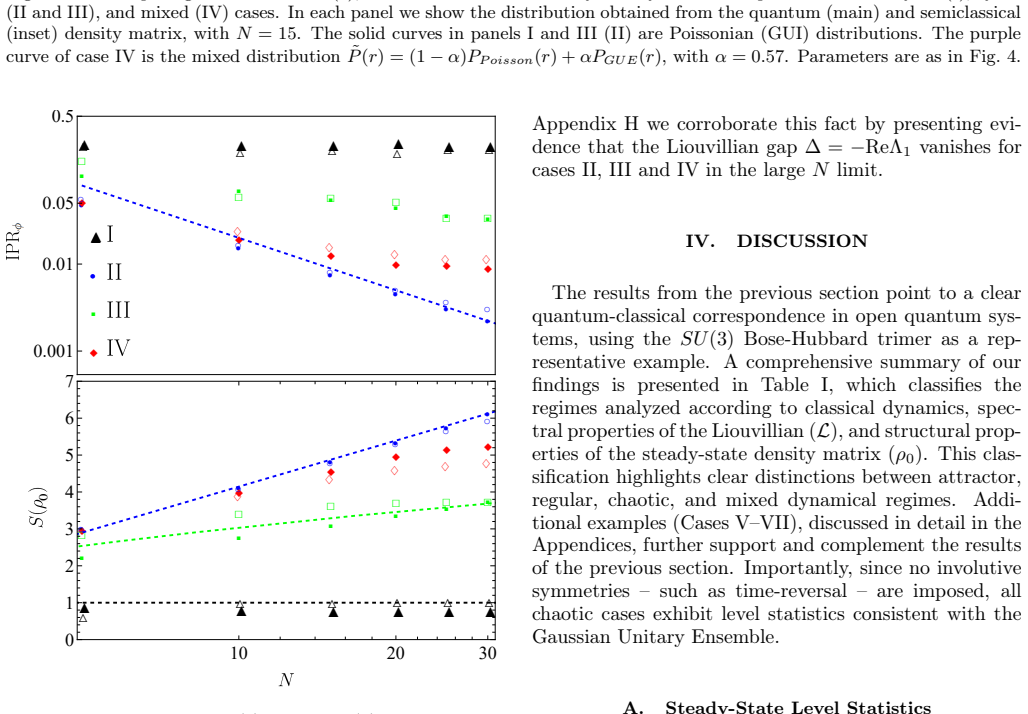
The central object is the effective Hamiltonian $H_{\mathrm{eff}}$, defined by writing the steady-state density matrix as $\rho_0 \propto e^{-H_{\mathrm{eff}}}$; its level-spacing ratio distribution is the paper's quantum-chaos diagnostic. The argument is carried by two further pieces. First, a semiclassical density matrix $\rho_C$ is built by adding multiplicative $1/\sqrt{N}$ stochastic noise to the classical mean-field equations (the noise comes from truncating a path-integral expansion of the dissipative dynamics at quadratic order), evolving many samples, and averaging the resulting coherent states; this converts classical trajectory ensembles into a candidate steady state. Second, a phase-space inverse participation ratio $\mathrm{IPR}_\phi$ computed from the Husimi distribution defines an effective dimension $D$ through $\mathrm{IPR}_\phi\sim N^{-D/2}$, linking phase-space localization to the entropy scaling $S\propto \ln N^D$. The sign of the leading Lyapunov exponent of the deterministic flow is the classifier that separates regular ($\lambda\le 0$) from chaotic ($\lambda>0$) classical behavior.
What would settle it
Take a parameter set of the trimer with no strong symmetry and an unambiguously positive leading Lyapunov exponent, exactly diagonalize the Lindblad equation at $N=30$, and compute the level-spacing ratio distribution of $H_{\mathrm{eff}}$; if that distribution fails to converge toward the GUE prediction, the claimed Lyapunov-to-statistics correspondence is falsified.
Extended reading notes
Core claim
The central discovery is a clean correspondence between classical mean-field dynamics and the structure of the quantum steady state in the $\mathrm{SU}(3)$ Bose-Hubbard trimer. When the classical equations of motion relax to a fixed-point attractor, the Liouvillian is gapped and the steady state is localized, with Poissonian level spacing in $H_{\mathrm{eff}}$ and entropy of order one. When dissipation instead drives cyclic motion, the Liouvillian gap closes as $N\to\infty$, and the steady state's spectral statistics follow the classical Lyapunov exponent: limit cycles and periodic orbits keep $H_{\mathrm{eff}}$ Poissonian, whereas chaotic dynamics produce GUE statistics, a delocalized Husimi distribution with $\mathrm{IPR}_\phi\propto N^{-2}$, and entropy scaling $S\propto \ln N^2$. The paper further establishes that a semiclassical density matrix built by averaging Langevin trajectories over noise samples reproduces all of these features, including the level statistics, to next-to-leading order in $1/N$.
Load-bearing premise
The whole correspondence rests on the assumption that quantum fluctuations around the classical trajectory are accurately represented by adding Gaussian noise to the classical equations, and that this quadratic-order approximation remains valid at arbitrarily long times.
Editorial extensions
If this is right
- In any large-$N$ dissipative system with a classical limit, the steady-state level statistics of $H_{\mathrm{eff}}$ can be predicted from the classical Lyapunov spectrum alone: Poissonian for non-positive exponents, GUE for positive exponents.
- The Liouvillian spectral gap distinguishes stationary from non-stationary classical regimes (gapped for fixed-point attractors, closing as $N^{-1}$ for limit cycles and chaos), but does not by itself identify chaos; the steady-state statistics of $H_{\mathrm{eff}}$ are needed for that.
- The entropy of the steady state obeys the universal scaling $S\propto \ln N^D$, with $D$ read off from $\mathrm{IPR}_\phi$: $D=0$ at a fixed-point attractor, $D=4$ for full phase-space delocalization, and reduced $D$ under strong symmetries or dynamical confinement.
- Strong symmetries constrain the dynamics to lower-dimensional manifolds and suppress chaos (in this $D=4$ system, any strong symmetry forces regular dynamics), while weak symmetries leave the phase-space structure and chaotic behavior intact.
- The semiclassical density matrix $\rho_C$ reproduces not only expectation values but also entropy, localization, and level statistics, so for large $N$ the Lindblad steady state is effectively a classical mixture of coherent states.
Reading between the lines
- An untested extension of the correspondence is that $H_{\mathrm{eff}}$ level statistics could serve as an experimental probe of the underlying classical attractor in platforms like triple-well Bose-Einstein condensates, where direct measurement of chaotic trajectories is difficult but steady-state correlation functions are accessible.
- The $\mathrm{IPR}_\phi$-based effective dimension $D$ suggests a general principle for open systems: in mixed phase spaces, the component with the smallest effective dimension dominates the IPR, so the asymptotic scaling of entropy and localization is set by the most localized sector rather than the most chaotic one.
- Because $\rho_C$ captures GUE statistics without any quantum coherence, the paper implies that Wigner-Dyson statistics in dissipative steady states is compatible with a fully incoherent, classical-mixture interpretation; a similar mechanism may explain apparent random-matrix signatures in other driven-dissipative systems whose classical limit is chaotic.
- The role of strong symmetries suggests a testable prediction beyond the trimer: in a four-well (or higher-dimensional) dissipative system, strong symmetries should reduce $D$ but still allow chaos when the remaining phase-space dimension exceeds two.
Signed reviews
Editorial analysis
A structured set of objections, weighed in public.
Referee Report
Summary. The manuscript studies an open SU(3) Bose-Hubbard trimer with number-conserving incoherent hopping, using four representative parameter sets to compare noiseless mean-field classical dynamics (Lyapunov exponents, Poincaré sections) with the exact Liouvillian spectrum and the steady-state density matrix, and with a semiclassical density matrix built from Langevin trajectories. The central claim is that the sign of the largest classical Lyapunov exponent determines the level statistics of the effective Hamiltonian H_eff defined by rho_0 = exp(-H_eff): non-positive exponents give Poissonian statistics and positive exponents give GUE statistics. The paper also introduces a phase-space inverse participation ratio IPR_phi whose scaling N^{-D/2} defines an effective dimension D, reports S proportional to ln N^D, and shows that the stochastic coherent-state mixture rho_C reproduces these spectral and structural features.
Significance. If established, the claimed correspondence would extend the Prosen–Žnidarič steady-state integrability dichotomy to a collective bosonic model with a well-defined classical limit, connecting the sign of the classical Lyapunov exponent to random-matrix statistics of a steady-state density matrix. The paper has real strengths: the Lyapunov exponents are computed from the noiseless mean-field equations independently of the quantum steady state; the Liouvillian is diagonalized exactly up to N=15 and treated with sparse methods at N=20,30; Appendix E gives an analytic attractor spectrum showing a Poisson-like two-grid structure; and the Langevin dynamics is derived from the Keldysh action rather than fitted. The authors are also transparent about inconclusive scalings and about the non-convergence of Case III. These strengths make the paper a plausible and potentially useful contribution, but the advertised universal dichotomy is currently supported by a small number of visually classified histograms, and the regular-dynamics branch lacks quantitative convergence evidence.
major comments (4)
- [§III.B, Fig. 6] For Case III, the authors state explicitly that 'we could not conclude that P(r) converges to a Poissonian distribution' even at N=30. Since Case III is the only non-attractor regular-dynamics example supporting the non-positive-Lyapunov branch of the central dichotomy, the claim that non-positive exponents yield Poissonian level statistics is not presently established for limit-cycle dynamics. The manuscript should provide a quantitative convergence test for Case III, such as the scaling of the mean and variance of r with N, a Kolmogorov–Smirnov or chi-square statistic against the Poisson and GUE ratio distributions, and bootstrap error bars; visual inspection and the absence of level repulsion are not sufficient to identify the distribution as Poissonian.
- [§II.C, §III.B, Fig. 6] The P(r) histograms in Fig. 6 are single-realization histograms: for N=15 the Hilbert-space dimension is d=(N+1)(N+2)/2=136, so each histogram is built from roughly 135 level-spacing ratios. No error bars, bootstrap resampling, or goodness-of-fit measures are provided, and the labels 'Poissonian' and 'GUE' are assigned by visual comparison with the limiting curves. With this sample size, distinguishing Poissonian statistics from weakly correlated distributions is not reliable, especially because the binning and the treatment of degenerate or nearly degenerate eigenvalues are not specified. Please add quantitative statistical measures and, where possible, averages over realizations or symmetry sectors.
- [§III.B, Table I, Fig. 7] For Case IV, the mixed distribution is fitted with alpha=0.57 without any reported uncertainty, and the finite-size scalings of IPR_phi and S are marked inconclusive in Table I. The statement in §IV.C that 'Across all regimes explored in Table I, we find that the entropy consistently scales as S∝ln N^D' is therefore stronger than the presented evidence: for Case IV the scaling is expressly not determined. The authors should either supply a scaling analysis with uncertainty for Case IV or restrict the entropy-scaling claim to the cases for which the scaling is actually established.
- [§II.B, Appendix C, Eq. (10), Eq. (C6)] The semiclassical density matrix rho_C is constructed from Langevin trajectories obtained by truncating the Keldysh action at quadratic order and using the smooth-path hypothesis of Eq. (C6). The paper validates rho_C against exact results mainly through observable averages and through the N=15 level-statistics insets of Fig. 6; it does not test whether rho_C approximates rho_0 in a norm that controls eigenvalue statistics at long times. Since the rho_C insets are presented as evidence that the semiclassical framework reproduces spectral correlations, please add a systematic check, for example the scaling of a trace distance or spectral distance between rho_C and rho_0 with N, and convergence in sampling time and in the number of noise realizations M_S, or explicitly label this as a heuristic assumption whose failure would not affect the exact-diagonalization results.
minor comments (5)
- [§I] In the first paragraph of the introduction, 'The reminder of Section I' should read 'The remainder of Section I'.
- [§II.E] In Section II.E, 'stochasitc evolution' is a typo for 'stochastic evolution'; the Fig. 4 caption also contains 'parmaeters' instead of 'parameters'.
- [§III.B, Fig. 6] In the caption of Fig. 6, 'GUI' should be 'GUE', and in the main text 'si well described' should be 'is well described'.
- [§IV.B] The statement that a strong symmetry 'necessarily leads to regular Liouvillian dynamics' in the trimer would benefit from a one-sentence justification that autonomous flows on a two-dimensional manifold cannot produce chaos, since the paper currently leaves this as an implicit dimensional argument.
- [Table I] The table uses empty entries to denote zeroes, but the note 'Empty entries correspond to zeroes' is easy to miss; please consider printing explicit 0 values or a clearer legend.
Circularity Check
No significant circularity: Lyapunov-to-level-statistics mapping is independently computed; minor self-citations and the IPR-entropy consistency check do not reduce to their inputs.
full rationale
The central claim that the sign of the classical Lyapunov exponent determines the level statistics of H_eff (rho0 = e^{-H_eff}) is not obtained by fitting: Lyapunov exponents are computed from the noiseless mean-field equations (Eq. 6), while P(r) histograms are computed by exact diagonalization of the steady-state density matrix (Fig. 6). No parameter is adjusted to connect them. The semiclassical density matrix rho_C is built from Langevin trajectories whose noise is derived from the Keldysh action (Appendix D), not tuned to reproduce H_eff statistics; its agreement with rho0 is a numerical prediction. The effective dimension D is inferred from the scaling IPR_phi ~ N^{-D/2} (Eq. 13), and the entropy scaling S ~ ln N^D is an independent measurement; the two are consistent (though Table I actually shows S ~ ln N^{D/2}, a factor-of-two inconsistency in the paper's own notation, not a circular derivation). Self-citations (e.g., refs. [29,33,34] by one of the present authors) are used only as diagnostic tools (CSR) and are not load-bearing for the central result. The admitted inconclusive convergence of Case III (Sec. III.B: 'we could not conclude that P(r) converges to a Poissonian distribution') is a limitation of the numerical evidence, not a circular step, because the claim is not forced by construction. Overall, the paper's derivation chain is self-contained and free of circular reductions.
Assumptions & free parameters
free parameters (1)
- mixing fraction alpha for Case IV level statistics =
0.57
assumptions (6)
- standard math SU(3) coherent states form an overcomplete basis with the given measure (Appendix B)
- domain assumption Markovian Lindblad master equation with jump operators in Eq. (3) describes the dissipative Bose-Hubbard trimer
- domain assumption Smooth-path hypothesis in Eq. (C6) and truncation at quadratic order in quantum fluctuations (Appendix D)
- domain assumption For large N, the mean-field limit yields the classical dynamics and noise is of order 1/sqrt(N)
- domain assumption Berry-Tabor and BGS conjectures transfer to the effective Hamiltonian H_eff of the steady state
- domain assumption Unique steady state for generic parameters (except symmetry sectors)
Cite this review
Pith. "Pith review of Quantum and Semi-Classical Signatures of Dissipative Chaos in the Steady State." pith.science (2026). https://pith.science/paper/C2W7XZZC
@misc{pith2026250614961,
  author       = {Pith},
  title        = {Pith review of: Quantum and Semi-Classical Signatures of Dissipative Chaos in the Steady State},
  year         = {2026},
  howpublished = {\url{https://pith.science/paper/C2W7XZZC}},
  note         = {Machine review of arXiv:2506.14961}
}
abstract
We investigate the quantum-classical correspondence in open quantum many-body systems using the SU(3) Bose-Hubbard trimer as a minimal model. Combining exact diagonalization with semiclassical Langevin dynamics, we establish a direct connection between classical trajectories characterized by fixed-point attractors, limit cycles, or chaos and the spectral and structural properties of the quantum steady state. We show that classical dynamical behavior, as quantified by the sign of the Lyapunov exponent, governs the level statistics of the steady-state density matrix: non-positive exponents associated with regular dynamics yield Poissonian statistics, while positive exponents arising from chaotic dynamics lead to Wigner-Dyson statistics. Strong symmetries constrain the system to lower-dimensional manifolds, suppressing chaos and enforcing localization, while weak symmetries preserve the global structure of the phase space and allow chaotic behavior to persist. To characterize phase-space localization, we introduce the phase-space inverse participation ratio IPR, which defines an effective dimension D of the Husimi distribution's support. We find that the entropy scales as $S \propto \ln N^D$, consistently capturing the classical nature of the underlying dynamics. This semiclassical framework, based on stochastic mixtures of coherent states, successfully reproduces not only observable averages but also finer features such as spectral correlations and localization properties. Our results demonstrate that dissipative quantum chaos is imprinted in the steady-state density matrix, much like in closed systems, and that the interplay between dynamical regimes and symmetry constraints can be systematically probed using spectral and phase-space diagnostics. These tools offer a robust foundation for studying ergodicity, localization, and non-equilibrium phases of open quantum systems.
Figures


Figures from the paper (10 more)




Reference graph
Works this paper leans on
-
[1]
9 (black tri- angle) a rigid gap as a function of size system
Gapped system To check the first part of the conjecture, we first con- sidered values of two-particle interactionU= 1for which a rigid gap∆ =Re(Λ 1)emerges in the Liouvillian spec- trum (Λn) of the non-cyclic case, see Fig. 9 (black tri- angle) a rigid gap as a function of size system. The importance of a gap in the first part of our conjecture resides in...
-
[2]
When the gap is zero, the imaginary part of Liouvillian eigenvalues contributes to the emer- gence of quantum dynamics that never ends (tr → ∞)
Gapless system The second part of the conjecture states about the cyclic gapless case. When the gap is zero, the imaginary part of Liouvillian eigenvalues contributes to the emer- gence of quantum dynamics that never ends (tr → ∞). We show the gap as a function of systems sizeNfor a set of cyclic cases in Fig. 9 (blue circle, green square, and red diamond...
-
[3]
13, the Liouvillian spectrum is exhibited for each case: (a) non-cyclicU= 1(black color), cyclic U= 6(blue color) (b), cyclicU= 0.01(green color) (c) and cyclicU= 1(red color) (d)
Liouvillian Spectrum In Fig. 13, the Liouvillian spectrum is exhibited for each case: (a) non-cyclicU= 1(black color), cyclic U= 6(blue color) (b), cyclicU= 0.01(green color) (c) and cyclicU= 1(red color) (d). The top figure is the Li- uvillian spectrum itself, and each middle panel represents a look more closely at the first spectrum points for some valu...
-
[4]
C. W. Gardiner and P. Zoller.Quantum Noise: A Handbook of Markovian and Non-Markovian Quantum Stochastic Methods with Applications to Quantum Op- tics. Springer Series in Synergetics. Springer, Berlin ; New York, 2nd enlarged ed edition, 2000
2000
-
[5]
Springer International Publishing, Cham, 2014
Gernot Schaller.Open Quantum Systems Far from Equilibrium, volume 881 ofLecture Notes in Physics. Springer International Publishing, Cham, 2014
2014
-
[6]
Felix Binder, Luis A. Correa, Christian Gogolin, Janet Anders, and Gerardo Adesso, editors.Thermodynam- ics in the Quantum Regime: Fundamental Aspects and New Directions, volume 195 ofFundamental Theories of Physics. Springer International Publishing, Cham, 2018
2018
-
[7]
Wiseman and Gerard J
Howard M. Wiseman and Gerard J. Milburn.Quantum Measurement and Control. Cambridge University Press, Cambridge, 2014
2014
-
[8]
Nielsen and Isaac L
Michael A. Nielsen and Isaac L. Chuang.Quantum Computation and Quantum Information. Cambridge University Press, Cambridge ; New York, 10th anniver- sary ed edition, 2010
2010
Show all 125 references
-
[9]
Petruccione.The Theory of Open Quantum Systems
Heinz-Peter Breuer and F. Petruccione.The Theory of Open Quantum Systems. Oxford University Press, Oxford ; New York, 2002
2002
-
[10]
Nonequilib- rium steady states and critical slowing down in the dis- sipative bose-hubbard model.Phys
Robbe Ceulemans and Michiel Wouters. Nonequilib- rium steady states and critical slowing down in the dis- sipative bose-hubbard model.Phys. Rev. A, 108:013314, Jul 2023
2023
-
[11]
Mixed-State Dynam- ics in One-Dimensional Quantum Lattice Systems: A Time-Dependent Superoperator Renormalization Algo- rithm.Phys
Michael Zwolak and Guifré Vidal. Mixed-State Dynam- ics in One-Dimensional Quantum Lattice Systems: A Time-Dependent Superoperator Renormalization Algo- rithm.Phys. Rev. Lett., 93(20):207205, November 2004
2004
-
[12]
Verstraete, J
F. Verstraete, J. J. García-Ripoll, and J. I. Cirac. Ma- trix Product Density Operators: Simulation of Finite- Temperature and Dissipative Systems.Phys. Rev. Lett., 93(20):207204, November 2004
2004
-
[13]
A simple tensor network algorithm for two-dimensional steady states.Nat Commun, 8(1):1291, December 2017
Augustine Kshetrimayum, Hendrik Weimer, and Román Orús. A simple tensor network algorithm for two-dimensional steady states.Nat Commun, 8(1):1291, December 2017
2017
-
[14]
Third quantization: A general method to solve master equations for quadratic open Fermi sys- tems.New J
Tomaž Prosen. Third quantization: A general method to solve master equations for quadratic open Fermi sys- tems.New J. Phys., 10(4):043026, April 2008
2008
-
[15]
Quantization over boson operator spaces.J
Tomaž Prosen and Thomas H Seligman. Quantization over boson operator spaces.J. Phys. A: Math. Theor., 43(39):392004, October 2010
2010
-
[16]
Solving quasi- free and quadratic Lindblad master equations for open fermionic and bosonic systems, April 2022
Thomas Barthel and Yikang Zhang. Solving quasi- free and quadratic Lindblad master equations for open fermionic and bosonic systems, April 2022
2022
-
[17]
Exact Nonequilibrium Steady State of a Strongly Driven Open X X Z Chain.Phys
Tomaž Prosen. Exact Nonequilibrium Steady State of a Strongly Driven Open X X Z Chain.Phys. Rev. Lett., 107(13):137201, September 2011
2011
-
[18]
Exact Nonequilibrium Steady State of an Open Hubbard Chain.Phys
Tomaz Prosen. Exact Nonequilibrium Steady State of an Open Hubbard Chain.Phys. Rev. Lett., 112(3):030603, January 2014
2014
-
[19]
Dissipation-driven integrable fermionic systems: From graded Yangians to exact nonequilib- rium steady states.SciPost Phys., 3(4):031, October 2017
Enej Ilievski. Dissipation-driven integrable fermionic systems: From graded Yangians to exact nonequilib- rium steady states.SciPost Phys., 3(4):031, October 2017
2017
-
[20]
Landi, Dario Poletti, and Gernot Schaller
Gabriel T. Landi, Dario Poletti, and Gernot Schaller. Non-equilibrium boundary driven quantum systems: Models, methods and properties, March 2022
2022
-
[21]
Ziolkowska and Fabian Essler
Aleksandra A. Ziolkowska and Fabian Essler. Yang- Baxter integrable Lindblad equations.SciPost Phys., 8(3):044, March 2020
2020
-
[22]
Rowlands and Austen Lamacraft
Daniel A. Rowlands and Austen Lamacraft. Noisy Spins and the Richardson-Gaudin Model.Phys. Rev. Lett., 120(9):090401, February 2018
2018
-
[23]
Integrable Quantum Dynamics of Open Collective Spin Models.Phys
Pedro Ribeiro and Tomaž Prosen. Integrable Quantum Dynamics of Open Collective Spin Models.Phys. Rev. Lett., 122(1):010401, January 2019
2019
-
[24]
Dissipativedy- namics in open XXZ Richardson-Gaudin models.Phys
PieterW.ClaeysandAustenLamacraft. Dissipativedy- namics in open XXZ Richardson-Gaudin models.Phys. Rev. Res., 4(1):013033, January 2022
2022
-
[25]
Quan- tum chaos, randomness and universal scaling of entan- glement in various krylov spaces.arXiv, July 2024
Hai-Long Shi, Augusto Smerzi, and Luca Pezzè. Quan- tum chaos, randomness and universal scaling of entan- glement in various krylov spaces.arXiv, July 2024
2024
-
[26]
Simon Lieu, Max McGinley, and Nigel R. Cooper. Ten- fold Way for Quadratic Lindbladians.Phys. Rev. Lett., 124(4):040401, January 2020
2020
-
[27]
Symmetry Classes of Open Fermionic Quantum Matter.Phys
AlexanderAltland, MichaelFleischhauer, andSebastian Diehl. Symmetry Classes of Open Fermionic Quantum Matter.Phys. Rev. X, 11(2):021037, May 2021
2021
-
[28]
Universal Spectra of Random Lindblad Operators.Phys
Sergey Denisov, Tetyana Laptyeva, Wojciech Tarnowski, Dariusz Chruściński, and Karol Ży- czkowski. Universal Spectra of Random Lindblad Operators.Phys. Rev. Lett., 123(14):140403, October 2019
2019
-
[29]
Random Lindblad dynamics.J
Tankut Can. Random Lindblad dynamics.J. Phys. A: Math. Theor., 52(48):485302, November 2019
2019
-
[30]
Spectral Gaps and Midgap States in Random Quantum Master Equations.Phys
Tankut Can, Vadim Oganesyan, Dror Orgad, and Sarang Gopalakrishnan. Spectral Gaps and Midgap States in Random Quantum Master Equations.Phys. Rev. Lett., 123(23):234103, December 2019
2019
-
[31]
Spectral transitions and universal steady states in random Kraus maps and circuits.Phys
Lucas Sá, Pedro Ribeiro, Tankut Can, and Tomaž Prosen. Spectral transitions and universal steady states in random Kraus maps and circuits.Phys. Rev. B, 102(13):134310, October 2020
2020
-
[32]
Complex Spacing Ratios: A Signature of Dissipative Quantum Chaos.Phys
Lucas Sá, Pedro Ribeiro, and Tomaz Prosen. Complex Spacing Ratios: A Signature of Dissipative Quantum Chaos.Phys. Rev. X, 10(2):021019, April 2020
2020
-
[33]
Levelclusteringinthereg- ular spectrum.Proc
MichaelBerryandM.Tabor. Levelclusteringinthereg- ular spectrum.Proc. R. Soc. Lond. A, 356(1686):375– 394, September 1977
1977
-
[34]
Bohigas, M
O. Bohigas, M. J. Giannoni, and C. Schmit. Character- ization of Chaotic Quantum Spectra and Universality of Level Fluctuation Laws.Phys. Rev. Lett., 52(1):1–4, January 1984
1984
-
[35]
Casati, F
G. Casati, F. Valz-Gris, and I. Guarnieri. On the con- nection between quantization of nonintegrable systems and statistical theory of spectra.Lett. Nuovo Cimento, 28(8):279–282, June 1980
1980
-
[36]
Spectral and steady-state properties of random Liouvillians.J
Lucas Sá, Pedro Ribeiro, and Tomaž Prosen. Spectral and steady-state properties of random Liouvillians.J. Phys. A: Math. Theor., 53(30):305303, July 2020
2020
-
[37]
Inte- grable nonunitary open quantum circuits.Phys
Lucas Sá, Pedro Ribeiro, and Tomaz Prosen. Inte- grable nonunitary open quantum circuits.Phys. Rev. B, 103(11):115132, March 2021
2021
-
[38]
From integrability to chaos in quantum Liouvil- lians.SciPost Phys
Alvaro Rubio-García, Rafael Molina, and Jorge Dukel- sky. From integrability to chaos in quantum Liouvil- lians.SciPost Phys. Core, 5(2):026, May 2022
2022
-
[39]
Thermofielddynamics: Quantumchaosver- sus decoherence.Phys
Zhenyu Xu, Aurelia Chenu, Tomaž Prosen, and Adolfo 22 delCampo. Thermofielddynamics: Quantumchaosver- sus decoherence.Phys. Rev. B, 103(6):064309, February 2021
2021
-
[40]
Spectral Statistics of Non-Hermitian Matrices and Dissipative Quantum Chaos.Phys
Jiachen Li, Tomaž Prosen, and Amos Chan. Spectral Statistics of Non-Hermitian Matrices and Dissipative Quantum Chaos.Phys. Rev. Lett., 127(17):170602, Oc- tober 2021
2021
-
[41]
Springer Series in Synergetics
Fritz Haake, Sven Gnutzmann, and Marek Kuś.Quan- tum Signatures of Chaos. Springer Series in Synergetics. Springer International Publishing : Imprint: Springer, Cham, 4th ed. 2018 edition, 2018
2018
-
[42]
Universality, robustness, and limits of the eigenstate thermalization hypothesis in open quantum systems
Gabriel Almeida, Pedro Ribeiro, Masudul Haque, and Lucas Sá. Universality, robustness, and limits of the eigenstate thermalization hypothesis in open quantum systems. 2025
2025
-
[43]
Chaos and thermalization in open quantum sys- tems
Filippo Ferrari, Vincenzo Savona, and Fabrizio Min- ganti. Chaos and thermalization in open quantum sys- tems. 2025
2025
-
[44]
Eigenvalue Statis- tics as an Indicator of Integrability of Nonequilibrium Density Operators.Phys
Tomaž Prosen and Marko Žnidarič. Eigenvalue Statis- tics as an Indicator of Integrability of Nonequilibrium Density Operators.Phys. Rev. Lett., 111(12):124101, September 2013
2013
-
[45]
Santos, and Pablo Barberis- Blostein
David Villaseñor, Lea F. Santos, and Pablo Barberis- Blostein. Breakdown of the Quantum Distinction of Regular and Chaotic Classical Dynamics in Dissipative Systems.Phys. Rev. Lett., 133:240404, Dec 2024
2024
-
[46]
Iemini, A
F. Iemini, A. Russomanno, J. Keeling, M. Schirò, M. Dalmonte, and R. Fazio. Boundary Time Crystals. Phys. Rev. Lett., 121(3):035301, July 2018
2018
-
[47]
Chaos in time: A dissipative continuous quasi time crystals
Parvinder Solanki and Fabrizio Minganti. Chaos in time: A dissipative continuous quasi time crystals. arXiv, November 2024
2024
-
[48]
Cambridge University Press, Cambridge ; New York, 2011
Alex Kamenev.Field Theory of Non-Equilibrium Sys- tems. Cambridge University Press, Cambridge ; New York, 2011
2011
-
[49]
Alireza Seif, Yu-Xin Wang, and Aashish A. Clerk. Dis- tinguishing between quantum and classical markovian dephasing dissipation.Phys. Rev. Lett., 128:070402, Feb 2022
2022
-
[50]
Semiclassical quantum trajectories in the monitored lipkin-meshkov-glick model.arXiv, July 2024
Alessandro Santini, Luca Lumia, Mario Collura, and Guido Giachetti2. Semiclassical quantum trajectories in the monitored lipkin-meshkov-glick model.arXiv, July 2024
2024
-
[51]
Quantum Effects in the Steady State of the Dissipative Standard Map.Euro- phys
T Dittrich and R Graham. Quantum Effects in the Steady State of the Dissipative Standard Map.Euro- phys. Lett., 4(3):263–268, August 1987
1987
-
[52]
Effects of Weak Dissipation on the Long-Time Behaviour of the Quantized Standard Map.Europhys
T Dittrich and R Graham. Effects of Weak Dissipation on the Long-Time Behaviour of the Quantized Standard Map.Europhys. Lett., 7(4):287–291, October 1988
1988
-
[53]
Long time behavior in the quantized standard map with dissipation.Annals of Physics, 200(2):363–421, June 1990
T Dittrich and R Graham. Long time behavior in the quantized standard map with dissipation.Annals of Physics, 200(2):363–421, June 1990
1990
-
[54]
Carlo, Giuliano Benenti, and Dima L
Gabriel G. Carlo, Giuliano Benenti, and Dima L. Shep- elyansky. Dissipative Quantum Chaos: Transition from Wave Packet Collapse to Explosion.Phys. Rev. Lett., 95(16):164101, October 2005
2005
-
[55]
Carlo, Leonardo Ermann, Alejandro M
Gabriel G. Carlo, Leonardo Ermann, Alejandro M. F. Rivas, María E. Spina, and Dario Poletti. Classical counterparts of quantum attractors in generic dissipa- tive systems.Phys. Rev. E, 95(6):062202, June 2017
2017
-
[56]
Carlo, Leonardo Ermann, Alejandro M
Gabriel G. Carlo, Leonardo Ermann, Alejandro M. F. Rivas, and María E. Spina. Classical properties of the leading eigenstates of quantum dissipative systems. Phys. Rev. E, 96(3):032202, September 2017
2017
-
[57]
Carlo, Leonardo Ermann, Alejandro M
Gabriel G. Carlo, Leonardo Ermann, Alejandro M. F. Rivas, and María E. Spina. Signatures of classical struc- tures in the leading eigenstates of quantum dissipative systems.Phys. Rev. E, 96(3):032202, sep 2017
2017
-
[58]
Carlo, Leonardo Ermann, and Alejan- dro M.F
Gabriel G. Carlo, Leonardo Ermann, and Alejan- dro M.F. Rivas. Effects of chaotic dynamics on quantum friction.Phys. Rev. E, 99(4):042214, April 2019
2019
-
[59]
Carlo, Leonardo Ermann, Alejandro M
Gabriel G. Carlo, Leonardo Ermann, Alejandro M. F. Rivas, and María E. Spina. Three-dimensional classical and quantum stable structures of dissipative systems. Phys. Rev. E, 99(1):012214, January 2019
2019
-
[60]
Morrison and A
S. Morrison and A. S. Parkins. Dynamical Quantum Phase Transitions in the Dissipative Lipkin-Meshkov- Glick Model with Proposed Realization in Optical Cav- ityQED.Phys. Rev. Lett., 100(4):040403, January2008
-
[61]
E. M. Kessler, G. Giedke, A. Imamoglu, S. F. Yelin, M. D. Lukin, and J. I. Cirac. Dissipative phase transition in a central spin system.Phys. Rev. A, 86(1):012116, July 2012
2012
-
[62]
Dissipation- driven quantum phase transitions and symmetry break- ing.Phys
Julia Hannukainen and Jonas Larson. Dissipation- driven quantum phase transitions and symmetry break- ing.Phys. Rev. A, 98(4):042113, October 2018
2018
-
[63]
Ferreira and Pedro Ribeiro
João S. Ferreira and Pedro Ribeiro. Lipkin-Meshkov- Glick model with Markovian dissipation: A description of a collective spin on a metallic surface.Phys. Rev. B, 100(18):184422, November 2019
2019
-
[64]
S. Ya. Kilin. Effect of high-power coherent radiation on spontaneous emission of systems of many particles.J Appl Spectrosc, 28(2):180–185, February 1978
1978
-
[65]
Drummond and H.J
P.D. Drummond and H.J. Carmichael. Volterra cycles and the cooperative fluorescence critical point.Opt. Commun., 27(1):160–164, October 1978
1978
-
[66]
Ivanchenko, Eugene A
Mikhail V. Ivanchenko, Eugene A. Kozinov, Valentin D. Volokitin, Alexey V. Liniov, Iosif B. Meyerov, and Sergey V. Denisov. Classical Bifurcation Diagrams by Quantum Means.Ann. Phys., 529(8):1600402, August 2017
2017
-
[67]
Nonlinear semiclassical dynamics of the unbalanced, open Dicke model.Phys
KevinC.Stitely, AndrusGiraldo, BerndKrauskopf, and Scott Parkins. Nonlinear semiclassical dynamics of the unbalanced, open Dicke model.Phys. Rev. Research, 2(3):033131, July 2020
2020
-
[68]
A. R. Kolovsky. Steady-state regime for the rotational dynamics of a molecule at the condition of quantum chaos.Phys. Rev. A, 48(4):3072–3081, October 1993
1993
-
[69]
Volokitin, A
V. Volokitin, A. Liniov, I. Meyerov, M. Hartmann, M. Ivanchenko, P. Hänggi, and S. Denisov. Com- putation of the asymptotic states of modulated open quantum systems with a numerically exact realization of the quantum trajectory method.Phys. Rev. E, 96(5):053313, November 2017
2017
-
[70]
Asymptotic Floquet states of open quan- tum systems: The role of interaction.New J
M Hartmann, D Poletti, M Ivanchenko, S Denisov, and P Hänggi. Asymptotic Floquet states of open quan- tum systems: The role of interaction.New J. Phys., 19(8):083011, August 2017
2017
-
[71]
Debabrata Mondal, Andrey Kolovsky, and S. Sinha. Dissipative chaos and steady state of an open tavis- cummings dimer.Phys. Rev. E, 111:L052204, 2025
2025
-
[72]
Steady-state quantum chaos in open quan- tum systems
Debbie Eeltink Filippo Ferrari, Luca Gravina and Pasquale. Steady-state quantum chaos in open quan- tum systems
-
[73]
Integrabil- ity versus chaos in the steady state of many-body open quantum systems.Phys
JosefRichter, LucasSá, andMasudulHaque. Integrabil- ity versus chaos in the steady state of many-body open quantum systems.Phys. Rev. E, 111:064103, 2025
2025
-
[74]
Lidar and K
Daniel A. Lidar and K. Birgitta Whaley. Decoherence- 23 Free Subspaces and Subsystems. In R. Beig, B. G. En- glert, U. Frisch, P. Hänggi, K. Hepp, W. Hillebrandt, D. Imboden, R. L. Jaffe, R. Lipowsky, H. v. Löh- neysen, I. Ojima, D. Sornette, S. Theisen, W. Weise, J. Wess, J. ...
2003
-
[75]
D. C. Meredith, S. E. Koonin, and M. R. Zirnbauer. Quantum chaos in a schematic shell model.Phys. Rev. A, 37:3499–3513, May 1988
1988
-
[76]
Quan- tum chaos of su3 observables
Sven Gnutzmann, Fritz Haake, and Marek Kus. Quan- tum chaos of su3 observables. 33(1):143–161, dec 1999
1999
-
[77]
Quantum signatures of an oscillatory instability in the bose-hubbardtrimer.Phys
Peter Jason, Magnus Johansson, and Katarina Kirr. Quantum signatures of an oscillatory instability in the bose-hubbardtrimer.Phys. Rev. E,86:016214, Jul2012
-
[78]
Nemoto, C
K. Nemoto, C. A. Holmes, G. J. Milburn, and W. J. Munro. Quantum dynamics of three coupled atomic bose-einsteincondensates.Phys. Rev. A,63:013604, Dec 2000
2000
-
[79]
Mossmann and C
S. Mossmann and C. Jung. Semiclassical approach to bose-einstein condensates in a triple well potential. Phys. Rev. A, 74:033601, Sep 2006
2006
-
[80]
Self-trapping mechanisms in the dynamics of three coupled bose- einstein condensates.Phys
Roberto Franzosi and Vittorio Penna. Self-trapping mechanisms in the dynamics of three coupled bose- einstein condensates.Phys. Rev. A, 65:013601, Dec 2001
2001
-
[81]
Dynamics of a bose–einstein condensate in a symmetric triple-well trap.Journal of Physics A: Mathematical and Theo- retical, 44(17):175301, mar 2011
Thiago F Viscondi and K Furuya. Dynamics of a bose–einstein condensate in a symmetric triple-well trap.Journal of Physics A: Mathematical and Theo- retical, 44(17):175301, mar 2011
2011
-
[82]
C. V. Chianca and M. K. Olsen. Quantum phase-space analysis of population equilibration in multiwell ultra- coldatomicsystems.Phys. Rev. A,84:043636, Oct2011
-
[83]
Open quantum symmetric simple exclusion process.Phys
Denis Bernard and Tony Jin. Open quantum symmetric simple exclusion process.Phys. Rev. Lett., 123:080601, Aug 2019
2019
-
[84]
Equilib- rium fluctuations in maximally noisy extended quantum systems.SciPost Phys., 6:045, 2019
Michel Bauer, Denis Bernard, and Tony Jin. Equilib- rium fluctuations in maximally noisy extended quantum systems.SciPost Phys., 6:045, 2019
2019
-
[85]
Generalized coherent states and their ap- plications.Springer-Verlag New York Inc., 1 1986
A Perelomov. Generalized coherent states and their ap- plications.Springer-Verlag New York Inc., 1 1986
1986
-
[86]
Keldysh field theory for driven open quantum systems.Reports on Progress in Physics, 79(9):096001, aug 2016
L M Sieberer, M Buchhold, and S Diehl. Keldysh field theory for driven open quantum systems.Reports on Progress in Physics, 79(9):096001, aug 2016
2016
-
[87]
Tabor, and John Michael Zi- man
Michael Victor Berry, M. Tabor, and John Michael Zi- man. Level clustering in the regular spectrum.Proceed- ings of the Royal Society of London. A. Mathematical and Physical Sciences, 356(1686):375–394, 1977
1977
-
[88]
Bohigas, M
O. Bohigas, M. J. Giannoni, and C. Schmit. Charac- terization of chaotic quantum spectra and universality of level fluctuation laws.Phys. Rev. Lett., 52:1–4, Jan 1984
1984
-
[89]
Connection between quantization of nonintegrable systems and sta- tistical theory of spectra.Lett
G Casati, F Valz-Gris, and I Guarnieri. Connection between quantization of nonintegrable systems and sta- tistical theory of spectra.Lett. Nuovo Cimento;(Italy), 28(8), 1980
1980
-
[90]
W. M. Visscher. Localization of electron wave func- tions in disordered systems.Journal of Non Crystalline Solids, 8-10:477–484, June 1972
1972
-
[91]
Dynamicalsystems.jl: A julia software library for chaos and nonlinear dynamics.Journal of Open Source Software, 3(23):598, mar 2018
George Datseris. Dynamicalsystems.jl: A julia software library for chaos and nonlinear dynamics.Journal of Open Source Software, 3(23):598, mar 2018
2018
-
[92]
Springer Nature, 2022
George Datseris and Ulrich Parlitz.Nonlinear dynam- ics: a concise introduction interlaced with code. Springer Nature, 2022
2022
-
[93]
Cvitanović, R
P. Cvitanović, R. Artuso, R. Mainieri, G. Tanner, and G. Vattay.Chaos: Classical and Quantum. Niels Bohr Inst., Copenhagen, 2016
2016
-
[94]
Com- plex spacing ratios: A signature of dissipative quantum chaos.Phys
Lucas Sá, Pedro Ribeiro, and Toma ž Prosen. Com- plex spacing ratios: A signature of dissipative quantum chaos.Phys. Rev. X, 10:021019, Apr 2020
2020
-
[95]
A note on symme- try reductions of the lindblad equation: transport in constrained open spin chains.New Journal of Physics, 14(7):073007, jul 2012
Berislav Buča and Tomaž Prosen. A note on symme- try reductions of the lindblad equation: transport in constrained open spin chains.New Journal of Physics, 14(7):073007, jul 2012
2012
-
[96]
An introduction to phase transitions in stochastic dynamical systems.Journal of Physics: Con- ference Series, 40(1):1, may 2006
R A Blythe. An introduction to phase transitions in stochastic dynamical systems.Journal of Physics: Con- ference Series, 40(1):1, may 2006
2006
-
[97]
Santos, and S
Debabrata Mondal, Lea F. Santos, and S. Sinha. Tran- sient and steady-state chaos in dissipative quantum sys- tems, 2025. [95]https://doi.org/10.54499/QuantERA/0003/2021
2025 doi
-
[98]
Ignacio Cirac
Tommaso Guaita, Lucas Hackl, Tao Shi, Eugene Dem- ler, and J. Ignacio Cirac. Generalization of group- theoretic coherent states for variational calculations. Phys. Rev. Research, 3:023090, May 2021
2021
-
[99]
Properties of coherent states.Rev
R Gilmore. Properties of coherent states.Rev. Mex. Fis., v. 23, no. 1-2, pp. 143-187, 23(1), 1 1974
1974
-
[100]
Semi- classical propagator for su(n) coherent states.J
ThiagoF.ViscondiaandMarcusA.M.deAguiar. Semi- classical propagator for su(n) coherent states.J. Math. Phys., 52:052104, 2011
2011
-
[101]
Baker-Campbell-Hausdorff relation for specialunitarygroupsSU(N).J
Stefan Weigert. Baker-Campbell-Hausdorff relation for specialunitarygroupsSU(N).J. Phys. A,30:8739–8749, 1997
1997
-
[102]
Cambridge University Press, 2010
Alexander Altland and Ben D Simons.Condensed mat- ter field theory. Cambridge University Press, 2010
2010
-
[103]
Vadim Oganesyan and David A. Huse. Localization of interacting fermions at high temperature.Phys. Rev. B, 75:155111, Apr 2007
2007
-
[104]
Y. Y. Atas, E. Bogomolny, O. Giraud, and G. Roux. Distribution of the ratio of consecutive level spacings in random matrix ensembles.Phys. Rev. Lett., 110:084101, Feb 2013
2013
-
[106]
Entropy of quantum states.Entropy, 23(6), 2021
Paolo Facchi, Giovanni Gramegna, and Arturo Kon- derak. Entropy of quantum states.Entropy, 23(6), 2021
2021
-
[107]
Ferreira and Pedro Ribeiro
João S. Ferreira and Pedro Ribeiro. Lipkin-meshkov- glick model with markovian dissipation: A description of a collective spin on a metallic surface.Phys. Rev. B, 100:184422, Nov 2019
2019
-
[108]
Kalthoff, Dante M
Mona H. Kalthoff, Dante M. Kennes, Andrew J. Millis, and Michael A. Sentef. Nonequilibrium phase transition in a driven-dissipative quantum antiferromagnet.Phys. Rev. Res., 4:023115, May 2022
2022
-
[109]
Santos, and Pablo Barberis- Blostein
David Villaseñor, Lea F. Santos, and Pablo Barberis- Blostein. Breakdown of the Quantum Distinction of Regular and Chaotic Classical Dynamics in Dissipative Systems.arXiv, June 2024
2024
-
[110]
Self-trapping mechanisms in the dynamics of three coupled Bose- Einstein condensates.Phys
Roberto Franzosi and Vittorio Penna. Self-trapping mechanisms in the dynamics of three coupled Bose- Einstein condensates.Phys. Rev. A, 65(1):013601, De- cember 2001
2001
-
[111]
Medvedyeva, Fabian H
Mariya V. Medvedyeva, Fabian H. L. Essler, and Tomaž Prosen. Exact Bethe Ansatz Spectrum of a Tight- 24 Binding Chain with Dephasing Noise.Phys. Rev. Lett., 117(13):137202, September 2016
2016
-
[112]
Properties of coherent states.Rev
R Gilmore. Properties of coherent states.Rev. Mex. Fis., v. 23, no. 1-2, pp. 143-187, January 1974
1974
-
[113]
I. I. Yusipov, O. S. Vershinina, S. Denisov, S. P. Kuznetsov, and M. V. Ivanchenko. Quantum Lyapunov exponents beyond continuous measurements.Chaos, 29(6):063130, June 2019
2019
-
[114]
Constructing Integrable Lindblad Superoperators
Marius de Leeuw, Chiara Paletta, and Balázs Pozs- gay. Constructing Integrable Lindblad Superoperators. Phys. Rev. Lett., 126(24):240403, June 2021
2021
-
[115]
Y. Y. Atas, E. Bogomolny, O. Giraud, and G. Roux. Distribution of the Ratio of Consecutive Level Spac- ings in Random Matrix Ensembles.Phys. Rev. Lett., 110(8):084101, February 2013
2013
-
[116]
Semi- classical propagator for SU(n) coherent states.J
ThiagoF.ViscondiaandMarcusA.M.deAguiar. Semi- classical propagator for SU(n) coherent states.J. Math. Phys., 52:052104, 2011
2011
-
[117]
I. I. Yusipov, S. V. Denisov, and M. V. Ivanchenko. Chaotic spin-photonic quantum states in an open pe- riodically modulated cavity.Chaos, 31(1):013112, Jan- uary 2021
2021
-
[118]
Complex WKB evolution of Markovian open systems.J
O Brodier and A M Ozorio de Almeida. Complex WKB evolution of Markovian open systems.J. Phys. A: Math. Theor., 43(50):505308, December 2010
2010
-
[119]
Quan- tum chaos ofSU 3 observables.J
Sven Gnutzmann, Fritz Haake, and Marek Kus. Quan- tum chaos ofSU 3 observables.J. Phys. A: Math. Gen., 33(1):143–161, January 2000
2000
-
[120]
I. I. Yusipov, O. S. Vershinina, S. V. Denisov, S. P. Kuznetsov, and M. V. Ivanchenko. Lyapunov expo- nents of quantum trajectories beyond continuous mea- surements.Chaos, 29(6):063130, June 2019
2019
-
[121]
Liniov, I
A. Liniov, I. Meyerov, E. Kozinov, V. Volokitin, I. Yusipov, M. Ivanchenko, and S. Denisov. Unfold- ing quantum master equation into a system of real- valued equations: Computationally effective expansion over the basis of $SU(N)$ generators.Phys. Rev. E, 100(5):053305, November 2019
2019
-
[122]
Nemoto, C
K. Nemoto, C. A. Holmes, G. J. Milburn, and W. J. Munro. Quantum dynamics of three coupled atomic Bose-Einstein condensates.Phys. Rev. A, 63(1):013604, December 2000
2000
-
[123]
Ignacio Cirac
Tommaso Guaita, Lucas Hackl, Tao Shi, Eugene Dem- ler, and J. Ignacio Cirac. Generalization of group- theoretic coherent states for variational calculations. Phys. Rev. Research, 3(2):023090, May 2021
2021
-
[124]
Reuben R. W. Wang, Bo Xing, Gabriel G. Carlo, and Dario Poletti. Period doubling in period-one steady states.Phys. Rev. E, 97(2):020202, February 2018
2018
-
[125]
Lindblad dynamics of Gaussian states and their super- positions in the semiclassical limit.J
E M Graefe, B Longstaff, T Plastow, and R Schubert. Lindblad dynamics of Gaussian states and their super- positions in the semiclassical limit.J. Phys. A: Math. Theor., 51(36):365203, September 2018
2018
-
[126]
Vadim Oganesyan and David A. Huse. Localization of interacting fermions at high temperature.Phys. Rev. B, 75(15):155111, April 2007
2007
Reviewed August 7, 2026 · model on record in the stance chip above.
Discussion (0). Continue with ORCID to comment.